Early Rolex, 1905 to 1959
Rolex began in 1905 as Wilsdorf & Davis, a London firm that bought Swiss movements, had them cased and sold the finished watches to retailers. This guide follows the firm to 1959: the Rolex name of 1908, the precision certificates of 1910 and 1914, the move to Geneva, the Oyster case of 1926, the Prince, the self-winding rotor of 1931 and the professional watches of the 1950s. Early watches are hard to date, because many have an unsigned or retailer's dial, the earliest are dated by their British import hallmarks, and parts were often replaced at service. A newcomer should first learn who supplied the movements, Aegler of Bienne, and then check that case, dial, crown and movement belong together.
The firm before the Oyster
Hans Wilsdorf was born in Kulmbach in Bavaria in 1881 and was orphaned at twelve. After school in Coburg and a short time with a pearl dealer in Geneva he went in 1900 to La Chaux-de-Fonds as English correspondent to a watch exporter, where he handled and checked many watches every day. He moved to London in 1903. In 1905 he and Alfred Davis, who put up half the money while Wilsdorf borrowed his half from his brother and sister, founded Wilsdorf & Davis in Hatton Garden. One detailed account gives the date as 22 June 1905 and describes Davis as a sleeping partner who in time became Wilsdorf's brother-in-law.
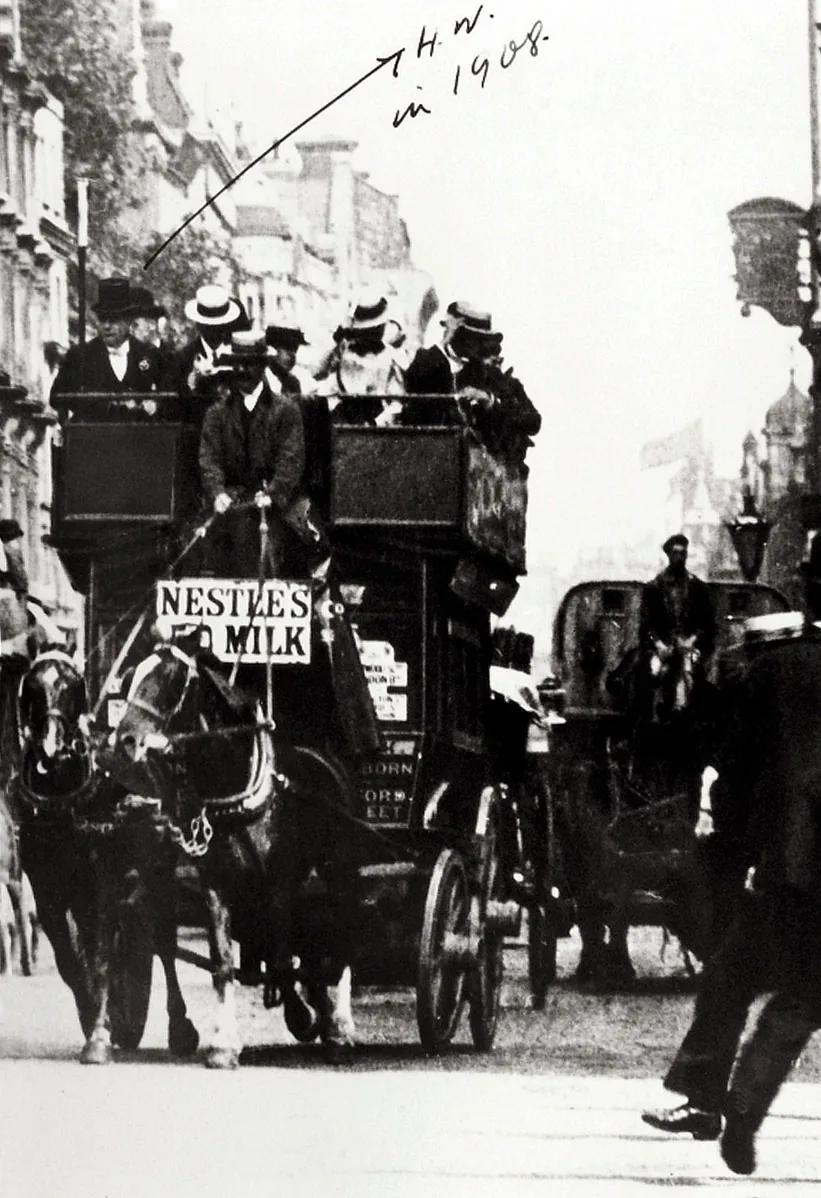

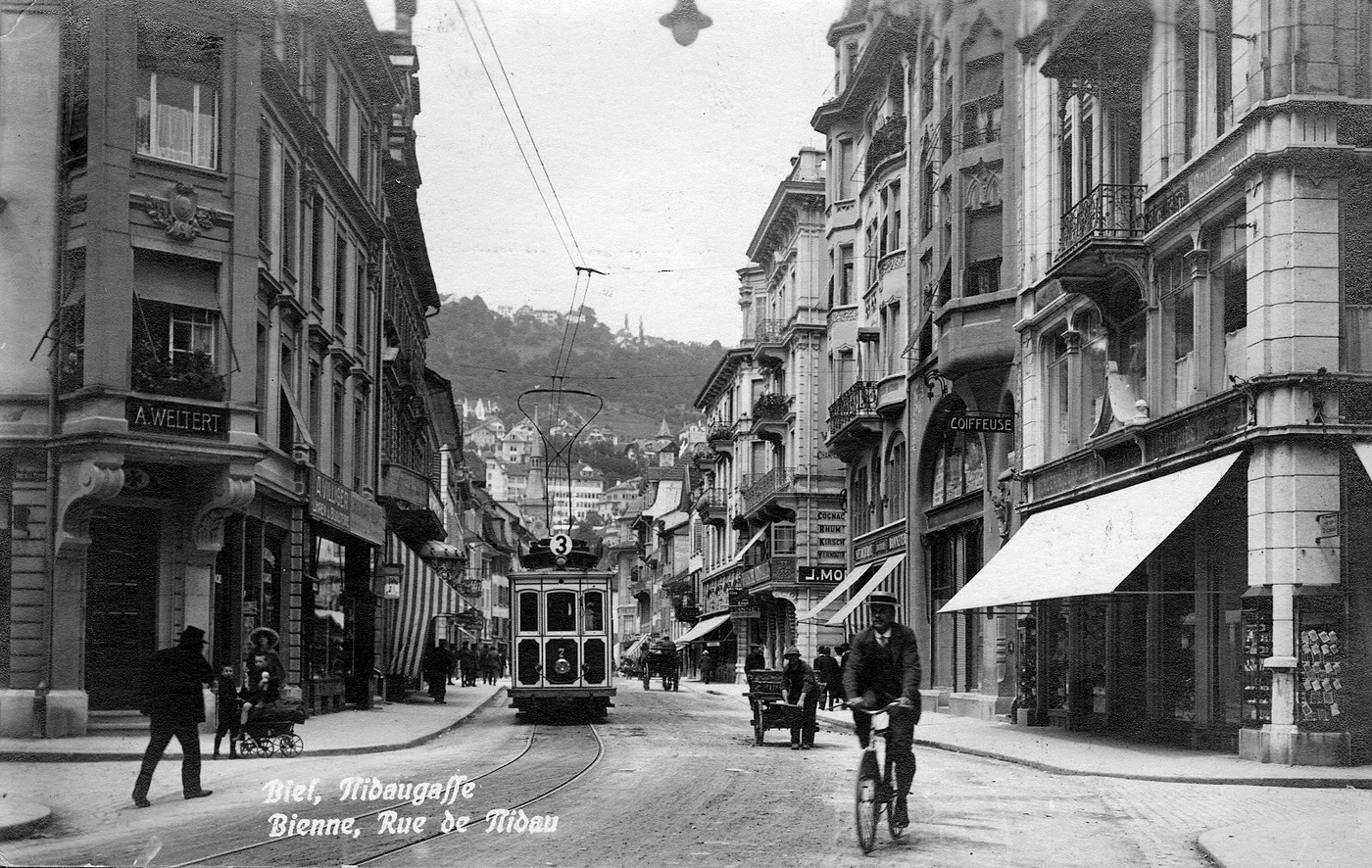

The firm made no watches. It bought them from Swiss makers and sold them to retailers, at first with no name on them. Wilsdorf's own account makes its first speciality a travelling watch in a leather case; another says the firm began with only two watches, a pocket watch for men and a purse watch for women (see below). In 1905, by most accounts, Wilsdorf went to Bienne and placed what he later called the largest order for wristwatch movements yet seen with Aegler, a family firm making small lever movements by machine, with parts that could be exchanged; one account puts his biggest supply contract with Aegler in 1908 instead. Aegler became the chief source of movements for about a century, but not at once exclusively: it also supplied other houses, among them Gruen, and Geneva gained exclusive rights to the Bienne output only in 1936. The later exceptions were chronograph movements, bought from Valjoux and, long after this period, from Zenith. Not everything the firm sold was Aegler. Watches with cylinder escapements carry its W&D sponsor's mark but were never branded Rolex, and the name was reserved for Aegler lever watches, some of them with only seven jewels instead of fifteen.
Wilsdorf's own account says the first wristwatches were made for men and women in silver cases on leather straps, followed by gold. The surviving evidence points to ladies' watches: hallmarked watches from before the First World War are mostly gold and in ladies' sizes, and those hallmarked after 1915 are mostly silver and in the men's 13-ligne size. A Britannic expanding bracelet, introduced about 1906, suited the small gold watch; it was guaranteed for five years and many have been replaced since. Its narrow lugs will not take an ordinary strap. Most accounts give 1908 for the registration of the name Rolex as a trademark (2 July in one). It was chosen to be short, easy to say in any language and small enough to fit on a dial. The story that it came to him on a London bus is Wilsdorf's own, and its truth is debated. At first only one watch in six was marked Rolex, since retailers preferred their own names, and it took about two decades for every watch to carry it. In November 1907 the firm had also registered three other names in Switzerland: Lusitania, Mauretania and The Eastern Watch.
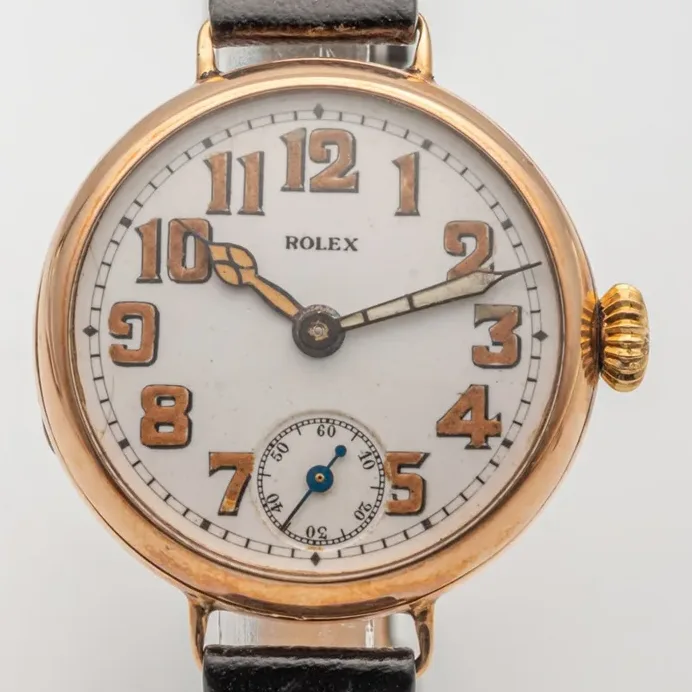
The case for the wristwatch was made with certificates. On 22 March 1910 the testing office at Bienne issued the first Swiss chronometer certificate for a wristwatch; the certificate names Aegler as the maker of the movement, which was cased by Wilsdorf & Davis. In July 1914 a small Rolex wristwatch was awarded a Class A certificate at Kew, after a test of about 45 days run to the rules for marine chronometers with no allowance for its size. The watch had a cushion-shaped case, a black enamel dial with large luminous numerals, small seconds at six and an 11-ligne hand-wound movement. One account says the firm became The Rolex Watch Co. Ltd in 1915, though the Kew certificate of July 1914 is already addressed to The Rolex Watch Co., London and Bienne. In 1915, by the usual account, Britain's new duty of one third on imported watches drove the export business to Bienne. In 1919 Wilsdorf bought Davis's share, took a stake in Aegler, the year most accounts give for it, and settled in Geneva, and Montres Rolex S.A. was registered there in 1920, though one account puts the new name in 1919. From then Bienne made movements, and Geneva made cases and bracelets, inspected movements and assembled and sold the watches; Aegler had given up case making in 1919. One account places the move to Geneva in 1915; most put it in 1919 and 1920.
- W&D in an oval inside the caseback, with British import hallmarks
- an unsigned or retailer-signed dial on an early watch
- an 11-ligne or 13-ligne hand-wound lever movement
- a Britannic expanding bracelet, often replaced
The Oyster case
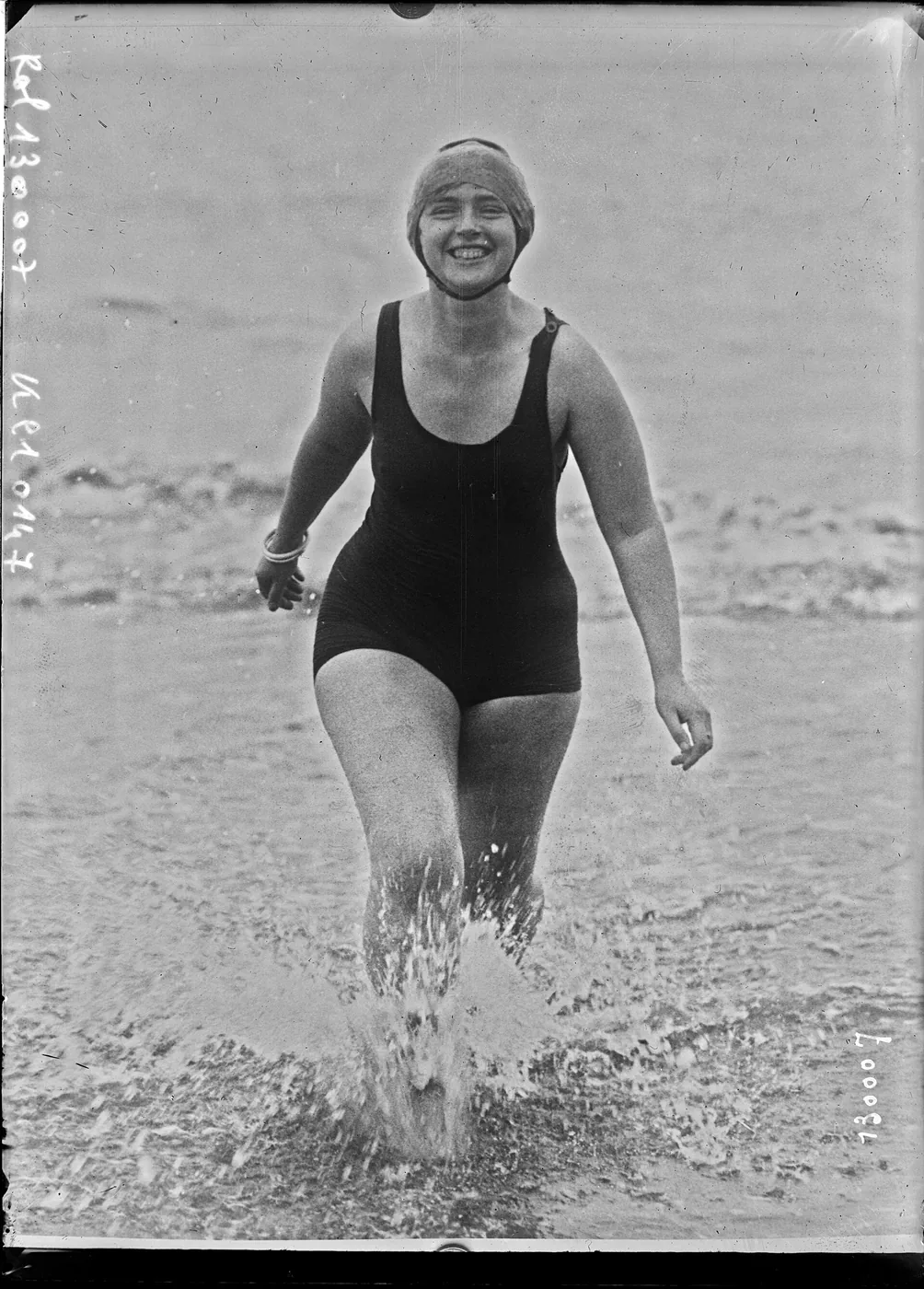
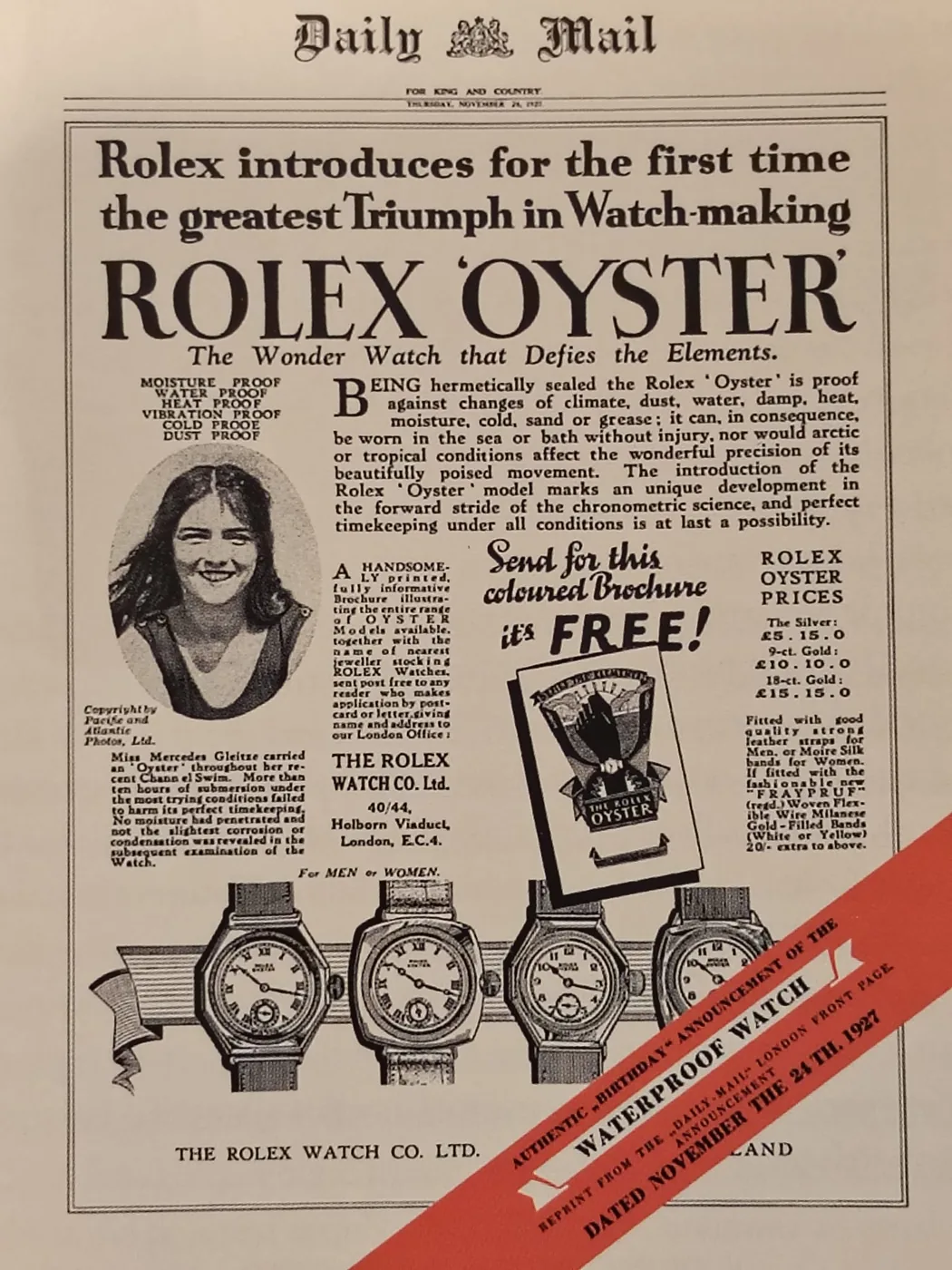
Water was the weak point of early wristwatches, and there were earlier attempts at sealing a case. Some put an inner case inside an outer one, closed by screw-down caps with milled edges, which meant the wearer had to unscrew the cap to wind the watch. By one detailed account Rolex used a Borgel one-piece case from about 1910 and 1911, and a Borgel three-piece case, with screwed back and bezel, from 1919 and 1920; examples of both are known stamped W&D. Accounts differ on the start, since another places Rolex's first limited run in a Borgel screw-in case in the 1920s (see below). In 1923 Wilsdorf also bought a patent for a sealed case with an inner container for the movement, which again had to be opened to wind. In 1926, on 24 July by one detailed account, the firm bought the rights to a Swiss screw-down crown patent filed in 1925, and it registered the name Oyster a few days later, on 29 July. Applications for patents on the case and on a crown with an internal clutch followed in September and October. The clutch let the crown be screwed down even when the spring was fully wound. The first Oyster cases were octagonal, and one account says they were made by C. R. Spillmann & Co. at Wilsdorf's request. They had a middle, a screw-down back and a screw-down bezel carrying the crystal, and the fluted edge of the bezel gave a grip for screwing it in. In the first design only the case back had a rubber gasket; the crown sealed on metal. Two rubber rings in the crown and its tube came with the Twinlock crown, which one account first gives to the Submariner of 1953. The accounts disagree on whether the Oyster's crown was the one in the 1925 patent, and on whether the case middle was a single piece from the start (see below). Wilsdorf sold the Oyster hard. A costly advertising campaign began in 1926, and dealers were offered small tanks in which an Oyster lay among fish in the shop window. On 21 October 1927 Mercedes Gleitze wore an Oyster on a necklace during a Channel swim, and on 24 November the Daily Mail carried a front-page advertisement with her testimonial. The case she wore is described as an octagonal 9-carat gold case with Glasgow import marks for 1926, engraved on the back as the companion Oyster of her vindication swim. In 1929 Wilsdorf bought a patent held by the owner of the Borgel firm, which may have been a way of settling any objection, since the Oyster's method of sealing the case was the same as in Borgel's three-piece case. A seamless one-piece middle came, by one account, as a refinement in 1931, after which nearly all Oysters had it, though some dress models kept a three-piece body. Few Oysters of the 1940s keep their original crowns, since most were replaced by the slimmer type used through the 1960s; a steel Oyster of 1945 is described with a substantial crown signed Royal Oyster and more heavily threaded than was usual for the decade, and a later Super Oyster crown is named for its improved seal.


- octagonal case with a screw-down bezel and back (the first form)
- a fluted bezel that screws into the case middle
- an original 1940s crown, not the slimmer type fitted at later services
- inscriptions inside the case back, with the R.W.C. Ltd cartouche
The Prince
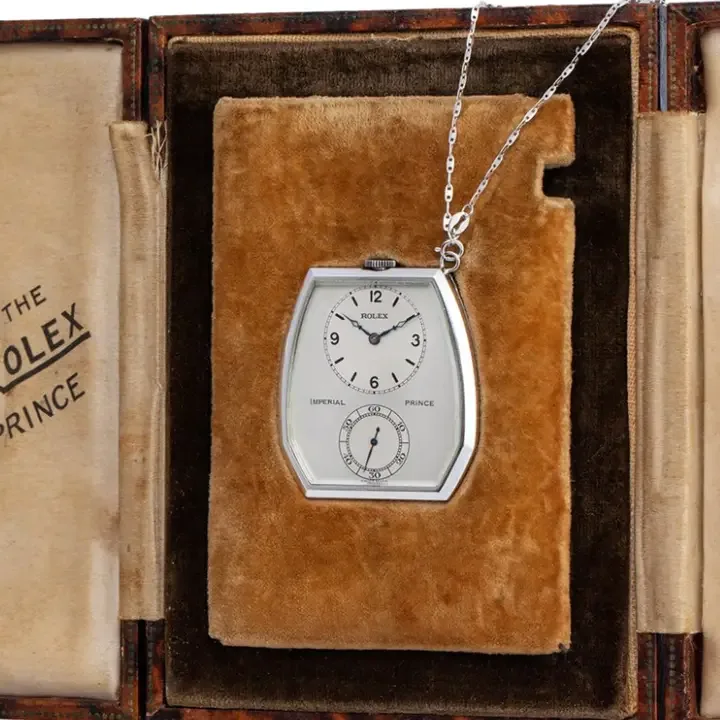
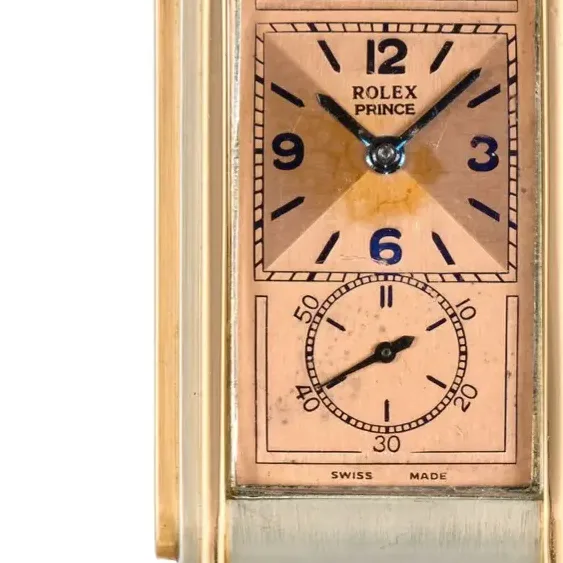
Most accounts date the Prince to 1928. It had a long rectangular case and a dial in two parts, with the hours and minutes in the upper section and a large seconds dial below. Its movement was the baguette-shaped hand-wound calibre T.S., with a large screw balance, and it was taken up by doctors, scientists and sportsmen. The movement met the official chronometer standards with ease and could clearly exceed them. On 15 December 1936 a T.S. calibre, running for about 58 hours on one winding, scored 87.6 points at Kew, the best result then recorded for a wristwatch.
The case came in several forms, called Brancard, Classic and Railway, which combined an Art Deco look with the movement. A Brancard and a Railway Prince are illustrated beside a Rolex catalogue page of 1938. The published accounts give no year for each case form, no references and no figures for numbers made, so those are best read from the line entry for the Prince in this library.
- a dial split into hours and minutes above and large seconds below
- a long rectangular case
- a baguette-shaped movement, calibre T.S.
The self-winding rotor and the bubbleback
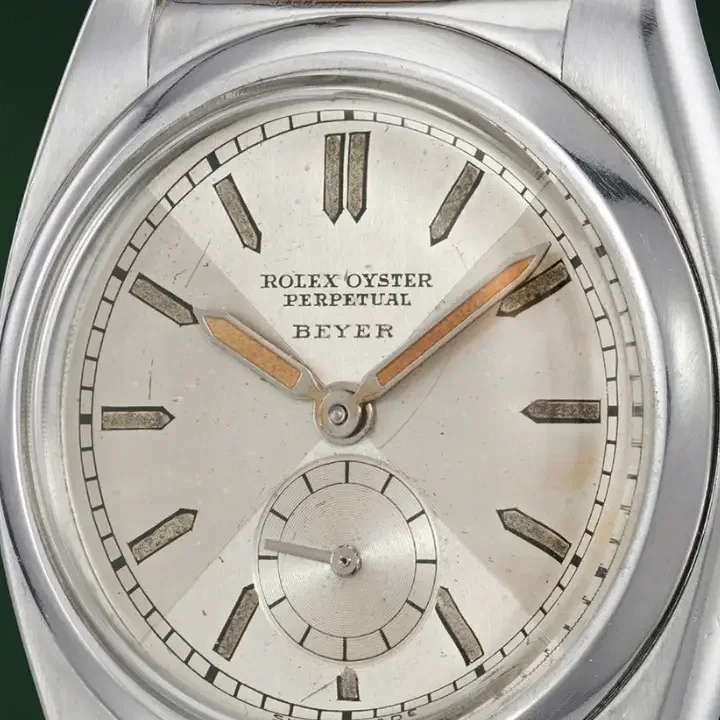
A hand-wound Oyster had to be unscrewed each day to wind it, and a crown not screwed down again defeated the case. The answer was the Perpetual rotor, patented in 1931 by most accounts: a weight mounted at the centre, turning through a full circle in either direction, and used in calibre NA 620, the firm's first automatic calibre, which beat at 18,000 half-oscillations an hour. It was developed at Bienne under its technical director. An earlier self-winding wristwatch by an English watchmaker used a weight swinging through a small arc with stops; the accounts date its patent to 1923, and one to 1924. The Rolex patent ran for up to fifteen years. Joined to the Oyster case, the rotor gave the Oyster Perpetual. The bubbleback is the name collectors give to the first Perpetual Oysters. The rotor made the movement thicker, so the case back was domed to hold it without making the case taller on the dial side. Dates are loose. Accounts date the first Oyster Perpetual to 1931, the year of the patent, or put the first self-winding Oysters at 1933 and 1934, with early references such as 1858 and 2940; by most accounts they ran to the mid-1950s, the 1940s being the busiest years. Men's cases are usually 30 to 32 mm and sometimes 34 mm. References 3372 and 3131 are among the best known of the mid-size models, both 32 mm, and the early calibre 9 3/4 ligne is named in the 3372. Cases are steel, steel and gold, or solid yellow, rose and occasionally white gold, with smooth, engine-turned or coin-edged bezels. A Big Crown was fitted at first and a Super Oyster crown later. Dials vary widely; the California dial has Roman numerals above and Arabic below. From the 1950s thinner movements, such as calibre 645, allowed flatter cases, and by one account the 6000 series (6010, 6084, 6085) ended the bubble profile.
- a markedly domed case back on a small case
- a movement whose calibre suits the case reference
- a California dial with mixed Roman and Arabic numerals
Chronographs and calendars
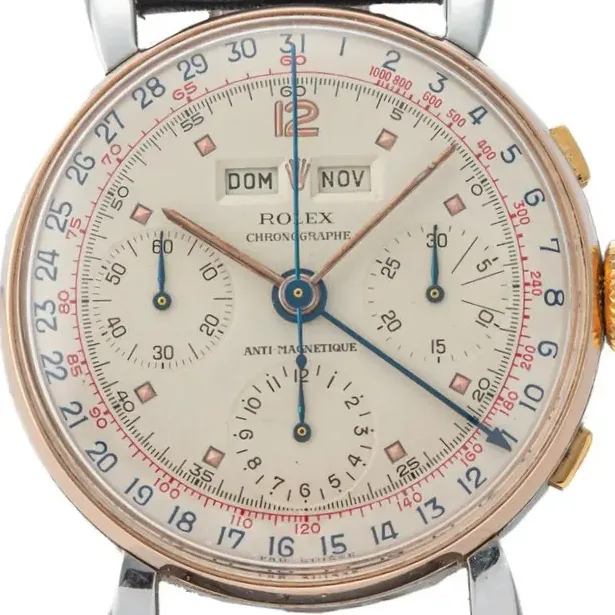
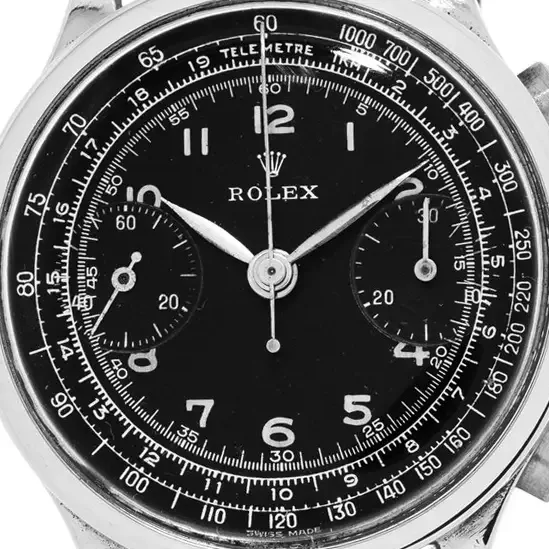
The published accounts available for this guide say little about the early chronographs. They record only that chronograph movements were an exception to the exclusive supply from Bienne, bought from Valjoux and, long after this period, from Zenith. The library's records show that chronographs and triple-calendar watches are a large part of what reaches the market, and they are treated by line in other entries.
The calendar story is better told. The Datejust of 1945 is described as the first wrist chronometer, and by some as the first wristwatch of any kind, with a date in a window on the dial that changed by itself at midnight; the date sat at three o'clock. The Cyclops lens, which enlarges the date by two and a half times, was by one account the subject of a patent application in 1952, and by some accounts it was fitted from 1953. The Day-Date of 1956 was the first wristwatch to show the day of the week spelled out in full, in a curved window, beside the date (the triple-calendar reference 8171 of about 1949 already showed day and date), and it came in a 36 mm gold case with a fluted bezel. The Lady-Datejust, the ladies' version, came in 1957.
The 1940s and the first Datejust
The Second World War showed again how much more practical a wristwatch was than a pocket watch. The firm's own story says that when captured Allied officers lost their watches, Wilsdorf offered replacements to be paid for after the war, around 3,000 watches in all; this account has been questioned in recent years. His wife died in 1944 and he put his shares in the Hans Wilsdorf Foundation, dated to 1945 by most accounts. He died in 1960 and the Foundation still owns the firm. After the war the 50,000th officially certified Rolex chronometer went to General Henri Guisan in 1946, the 100,000th, a rose gold Datejust, to Winston Churchill in 1948, and the 150,000th, a yellow gold Datejust, to General Eisenhower in 1951.
The Datejust came in 1945 for the firm's fortieth anniversary. Besides the date window it had the Jubilee bracelet and a fluted screw-down bezel. One account adds that it had a centre seconds hand where earlier watches had small seconds. The Air-King, dated 1945, followed earlier Air-Lion, Air-Giant and Air-Tiger names; the first Air-King references are given as 4925 at 34 mm and 4365 with small seconds, though accounts differ on the 4365, which is also described as a Speedking (see below). The dials of these watches read Precision or Super Precision, since the movements were not sent for chronometer tests, and by one account the Air-King reference 5500 of 1957 used calibre 1520. A steel Oyster of 1945, reference 4444, is described with a dial signed Rolex Oyster, Shock Resisting, Swiss Made, with the coronet and the name of a Liverpool retailer, and with Rolex S.A., Geneva and the R.W.C. Ltd cartouche inside the back. Shock resistance and better magnetic protection are said to have come to early post-war Oysters from wartime work. Calibre 1030, a new automatic generation, is dated 1950 by one account.
- a dial signed with a retailer's name beside Rolex
- 'Precision' or 'Super Precision' in place of a chronometer certificate
- a Jubilee bracelet with a date window at three
The 1950s and the professional watches
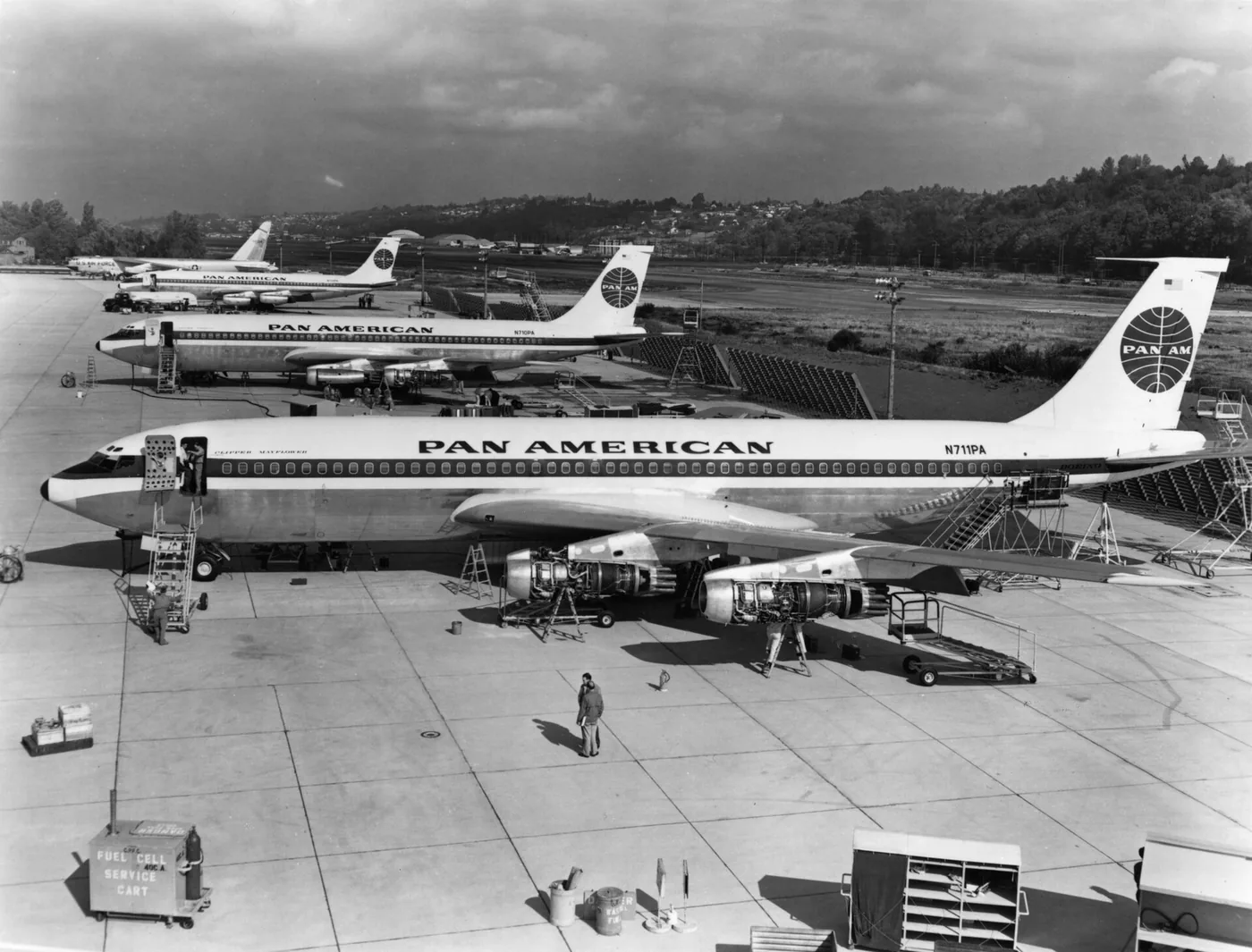
The 1950s brought watches made for particular work. The Submariner of 1953, shown at Basel that year by one account, was by the usual account reference 6204, rated to 100 metres, with a rotating bezel and luminous markers; one account adds that it brought the new Twinlock crown. By 1954 the rating had been doubled to 200 metres. In 1953 the British Everest expedition carried Rolex watches. The watch supplied is described as reference 6098 with calibre A296, and the Explorer, reference 6350, followed, called by one account the first official Explorer; reference 6150 is said to have set the dial layout, with an inverted triangle at twelve and numerals at three, six and nine. The GMT-Master, of 1955 by some accounts, was made with Pan American pilots in mind, and had a fourth hand and a rotating 24-hour bezel in red and blue. The Milgauss, for scientists, and the Day-Date came in 1956.

A different kind of rarity is the Kew A watch. Of about 145 movements made to the standard, 136 passed and received certificates, and only 24 were cased in full-size gold watches, all in 1952, under reference 6063; another 112 went into 28 mm steel Oysters whose dials carry a Kew A certificate line at six. The movement of the gold watches is marked as Kew A tested. Their special part is the escapement with its Guillaume balance, which has no shock protection and was often broken and replaced; without it the watch is not what it was.
- a 28 mm steel Oyster with a Kew A certificate line on the dial
- 'Kew A Tested' on the movement and the original Guillaume balance
References, case numbers and how an early watch is dated
The watches of the London years are known by the W&D mark, the hallmarks and the movement. On later watches a case reference and a serial number are stamped between the lugs, and the reference is repeated inside the case back; descriptions of Oysters of 1945 and 1951 put the reference between the upper lugs, at twelve, and the serial between the lower lugs, at six, while another account has them the other way round (see below). A serial can be set against the published tables to give a year, and the reference against the movement. The count reached 999,999 in about 1954 and began again from a low number, so a six-digit number was used twice, in two different decades, and the reference and the rest of the watch must decide which run it belongs to. One account of a steel Oyster gives the 1945 serials as running from about 348000 to 413000, with the watch at 358465. Such a table does not run back to the first years: a silver watch of 1916 is described with the serial number 773207, higher than the 1945 figures, and watches of the 1910s are dated by their hallmarks instead. A British import hallmark carries a date letter for the year in which the case was assayed, and London and Glasgow marks are both seen on early Rolex cases. One account adds that this year is only the earliest date for the watch, since the case was marked before the movement and dial went in. The letters run in yearly cycles, so the same letter recurs: one source gives a London k for 1906 on one page and for 1925 on another, in a different typeface, and its two pages also differ on the London import mark. The letters are not repeated here; use the assay office's own tables. One account says gold was stamped 9, 12, 15 or 18 carat until 12 and 15 carat were dropped in 1932, so that a 15-carat stamp marks a case made before that year. Dial wording also helps: on the Air-King, Precision or Super Precision marks a movement that was not sent for chronometer testing, and a steel Oyster of 1945 is signed Rolex Oyster, Shock Resisting, Swiss Made.
- case reference and serial between the lugs, repeated inside the back
- a hallmark with a clear date letter and the assay office's import mark
- the numbers on case back, case front and movement agreeing with the year
Cases, hallmarks and makers' marks
From 1 June 1907 every imported gold or silver watch case had to be hallmarked at a British assay office, and a sponsor's mark had to be registered first. Wilsdorf & Davis entered theirs, the initials W&D in an oval with points top and bottom, at the London office on 25 June 1907, which was after the Act took effect. The same mark is found on movements, though the law did not require it. Nothing imported before 1907 is known, since it carried no name. A silver watch of 1916 has W&D, Rolex, Swiss and the silver standard stamped in the case, with the number of the Swiss patent for the hunter-type case; the patent was granted on 23 June 1915. By 1916 a case could carry both W&D and Rolex, as that watch shows; one source dates the first Rolex stamps beneath the W&D mark to about 1910 on one page and to about 1913 to 1915 on another. The dials of the time were often unsigned or showed the retailer's name. Silver cases are sterling as a rule; one account adds .935 and .800 silver on Swiss-cased watches for the Continent. One account finds Glasgow import marks common on watches of 1908 to 1915; the Gleitze Oyster, as noted, has a Glasgow mark.
Cases were made by others. Borgel supplied screw-down cases before the Oyster, and one account names C. R. Spillmann & Co. as the maker of the first Oyster cases. After 1919 the firm made cases in Geneva. A steel Oyster of 1945 is marked inside the back with the firm's name, Geneva and an R.W.C. Ltd cartouche, standing for Rolex Watch Company Limited.
- W&D in an oval stamped on the inside back and sometimes on the movement
- W&D and Rolex stamped together in a case of the 1910s
- a sterling silver or 9, 15 or 18 carat gold stamp with an import mark
- the R.W.C. Ltd cartouche inside the case back of a 1940s Oyster
What to look at on an early watch
Start with whether the parts belong together. The case numbers should agree, the case reference should suit the movement, and the dial should be in the style of the year. Redials are common, so judge the typeface, the print quality and the wear of the dial. Wrong movements are often found, so the calibre should suit the case. One account holds that an unsigned Aegler movement is normal in a watch of the first years if it sits in a case with W&D or Rolex marks and hallmarks of the right period, and that a genuine hallmark is struck, with metal pushed up at its edges, not flat as in etching.
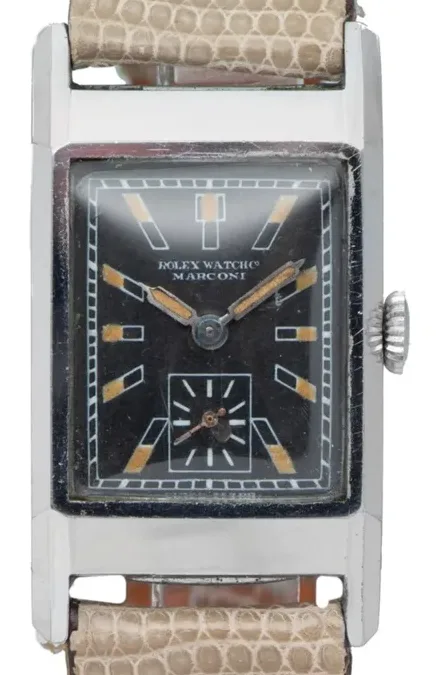
Next the parts that wear or are replaced. Crowns were often changed for later, slimmer ones, and bracelets, including the Britannic expanding type, were replaced. A case that has been over-polished loses the sharp definition of its lines. On a Kew A watch the escapement matters most. On a retailer's watch, a dial with a retailer's name beside Rolex is a known feature, as with the Liverpool retailer named above. Last, remember that the published literature on these years leans on the firm's own telling, which is marketing as well as history: the Gleitze swim, the prisoners' watches and the origin of the name all come with a story attached.
- matching numbers on case back, case front and reference
- original dial printing, not a refinished one
- the original crown and escapement, and a case that is not over-polished
The watches of these years
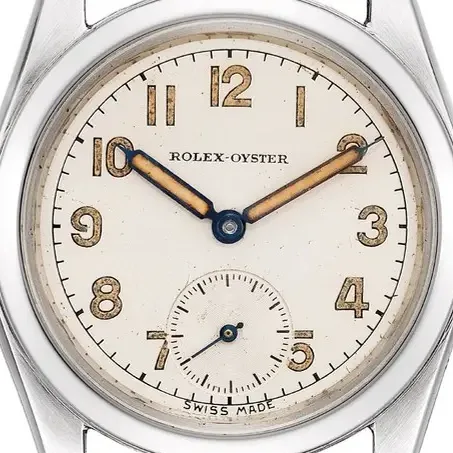
One entry for each kind of watch of this era. Each sets it out production by production, with what to look for.








Also in the library
Other written entries that fall in these years.
- Rolex 3525 Oyster Chronograph Antimagnetic (Monoblocco), from 1939
- Rolex 4467 Oyster Perpetual Datejust (first Datejust), from 1945
- Rolex 8171 Perpetual Triple Calendar Moonphase, from 1949
- Rolex 6062 Oyster Perpetual Triple Calendar Moon Phase, from 1950
- Rolex 6098 Oyster Perpetual Ovettone, from 1952
- Rolex 6150 Oyster Perpetual Precision (Pre-Explorer), from 1953
- Rolex 6202 Turn-O-Graph, from 1953
- Rolex 6204 Submariner (first reference), from 1953
- Rolex 6298 Oyster Perpetual Ovettone (Pre-Explorer), from 1953
- Rolex 6305 Datejust (Ovettone, Big Bubbleback), from 1953
- Rolex 6350 Explorer, from 1953
- Rolex 6200 Submariner (Big Crown, Explorer dial), from 1954
- Rolex 6205 Submariner (small crown, second reference), from 1954
- Rolex 6556 Oyster Perpetual Tru-Beat, from 1954
- Rolex 6234 Oyster Chronograph, from 1955
- Rolex 6536 Submariner (Small Crown), from 1955
- Rolex 6542 GMT-Master (Bakelite bezel), from 1955
- Rolex 6538 Submariner (Big Crown), from 1956
- Rolex 6541 Milgauss, from 1956
- Rolex 6605 Datejust, from 1956
- Rolex 6610 Explorer, from 1956
- Rolex 5500 Air-King, from 1957
- Rolex 6611 Oyster Perpetual Day-Date, from 1957
- Rolex 5508 Submariner (small crown, no date), from 1958
- Rolex 5510 Submariner, from 1958
- Rolex 1002 Oyster Perpetual, from 1959
- Rolex 1005 Oyster Perpetual, from 1959
- Rolex 1601 Datejust, from 1959
- Rolex 1603 Datejust 36, steel with engine-turned bezel, from 1959
- Rolex 1675 GMT-Master, from 1959
- Rolex 1803 Day-Date, from 1959
- Rolex 5512 Submariner, from 1959
Chronology
Where accounts differ
- Whether Gleitze finished the swim. Several accounts say she wore the Oyster on the swim of 21 October 1927 and did not reach France, though the watch kept time (about ten hours in the water). One of them adds that the newspaper advertisement cited her earlier successful swim, made without a Rolex. Other accounts say she swam or crossed the Channel with the watch, and one timeline gives fifteen hours. The accounts that call the swim unsuccessful agree with one another and are followed here.
- Year of the Hans Wilsdorf Foundation. One page's timeline says 1944, the year Wilsdorf's wife died; the same page's text, and the others, say 1945 for the Foundation and the transfer of his shares.
- Move of headquarters to Geneva. One account says the firm moved its headquarters to Geneva in 1915. Others say that in 1915 the export business went to Bienne because of the British duty, and that the move to Geneva was in 1919, with Montres Rolex S.A. registered in 1920 (17 January in one account). One account has the firm move to Geneva in 1919 and take the name Montres Rolex S.A. at that time.
- The crown of the first Oyster. One account says the Oyster's screw-down crown was a modification of the 1925 patent the firm bought; another says that patent was not used, since its reverse-threaded crown had no clutch and could not be closed once the watch was fully wound, and that the Oyster's own crown patent was a different one.
- One-piece case middle. One account says the first Oyster's bezel and back screwed into a middle cut from one piece of gold. Another says a one-piece case was not in the 1926 design and came as a refinement in 1931, and a third says the first Oyster was a three-piece case of the Borgel kind.
- Year of the first Oyster Perpetual. Two accounts and another Oyster page put the first self-winding Oyster Perpetual in 1931, the year of the rotor patent. The same account bubbleback page puts the first automatic Oysters at 1933 to 1934, with references 1858 and 2940. The library's records hold bubbleback references such as 2940 with stated years from 1935, which does not settle the point.
- Size, metal and movement of the first Oyster. One account describes the first Oyster of 1926 as a 33 mm 21-carat gold case and says a 35 mm Oyster with a self-winding movement followed in 1927. Other accounts describe the first Oysters as octagonal and put the self-winding Perpetual in 1931. The second account is followed.
- Where the serial and reference are stamped. One account puts the serial between the lugs at twelve and the reference at six. Descriptions of a 1945 and a 1951 Oyster from another account put the reference between the upper lugs and the serial between the lower ones, and that is followed here.
- W&D sponsor's mark and the date letters. One account says the W&D mark was registered at London in 1905 and at Glasgow and Birmingham soon after; another says it was entered in London on 25 June 1907, after the Act took effect, and that earlier imports were unmarked. The two one accounts give the London letter k for 1906 on one and for 1925 on the other, in different typefaces, which the yearly cycle of letters allows; they differ on London's import mark, a Saturn sign on one and a sunburst on the other. The 1907 date is followed here, and the letters are left out.
- Reference of the first GMT-Master. One account gives the first GMT-Master as reference 6452. The library's records hold the watch described by sellers as the GMT-Master, with the bakelite bezel, under reference 6542, the most listed reference of these years; no listing gives 6452.
- When the first large order went to Aegler. Three accounts, the last from Wilsdorf's own telling, put the large first order for movements with Aegler in 1905. Another has Wilsdorf return to Bienne in 1908 and negotiate the largest supply contract of its time.
- The firm's first watches. One account, from Wilsdorf's own telling, and another give the first speciality as a travelling or portfolio watch cased in leather. Another says the firm at first produced only two watches, a pocket watch for men and a purse watch for women.
- When Rolex first used Borgel cases. One account dates Rolex's first water-resistant watches, in a Borgel one-piece case known stamped W&D, to 1910 and 1911, and another says Rolex used that case in its earliest days. Another published account places Rolex's limited run of watches in the Borgel screw-in case in the 1920s and calls it the first Rolex case designed to give protection from the elements.
- Reference 4365. One account gives the first Air-King of 1945 as reference 4925 at 34 mm and as 4365 with small seconds. Another published account lists 4365 as the Speedking Elegant, 33 mm with 19 mm lugs.
In the records
Counted from 9,797 listings at dealers and auction houses. Only listings a seller dates to 1959 or before are counted here; a line's own page, and its card above, also count its undated listings, so their figures are larger. These are what sellers state, not measurements, a stated year is often an estimate, and a count of listings is not a count of watches made.
Kind of object
| Kind | Listings |
|---|---|
| Wristwatches | 9,494 |
| Pocket watches | 274 |
| Clocks | 29 |
Case metal
| Metal | Listings | Share |
|---|---|---|
| Steel | 3,392 | 47% |
| Gold, any colour | 3,180 | 44% |
| Yellow | 617 | 9% |
| Pink | 426 | 6% |
| White | 120 | 2% |
| More than one colour | 18 | under 1% |
| Colour not stated | 1,999 | 28% |
| Silver | 357 | 5% |
| Steel and gold | 133 | 2% |
| Gold plated, filled or capped | 95 | 1% |
| Plated | 58 | 1% |
| Rolled | 19 | under 1% |
| Filled | 9 | under 1% |
| Capped | 9 | under 1% |
| Platinum | 53 | 1% |
| Steel and platinum | 3 | under 1% |
| Base metal | 1 | under 1% |
As sellers state it. Shares are of the 7,216 listings that name a metal. A listing that says "gold" or "18K gold" names no colour: it is counted under "colour not stated", not as yellow gold. Carat, where a listing of gold gives one: 18k 1,241 · 9k 905 · 14k 159 · 10k 15 · 15k 9.
Case size
| Size | Listings | Share |
|---|---|---|
| 36 mm | 729 | 13% |
| 34 mm | 706 | 13% |
| 32 mm | 631 | 11% |
| 35 mm | 440 | 8% |
| 30 mm | 366 | 7% |
| 38 mm | 243 | 4% |
| 31 mm | 238 | 4% |
| 33 mm | 232 | 4% |
| Other sizes | 1,963 | 35% |
As sellers state it. Shares are of the 5,548 listings that give a size.
Listings by decade the seller gives
| Decade | Listings |
|---|---|
| 1900s | 13 |
| 1910s | 288 |
| 1920s | 819 |
| 1930s | 1,491 |
| 1940s | 2,206 |
| 1950s | 4,980 |