Prince
The Prince is Rolex's rectangular wristwatch of the late 1920s to the 1940s, built around a shaped movement with a large seconds dial that earned the early watches the name 'doctor's watch'. From the start it came in two cases, a plain rectangular one and the curved Brancard; the stepped-side Railway, a jump-hour version, the single-dial Elegante and a central-seconds Aerodynamic followed, in silver, gold, platinum, steel and two-colour combinations. These are not Oyster watches, so their dials have often aged and many were repainted. Collectors look first at the dial, the case signature and the movement, since redials and replaced parts are common.
This maker's early watches are described by kind of watch, not by reference number: many carry no number, and one number can cover quite different watches. The wider picture is in Early Rolex, 1905 to 1959.
- Made
- from c. 1928Published accounts put the introduction at 1928 or 1929; one puts the end in the 1940s, another in the 1940s or 1950s. The maker releases no production records, so no firmer dates exist.
- On record
- 470 listings113 of them give no reference
- Reference numbers
- 11 describedmany early watches carry none
Production by production 8 described
Classic Prince, reference 1343
The original Prince is a rectangular watch with two dials: hours and minutes above, and a large seconds dial below, which could be read for timing a pulse. Published accounts describe it in 9 and 18 carat gold, sterling silver and steel. It was brought out with the Brancard rather than before it, and the two are given as the line's original styles. Introduction is given as 1928 by some accounts and 1929 by others.
Signature and marks. Not given in the literature for this case.
- standard rectangular case
- large separate seconds dial
- hours and minutes centre set above the line of the crown
References: 1343
Brancard, references 971, 971U and 971A
The Brancard is the curved version of the Prince, named after the French word for a stretcher. It was introduced at the same time as the classic case, in a two-tone 18 carat gold form and in a gold-and-silver form known as the 'zebra'. By the 1930s the 971U and 971A had been added, with faceted end pieces: the 971U in gold and silver, the 971A with two-colour gold stripes across the case top, known as the 'tiger stripe'. A steel Brancard came in 1934, and the line was also made in solid platinum. Two silver Brancards of 1930 measure 23 x 43 mm with 20 mm lugs; one is stamped reference 971, the other, hallmarked at Glasgow, reference 1490.
Signature and marks. Dial signed 'Rolex Prince' above the centre and 'Chronometer' below. Case signed 'Rolex', '25 World's Records', 'Geneva-Suisse', with the metal mark, reference and case number; a Glasgow-hallmarked silver case of 1930 also carries 'RWCLtd.' (Rolex Watch Company Ltd). Movement: the Rolex Extra Prima, numbered, in one of the two with a protective cap.
- curved case
- faceted ends on 971U and 971A
- stripes across the top on the tiger stripe
- Extra Prima movement, 15 jewels, timed to six positions
- blued steel poire hands
References: 971, 971U, 971A, 1490
Railway Prince, reference 1527
The Railway Prince is named for its stepped case sides, which recall a locomotive and the lines of the fast trains of the day. Reference 1527 is given as the Railway, introduced in 1935 by published accounts, though the library's records hold one with a British import mark for 1931; the jump-hour reference 1587 is also called a Railway. A published comparison sets a Railway of reference 1587 beside another Prince branded for the retailer Bucherer, the difference being one step against two on the case. In the library's records reference 1527 is mostly described in two-colour gold.
Signature and marks. Not given in the literature.
- stepped case sides
- one or two steps on the case
Jump hour (Heures Sautantes), reference 1587
Published accounts date Rolex's jump-hour (heures sautantes) movement for the Prince to 1935, though the library's records hold jump-hour cases with British import marks for 1930. A small aperture at twelve replaces the hour hand and shows the hour on a wheel, or disc; when the minute hand passes sixty the wheel steps to the next hour. Published accounts name it as the exception to the broadly similar movements of the Prince, and it was made in small numbers. A Rolex advertisement of 1936 shows it in two-tone gold and still calls it a doctor's watch. Original dials are hard to find, since many were repainted, and Gruen jump-hour watches have been redialled as Rolex.
Signature and marks. Not given in the literature.
- hour aperture at twelve in place of an hour hand
- red hour numeral on some examples
- large separate seconds dial
- original, unrepainted dial
Prince Elegante
The Elegante keeps the rectangular case of the early Prince but has a conventional dial with the seconds counter set within it, in place of the separate seconds dial. It is thought to have appeared about 1936 and to have been dropped just before or soon after the end of the Second World War; examples of 1938, 1941 and 1943 are recorded in the literature. It uses the shaped calibre 360, known as the HW, with a SuperBalance. The dial reads 'Rolex, Prince, Elegante' above the centre for Britain and Canada; in Italy and France the name was printed 'Elegant'. A Canadian-market example has a gold-filled case with a steel back, stepped sides and a case back signed only 'Rolex' in capitals, and a pink gold ring on the dial between numerals and minute track.
Signature and marks. Dial: 'Rolex, Prince, Elegante' above the centre, 'Swiss Made' at the foot. Movement bridge: 'Rolex, 17 Rubies, Swiss Made, Fab Suisse'. Early HW movements carry 'Patented SuperBalance' on the winding wheel, which is said to have gone by about 1938. Canadian case back: 'Rolex' alone.
- integrated seconds counter on the main dial
- diamond-shaped blued steel hands
- two-tone dial with pink gold bezel ring
- 'Elegante' for the UK and Canada, 'Elegant' for France and Italy
- single-word 'Rolex' case back on Canadian-market watches
References: 2874
Aerodynamic, central seconds
A later single-dial Prince, called the Super Precision Aerodynamic, has a central seconds hand. It is listed among the later rectangular Princes, but the literature gives no date for its start.
Signature and marks. Not given in the literature.
- single dial
- central seconds hand
References: 3361
Eaton Quarter Century Club Prince
A special Prince was made for the Canadian department-store firm Eaton as a service award for employees of twenty-five years. The words '1/4 Century Club' are engraved around the top dial, and the case back carries the employee's name and years of service. Several Eaton Rolex watches exist apart from this one.
Signature and marks. '¼ Century Club' around the top dial; the recipient's name and years of service engraved on the case back.
- '1/4 Century Club' on the dial
- engraved name and years of service on the case back
Sporting Prince
A Sporting Prince is described as a pocket watch with a hunting case that opens to release a spring-loaded protection for the movement during sport, notably golf. The same model was later made as a wristwatch. Both were made in very small numbers.
Signature and marks. Not given in the literature.
- hunting case with a protective spring mechanism
Chronology
Specification
| Case | Rectangular, in several forms: a plain rectangular case, the curved Brancard (faceted ends on two of its versions), the stepped-side Railway and a straight-sided design. Silver, gold, platinum, steel and two-colour gold or gold-and-silver. A silver Brancard of 1930 measures 23 x 43 mm with 20 mm lugs |
| Dial | Duo-dial on the early watches, with the large seconds dial set apart from the hours and minutes; a jump-hour version shows the hour in a window at twelve; later single dials have the seconds counter within the main dial, or a central seconds hand |
| Movement | Shaped. The silver Brancards of 1930 described have the manual-wind Rolex Extra Prima, 15 jewels, in observatory-quality form; the Elegante has the manual-wind calibre 360 'HW' with 17 jewels |
| Hands | Blued steel on the watches described: fine 'poire' hands on two silver Brancards of 1930, diamond-shaped hands on the Elegante |
| Winding | Manual; an automatic Prince is said to have been added in later years |
| Water resistance | Not water-resistant: the Prince is not an Oyster watch |
Dial 3 described
The duo dials of the early watches set a large seconds dial below the hours and minutes. Later dials bring the seconds inside the main dial, show the hour through an aperture, or use a central seconds hand. The watches were not water-resistant, so dials age, and many were repainted in the 1980s and 1990s.
Duo dial, two-tone silvered
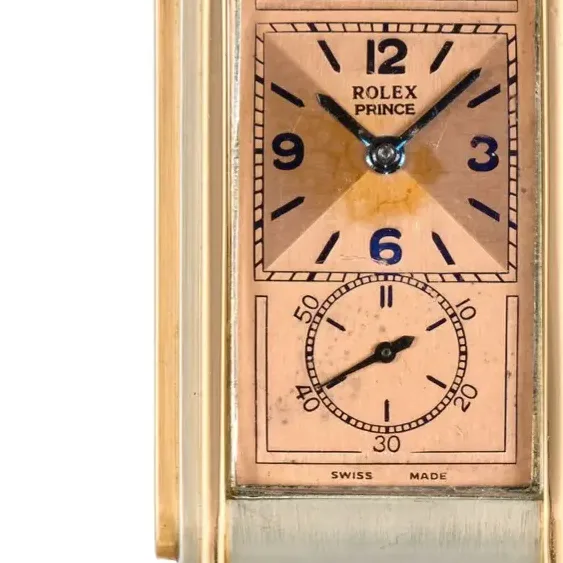
Two silver Brancards of 1930 have a two-tone silvered dial with black fancy Arabic numerals and a large subsidiary seconds dial, signed 'Rolex Prince' above the centre and 'Chronometer' below. On the duo-dial watches the hours and minutes sit above the line of the crown, which sets them apart from other rectangular watches.
- fancy black Arabic numerals
- signature 'Rolex Prince' above the centre
- 'Chronometer' below
Jump hour aperture
A small window at twelve shows the hour on a wheel in place of an hour hand. On some examples the numeral is red.
- window at twelve
- no hour hand
Elegante dial
A single dial with the seconds counter inside it. The Canadian-market example described has Arabic numerals, a railway minute track and a pink gold ring between numerals and minute track, with 'Rolex, Prince, Elegante' above the centre and 'Swiss Made' at the foot. France and Italy used 'Elegant'.
- railway minute track
- 'Elegante' or 'Elegant' spelling
- 'Swiss Made' at the foot
Hands 2 described
The hands on the watches described are blued steel: one style on the 1930 Brancards and another on the Elegante.
Poire hands
Fine blued steel pear-shaped hands are found on the two silver Brancards of 1930 described.
- blued steel
- fine pear-shaped hands
Diamond hands
The Elegante has blued steel hour and minute hands of a distinctive diamond shape, matching those in a 1940 advertisement. Correct period hands are hard to find for a watch that has been altered.
- diamond-shaped blued steel hands
Case and sizes 6 described
The Prince was made in a plain rectangular form, the curved Brancard, the stepped-side Railway and a straight-sided design, in silver, gold, platinum, steel and two-colour combinations. Case marks differ by market, and for some markets cases were made in the country of sale.
Classic rectangular
A straight rectangular case, made in 9 and 18 carat gold, silver and steel.
- plain rectangular outline
Brancard
A curved case, in two-tone 18 carat gold, gold-and-silver ('zebra'), silver, platinum and from 1934 steel. The 971U and 971A add faceted ends; the 971A has two-colour gold stripes across the top. Two silver examples of 1930 measure 23 x 43 mm with 20 mm lugs.
- curved sides
- faceted ends
- stripes across the top on the 971A
Railway
The sides are stepped, recalling a locomotive, as on reference 1527. One published comparison sets a Railway case with one step against another with two.
- stepped sides
- one or two steps
Straight-sided
A straight-sided rectangular case is listed as a further case design of the Prince, apart from the Brancard and the Railway. No date or reference is given for it.
- straight case sides
British hallmarked cases
A silver Brancard of 1930, reference 1490, carries a Glasgow hallmark for 1930 and the RWCLtd. mark alongside the '25 World's Records' stamp. Gold Rolex watches sold in Britain in the 1930s and 1940s are said to be almost always in cases by Dennison of Birmingham, to avoid import duty and, in the war years, a ban on importing gold; accounts differ, since another holds that Rolex cases of the years between the wars were nearly all hallmarked at Glasgow.
- Glasgow hallmark
- Dennison case maker's mark
Canadian-market gold-filled case
Most non-Oyster Rolex watches sold in Canada had cases made in Canada, to avoid duty on complete watches. A Canadian-market Elegante is gold-filled with a steel back and a case back signed only 'Rolex' in large capitals, not the longer 'World's Records' stamping of European cases.
- steel back
- single-word 'Rolex' signature
- gold-filled front
Movement 3 described
The early Prince has a shaped movement, from a patent filed in 1927, made at first by Aegler, which also supplied Gruen; the later Elegante has the calibre 360. The literature does not say who made the calibre 360.
Extra Prima
A manual-wind 15-jewel movement of observatory quality, timed to six positions, with a Rolex hairspring, described on two Brancards of 1930, one with a protective cap. In the shaped design the barrel and balance sit at opposite ends, which allows a larger balance wheel and a larger barrel. Most Princes were rated as chronometers and sold with a certificate.
- 15 jewels
- six positions
- numbered movement
- protective cap
Calibre 360 (HW), early, 'Patented SuperBalance'
A tonneau-shaped, manual-wind 17-jewel movement with a SuperBalance, signed 'Rolex, 17 Rubies, Swiss Made, Fab Suisse' on the bridge. Early examples add 'Patented SuperBalance' on the winding wheel; the wording is thought to have been dropped from about 1938.
- 'Patented SuperBalance' on the winding wheel
Calibre 360 (HW), later
The same movement with a SuperBalance but without the wording on the winding wheel, as on an Elegante of 1941.
- SuperBalance, but no wording on the winding wheel
Reference numbers
The numbers that belong to the line, with the listings on record under each, as its own page counts them. A number links to its own page, where the components of dated watches are set side by side.
| Number | What it is | Listings |
|---|---|---|
| 1343 | The classic Prince in a standard rectangular case. | 12 |
| 971 | The Brancard; also seen with U and A suffixes for the faceted-end and tiger-stripe versions. | 102 |
| 971U | Brancard with faceted end pieces, in gold and silver. | |
| 971A | Brancard with faceted end pieces and two-colour gold stripes across the top, the 'tiger stripe'. | |
| 1527 | The Railway Prince, given as introduced in 1935. | 21 |
| 1587 | The jump-hour Prince, also called a Railway in the literature. | 1 |
| 1490 | Stamped on a Glasgow-hallmarked silver Brancard of 1930; sellers also describe it as a Railway and as a jump hour, in silver, steel or gold. | 59 |
| 1491 | Described by sellers as a jump-hour Prince. | 19 |
| 3937 | Described by sellers as a curved rectangular Prince, including Eaton Quarter Century Club watches. | 21 |
| 3361 | Described by sellers as the Aerodynamic. | 9 |
| 2874 | A Prince Elegant, as sellers describe it. | 4 |

Originality
- Dials are often replaced: the watches are not water-resistant, many were repainted in the 1980s and 1990s, and an original unrepainted dial is hard to find.
- Gruen jump-hour watches have been redialled as Rolex, so jump-hour watches deserve close checking.
- Correct period hands are hard to source for a watch that has been altered, so hands should be checked against the model.
- Movements, especially pre-war ones, often carry some replaced parts.
Names
- Doctor's watch. The large seconds dial let the wearer time a heartbeat, and the hands never overlapped the seconds dial.
- Duo-dial. The watch has a separate dial for the seconds.
- Brancard. French for a stretcher.
- Zebra. The gold-and-silver Brancard case.
- Tiger stripe. Two-colour gold stripes across the top of the 971A.
- Railway. The stepped case sides suggest a locomotive.
- Quarter Century Club. Made for the Eaton firm to mark twenty-five years of service.
Where accounts differ
Points on which the published literature and the library's own records do not agree, or on which the literature contradicts itself.
- Year of introduction. Two accounts put the first Prince in 1928; another says it was first produced in 1929. The library's records hold a sale title for a reference 971 with a Glasgow import hallmark of 1924, before either date.
- Start of the HW calibre. One dealer places the calibre 360 in about 1934, and says a book that puts it at 1937 to 1953 is too late. The dealer says it is a view reached by comparison with a contemporary movement of another maker and by the SuperBalance, not a record.
- End of production. One account says production ended in the 1940s; a Chinese passage in another says around the 1940s or 1950s. The library's records hold six listings stated as of the 1950s, for example under references 3361 and 3937.
- Start of the jump hour. One account says Rolex introduced the jump-hour movement in 1935. The library's records hold a sale title for a 9 carat gold jump-hour Prince, reference 1491, with a Glasgow import mark for 1930.
- Where gold cases sold in Britain were made and hallmarked. One account says gold Rolex watches sold in Britain in the 1930s and 1940s are almost always in cases made by Dennison of Birmingham, to avoid import duty and, in the war years, a ban on bringing gold into the country. Another account says Rolex cases were mostly assayed in London before 1920 and almost only in Glasgow between the wars.
- Start of the Railway. Two accounts say the Railway, reference 1527, was introduced in 1935. The library's records hold a sale title for a reference 1527 Railway with Glasgow import hallmarks for 1931, and another titled 1934.
In the records
Counted from 470 listings at dealers and auction houses. These are what sellers state, not measurements, a stated year is often an estimate, and a count of listings is not a count of watches made.
Case metal
| Metal | Listings | Share |
|---|---|---|
| Gold, any colour | 220 | 63% |
| Yellow | 29 | 8% |
| Pink | 20 | 6% |
| White | 20 | 6% |
| More than one colour | 20 | 6% |
| Colour not stated | 131 | 38% |
| Steel | 59 | 17% |
| Silver | 52 | 15% |
| Platinum | 8 | 2% |
| Steel and gold | 4 | 1% |
| Gold filled | 2 | 1% |
| Steel and platinum | 2 | 1% |
As sellers state it. Shares are of the 347 listings that name a metal. A listing that says "gold" or "18K gold" names no colour: it is counted under "colour not stated", not as yellow gold. Carat, where a listing of gold gives one: 9k 52 · 18k 47 · 14k 20.
Case size
| Size | Listings | Share |
|---|---|---|
| 20 mm | 27 | 15% |
| 22 mm | 22 | 12% |
| 23 mm | 21 | 11% |
| 43 mm | 20 | 11% |
| 42 mm | 19 | 10% |
| 25 mm | 10 | 5% |
| 36 mm | 8 | 4% |
| 26 mm | 6 | 3% |
| Other sizes | 50 | 27% |
As sellers state it. Shares are of the 183 listings that give a size.
Listings by decade the seller gives
| Decade | Listings |
|---|---|
| 1920s | 22 |
| 1930s | 224 |
| 1940s | 42 |
| 1950s | 6 |