Pocket watches
Rolex began, as Wilsdorf & Davis in London in 1905, by assembling watches from Swiss parts for sale to jewellers, and many of those first pieces were pocket watches. The firm soon put its effort into the wristwatch, so its own pocket watches are few. Published accounts describe bought-in movements in cases from outside makers, a single pocket calibre made with Aegler, a pocket stopwatch, a chronograph, a world-time watch and a split-seconds watch of doubtful standing, and a last handful of small gold Cellini models in the 1970s. The library's records add Prince Imperial, military and travel pieces that the literature does not describe. Few carry a reference that the literature explains.
This maker's early watches are described by kind of watch, not by reference number: many carry no number, and one number can cover quite different watches. The wider picture is in Early Rolex, 1905 to 1959.
- Made
- from c. 1905The start is the founding of the London firm; the last pocket watches are placed in the 1970s, a decade rather than a year, and the library's records include later stated years.
- On record
- 1,074 listings929 of them give no reference
- Reference numbers
- 9 describedmany early watches carry none
Production by production 8 described
Wilsdorf & Davis assembled pocket watches
In its first years the London firm made no component itself. It assembled watches from parts bought from Swiss makers and sold them on to other jewellers, sometimes with the Wilsdorf & Davis mark beside the retailer's name and sometimes with no mark of its own. Many of these early pieces were pocket watches, then by far the commoner kind, while the wristwatch was still thought of as a woman's piece. The name Rolex was registered as a trade mark in 1908, and the firm is placed in Geneva from 1919. The literature gives no case numbers, signatures or sizes for these watches.
Signature and marks. The W&D mark beside a retailer's name, or the retailer's name alone with no mark of the firm.
- a W&D mark beside a retailer's name
- a watch with no Rolex or W&D mark
Rolex pocket watches of the 1920s and 1930s
Through the 1920s and 1930s the firm kept making pocket watches while its effort went into the wristwatch, the Oyster case and the self-winding movement. The movements were bought in from established makers and the cases came from makers such as A. L. Dennison. Cortebert is named as one supplier of the firm's pocket movements, though not for any one period. In the library's records many of these are 9 ct gold watches with Birmingham hallmarks or Glasgow import marks, beside silver, steel and nickel watches, and several records give a case number and a movement number separately.
Signature and marks. Case number and movement number given separately in several records; Birmingham hallmarks or Glasgow import marks on gold and silver cases.
- a British hallmark or import mark in a 9 ct gold case
- separate case and movement numbers
References: 1268
The Aegler pocket calibre
Of all the movements the firm used, only one pocket watch movement was made in partnership with Aegler, the Swiss maker of small movements for ladies' watches that also made the firm's early chronometer calibres. It is described as an unorthodox design with a sub-dial for the running seconds, and is placed in the 1920s and 1930s. The literature does not give its calibre number or a year.
Signature and marks. Not given in the literature.
Compteur pocket stopwatch
A Rolex Compteur of about the 1930s is described as a pocket stopwatch that does not tell the time. The example published was sold new in Kenya and has a double-signed dial carrying the name of the Nairobi retailer Dobbies Ltd. Collectors of Rolex have tended to look at watches of the 1950s and later, so the model is little known.
Signature and marks. Dial signed Rolex and stamped Dobbies Ltd. Nairobi on the one example described.
- a pocket stopwatch dial that does not show the time
- a double-signed dial with a retailer's name
Chronograph, reference 3068, and two-tone dial watches
The firm made very few pocket watches, and reference 3068, a chronograph, is the one the literature names among them; several have been sold at auction. A seller describes one as a single-button chronograph in 18 ct gold with a two-tone rose sector dial. The records add a steel single-button chronograph with a sector dial, reference 28d1, an 18 ct gold pocket chronometer with a two-tone dial and a class A certificate, reference 2552, and an 18 ct gold lever watch with a two-tone dial, reference 3038. Dated watches so described fall mostly between about 1937 and 1950.
Signature and marks. Dial signed Rolex, with Genève on a 3068 as sellers give it; case numbers of about 1,008,000 on the gold watches in the records.
- a sector dial with two tones
- one pusher on the case band
- a class A chronometer certificate with the watch
References: 3068, 28d1, 2552, 3038
World-time watches
A Rolex pocket watch with a world-time mechanism by an independent Geneva maker of complicated watches is published with the date 1945; that maker's world-time mechanisms let the times of all twenty-four zones be read from one dial. Sellers give reference 4262 for gold and pink gold world-time pocket watches, one of them retailed by Philippe Beguin of Geneva. Two are described as signed Rolex, chronometre, one is called one of twelve examples known, and one seller names that Geneva maker beside Rolex. The literature does not say that the 1945 watch is a 4262.
Signature and marks. Signed Rolex, chronometre on two as sellers give them, with Philippe Beguin, Geneve on one; movement numbers of about 1,001,200 and case numbers of about 1,010,400 on those two.
- pink gold case
- Rolex, chronometre in the signature
References: 4262
Split-seconds watch without a reference
One steel pocket watch of 51 mm, offered at auction in 2017, has a split-seconds chronograph movement with the bridge engraved Rolex Geneve, movement number 88305 and case number 2885. The dial is printed with the Rolex name, its back carries a ZJ mark of one of the firm's dial makers, and the case back a green sticker. It is stated to be of 1955, though the movement looks older. It has no reference, and the Rolex literature is said never to mention a split-seconds pocket watch by the firm; enquiries with the firm came to nothing, and it was thought possibly a re-casing, a limited production or a doubtful piece. Its status was unresolved.
Signature and marks. Rolex Geneve on the split-seconds bridge; ZJ on the dial back; green sticker on the case back.
- split-seconds bridge engraved Rolex Geneve
- ZJ mark behind the dial
- green sticker on the case back
Cellini pocket watches
The last Rolex pocket watches were small 18 ct gold models issued with the Cellini line, a range of non-Oyster, mainly hand-wound dress watches, and are placed in the 1970s, made more as a novelty than anything else. Sellers give references 3608, 3694, 3718, 3727, 3728, 3729 and 3767 for Cellini pocket watches, in yellow and white gold, with stated years from 1960 to 1978 and others from 1980 to 1999; one 3608 has a London import mark for 1964. Some are described as pendant or coin watches, and some as set with diamonds.
Signature and marks. Not given in the literature; sellers write some references with a suffix, such as 3608 J or 3694/9.
- small gold open-face case
- Roman numerals
- engine-turned bezel
- a chain or pendant fitting
Chronology
Specification
| Case styles | Open face, half hunter and full hunter cases appear in the records; a hinged lid covers the dial on hunter styles |
| Case metals | Steel, nickel, silver, 9 ct and 18 ct gold, and gold plate, as sellers describe them |
| Size | Most often given as 50 or 49 mm; the commonest sizes in the records lie between 42 mm and 52 mm |
| Movement | Mostly bought-in Swiss lever movements finished for the firm; one pocket calibre was made with Aegler |
| Winding | Keyless and hand wound in the records; the Cellini line under which the last were issued is described as mainly hand-wound dress watches |
Dial 3 described
Some dials carry a retailer's name beside Rolex. The firm's earliest watches might carry the retailer's name with the W&D mark beside it, or no mark of the firm at all.
Double-signed retailer dial
A retailer's name is printed on the dial alongside Rolex. Dobbies Ltd. of Nairobi is so described on the Compteur stopwatch, and Serpico y Laino on a white gold watch in the records. Other watches in the records are described as retailed by Asprey, Philippe Beguin of Geneva, James Walker Ltd and the Alex Clar Company, without saying where the name appears.
- a second name printed below or above Rolex
Dial maker mark behind the dial
On the split-seconds watch offered in 2017 the back of the dial is marked ZJ, said to be that of one of the firm's dial makers. It is the only dial-back mark described.
- ZJ on the dial back
Sector dial with two tones
Gold chronographs and lever watches are described with two-tone dials, one of them rose. Dated watches so described fall mostly between about 1937 and 1950.
- sector layout
- two colours of dial
Case and sizes 4 described
The firm bought in its cases; A. L. Dennison is named among the case makers of the 1920s and 1930s. Open face, half hunter and full hunter styles are all recorded, in metals from steel and nickel to 18 ct gold.
Dennison case
A. L. Dennison is named as a maker of the cases of the 1920s and 1930s. The literature gives no mark for it.
British hallmarked and import-marked case
Many 9 ct gold watches in the records, and some silver and 18 ct gold ones, are described with a Birmingham hallmark or a Glasgow or London import mark, each with a year.
- Birmingham, Glasgow or London mark
Hunter and half hunter cases
On a hunter the dial and crystal are covered by a hinged metal lid, which protected the watch better than an open face.
- hinged lid over the dial
- a window in the lid on a half hunter
Green sticker
A green sticker on the case back is said to have been on every Rolex when it left the maker, and is still on the split-seconds watch of 2017.
- a green sticker on the outside of the back
Movement 2 described
The movements were bought in and finished by the firm, apart from one calibre made with Aegler. Sellers name a number of calibres.
Bought-in lever movement
Swiss lever movements from established makers, Cortebert among them, were finished by the firm. In the records they are described as Swiss lever, with a cut and compensated bi-metallic balance on several.
Cal. 1600 and cal. 750
Sellers give calibre 1600, 19 jewels, hand wound, on Cellini pocket watches stated from 1964 to the 1970s, and calibre 750, 20 jewels, on Cellini watches stated 1991 to 1999. Military watches are given calibres 540 and 548, and other numbers appear once or twice. The literature does not describe any of them.
- calibre number on the movement
Box and papers 1 described
Some watches are recorded with their chain, fob or pouch.
Chain, fob or pouch
Records mention a 9 ct gold chain with a hardstone fob, a chain with a stainless steel watch, and an original pouch with a world-time watch.
- original pouch
- chain of matching metal
Reference numbers
The numbers that belong to the line, with the listings on record under each, as its own page counts them. A number links to its own page, where the components of dated watches are set side by side.
| Number | What it is | Listings |
|---|---|---|
| 3068 | A chronograph pocket watch, named in the literature among the few pocket watches the firm made; a seller describes a gold single-button example. | 1 |
| 4262 | A world-time pocket watch in gold, as sellers describe it; one is called one of twelve known. | 4 |
| 2728 | A reversible travel or table watch in steel and leather, as sellers describe it. | 2 |
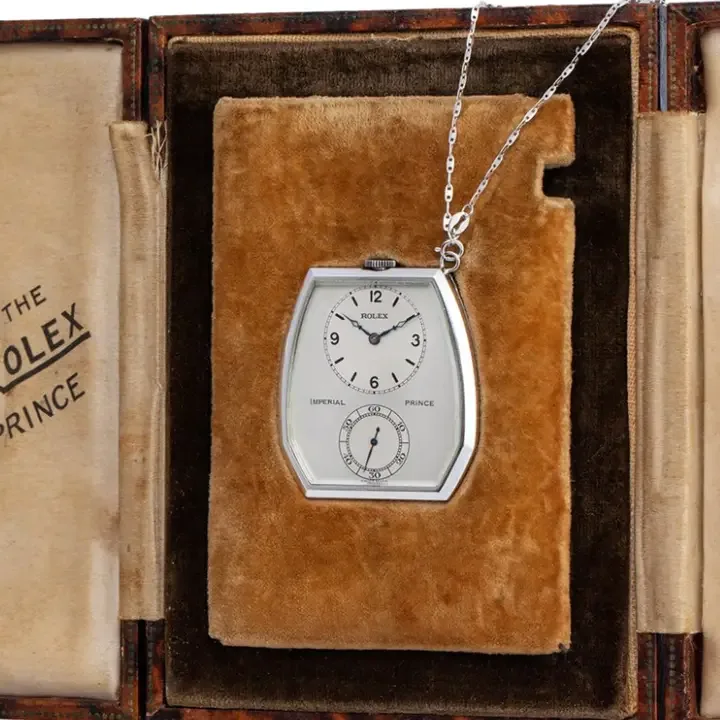
| 1645 | A steel Prince Imperial pocket watch in a Rolesium case, as sellers describe it. | 1 |
| 1585 | A Prince Imperial pocket watch with an enamel dial or case, as sellers describe it. | 2 |
| 3608 | A Cellini 18 ct gold pocket watch, as sellers describe it. | 1 |
| 1586 | A white gold Prince Imperial type pocket watch with diamond-set numerals and a chronometer certificate, as sellers describe it. | 4 |
| 1609 | A 9 ct gold Prince Imperial pocket watch retailed by Asprey, as sellers describe it. | 1 |
| 3718 | A white gold Cellini pocket watch, as sellers describe it. | 5 |

Originality
- The firm is said sometimes to have cased older movement blanks some years after they were made, so a movement can be older than its case.
- Rolex pocket watches have been converted to wristwatches: lugs are welded to the case, the pendant and bow are cut away, and the stem shortened, sometimes with a flat crown in place of the tall original.
Where accounts differ
Points on which the published literature and the library's own records do not agree, or on which the literature contradicts itself.
- End of production. One published account places the last Rolex pocket watches in the 1970s, all Cellini. The library's records show Cellini pocket watches with stated years from 1980 to 1999, among them reference 3767 stated as 1995. The records rest on sellers' stated years, which are often guesses.
In the records
Counted from 1,074 listings at dealers and auction houses. These are what sellers state, not measurements, a stated year is often an estimate, and a count of listings is not a count of watches made.
Case metal
| Metal | Listings | Share |
|---|---|---|
| Gold, any colour | 317 | 46% |
| Yellow | 26 | 4% |
| White | 15 | 2% |
| Pink | 8 | 1% |
| Colour not stated | 268 | 39% |
| Gold plated, filled or capped | 144 | 21% |
| Plated | 111 | 16% |
| Rolled | 27 | 4% |
| Filled | 6 | 1% |
| Steel | 108 | 16% |
| Silver | 105 | 15% |
| Base metal | 7 | 1% |
| Nickel chrome | 1 | under 1% |
| Steel and platinum | 1 | under 1% |
As sellers state it. Shares are of the 683 listings that name a metal. A listing that says "gold" or "18K gold" names no colour: it is counted under "colour not stated", not as yellow gold. Carat, where a listing of gold gives one: 9k 136 · 18k 67 · 14k 2 · 10k 1.
Case size
| Size | Listings | Share |
|---|---|---|
| 50 mm | 111 | 21% |
| 49 mm | 65 | 13% |
| 48 mm | 43 | 8% |
| 52 mm | 42 | 8% |
| 51 mm | 30 | 6% |
| 45 mm | 29 | 6% |
| 44 mm | 24 | 5% |
| 42 mm | 17 | 3% |
| Other sizes | 157 | 30% |
As sellers state it. Shares are of the 518 listings that give a size.
Listings by decade the seller gives
| Decade | Listings |
|---|---|
| 1900s | 2 |
| 1910s | 15 |
| 1920s | 86 |
| 1930s | 88 |
| 1940s | 73 |
| 1950s | 10 |
| 1960s | 17 |
| 1970s | 12 |
| 1980s | 2 |
| 1990s | 7 |
| 2000s | 1 |
| 2010s | 2 |
| 2020s | 2 |