Chronographs before the Daytona
The wristwatch chronographs Rolex made before the first Daytona, from the four-digit references of the 1930s and 1940s to the smooth-bezelled Oyster chronographs of the 1950s and early 1960s. The earlier watches include the 2508, the 3330 and 3335, the sealed-case 3525 and the split-seconds 4113, of which twelve were made. By 1950 the 6000 series had begun: the 6034, the 6234 and the 6238, with the tachymeter printed on the dial rather than engraved on the bezel, and a few two-register watches, the 6032 and 6232. The 6238 was made alongside the first Daytonas until about 1967 or 1968. Collectors look first at the dial: its text, colour, finish and printing.
This maker's early watches are described by kind of watch, not by reference number: many carry no number, and one number can cover quite different watches. The wider picture is in Early Rolex, 1905 to 1959.
- Made
- to c. 1968The literature dates the earliest watches only to the 1930s and 1940s, apart from the split-seconds 4113 in 1942. A new set of 6000-series chronographs is placed by 1950, the 6234 runs from about 1955 to 1961, and the 6238 ends in 1967 or 1968, accounts differing on the last year.
- On record
- 975 listings26 of them give no reference
- Reference numbers
- 15 describedmany early watches carry none
Production by production 7 described
Early chronographs of the 1930s and 1940s (2508, 3330, 3335, 3484, 3529)
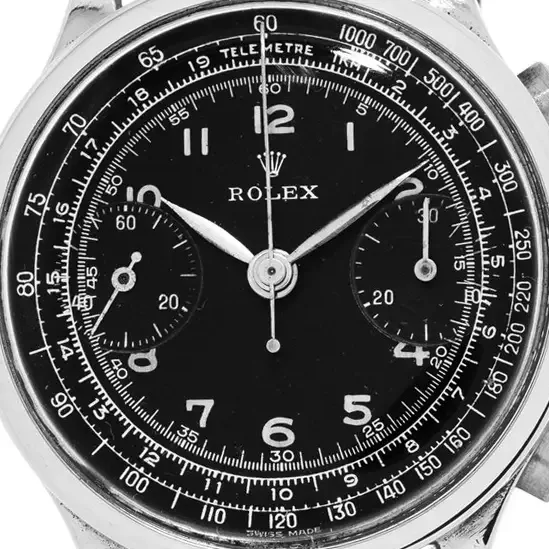
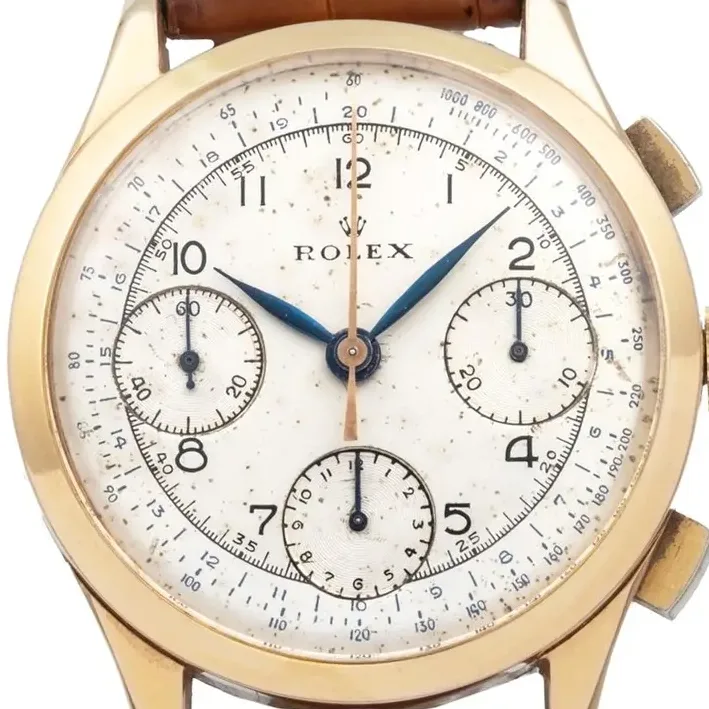
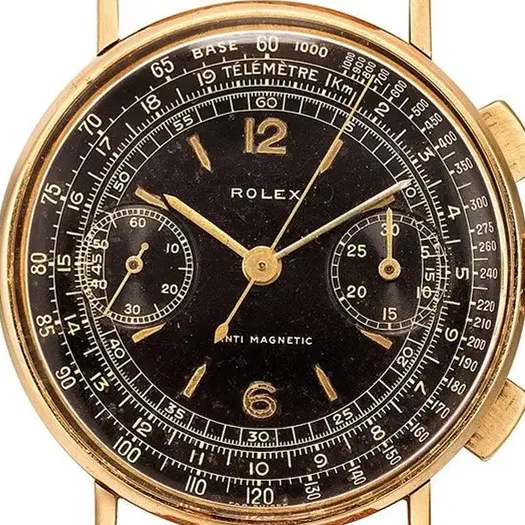
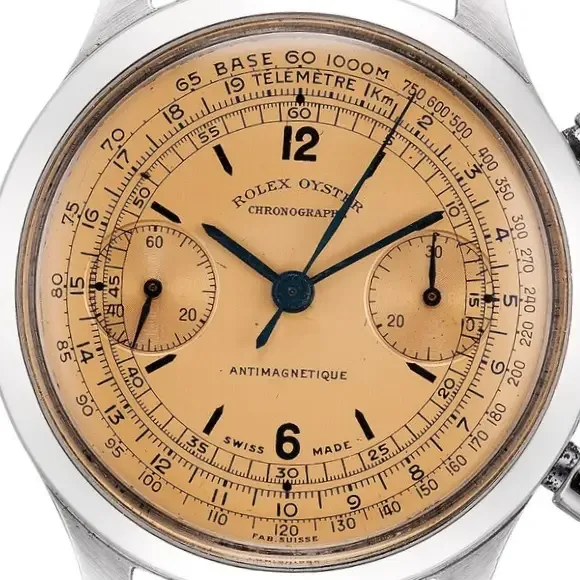
Published accounts say little about these watches beyond their dials and a few movements. A large reference 2508 is shown beside the note that Rolex introduced a chronograph with a 30-minute and a 12-hour counter on the eve of the Second World War; its black-dial examples are far rarer than the usual white or silver ones, and some have olive-shaped pushers where others have rectangular ones. The 3330 and 3335 are almost the same watch, the 3330 with traditionally shaped lugs and the 3335 with angular ones. The 3529 is the smallest Rolex chronograph, a square watch 26 mm on the side with a Valjoux 69 movement, placed in the late 1930s. Across its chronographs Rolex used the Valjoux 23, 69, 72 and 72C; the 72, made from about 1938, added the 12-hour counter at six. Dates are given as decades only.
Signature and marks. The 3330 and 3484 carry a straight Rolex signature and the 2508 a plain one. A pink dial with applied markers and numerals and a curved signature, printed with both Swiss made and fabrique suisse, is also shown among the chronographs of the period, its reference not given.
- straight Rolex logo on the dial
- olive or rectangular pushers
- angular lugs (3335) or traditional lugs (3330)
- 26 mm square case (3529)
Reference 3525, the sealed-case chronograph ("monoblocco")
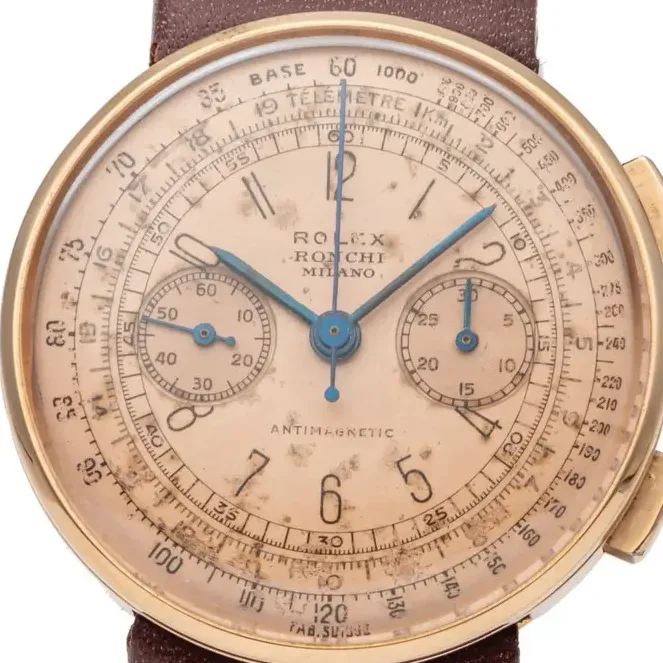
The 3525 was introduced at the end of the 1930s, shortly before the war. Sealed cases were then new for chronographs, and the watch was valued for its toughness; it was also sold for civilian wear. Its outline is of the Calatrava kind, unlike the tonneau shape Rolex began to give its chronographs only in the middle of the 1940s. It is found in steel and in pink gold, and sellers also describe yellow gold examples. One pink gold example has a two-part case and a salmon dial with a fan-shaped tachymeter scale and the name of a Roman concessionaire; a steel one has a black galvanic dial with radium lume and a pulse scale, a layout read as meant for a field doctor. Some dials carry the name of Beyer, a Zurich dealer that sold many of the watches known as Prisoner of War watches during the war.
Signature and marks. The earliest watches have a straight Rolex logo; later ones a more ornate one. Some dials carry a retailer or concessionaire's name.
- Calatrava-style outline
- straight Rolex logo on the earliest examples
- retailer's name on the dial
- pulse scale on rare dials
References: 3525
Split-seconds chronograph, reference 4113
The 4113 is the only split-seconds chronograph Rolex made. It was made briefly in 1942 and only twelve were produced, in a steel case of about 44 mm, large for its day. Its Valjoux 55 is a version with three pushers: the top one for the split second, one set in the crown, on its axis, for start and stop, and the bottom one for reset. Each watch had a different dial design, the buyer choosing the layout. The dial uses the French form antimagnetique where English-language dials say antimagnetic.
Signature and marks. The dial reads antimagnetique, in French, and differs from watch to watch.
- three pushers, one of them in the crown
- oversized steel case
- French wording on the dial
References: 4113
Two-register chronographs, 6032 and 6232
These are the two-register watches of the 6000 series, with the Valjoux 23 movement, made in extremely small numbers: ten to twenty of the 6032 and about a dozen of the 6232, fewer than three dozen together. One account places them in the 1950s, though a caption on the same account calls the 6032 a watch of the 1940s made for the French market; another account dates the start of the 6032, 6034 and 6036 to the end of the 1940s or the early 1950s. The 6032 is shown in gold, pink gold among them, with a slim bezel and tachymeter and telemeter scales that leave much of the dial open. The 6232, in the later three-part case, may have been made for the French market, which taxed gold watches heavily.
- two registers, running seconds at nine and a minute counter at three
- slim bezel on the 6032
Reference 6034
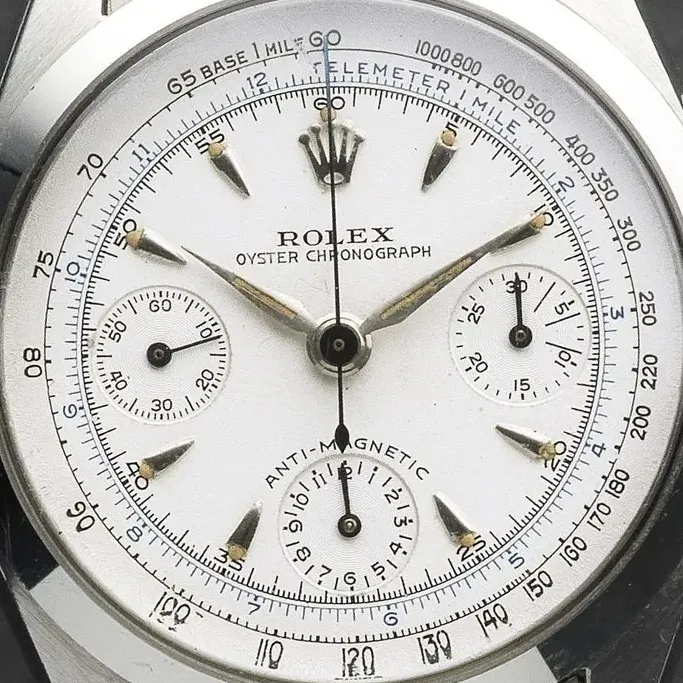
The 6034 belongs to the early 1950s and is the first of the three-register 6000-series watches. It has a 36 mm tonneau-shaped Oyster case, with the crown and back screwed down, round pushers either side of the crown, and a Valjoux 72 with 17 jewels and a monometallic screw balance. It was made in steel and in yellow or pink gold, steel far outnumbering gold; output is estimated at about 3,700, though another account calls it very few. The case is in two parts, bezel and middle in one. Most have a silver dial with tachymeter and telemeter printed in red and blue; black dials are rarer. It was made before the T Swiss T marking, so its dials carry only a Swiss signature at six.
Signature and marks. Sellers describe dials signed Rolex, Oyster Chronograph (or Chronographe) and Anti-Magnetic (or Anti-Magnetique); a Swiss mark at six, without the T Swiss T of later dials. One account says Oyster is rarely seen on the dials of this series.
- leaf hands
- red and blue scales on a silver dial
- Swiss only at six o'clock
- gilt writing on a glossy black dial
References: 6034
Reference 6234
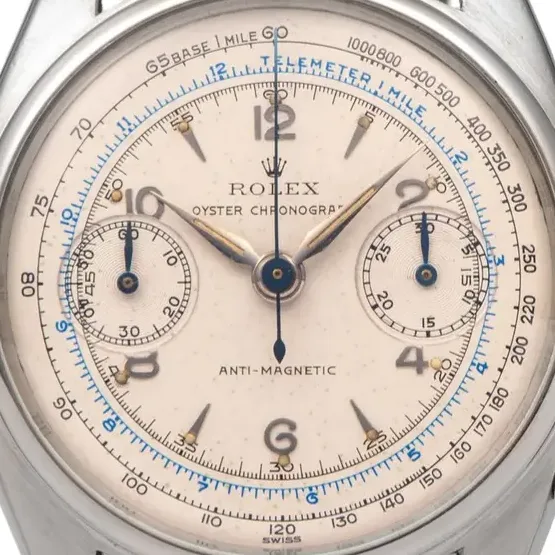
The 6234 was made from about 1955 to 1961 and is listed in period materials until 1963. It is the first Rolex chronograph in a three-part Oyster case, and differs little in appearance from the 6034; inside, a shock protector is added over the balance staff, and the pink gold versions and some of the dial choices are dropped. It has a smooth bezel, both scales on the dial, three registers and a Valjoux 72-family movement. Estimates of output run to about 2,300 or 2,450; one collector's count is 2,250 in steel, 36 in 18 ct gold and 108 in 14 ct gold. The 14 ct watches were most likely for the American market, where 18 ct watches paid a much higher import tax. Dials were supplied by Stern: steel watches had, as standard, stamped dials with the crown and markers in relief, gold ones applied gold crowns and markers.
Signature and marks. Rolex, Oyster Chronograph and often Anti-Magnetic on the dial; some dials carry T Swiss T at six, and some an underlined Swiss mark.
- smooth bezel with tachymeter and telemeter on the dial
- applied dagger markers
- radium lume ageing to yellow
- 14 ct gold case, made for the American market
References: 6234
Reference 6238 (the 'Pre-Daytona')
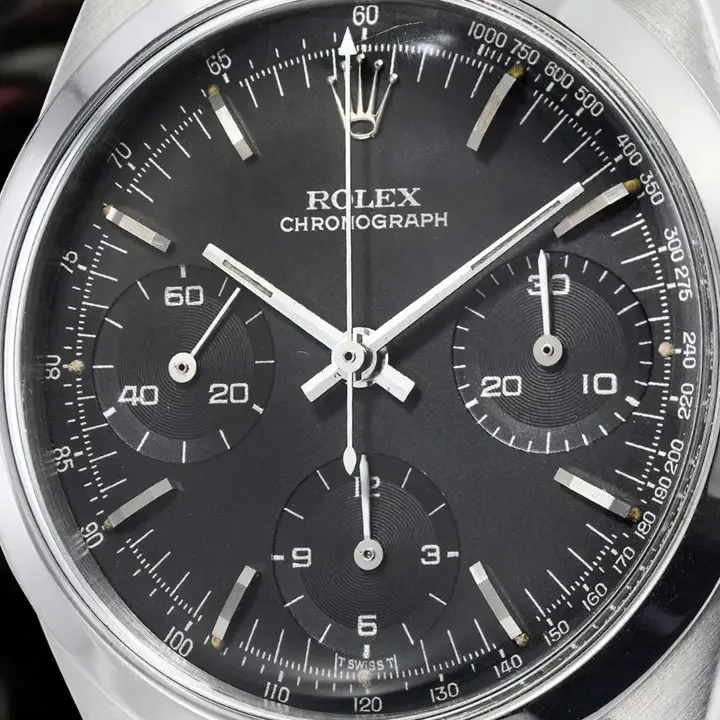
The 6238 is the last smooth-bezelled Rolex chronograph before the Daytona. It has a 36 mm Oyster case, round pump pushers, an Oyster Twinlock crown, a domed acrylic crystal and a tachymeter printed on the dial; the telemeter is dropped on all but some early dials. It was made from 1962, though one account says 1961, until 1967 or 1968, alongside the first Daytona, the 6239, which differs mainly in its tachymeter bezel and contrasting sub-dials. Output is put at about 3,590 in steel, 150 in 18 ct gold and 225 in 14 ct gold, with another count of 3,500 steel, 220 14 ct and 150 18 ct, and one account of about 1,500 in all. Fourteen dial variants are recorded. Collectors divide the watch into three series by case number: the first to about 800,000, the second to about 950,000, and the third from about 1,000,000. A 6238 bought in 1968 from a Swiss retailer by the producers of a James Bond film was worn on screen in 1969, modified with a red chronograph seconds hand.
Signature and marks. Rolex, Oyster Chronograph and Anti-Magnetic on the first dials, some without Oyster; later Rolex and Chronograph only, and on a few Rolex alone; T Swiss Made T at six on many, others without the Ts.
- leaf hands, diamond markers and sometimes two scales (first series)
- baton hands and a single tachymeter (later series)
- T Swiss Made T at six
- case number between the lugs at six
References: 6238
Chronology
Specification
| Case, 6000 series | 36 mm Oyster case with screw-down crown and back, smooth bezel in the case metal, round pump pushers; two-part case in the 60xx references, three-part in the 62xx |
| Dial scales | Tachymeter and telemeter printed on the dial in the 6034 and 6234 (on some 6034 dials a pulse scale in place of the telemeter); tachymeter alone on most 6238 dials, though some early 6238 dials keep a second, telemeter scale |
| Movement, three registers | Hand-wound Valjoux 72 family (cal. 72, 72A, 72B, later 722), column wheel, 17 jewels, 18,000 vph |
| Movement, two registers | Hand-wound Valjoux 23 in the 6032 and 6232 |
| Metals | Mostly stainless steel; 14 ct and 18 ct yellow gold; pink gold in the 6034 and the 6032, and in earlier watches such as the 3525 |
| Crystal | Domed acrylic (described for the 6238) |
| Output (estimates) | Estimates differ: about 3,700 of the 6034; about 2,300 to 2,450 of the 6234; about 3,600 to 3,965 of the 6238 (one account gives about 1,500); fewer than three dozen 6032 and 6232 together |
Dial 15 described
The dial carries most of the change in these watches. The 6034 and 6234 print tachymeter and telemeter scales; the 6238 drops the telemeter on all but some early dials and ends as a plain Rolex Chronograph dial. Collectors look first at the text, the colour and surface of the dial, then at the maker's printing. A missing scale on an early dial can be correct.
6034 silver dial with red and blue scales
The usual 6034 dial is silver, with tachymeter and telemeter in red and blue; the telemeter is sometimes inside the tachymeter, in blue, or replaced by a pulse scale.
- tachymeter and telemeter in red and blue
- inner telemeter ring
6034 glossy black dial with gilt
The rarer black dials were often glossy with gilt writing, the signature and outer scales showing through the black in negative relief.
- gilt text on glossy black
- printing in negative relief
6034 diamond markers and arrow hands
Some 6034 dials replace the arrow markers with shorter diamond-shaped ones, usually paired with arrow-shaped hands.
- short diamond markers
- arrow hands
6234 dials with both scales
Most 6234 dials show tachymeter and telemeter on two fine rings with applied dagger markers, often with an anti-magnetic line. Scale colours differ, in one colour or several; some late-1950s watches pair a blue telemeter with a darker tachymeter.
- two scale rings
- dagger markers
- blue telemeter
6234 Stern dials, stamped and applied
Stern supplied the 6234 dials: stamped for steel with relief crown and markers, applied gold for gold watches.
- relief crown and markers on steel
- applied gold crown on gold
6234 for the American market
American-market 6234 watches are said to show a telemeter graduated in miles together with a ROW marking on the movement; the two should agree.
- miles on the telemeter
- ROW on the movement
6234 T Swiss T without lume
Some 6234 watches have T Swiss T printed but no lume on dial or hands, with no sign it was removed; one collector thinks they were sold in Japan.
- T Swiss T with plain hands and markers
6234 no-scale black dial
A black 6234 dial without scales, by Stern, is documented as an outlier.
- black dial with no scales
6238 first series, transitional dial
The first 6238 dials follow the 6234: Rolex with Oyster Chronograph below, Anti-Magnetic above six, and applied diamond or leaf-shaped markers, made with or without tachymeter and with or without Oyster; some keep a second, telemeter scale. The hands are leaf hands in most accounts, dagger-style in one.
- Oyster Chronograph under the crown
- Anti-Magnetic above six
- leaf hands
6238 second series, two-tone dial
The second series, the rarest, has straight hands, faceted baton markers and one tachymeter. The dial is two-tone, with the tachymeter track set further from the registers, nearer the edge. Its Rolex signature is described in one account as lightly serifed and in another as having a graceful R.
- two-tone dial
- faceted baton markers
- tachymeter track near the edge
6238 third series, single-colour dials
From late 1963 dials read Rolex and Chronograph only. Silver is by far the most common; a darker grey, found only on steel, is rarer, and black is also rare, mostly matte, sometimes glossy or galvanic, printed in silver, white or gilt, gilt on glossy black being the rarest. Steel watches usually have a silver sunburst dial with black print from 1964. Dials of this series are divided into a first and a second production and those fitted after service.
- silver, grey or black
- matte against glossy black
- gilt print
6238 Rolex solo
In some very rare dials only Rolex is printed, with no Chronograph and no scale, on a two-tone dial.
- Rolex alone
6238 early Singer dials
The first Singer dials, on steel watches with case numbers around one million, show a small Mile, or perhaps Base, to the right above the coronet, and a Rolex signature with a wide R, both gone in later production; the first modern-style indices were soldered, later ones riveted. Gold watches could still be ordered with Stern's classic dials into the second half of the 1960s.
- Mile or Base above the crown
- wide R
- soldered indices
6238 T Swiss T and plain Swiss
T Swiss T at six shows tritium on the hour markers; examples without the Ts probably have radium or strontium.
- T Swiss T at six
Dealer-signed dials
Retailers' names appear on dials: Tiffany on some 6238s, Beyer on a 3525, and, in sellers' descriptions, Verga and Astrua on 3525s and Mappin on a 2811.
- a retailer's name on the dial
Hands 4 described
Hands move from leaf and dagger shapes to baton hands as the dials change, and one hand length is disputed.
Leaf, arrow and alpha hands (6034, 6234, early 6238)
The 6034 has leaf hands, and arrow-shaped hands with diamond markers on some dials; alpha hands are recorded on the 6234. Early 6238 watches have leaf hands in most accounts, dagger-style in one.
- leaf hands
- arrow hands
- alpha hands
Baton hands (later 6238)
The later 6238 has straight baton hands, with faceted baton markers.
- straight baton hands
6238 minute hand length
A shorter minute hand not reaching the outer scale is generally thought the original. Some later watches have a longer one like that of the 6239, either because the Daytona hands were fitted late in production or after service. Both are Rolex hands.
- minute hand ending inside the scale
Sub-dial hands
6238 sub-dial hands are thinner than those of the 6239. One steel 6234 has blue sub-dial hands to match its scales, presumed correct; usually they match the case metal.
- thin sub-dial hands
- blue sub-dial hands on one 6234
Subregisters 3 described
The 6034 and 6234 have registers at three, six and nine; the registers and how they sit against the scales differ.
Register layout, three-register watches
Running seconds are at nine, 30 minutes at three and 12 hours at six; the 6032 and 6232 have two registers.
- 12-hour register at six
6234 small and large registers
The 6234 has both small and large registers, the two overlapping in time. The small ones keep clear of the scales; on the large ones the scales run through them, an older practice.
- scales running through registers
6238 milled registers
The 6238 registers are milled and the colour of the dial, with a more modern numeral typeface; the Daytona changed the sub-dial colours to contrast.
- milled registers matching the dial
Bezel 1 described
The 6000-series watches all have a smooth bezel; the scale is on the dial until the Daytona.
Smooth bezel
A tachymeter-engraved bezel is wrong on these watches. The 62xx bezel is broader, almost blending into the case, with a clear line at its edge and a smaller gap, while on the 60xx it merges more smoothly. The 6238 bezel is likened to that of an Explorer.
- smooth bezel without scale
Case and sizes 4 described
The cases run from the Calatrava-like outline of the 3525 to the tonneau-shaped Oyster, in two parts and then three.
Oyster case in two parts (60xx)
The 6034 and the other 60xx watches have a two-part case; bezel and middle are one.
- bezel merging into the middle
Oyster case in three parts (62xx)
The 6234, 6238 and 6232 have three components, bezel, middle and back, with a visible line at the bezel edge.
- line and shadow at bezel edge
Gold cases: 14 ct and 18 ct
Gold watches are much rarer than steel. A 14 ct watch was most likely sold in America, where import tax on 18 ct was higher; gold cases need correct hallmarks, and soft stamps point to polishing or a replaced case.
- crisp hallmarks
Caseback engraving
A 6238 was supplied to the Peruvian Air Force with an engraved back, unremarkable from the front.
- engraved Fuerza Aerea del Peru caseback
Crown 1 described
Crown and pushers are matched to the case.
Oyster Twinlock crown, round pushers
The 6238 has a screw-down Twinlock crown and 600-series pump pushers, as does the 6239.
- Twinlock crown
- round pump pushers
Movement 8 described
The movements the literature describes are all Valjoux. Which calibre a given watch has is recorded unevenly.
Valjoux 72, 72A, 72B (6034, 6234)
The 6034 is described with cal. 72 (17 jewels, monometallic screw balance) and the 6234 with 72, 72A or 72B, the reason for the difference not being documented.
- Valjoux 72 family
Valjoux 72B to 722 (6238)
Early 6238 watches keep the 72B, the calibre also said to be in the 6234, and later ones have the 722, used in the first Daytonas; both run at 18,000 vph with 17 jewels and 48 hours' reserve. Accounts differ on the change: about 1965, or with the second series; one account dates the Rolex 72B to 1966.
- calibre engraving under the bridge
Valjoux 72
Made from 1938, the Valjoux 72 added a 12-hour counter at six. It is a column-wheel movement beating at 2.5 Hz.
- 12-hour counter at six
Valjoux 72C
Brought a full calendar in 1946; it is the movement of the triple-calendar Rolex chronograph.
Valjoux 23 (6032, 6232)
The two-register Valjoux 23 powers the 6032 and 6232.
- two-register Valjoux 23
Valjoux 69 (3529)
A small calibre in the square 3529.
- 26 mm square case
Valjoux 55 (4113)
A 39 mm split-seconds movement with three pushers.
- three pushers
6234 shock protection
The 6234 movement gains a shock protector above the balance staff.
- shock protector
Bracelet and strap 1 described
Few bracelets are recorded.
Oyster, Jubilee and Big Logo bracelets
The 6238 is seen on Oyster and Jubilee bracelets and on leather straps; one 14 ct 6234 made for the American market is offered with its original Big Logo bracelet.
- Big Logo clasp
Reference numbers
The numbers that belong to the line, with the listings on record under each, as its own page counts them. A number links to its own page, where the components of dated watches are set side by side.
| Number | What it is | Listings |
|---|---|---|
| 2508 | A large early chronograph, shown with black dials far rarer than the usual white ones, and with rectangular or olive-shaped pushers. | 80 |
| 3330 | A chronograph with traditionally shaped lugs; near twin of the 3335. | 25 |
| 3335 | A chronograph like the 3330 but with angular lugs; sellers call it an oversize chronograph with minute and hour counters. | 18 |
| 3484 | A chronograph with a straight Rolex signature; sellers call it an antimagnetic chronograph. | 25 |
| 3525 | The sealed-case chronograph of the end of the 1930s, called monoblocco. | 86 |
| 3529 | The 26 mm square chronograph with a Valjoux 69, from the late 1930s. | 10 |
| 4113 | The split-seconds chronograph of 1942, of which twelve were made. | 2 |
| 6032 | The two-register chronograph with the Valjoux 23, a gold case and a slim bezel, dated to the 1950s in one account and the 1940s in another, and placed by a third in a series begun at the end of the 1940s. | 1 |
| 6232 | The two-register version in the later case, perhaps for France. | 3 |
| 6034 | The early 1950s three-register chronograph in a two-part Oyster case. | 72 |
| 6234 | The three-part case chronograph made from about 1955 to 1961. | 137 |
| 6238 | The last smooth-bezel chronograph, made alongside the first Daytonas. | 241 |
| 3233 | As sellers describe it, an antimagnetic chronograph, one with 'hidden' lugs and called Moneta. | 12 |
| 3346 | As sellers describe it, a Zerographe chronograph. | 2 |
| 4500 | As sellers describe it, an Oyster monoblocco chronograph. | 61 |








Originality
- Dials are the usual replacement: on the 6234 and 6238 check the spacing, typeface and surface of the printing against the lume ageing.
- Unusual scale layouts, including multiscale and medical-style dials on the 6238, are where fantasy dials hide, so compare them with documented examples.
- A black dial must be named precisely, matte, galvanic gloss, or silver, white or gilt print, since each is a different rarity.
- A correct movement does not rescue a redial; the 72B, 722 or 72A should be Rolex-signed and healthy.
- Hands on the 6238 can be replacements: a longer minute hand may be from service, though both lengths are Rolex.
- Mismatched ageing between the lume of hands and dial plots points to later replacement, and some 6238 dials were fitted after service.
- Gold cases that are over-polished lose their stamps; blurred hallmarks may mean a replaced case.
- Fake chronographs exist with a straight Rolex logo added to an anonymous Swiss chronograph.
- On the 6234 a tachymeter-engraved bezel is wrong, and American-market features, a miles telemeter and a ROW mark, should appear together.
Names
- Pre-Daytona. A collectors' name for the chronograph before the Daytona; some use it for the 6238 alone, others for the 6000-series watches.
- Rolex solo. A rare 6238 dial printed with Rolex alone.
- Monoblocco. A name for the 3525; sellers also call it bariletto or barilotto.
- Prisoner of War. A name for the 3525 of the war years; a Zurich dealer whose name is on some dials sold many of them.
- Moneta. A seller's name for a 3233 with an ivory grained dial and hidden lugs.
- Jean-Claude Killy. The Rolex triple-calendar chronographs built on the Valjoux 72C, among them the 6236, one of the xx36 numbers of the 6000 series.
- Datocompax. In the 60xx and 62xx ranges the xx36 numbers are the triple-calendar chronographs.
Where accounts differ
Points on which the published literature and the library's own records do not agree, or on which the literature contradicts itself.
- What Pre-Daytona means. One account holds that the 6238 alone is the Pre-Daytona, the 6034 and 6234 being further from the Daytona. Others take the 6034, 6234 and 6238 together, or every Oyster-cased chronograph before the 6239. A further view, reported on two sites, is that the 6238, made in parallel with the Daytona, is its sibling rather than its predecessor.
- Output of the 6238. One account puts the total at about 1,500 pieces; another gives about 3,600, a third 3,500 steel plus 370 gold and another 3,590 steel plus 375 gold.
- Dates of the 6238. Start 1961 on one site, 1962 or the early 1960s elsewhere; end 1967 or 1968. The library's dated 6238 listings run 1953 to 1966, an earlier span than any of these.
- Dates of the 6234. The 6234 is given as 1955 to 1961 and period catalogues through 1963; sellers' years in the library run from 1942 to 1965.
- Movement change. One account has the Valjoux 72B used up to about 1965 and then the 722; another has the 722 arrive with the second series, and says the 72B is the movement of the 6234; a third says the Rolex 72B, or 722, replaced the 72A of the 6234 and dates it to 1966.
- Date of the 6032. One account counts the 6032 and 6232 among the chronographs of the 1950s and ties the French market to the 6232, while a caption on another of its pages calls the 6032 a watch of the 1940s made for the French market; another has the 6032, 6034 and 6036 introduced at the end of the 1940s or the start of the 1950s.
- First Oyster chronograph. One account names a reference 3535, launched in 1939, as the first chronograph in an Oyster case; no other account names a 3535. Another describes the 3525, introduced at the end of the 1930s, as having a sealed case when such cases were new for chronographs.
- Oyster on the dial. One account says Oyster is rarely seen on the dials of the 6000-series chronographs, Anti-Magnetique being usual; three others describe Rolex Oyster Chronograph on the 6234 and the first 6238 dials, and sellers in the library's records describe 6034 and 6234 dials signed Oyster Chronograph.
- Hands of the first 6238. Two accounts give the first 6238 dials leaf hands; another calls them dagger-style.
- Output of the 6234. One account puts the total at about 2,300 in steel plus a few in gold, and quotes a count of 2,250 steel, 36 in 18 ct and 108 in 14 ct gold; another gives 2,450.
In the records
Counted from 975 listings at dealers and auction houses. These are what sellers state, not measurements, a stated year is often an estimate, and a count of listings is not a count of watches made.
Case metal
| Metal | Listings | Share |
|---|---|---|
| Steel | 504 | 64% |
| Gold, any colour | 238 | 30% |
| Yellow | 111 | 14% |
| Pink | 67 | 8% |
| Colour not stated | 60 | 8% |
| Steel and gold | 26 | 3% |
| Silver | 18 | 2% |
| Gold plated | 2 | under 1% |
| Bronze | 1 | under 1% |
As sellers state it. Shares are of the 789 listings that name a metal. A listing that says "gold" or "18K gold" names no colour: it is counted under "colour not stated", not as yellow gold. Carat, where a listing of gold gives one: 18k 195 · 14k 30 · 9k 6.
Case size
| Size | Listings | Share |
|---|---|---|
| 36 mm | 271 | 48% |
| 35 mm | 112 | 20% |
| 37 mm | 46 | 8% |
| 32 mm | 23 | 4% |
| 33 mm | 17 | 3% |
| 30 mm | 16 | 3% |
| 29 mm | 15 | 3% |
| 36.5 mm | 15 | 3% |
| Other sizes | 53 | 9% |
As sellers state it. Shares are of the 568 listings that give a size.
Listings by decade the seller gives
| Decade | Listings |
|---|---|
| 1920s | 1 |
| 1930s | 136 |
| 1940s | 276 |
| 1950s | 179 |
| 1960s | 268 |