The first Rolex wristwatches, before the Oyster
The wristwatches sold by Wilsdorf and Davis of London from 1905, under the Rolex name from 1908 and by the Rolex Watch Company from 1915, up to the launch of the Oyster in 1926. They are mostly round, in silver or gold, with movements from the Aegler factory at Bienne, and they include the first wristwatch to gain a Swiss chronometer certificate and the first to gain a Kew Class A certificate, the officer's watches of the First World War and the early protective cases that came before the Oyster. Many carry a retailer's name on the dial rather than Rolex, and few are known by a reference number. Collectors look first at the marks inside the case back, the grade of the movement and whether dial, hands and crown are original.
This maker's early watches are described by kind of watch, not by reference number: many carry no number, and one number can cover quite different watches. The wider picture is in Early Rolex, 1905 to 1959.

- Made
- c. 1905–1926The start is the founding of the London firm and the end is the launch of the Oyster; round officer's watches are described into the mid-1920s, and the literature gives no firm end date for any one production.
- On record
- 764 listings693 of them give no reference
- Reference numbers
- 4 describedmany early watches carry none
Production by production 5 described
Wilsdorf and Davis wristlets
The London firm of Wilsdorf and Davis traded from Hatton Garden from 1905, importing Swiss watches and building its range on small lever movements from the Aegler factory at Bienne, made in several sizes for women's and men's watches. Silver and gold watches on leather straps were followed by watches on gold bracelets. The Rolex name was registered on 2 July 1908, but because of British trade custom it was close to twenty years before every watch carried it on the dial, and many bore the retailer's name instead. The firm's very first watches are described differently: one account gives a leather-backed portfolio pocket watch, another a pocket watch and a purse watch only. The firm was renamed The Rolex Watch Company Limited on 15 November 1915; W&D and Rolex were then used together for some years.
Signature and marks. Dial often signed with a retailer's name rather than Rolex; case back stamped W&D, later W&D with Rolex.
- retailer's name on the dial
- W&D stamp inside the case back
Certificated chronometer wristwatches
In 1910 a Rolex wristwatch with an 11 ligne lever Rebberg movement passed the fifteen-day tests of the rating office at Bienne and became the first wristwatch to gain a Swiss chronometer certificate; the certificate names the Aegler firm as maker, though the watch was a Wilsdorf and Davis one. The 1910 watch is thinly documented, its certificate being the main trace of it. In 1914 a small women's wristwatch, about 25 mm, passed the Kew Observatory's tests with a Class A certificate, a grade until then given only to marine chronometers; published accounts give the Kew test as 44 or 45 days, in five positions and at three temperatures, and record a mean variation of 0.7 seconds a day.
Signature and marks. The 1910 certificate names Aegler as maker, though the watch was a Wilsdorf and Davis one.
- certificate naming the movement and its trial results
Trench and officer's watches of the First World War
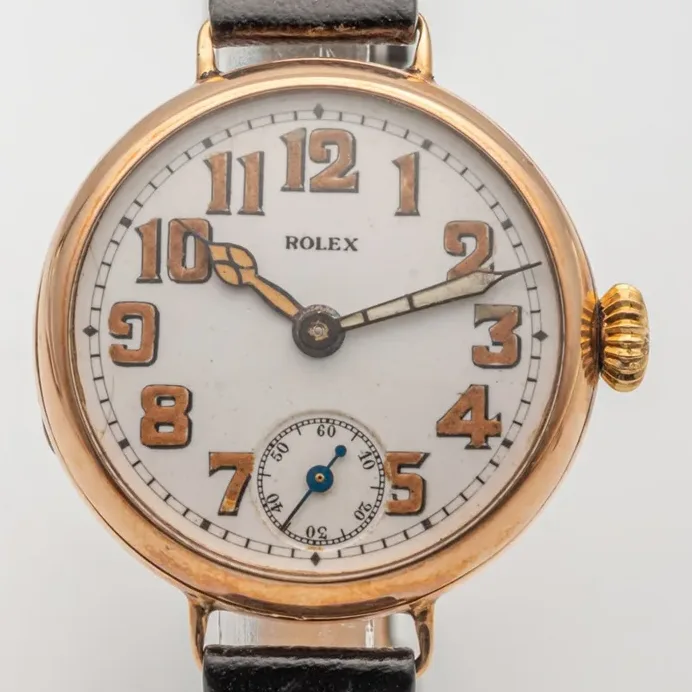
Round watches in the pocket-watch shape, with wire lugs soldered on for a leather strap, of the kind called the officer's or trench watch. Silver is the usual metal: by one estimate only about one in ten surviving Rolex officer's watches is gold. In the early war years, by one account, the movement and dial carried the Rolex name while the case back carried the W&D mark, though accounts differ on whether dials sold in Britain then bore any maker's name; a dual W&D and Rolex stamp appears in case backs from about 1917, though another account dates Rolex stamps beside the W&D mark from about 1913 to 1915. A 9 ct rose gold watch of 1919 has a white enamel dial with black Arabic numerals, a red twelve and subsidiary seconds, a movement signed Rolex with 15 jewels, and a case signed Rolex and W&D.
Signature and marks. Rolex on movement and dial on the watches so described; W&D in the case back at first, then both names, from about 1917 by one account or about 1913 to 1915 by another.
- soldered wire lugs
- case back stamped W&D
- white enamel dial with a red twelve
Round officer's watches of the early 1920s
The round case continued into the early 1920s with flatter case sides than the war-time watches and lugs made as part of the case, sometimes hinged, which cost more to make and are uncommon. A large gentleman's case of 1923 measures just under 35 mm. That watch, in gold, has a white enamel dial signed Rolex above the centre, blued gothic hands, a signed 15-jewel 13 ligne Rebberg movement and a case back reading Rolex, 7 World's Records, Gold Medal, Geneva Suisse, with no W&D mark. A Rolex-only case signature is unusual this early; a silver watch of 1922 is recorded with W&D alone. Enamel dials were giving way to painted ones, which replaced them in the Rolex range some five or six years after 1923. The Hunter calibre was introduced in 1923, and the Rebberg movements of that year are among the last.
Signature and marks. Rolex above the centre of the dial and Rolex, 15 Jewels, Swiss Made on the winding wheels; case back may read Rolex, 7 World's Records, Gold Medal, Geneva Suisse; W&D alone on a silver watch of 1922.
- hinged or integral lugs
- flatter case sides
- white enamel dial
- gothic-style blued hands
- 15 Jewels Swiss Made on the winding wheel
Early protective cases: screw-in and hermetic
In the 1920s, before the Oyster, Rolex made a limited run of watches in the Borgel screw-in case, described as the first Rolex case designed to protect the movement from some of the elements; Borgel cases were in Wilsdorf and Davis's hands earlier, though, as a W&D-stamped one-piece Borgel case hallmarked in 1910 or 1911 is recorded, on a watch that does not carry the Rolex name. In the Borgel system the movement is screwed in through the front of a one-piece case. Wilsdorf and Rolex later bought one of Borgel's case patents. Earlier still, a 34 mm 9 ct rose gold officer's watch of 1919 described as semi-hermetic has both the bezel and the case back screwing onto the body, with a signed 15-jewel movement and enamel dial. A further early design, which one account presents as Rolex's own while another gives it to an outside maker who also sold it to other brands, sealed an inner case inside an outer one with coin-edged screw-down caps; it also sealed in the winding crown, which had to be uncovered each day to wind, and did not last. The Oyster case of 1926 followed.
Signature and marks. Borgel stamped its cases inside with its mark, the initials FB over a small key. The 1919 semi-hermetic case is signed Rolex and W&D and marked 9k.
- FB and key inside the case
- bezel and case back that screw on
- coin-edged screw cap
Chronology
Specification
| Case | Mostly round, in silver or gold (9 ct among them); men's cases of 1919 and 1923 measure 34 mm and just under 35 mm; wire lugs soldered on in the war years |
| Dial | White enamel with black Arabic numerals, a red twelve and subsidiary seconds, signed Rolex above the centre; painted dials took over in the Rolex range by the end of the 1920s |
| Movement | Aegler Rebberg lever movement, 11 and 13 ligne recorded; 7-jewel and 15-jewel grades; the Hunter calibre from 1923 |
| Marks | W&D inside the case back, then W&D with Rolex (from about 1917 by one account, about 1913 to 1915 by another), and Rolex alone on some watches of the early 1920s |
| Water resistance | Not claimed for the plain cases; the Borgel screw-in case, a semi-hermetic case of 1919 and an early hermetic case gave some protection against dust and moisture |
Dial 3 described
Dials of the war years and early 1920s are white enamel; a watch of 1919 has black Arabic numerals, a red twelve, subsidiary seconds and the name Rolex above the centre. Many watches of the period carry a retailer's name instead, since it was close to twenty years after the name was registered before every dial bore it. Painted dials were the rule in the Rolex range by about the end of the 1920s.
Retailer's name on the dial
Because of British trade custom, a good many Wilsdorf and Davis and Rolex watches were dialled with the retailer's name instead of Rolex.
- retailer's name where Rolex would be
- W&D inside the case back
White enamel dial
A hard glazed surface that resists staining but may show hairline cracks. Black Arabic numerals, a red twelve and a subsidiary seconds dial; Rolex signed above the centre. Enamel was almost at an end in 1923.
- red twelve
- signature above the centre
- hairline cracks
Painted dial
Painted dials took over from enamel in the Rolex range some five or six years after 1923, so by the end of the 1920s.
Hands 1 described
Only one hand style is described.
Gothic-style blued steel hands
Found with the enamel-dialled officer's watch of 1923. Original blued hands that are free of corrosion are noted as a point of originality.
- gothic shape
- blued steel
Case and sizes 5 described
The cases are mostly round and made in silver or gold, with soldered wire lugs in the war years and lugs formed with the case, sometimes hinged, by the early 1920s. Gold was far scarcer than silver.
Wire-lug case
Pocket-watch shape with wire lugs soldered to the sides.
- soldered wire lugs
Flat-sided case with integral or hinged lugs
In the early 1920s the sides become flatter and the lugs are part of the design; hinged lugs are uncommon because they cost more to make. A large case of this kind, of 1923, measures just under 35 mm.
- hinged lugs
Borgel screw-in case
A one-piece case in which the movement screws in from the front, used by Rolex for a limited run in the 1920s by one account; a Wilsdorf and Davis watch in such a case, hallmarked 1910 or 1911, is recorded by another. The case maker registered its mark, FB over a small key, in 1887 and patented the screw-in system in 1891.
- FB and key stamp
Semi-hermetic case
Bezel and case back both screw onto the case body. Described on a 34 mm 9 ct rose gold watch of 1919 with a signed 15-jewel movement.
- screw bezel and back
Coin-edged hermetic case
Screw-down coin-edged caps closed an inner case within an outer case. The crown was sealed in, so the cap had to be unscrewed to wind the watch; the design was short-lived.
- coin-edged caps
Movement 3 described
Movements come from the Aegler factory at Bienne and are known by the name Rebberg. They are small lever movements; 11 and 13 ligne are recorded, the 13 ligne being the largest made for wristwatches at its time. One account holds that most movements before the late 1920s were unsigned; other accounts describe movements signed Rolex from the war years, and the evidence is not settled.
Rebberg lever movement
The word Rebberg was registered as a trademark by the Aegler firm on 21 January 1903, and Aegler's first lever calibres, designs for pocket watches, were registered four days later. The early Aegler lever movements are commonly called Rebberg movements, though Rebberg Déposé is also found on Aegler's cylinder movements. The period 1905 to 1923 is called the Rebberg years.
- Rebberg Déposé
7-jewel and 15-jewel grades
The Rebberg came in a standard 7-jewel grade, with broad Geneva stripes, and a 15-jewel grade with engine-turned plates and the winding wheel signed Rolex, 15 Jewels, Swiss Made. Winding wheels from the 7-jewel type are sometimes swapped for the signed 15-jewel type, so the plate finish should agree. One account also gives 17- and 18-jewel grades, with 17 jewels from about 1915, and Prima and Extra Prima adjustments.
- engine-turned plates on a 15-jewel
- winding wheel signature
Hunter calibre
Introduced in 1923, the year in which the Rebberg was ending; one account says it remained the flagship Rolex calibre until 1969.
Reference numbers
The numbers that belong to the line, with the listings on record under each, as its own page counts them. A number links to its own page, where the components of dated watches are set side by side.
| Number | What it is | Listings |
|---|---|---|
| 4430 | As sellers describe it, a silver watch of about 1925 with a black dial, called an early waterproof; two listings. | 3 |
| 1872 | As sellers describe it, a steel and gold-plated watch stated as circa 1920; two listings. | 2 |
| 309 | As sellers describe it, a 9 ct rose gold watch circa 1925. | |
| 2429 | As sellers describe it, a ladies' 9 ct pink gold watch stated as 1921; one listing. | 1 |
Originality
- Hands, crowns and dials should be checked for originality; correct parts of this age are very hard to find, so a changed part is seldom put right.
- The winding wheel of a 7-jewel Rebberg is sometimes replaced with a signed 15-jewel wheel; the plate finish shows the mismatch.
- Most surviving Rebberg movements are worn and often hold non-standard parts.
- Enamel dials often show hairline cracks.
Names
- Officer's watch. Round, wire-lugged watches of the First World War period and just after, so called from the officers who bought them.
- Trench watch. The same kind of watch, named for its use in the trenches of the First World War.
- Rebberg. The Aegler movement, taken from the vineyard district of Bienne where it was made.
Where accounts differ
Points on which the published literature and the library's own records do not agree, or on which the literature contradicts itself.
- Whether the movements were signed. One account states that Rolex movements of 1910 to the late 1920s were generally unsigned, with identification by case marks. Other accounts describe movements and dials signed Rolex from the early war years, a movement signed Rolex with 15 jewels in 1919, and a 15-jewel movement signed on the winding wheels in 1923.
- Aegler and the lever escapement. One history says Aegler made only cylinder movements before about 1902 and that its first lever calibres were registered in 1903. Another says its movements were noted for their lever escapements, which fits Wilsdorf's own later description of the firm.
- When the first order was placed. One history puts the large first order for movements in 1905; another has Wilsdorf negotiating the largest supply contract in 1908.
- Move to Geneva. Dates differ: an office at Bienne in 1915 or 1916, a move to Geneva in 1919, the incorporation of Rolex SA in 1919 or 1920.
- Aegler's Rolex name and the share purchase. Two accounts say the Aegler firm took a name including Rolex in 1914; another says it did so in 1919, when Rolex bought a share in it; another has the Aegler firm listed from 1916 under its Rebberg name joined with Final and Rolex, and has the two firms buying shares in each other in the 1920s.
- Makers' names on war-time dials. Pages here describe dials and movements signed Rolex in the early war years and a Rolex-signed enamel dial on a watch of 1919. Another account says watches of about 1917 to 1918 sold in Britain carried no maker's name on the dial, because British retailers would not accept one until the mid-1920s, and that a brand name engraved on a movement was unusual before the 1920s.
- Who designed the hermetic double case. One history describes the coin-edged case-in-case design as Rolex's own early attempt at a waterproof case. Another says the 1922 hermetic double case was patented and made by an outside maker, was used by other brands as well, and was not a Rolex invention.
- When Rolex joined W&D in the case back. One account sees a dual W&D and Rolex signature in case backs from about 1917. Another has the Rolex stamp brought progressively onto case backs from about 1913 to 1915. Another published account puts Rolex beneath the W&D mark from about 1910.
- When Rolex first used Borgel cases. Two accounts, following a published history of the firm, place Rolex's limited run in the Borgel screw-in case in the 1920s and call it the first Rolex case designed to protect against the elements. Another published account records a Borgel one-piece case with the W&D mark and London hallmarks for 1910 or 1911, on a watch that does not carry the Rolex name, as evidence that Wilsdorf was using Borgel cases well before the war.
- When Borgel devised the screw-in case. Most accounts give 1891 for the Borgel patent on the screw-in case. One account says Borgel invented the system in 1898 for pocket watches.
In the records
Counted from 764 listings at dealers and auction houses. These are what sellers state, not measurements, a stated year is often an estimate, and a count of listings is not a count of watches made.
Case metal
| Metal | Listings | Share |
|---|---|---|
| Gold, any colour | 414 | 67% |
| Pink | 31 | 5% |
| Yellow | 18 | 3% |
| White | 14 | 2% |
| Colour not stated | 351 | 57% |
| Silver | 179 | 29% |
| Steel | 15 | 2% |
| Gold plated, filled or capped | 7 | 1% |
| Plated | 4 | 1% |
| Rolled | 3 | under 1% |
| Platinum | 4 | 1% |
| Ceramic | 1 | under 1% |
As sellers state it. Shares are of the 620 listings that name a metal. A listing that says "gold" or "18K gold" names no colour: it is counted under "colour not stated", not as yellow gold. Carat, where a listing of gold gives one: 9k 232 · 18k 45 · 15k 8 · 14k 1.
Case size
| Size | Listings | Share |
|---|---|---|
| 25 mm | 50 | 12% |
| 26 mm | 45 | 10% |
| 34 mm | 39 | 9% |
| 28 mm | 32 | 7% |
| 29 mm | 29 | 7% |
| 27 mm | 25 | 6% |
| 32 mm | 22 | 5% |
| 33 mm | 20 | 5% |
| Other sizes | 171 | 39% |
As sellers state it. Shares are of the 433 listings that give a size. 2 more give a figure outside 12 to 56 mm, which is a strap, a box or a slip, and are left out.
Listings by decade the seller gives
| Decade | Listings |
|---|---|
| 1900s | 7 |
| 1910s | 272 |
| 1920s | 485 |