Dato-Compax
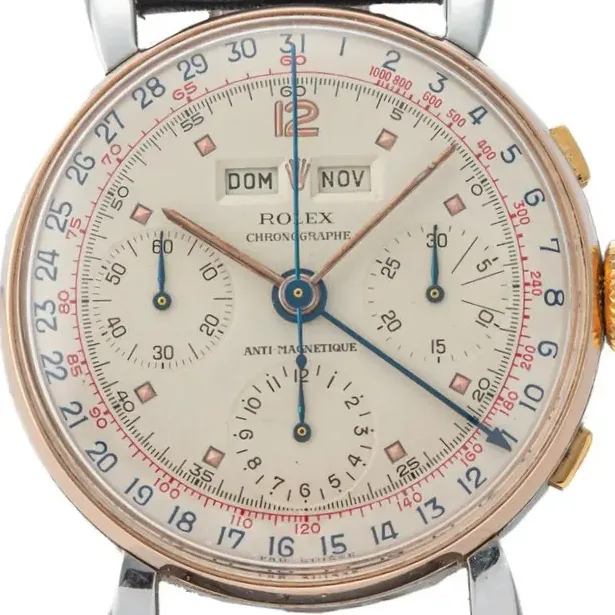
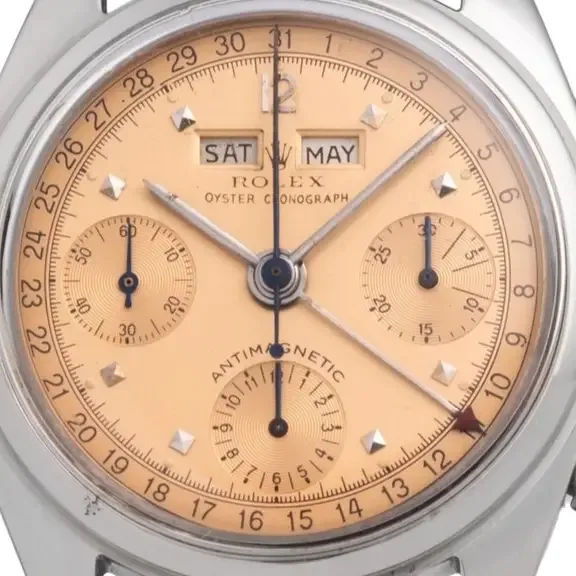
The Dato-Compax is Rolex's triple-calendar chronograph: a hand-wound, anti-magnetic watch with day and month in windows at twelve, three registers at three, six and nine, and the date pointed out by a central hand on an outer track. It was introduced in 1947 as the firm's first water-resistant chronograph with a full calendar and ran through five references, 4768, 4767, 5036, 6036 and 6236, until the 1960s. Collectors call them the Killy, after the French ski champion who became a Rolex ambassador, although the link between him and the watch is thin. Cases were made in steel, yellow gold and pink gold, and in steel with gold for the 4768; the size given is 36 mm. The dials are the main point of study.
This maker's early watches are described by kind of watch, not by reference number: many carry no number, and one number can cover quite different watches. The wider picture is in Early Rolex, 1905 to 1959.
- Made
- c. 1947–19641947 is given by several accounts for the first Oyster version, the 4767; one account starts the line in the mid-1940s and the 4768 is not dated. The end is given as 1964 for the last reference and as the early 1960s generally; another account compresses the whole line to about 1958 to 1962. The numbers made are unknown except for one reference.
- On record
- 165 listings2 of them give no reference
- Reference numbers
- 5 describedmany early watches carry none
Production by production 5 described
Reference 4768, non-Oyster case
Reference 4768 is the odd one of the five: it has a snap-back case with decorated lugs, not the screw-back Oyster, and a tachymeter scale. It is often left out of the Oyster Dato-Compax series, although it is counted among the five Killy references. Examples are shown in 18-carat yellow gold and in steel with gold; the library's records describe steel with pink or with yellow gold, with stated years of 1945 to 1948. Published accounts place the whole line from the mid-1940s but name the 4767 as the watch of 1947, and give no date for the 4768.
Signature and marks. No 'Oyster' on the dial, which the 4767 adds; sellers give the signature as 'Chronographe Antimagnetique'.
- snap-back case
- ornamental lugs
- tachymeter scale
- no Oyster printing on the dial
References: 4768
Reference 4767, the first Oyster Dato-Compax
Reference 4767 has a screw-back Oyster case and 'Oyster' added to the dial. In the first production the dial changes little apart from the tachymeter scale, and the outer scale of days is numbered continuously. The first production differs in the colour of the base under the outer day scale and usually in a more porous paint. Steel examples are shown, and the library's records also hold gold ones. One dial carries the name of the Venezuelan retailer Serpico y Laino. A dial examined in detail shows several stages of printing, in black and blue in different typefaces on different surfaces, and a round cut at seven o'clock through which a pink gold dot shows.
Signature and marks. 'Oyster' added to the dial; one dial signed by the retailer Serpico y Laino.
- Oyster printed on the dial
- porous early paint
- pink gold dot at seven o'clock
- continuous day numbering on the scale
References: 4767
Reference 5036, transitional
Reference 5036 sits between the 4767 and the 6036 and is called transitional because the printing of the old and the new dials overlaps on it. It is said to have been made for a short time, from 1948 to 1951, probably in few numbers. A pink gold example of 1950 with a dial signed twice, by Rolex and by the retailer Serpico y Laino, is recorded, restored by Rolex's own workshop in Geneva; sellers also describe a pink gold 5036 with a two-tone dial.
Signature and marks. Double signed with the retailer's name, Serpico y Laino, on the example described in the literature.
- double signature with the retailer's name on some
References: 5036
Reference 6036, mono-bloc Oyster
In the 6036 the Oyster case is still mono-bloc, with the upper part in one piece and a case back, so two parts in all. It was the third reference of the Oyster series and, in most accounts, the last before the three-piece 6236; one account calls it the last generation. About five hundred were made in steel, one hundred and seventy in yellow gold and one hundred and forty-four in pink gold. Dials include gold indices and gold hands on steel, steel indices and hands, engraved steel indices, and a red Italian day and date disc. Watches signed by Serpico y Laino are recorded in yellow gold, pink gold and steel; on one steel watch the name is at twelve and on one pink gold watch at six, and only three pink gold ones so signed are said to be known.
Signature and marks. On the pink gold example described the case back is engraved with the gold hallmark and the reference; sellers give the signature as 'Oyster Chronographe Anti-Magnetique' or 'Oyster Chronograph Anti-Magnetic'.
- case in two parts
- gold or steel indices
- blue date track
- retailer's name at twelve or six
References: 6036
Reference 6236, three-piece Oyster
Reference 6236 is the last in most accounts, with a three-piece 36 mm Oyster case that adds a separate bezel. The dial was redrawn: the date track has closed sixes and nines, and the coronet is in a newer style, as on the 6234 and early 6238. Hands are luminous. The number made is unknown. It was made in steel, yellow and pink gold and is the last Rolex to join a triple calendar to a chronograph. One account says the run lasted four years, another dates it from 1958 to 1964.
Signature and marks. Signed 'Rolex, Oyster Chronograph, Anti-magnetic' on an example of about 1958.
- separate bezel, three-piece case
- closed 6s on the date track
- new-style coronet
- paint on sides of indices matching the dial
References: 6236
Chronology
Specification
| Case | 36 mm; steel, 18-carat yellow gold or pink gold, and steel with gold on the 4768; Oyster case on four of the five references, a non-Oyster snap-back case on one |
| Movement | Hand-wound calibre 72C, 17 jewels, a modified Valjoux 72, with chronograph and triple calendar |
| Dial | Day and month in windows either side of the coronet at twelve; three registers at three, six and nine; date on the outer track in blue, pointed by a central hand |
| Chronograph | Thirty-minute and twelve-hour totalisers |
| Hands | Sword-shaped hour and minute hands with a luminous strip; central chronograph and date hands |
| Bracelet | A riveted expanding bracelet with 71 end links is recorded on one 6236 |
Dial 9 described
The dial is busy for a Rolex but easy to read. Day and month show in small rectangular windows beside the coronet at twelve, three registers with arabic numerals sit at three, six and nine, and the date is printed in blue on the outer track. Collectors read differences in print, paint, colour and indices.
Early 4767 dial
'Oyster' is added to the dial; in the first production the base under the outer day scale is a different colour and the paint is usually more porous.
- Oyster on dial
- porous paint
Layered printing and gold dot
One 4767 dial shows several printing stages in black and blue in different typefaces, and a pink gold dot under the dial at seven o'clock.
- dot at seven o'clock
Gold or steel indices and hands
Dials of the 6036 and 6236 are found with gold indices and hands, which were fashionable, and with steel indices and hands for a single-tone look; some 6036 have engraved steel indices.
- gold markers on steel case
- engraved steel indices
Closed sixes and nines and new coronet
On the 6236 the date track has closed sixes and nines and the coronet is a newer design, as on the 6234 and early 6238.
- closed 6s and 9s
31 or 1 above twelve
Many dials have the thirty-first at the top of the date track above twelve; some of the rarest have the first.
- 31 or 1 above twelve
Two-tone silvered dial
In the library's records sellers often describe two-tone or silvered dials, in steel and in gold watches; the literature does not describe them.
Black dial
A yellow gold watch with a black dial is called rarely seen; the reference is not given. A black dial is held to be among the most valuable variants.
- black dial
Retailer signature
Serpico y Laino, a Venezuelan retailer that closed in 1966, signed dials of the 4767, 5036 and 6036; the signature is at twelve on a steel 6036 and at six on a pink gold one. A 5036 is double signed.
- retailer name at twelve or six
Italian disc
A 6036 with the day and date disc printed in red in Italian.
- day and date disc printed in red in Italian
Luminous material 1 described
Lume appears on the hands and, on some watches, the hour markers.
Luminous hands
Hour and minute hands carry a luminous strip along the sword shape; those of the 6236 are luminous.
- lume strip on hands
Hands 2 described
A central hand points to the date, besides the central chronograph seconds.
Sword hands with luminous strip
The hour and minute hands are sword-shaped.
- sword hands
Steel or gold handset
Handsets match the indices, in gold or in steel.
- gold or steel hands
Subregisters 1 described
Three registers share the dial.
Three engine-turned registers
Three registers at three, six and nine, with arabic numerals and an engine-turned surface; two of them are the thirty-minute and twelve-hour totalisers.
- engine-turned registers
Bezel 1 described
The bezel grew over the years.
Separate bezel of the 6236
The 6236 has a separate bezel that makes the case three-piece; earlier Oyster cases are mono-bloc.
- separate bezel
Case and sizes 4 described
The size given is 36 mm. The case moves from a non-Oyster snap-back, through a mono-bloc Oyster, to a three-piece Oyster.
Snap-back case with fancy lugs
Reference 4768, without the Oyster screw-back.
- snap back
- fancy lugs
Screw-back Oyster
Reference 4767.
Mono-bloc Oyster, two parts
Reference 6036, with the upper part of the case in one piece plus a case back; on one pink gold watch the case back carries the hallmark and the reference.
- hallmark and reference engraved in the case back
Three-piece Oyster
Reference 6236, with a separate bezel.
Date 1 described
The triple calendar is the identity of the watch.
Central date hand with day and month windows
The date pointer runs around the outer track while day and month show at twelve.
- central date pointer
Movement 2 described
The literature names one calibre for the line.
Calibre 72C
A hand-wound movement with 17 jewels, a modified Valjoux 72; the one Rolex movement with a triple calendar.
United States patent
A US patent dated 8 April 1952 covers the movement and case design.
Bracelet and strap 1 described
Bracelets are seldom described.
Riveted expanding bracelet
A 6236 is described on an expanding riveted bracelet with 71 end links.
- riveted bracelet
Reference numbers
The numbers that belong to the line, with the listings on record under each, as its own page counts them. A number links to its own page, where the components of dated watches are set side by side.
| Number | What it is | Listings |
|---|---|---|
| 4768 | The non-Oyster snap-back version, often excluded from the Oyster series. | 18 |
| 4767 | The first Oyster version, from 1947. | 23 |
| 5036 | The transitional version, given as 1948 to 1951. | 3 |
| 6036 | The mono-bloc Oyster version. | 77 |
| 6236 | The three-piece Oyster version, the last. | 40 |


Originality
- An unrefinished dial is judged by clear printing, no corrosion and indices whose sides are covered with paint matching the dial, a sign that they have never been removed.
- Cases are judged by how full they are and how sharp their edges and hallmarks remain.
- Pink gold cases of the period oxidise with time, on the case sides and the backs of the lugs.
- Some watches have been restored and serviced by Rolex's own restoration workshop in Geneva, which supplies documents for the work.
Names
- Killy or Jean-Claude Killy. Named after the French skier who won three Olympic gold medals at the 1968 Winter Games and was a Rolex ambassador and board member for more than forty years. There is little photographic evidence of him wearing a Dato-Compax; he is said to have owned a 6236, and to have given his own watch to a friend as a wedding present.
- Dato-Compax. The name under which the line is usually described, as the Oyster Dato-Compax; one account says triple-calendar chronographs are only sometimes so called.
- Triple Crown. Used in one account for the watch, with its triple calendar, after Killy's three Alpine titles; another calls that link likely but does not show it.
Where accounts differ
Points on which the published literature and the library's own records do not agree, or on which the literature contradicts itself.
- Years of production. One account gives the five references as made from about 1958 to 1962, whereas other accounts date the first Oyster version to 1947, the 5036 to 1948 to 1951 and the 6236 to 1958 to 1964 or about four years. The library's records, by sellers' stated years, run from 1945 for the 4768 to 1965 for the 6036 and 1978 for the 6236.
- Killy's watch. Three accounts say there is almost no photograph of Killy wearing a Dato-Compax; two others say he owned a 6236, and another that he gave his to a friend. One of those accounts (cool finds) says instead that he used to wear a 6036, and another that he once wore one.
- How many references. Some accounts list five references as Killys; others count four Oyster ones and leave out the 4768, which has no Oyster case, and one account speaks of a series of four ending with the 6236.
- The last reference. Two accounts make the 6236 the last of the line; another (cool finds) calls the 6036 the last generation, after the 4767 and the 5036.
In the records
Counted from 165 listings at dealers and auction houses. These are what sellers state, not measurements, a stated year is often an estimate, and a count of listings is not a count of watches made.
Case metal
| Metal | Listings | Share |
|---|---|---|
| Steel | 86 | 58% |
| Gold, any colour | 57 | 39% |
| Yellow | 18 | 12% |
| Pink | 17 | 11% |
| Colour not stated | 22 | 15% |
| Steel and gold | 5 | 3% |
As sellers state it. Shares are of the 148 listings that name a metal. A listing that says "gold" or "18K gold" names no colour: it is counted under "colour not stated", not as yellow gold. Carat, where a listing of gold gives one: 18k 54.
Case size
| Size | Listings | Share |
|---|---|---|
| 36 mm | 66 | 68% |
| 35 mm | 18 | 19% |
| 37 mm | 8 | 8% |
| 34.4 mm | 2 | 2% |
| 36.5 mm | 1 | 1% |
| 37.5 mm | 1 | 1% |
| 39 mm | 1 | 1% |
As sellers state it. Shares are of the 97 listings that give a size.
Listings by decade the seller gives
| Decade | Listings |
|---|---|
| 1940s | 35 |
| 1950s | 92 |
| 1960s | 23 |
| 1970s | 1 |
1 more gives a year outside the years the line was made (1947 to 1964): a later watch sold under the name, or a slip. It is left out.