Marconi, Unicorn, Rolco and Rolex's other names
Before and alongside the Rolex name, Hans Wilsdorf registered a long run of other trade names for watches: Marconi Lever in 1911, Unicorn Lever in 1919, Rolco in 1927 and many more that were registered and never used; in 1928 he also formed a separate Oyster Watch company. Marconi and Rolco appear on dials and movements; Oyster Watch Co. appears chiefly inside case backs. Published accounts differ on whether these were cheaper alternatives, lines for other retailers and markets, or an experiment that ended with the firm consolidating under one name, and on how far a watch carrying one of the names counts as a Rolex. Collectors look first at the signature on the dial, the movement and the case back, who made the movement and the case, and whether a Rolex legend has been added to the dial since.
This maker's early watches are described by kind of watch, not by reference number: many carry no number, and one number can cover quite different watches. The wider picture is in Early Rolex, 1905 to 1959.
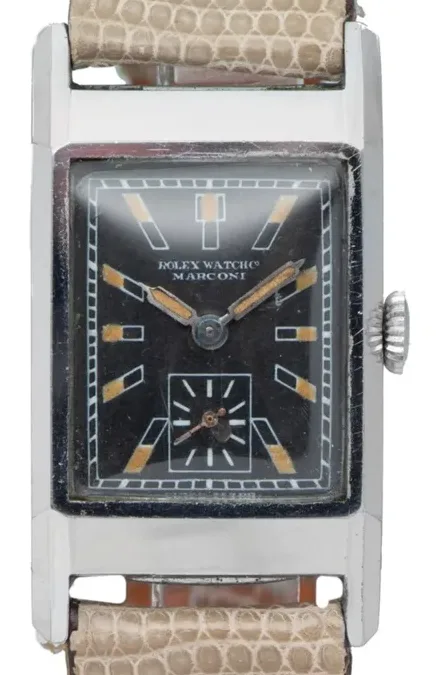
- Made
- c. 1911–19421911 is the year the Marconi Lever name was registered, and one published history puts the first use of the name on a watch in 1920; the Oyster Watch Co. name is said to have been dropped around 1941 or 1942, or at some point during the Second World War.
- On record
- 218 listings183 of them give no reference
- Reference numbers
- 3 describedmany early watches carry none
Production by production 5 described
Marconi (Marconi Lever and the later Marconi marks)
The first of the other names to be used for any length of time, taken from the wireless pioneer. Marconi Lever was registered on 24 January 1911; Marconi Prima, Standard, Special and Watch followed in 1923 and Marconi Verifiat in 1925, and Marconi Aqua is listed with no confirmed date. The name was kept apart from Rolex: the watches were sold outside the Rolex agents, through a small number of London jewellers and some overseas retailers such as Cuervo y Sobrinos in Havana, with movements mostly from Beguelin or the General Watch Co. rather than Aegler. Surviving Marconi watches include both wristwatches and pocket watches. The first use of the name on a watch is put at 1920, nine years after registration, yet a silver trench-style wristwatch with a London import hallmark for 1917 to 1918 has a movement engraved Marconi Lever; whether that case and movement began together is open to question. The end is placed at 1919, when the name is said to have given way to Unicorn, or in the 1930s; the reasons given are that it advertised the wireless company and that buyers saw the watches as Rolex watches with a different movement.
Signature and marks. Dial: MARCONI or a variant such as Marconi Lever, and no Rolex name. Movement: stamped or engraved MARCONI or Marconi Lever. Case back: sometimes RWC, sometimes a retailer's name, sometimes plain; on the 1917 to 1918 example a London import hallmark, the sponsor's mark of the importer and a doubtful W&D mark.
- Marconi name on the dial or the movement, and no Rolex name
- movement by the General Watch Co. or Beguelin, not Aegler
- RWC mark or W&D mark on the case back, treated with care
- a Rolex Marconi legend that sits slightly off the line of the numerals or looks fresh against an aged enamel dial
References: 336
Unicorn (Unicorn Lever and Unicorn Watch)
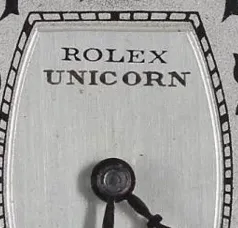
Unicorn Lever was registered in 1919. The name is said to have been entered as Unicorn Watch as well, because the common noun could not be registered on its own, though that form is also dated to 1923. It is described as the successor to Marconi and as the same idea: a lower-priced watch with a cheaper movement, not sold through the Rolex agents. Further use of the name in the early 1920s is also recorded, and the name was in time dropped; one date given is the 1930s. Not every watch signed Unicorn belongs to Wilsdorf's business, since the word was in use elsewhere in the trade. The literature describes no surviving example in detail. In the library's records the watches called Unicorn are mostly in 9 ct gold or silver, with others in steel or plated cases, and one movement is described by its seller as marked RWC Ltd Unicorn. The white gold chronograph nicknamed Unicorn is unrelated to this name, as are a few later watches to which sellers give the word.
Signature and marks. The literature does not say where the name is placed on the watch. One movement in the library's records is described by its seller as marked RWC Ltd Unicorn. An RWC mark shows who submitted a case for hallmarking and does not alone make a watch a Rolex.
- the Unicorn name on the movement or the watch
- RWC or R.W.C Ltd mark in a gold or silver case
- evidence tying the watch to Wilsdorf's business, since others used the word
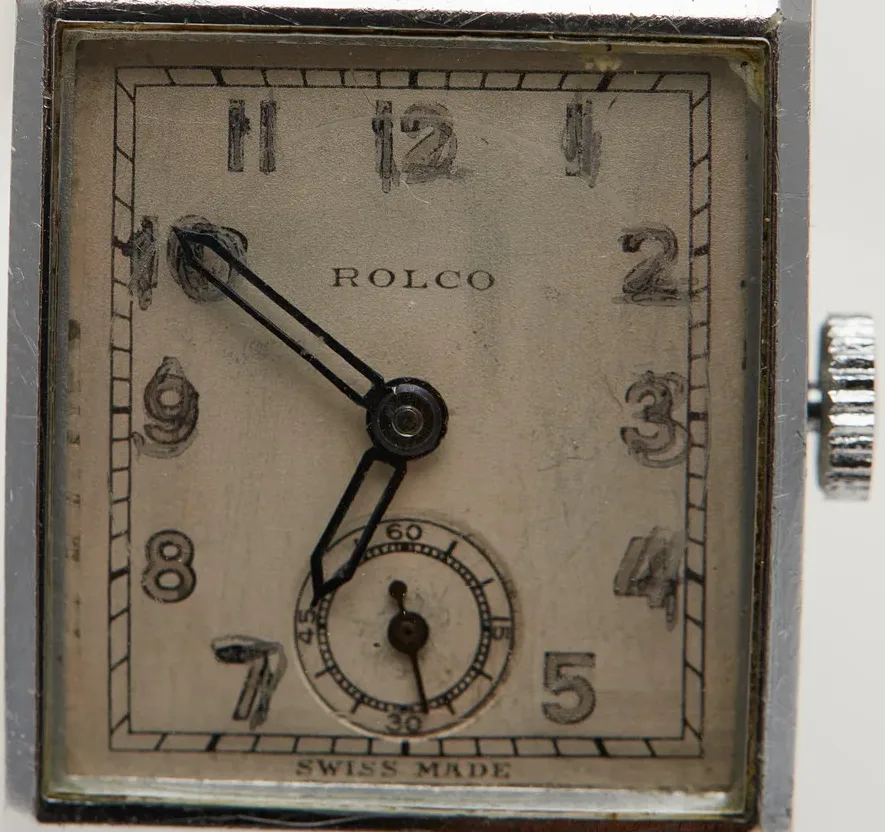


Rolco, a contraction of Rolex Company, was registered in London on 15 September 1927 with the number 65389. It appears fairly regularly on movements of the late 1920s and the 1930s, and on dials. Among the first examples are movements signed both Rolex Watch Co and Rolco on the bridge, with 15 Rubies and Swiss Made; only three or four others signed that way are known to the describer, all from late 1927 or 1928. A tonneau watch of 1928 of that kind has a hinged folding case, cathedral hands in blued steel, a serrated crown and a 9¾ ligne movement based on the Hunter calibre but with slightly different bridges. A large 9 ct pink gold cushion hallmarked at Glasgow in 1934 has a hard-glazed enamel dial signed Rolco, blued steel hands, an engine-turned case back signed R.W.C Ltd, and the mark of the case maker C. R. Spillmann & Cie of La Chaux-de-Fonds under the hallmarks. Its movement is a close relation of the Hunter, with Rolco on the winding wheel.
Signature and marks. Dial: Rolco above the centre. Movement: Rolco on the winding wheel with 15 Fifteen Jewels and Swiss Made on the bridge, or, on the first examples, Rolex Watch Co, Rolco, 15 Rubies, Swiss Made on the bridge. Case back: R.W.C Ltd in a cartouche, a stamp often used on gold Rolex cases between the wars, British hallmarks, a case maker's mark, and on the 1934 cushion the serial number 846852 and model reference 672 on the outside.
- Rolco signature on the dial and on the movement
- R.W.C Ltd cartouche and Glasgow hallmarks inside a gold case
- hard-glazed enamel dial on the cushion form
- Spillmann case maker's mark beneath the hallmarks
References: 672
Oyster Watch Co.
Montres Huître S.A., in English Oyster Watch Ltd, was formed in Geneva on 31 August 1928, with the right to use the Oyster waterproofing patents free of charge, and was legally a separate company from Rolex. Watches with Oyster Watch Co. on the movement or inside the case back usually have movements by a maker other than Aegler, often Fontainemelon, and some have cheap injection-moulded zinc-alloy cases; one example with an FHF 30 movement is marked unadjusted. Silver and gold Oyster Watch Co. cases carry the incuse RWCLTD mark, which is a sponsor's mark for hallmarking, not proof that the watch is a Rolex. A second group has dials marked Rolex Oyster and Aegler movements but Oyster Watch Co. inside the case back: at least three of reference 2416 with serial numbers consistent with the mid-1930s have been identified, and how this group came about is still under study. Most, if not all, of the cases in this group were made by a Geneva case maker, whose parachute and RM mark, and SAR under a seven-point crown, are often found. It is also said that most Rolex Oysters of 1932 to 1938 carry the Oyster Watch Co. stamp inside the back. The company did little but appear in trade directories, ceased to be active on 28 August 1940 and was struck from the Swiss register in December 1969; the name was dropped during the Second World War, when only Tudor was kept, or around 1941 or 1942.
Signature and marks. Inside the case back: Oyster Watch Co.; on the zinc-alloy example described, the Oyster patents listed and SAR under a coronet; RWCLTD in an incuse oval on silver and gold cases; the parachute and RM mark of a Geneva case maker where that firm made the case. Movement: the maker's own marks, for instance FHF, or Oyster Watch Co. on the movement.
- Oyster Watch Co. engraved inside the case back
- Fontainemelon or other non-Aegler movement
- RWCLTD sponsor's mark in an oval
- reference number stamped outside the back, such as 2416
- pitting of the zinc-alloy case back
References: 2416
The other registered names
Hans Wilsdorf, whose London firm Wilsdorf & Davis was founded in 1905, had a wide range of other names protected. A published list of the registrations runs from Elvira and Omigra in 1909 through Coronation Lever in 1911, Marguerite in 1912, Marukoni in 1913, a group of royal names in 1914 (King George Lever, Prince of Wales Lever, Crown Jewels Lever and wristlets named for Queen Alexandra and the Princess Royal), Calix Lever and Lexis in 1916, Brex Lever in 1919, Lonex, Genex, Falcon and Rolwatco in 1920, Hofex and Viceroy in 1921, and Admirality in 1922. Omigra was cancelled after four months. Rolexis is also put at 1920 and Rox at 1927. Only a few of the names were used on watches. Solar Aqua watches were sold in Canada through Eaton's and can show Rolex links in the case and its inside marks. A Genex watch is described as an octagonal Oyster of about 1934 with a 15-jewel movement signed Genex. Tudor, registered in 1926 in Wilsdorf's name, was the name that lasted: Wilsdorf took it over in 1936 and Montres Tudor S.A. was founded in 1946. Tudor watches could be sold through Rolex's agents, and some of the earliest, sent almost entirely to Australia, carried Rolex Watch Co. Ltd under the Tudor name.
Signature and marks. Whatever the individual name is: usually the name alone on the dial, with Rolex marks, if any, on the case back or movement.
- a rare name on the dial, with the case and movement checked against each other
- Rolex-related marks inside the back
Chronology
Specification
| Names registered | Marconi (Lever, Prima, Standard, Special, Watch, Verifiat), Unicorn (Lever, Watch), Rolco, Oyster Watch, Rolwatco, Rolexis, Rox, Genex, Lonex, Falcon, Hofex, Viceroy and others |
| Cases | Round, rectangular, cushion and tonneau forms; in the library's records 9 ct pink gold, silver, steel and gold filled; some Oyster Watch Co. cases in injection-moulded zinc alloy |
| Dial | Usually the other name alone, with no Rolex name; enamel on the Marconi Lever and Rolco examples described, while by the mid-1930s Rolex dials were almost all painted |
| Movements | Marconi and Oyster Watch Co. watches with bought-in Swiss movements (General Watch Co., Beguelin, Fontainemelon) rather than Aegler; Rolco movements based on or close to the Hunter calibre; 15 jewels is the figure most often given; some signed with the other name |
| Case-back marks | RWC or R.W.C Ltd cartouche, W&D mark, SAR under a crown, Oyster Watch Co. inside the back, case makers' marks, British import or assay hallmarks |
| Retail | Marconi through a small number of London jewellers and some overseas retailers, outside the Rolex agents; Solar Aqua through the Canadian department store Eaton's |
Dial 3 described
On the Marconi and Rolco dials described, the other name stands alone. One account holds that British retailers would not take makers' names on dials until the mid-1920s, so that watches of about 1917 to 1918 sold in Britain carry none; accounts differ, since Rolex-signed dials of the war years are also described. The Marconi Lever and the 1934 Rolco cushion described have enamel dials; by the mid-1930s Rolex dials were almost all painted. Later additions of a Rolex legend are a known problem.
Brand name alone, no Rolex name
Marconi dials are described as deliberately free of the Rolex name, and the same is said of the other names in general.
- Marconi, Unicorn or Rolco across the upper dial
- no Rolex name
Hard-glazed enamel with Rolco
A large gold cushion of 1934 has a white hard-glazed enamel dial with double minute track, large Arabic numerals and Swiss Made at the foot, with Rolco above the centre. Enamel keeps its appearance well but cracks on impact; this style recalls the First World War officers' watches.
- Rolco above the centre
- double minute track
- large Arabic numerals
- Swiss Made at the foot
Rolex Marconi legend added later
Watches turn up with Rolex Marconi on the dial. On one examined enamel dial the legend had been painted on long after the dial was made, sitting off the horizontal and blacker and crisper than the fired numerals. Many such watches offered online were old parts with the name added. Real Rolex Marconi watches of the 1920s are also said to exist, so whether such a legend can ever be original is disputed.
- legend on the surface of the enamel, not fired in
- legend crisper than the aged hands and lume
- legend not level with the numerals
Case and sizes 3 described
Rolex did not make its own cases. The Oyster Watch Co. name is chiefly a case-back mark. Gold and silver cases carry the RWC sponsor's mark and British hallmarks; cases are said to have been assayed in London before 1920 and, between the wars, in Glasgow almost exclusively, though accounts differ for gold watches of the 1930s, which another account finds mostly in cases made in Britain.
RWC and R.W.C Ltd sponsor's mark
RWC in an oval or cartouche is a sponsor's mark registered with a British assay office and struck before hallmarking. It shows that the Rolex Watch Company took responsibility for submitting the case; it appears on silver and gold Oyster Watch Co. cases and does not alone identify a Rolex. A W&D mark is a Wilsdorf and Davis sponsor's mark and is found on many non-Rolex watches; on one Marconi Lever case it appears to be an engraved copy added later.
- incuse RWCLTD in an oval
- R.W.C Ltd cartouche on an engine-turned back
Oyster Watch Co. case back
Oyster Watch Co. marked inside the back; the zinc-alloy example described also lists the Oyster patents and carries SAR under a coronet. Cases of the Rolex Oyster group were made by a Geneva case maker, whose parachute and RM mark is found, and which was registered as number 10 under the Geneva-key poinçon de maître no. 5. A zinc alloy called Snowite corrodes heavily; later Snowite fronts have steel backs. The third batch of reference 3646, from 1942, returns to the usual Rolex case-back engravings, one marker for when the mark stopped.
- Oyster Watch Co. inside the back
- RM parachute mark
- SAR under a seven-point crown
Spillmann gold cushion
A 9 ct pink gold cushion case with wire lugs, a deep snap-on back and integrated body and bezel, case maker C. R. Spillmann & Cie of La Chaux-de-Fonds, Glasgow hallmark for 1934. The style was already dated when new.
- wire lugs
- snap-on back
- maker's mark under the hallmarks
Movement 3 described
These watches were assembled from bought-in Swiss movements. For Marconi, Unicorn and Oyster Watch Co. watches the movement maker is often the only difference from a Rolex: Aegler for Rolex, others for the second names. The Rolco movements described are close to the Rolex Hunter.
Marconi Lever movement (General Watch Co.)
A split-plate lever movement with 15 jewels, plain balance and blued spring, not temperature compensated, made by the General Watch Co. of Bienne and engraved Marconi Lever. One account says engraving a brand name on a movement was unusual before the 1920s, though others describe Rolex-signed movements from the war years, so whether that example's case and movement began together is open to question.
- Marconi Lever engraved on the movement
- General Watch Co. origin
Rolco movements
Hunter-based or Hunter-like manual movements of 15 jewels, signed Rolco on the winding wheel or bridge. The earliest are signed Rolex Watch Co, Rolco, 15 Rubies, Swiss Made. One 1934 example is not the Hunter itself, though its architecture is almost identical.
- Rolco on winding wheel or bridge
- 15 jewels, Swiss Made
Fontainemelon FHF 30 in Oyster Watch Co. watches
A 10½ ligne, 15-jewel movement at 18,000 vibrations an hour with a straight-line lever, marked FHF and, on the example described in the literature, unadjusted. The same movement was used as the Tudor calibre 59. The Oyster Watch Co. watches described mostly date from the 1930s.
- FHF trademark on the bottom plate
- unadjusted marking
Reference numbers
The numbers that belong to the line, with the listings on record under each, as its own page counts them. A number links to its own page, where the components of dated watches are set side by side.
| Number | What it is | Listings |
|---|---|---|
| 336 | The literature does not describe the number. | 1 |
| 672 | Given on the outside of the case back of the 1934 gold Rolco cushion, with the serial number 846852. | |
| 2416 | Stamped outside the back of Rolex Oyster watches whose cases are marked Oyster Watch Co. inside; at least three with mid-1930s serials are recorded. | 13 |
Originality
- A Rolex or Rolex Marconi legend on an enamel dial may have been painted on later, so the dial is the first thing to examine under a lens.
- A watch whose movement, case and dial belong to different makers may be a marriage; for example the movement of a Marconi Lever may be a few years later than a hallmarked 1917 to 1918 case.
- On the 1928 Rolco tonneau, cathedral hands in blued steel and a serrated crown, a flattened form of the onion crown, are given as correct; replaced hands or crown, a refinished dial or a case not matched to the movement lower an early watch markedly.
- A W&D mark can be engraved onto a case afterwards to suggest a Rolex origin, so a clean punched strike is more convincing than a shallow or crooked engraving.
- A seller's wording such as Rolex-related is not the same as Rolex; the dial, movement and case marks should all tell the same story.
- A Rolex signature can be added to a dial, a movement put in another case, or a period case matched to a movement that was not its own; the dial, movement and case should belong together.
Names
- Marconi. Named after the wireless inventor; the name registered for Wilsdorf's first long-lived second line.
- Unicorn. The early trade name Unicorn Lever. The same word is the nickname of a white gold Daytona reference 6265, a chronograph made in 1970 with no connection to the early name.
- Rolco. A contraction of Rolex Company.
- Rolwatco. Read as a contraction of Rolex Watch Company; dated to 1920.
- Rolexis. A variant on the Rolex name registered in 1920.
Where accounts differ
Points on which the published literature and the library's own records do not agree, or on which the literature contradicts itself.
- Whether Marconi was dearer or cheaper than Rolex. One account describes Marconi as a premium dress line at the dearer end of the market, sold to a more exclusive clientele. Another says Marconi watches were meant to sell below Rolex, and a third says the cheaper brand sold at the expense of the dearer one, while also calling Marconi watches 'basically the much more expensive Rolex watches' with a different movement.
- When Marconi began and ended, and whether Unicorn replaced it. The registration is dated 24 January 1911. One account gives 1920 for first use on a watch, and describes a case hallmarked 1917 to 1918 with a Marconi Lever movement that may not be original to it. Two others say Marconi was renamed Unicorn in 1919, but one of those accounts also lists Marconi registrations in 1923 and 1925 and has the name retired in the 1930s.
- Whether a Rolex Marconi dial can be original. One account says the Rolex name does not appear on the dial of a genuine Marconi. Another shows a Rolex Marconi dial legend as a recent addition and thinks such legends are probably all later. Another says some real Rolex Marconi watches of the 1920s exist, while many were assembled from old parts.
- How common the Oyster Watch Co. mark is in Rolex Oysters. One account says the earliest Rolex Oysters are marked Rolex Oyster inside the back and treats Rolex Oysters in Oyster Watch Co. cases as a puzzling group, at least three of reference 2416 so far. Another says most Rolex Oysters made from 1932 to 1938 carry the Oyster Watch Co. stamp inside the case back.
- When the Oyster Watch Co. mark ended. One account says Rolex abandoned the name around 1941 or 1942, and that the third batch of reference 3646, of 1942, has the usual Rolex engravings. Another says it was dropped before or during the Second World War, when all names but Tudor were dropped, and that the company ceased to be active on 28 August 1940.
- Whether Oyster Watch Co. watches were a separate cheaper line. One account first held that Oyster Watch Co. watches were a distinct, cheaper product from the Rolex Oyster, a view it also attributes to a published history of the firm; it now reports genuine Rolex Oyster watches with Aegler movements in Oyster Watch Co. cases, and says the question is still under study.
- Year the Oyster was launched. Two accounts give 1926 for the Oyster; another speaks of its launch in 1927. The Oyster Watch company followed in 1928.
- Year the Rolex name was registered. One account says Wilsdorf registered Rolex as a trade mark in 1908; another says the name was patented on 15 November 1915, four years after Marconi Lever.
- How scarce Unicorn is, and when the names ended. One account says Unicorn watches are largely unknown and very few survive, and that the names were discontinued in the 1930s. Watches sold as Unicorn are fairly common in the library's records, and the years sellers state for them fall mostly between the late 1920s and the late 1930s.
- Makers' names on dials and movements before the mid-1920s. One account says watches of about 1917 to 1918 sold in Britain carried no maker's name on the dial, because British retailers would not accept one until the mid-1920s, and that a brand name engraved on a movement was unusual before the 1920s. Another describes movements and dials signed Rolex in the early war years, and a third a Rolex-signed enamel dial and movement on a watch of 1919.
- Where gold cases sold in Britain were made and hallmarked. One account says Rolex cases were mostly assayed in London before 1920 and almost only in Glasgow between the wars. Another account says gold Rolex watches sold in Britain in the 1930s and 1940s are almost always in cases made by Dennison of Birmingham, to avoid import duty and, in the war years, a ban on bringing gold into the country.
- When Unicorn Watch was registered. Two accounts say that in 1919 the name had to be listed as both Unicorn Lever and Unicorn Watch. Another gives 17 March 1919 for Unicorn Lever and 20 November 1923 for Unicorn Watch, and finds no registration of the single word Unicorn.
In the records
Counted from 218 listings at dealers and auction houses. These are what sellers state, not measurements, a stated year is often an estimate, and a count of listings is not a count of watches made.
Kind of object
| Kind | Listings |
|---|---|
| Wristwatches | 216 |
| Clocks | 2 |
Case metal
| Metal | Listings | Share |
|---|---|---|
| Gold, any colour | 84 | 55% |
| Yellow | 7 | 5% |
| Pink | 5 | 3% |
| White | 3 | 2% |
| Colour not stated | 69 | 45% |
| Steel | 32 | 21% |
| Silver | 28 | 18% |
| Gold plated, filled or capped | 7 | 5% |
| Rolled | 3 | 2% |
| Plated | 2 | 1% |
| Filled | 2 | 1% |
| Base metal | 1 | 1% |
| Platinum | 1 | 1% |
As sellers state it. Shares are of the 153 listings that name a metal. A listing that says "gold" or "18K gold" names no colour: it is counted under "colour not stated", not as yellow gold. Carat, where a listing of gold gives one: 9k 58 · 14k 1.
Case size
| Size | Listings | Share |
|---|---|---|
| 25 mm | 13 | 13% |
| 21 mm | 9 | 9% |
| 26 mm | 8 | 8% |
| 32 mm | 8 | 8% |
| 30 mm | 6 | 6% |
| 31 mm | 6 | 6% |
| 24 mm | 5 | 5% |
| 28 mm | 5 | 5% |
| Other sizes | 43 | 42% |
As sellers state it. Shares are of the 103 listings that give a size.
Listings by decade the seller gives
| Decade | Listings |
|---|---|
| 1920s | 13 |
| 1930s | 33 |
| 1940s | 6 |
1 more gives a year outside the years the line was made (1911 to 1942): a later watch sold under the name, or a slip. It is left out.