Bubbleback
The bubbleback is the name collectors give to Rolex's first self-winding Oyster wristwatches, whose backs bulge outward to make room for the thick rotor movement. The watches are usually said to have been launched in 1933 and made for roughly twenty years, to the mid-1950s; one account stretches the run from the late 1920s to the early 1960s. Rolex never used the word on the watches. The line covers dozens of references in steel, gold and two-tone, with an enormous range of dials. The ordinary men's size is about 32 mm. A larger 36 mm family, the ovettone or big bubbleback, followed in the 1940s and carried the first Datejusts and the early Explorer prototypes. Collectors look first at the dial, the case and the match between movement and reference.
This maker's early watches are described by kind of watch, not by reference number: many carry no number, and one number can cover quite different watches. The wider picture is in Early Rolex, 1905 to 1959.
- Made
- c. 1933–1955Most accounts start the line in 1933, but one has the first bubbleback launched in 1931 and another speaks of the late 1920s; the end is put at 1955 or the mid-1950s in two accounts and in the early 1960s in a third, and the library's records include watches described as bubblebacks with stated years into the 1960s.
- On record
- 1,378 listings202 of them give no reference
- Reference numbers
- 21 describedmany early watches carry none
Production by production 10 described
First bubblebacks, reference 1858 and early three-piece cases
The first reference of the line was the 1858, powered by calibre 520; the early bubblebacks had cases of three pieces. It was the first Oyster to carry the Perpetual rotor: the movement was thicker than the hand-wound calibres before it, and Rolex domed the back of the case rather than make the whole watch bigger. The original model had subsidiary seconds; sweep seconds followed in later models. Reference 2940 is also placed in the first years of the run in one account.
Signature and marks. Some first-generation watches have a movement with the watchmaker's dismantling instructions written on it in French and English; no other signature of this generation is given.
- strongly domed case back
- three-piece case
- subsidiary seconds on the earliest watches
- dismantling instructions in French and English on some movements
Two-piece case, references 3131 and 3132
A case made in two pieces came in with references 3131 and 3132, the first of the line to leave the three-piece construction; one account dates this to 1936, while another places the introduction of the 3131 in the 1940s. The 3131 is a 32 mm watch with a smooth fixed bezel, a domed acrylic crystal and hours, minutes and running seconds. It was made in yellow or rose gold of 9, 14 or 18 carat, on a leather strap or a metal bracelet. Dials and hands vary widely.
- 32 mm case
- smooth gold bezel
- two-piece case
Steel centre-seconds chronometer, reference 2940
Reference 2940 is a stainless-steel bubbleback. Two examples, dated 1945 and 1946, are 32 mm with centre sweep seconds and carry calibre 630 with a Super Balance and seventeen jewels, a black dial with white arabic numerals at the quarters, luminous blued-steel hands and a dial signed Rolex Oyster Perpetual Chronometer; the later one has a red seconds hand. A steel watch of the mid-1940s with a military-style dial and radium on the hands and dial is also described, and is thought likely to be a 2940. One account places the 2940 among the first references of 1933 and 1934, a decade before the described examples.
Signature and marks. Case signed 'Brevetee, Rolex SA, Geneve-Suisse, 31 Victoires, Haute Precision' with the reference, and numbered between the lugs; movement signed 'Rolex Perpetual Chronometer, Swiss Made, Super Balance'.
- black dial with white arabic quarter numerals
- centre sweep seconds
- luminous blued-steel hands
- case signed 31 Victoires
References: 2940
Ladies' bubbleback
A ladies' version was launched in 1941 with calibre 420. Rolex had by then begun to offer the bubbleback in three sizes, to appeal to both men and women. Published accounts give nothing more about the ladies' watches.
Hooded bubbleback
In the hooded bubbleback a separate pressed-metal piece fills the space between the lugs, closing in the front of the watch. The hoods were finished smooth (reference 3065), ribbed, engine-turned or with vertical lines, and scalloped on 3801; the watches were made in steel and in yellow and rose gold (3159 is given as an example), and some have gold hoods on a steel case. A 3599 of 1942 has a wide flat cylindrical bezel in place of the usual bevelled one, 32 mm, with a white dial and closed minute track; that example has gold-striped hoods, where the 3599 is normally all steel. The lugs are rounder and end more abruptly than on later Oysters. One account treats the hooded case as pre-war and of the 1930s and 1940s and says it was dropped in the late 1940s; another says it was designed in the 1940s and soon stopped when it failed to revive sales. They are said to have been made mostly for the United States, though the 3599 described is called a European model.
Signature and marks. On the 3599 described, the movement, case back and dial are signed; the wording is not given.
- hoods filling the space between the lugs
- rounded club-like lugs
- flat wide bezel on 3599
First ovettone, the 5020 series (references 5026 and 5028)
The 5020 series made the case larger: 36 mm against the 32 or 33 mm usual in the 1940s, with a 19 mm lug width, a monobloc case, a pressure-fit crystal and the ordinary bubbleback crown and tube. Reference 5028 is time-only with centre seconds; reference 5026 has seconds in a register in the lower half of the dial. They were sold on straps or on bracelets with straight end pieces, since flush end pieces came only in the early 1950s. The name ovettone, Italian for big egg, describes the deep back and tall domed crystal together. Accounts date the start to the mid-1940s or to the late 1940s. Some 5026 dials have applied arabic numerals and some 5028 dials radium arabic numerals.
- 36 mm monobloc case
- 19 mm lugs
- radium arabic numerals on some dials
- centre seconds on 5028, small seconds on 5026
Datejust ovettone, reference 4467
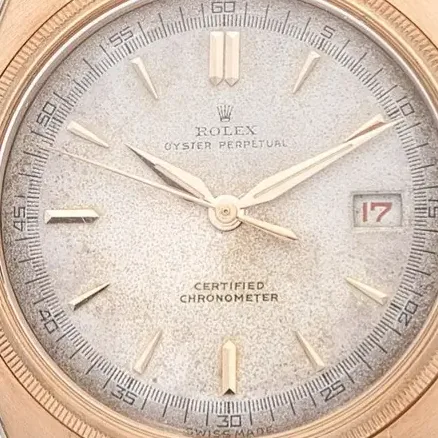
Reference 4467 marked Rolex's fortieth anniversary: a 36 mm 18-carat yellow gold Oyster with a coin-edge fluted bezel, a date window at three o'clock without a magnifier, and the first five-piece Jubilee bracelet. Its calibre, given as 710 in one account and as A295 or 740 in others, was large enough to need the deeper ovettone back. It began as an edition of one hundred, some sold with a Geneva newspaper and numbered between the lugs, then went into ordinary production; around one thousand were made. The dial described is off-white, gold dagger markers with radium dots and gold alpha hands. The dial reads 'Chronometre' above six and not 'Datejust'; later 4467 dials read 'Certified Chronometer' there. Water resistance was 100 metres. Variants include a left-handed model with the crown at nine, a black dial in rose gold with red figures in a white date window, and dials without lume.
Signature and marks. Dial printed Rolex and Oyster Perpetual below twelve with a coronet and 'Chronometre' above six; edition numbers between the lugs on the earliest watches.
- black date print on the earliest dials, then white window with red print from 1945 to 1947
- radium dots and gold dagger markers
- coin-edge fluted bezel
- no 'Datejust' on the dial
References: 4467
Transitional Datejust ovettone, references 5030 and 5031
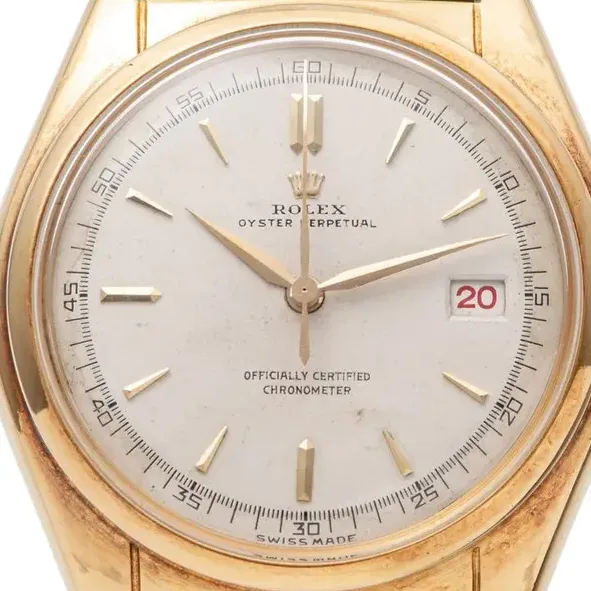
References 5030 and 5031 kept the 4467 look and the ovettone back, but added a gold-and-steel Rolesor version and an all-steel one. The 5030 has a smooth bezel and the 5031 an engine-turned bezel; otherwise they are the same. White and black dials were standard, mostly with a roulette date wheel of black and red numerals. Three different coronets are seen, short or tall. A published 5030 in 36 mm yellow gold has the squared-off space between the lugs and the old 'Rolex Oyster' crown of earlier bubblebacks, and a Jubilee bracelet whose end links are not flush with the case. These are the first references on which some dials carry the word Datejust. The 5030 described has a matte cream-white dial, polished alpha hands and an early triangular marker at twelve.
Signature and marks. Crown signed Rolex Oyster on the example described in the literature; three forms of coronet, short or tall, are recorded on these references; some dials printed Datejust.
- smooth bezel on 5030, engine-turned on 5031
- roulette date wheel
- squared space between the lugs
Second ovettone series, reference 6098, and the 34 mm reference 6106
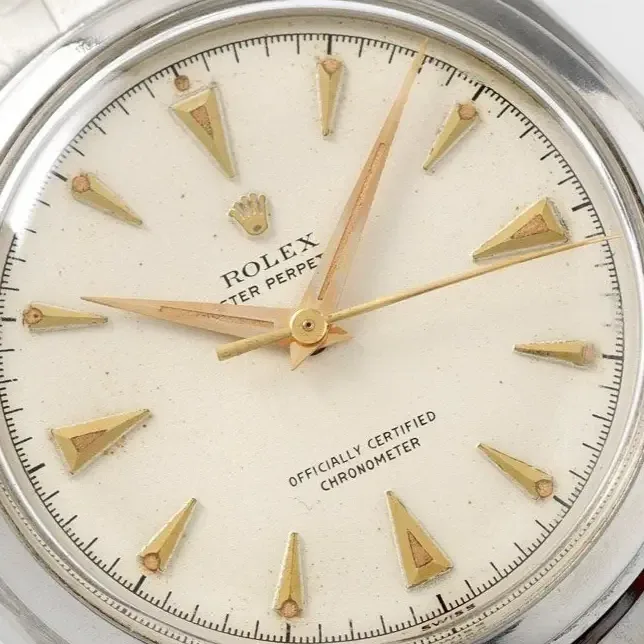
The second ovettone series began in 1950 with reference 6098, again a monobloc case, with the newly designed Super Oyster crown and calibre A296. That crown was pushed in rather than screwed down and proved prone to leaks. Dials have a closed minute track, applied arrow hour markers and an applied coronet, and collectors call them Everest dials. Rolex supplied twenty 6098 watches to the British climbers of 1952 and 1953, seven in 1952 to the research party and thirteen to the rest of the expedition; the watches were chronometer-rated. Reference 6106 is a separate big bubbleback of 34 mm, which the literature does not place in either ovettone series; the example described in the literature has a Super Oyster crown, a riveted bracelet with spring-loaded links, a radium dial with a red 'Officially' line, and a serial number and chronometer certificate of 1952.
Signature and marks. Super Oyster crown; at least one expedition watch has an engraved case back.
- Super Oyster push-in crown
- applied arrow markers and coronet
- radium dial
Three-piece ovettone, references 6298, 6150 and 6350
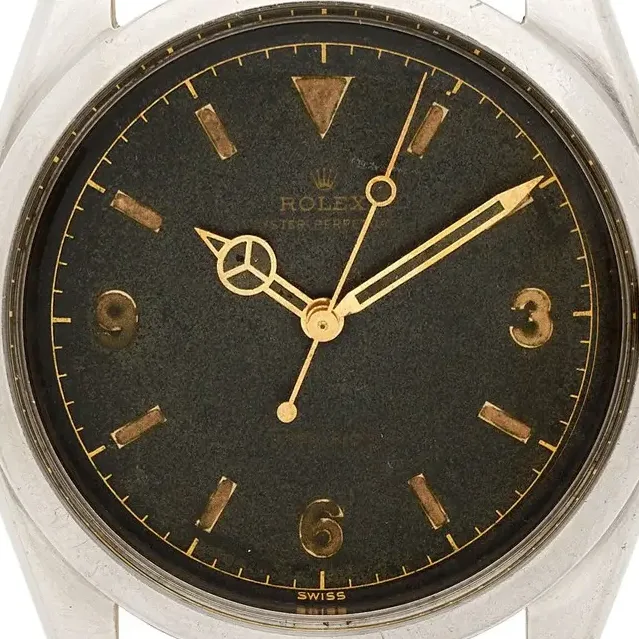
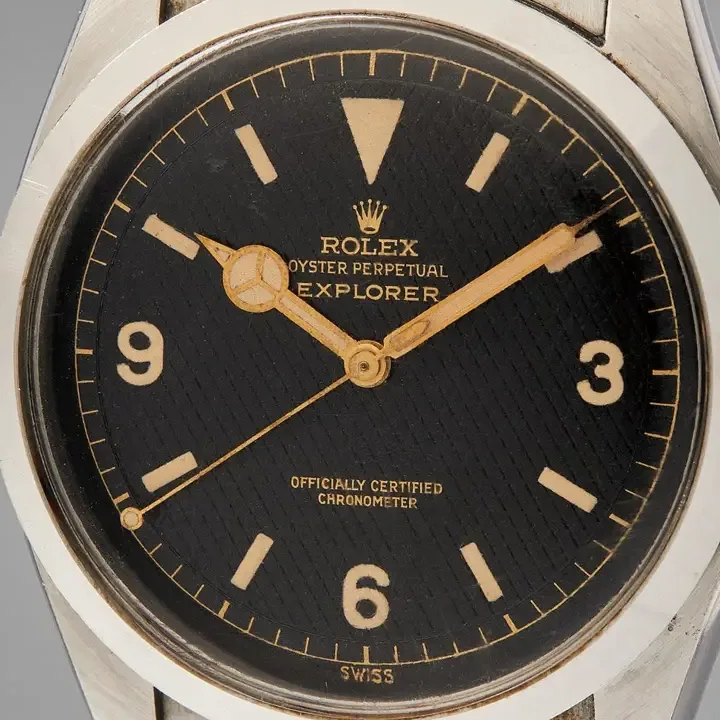
Reference 6298 followed the 6098 in 1953 with a three-piece case: the bezel was now a separate part which held a tropic crystal onto the middle case and made a watertight seal. A new 6 mm 'brevet +' screw-down crown replaced the leaky Super Oyster crown. The A296 movement and the large domed back stayed. The 6298 and 6098 share the Everest dial. References 6150 and 6350, their successors in one account (another has the 6150 made beside the 6098 in 1952), kept the A296 and the three-piece case, and with them Rolex officially brought in the black 3-6-9 dial, which had been used before, with an inverted triangle at twelve, painted numerals and, by one account, Mercedes hands (some had pencil hands); another account says Mercedes hands came only with the 6610. The 6150 was marked Precision and the 6350 was chronometer-rated; the 6350 was the first to carry the word Explorer. A honeycomb dial is recorded as very rare.
Signature and marks. 'Brevet +' crown; the 6150 dial reads Precision, the 6350 dial reads Officially Certified Chronometer and Explorer.
- 6 mm screw-down crown
- tropic crystal
- black 3-6-9 dial on 6150 and 6350
Chronology
Specification
| Case | Oyster case with a markedly domed back; usually 30 to 32 mm for men's watches, up to 34 mm in some, and 36 mm in the larger ovettone family; steel, gold in yellow, rose and sometimes white, and steel with gold; early cases in three pieces, from 1936 in two |
| Crystal | Domed acrylic; pressure-fit in the 36 mm monobloc cases |
| Bezel | Smooth, engine-turned or coin-edged |
| Movement | Self-winding with a rotor that winds in both directions, built on Aegler movements of the Hunter type with a winding module added; early calibre 520, then calibres such as 9 3/4 ligne, 10 1/2 ligne and 630 and, in the large watches, A296 and 710 |
| Crown | Large early Oyster crown, later the Super Oyster crown and, from 1953 in the large watches, a 6 mm screw-down crown |
| Bracelet | Riveted bracelets with parallel sides were made for bubblebacks in the 1930s and 1940s; before the early 1950s bracelets had straight end pieces, and flush-fitting end pieces came after; many watches were sold on leather straps |
| Dial | Very varied: arabic, roman, California, sector, honeycomb, black gilt, two-tone and 24-hour styles |
| Lume | Radium on watches of the 1940s and early 1950s |
Dial 7 described
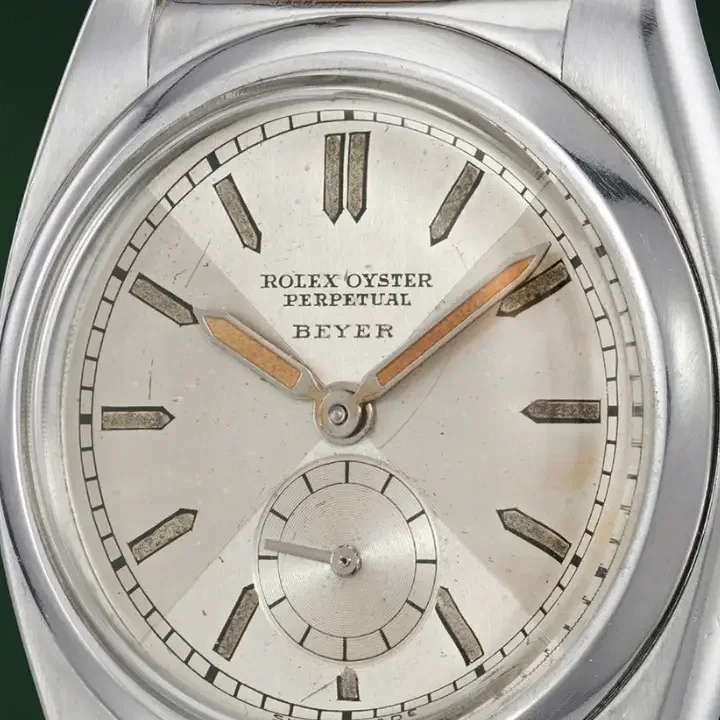
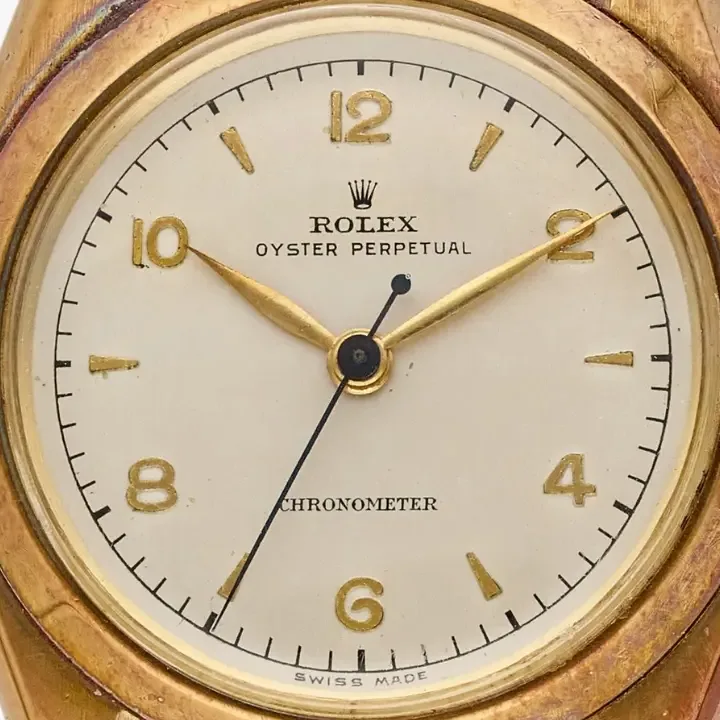
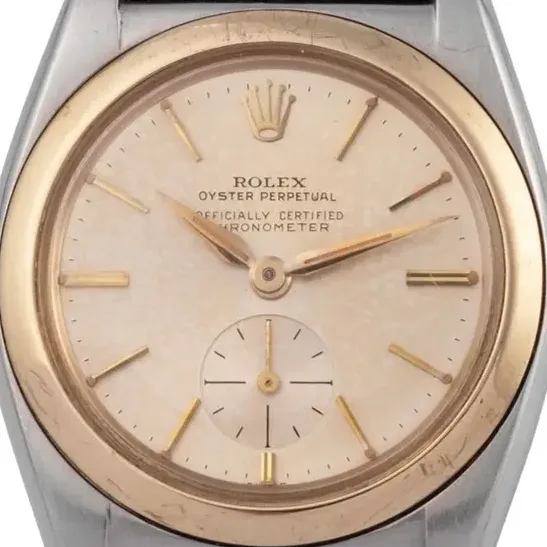
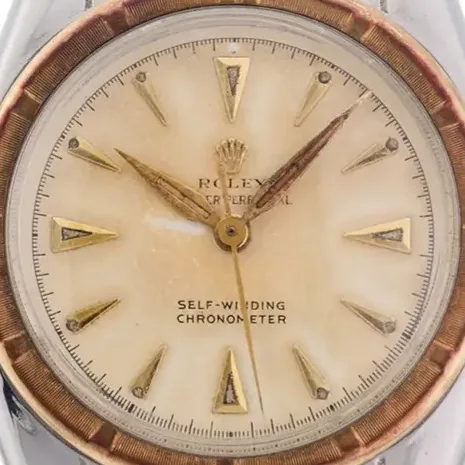
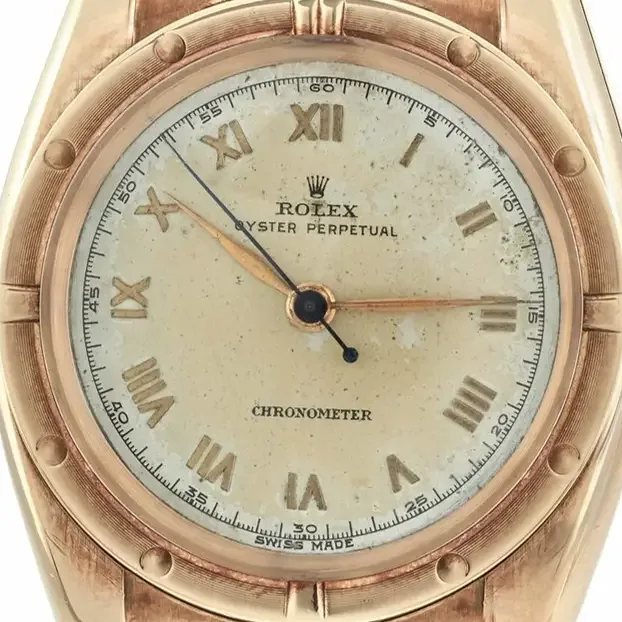
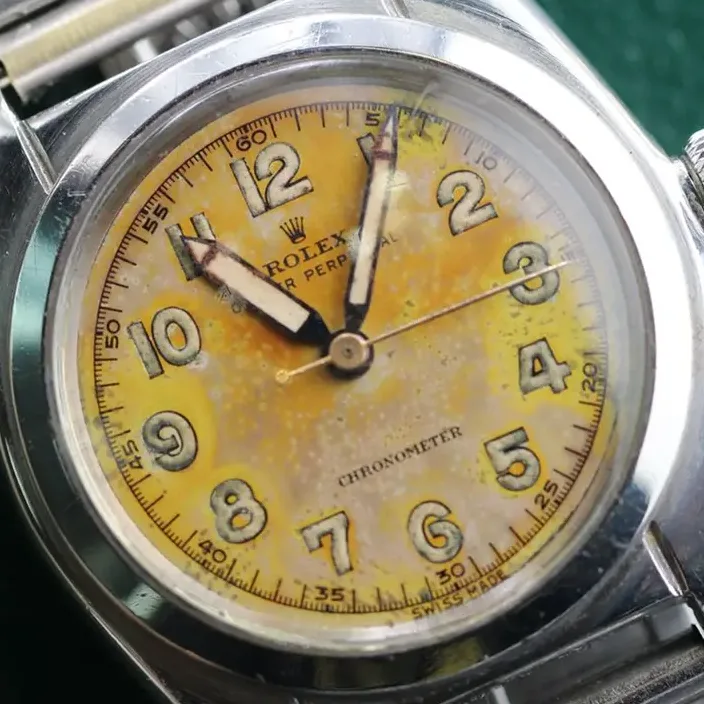
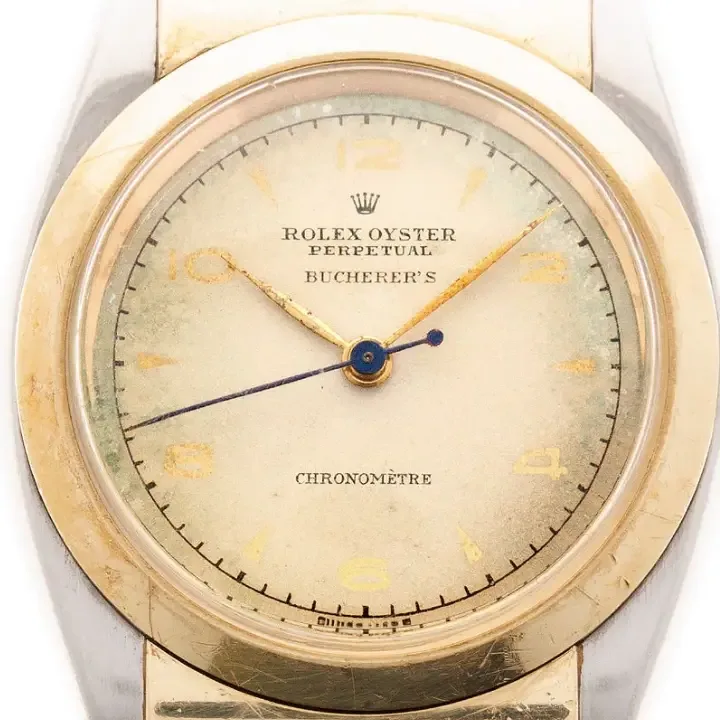
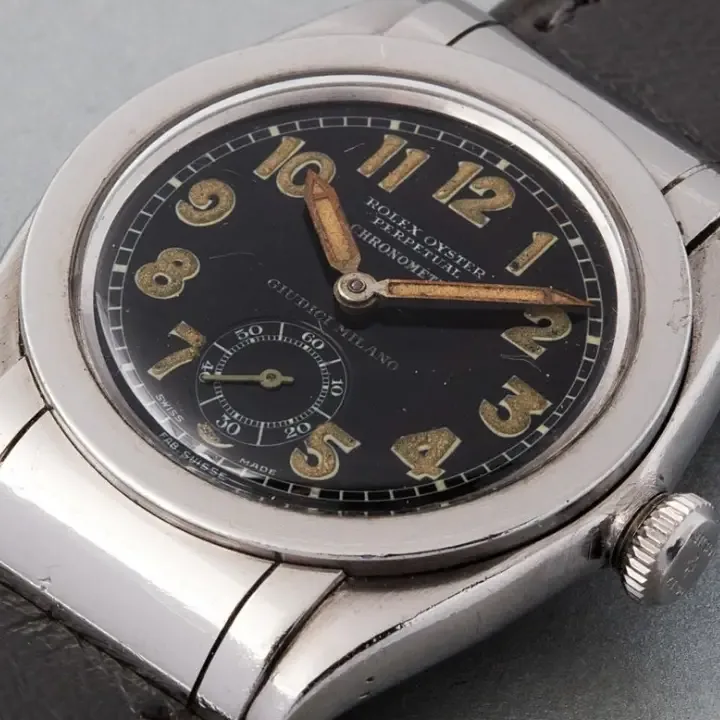
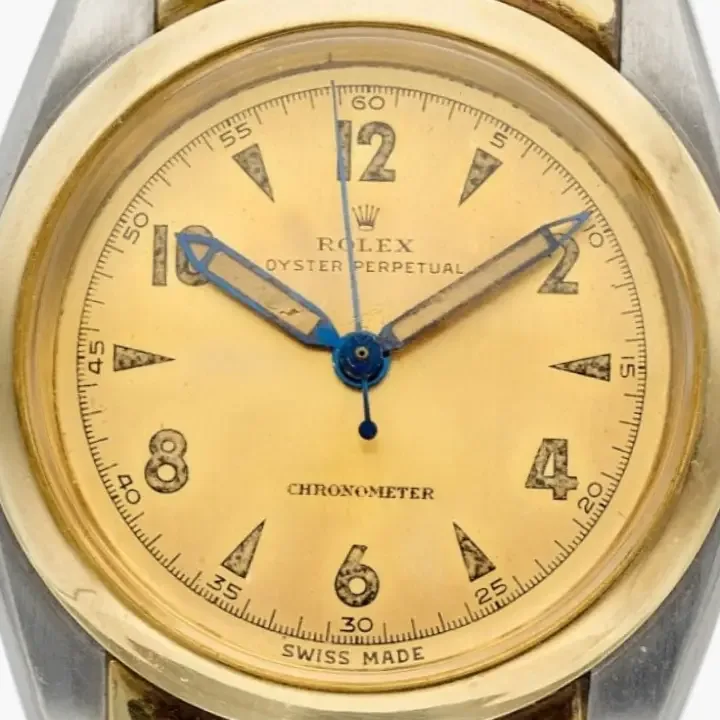
Dials are the widest field of variation in the line. Accounts list arabic and roman numerals, sector dials, two-tone dials, honeycomb texture, lacquer black with gilt print, and 24-hour dials in a military style. Some dials carry a retailer's name. Redials are common and a dial's originality counts for more than most other points.
California dial
Roman and arabic numerals share the dial: roman at the top, arabic below in one description; roman at 1, 2, 10 and 11 and arabic at 4, 5, 7 and 8 in another. Rolex patented the layout in 1941 as the Error-Proof dial. The name California was adopted only around the 1980s, and its origin is not settled.
- mixed roman and arabic numerals
- roman numerals in the upper half, arabic in the lower
Black gilt dial
A black lacquer dial with gold printing, which takes on a patina with age; described as rare. Black dials are among the features that make a bubbleback most wanted.
- black lacquer
- gold print
Explorer-style and sector dials
Gilt dials with plain arabic numerals, made before the Explorer existed, and sector dials appear among bubblebacks. Honeycomb-textured dials are also recorded.
- plain arabic numerals with gilt print
- textured honeycomb surface
Military-style 24-hour and two-tone dials
A steel watch is described with bold arabic numerals at the even hours and a dash at the odd hours, a 60-second track in fives and luminous markers and hands. Two-tone dials, including one with a quartered pattern and dotted indexes, and pink and white dials also appear; sellers also describe salmon dials.
- bold arabic numerals on even hours
- outer seconds track in fives
Retailer and market signatures
Some dials are signed by the retailer: a Venezuelan jeweller (Serpico y Laino) and a Milan dealer (Ronchi) are described, and the library's records include a London retailer (Mappin). 'Swiss Made' with 'FAB SUISSE' on a dial generally indicates delivery to the French market.
- retailer name on the dial
- FAB SUISSE on the dial
Everest dial
On the 6098 and 6298: closed minute track, applied arrow hour markers and an applied coronet.
- applied arrow markers
- applied coronet
Black 3-6-9 dial
Rolex introduced it officially on the 6150 and 6350: an inverted triangle at the top, Rolex and coronet printed, and painted 3, 6 and 9. It was used before.
- inverted triangle at twelve
- painted 3-6-9
Luminous material 1 described
Bubbleback dials and hands of the 1940s and early 1950s are described with radium. Tritium did not appear before the early 1960s.
Radium
Radium dots on 4467 and radium markers and hands on 2940, and radium on a 1952 6106.
- radium dots on the markers
Hands 3 described
Hand styles differ by reference.
Gold alpha hands with radium inserts
On the Datejust 4467; polished alpha hands also on the 5030 described.
- gold alpha hands
Blued-steel luminous hands
On the 2940; a red centre seconds hand is described on one 1946 example.
- blued steel
- red seconds hand
Mercedes and pencil hands
Mercedes hands arrived with the 6150 and 6350 by one account, and with the later 6610 by another; some watches had pencil hands.
- Mercedes hour hand
- pencil hands
Subregisters 2 described
The first bubbleback showed seconds in a small register; sweep seconds replaced it in later watches.
Small seconds at six
The original arrangement, also found on 5026 in the large series.
- register in lower half of dial
Centre sweep seconds
Found on the 2940, 5028 and others.
- central seconds hand
Bezel 3 described
Bezels are smooth, engine-turned or coin-edged.
Smooth
Fixed and smooth on the 3131, narrow and low on the 5030.
Engine-turned
On the 5031 and other watches.
- turned bezel
Coin-edge fluted
On the 4467.
- fine fluting
Case and sizes 5 described
The Oyster case of 1926 was of three pieces, front and back screwed into the middle. Early bubbleback cases were also of three pieces, with a two-piece case introduced with the 3131 and 3132. The large series brought monobloc cases and, in 1953, a three-piece case again. The bubbleback case was also used for hand-wound models such as the Air-King 4925.
Three-piece case
The early bubbleback cases, replaced by the two-piece case of 3131 and 3132.
Two-piece case
Introduced with the 3131 and 3132, in 1936 by one account; another places the 3131 in the 1940s.
Steelium and Rolesor
Rolex's names for steel and for steel with gold, patented in 1931 and 1933.
Monobloc case
Middle and bezel made from one block of steel, on the 5020 series and the 6098.
Case signature on 2940
Case signed with the maker's name and Geneva address, '31 Victoires' and 'Haute Precision', with the reference.
- 31 Victoires
Crown 3 described
Crowns move from large Oyster crowns to the Super Oyster and then to a screw-down crown.
Early large Oyster crown
The early crown; the 5030 still has an old-style one signed Rolex Oyster.
- Rolex Oyster signed crown
Super Oyster crown
Newly designed for the 6098, pushed in and not screwed down; it leaked.
'Brevet +' 6 mm screw-down crown
Fitted to the 6298 to replace the Super Oyster crown.
- 6 mm crown
Crystal 1 described
Crystals are domed acrylic.
Tropic crystal
Held onto the middle case by the bezel on the 6298.
Date 2 described
Date appeared on the large watches.
Date window without magnifier
At three o'clock on 4467, with black print on the earliest watches and red on a white window for most dials from 1945 to 1947.
- no cyclops
Roulette date wheel
Even days in red and odd days in black, used on 4467 and mostly on 5030 and 5031.
- alternating red and black numbers
Movement 7 described
The movement drove the form of the case. Rolex patented its Perpetual rotor in 1931 by most accounts. Its automatic movements before calibre 1030 were Hunter movements from Aegler with a module added for the rotor, and they were thick.
Calibre 520
Powered the first bubbleback, reference 1858.
Calibre 9 3/4 ligne
The movement of references such as 3372.
Calibre 10 1/2 ligne
A later and larger movement than the 9 3/4 ligne, with better timekeeping; later Rolex calibres were built on it.
Calibre 630 with Super Balance
Seventeen jewels, in the 2940. The Super Balance dates to 1935.
Calibre A296
The thick movement of the ovettone watches from 6098 to 6350.
Calibres 710 and 1065
710 is named for the 4467 in one account, A295 or 740 in others; 1065 allowed the slimmer 6604 and 6605 of 1956 to 1959.
Calibre 1030
Rolex's first complete in-house movement, slimmer than the bubbleback calibres, in the 6610 of about 1956. One account says the calibre dates from the mid-1950s and another puts it in 1950.
Bracelet and strap 2 described
Bracelets are dated in broad bands.
Riveted parallel-sided bracelet
Parallel-sided riveted bracelets were made for the bubblebacks in the 1930s and 1940s and are generally held to be the only non-tapering bracelets Rolex made. They had straight end pieces until flush end pieces came in the early 1950s. A riveted bracelet with spring-loaded links that stretch is described on a 1952 reference 6106.
Jubilee bracelet
Five-piece, introduced with the 4467.
Reference numbers
The numbers that belong to the line, with the listings on record under each, as its own page counts them. A number links to its own page, where the components of dated watches are set side by side.
| Number | What it is | Listings |
|---|---|---|
| 1858 | The first bubbleback, with calibre 520 in a three-piece case. | 6 |
| 3131 | 32 mm two-piece case in gold; from 1936 in one account, the 1940s in another. | 125 |
| 3132 | Introduced with the 3131 in 1936. | 10 |
| 5015 | Named among the notable bubbleback references, in rose or yellow gold; no other description is given. | 38 |
| 3372 | A 32 mm bubbleback with calibre 9 3/4 ligne. | 131 |
| 2940 | Steel centre-seconds chronometer with calibre 630. | 151 |
| 3065 | Hooded bubbleback with smooth hoods. | 50 |
| 3159 | Hooded bubbleback in gold. | |
| 3801 | Hooded bubbleback with scalloped hoods. | |
| 3599 | Hooded bubbleback in steel, 32 mm. | 4 |
| 6064 | Hooded bubbleback; no further description is given. | 2 |
| 5026 | 36 mm ovettone with seconds register. | 4 |
| 5028 | 36 mm ovettone with centre seconds. | 16 |
| 4467 | First Datejust, 1945 to 1949. | 38 |
| 5030 | Transitional Datejust with smooth bezel. | 15 |
| 5031 | Transitional Datejust with engine-turned bezel. | 7 |
| 6098 | Second ovettone series, with Super Oyster crown. | 85 |
| 6106 | A 34 mm big bubbleback; the example described in the literature dates from 1952. | 8 |
| 6298 | Three-piece ovettone of 1953. | 43 |
| 6150 | Black 3-6-9 dial, Precision. | 61 |
| 6350 | Black 3-6-9 dial, chronometer, first to say Explorer. | 30 |












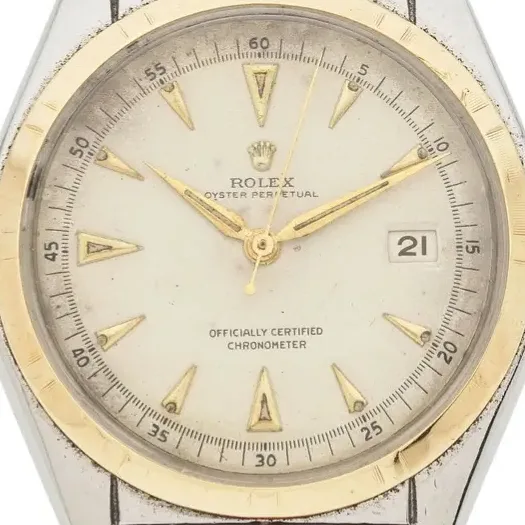

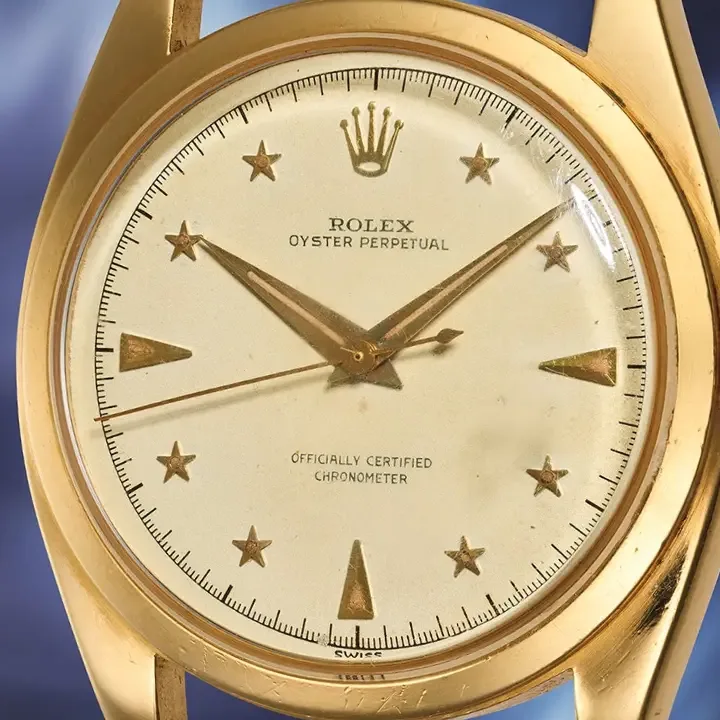

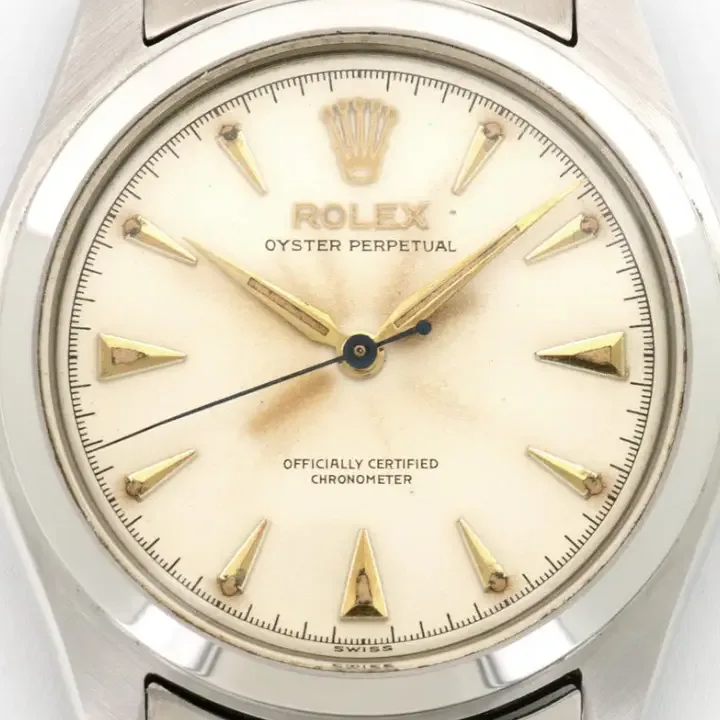

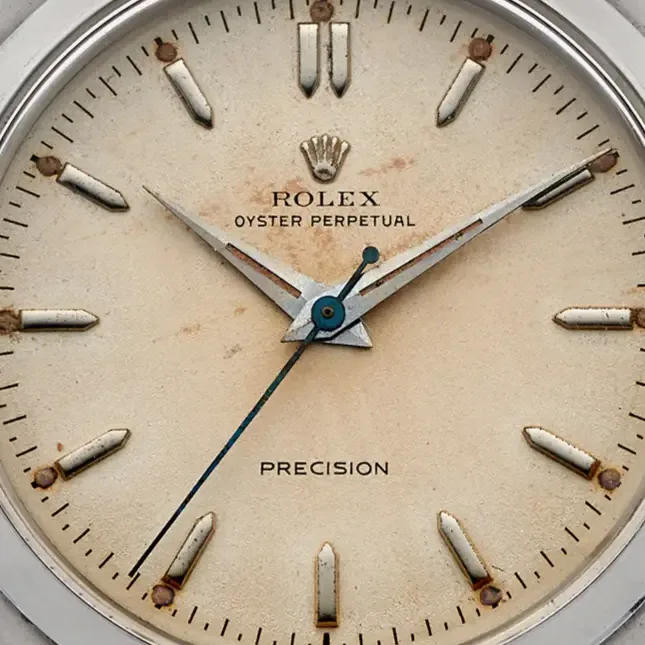



Originality
- Case and bracelet parts were commonly replaced over the years, through service and wear.
- Redials are common and show in the font and print quality and in how the dial has aged.
- A case that has been over-polished loses the definition of its original lines.
- The movement should be the calibre that belongs with the reference, as wrong movements were often fitted.
- The reference sits between the upper lugs, at twelve, and the serial number between the lower lugs, at six; the two together, checked against Rolex production numbers, give the approximate year and help confirm the watch.
Names
- Bubbleback. The back of the case bulges to hold the rotor movement; Rolex never marked or recognised the name.
- Ovetto and Ovettone. Italian for egg forms, for the shape of the case in profile: ovetto for the 32 mm watches and ovettone, big egg, for the 36 mm ones in most accounts; one account uses ovettone for the bubbleback in general and renders it as little egg.
- Big Bubbleback. The larger 34 or 36 mm bubblebacks, from the 4467 of 1945 onward.
- Little Coffin. The name used in Hong Kong for the shape of the case.
- Pre-Explorer. The 6098 and 6298, forerunners of the Explorer.
- Hooded. The pressed-metal hoods between the lugs.
Where accounts differ
Points on which the published literature and the library's own records do not agree, or on which the literature contradicts itself.
- Years of production. One account puts the run from about 1933 to the mid-1950s, another from 1933 to 1955, and a third from the late 1920s to the early 1960s; the last start precedes the 1931 movement. The library's records, by sellers' stated years, include listings in the 1960s and several references, such as 6105, 6084 and 6085, with stated years to 1962.
- Date of the rotor movement. One account dates the rotor to 1931 and another gives the patent as 1932, with the first bubbleback in 1933; a third says the first bubbleback was launched in 1931.
- Hooded bubblebacks. One account treats the hooded bubbleback as a pre-war case of the 1930s and 1940s, dropped in the late 1940s; another says it was designed in the 1940s to refresh the case and soon stopped. The same blog says the hooded watches were normally made for the United States but calls its 3599 of 1942 a European model.
- Start of the ovettone. Two accounts start the 5020 series in the mid-1940s, another in the late 1940s, and a third dates the ovettone from 1945 with the 4467.
- When the 3131 came. One account's 3131 page dates the two-piece 3131 and 3132 to 1936; its main bubbleback guide puts the introduction of the 3131 and 3372 in the 1940s. In the library's records sellers' stated years for the 3131 begin in 1930, before either date, and those for the 3372 in 1931.
- The first automatic calibre. One account gives calibre 520 for the first bubbleback, the 1858; another says the Oyster Perpetual began in 1931 with calibre 620.
- Are the 6084 and 6085 bubblebacks?. One account names the 6010 and the 6084 and 6085 as flatter automatic Oysters without the bubble profile; one captions a pink gold 6085 as a 'Bubbleback'. The library's records file listings of both references among bubblebacks, and some sellers write 'semi-bubble back' for watches of the early 1950s.
- The first chronometer automatic with a date. One account calls the movement of the 1949 reference 5030 the first chronometer-certified automatic with a date wheel; another describes the 4467 of 1945 as a dated automatic with 'Chronometre' on the dial.
- Calibre of the 4467. One account names calibre 710 for the 4467; another gives A295, and a third 740 in its text and 3730 in a picture caption.
- Order of the 6150 and the 6298. One account makes the 6150 and 6350 the successors of the 6098 and 6298; two others have the 6150 made with the 6098 in 1952 and the 6298 following in 1953.
- First Mercedes hands. One account says Mercedes hands came with the 6150 and 6350; another says the 6610 introduced them.
- When the 6610 came. One account gives about 1956 and another 1956; two others give 1955, another 1955 to 1959, and two others 1959.
- Years of the 8171. One account gives 1948 to 1952; four others start it in 1949.
- Where the reference and serial are engraved. One account's bubbleback guide puts the serial number between the lugs at twelve and the reference at six, and another describes a 1961 Tudor Oyster with the serial between the upper lugs and the reference between the lower; a third and another guide put the reference at twelve and the serial at six.
- The first dial to read Explorer. One account makes the 6350 the first reference with Explorer on the dial and the 6150 a Precision; another says most 6150 dials read Precision but a small number read Explorer.
In the records
Counted from 1,378 listings at dealers and auction houses. These are what sellers state, not measurements, a stated year is often an estimate, and a count of listings is not a count of watches made.
Kind of object
| Kind | Listings |
|---|---|
| Wristwatches | 1,377 |
| Clocks | 1 |
Case metal
| Metal | Listings | Share |
|---|---|---|
| Steel | 393 | 47% |
| Gold, any colour | 373 | 45% |
| Yellow | 123 | 15% |
| Pink | 85 | 10% |
| White | 2 | under 1% |
| Colour not stated | 163 | 19% |
| Steel and gold | 60 | 7% |
| Gold plated, filled or capped | 6 | 1% |
| Plated | 4 | under 1% |
| Filled | 1 | under 1% |
| Capped | 1 | under 1% |
| Platinum | 4 | under 1% |
| Silver | 2 | under 1% |
As sellers state it. Shares are of the 838 listings that name a metal. A listing that says "gold" or "18K gold" names no colour: it is counted under "colour not stated", not as yellow gold. Carat, where a listing of gold gives one: 18k 202 · 14k 72 · 9k 12 · 10k 7.
Case size
| Size | Listings | Share |
|---|---|---|
| 32 mm | 448 | 53% |
| 36 mm | 109 | 13% |
| 31 mm | 75 | 9% |
| 33 mm | 52 | 6% |
| 34 mm | 49 | 6% |
| 35 mm | 28 | 3% |
| 30 mm | 21 | 2% |
| 32.5 mm | 11 | 1% |
| Other sizes | 58 | 7% |
As sellers state it. Shares are of the 851 listings that give a size.
Listings by decade the seller gives
| Decade | Listings |
|---|---|
| 1920s | 1 |
| 1930s | 90 |
| 1940s | 547 |
| 1950s | 300 |
| 1960s | 26 |
1 more gives a year outside the years the line was made (1933 to 1955): a later watch sold under the name, or a slip. It is left out.