Early Oyster, 1926 to the 1940s
The Oyster is the waterproof wristwatch that Rolex launched in 1926: a three-piece case whose bezel and back screw onto a central carrier ring, closed by a screw-down crown. The first wristwatches were octagonal or cushion-shaped, in silver or gold, with a 15-jewel movement, and a few Oyster pocket watches came first of all. Steel cases, a streamlined solid-lug case and a run of named entry-level models followed through the 1930s and 1940s, among them the Oyster Royal and the Speedking. The line sits before the self-winding Perpetual and alongside it as the manual-wind Oyster. Collectors look first at the case maker's marks and hallmarks, the case and movement numbers, and whether the dial, hands, crown and movement still belong to the case.
This maker's early watches are described by kind of watch, not by reference number: many carry no number, and one number can cover quite different watches. The wider picture is in Early Rolex, 1905 to 1959.
- Made
- from c. 1926The Oyster name and case date from 1926; the manual-wind Oyster carried on through the 1940s and into the 1950s, so the end of this line is a matter of definition and no published end date is given.
- On record
- 1,507 listings772 of them give no reference
- Reference numbers
- 12 describedmany early watches carry none
Production by production 7 described
Hermetic cases before the Oyster
Before 1926 Rolex tried several ways of sealing a watch. In 1922 it made a small series in a one-piece Borgel screw case, a type also used by other makers, and it used a hermetic double case, which one account says was patented and made by another maker and sold to other brands as well, while another presents it as Rolex's own design, in which an inner case sat inside an outer one. The double case closed the crown inside, so the wearer had to open it every time the watch was wound; it did not last. Borgel screw cases had also been used for watches imported before the Oyster, including one with London import hallmarks for 1910, and the Borgel firm supplied three-piece screw cases in the 1920s. These are the background to the Oyster and are not Oysters themselves.
Signature and marks. None recorded in the literature for these cases beyond the sponsor's mark W&D (Wilsdorf and Davis) on an imported Borgel case.
- a case in two shells, or a one-piece case with the movement screwed in from the front
- no Oyster name on the dial
Oyster pocket watches
Recent research places some Oyster pocket watches among the very first Oysters, made between October 1925 and May 1926 while the patent for the screw-down crown was still pending. Every known example has the stamp 'Patent applied for +114948' in the case back. A pocket watch case with the Glasgow import hallmark for July 1926 to June 1927 is also recorded. They are very rare.
Signature and marks. Case back stamped 'Patent applied for +114948'; Glasgow import hallmark on one recorded case.
- pocket watch with a screw-down crown
- Patent applied for +114948 inside the back
The first Oyster wristwatches: octagonal and cushion
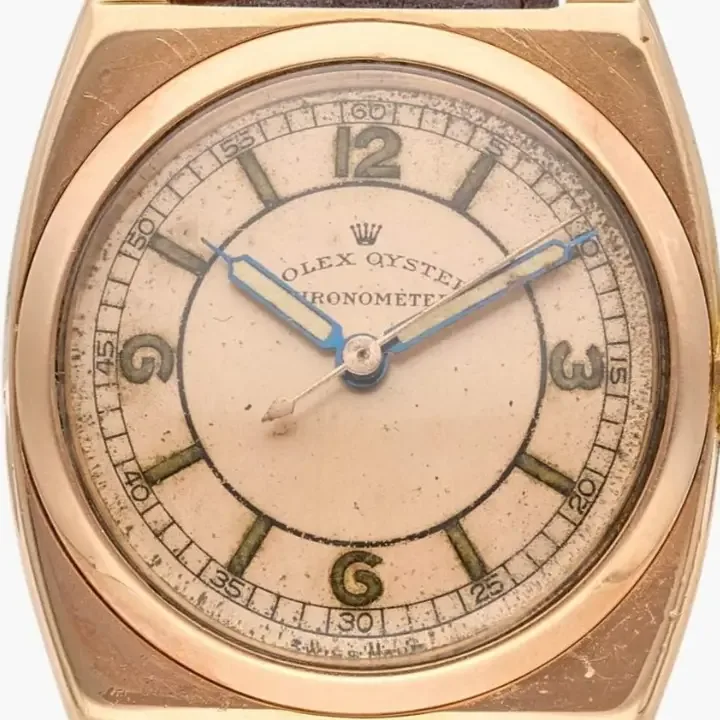
The first Oyster wristwatch case is a three-piece case with wire lugs and a milled bezel and back, made in octagonal and cushion shapes. By the time of the 1927 Channel swim Rolex is said to have had four versions, in gold or silver, with Arabic or Roman numerals, in cushion or octagonal cases, all with the screw-down crown and a 15-jewel manual-wind Aegler movement. Recorded octagonal examples include a silver case of 32 x 34 mm with 16 mm lugs and a lady's 9 ct rose gold case of 28 x 35 mm with 14 mm lugs. The cases were made by C. R. Spillmann & Co of La Chaux-de-Fonds and carry Glasgow import hallmarks. In these first cases the crown thread was cut into a pendant that was part of the gold or silver middle, which wore quickly; many have since been fitted with a separate steel tube.
Signature and marks. Dial signed Rolex Oyster above the centre. Case signed RWC Ltd (Rolex Watch Company Limited) and Rolex, with a count of 'World's Records' (16 on the silver watch, 7 on the lady's watch), and numbered; Glasgow import hallmark with the sponsor's mark R.W.C.Ltd incuse in an oval. The case maker's poinçon de maître is a hammer head without a handle bearing the number 136. Movement signed Rolex, Timed to 6 Positions, For All Climates, numbered, 15 jewels. Patent numbers listed inside the back.
- octagonal or cushion case with wire lugs
- knurled bezel
- crown marked Oyster Patent
- Glasgow date letter d or e for 1926 to 1928
- poinçon de maître hammer head with 136
The streamlined Oyster of the 1930s
In the 1930s Rolex developed with a second case maker a streamlined Oyster case with solid lugs and a simpler construction. One account puts the introduction of the classic Oyster shape at 1932. Glasgow hallmark date letters on recorded Oyster cases run through 1928/29, 1930/31 and 1933/34 to 1936/37, all with the mark of C. R. Spillmann & Co; a case hallmarked in 1937/38 bears the other maker's mark. The original wire-lug construction did not disappear; it lived on in the watches made for the Italian Navy.
Signature and marks. Case maker shown by the poinçon de maître: hammer head without a handle, 136 (C. R. Spillmann & Co), to 1936/37 on the examples recorded; Key of Geneva, 10, on one case hallmarked 1937/38.
- solid lugs in place of wire lugs
- poinçon de maître number
- Glasgow import hallmark with date letter
Named entry-level Oysters of the 1930s and 1940s
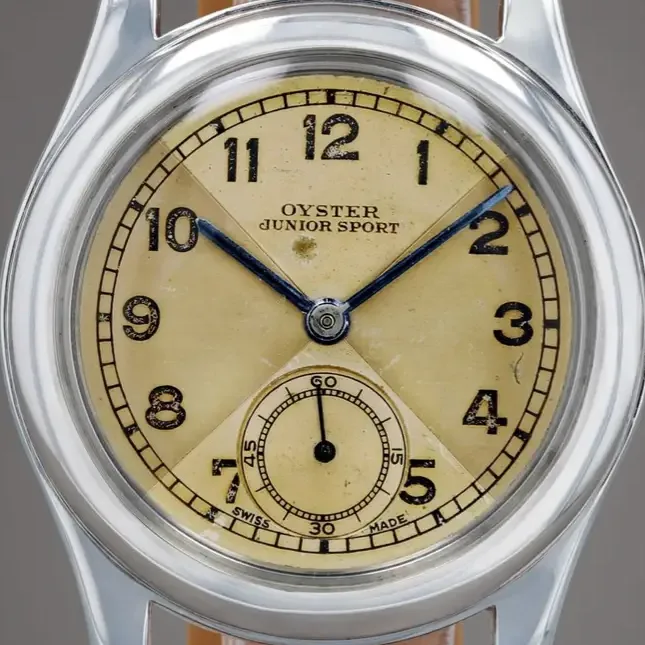
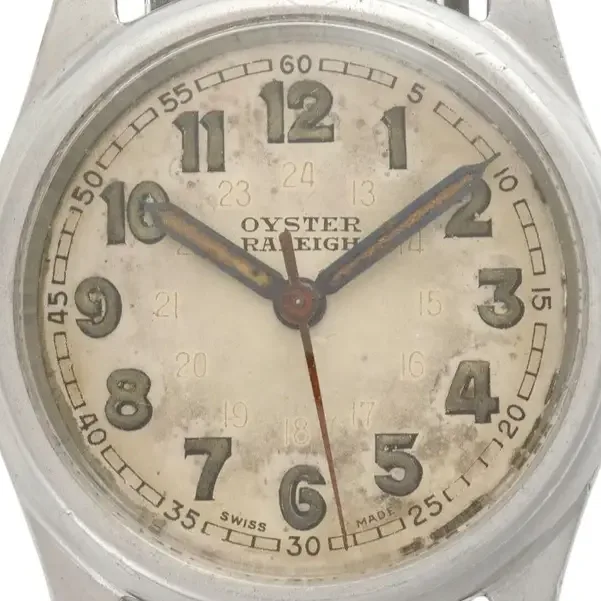
When the Oyster Perpetual arrived in 1931 the plain Rolex Oyster remained as the cheaper manual-wind watch. By the late 1930s Rolex was trying names such as Oyster Royal and Royalite for it, and the Canadian market used many short-lived names. Early Royals and Speedkings were both about 30 mm; by the late 1940s the Royal was 32 mm and the Speedking stayed at 30 mm, while names such as Firefly, Drake and Ellsworth were dropped. Cushion-case models called Army, Clive and Viceroy, and the straight-lug Athlete, also faded out by the late 1940s. The library's records also hold watches that sellers call Imperial, Junior Sport, Lipton and Raleigh; the literature gives no dates for these names.
Signature and marks. Model name printed on the dial, as in Rolex Oyster Speedking. On the 34 mm manual-wind Precision Oysters 6426 and 6427, an extra Royal line on the dial is said to mark watches meant for Great Britain and Canada.
- Royal or Royalite line on the dial
- 30 mm or 32 mm case
The wire-lug Oyster made for Panerai
The original three-piece Oyster construction with wire lugs lived on in the diving watches that Rolex made for the military divers of an Italian Navy unit, sold through the Italian retailer G. Panerai & Figlio, which fitted its own Radiomir dials. A Rolex director said in 1964 that the watches were sold to a Swiss customer and re-exported, and that Rolex learned the destination much later. They are described as the first professional diving watches. The divers' raids on enemy ships were in 1940 and 1941. Sellers describe reference 3646 as a large stainless steel cushion-shaped case.
Signature and marks. Radiomir dial fitted by the retailer; one account speaks of Rolex markings throughout the watch, though accounts differ for the last wartime batches; sellers describe the dial as signed Panerai Radiomir and the case and movement as signed Rolex S.A.
- wire lugs
- Radiomir dial
- Rolex signature inside
References: 3646
The Speedking and its 1940s references
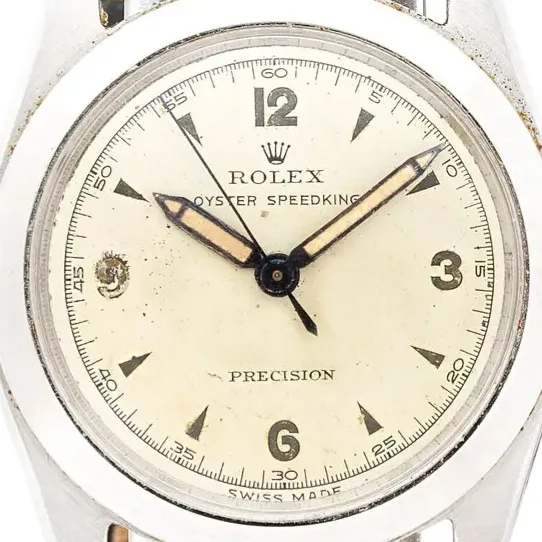
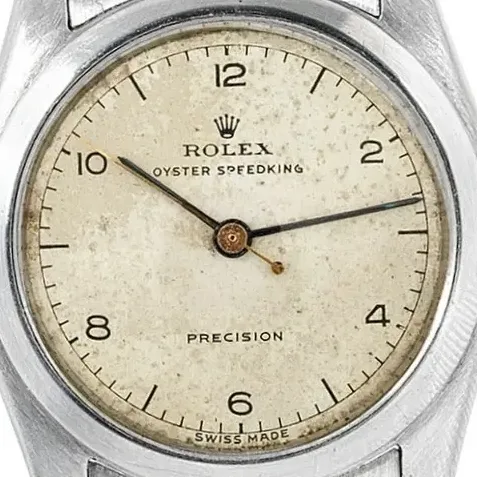
The Speedking is a plain manual-wind Oyster of about 30 mm, almost always in stainless steel. Published accounts disagree on its start: one puts the launch at about 1936 and links the name to a record-breaking motorist who advertised Rolex, the other finds nothing reliable before 1941 and says serious production began in the 1940s with references 2280 and 4220. Early Speedkings were on leather straps, with Mercedes or pencil hands, and the California dial is found on them. A chart gives the 2280 the 10 1/2 ligne Hunter and the 4220 a small-seconds calibre 700 or 710; yet a 1948 tropical-cased 4220 in 9 ct gold with a steel back has a 17-jewel Hunter with Superbalance, and two 4220s of the 1940s are described with the 10 1/2 ligne Hunter. The Oyster bracelet arrives in 1948; by about 1950 alpha hands were standard and the California dial was dropped. 5020 and 5056 follow in the late 1940s.
Signature and marks. Dial signed Rolex, Oyster Speedking above the centre and Precision, Swiss Made below. Case back signed Geneva, Suisse, Rolex, Brevete with a large coronet and the model number on a 1948 4220. Movement on a 17-jewel example signed Rolex, 17 Jewels, Swiss Made, Patented SuperBalance. Reference number stamped between the lugs and repeated inside the back on a 1951 example.
- 30 mm case, lugs 17 mm
- Oyster Speedking and Precision, Swiss Made on the dial
- Mercedes or pencil hands
- California dial
- leather strap
Chronology
Specification
| Case | Three-piece Oyster case: bezel and back screw onto a threaded carrier ring that holds the movement. Octagonal or cushion with wire lugs at first (one silver octagonal example 32 x 34 mm; one lady's 9 ct rose gold octagonal 28 x 35 mm with lugs); a streamlined case with solid lugs in the 1930s; Speedkings of the 1940s about 30 mm |
| Metals | Silver and 9 ct gold on the 1926 cases described; 14 ct and 18 ct gold, a gold front with a steel back (the tropical case) and gold-capped cases are also known; the Speedking is almost always stainless steel |
| Crown | Screw-down crown on a threaded pendant, later a separate steel tube; an improved crown with an internal clutch, patent applied for in October 1926, lets it be screwed down on a fully wound watch |
| Movement | Manual wind. Rolex Prima, 15 jewels, on the 1926 octagonal watches described; the Hunter calibre (introduced 1923), 10 1/2 ligne, 15 or 17 jewels, in watches of the 1940s; a published chart gives calibres 700 and 710 with small seconds for some Speedking references |
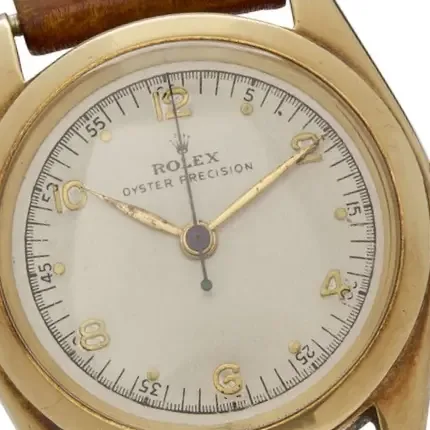
| Dial | Signed Rolex Oyster; later dials carry model names such as Oyster Speedking, and some a Royal line |
| Strap or bracelet | Leather on early Speedkings; an Oyster bracelet from 1948 on the Speedking |
| Water resistance | Sealed by the screw-down case and crown; the published accounts do not give a depth rating for these watches and say the Oyster was not made as a dive watch |
Dial 5 described
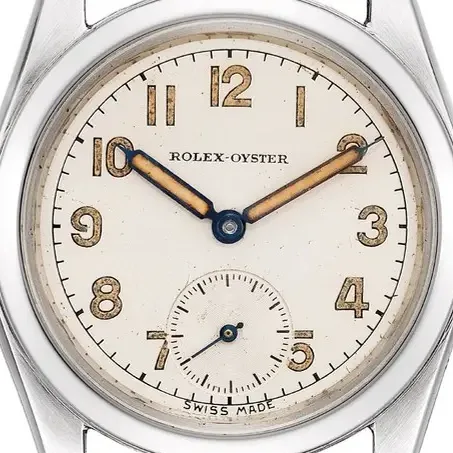
Dials of the first Oysters are signed Rolex Oyster above the centre and show subsidiary seconds, with Arabic or Roman numerals on champagne or silvered guilloche faces. By the 1940s the entry-level models carry a model name and the line Precision, Swiss Made, and the half-Roman California dial appears. Many dial types are known to sellers by nicknames the literature does not date.
Rolex Oyster signed dial, subsidiary seconds
On the 1926 octagonal watches the dial is signed Rolex Oyster above the centre. One is champagne with black Arabic numerals; one is a silvered engine-turned dial with black Roman numerals; both have a subsidiary seconds dial.
- Rolex Oyster above the centre
- subsidiary seconds
- black Arabic or Roman numerals
California dial (Error-Proof dial)
A half-Roman dial for which Rolex applied for a patent in 1941. Almost all have blued Mercedes hands, though not every blued Mercedes hand sits on one. California dials were dropped at about the time alpha hands became standard, around 1950, and after the war well-lumed numerals gave way to modest stick markers. Radium lume may have scorched the dial.
- half Roman, half Arabic numerals
- blued Mercedes hands
- radium lume, sometimes scorched
Waffle dial
A seller's name for a textured dial, found on watches such as reference 4499 that sellers state to 1945. The literature does not describe it.
Observatory dial
A dial type that sellers write as Observatory on references such as 2765 and 2280; the literature does not date or describe it.
Tropical dial
A sellers' term, used beside phrases such as crème brûlée and lemon patina, for dials on references such as 4499 and 4444; the literature does not describe or date it.
Hands 3 described
The first Oysters have blued steel hands of cathedral or Breguet shape. Mercedes hands appear from 1937 and are common in the early 1940s; alpha hands are usual by 1950.
Cathedral and Breguet hands
Fine blued steel hands: cathedral hands on a 1926 silver octagonal watch, Breguet hands on a 1926 lady's gold watch.
- blued steel hands
Mercedes hands
First seen on the 1937 reference 3346 Centregraph; they spread to the Oyster, Oyster Perpetual, Athlete and especially Speedking in the early 1940s. Early ones are blued with a tapered minute hand and a fully lumed triangular tip. One account calls the flared form typical of the inter-war years and not found in that form after 1950.
- blued
- tapered minute hand with lumed triangle
Pencil and alpha hands
Early Speedkings had Mercedes or pencil hands. Alpha hands became standard by 1950; a gilt alpha pair with a blued seconds hand ending in a circle appears on a 1951 watch.
- gilt alpha hands
Case and sizes 3 described
The Oyster case has a carrier ring on which the bezel and back screw, clamping the middle between them. Early cases are octagonal in silver or gold, then cushion and steel. Hallmarks, makers' marks and patent numbers inside the back are the main means of dating and attributing them.
Octagonal three-piece case
Octagonal case with wire lugs by C. R. Spillmann & Co SA. Patents named inside the back are two British (260554/1925 and 274789) and two Swiss (114948 and 120851). The first examples have the crown thread in the pendant; many have been converted to a separate steel tube.
- British and Swiss patent numbers inside the back
- poincon 1 / 136
- RWC Ltd sponsor's mark
Streamlined solid-lug case
In the 1930s Rolex developed with a second case maker a streamlined case with solid lugs. The case hallmarked 1937 to 1938 bears that maker's poinçon de maître, the Key of Geneva with the number 10.
- solid lugs
- Key of Geneva poincon, 10
Tropical case
A gold case front with a stainless steel back, offered from the late 1930s for about twenty years, mainly through the Far Eastern and Indian distributors. It is told from a gold-capped case by looking at the back of the case front: on a tropical case the lugs show as gold, on a gold-capped case the whole back looks steel.
- gold lugs seen from the back
- steel back
Crown 3 described
The crown is the core of the invention. From 1926 it screws down onto a pendant or tube; an improved crown with a clutch, applied for in October 1926, lets it be screwed down on a fully wound watch. Signed crowns of the 1940s read Rolex Oyster.
Oyster Patent screw-down crown
The crown on the 1926 octagonal watches is marked Oyster Patent. The crown first patented had no clutch and could not be screwed down on a fully wound watch, which strained the parts; the clutch design applied for in October 1926 let the crown turn freely and engage the stem only when pulled out. The first Oyster case used a rubber gasket only at the back; the crown relied on metal gaskets.
- Oyster Patent on the crown
Rolex Oyster signed crown
A crown signed Rolex Oyster was used from the early to the late 1940s.
- Rolex Oyster on the crown
Super Oyster crown
A push-in crown said to be sealed without screwing down. It was launched in 1950 and dropped in 1952, soon after the end of this line; leaks developed and many were replaced with screw-down crowns at service.
- Rolex Super Oyster on the flat face
Movement 3 described
The first octagonal Oysters use the 15-jewel Rolex Prima. The 10 1/2 ligne Hunter calibre, introduced in 1923, is the usual manual-wind movement of the watches described, with a deluxe 17-jewel form and, from 1935, the Superbalance.
Rolex Prima, 15 jewels
A 15-jewel manual-wind movement signed Rolex, Timed to 6 Positions, For All Climates and numbered, on the 1926 octagonal watches.
- Timed to 6 Positions, For All Climates
Hunter, 10 1/2 ligne
Introduced in 1923 and made until 1969, with many revisions: a Hunter of the late 1920s is not the same as one of the 1940s. Hunters of the same size are interchangeable, so a case may hold one of the wrong age. Usually 15 jewels; some have 17.
- 15 or 17 jewels
Superbalance
A balance wheel with the timing screws sunk into the rim; movements are signed Patented Superbalance, for example Rolex, 17 Jewels, Swiss Made, Patented SuperBalance. By the early 1950s it was standard and no longer named.
- Patented SuperBalance on the movement
Bracelet and strap 2 described
Speedkings of the 1940s were sold on leather straps; the Oyster bracelet came to them in 1948.
Leather strap
Factory leather straps on the Speedking from 1941 and for years after.
Rivet Oyster bracelet
The Oyster bracelet came to the Speedking in 1948. A published table gives the stretchy rivet Oyster 6636, with spring-loaded expandable links and end links 62, from 1948 to 1961; other published accounts put the introduction of the 6636 in the mid-1950s.
- expandable rivet links
- end links 62
Box and papers 1 described
Rolex sold a tool for opening the milled case back and bezel.
Eazy Oyster Opener
Wilsdorf designed a tool in 1926 to grip the millings. He applied for a Swiss patent on 3 October 1929 and it was registered on 15 November 1930 as CH 143449. It came in a box with dies for different case sizes.
- boxed tool with a set of dies
Reference numbers
The numbers that belong to the line, with the listings on record under each, as its own page counts them. A number links to its own page, where the components of dated watches are set side by side.
| Number | What it is | Listings |
|---|---|---|
| 2280 | Speedking in steel with the 10 1/2 ligne Hunter, described in a published chart as about 1941 to 1944, and Oyster Royal as sellers describe it; sellers state years from 1935 on. | 63 |
| 4220 | Speedking, given in a published chart as about 1941 to 1947 with a small-seconds calibre 700 or 710; a 1948 tropical-cased example, dated by its serial, has a 17-jewel Hunter. | 73 |
| 5020 | Speedking with calibre 700 or 710, described as about 1947 to 1950, available in two-tone. | 6 |
| 5056 | Speedking with calibre 700 or 710, described as about 1947 to 1950. | 46 |
| 4365 | Speedking Elegant, 33 mm with 19 mm lugs, described as 1946; another account gives 4365, with small seconds, as one of the first Air-King references. | 14 |
| 3346 | Centregraph or Zerographe, on which Mercedes hands are said to appear first in 1937. | 2 |
| 3646 | Large steel Oyster made for Panerai and the Italian Navy, with Radiomir dial. | 22 |
| 4499 | Oyster Air-King in an image caption circa 1945, and Oyster Precision as sellers describe it. | 46 |
| 6426 | With 6427, a 34 mm manual-wind Precision Oyster; some carry an extra Royal line on the dial. A published photograph dates a 6426 to about 1958, after the period of this line. | 420 |
| 3116 | Oyster Imperial in 9 ct gold or steel, as sellers describe it. | 37 |
| 2784 | Oyster Junior Sport, Sky Rocket or Commander, as sellers describe it. | 33 |
| 3478 | Oyster Viceroy, a military-style cushion watch, as sellers describe it. | 26 |




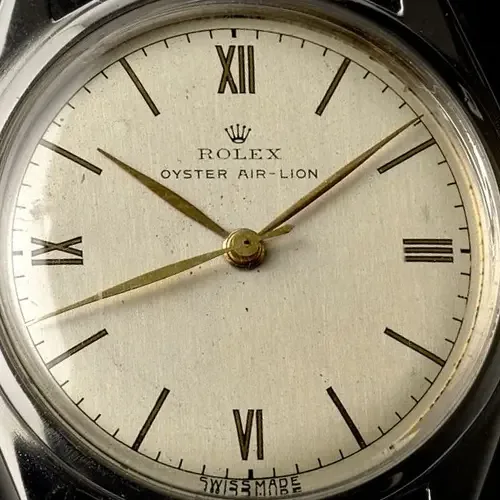

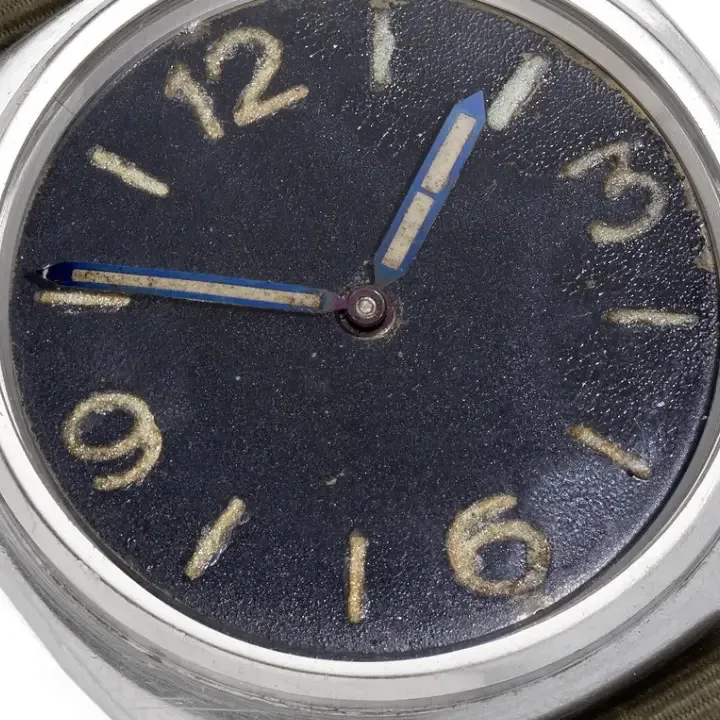

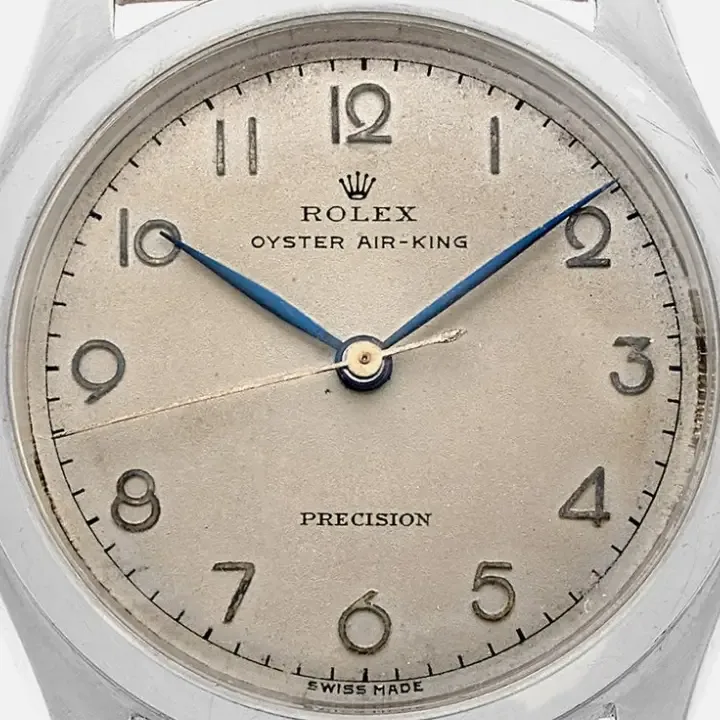

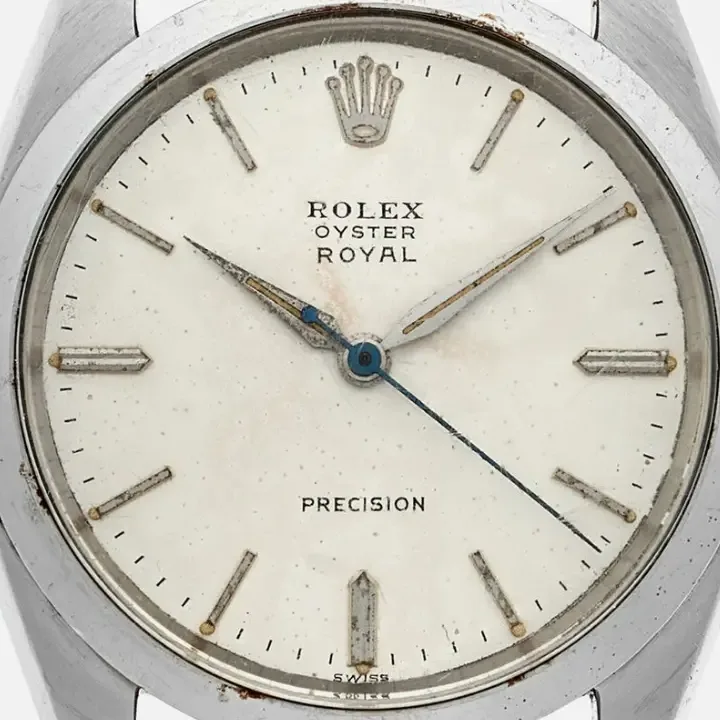




Originality
- Case bodies, backs and movements have often been swapped, so the reference on the case must match the reference on the back and the movement must fit the date of the case.
- Hunter movements of one size are interchangeable, so a watch may hold a movement that is the wrong age for its case.
- Crown tubes in gold and silver cases were often replaced by steel tubes because the soft threads wore.
- Super Oyster crowns were often exchanged for screw-down crowns at service.
- A restored dial, one stripped and refinished, is distinct from an original dial in poor condition.
- A chewed case-back edge shows the back was forced with pliers rather than opened with the maker's tool.
- Radium lume on hands has often been removed or replaced, but most dials remain with their original lume.
Names
- California dial. The half-Roman dial that Rolex patented in 1941 as the Error-Proof dial.
- Tropical case. Gold front with a steel back, sold mainly in the Far East and India.
- Rolex Submarine. The 1922 hermetic double case in which a case sat inside a case.
Where accounts differ
Points on which the published literature and the library's own records do not agree, or on which the literature contradicts itself.
- The first waterproof wristwatch. One account calls the 1926 Oyster the first properly waterproof watch and another the first commercially available waterproof wristwatch; a third holds that waterproof pocket watches go back to 1851 and waterproof wristwatch cases to 1911, and that the Oyster's real advance was the screw-down crown on a three-piece case close to an earlier Borgel design.
- Start of the Speedking. One account says the Speedking was launched in about 1936; another finds no reliable evidence for it before 1941 and puts serious production in the 1940s. The library's records state years from 1926 for reference 2280, against a published 1941 to 1944.
- The Gleitze swims. One account puts Mercedes Gleitze's Channel swim with an Oyster on 21 October 1927 as her first attempt; others say she succeeded on 7 October and wore the Oyster on 21 October for a vindication swim that she did not finish. Which exact watch she wore is not known for certain, though one account describes it as a 9 ct octagonal gold case with Glasgow marks for 1926.
- Earlier screw cases. Accounts give Borgel's screw-case patents as 1881, 1891 and 1903 for the one- and three-piece types. One says there was no known collaboration between Borgel and Rolex on the Oyster case; another says no link has been proven but that Borgel cases were used for Wilsdorf and Davis imports and supplied to Rolex in the 1920s.
- Dates of references 2280 and 5056. A published chart gives 2280 as 1941 to 1944 and 5056 as 1947 to 1950. In the library's records sellers state 2280 from 1926 to 1945 and 5056 from 1940 to 1949.
- Grant of the Oyster case patent. One account says the octagonal case patent was granted in July 1926; another gives the Swiss application as 21 September 1926 and the grant as 16 June 1927.
- Movement of reference 4220. A published chart gives the Speedking 4220 a small-seconds calibre 700 or 710; a dealer's account of a 1948 4220 describes a 17-jewel Hunter and cites two 1940s examples with the 10 1/2 ligne Hunter. The literature does not say whether these names refer to the same movement.
- The 1925 crown patent in the Oyster. One account says the 1925 crown patent was not used in the Oyster because it was flawed; another calls that crown the real innovation of the Oyster, and early case backs list the patent number 114948.
- Who designed the hermetic double case. One account says the 1922 case-in-case, sold as the Rolex Submarine, was patented and made by an outside maker, was used by other brands as well, and was not a Rolex invention. Another describes the coin-edged case-in-case as Rolex's own early design for a waterproof case.
- Rolex markings on reference 3646. One account of the Oyster says the watches made for the Italian Navy carry Rolex markings everywhere, proof that Rolex made them. The same researcher's batch tables for reference 3646 show the Rolex stamps removed from the case back and the movement engravings left off in the last batches of 1944.
- Reference 4365. One account lists 4365 as the Speedking Elegant of 1946, 33 mm with 19 mm lugs and the 10 1/2 ligne Hunter. Another published account gives 4365, with small seconds, as one of the first Air-King references of 1945.
- Date of the rivet bracelet 6636. One account gives the stretchy rivet Oyster bracelet 6636 on the Speedking from 1948 to 1961 with end links 62. Other accounts say the 6636 was introduced in 1954, or give it from about 1958, with the reference stamped on the bracelet from 1961.
In the records
Counted from 1,507 listings at dealers and auction houses. These are what sellers state, not measurements, a stated year is often an estimate, and a count of listings is not a count of watches made.
Case metal
| Metal | Listings | Share |
|---|---|---|
| Steel | 620 | 59% |
| Gold, any colour | 348 | 33% |
| Pink | 20 | 2% |
| Yellow | 13 | 1% |
| White | 8 | 1% |
| Colour not stated | 307 | 29% |
| Silver | 57 | 5% |
| Gold plated | 10 | 1% |
| Steel and gold | 5 | under 1% |
| Platinum | 3 | under 1% |
| Base metal | 1 | under 1% |
As sellers state it. Shares are of the 1,044 listings that name a metal. A listing that says "gold" or "18K gold" names no colour: it is counted under "colour not stated", not as yellow gold. Carat, where a listing of gold gives one: 9k 182 · 18k 39 · 14k 6 · 15k 2.
Case size
| Size | Listings | Share |
|---|---|---|
| 30 mm | 199 | 24% |
| 32 mm | 155 | 18% |
| 29 mm | 119 | 14% |
| 31 mm | 81 | 10% |
| 28 mm | 76 | 9% |
| 34 mm | 26 | 3% |
| 33 mm | 21 | 2% |
| 27 mm | 19 | 2% |
| Other sizes | 147 | 17% |
As sellers state it. Shares are of the 843 listings that give a size.
Listings by decade the seller gives
| Decade | Listings |
|---|---|
| 1920s | 45 |
| 1930s | 215 |
| 1940s | 392 |