Milgauss
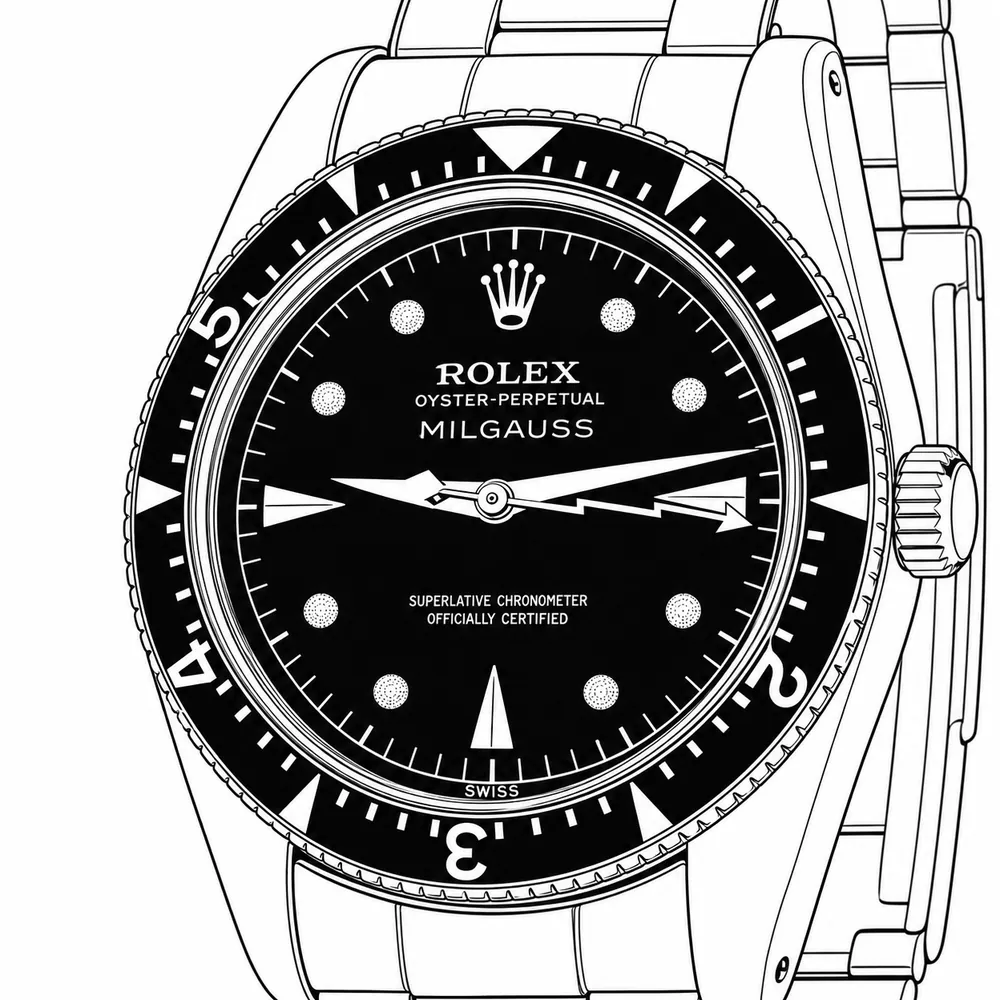
The 6541 is the first Milgauss put on general sale: a 38 mm steel automatic made for scientists and others working near strong magnetic fields. A soft iron shield round the movement, an inner caseback and a metal-woven honeycomb dial protect it, and the name means a thousand gauss. It has a lightning-bolt seconds hand and, usually, a rotating bezel with an insert numbered 1 to 5. It followed the rarer 6543 and was replaced in 1960 by the 1019. Dating varies: the usual account runs from 1956 to 1960, though some place the launch in 1957 or 1958, while the library's dated case numbers all fall in 1958, the year sellers state. Sales were poor and perhaps two hundred were made.
- Made
- 1956–1960dates approximate
- Seen in the library
- 1958by case numbers
- Case
- 38 mm · steelas sellers state
- Movement
- Calibre 1066Mautomatic
- On record
- 37 listings108 photographs · 10 holders
Components
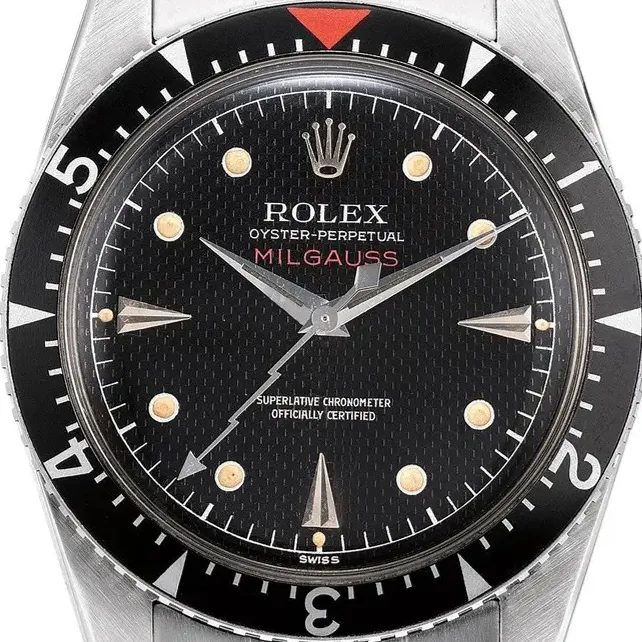
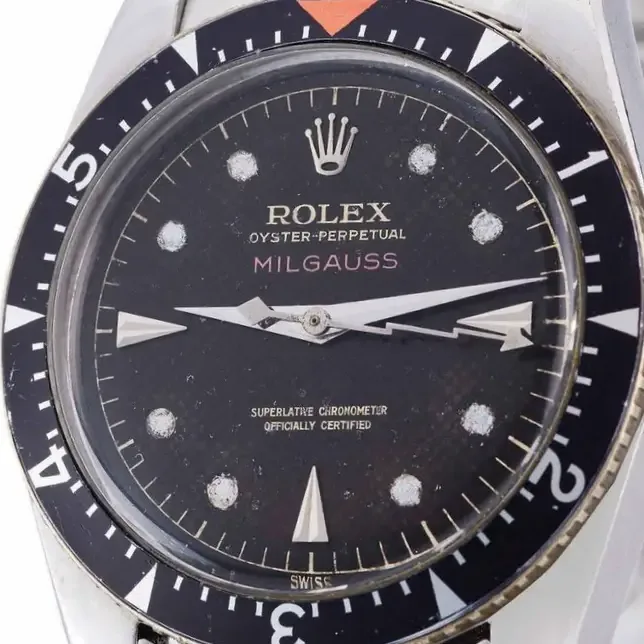
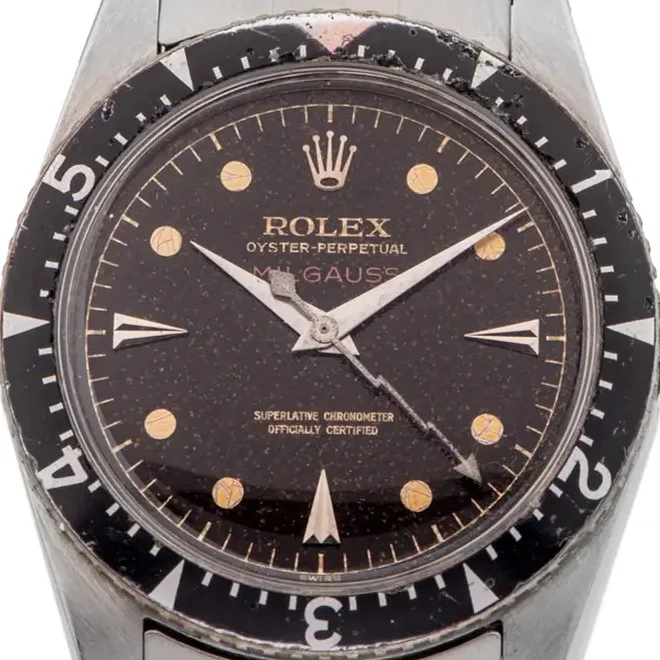
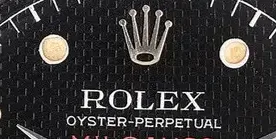
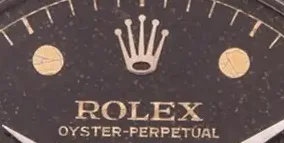
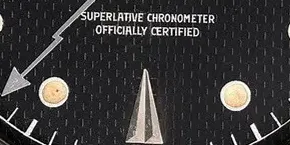
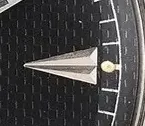
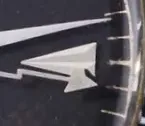
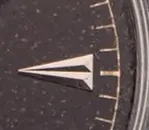
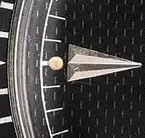
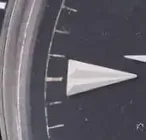
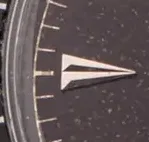
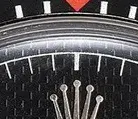
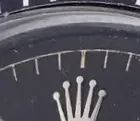
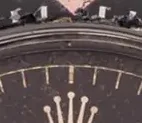
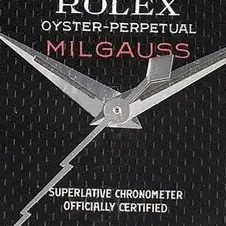
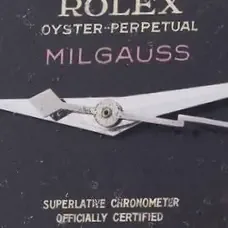
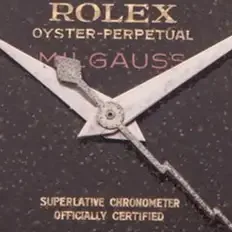
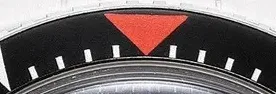
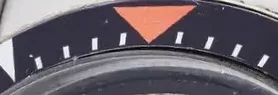
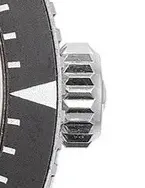
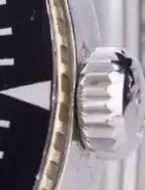
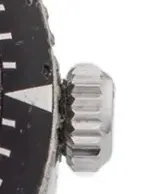
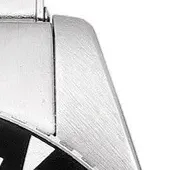
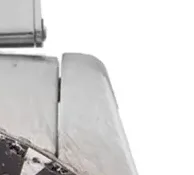
3 watches, oldest first, each straightened and cut the same way so that one row shows one component across them all. Chosen from 108 photographs on file for sharpness and for a face typical of the reference. A year marked c. is one its holder gives only roughly. Each picture is a detail cut from a listing photograph. Select the small mark in its corner for its year, its holder, a link to the listing it came from, and a way to report it.







Chronology
Published accounts start the reference in 1956, 1957 or 1958 and end it in 1960; every dated case number in the library falls in 1958, the year sellers state for the dated watches.
Every dated variant: what is written, and what the records show
For the reference the marks are every dated watch; for a variant, the watches a seller names as that variant, so a variant sellers do not name has none.
The reference's own marks are dated by case number. A variant's marks use the year each seller states, so a variant can show watches in a year where the row for the reference shows fewer, or none.
Specification
| Case | 38 mm steel Oyster case with 20 mm lugs, screw-down back and a separate inner caseback that completes the iron shield |
| Crystal | Acrylic |
| Bezel | Black rotating bezel with an aluminium insert scaled one to five, or a fixed, smooth domed steel bezel on some, said to be for the American market |
| Dial | Black honeycomb dial of woven metal, MILGAUSS in red, three triangular indices at 3, 6 and 9 |
| Hands | Dauphine hour and minute hands; lightning-bolt centre seconds hand |
| Movement | Automatic, with a soft iron ring and cover round it; calibre given as 1066M or 1080, chronometer rated, 18,000 beats an hour |
| Bracelet | Riveted Oyster bracelet; sellers give the bracelet reference as 7206 on a few watches and other numbers on others, with end-link numbers that vary |
| Water resistance | Oyster case; the magnetic rating is 1,000 gauss |
Dial 2 described
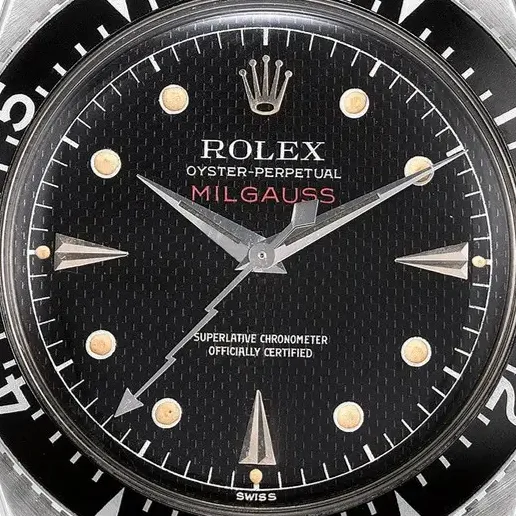
A black honeycomb dial, woven from metal for extra magnetic resistance, with red MILGAUSS and round indices. The three triangular indices at 3, 6 and 9 carried over from the 6543 and the honeycomb texture is also how the dial is judged.
Black honeycomb dial
The surface is woven metal, a waffle pattern in two crossed layers that adds shielding as well as depth. The text runs coronet, ROLEX, OYSTER PERPETUAL and MILGAUSS in red. Round indices stand at the hours, with faceted triangles at 3, 6 and 9. Some dials show a smaller logo.
- honeycomb or waffle texture
- MILGAUSS in red
- triangles at 3, 6 and 9
- small logo on some

Tropical dial
The black dial turns brown with age; the colour is described as chocolate, espresso or brown. A genuine tropical dial has only changed colour and is otherwise intact. Sellers describe many dials as tropical. A dial with damage may have been replaced after water entered the case.
- brown honeycomb
- uniform colour change
- intact printing
Luminous material 2 described
Lume is difficult to read on these dials because some round indices look luminous and are not.
Radium lume
Radium lume on the hour markers ages to an orange-brown. A guarantee card from 1958 describes the watch as radium safe.
- orange-brown lume
- radium card
Unlumed indices
On some watches the round indices have no lume at all, though they look as if they do. They are described as no-lume dials, some with a brown tropical finish.
- round indices without lume
Hands 3 described
Dauphine hour and minute hands, and a lightning-bolt seconds hand that the 6541 introduced.
Dauphine hands
The hour and minute hands are of dauphine shape with lume inserts.
- dauphine hands
Lightning-bolt seconds hand
A seconds hand with a lightning-bolt shape; it became the best-known feature of the Milgauss line and is absent from the 6543. Early hands have a plain tip.
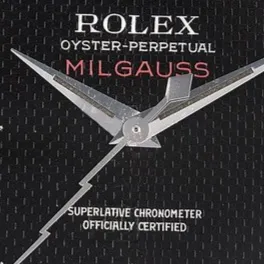
9 listings on record under the name.
Red-tipped seconds hand
A red tip on the lightning-bolt hand appears only in later production runs.
- red tip
Bezel 2 described
There were two bezels: a rotating one with a unique insert, and a fixed domed one. Many rotating bezels have been replaced.
Rotating insert, 1 to 5
A black rotating bezel with an aluminium insert. It has six divisions with triangular hash marks, a large red triangle at twelve to match the red name, and figures 1, 2, 3, 4 and 5 without zeros, as against the 60-minute scale of the 6543. It was used as a simple timer.
- five numerals
- triangular hash marks
- red triangle at 12
Fixed smooth bezel
A fixed, polished, domed steel bezel, said to be made for the American market and seen in the later period of production. Sellers name a smooth domed bezel on a few watches.
- polished smooth domed bezel
Case 1 described
A 38 mm steel Oyster case that is thick because of the shielding. The case should show thick lugs and intact bevels. Watches are said to carry a patented mark and a quarter-year production stamp inside the back, and one watch without them was doubted; this is a check, not a separate version.
Standard case with inner caseback
Steel, 38 mm, with 20 mm lugs and an acrylic crystal. The outer back is normal, and a metal inner back completes the shield, so the case is not as thick as the one-piece back of the 6543.
- inner caseback inside the back
- thick lugs with bevels
Movement 3 described
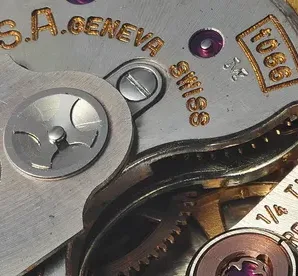
A self-winding Rolex movement inside a soft iron cage. The calibre is given variously as 1066M and 1080.
Calibre 1066M
A version of the 1066 made with antimagnetic parts, including the hairspring and mainspring, and marked with an M under the calibre number. A plain 1066 with an unsuitable balance cock suggests a replacement movement.
- M after the calibre number
Calibre 1080
Reported as the movement made specially for the Milgauss, based on the 1030 of 1950, rated as a chronometer at 18,000 beats an hour. Some accounts give it from the start; others place it in later production runs, and one calls it 1065M. Sellers' calibre texts also name 1065 and 1065/6 on a few watches.
- chronometer rated
Soft iron ring and cover
The Faraday cage is a ring round the movement with a cover over it, in soft iron, with a raw iron surface. Brass parts would not shield and suggest a built-up or imitation watch.
- iron ring and cover
- raw iron surface
Bracelet 1 described
A riveted Oyster bracelet fits the 20 mm lugs; the 6543 had none.
Riveted Oyster bracelet
A folded-link riveted Oyster bracelet, named by sellers on many watches. Those with tight links are rare, and many have been replaced by later Oyster bracelets. Sellers give the bracelet reference as 7206 on a few watches and 7205 or 6636 on others, and the end-link numbers they state vary.
- folded links
- rivets
Box and papers 1 described
Some watches survive with the chronometer certificate, guarantee card, booklet, hangtag and box they were sold with, and a complete set is rare.
Papers, booklet and box
A complete set has a chronometer certificate, guarantee card, booklet, hangtag and box. The booklet reports tests showing the watch could stand fields of 1,000 gauss without effect on timekeeping, as confirmed by a particle physics laboratory in Geneva.
- certificate
- guarantee card
- booklet
- hangtag
- box
Originality
- Rotating bezel inserts are often replaced with Submariner-type service parts; a true insert has serifed characters and the five-figure scale.
- Honeycomb dials are fragile and may be replaced after water damage; a true tropical dial has only changed colour.
- Movements may be a plain 1066 in place of the 1066M with its M mark and its particular balance cock.
- The iron ring and cover are soft iron; brass parts suggest an assembled watch.
- Genuine watches are reported to carry a patented mark and a quarter-year production stamp inside the caseback; one watch without them was doubted.
- Bracelets are often later Oyster replacements for the original riveted one.
Names
- Tropical. The black honeycomb dial turns brown.
- Lightning bolt. The seconds hand has the shape of a lightning bolt.
- Honeycomb. The dial surface is a woven pattern.
Where accounts differ
Points on which the published literature and the library's own records do not agree, or on which the literature contradicts itself.
- Start date. Published accounts place the launch in 1956 (most of them), 1957 or 1958, with some counting the 6543 as the first model. The library's dated case numbers and sellers' stated years all fall in 1958; no watch in the records is dated 1956 or 1957.
- Movement calibre. Three accounts (2023) give calibre 1080; two others (2024) give 1066M, with the 1080 coming in later. Sellers in the library's records name 1066 and 1066M most often, and a few name other numbers.
- Number made. One account puts the 6541 at some 200; another gives fewer than 200 for the 6543 and 6541 together. For the 6543 alone two others give about 150 and another 75 to 200.
Back and movement
From listings of this reference, each confirmed by eye to show what it is filed under. A picture on which a person's name or a personal engraving can be read is not shown. From most holders a detail from the middle of the photograph is shown; the mark in its corner gives its holder and a link to the listing.
Caseback
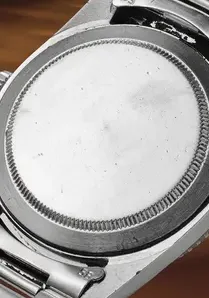

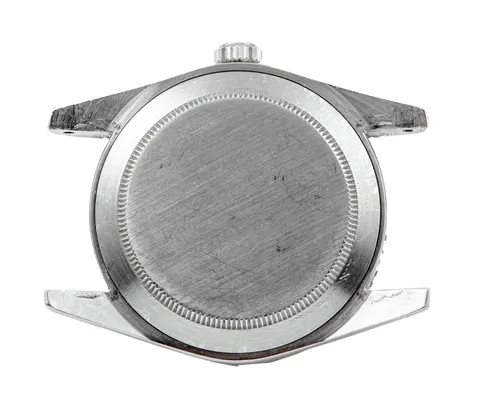

Movement
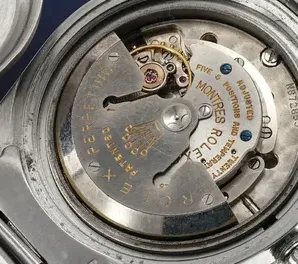

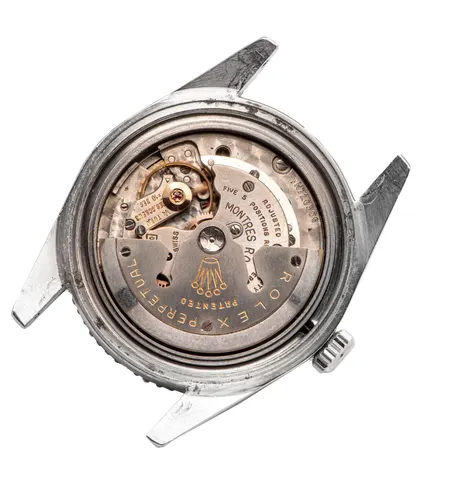


In the records
Counted from 37 listings at 10 holders between 2 December 2009 and 14 November 2026. These are what sellers and auction houses state, not measurements.
All 28 dated watches are of 1958.
Case metal
| Steel | 34 |
Dial colour
| Black | 3 | |
| Brown | 2 |
Case size
| 38 mm | 19 | |
| 37 mm | 1 | |
| 39 mm | 1 |
Calibre named
| 1066 | 7 | |
| 1066M | 6 | |
| 1055 | 3 | |
| 1065 | 2 |
Bracelet or strap
| Oyster bracelet | 19 | |
| Metal bracelet, kind not stated | 7 | |
| Leather strap | 1 |
Each table counts the listings that state the thing, in the seller's own terms. A size, metal, colour or calibre that cannot belong to this reference is a seller's slip or a listing filed under the wrong number.