Early Cartier, 1904 to 1972
Cartier was a Paris jeweller that became a maker of wristwatches in the first years of the twentieth century, with branches in Paris, London and New York that worked with a good deal of independence. Its early watches were designed in the house and fitted with movements from outside suppliers, above all the partnership of the Jaeger and LeCoultre firms, so who made a watch is read from its movement and case as well as its dial. This guide follows the firm from the Santos of 1904 to the sale of the family business in 1972. It covers the shapes, the suppliers, the clocks, the London workshop of the 1960s, and what to look at on a watch before trusting its name.
A jeweller's family and the first wristwatches
The firm began in Paris in 1847, when Louis-Francois Cartier took over a jeweller's workshop, and passed to his son Alfred in 1874. Alfred's sons Louis, Pierre and Jacques made it international: Pierre built the New York branch, Jacques the London one, and Louis, who joined in 1898, was the designer. In the early years of the twentieth century watches were a small part of the business. Cartier made a few special pieces with outside watchmakers and resold timepieces made elsewhere; its pocket and pendant watches were fitted with movements from established houses, and some of the same records note the resale of very old watches.
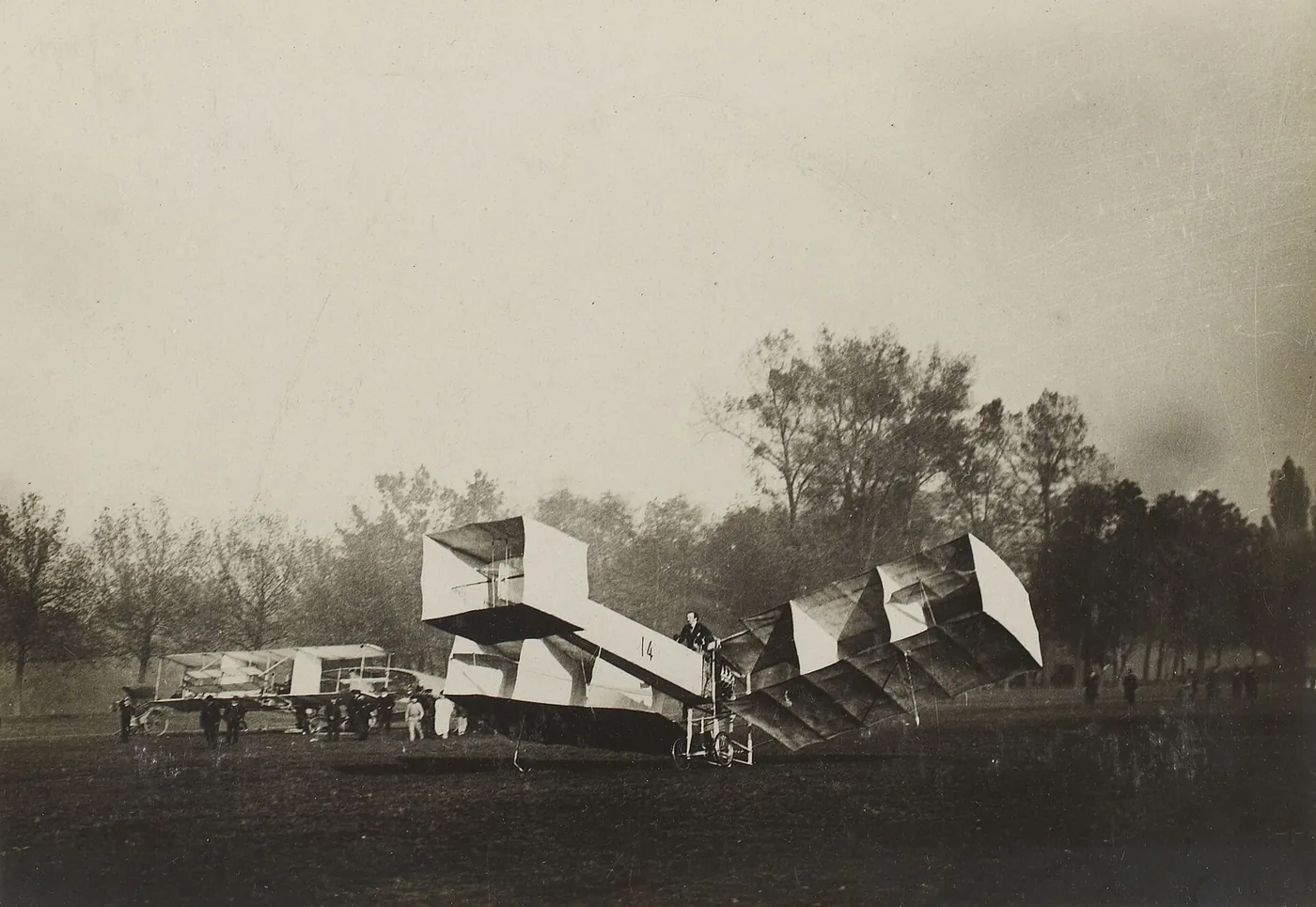

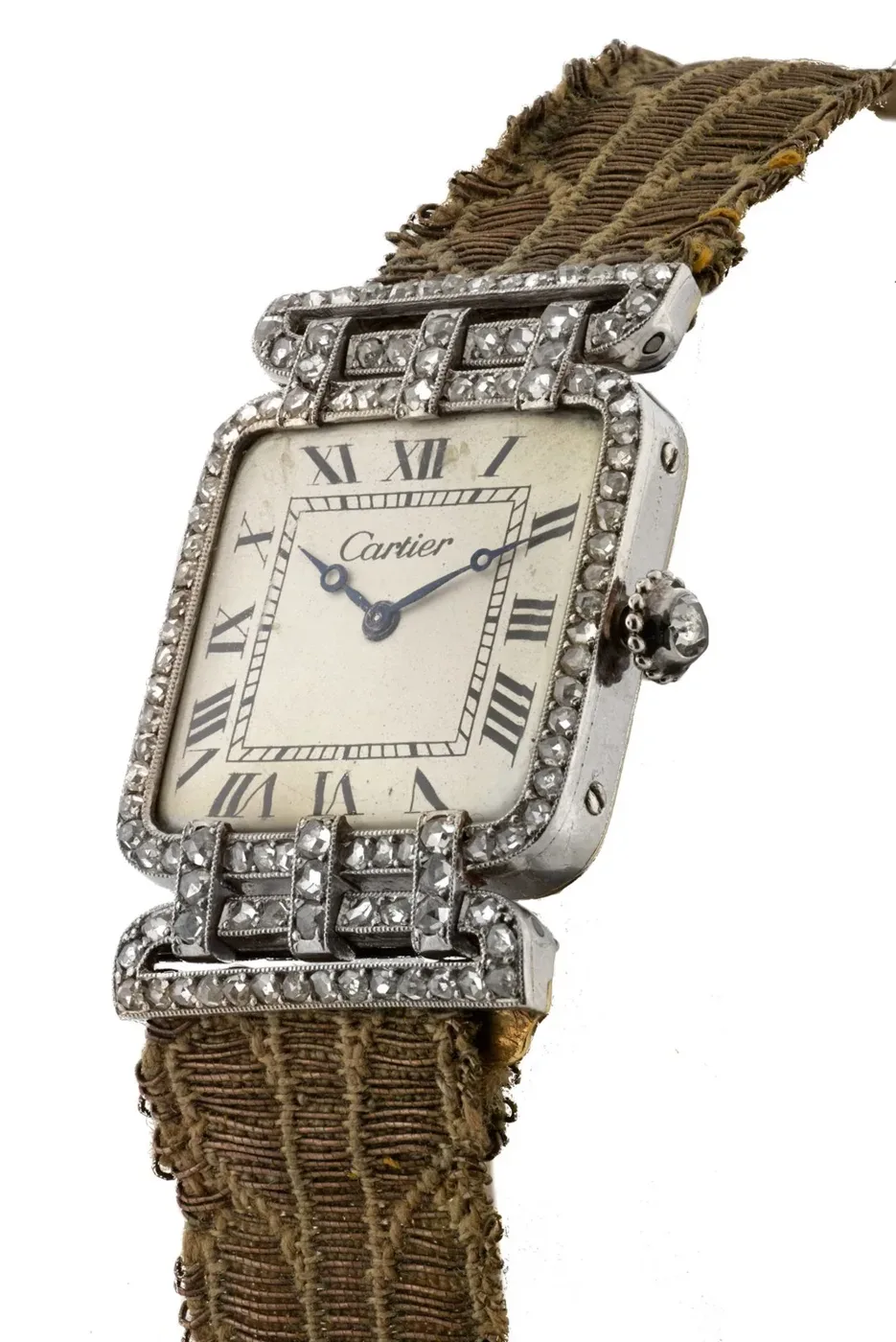
Louis Cartier is credited with a plan for the watch side of the business: set up a workshop, treat the wristwatch as jewellery, and support watch sales with a range of decorative clocks. The first of his shapes was the Santos, designed in 1904 for his friend, the aviator Alberto Santos-Dumont, who wanted to read the time without taking a hand from the controls. Nothing is known of where the first watch went; a successor of 1908, sold at first as the Santos and soon renamed Santos-Dumont, is thought to have looked much like it. The commercial Santos-Dumont is dated to 1911; it was square, roughly 35 by 25 mm, in yellow gold or platinum, on a black or brown leather strap with a gold folding buckle, and the lugs were part of the case rather than separate fittings. Eight visible rivets, later screws, held the bezel, the Roman numerals were thin and black, and the crown carried a cabochon.
Wristwatches were not new: women had worn them for decades, mostly as jewelled pieces, and men's wristwatches had been made before, some for military use, without catching on. What the Santos offered was a gentleman's watch designed from the start for the wrist. It was followed by the tonneau (1906), a long, curved barrel shape, and the tortue (1912, or 1913 in one account), a more compact tonneau with short integral lugs, which took round movements of larger diameter. Platinum was growing in importance for the firm's watches and jewellery, and in 1899 a diamond-set platinum watch was sold to a famous American banker.
- square case about 35 by 25 mm with lugs formed as part of the case
- eight visible rivets or screws on the bezel
- thin black Roman numerals and a railway-style minute track
- crown set with a cabochon stone
- gold folding buckle on a leather strap
Three houses, not one firm
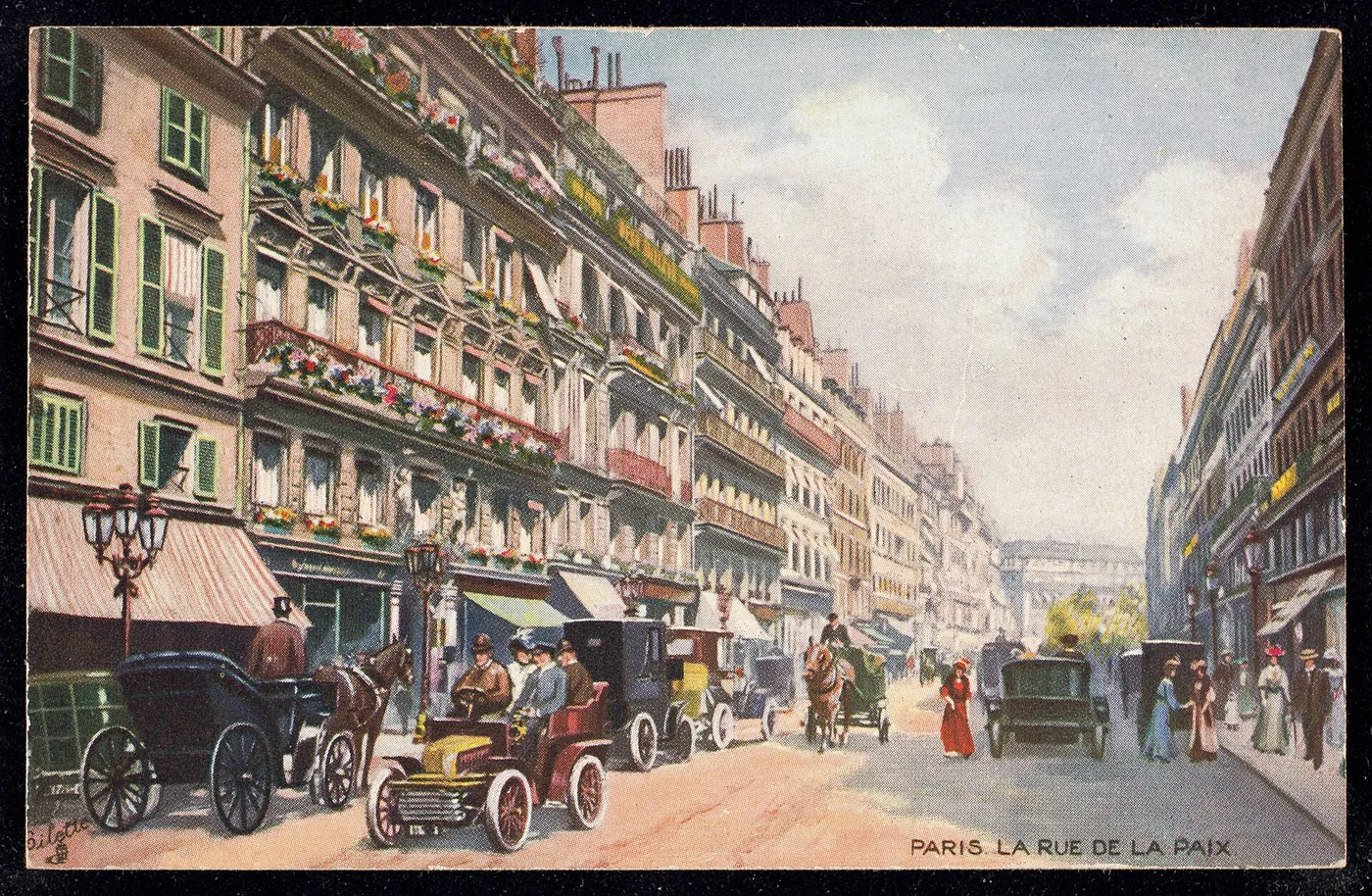
Cartier Paris stood at 13 Rue de la Paix from 1899, near the Place Vendome. Cartier London was opened a few years after the Paris shop, at 4 New Burlington Street, by Pierre in one account and by the brothers together in another; Jacques looked after its expansion from 1902 and, by one account, took charge of it when Pierre left for New York in 1909, and the house received a Royal Warrant from Edward VII in 1904. Pierre opened Cartier New York in 1909 at 712 Fifth Avenue, and in 1917 the firm moved to its permanent address at 653 Fifth Avenue, which it obtained in exchange for a natural-pearl necklace.


By about 1910 the three branches ran with a good deal of independence. Each brother made his own contacts and chose his own products, while the look of the work stayed consistent. For a collector this matters because a watch carries the name of the house that sold it: on the Tank Normale of the 1970s a Swiss signature on the dial is read as a mark of first distribution through New York, Paris signatures being the commoner, and the library's records show watches signed in Paris, France, London and New York. The house is a clue to where a watch was sold, not proof of where it was made.
- signature naming Paris, France, London or New York (N.Y.)
- on a 1970s Tank Normale, Paris or Swiss under the name at six o'clock
Who made the watches
In the early years the movements came from established makers; the house's records show work with the LeCoultre firm in 1899, and pocket and pendant watches were fitted with movements from houses such as Audemars Piguet and Vacheron Constantin. From 1900 three clockmakers were engaged to make the movements of the table clocks, and the same trio became the first suppliers of movements for pocket and pendant watches. A separate maker produced the gold coin-watch cases, and introduced a Paris watchmaker of the Jaeger firm, who by one account became the house's main supplier from 1903 and is said to have worked earlier for the Breguet firm.
The terms of the supply are told in different ways. One account puts an arrangement to supply movements and complete watches at around 1905, with Cartier bound to buy all the output at no less than 250,000 francs a year; another gives a formal fifteen-year exclusive contract signed in 1907; a third speaks of an exclusive contract of 1919 that formed the European Watch and Clock Company, which would supply ultra-thin movements made by the LeCoultre firm. The Jaeger firm is thought to have invited LeCoultre & Cie. of the Vallee de Joux to build its thin movements; LeCoultre, which rarely sold watches under its own name, also supplied other houses, including Patek Philippe and Vacheron Constantin. A patent for a folding clasp was filed by the Jaeger firm in 1909. The European Watch and Clock Company, with a Paris office, finished and signed the movements of the early Tortue chronograph; the library's records contain many watches whose movements carry its name, in several spellings.
A clockmaker at the Paris branch, also described as an exclusive supplier to the firm, made its first mystery clock. In the 1930s the firm took out patents mainly on strap and lug systems, introduced a very small calibre, 101, developed by Jaeger-LeCoultre, and made its first waterproof watches. In London, one account says all watches came in from Switzerland and France until 1966, after which the London house made its own with the case maker Wright & Davies; accounts differ on when London's own production began (see the section on London).
- movement signed Cartier, or European Watch and Clock Co. (also written E.W. & C. Co. Inc.)
- a case stamped with initials, as on a Paris watch of about 1915 stamped EJ
- a case number, and a separate number of its own on the movement
The shapes of the 1910s to 1930s
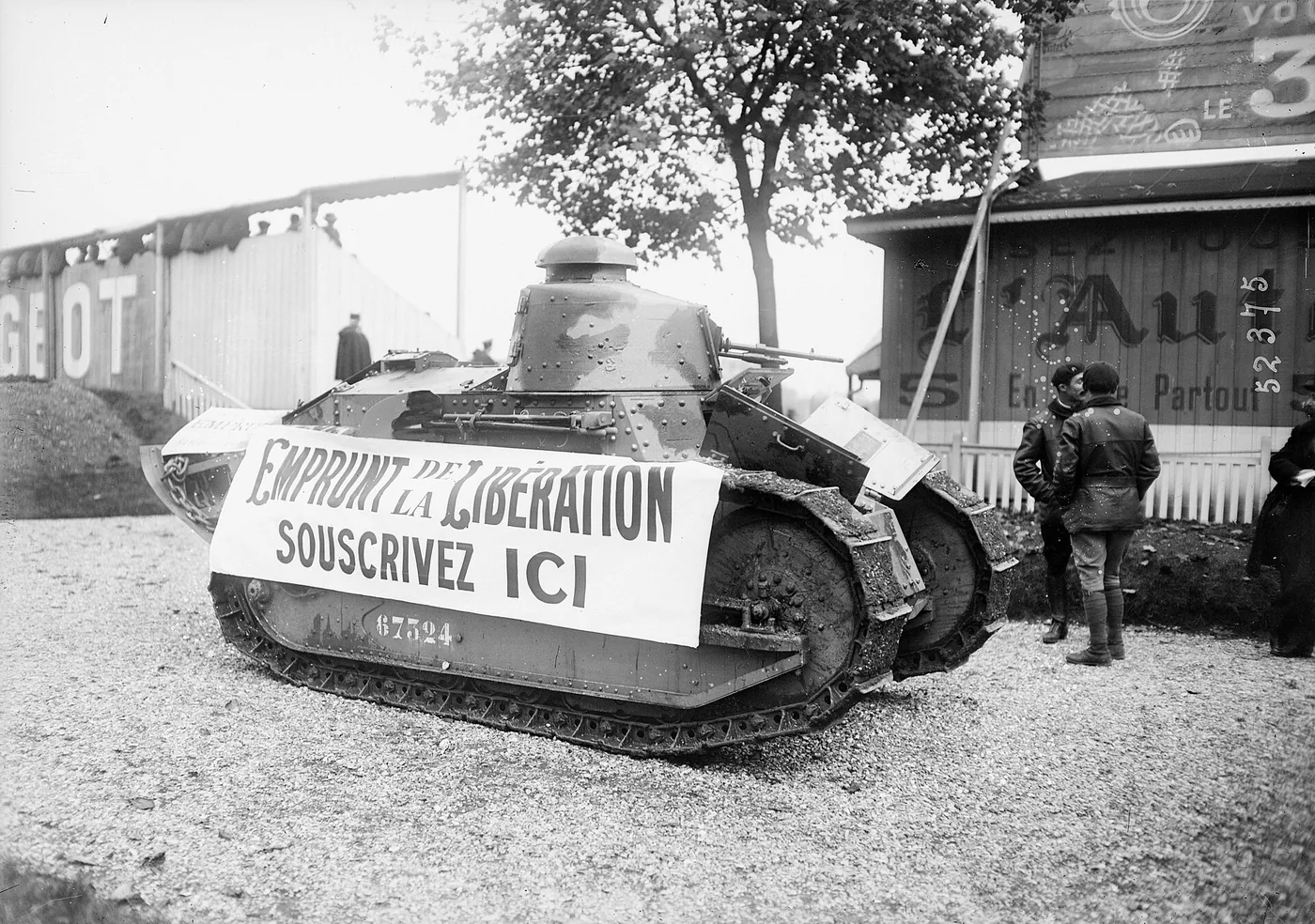
Cartier's reputation rests on shaped cases. After the Santos (1904), the tonneau (1906) and the tortue (1912) came the baignoire, which one account says was introduced in the same year as the tortue, and the first Panthere, set with diamonds and onyx, in 1914. Other accounts date only the first oval design of the baignoire to 1912 and put its production in the late 1950s. The Tank was designed in 1917 and sold from 1919, at first in a series of six; the earliest prototype is said to have been offered to an American general of the First World War. Its straight sides, the brancards, run past the dial to form the lugs, and the strap is meant to read as a continuation of the case. The usual account is that Louis took the idea from the new Renault tanks pictured in a magazine of the First World War. Variations followed quickly: the Cintree of 1921, longer and curved; the Tank Louis Cartier and the Chinoise, both 1922; the Allongee of 1922, the first Tank made for women; a Tank with apertures in 1928; a reversible case from 1932; the Asymetrique of 1936, with the dial tilted. The 1930s brought an eight-day Tank (1931) with two barrels, a Swiss lever escapement and a bimetallic balance; many of these have no cabochon on the crown, which the literature puts down to the economic depression. The name Tank Normale is used for the original form, and the Louis Cartier, which came later, has softened, rounded brancards. The tortue was made first as a time-only watch. In 1928, the year usually given, it was also made as a minute repeater and as a chronograph with start, stop and reset all worked by one pusher in the crown. The chronograph, about 25 by 35 mm, had a column wheel, a horizontal clutch, a thin bezel, a matte dial with heavy Roman numerals and a railway track, and blued hands described as Breguet-style, on a thin movement by LeCoultre finished by the European Watch and Clock Company. It was made in very small numbers; an estimated eleven original examples have reached auction.

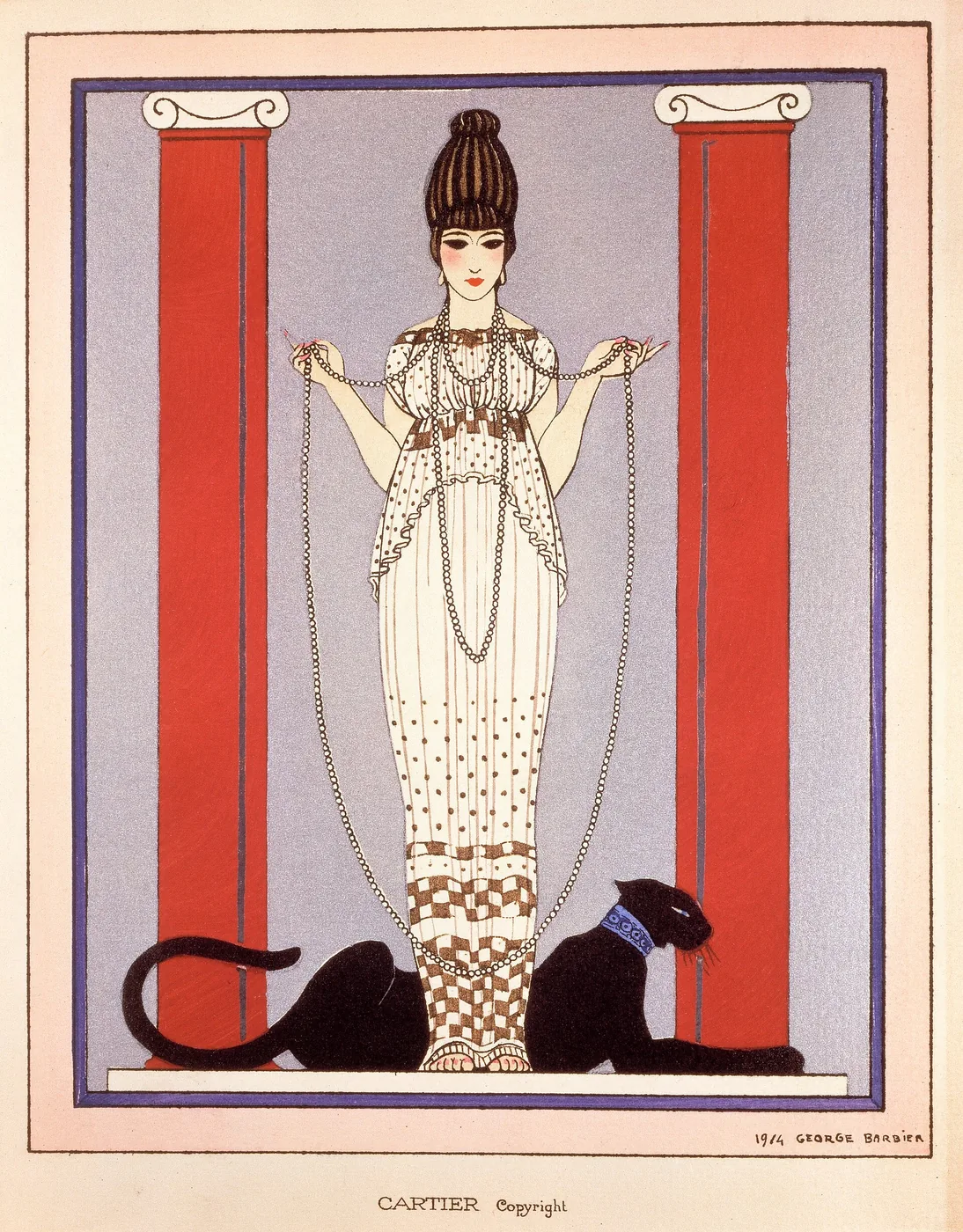

- Tank: parallel brancards that continue into the lugs, and a crown with a cabochon (absent on many eight-day watches)
- Tank Louis Cartier: brancards rounded and softened; Tank Normale: flat, squared brancards
- Tortue: round-bodied tonneau case with short integral lugs
- Roman numerals, a railway minute track and blued hands, described as Breguet-style on the Tortue chronograph
Clocks and objects
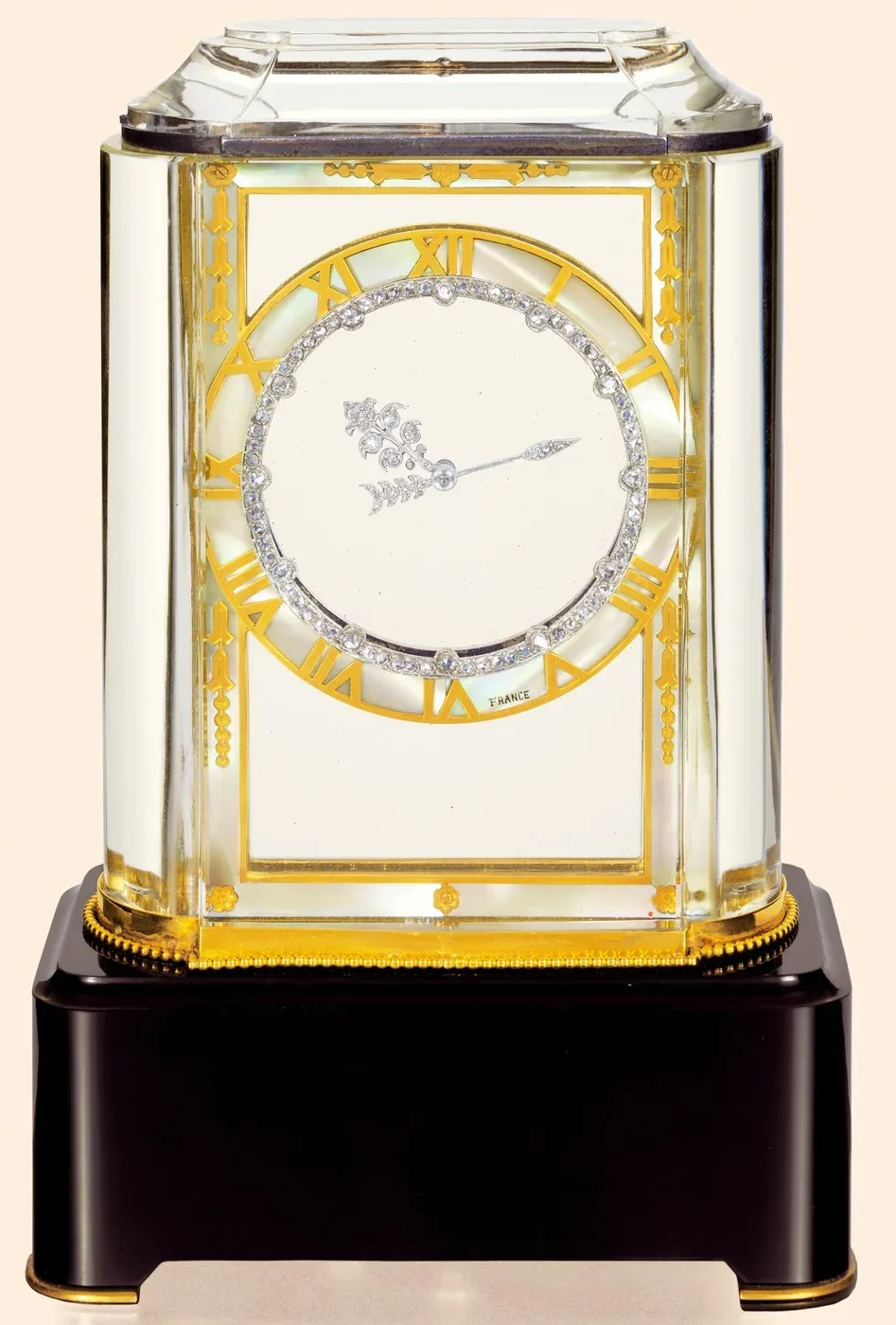
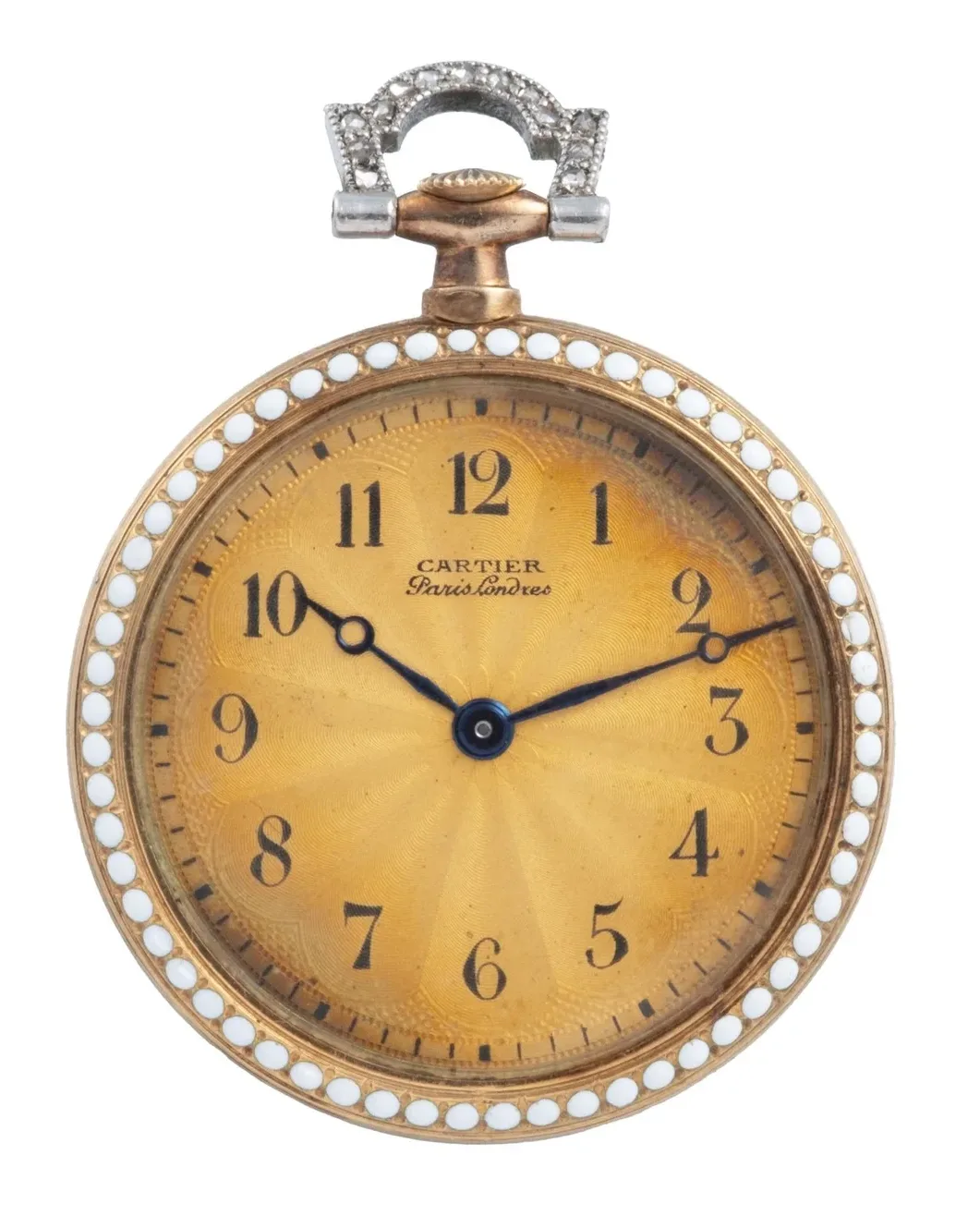
Clocks were part of the plan from the start: Louis Cartier's scheme for the watch business included supporting wristwatch production with a range of decorative clocks, and about one in twelve of the listings in the library's records for these years is a clock. The best known are the mystery clocks, in which a clear dial makes the hands look as though they float. The first is dated to about 1912 and credited to the clockmaker at the Paris branch, who is variously said to have been inspired by a magician who was also a watchmaker and by his own father, a stage illusionist. A fashion magazine of 1925 called these clocks marvels of timekeeping. The library's records hold table and travelling clocks in silver, gold, enamel, rock crystal, agate, lapis lazuli and onyx, among them repeaters, alarm clocks and eight-day travel clocks. In the 1930s the firm brought out mystery pocket watches, a development of the clocks, and watches with interchangeable movements, and patented a way of fitting a movement into cuff links. Cigarette boxes, vanity cases, money clips and pendant or purse watches belong to the same decorative side of the business; the library's records hold pocket, pendant and purse watches and jewellery and cocktail watches of 1910 to 1960 as groups of their own.
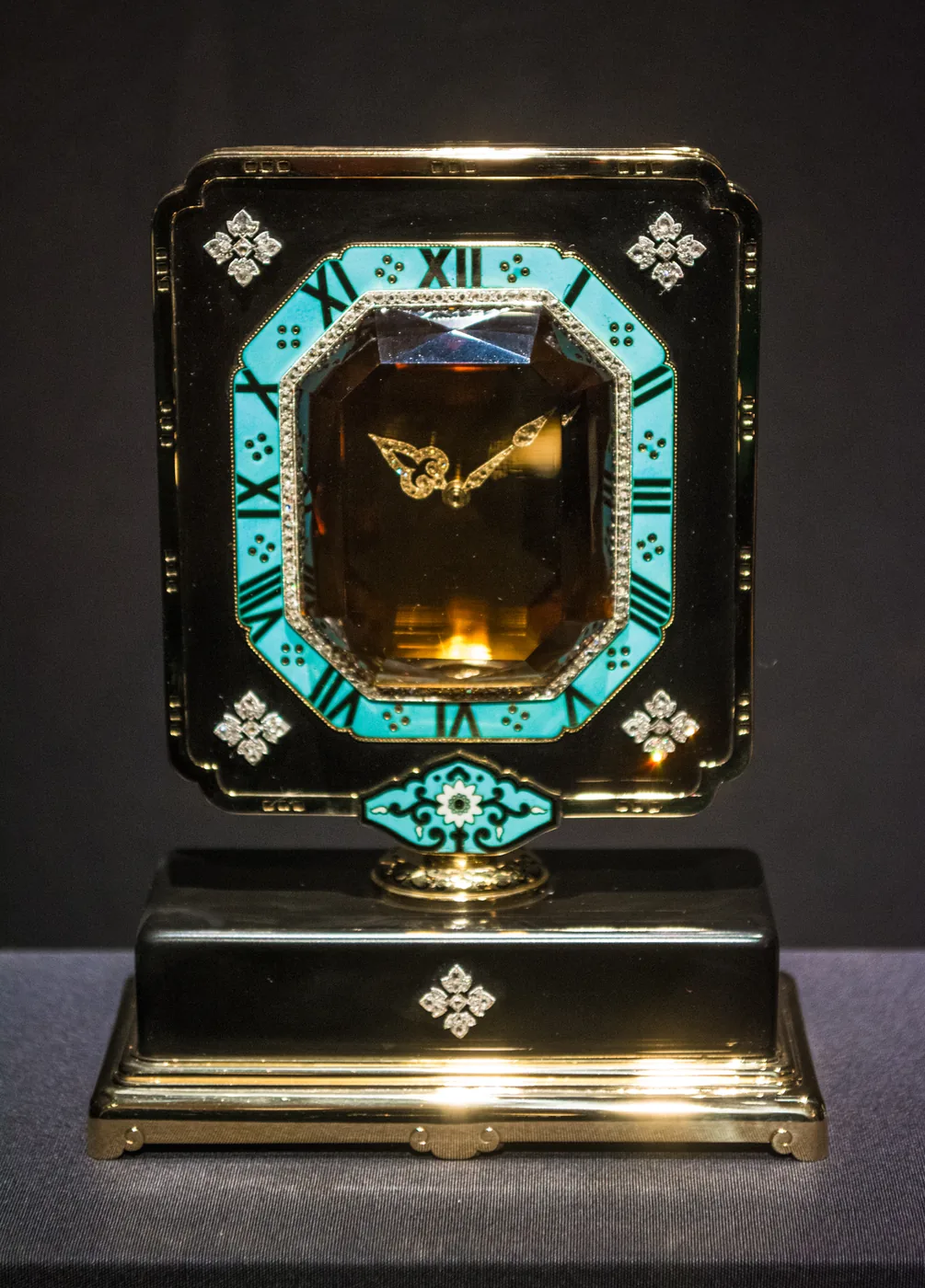

- a movement signature on a clock (the records show makers' names such as Bako, Nocturna and Concord)
- a case stamped with a reference or model number, and a number on the movement
- a mystery clock signed with the house (Paris or N.Y.) and a number
The war and the 1940s and 1950s
The literature says little about these years. The Santos was produced through the first half of the century but declined in popularity during the Second World War, when military demand favoured round watches. By one account Jacques Cartier died in 1941, and Louis died in 1942; the same account has their sons taking over their branches. The records show that wristwatches and clocks continued to be made and that some fell outside the classic shapes: a Helm (gouvernail) shape, given years from the 1940s to the 1960s, and a Prisme Mysterieuse of about 1950 are among the seller titles, and the movements of some are signed by the European Watch and Clock Co. No published account the library has drawn on describes the output of these years in detail, and none gives numbers. The stated years in the records for the 1940s and 1950s are the sellers' estimates.
London in the 1960s
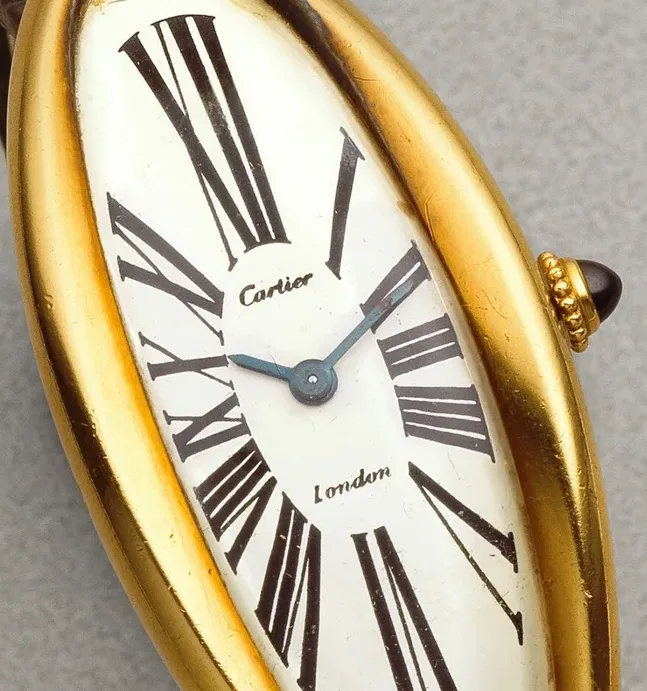
Until 1966, by one account, Cartier London imported all its watches, made in Switzerland and France, and from then it made its own, by hand, with the case maker Wright & Davies; accounts differ on when London's own production began. The London designs that account names are the Baignoire Allongee, the Pebble, the Tank Asymetrique, based on the Parallelogram that Louis Cartier drew in the 1930s, and the Crash, though accounts differ on when the Baignoire Allongee was first made. The Crash was made jointly by Jean-Jacques Cartier, Jacques's son, and a designer; the story that it was inspired by a watch melted in a car fire is described as a myth. The records add detail the literature does not give. The records hold a group of shaped watches of London make of the 1960s and 1970s, and seller titles quote London hallmarks, including a Tank hallmarked 1960, a Baignoire of 1968 and an oval baignoire of 1969, as well as watches described as made in the London workshops. The titles do not say where the watches hallmarked before 1966 were made, so they neither confirm nor contradict the statement that London imported its watches until then.
- a London hallmark, which sellers quote with its year
- signature Cartier London
- hand-finished case with the irregularities of work made one at a time
The end of the family firm
After Pierre Cartier died, the family members who ran the Paris, London and New York branches chose to sell. He died in 1964. The late 1960s were financially hard. In 1972 a businessman led a group of investors in buying Cartier Paris, and then the London and New York companies. The Must de Cartier watches, which most accounts date to 1977 and some to 1976, brought lower prices into the range, the Santos was redesigned in steel and gold in 1978, and in 1979 the firm dropped the separate treatment of the cities.
Output rose from around 3,000 watches a year to more than 160,000 by the end of the 1970s, with quartz movements the main growth. Many Must references were made in vermeil, which is gold-covered silver and not solid gold. Cartier returned to its earlier shapes with the Collection Privee Cartier Paris of 1998 (1997 in one account) to 2008, whose watches use the old names, are signed Paris and carry modern movements. A Tank Louis Cartier of the 1990s made before that collection differs from the collection's version in its dial (no 'Paris' under the name), a finer guilloche pattern and slightly thinner brancards. These are not early watches, but they share their names and shapes with early ones and are easy to mistake for them.
- the word Paris under the name on a dial (found on the revival watches of 1998 to 2008, and also on Paris-signed 1970s watches)
- quartz movements in a case with an older name
- vermeil (gold-covered silver) in Must watches
Signatures, numbers and hallmarks
The literature reviewed is thin on marks for the years before 1972, so what follows is mostly drawn from one reference of the 1970s, the Tank Normale 78092, and from the way the library's records quote early watches. On the 78092, the dial is signed Paris or Swiss at six o'clock; a signature hidden in the VII is present on some examples and not on others, and is said to appear only from a later execution. The case number may begin with the reference number, followed by a serial, while some catalogues give a four-digit serial alone; the case back is held by four screws; one catalogued example carries French assay marks; and the movement is a hand-wound calibre 78-1. These points belong to that reference and should not be applied to earlier watches.
For early watches the records show a range of practice. Case numbers of three to six digits are quoted, some with apostrophes in the thousands; one watch can carry two case numbers, and a movement may carry its own number or be signed with the Cartier name, or with the name of the European Watch and Clock Company, or of another supplier. Some cases are stamped with a maker's initials or with a reference or model number. London watches are described with the year of their London hallmark. A model name in a seller's title (Tank Normale, Baignoire, Tortue, Cintree, Carre) is the seller's description.
- dial signature (Cartier, Paris, France, London, N.Y., Swiss) and any hidden signature in a numeral
- case number or numbers on the case back, and the movement's own number
- movement signature: Cartier, European Watch and Clock Co., or another maker
- French assay marks (found on one catalogued 78092), or a London hallmark and date
- four screws holding the case back, on the 1970s Tank Normale
What to look at on an early watch
Start with the shape and its proportions: Cartier's early cases are valued for their form, and a case that has been polished loses it. On the Tank Normale of the 1970s the brancards are the first thing to go: polishing rounds their sharp chamfers towards the profile of the Tank Louis Cartier, and cannot be undone. Check the crown for a stone of the right pattern, and the clasp: a signed gold folding buckle goes with many watches.
Then read the numbers and signatures together. The dial signature, the case number, the movement signature and number and any hallmark should tell one story. On the 1970s Tank Normale 78092, a quartz movement is not original. The dial should show crisp black Roman numerals, a railway track and blued hands that match one another. Size and metal are worth checking against the reference: the 78092 is about 23 by 30 mm in 18 carat gold. Remember that gold-covered silver and plating exist in later watches, and that a revival watch of 1998 to 2008 has the old shape with a new movement.
- sharp chamfers on the brancards of a Tank Normale
- a crown stone of the right pattern
- dial, case and movement signatures and numbers that tell one consistent story
- a clasp signed Cartier in gold
- no quartz movement in a 78092 case
The watches of these years
One entry for each kind of watch of this era. Each sets it out production by production, with what to look for.




Also in the library
Other written entries that fall in these years.
- Paris, London and New York: the three houses and how to tell their watches apart
- Tonneau, from 1906
- Santos-Dumont, from 1911
- Tortue, from 1912
- Tank Normale, from 1919
- Cloche, from 1921
- Tank Cintrée, from 1921
- Tank Chinoise, from 1922
- Tank Louis Cartier, from 1922
- Ceinture, from 1927
- Tank à Guichets, from 1928
- Tank Basculante, from 1932
- Tank Asymétrique, from 1936
- Baignoire, from 1958
- Crash, from 1967
- Pebble, from 1972
Chronology
Where accounts differ
- The supply arrangement with the Paris watchmaker and the European Watch and Clock Company. One account puts a one-way arrangement to supply movements and complete watches at around 1905, with a minimum yearly order of 250,000 francs, and calls most of the stories about the supplier, including his exclusive deal with Cartier, more folklore than history; another has the watchmaker as Cartier's main supplier since 1903 and dates a formal fifteen-year contract giving Cartier exclusive rights to most of the output to 1907; a third dates a contract that formed the European Watch and Clock Company to 1919. They may describe different agreements, but the pages do not say so.
- Date of the Tank Louis Cartier. One account says the Tank Louis Cartier appeared in 1919, two years after the Tank Normale; two others place it in 1922 and treat 1919 as the year the original Tank went on sale. The later date is the more common.
- Date of the Tortue and the Tonneau. Most accounts put the tortue at 1912 and the tonneau at 1906. One places the tortue in 1913 and calls it later than the tonneau; another says the tonneau was the first public wristwatch collection.
- Who inspired the first mystery clock. One account says the firm's clockmaker in Paris was inspired by a nineteenth-century magician and watchmaker and dates the first clock to about 1912; another says he drew on his own father, an illusionist and conjuror.
- Who opened Cartier London, and when Jacques took charge. One account has Pierre Cartier open the London branch and leave Jacques in control when he went to New York in 1909. Another has Jacques looking after the London business from 1902, and a third says the brothers opened the London shop at the King's suggestion.
- Start of the Collection Privee Cartier Paris. Four accounts date the Collection Privee Cartier Paris from 1998; another says it was relaunched in 1997 for the firm's hundred and fiftieth anniversary.
- Date of the baignoire. One account has the baignoire introduced in 1912, the same year as the tortue. Accounts of the Baignoire date the first oval design to 1912 and say the curved oval watch reached production in the late 1950s, most often 1958.
- Year of the first Must de Cartier watches. Two accounts date the Must de Cartier watches to 1977, as most accounts of the Must de Cartier Tank do. One of those puts the Tank on sale in 1976 and another gives 1976 to 1977.
In the records
Counted from 2,047 listings at dealers and auction houses. Only listings a seller dates to 1972 or before are counted here; a line's own page, and its card above, also count its undated listings, so their figures are larger. These are what sellers state, not measurements, a stated year is often an estimate, and a count of listings is not a count of watches made.
Kind of object
| Kind | Listings |
|---|---|
| Wristwatches | 1,683 |
| Pocket watches | 190 |
| Clocks | 174 |
Case metal
| Metal | Listings | Share |
|---|---|---|
| Gold, any colour | 1,043 | 77% |
| Yellow | 449 | 33% |
| White | 72 | 5% |
| Pink | 10 | 1% |
| More than one colour | 6 | under 1% |
| Colour not stated | 506 | 37% |
| Platinum | 182 | 13% |
| Silver | 64 | 5% |
| Steel | 29 | 2% |
| Platinum and gold | 15 | 1% |
| Gold plated | 10 | 1% |
| Bronze | 3 | under 1% |
| Brass | 2 | under 1% |
As sellers state it. Shares are of the 1,350 listings that name a metal. 5 more name a stone, a wood or the shape of the case instead. A listing that says "gold" or "18K gold" names no colour: it is counted under "colour not stated", not as yellow gold. Carat, where a listing of gold gives one: 18k 713 · 14k 23 · 9k 2.
Case size
| Size | Listings | Share |
|---|---|---|
| 23 mm | 66 | 8% |
| 25 mm | 38 | 5% |
| 26 mm | 30 | 4% |
| 24 mm | 29 | 4% |
| 20 mm | 26 | 3% |
| 32 mm | 26 | 3% |
| 21 mm | 25 | 3% |
| 30 mm | 25 | 3% |
| Other sizes | 513 | 66% |
As sellers state it. Shares are of the 778 listings that give a size.
Listings by decade the seller gives
| Decade | Listings |
|---|---|
| 1840s | 2 |
| 1850s | 1 |
| 1870s | 2 |
| 1890s | 3 |
| 1900s | 35 |
| 1910s | 140 |
| 1920s | 367 |
| 1930s | 339 |
| 1940s | 173 |
| 1950s | 208 |
| 1960s | 337 |
| 1970s | 440 |