Tank Cintrée
The Tank Cintrée is the curved, elongated rectangular watch Cartier introduced in 1921, two years after the Tank went on sale in series. It was designed, made and sold in Paris at first; New York and London made their own curved Tanks later, and the houses' watches differ in dial, case and quality. The classic form has elongated Roman numerals, a chemin de fer minute track that bows with the case, Breguet hands and a sapphire cabochon on a beaded crown. Output was always small. Between 1998 and 2008 the Collection Privée Cartier Paris revived it, and new and re-edited versions followed in 2017, 2018, 2021, 2023 and 2026.
Cartier's entries are arranged by model, not by reference number, because its reference numbers are several systems at once and many of its watches carry none. The houses are set out in Paris, London and New York.
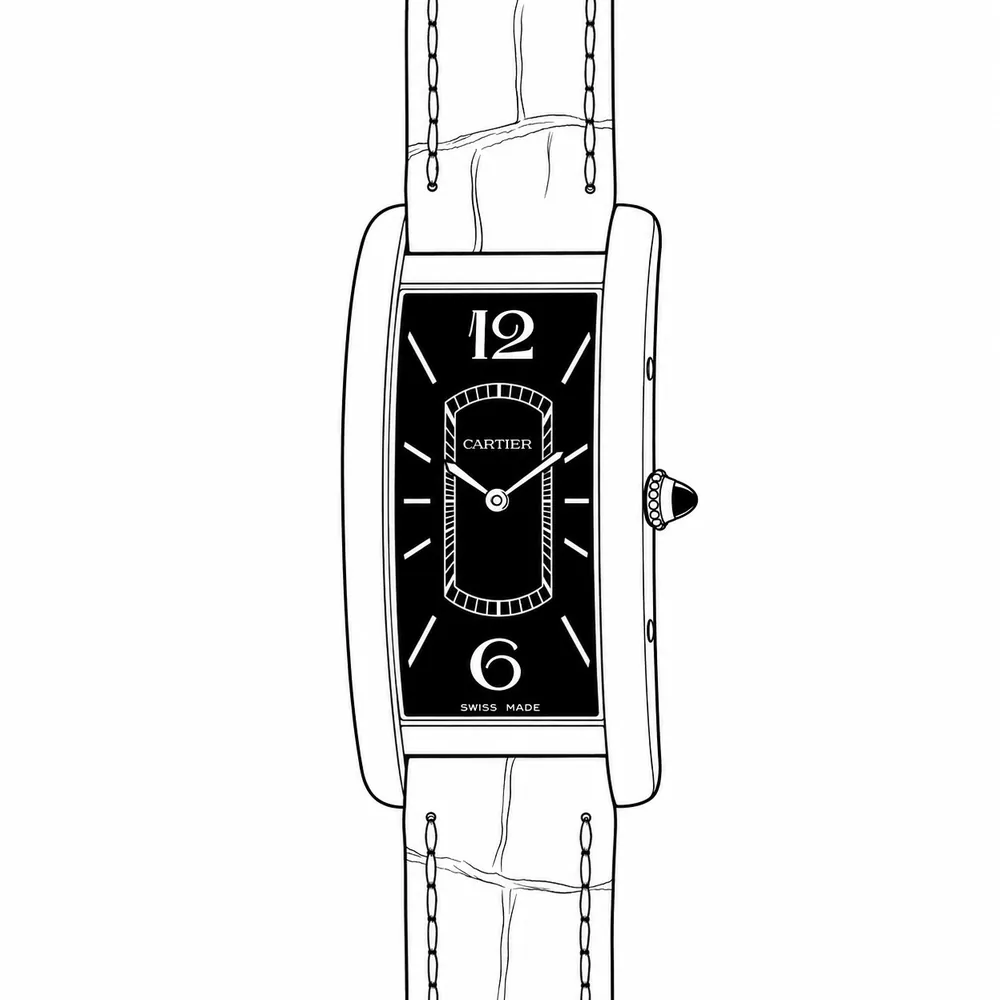

- Made
- from c. 1921The launch year of 1921 is agreed; the model has never been dropped for good, and the published accounts give no firm date for the end of the vintage production, so the span is left open.
- On record
- 210 listings106 of them give no reference
- Reference numbers
- 12 described43 seen in listings
- House named in the title
- Paris 23, London 8, New York 1most older watches are not labelled
What to look for
Details cut from photographs of watches of this line on record. Each was chosen by eye from a listing on the line and then checked again against the words beneath it. More sit beside the productions and parts they belong to, below. Select the small mark in a picture's corner for its holder and a link to its listing.



Components
3 watches of this line, oldest first. Each photograph is turned upright and scaled so the dial is the same height, and every crop is cut from the same place on the dial, so one row shows one part across them all. A watch is shown only if its seller's title names the line and the picture has been checked by eye, twice, to show it. Years are as sellers give them. Each picture is a detail; select the small mark in its corner for its holder and a link to its listing; the whole watch is shown only for holders whose pictures may be shown whole.
| 2019 | 2022 | undated | |
|---|---|---|---|
| Signature under twelve |  |  |  |
| Dial above six |  |  |  |
| Numeral at twelve |  |  |  |
| Numerals at seven and eight |  |  |  |
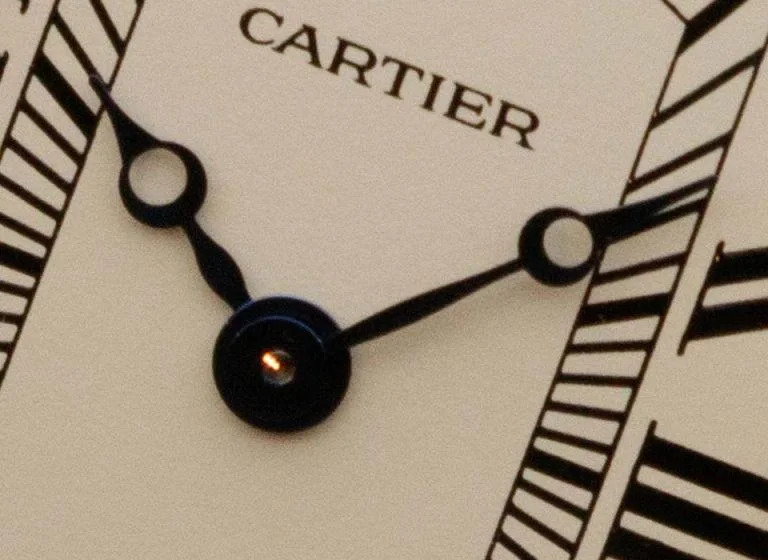
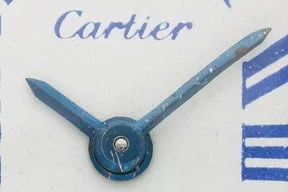
| Hands |  |  |  |
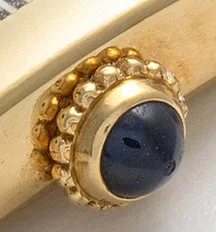
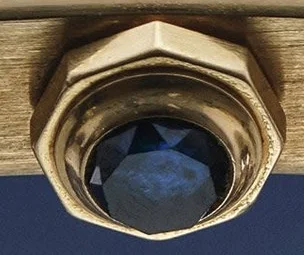
| Crown |  |  |  |
| Case corner and lug |  |  |  |
| Reference | WGTA0025 | WGTA0025 | 4122 |


By house and period 11 described
Paris, 1920s onward
The original watches of 1921 were designed, made and sold in Paris, at a time when the three Cartier houses worked fairly independently. At first the cases were made in the Paris workshop and fitted with movements from Switzerland; at some unrecorded point Jaeger became able to make the whole watch and send it to Cartier complete, and the hallmarks on the case should show where a case came from. The first watches came in three sizes set by 7, 8 and 9 ligne movements, the 9 ligne reaching 46.5 mm by 23 mm. The curved minute track, elongated Roman numerals, Breguet hands and a prominent pointed sapphire cabochon define the type. Platinum was first used in 1923, though no watch of that year is known and the earliest surviving platinum example is of 1924; a medium-size platinum watch of 1930, made in France, has its original platinum seven-link bracelet. A silver-cased Paris watch of 1926, described as unique or possibly unique, has exploded, elongated Arabic numerals and a European Watch movement, and the luminous watch of about 1928 to 1929 later sold in London has a French eagle head hallmark on its case and is described by one account as made in France.
Signature and marks. The original design carries Cartier alone on the dial; the 2021 re-edition copies it by dropping every other signature. The literature does not say whether vintage Paris dials add the word Paris. A case made in France carries French hallmarks, such as the eagle's head for 18 carat gold on the 1929 watch made in France. Movements may be signed European Watch and Clock Co.

- Breguet hands on the early watches; sword-shaped hands later
- protruding pointed sapphire cabochon on a beaded crown on the first watches; on Paris watches that sellers date to the 1960s in the library's records, often an octagonal crown with a faceted stone
- flat caseback sunk into the curve
- French hallmarks inside the case
New York, early 1930s to 1970s
Cartier New York was the first of the other houses to take up the curved shape, with watches leaving its workshop from the early 1930s. They were sold as curved Tanks, never under the French name, because New York did not use French model names. Curved Tanks were on sale there by 1934, and a New York design drawing made for a client is dated 1935 in one caption and to 1931 or 1932 in another account. One collector holds that quality fell through the century, ending in a gold-filled curved watch made in Switzerland by Bueche-Girod for New York at the end of the 1970s, which he does not count as a true Cartier object; another expert regards all New York curved Tanks as Cintrées.
Signature and marks. Not given in the literature beyond the sale name: the New York watches were called curved Tanks, not Cintrées.
- sold as a curved Tank
- late examples gold-filled
References: 21612
London, 1960s onward
Cartier London made curved Tanks mostly in the 1960s under Jean-Jacques Cartier, and the model had a small revival there in the late 1960s. Its most distinctive dial drops the chemin de fer and stretches the painted Roman numerals out to the edge, so that their feet form a rectangle at the centre; the dial was used on both the Cintrée and the less curved elongated Tank, with flame-blued sword-shaped hands in place of Breguet hands. London watches with the classic chemin de fer dial are also found in the library's records, some with LONDON printed on the dial. The London watches were not named Tank Cintrée when sold, differ slightly in dimensions from the Paris watches, and usually carry a much flatter cabochon. A London-sold watch of 1929 is exceptional: it has luminous Arabic numerals and luminous cathedral hands, a French eagle head hallmark, and a personal engraving on the case back dated 1929. Accounts differ on whether it was made by Cartier London or made in France about 1928 to 1929 and sent to London to be sold.
Signature and marks. The literature gives no dial signature for the London watches; on some London watches with the classic dial in the library's records LONDON is printed below the centre, though sellers describe some of those dials as restored or reprinted. The 1929 watch has a French eagle head hallmark and an engraved case back.
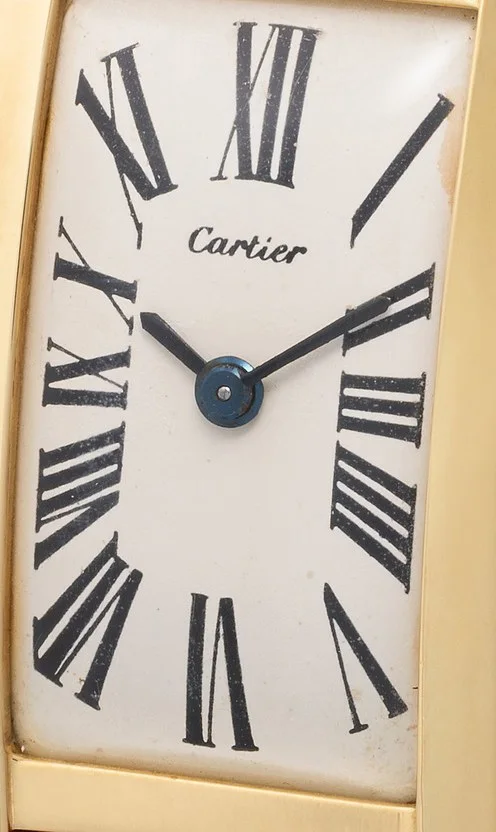

- no minute track and long stretched Roman numerals on the distinctive London dial
- flame-blued sword hands with that dial
- cabochon flatter than on the first Paris watches
- slightly different proportions from Paris watches
Dual Time, two movements
The dual-time Tank Cintrée carries two dials, one above the other, each with its own movement and its own crown. The case was altered for it, with squared-off lugs and sharper angles, and the crowns are flatter octagonal ones with a flat cabochon instead of the knurled crown with a pointed cabochon of the time-only watches. The upper dial usually has all twelve Roman numerals and the lower only 12, 3, 6 and 9; other layouts have Arabic numerals in an Art Deco style on the lower dial, or Chinese numerals at 12, 3, 6 and 9 on a version believed sold only in Asia in 100 white gold and 100 rose gold watches. Some platinum watches have a salmon dial, fifty made. One vintage-looking watch of this type has Paris on the dial, two movements based on the ETA 2412 and blued hands. Its introduction is put at 1990 in one account and at 1998, with the start of the Collection Privée, in another.
Signature and marks. Cartier, with Paris on the dial of the watch described as dating from about 1990; the Collection Privée Cintrées are said not to carry Paris.
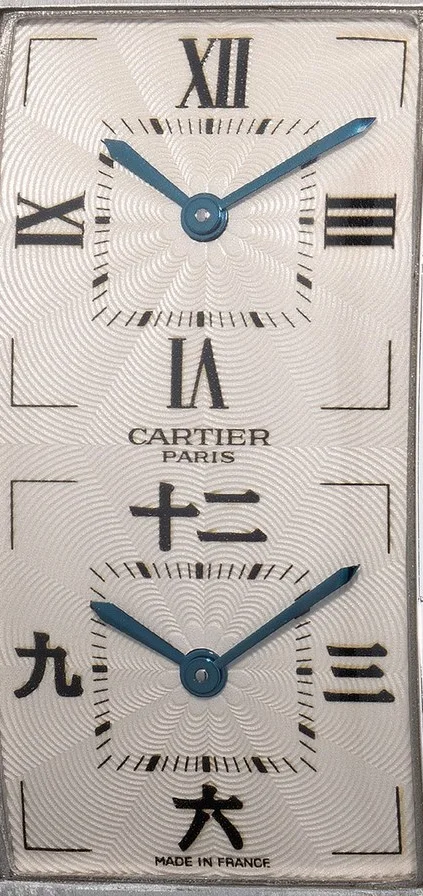

- two octagonal crowns with blue cabochons
- squared lugs
Collection Privée Cartier Paris, 1998 to 2008
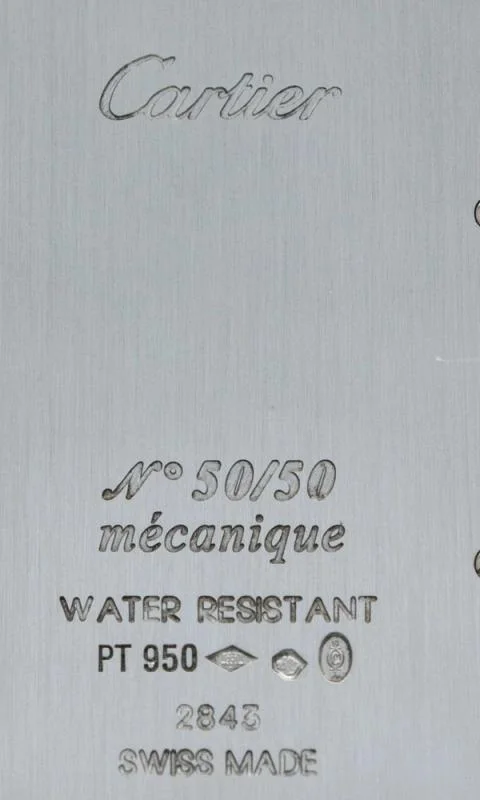
The Collection Privée Cartier Paris ran from 1998 to 2008 and re-created historic Cartier shapes in precious metal with hand-wound movements. For the Tank Cintrée it made a time-only watch in 2004 (also dated 2005) and the dual-time versions above. The time-only watch was limited to 50 in platinum and 150 in yellow gold, in the proportions of the largest 9 ligne vintage case, 46 by 23 mm, with Arabic numerals, a flame-blued Breguet hand set and a manual-wind calibre based on the Jaeger-LeCoultre 849. Its dial was inspired by the 1929 London watch except that the numerals are not luminous and the hands are not cathedral. The limited editions were individually numbered within their series; the other pieces simply took ascending case numbers. Some platinum watches came with a brick-style white gold bracelet, and the sets were delivered in boxes signed Collection Privée Cartier Paris. A few unique watches were made in this period, including a platinum watch with red numerals, its case back engraved 2007/n.1 (the literature gives the numerals as Roman, sellers' descriptions as Arabic), and another with red Urdu numerals and Cartier Paris on the dial; these are described as running on calibre 9770 MC, a manual calibre based on a Jaeger-LeCoultre ébauche, though the passage may mean the Collection Privée Cintrées as a whole.
Signature and marks. Cartier only on the dial of the Cintrée; Paris is printed under the name on every other Collection Privée model, but one custom Urdu-numeral Cintrée carries Cartier Paris. Limited watches are numbered within their series; a unique piece is engraved on the back with its year and number, such as 2007/n.1.

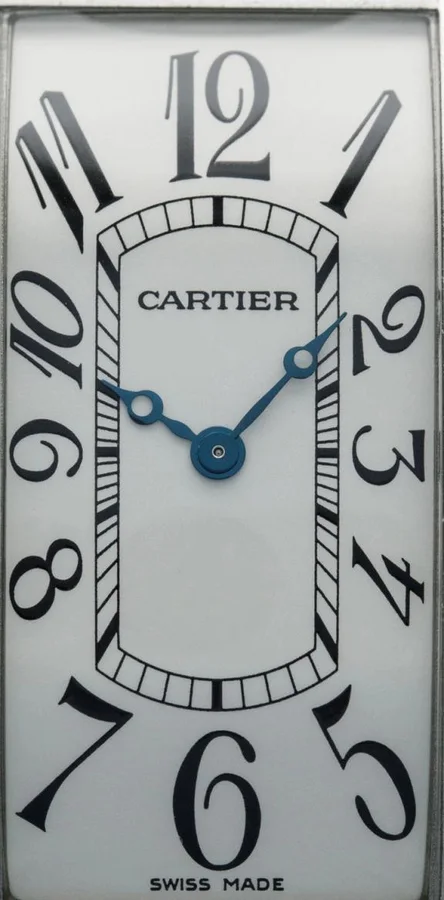

- Collection Privée box and papers
- brick bracelet on some platinum watches
Special orders
In the modern period Cartier has given a few collectors the chance to commission custom Tank Cintrées. Before Cartier was bought by Richemont in 1993 clients had more freedom in these commissions; since then the dial layout cannot be changed greatly and some signatures cannot be removed. Current custom watches are never called unique but 'commande spéciale', French for special order.
Signature and marks. The wording commande spéciale describes the order, not a printed mark.
- unusual numeral colours or scripts
- dials not found in a standard series
Skeleton and 2018 series
The 2017 skeleton Tank Cintrée uses the curved minute track as the frame to which the exposed movement is attached, and was part of the celebrations of one hundred years of the Tank. The three watches of 2018 followed: a platinum watch limited to 100, and yellow gold and rose gold watches that were not limited but made for one year only. The three 2018 watches measure 46.3 by 23 mm and 7.2 mm high (7.6 mm in another account) and use manual-wind calibre 8971 MC, based on Jaeger-LeCoultre 846. Their dials have numerals at 12 and 6 with baton markers around the curved track and sword-shaped hands; most accounts give the numerals as Arabic, one as Roman. The cabochon is blue on the gold watches and red on the platinum, and is more pronounced again. They have a snap-on back with twin slots and are rated to 30 metres. The platinum watch came on a strap with a tang buckle.
Signature and marks. The literature does not give the dial signature of the 2018 watches.
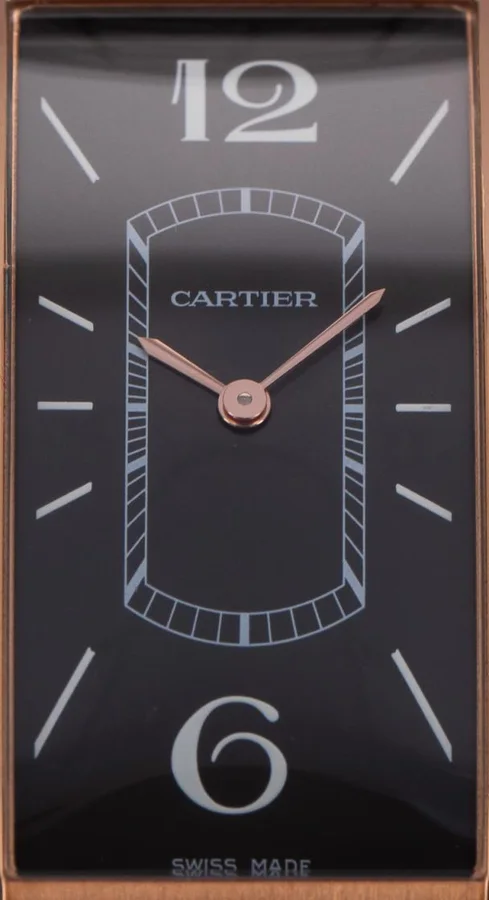

- snap-on back with twin slots
- platinum with red cabochon, gold with blue
Centenary limited edition, 2021
A yellow gold limited edition of 150 watches, issued in 2021 for the hundredth year of the model, sold before launch. It follows the 1921 watch closely: a parchment or ivory dial with a grained surface, blue Breguet hands, a curved chemin de fer, and no signature other than Cartier. The case is 46.3 by 23 mm and 6.4 mm high, thinner than the 2018 watches, with a back that slides into the case and is held by lateral screws; it is not water resistant and has a mineral crystal. The movement is 9780 MC, based on Jaeger-LeCoultre 849, with 36 hours reserve (35 in another account). It is in effect a new dial on the case and movement of the 2004 or 2005 reference 2718. The strap is calfskin with a pin buckle. Descriptions of the cabochon differ: one says smaller and thinner than before in a heavier gold crown, others that it is a little sharper than on earlier modern watches.
Signature and marks. Cartier alone on the dial, with every other signature removed.
- ivory or parchment grained dial
- Breguet hands in blue
- cabochon crown set slightly pointed
- 46.3 x 23 x 6.4 mm
Les Rééditions, platinum, 2023
A 150-piece 950 platinum edition in Cartier's Les Rééditions, individually numbered, available from the end of September 2023 and marking a hundred years of the platinum Tank Cintrée. The case is 46.3 by 23 mm and 6.03 mm high, with a beaded crown set with a ruby cabochon, brushed surfaces at the ends and sides, a mineral crystal and a solid back; it is not water resistant. The dial is eggshell with black printed Roman numerals and track, with blued steel apple-shaped hands, and the Swiss made mention is left off. The movement is 9780 MC, described as the hand-wound Jaeger-LeCoultre 849; one account calls it automatic with a 33-hour reserve.
Signature and marks. The Swiss made mention is left off the dial; the literature gives nothing more.
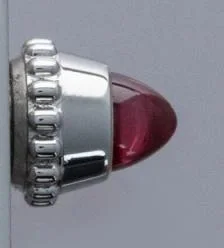

- eggshell dial
- platinum ardillon buckle on black alligator
- 6.03 mm height
References: WGTA0193
Montenapoleone, Milan boutique edition
A platinum watch made for the Milan boutique, 46.3 by 23 mm and 6.9 mm thick, with a ruby cabochon on the crown and brushed horizontal and polished vertical sides. The silvered opaline dial takes up the codes of the 2004 watch, with chemin de fer, Arabic numerals and hollow apple hands; red appears on the alligator strap, the cabochon and the 1 and 6 of the dial, the pair standing for the boutique's street number, 16. The back reads Milano Edition. It is not a limited edition, but production is limited and largely to demand. It runs on calibre 1917 MC, 21,600 vibrations per hour, 38 hours.
Signature and marks. Milano Edition on the back; the literature gives no dial signature.
- Milano Edition on the back
- red 1 and 6 on a silvered opaline dial
- ruby cabochon
Cartier Privé La Collection, 2026
A yellow gold Tank Cintrée shown at Watches and Wonders 2026 in the Cartier Privé 'La Collection' group, with a gold dial, Roman numerals with the curved chemin de fer, blued steel apple-shaped hands, a semi-matte dark grey alligator strap and the manual-wind calibre 1917 MC with 38 hours reserve.
Signature and marks. The literature gives no dial signature.
- gold dial with blued apple hands
- dark grey alligator strap
References: WHTA0037
Chronology
Specification
| Case | Curved rectangular case in platinum or gold; the original is given as 44.7 x 23 mm and 6.7 mm thick at its highest point, the largest vintage cases run to 46.5 mm; flat back recessed into the case |
| Sizes | Three vintage sizes set by the movement: 7, 8 and 9 ligne |
| Dial | Roman numerals and a curved chemin de fer minute track in the classic form; no seconds hand |
| Hands | Blued Breguet (pomme) hands in the early form; sword-shaped hands appear later |
| Crown | Usually a beaded crown set with a sapphire cabochon, though octagonal crowns also occur; on Paris watches that sellers date to the 1960s in the library's records the crown is often octagonal with a faceted stone; red or ruby cabochon on the platinum watches of 2018 and 2023 and the platinum Montenapoleone |
| Movement | Calibre 123 supplied by LeCoultre in the 1920s watches; later manual-wind calibres from Jaeger-LeCoultre and others |
| Strap | Folding clasp on most early watches; some on metal bracelets |
Dial 8 described
The classic dial has elongated Roman numerals and a chemin de fer that bows outwards from 10 to 1 and from 5 to 7, and it carries no seconds hand. Four other schemes depart from it: Arabic numerals, stretched numerals with no track, the dual-time pair and the 2018 mixed layout. Vintage dials look hand drawn, including the Cartier signature, and recent ones sometimes look less so.
Roman numerals with chemin de fer
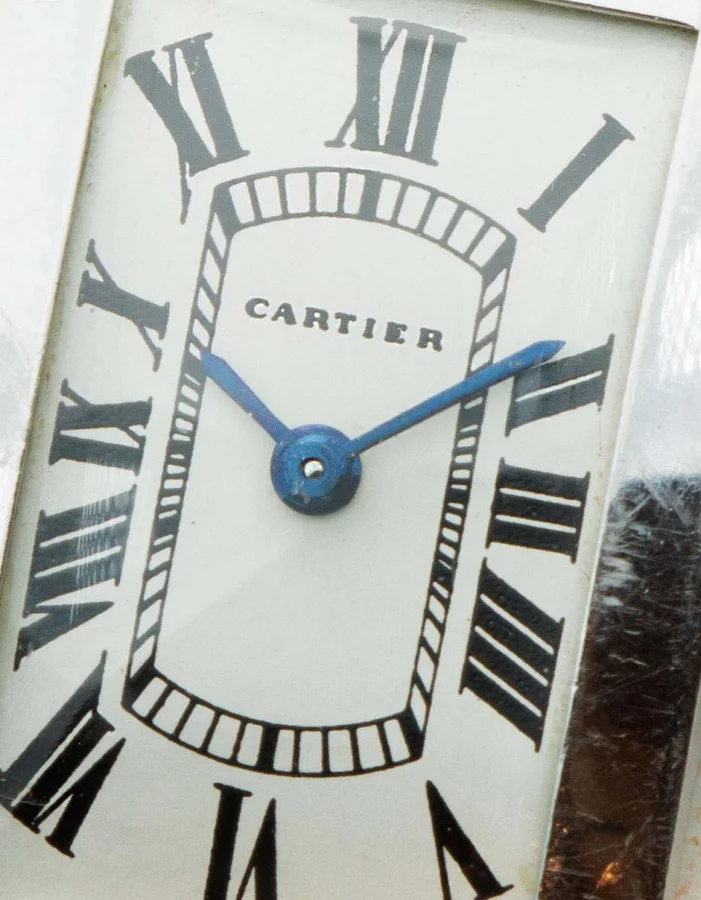
The main design, developed from the Tank Normale dial: long Roman numerals and a minute track that curves with the case, the feet of the seven o'clock numeral meeting the corner of the track at a sharp angle. Index length depends on case size, longer on the 9 ligne watches and shorter on the 7 and 8 ligne.
- sharp angle at the feet of VII
- curved ends to the track
- long numerals on large watches
Arabic numerals, black ink
Early Arabic-numeral dials exist from before the late 1920s, painted in black ink, including a silver-cased Paris watch of 1926, described as unique or possibly unique, with exploded, elongated Arabic numerals. One further watch has the case stamped EJ, numbered 21082, 1246 and 27631, a movement signed European Watch and Clock Co. and the inside of the case stamped JC with an import letter for Glasgow in 1936.
- black painted Arabic numerals
- chemin de fer retained
Luminous Arabic numerals, radium
A handful of watches from the late 1920s and early 1930s have luminous numerals. The best known is the London-sold watch of 1929 with large radium Arabic numerals and radium cathedral hands; its dial was restored with paint after it was found with its original dial badly aged. A white gold watch with a similar dial, restored by Cartier with modern luminous material, is described as the only one known in that metal.
- large Arabic numerals filled with luminous material
- cathedral hands
Stretched Roman numerals, no chemin de fer
Born at Cartier London in the 1960s and used on the Cintrée and the elongated Tank. The numerals run out from the centre to the case edge, and their feet make a rectangle in the middle of the dial. Hands are plain flame-blued sword hands.
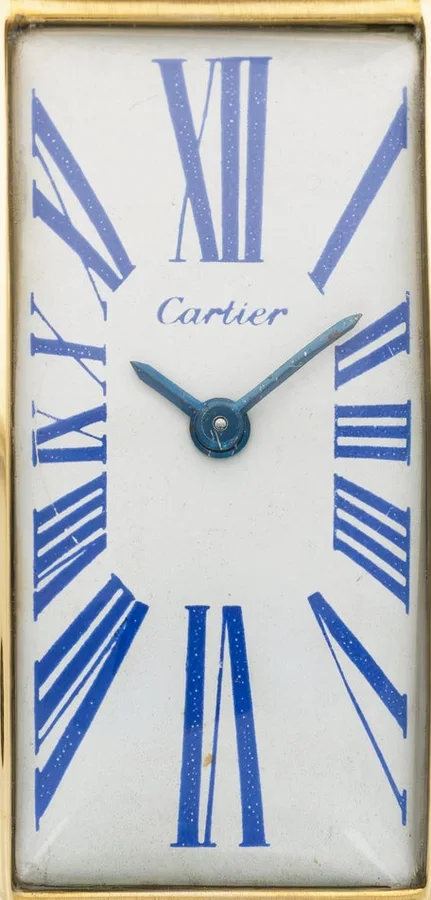

- rectangle formed by numeral feet
Dual time layouts
Two dials set one above the other. The common layout has twelve Roman numerals above and 12, 3, 6 and 9 below; others have Art Deco Arabic numerals or Chinese numerals at the same four points below. Platinum watches with a salmon dial were made in a series of fifty.
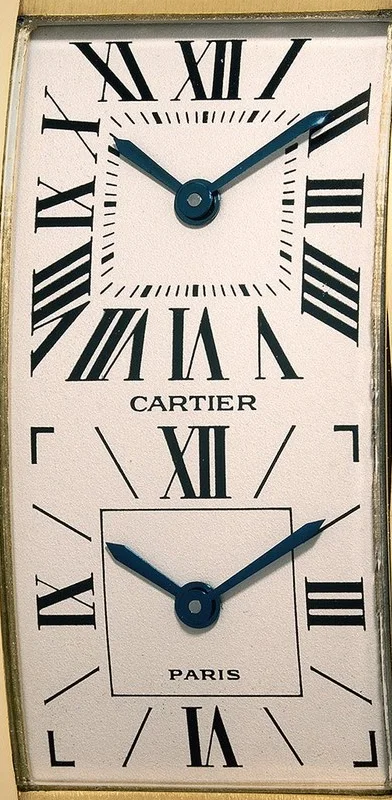

- salmon dial on platinum
Arabic 12 and 6 with batons
A new dial of 2018 with numerals at 12 and 6, baton markers between them, the railroad track and sword-shaped hands. Most accounts give the 12 and 6 as Arabic; one gives them as Roman.
- Arabic 12 and 6
- baton markers
Unusual numeral colours and scripts
A few watches of the Collection Privée years, made as unique pieces or custom orders, have red numerals, Roman or Arabic in different descriptions of the same watch, or red Urdu numerals; the Urdu example is signed Cartier Paris.
- red printed numerals
- non-Latin numerals
Ivory, parchment and eggshell dials
The 2021 gold edition has an ivory or parchment dial intended to look like an aged vintage dial, with a grained surface and higher gloss print; the 2023 platinum watch has an eggshell dial. Early platinum watches are described as having a bright dial that often aged to eggshell.
- grained cream dial
- glossy printed numerals
Hands 4 described
Breguet (pomme, apple) hands are the standard on early watches, which also sets the Cintrée apart from the Tank allongée with its leaf hands. Sword hands appear later, and other shapes belong to particular watches.
Blued Breguet hands
Used on most early watches and returned on the 2004, 2021 and 2023 editions in flame-blued or blued steel.

Cathedral hands
Luminous lume-filled cathedral hands are on the 1929 London-sold watch with radium numerals.
- lume-filled cathedral hands
Flame-blued sword hands
Sword-shaped hands appear on the Cartier London dial of the 1960s, and sword-shaped hands are also noted generally among later hands.

Épée hands
Narrow épée hands go with the 2018 Arabic and baton dial.
- épée hands
Case and sizes 4 described
The case is a long curved rectangle whose thickness changes along its length; the height quoted is the greatest, at one point in line with the crown. The flat back is sunk into the curve so it is hidden when worn. Vintage cases vary a good deal: some of the 1930s are noticeably thinner than some of the 1950s, and the screws and hallmarks differ. The literature gives sizes by movement size in lignes, with large and medium used loosely.
9 ligne, large
The largest vintage size is 23 mm wide and up to 46.5 mm long, with the original of 1921 given as 44.7 mm and 6.7 mm thick; another source rounds the length to 45 mm, and another says 46 mm. A 1924 watch is given as 4.63 by 2.30 cm. This size is the model for the 2004 and later re-editions at 46 to 46.3 mm.
- 23 mm width
- 44.7 to 46.5 mm length
8 ligne and 7 ligne, smaller
Two smaller vintage sizes, with shorter numerals; a platinum watch of 1930 made in France is described as medium size. The literature gives no millimetre sizes for them.
- shorter numerals
- smaller case
Six-lug leather version
A 9 ligne watch was made with an extra metal lug between the two normal lugs for a leather strap, apparently to match women's watches of the time.
- three lugs on each side
Slide-in back, 2004 to 2021 construction
The 2021 case, like the yellow gold reference 2718 of 2004 or 2005, has a back that slots into the case middle with side screws and is not water resistant; on platinum reference 2843 watches in the library's records the back is held by screws set through it near its edge and engraved water resistant. The 2018 case has a snap-on back and is rated to 30 m. The 2023 platinum case is 6.03 mm high.
- lateral screws
- snap-on back with slots
Crown 3 described
The crown is usually beaded and set with a sapphire cabochon; the platinum watches of 2018 and 2023 and the Montenapoleone have a red or ruby cabochon. Its shape and height vary by house and period.
Beaded crown, prominent pointed cabochon
On the first watches the jewel stands well out from the beaded crown; later it was flattened. It is returned in 2018 and, slightly, in the 2021 edition.
- pointed jewel standing proud
Flat cabochon, London
London watches usually have a far flatter jewel.
- jewel flatter than on the first Paris watches
Octagonal crown with flat cabochon
Used on dual-time watches, one crown for each movement. A watch from about the 1950s is also pictured with an octagonal crown and its original bracelet.

Movement 5 described
Louis Cartier asked Edmond Jaeger for an especially thin movement; in Cartier's naming it is calibre 123, described as round with 18 jewels, a Swiss lever escapement and a Breguet balance spring, though one account calls the thin movement rectangular. European Watch and Clock Co. was the Cartier and Jaeger company that supplied movements. Later watches use other manual-wind calibres, and the dual-time watch two movements based on the ETA 2412.
Calibre 123
Made by LeCoultre and sold on to European Watch and Clock Co.; a 1924 movement is described with Côtes de Genève and rhodium plating, while another account calls the calibre gilt. Many movements are signed EWC. It fits in the curve with a fraction of a millimetre to spare.
- EWC signature
- Côtes de Genève
9780 MC and 849 base
A manual-wind calibre based on the Jaeger-LeCoultre 849, 1.85 mm thick (1.89 mm in one account). It is in the 2004 or 2005 watch of the same case, and in the 2021 and 2023 editions. Reserve is given as 35 or 36 hours; one account of the 2023 watch calls it automatic with 33 hours.
- 9780 MC
8971 MC
Manual-wind calibre based on Jaeger-LeCoultre 846 in the 2018 watches.
- 8971 MC
9770 MC
A manual-wind calibre based on a Jaeger-LeCoultre ébauche, named for the unique Collection Privée Cintrées with red numerals and perhaps meant for the series as a whole. Sellers give it for the platinum limited edition, reference 2843, and give 9780 MC for the yellow gold reference 2718.
- 9770 MC
1917 MC
A small tonneau-shaped manual calibre, under 3 mm thick, in the Milano Edition and the 2026 gold watch, with 38 hours reserve.
- 1917 MC
Bracelet and strap 4 described
Cartier offered metal bracelets from the 1920s, and most early Cintrées were fitted with Cartier's folding clasp, which was not adjustable until 1989, so straps were made to fit the wearer.
Platinum seven-link bracelet
Platinum watches of 1927 and about 1930 are pictured on a matching seven-link platinum bracelet.
- seven-link platinum bracelet
Mesh bracelets
Milanese bands and fishscale mesh are recorded on vintage Cintrées, along with an original gold bracelet on a 1951 yellow gold watch.
- Milanese or fishscale mesh
Brick-style bracelet
Some Collection Privée platinum watches came on a brick-style white gold bracelet, a nod to earlier ones.
- brick links
Tang-buckle strap
The 2018 platinum watch and the 2021 and 2023 re-editions come on a leather strap with an ardillon buckle, not a folding clasp.
- pin buckle
Box and papers 1 described
Little is recorded about boxes and papers apart from the Collection Privée.
Collection Privée box and papers
Larger boxes in a better leather, signed Collection Privée Cartier Paris, with extra printed papers for limited pieces.
- signed larger box
- certificate
Reference numbers
A four-digit number is stamped on the case and covers a case; a code beginning W, or the newer letter codes, is a catalogue number for one version of it (metal, dial, strap). Many older watches carry neither. The last column is the listings on record under the number, as its own page counts them.
| Number | What it is | Listings |
|---|---|---|
| 2843 | The platinum time-only Collection Privée limited edition of 50, with Arabic numerals and Breguet hands; dated 2004 by the published accounts that name the series; sellers' stated years for the number run from 2000 to 2006, and sellers give its calibre as 9770 MC. | 8 |
| 2718 | The yellow gold limited edition of 150 from the same series, whose case and movement the 2021 watch repeats; sellers also list it beside WGTA0057. Catalogue codes seen beside it in listings: WGTA0057 | 17 |
| WGTA0057 | The 2021 yellow gold centenary limited edition of 150; the literature names this code, and sellers pair it with 2718. | 8 |
| WGTA0193 | The 2023 platinum re-edition of 150 pieces. | 6 |
| WHTA0037 | The yellow gold Cartier Privé Tank Cintrée of 2026. | |
| 2767 | The white gold dual-time Collection Privée watch, as sellers describe it, limited to 100. | 5 |
| 2768 | The pink gold dual-time Collection Privée watch, as sellers describe it. | 4 |
| 4122 | The 2018 rose gold watch, as sellers describe it, with WGTA0025 seen beside it. Catalogue codes seen beside it in listings: WGTA0025 | 3 |
| WGTA0025 | The pink gold 2018 watch with a black dial, as sellers describe it. | 6 |
| 4124 | A 2018 platinum Tank Cintrée, as sellers describe it. | 2 |
| HPI01123 | The platinum skeleton Tank Cintrée with a diamond-set bezel, limited to 100, as sellers describe it (one listing, stated year 2017). | 1 |
| 21612 | A gold-plated New York curved Tank Cintrée, as one seller describes it; the literature names no New York reference. | 2 |
Originality
- Dials of the 1920s, bright when new, often age to an eggshell or darker tone; whether a dial's signature is correct, or whether it has been restored or reprinted, is hard to settle without a reference example.
- Radium dials are sometimes restored with paint or modern luminous material, as with the 1929 London watch, so luminous numerals alone prove nothing.
- Hallmarks, case screws and case thickness vary across vintage watches, so a replaced case can be hard to spot; the hallmark on the case shows its origin.
- Movements signed European Watch and Clock Co. were still made by Jaeger, so the movement signature alone does not name the maker.
Names
- Cintrée. The French for curved.
- Curved Tank. The name under which Cartier New York sold its curved watches.
- Grande Tank Cintrée. Sellers use it in titles for large vintage watches.
- CPCP. Short for Collection Privée Cartier Paris.
Where accounts differ
Points on which the published literature and the library's own records do not agree, or on which the literature contradicts itself.
- Where the Cintrée began. One published account says the original watches of the early 1920s were all designed, made and sold in Paris and that New York adopted the curve in the early 1930s. Another says the watch first appeared in New York. The library's records do not settle it.
- The luminous watch of 1929. One published account describes it as a Tank Cintrée by Cartier London, while a caption in another says it was made in France in about 1928 or 1929 and only afterwards sent to the London house for sale.
- Date of the limited edition with Arabic numerals. Several published accounts date the platinum and yellow gold limited edition to 2004; another dates reference 2718 to 2005. In the library's records, reference 2843 has stated years from 2000 to 2006 and reference 2718 from 2004 to 2021, since the 2021 watch is listed with the same number.
- Introduction of the dual time. One published account says the dual-time Cintrée was introduced in 1998 with the Collection Privée; another dates it to 1990 and describes a Paris dial. The library's records hold dual-time listings with years stated between 1990 and 2006.
- Thickness of the Collection Privée case. One published account gives the Collection Privée watches as 7.2 mm thick; another says the 2004 limited edition and the 2021 watch are the thinnest ever made, and a third that the 2021 case is the same as the 2005 case at 6.4 mm.
- Numerals of the 2018 dial. Two accounts give the 2018 dial Arabic numerals at 12 and 6 with batons; another describes the same watches with Roman numerals at 12 and 6. Sellers in the library's records describe the 2018 references with Arabic numerals.
- Shape of the original movement. One account, a Cartier caption it prints and another describe calibre 123 as round; a third says Jaeger developed an especially thin rectangular movement for the case. One of those accounts also calls it gilt where the 1924 caption says rhodium-plated.
- Numerals of the unique red-numeral watch of 2007. One account describes the platinum Collection Privée Cintrée engraved 2007/n.1 with Roman numerals printed in red; the auction descriptions in the library's records of the unique platinum reference 2843J, case number 1.1 of 2007, give it red Arabic numerals.
In the records
Counted from 210 listings at dealers and auction houses whose title, or whose reference, places them on the line; 162 state a year. These are what sellers state, not measurements, and a count of listings is not a count of watches made.
Case metal
| Metal | Listings | Share |
|---|---|---|
| Gold, any colour | 115 | 73% |
| Yellow | 66 | 42% |
| Pink | 13 | 8% |
| White | 12 | 8% |
| Colour not stated | 24 | 15% |
| Platinum | 42 | 27% |
As sellers state it. Shares are of the 157 listings that name a metal. A listing that says "gold" or "18K gold" names no colour: it is counted under "colour not stated", not as yellow gold. Carat, where a listing of gold gives one: 18k 101.
Case size
| Size | Listings | Share |
|---|---|---|
| 23 mm | 38 | 38% |
| 46.3 mm | 16 | 16% |
| 46 mm | 15 | 15% |
| 45 mm | 5 | 5% |
| 20 mm | 3 | 3% |
| 46.5 mm | 3 | 3% |
| 22.5 mm | 2 | 2% |
| 24 mm | 2 | 2% |
| Other sizes | 15 | 15% |
As sellers state it. Shares are of the 99 listings that give a size. On a watch that is not round some sellers give the width and some the length, so one watch can stand under two sizes.
Movement
| Kind | Listings | Share |
|---|---|---|
| Hand-wound | 134 | 99% |
| Mechanical, winding not stated | 1 | 1% |
Shares are of the 135 listings whose description says how the watch is driven.
Listings by decade the seller gives
| Decade | Listings |
|---|---|
| 1920s | 8 |
| 1930s | 8 |
| 1940s | 1 |
| 1950s | 5 |
| 1960s | 15 |
| 1970s | 28 |
| 1980s | 2 |
| 1990s | 15 |
| 2000s | 30 |
| 2010s | 12 |
| 2020s | 38 |