Crash
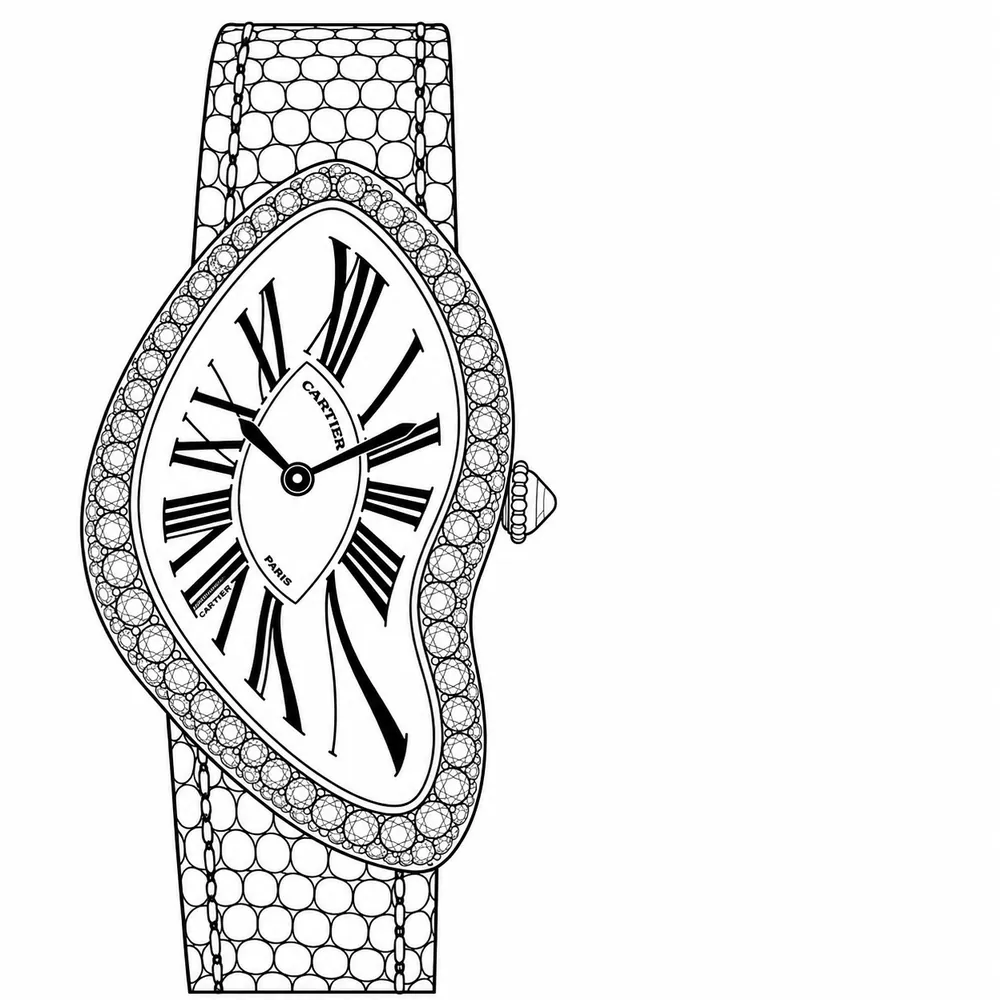
The Crash is Cartier's asymmetric, apparently melted wristwatch, launched by Cartier London in 1967 and worked up from the oval Baignoire Allongée, the Maxi Oval. The London watches, hand-formed and few in number, were made in a first series from 1967 and again in the late 1980s. Cartier Paris issued its own smaller version in 1991, numbered to 400 and signed Paris. Diamond-set, skeleton, Radieuse, London boutique, enamel and special-order Crashes followed in small runs. Collectors start with the dial signature, the case back marks and the movement, because the London and Paris watches differ in all three.
Cartier's entries are arranged by model, not by reference number, because its reference numbers are several systems at once and many of its watches carry none. The houses are set out in Paris, London and New York.

- Made
- from c. 1967The launch in 1967 is firm; production has been in small, separate runs ever since, and accounts differ on when London stopped making it, so no end date is given.
- On record
- 148 listings94 of them give no reference
- Reference numbers
- 18 described38 seen in listings
- House named in the title
- Paris 30, London 11most older watches are not labelled
What to look for
Details cut from photographs of watches of this line on record. Each was chosen by eye from a listing on the line and then checked again against the words beneath it. More sit beside the productions and parts they belong to, below. Select the small mark in a picture's corner for its holder and a link to its listing.



By house and period 12 described
London, first series, 1967 to about 1970
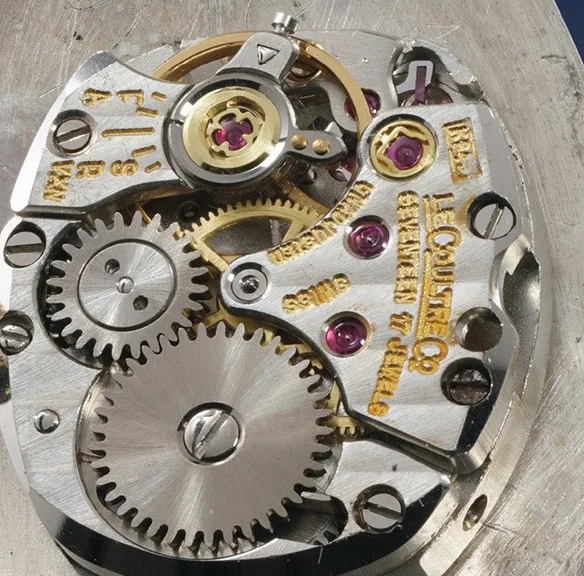
The Crash began at Cartier London, which made it in its own workshops by hand. The first cases were formed by Wright & Davies, a workshop run by Cartier London, without a mould, and the dial was hand-painted; its distorted numerals had to be repainted several times before the hands read the time correctly. The movement is the Jaeger-LeCoultre calibre 841, signed Cartier and said to have been supplied by way of New York. The case is the largest of the classic Crashes, about 43 mm long. Estimates of the number made run from a handful or fewer than a dozen to about twenty, and no two cases are exactly alike.
Signature and marks. White dial signed London; one account says some early London dials carry no city name at all. Inside the solid screwed case back, London hallmarks for 18 ct gold with the date letter and, on many examples, the JC punch, read as Jean-Jacques Cartier's. The deployant buckle is often stamped JC and the watch's own case number, and one catalogued buckle also carries London hallmarks. Four-digit case numbers, for example 9526.

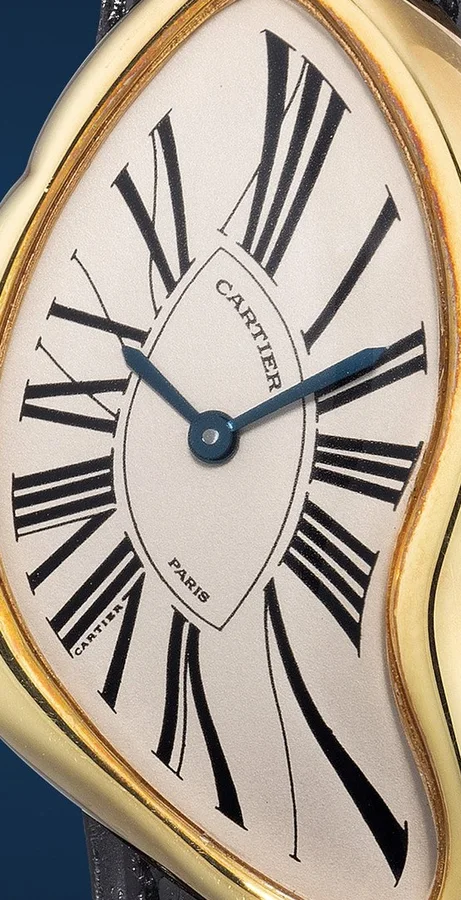
- white dial signed London with black painted Roman numerals that look hand-done and slightly uneven
- London hallmarks and the JC punch inside the case back
- a case number on the buckle that matches the case
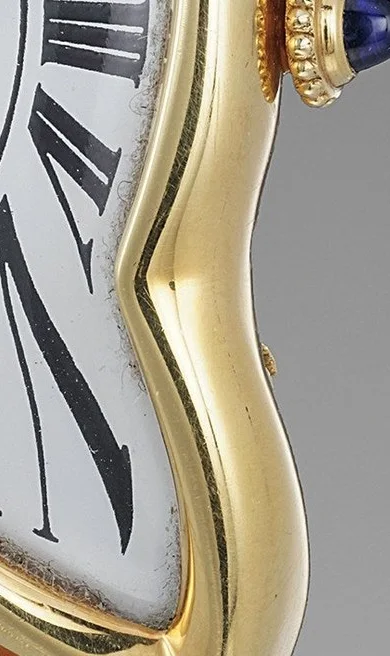
- bulges in slightly different places from one watch to the next, as the cases were not moulded
- blades of the deployant that fit only their own watch
- Jaeger-LeCoultre calibre 841, 17 or 18 jewels as catalogued
- about 43 mm long, 22.3 to 26 mm wide
References: case numbers 9526 and 9'658 as seen in this series
London, late 1980s to 1990
Cartier London made the Crash again in the late 1980s, after the family had sold the London house. Only a handful were made and no official count exists; three are said to have been made in 1987 to special order. The run is credited to a different London maker from the first series, and the watches carry five-digit case numbers, some with a letter. The movement given for London watches is again the Jaeger-LeCoultre 841, though one account says watches of 1990 used a round Patek Philippe calibre 5½. Dating is loose: one case was offered as hallmarked 1989 and later sold with a Cartier certificate dating it to 1988, and a 1989 case is not stamped with its year of production.
Signature and marks. Dial signed London. London hallmarks on the case back with the JC punch and a London date letter (N for 1987 on one case); published accounts place these marks inside the back, but on the late-run watches photographed in the library's records the hallmarks and the case number are struck on the outside. One catalogue reads the JC on case 80298 as Jacques Cartier's mark. One case is engraved Cartier London in script. Five-digit case numbers, for example 34716A to 80298, 39153A and 40237.
- London hallmarks with the JC punch on the case back; on late-run watches in the library's records the hallmarks are on the outside of the back
- a five-digit case number, sometimes with a letter
- a Cartier certificate where one survives, since hallmark and certificate years can differ
References: case numbers 34716A to 80298, including 39153A and 40237; a seller also gives 24175B, with case and clasp hallmarked for 1986
Paris, 1991 limited edition
Cartier Paris issued its own Crash 24 years after London's, as a numbered edition of 400 in 18 ct yellow gold; it was one of the first larger runs and remains the largest Crash edition. Every example is dated 1991 on the case back, though the papers that came with them run from December 1991 to June 1993. It is smaller than the London watch, about 38 mm by 22.5 to 23 mm against about 43 mm, and slightly smoother and more regular in its curves. The movement is a 17-jewel Cartier manual calibre, catalogued as 160 by some and as 1978-2 by others, where London used the Jaeger-LeCoultre 841; one catalogue entry gives both, an oval AS 1978-2 signed Cartier 160. The strap is crocodile or alligator with an 18 ct gold Cartier deployant, usually yellow gold.
Signature and marks. Dial signed Paris at six o'clock, with the secret signature at VII. Case back signed Paris, with the edition number and the year as NNN-91 (for example 113-91, 303-91; written 113/400 on certificates) beside a Cartier serial of A and six digits in the A108 to A109 range, struck at the foot under MADE IN FRANCE on at least some backs, the metal mark 750 in a rectangle, and a lozenge, 750 and two eagle's heads as hallmarks. The case back is held by four screws.
- PARIS under the six and the secret signature at VII
- an edition number in the NNN-91 form on the case back, crisply cut and evenly spaced
- a serial from A108 to A109
- yellow gold only: a white or rose gold watch described as the 1991 edition is not that edition
- unpolished, uninterrupted curves on the best examples
- a clasp whose gold matches the case, since a few were sold with a pink gold clasp
- the original certificate recording the number out of 400
References: no reference; case serials A108 to A109 with an edition number NNN-91
Paris, platinum run, about 1992 to 1993
A very small platinum run followed the gold edition. Its size is uncertain: the catalogues of the platinum watches say possibly as few as 8, and other estimates are 8 and 10, while two catalogue essays written for gold watches say 50. The serials are given in the A110 range and no edition number has been found on them; sellers' listings, however, show platinum watches with serials A109835 and A109836, one numbered 003-92.
Signature and marks. Signed Paris, as sellers describe them; serials given as A110 and digits, with A109 in some sellers' listings.
- platinum case
- serial A110, or A109 as some sellers give it
- an edition number, if any, in the NNN-92 form
References: case serials in the A110 range as seen
Paris, later 1990s diamond-set and boutique runs
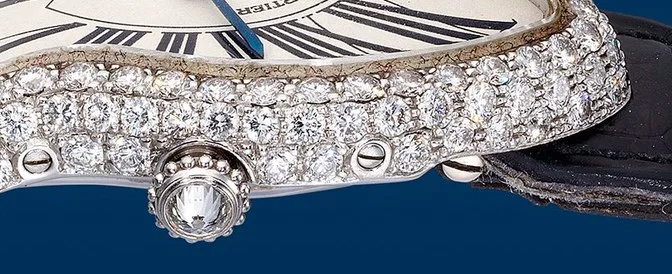
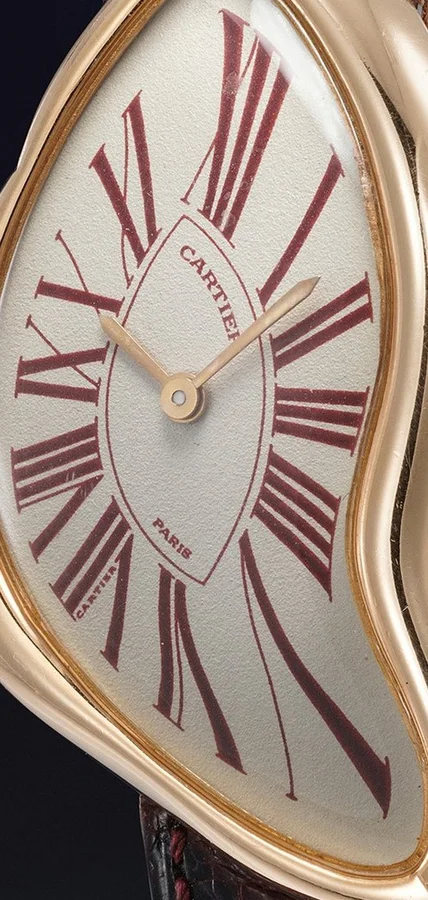
Through the 1990s Cartier added diamond-set and special runs in the same case size as the 1991 watch. The diamond-set versions have three rows of pavé stones along the curved sides and a brilliant-cut diamond in a beaded crown. A pink gold watch with burgundy Roman numerals, a limited edition of 40 in 1994, is the first Crash in that metal. A run of 13 yellow gold watches is said to mark the 1997 reopening of the boutique at 13 rue de la Paix; sellers also describe white gold, diamond-set watches as editions for that reopening, so the metal and number are not settled.
Signature and marks. As sellers describe them: a Paris dial on reference 2236, and signed Cartier, 13 rue de la Paix, Paris on reference 2774.

- burgundy Roman numerals on the pink gold watch
References: 2774 and 2236 as sellers describe them
Reference 2463, about 2001 to 2003
A rose gold Crash of the early 2000s; one seller describes an example with pink diamonds on the bezel, the others plain rose gold. Unlike the 1991 watch it carries a reference number and a serial on the case back, and the dial reads MADE IN FRANCE. It should not be taken for the 1991 Paris edition.
Signature and marks. Reference 2463 and a serial on the case back; MADE IN FRANCE on the dial.
- 2463 engraved on the case back
- MADE IN FRANCE on the dial
- rose gold case, on one listed example with a pink diamond-set bezel
References: 2463
Diamond-set Crash for women, 2013
Shown in 2013 as a Crash for women, in white and pink gold with diamonds set in the bezel and case and a gold bracelet, the first Crash on a bracelet. The diamond-set watches were made in 267 pieces in each metal, and two further editions of 67 each, one in each metal, were paved with diamonds over the case and bracelet.
- gold bracelet
- diamond-set case in white or pink gold
Crash Skeleton, 2015 and 2016
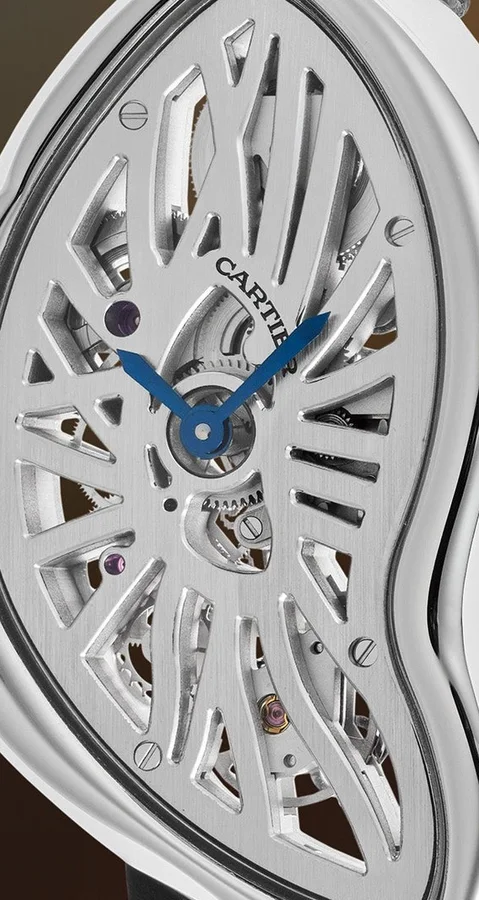
A skeletonised Crash with an open-worked dial and a movement shaped to the case: the Cartier 9618 MC, hand-wound, with two barrels in series, a power reserve of about 72 hours, and plates and bridges cut into the Roman numerals. The platinum watch was shown in 2015 (one account says 2014) in 67 pieces and the pink gold one followed in 2016, again 67 pieces; the number nods to 1967. The case is the largest of the line, about 45.32 by 28.15 mm.
Signature and marks. Numbered edition, for example 60/67 or 64/67 in sellers' titles; Cartier manufacture calibre 9618 MC.

- limited number out of 67
References: 3740 and CRWHCH0006 as sellers describe them
Crash Radieuse, about 2018
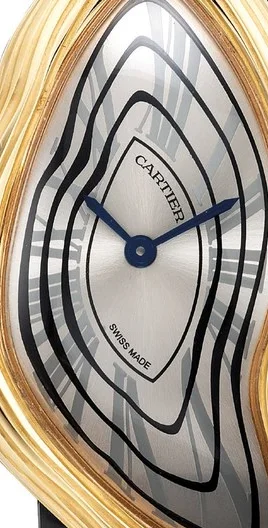
A 50-piece edition with concentric rippled ovals on the dial that carry into a stepped texture on the case, in yellow gold at 42 by 23.3 mm, with a diamond cabochon in the crown. It runs on the Cartier manual calibre 8970 MC. It is usually dated 2018; one account places it in 2017 in the Cartier Libre group.
Signature and marks. Numbered x of 50 in sellers' titles; calibre 8970 MC.

- stepped case
- diamond in the crown
References: 4127 as sellers describe it
London boutique reissue, 2019
Announced in 2018 and sold in 2019, to mark the reopening of the Bond Street boutique, in 67 pieces of yellow gold with a cream guilloché dial and a case of about 38.5 by 22.5 mm, released one a month to clients who had ordered. The dial reads Swiss Made where earlier London watches read London. A 15-piece white gold, diamond-set edition came with it. Custom versions followed, including blue, black, onyx-crowned, jade-crowned and Super-LumiNova-numeral watches. A later platinum version, not limited, has a white dial, a ruby cabochon crown, the Cartier 1917 MC and the case back engraved Cartier Bond Street London.
Signature and marks. Swiss Made on the dial, not London. On the later platinum watch, Cartier Bond Street London on the case back.
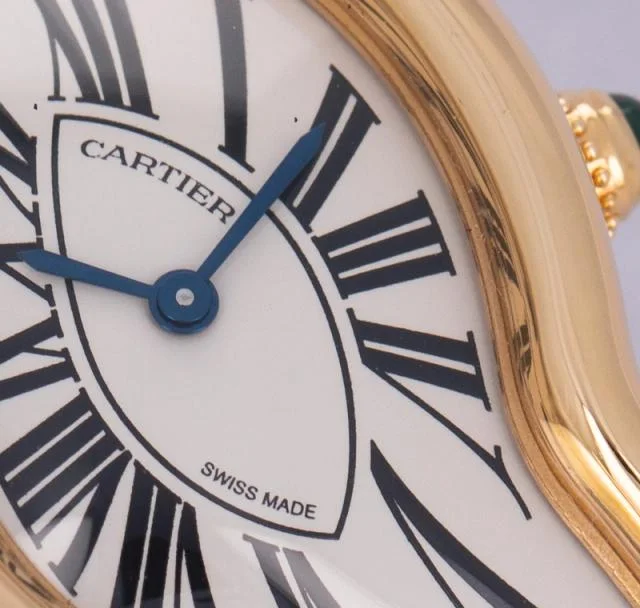

- cream guilloché dial
- Bond Street engraving on the case back of the platinum watch
References: WGCH0006 as the London boutique edition; 4127 as sellers also give it
Crash Tigrée, 2022 or 2023
A yellow gold Crash with diamonds set in tiger stripes between champlevé enamel in green and blue, limited to 50 pieces. Published accounts place it in 2023; sellers state 2022 for it.
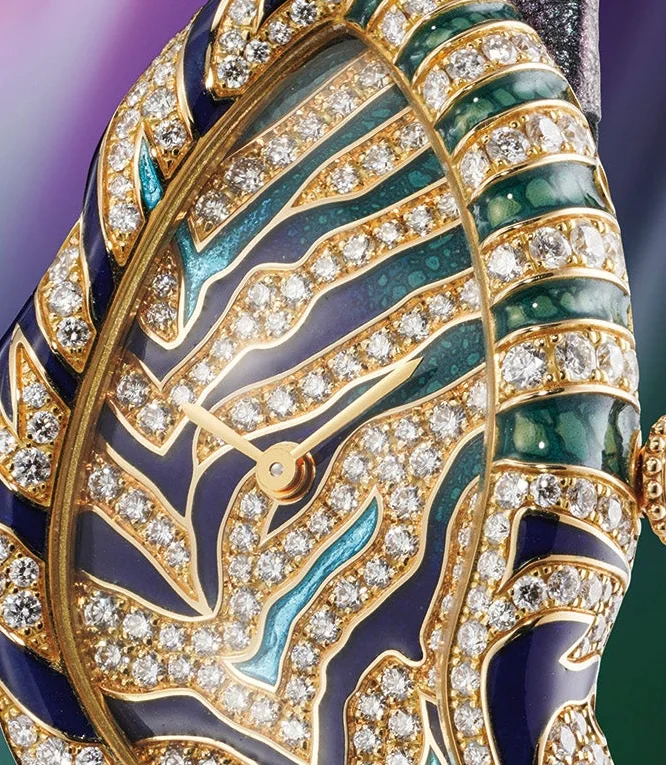

- numbered out of 50
References: HP101529 as sellers describe it
Special orders and other modern Crashes, 2018 onward
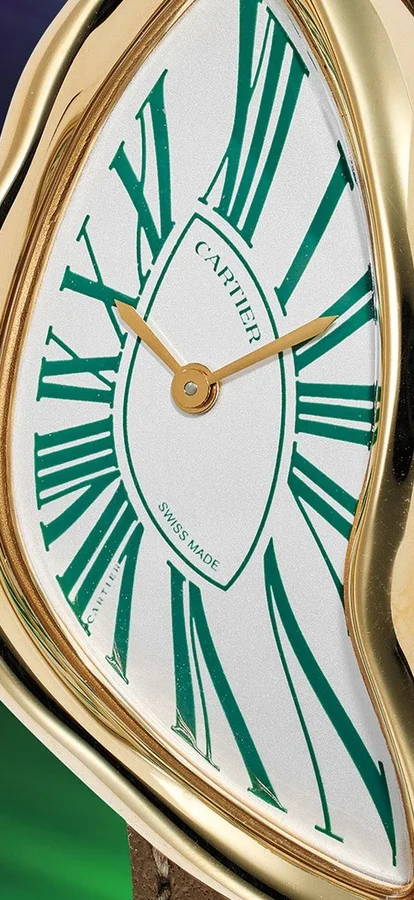
Cartier also makes the Crash to special order. A platinum watch of 2018 and a yellow gold edition of 2020 are reported, and one account gives modern white gold, platinum and yellow gold watches at about 45 by 25.5 mm on the 8970 MC. Special orders vary dial colour, numerals, crown stone and engraving, among them a 2021 white gold watch with a nickelé grey dial and a red gold watch with an ivory dial and burgundy numerals.
- unusual dial colours or numeral colours
- unusual crown stones
- engraving on the case back
References: 4131, WGCH0087 and WGCH0135 as sellers describe them
Chronology
Specification
| Case | Asymmetric 'melted' case with pinched ends and a kink at the centre. London: about 43 mm long, 22.3 to 26 mm wide depending on where it is measured. Paris 1991: about 38 mm by 22.5 to 23 mm |
| Metal | London watches as catalogued and the Paris 1991 edition in 18 ct yellow gold, though some accounts report platinum and white gold London watches; platinum, white gold, pink gold and diamond-set versions in later runs |
| Dial | Roman numerals distorted to follow the case; London watches signed London, the 1991 Paris edition signed Paris at six o'clock, later editions Swiss Made |
| Hands | Blued steel, sword-shaped |
| Crown | Sapphire cabochon on the 1991 Paris edition; a ruby cabochon on the platinum Bond Street watch, a diamond on the diamond-set and Radieuse watches, and other stones on special orders |
| Movement | Hand-wound throughout. London: Jaeger-LeCoultre calibre 841. Paris 1991: a 17-jewel Cartier manual calibre catalogued as 160 or as 1978-2. Later: 9618 MC (skeleton), 8970 MC, 1917 MC |
| Strap and clasp | Leather strap with an asymmetric 18 ct gold Cartier deployant clasp |
Dial 7 described
All Crash dials follow the case: Roman numerals are stretched and tilted so that the hands, which turn on a circle, still read the time. London dials were hand-painted and show it. The signature at six o'clock tells the productions apart: London, Paris, then Swiss Made.
London dial
White dial with black painted Roman numerals that distort with the case, signed London; one account says some early London dials carry no city name. The painting is uneven and the hands do not line up with the numerals as cleanly as on later watches. One account warns that watches with London on the dial made in the 1990s were not made in London and may be fakes, though others say London went on making the Crash into the early 1990s.
- London under the six
- hand-done, slightly uneven numerals
- text precision, alignment and crown that differ from genuine London watches
Paris dial
Silvered or white dial with black Roman numerals, signed Paris at six o'clock, with the secret signature at VII, said to be the first on a Crash.
- PARIS at six
- secret signature in the VII
Burgundy Roman numerals
Burgundy numerals are recorded on the 1994 pink gold edition of 40 and on a later special order in red gold with an ivory dial.

MADE IN FRANCE dial
The dial of the rose gold reference 2463 reads MADE IN FRANCE.
- MADE IN FRANCE on the dial
Swiss Made dial
Later editions, including the 2019 London boutique reissue, read Swiss Made at the foot of the dial in place of a city. This is a required marking, not a copy of the London dial.
- Swiss Made at the foot of the dial
Radieuse dial
Concentric rippled ovals follow the case from centre to edge.
- concentric rippled ovals
Special-order dial colours
After the 2019 reissue, special orders brought blue, black and nickelé grey dials and Super-LumiNova numerals; sellers also describe green numerals.

Hands 1 described
The hands are the sword shape found across Cartier watches.
Blued sword hands
Blued steel sword-shaped hands on the London and Paris watches; luminescent sword hands are also recorded.
- blued steel sword hands
Case and sizes 7 described
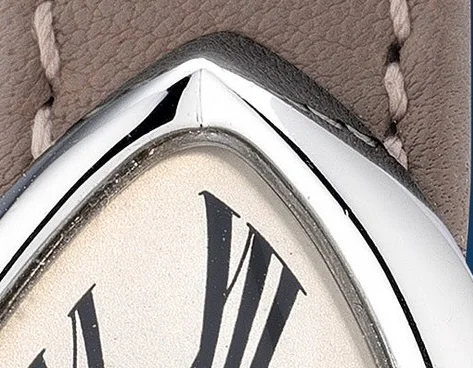
The case is the Maxi Oval stretched and pinched at the ends with a dent at the centre. London made it by hand without a mould; Paris made it smaller and more regular, and later runs brought new metals and sizes.
London first-series case
Hand-formed 18 ct yellow gold as catalogued (three white gold first-series watches are reported), about 43 mm long and 22.3 to 26 mm wide depending on where measured, more curved and 'sensual' than the Paris case. Solid screwed back, London hallmarks inside and, on many, the JC punch.
- London hallmarks and JC punch inside the back
- bulges that differ between watches
London late-1980s case
Same large size and marks; the run is credited to a different London maker. The numbers run roughly 34716A to 80298.
- five-digit number with letter
- London date letter
Paris 1991 case
18 ct yellow gold, about 38 by 22.5 to 23 mm (catalogues also give up to 39 mm and about 22 mm), four-screw back with the edition number and year, 750 and the hallmark group, and MADE IN FRANCE on some backs.
- four screws
- NNN-91 number
- 750 in a rectangle
- lozenge and two eagle's heads
Platinum case, Paris
Platinum run after the gold edition, given A110 serials and no edition number; sellers' listings show A109 serials and one number 003-92.
- A110 serial
Diamond-set case
Three rows of pavé diamonds along the curved sides with a brilliant-cut stone in the beaded crown, in the 1991 case size, from the 1990s; fully diamond-set white and pink gold cases in 2013.
- pavé rows on the case sides
Skeleton case
Platinum in 2015 and pink gold in 2016, about 45.32 by 28.15 mm, the largest in the line; another account gives about 28 by 45 mm.
- largest Crash case, open-worked
Radieuse case
Yellow gold, 42 by 23.3 mm, stepped texture continuing the dial ripples.
- stepped case texture
Crown 4 described
Crowns carry a cabochon whose stone varies with the metal and the series.
Sapphire cabochon
On the Paris 1991 edition and on some later special orders in yellow and red gold.
- blue cabochon
Ruby cabochon
Reserved by Cartier for platinum cases, as on the platinum London boutique watch.
- red cabochon on platinum
Diamond cabochon and beaded diamond crown
A diamond in a beaded crown on the 1990s diamond-set watches and a diamond cabochon on the Radieuse.
- diamond in the crown
Special-order stones
Jade, onyx and other stones were ordered after the 2019 reissue.
- jade or onyx cabochon
Movement 6 described
Every Crash is hand-wound. London used a Jaeger-LeCoultre tonneau calibre; Paris used a Cartier manual calibre; later watches use Cartier manufacture calibres.
Jaeger-LeCoultre 841
Hand-wound, 17 or 18 jewels as catalogued, about 36 to 40 hours; its tonneau shape fits the twisted case. Signed Cartier.
- hand-wound tonneau calibre signed Cartier
Cartier manual calibre 160 or 1978-2
17 jewels; catalogues split between the two numbers, and one entry gives both.
- 17 jewels
- oval movement
9618 MC
Skeleton calibre of two barrels and about 72 hours, with plates and bridges cut as numerals.
- skeleton movement
8970 MC
Manufacture manual calibre, 18 jewels in sellers' listings, about 38 hours; used in the Radieuse and the modern watches.
- 8970 MC
1917 MC
Calibre of the platinum London boutique watch, behind the engraved case back.
- 1917 MC
Quartz, as sellers describe it
One listing of a pink gold diamond-set watch, reference 2900, calls it a Tank Crash with quartz movement. The Crash is otherwise described as hand-wound only, never quartz.
- quartz movement
Bracelet and strap 3 described
The Crash was made with a strap and an asymmetric gold deployant clasp.
London deployant
Asymmetric 18 ct gold deployant made by hand at Wright & Davies, often stamped JC and the watch's case number, one catalogued with London hallmarks as well; blades from different watches do not fit. One London watch is catalogued with an asymmetric D clasp.
- stamped case number matching the watch
Paris deployant
Cartier 18 ct gold deployant on a crocodile or alligator strap, yellow gold on most; a few pink gold clasps have been sold on yellow gold watches.
- gold matching the case
Gold bracelet
First offered with the 2013 diamond-set women's watches, in gold to match the case.
- bracelet on a Crash
Box and papers 2 described
Papers help date and place a Crash.
Paris 1991 papers
Examples come with a certificate or guarantee from Cartier, a separate limited-edition certificate that records the watch's number out of 400, a manual and a presentation box. The dates on these papers run from 24 December 1991 to a guarantee of June 1993.
- certificate with the edition number
London certificate
A Cartier certificate can date a London watch; its year can differ from the hallmark year.
- certificate
- presentation box
Reference numbers
A four-digit number is stamped on the case and covers a case; a code beginning W, or the newer letter codes, is a catalogue number for one version of it (metal, dial, strap). Many older watches carry neither. The last column is the listings on record under the number, as its own page counts them.
| Number | What it is | Listings |
|---|---|---|
| No reference (London) | London-made watches carry a case number only, four digits in the first series and five digits, some with a letter, in the late-1980s run. | |
| A108 to A109 | Case serial range of the 1991 Paris edition (A and six digits), beside an edition number NNN-91; the platinum run is given A110 serials, though sellers show A109 serials on platinum watches too. | |
| 2463 | Rose gold Crash of about 2001 to 2003, reference engraved on the case back, MADE IN FRANCE on the dial; one seller describes a pink diamond bezel. | 5 |
| 2774 | White gold and diamond-set Crash; one is described as possibly unique and sapphire-set. As sellers describe it, also the 13 rue de la Paix edition. | 6 |
| 2236 | White gold and diamond-set, with a Paris dial, as sellers describe it. | 1 |
| 2838 | Pink gold with a deployant clasp, as sellers describe it. | 2 |
| 2899 | Yellow gold and diamond-set 'Tank Crash', as sellers describe it. | 1 |
| 2900 | Pink gold and diamond-set 'Tank Crash' described by a seller as quartz. | 2 |
| 3174 | White gold and diamond-set, listed by a seller as a Baignoire S Crash. | 2 |
| 3740 | Platinum skeletonised limited edition, as sellers describe it. | 1 |
| CRWHCH0006 | Pink gold skeletonised limited edition numbered out of 67; the library also holds WHCH0006 in rose gold. | 1 |
| 4127 | Given by sellers both for a Radieuse and for a London edition, so it cannot be tied to one version. | 2 |
| WGCH0006 | London boutique edition in yellow gold. | 2 |
| WGCH0014 | 18 ct gold with burgundy Roman numerals, as sellers describe it. | 1 |
| WGCH0087 | Yellow gold special order with green numerals, described as possibly unique. | 1 |
| WGCH0135 | White gold new special order with grey fumé dial and green indexes, described as unique. | 1 |
| 4131 | White gold special order with a nickelé grey dial. | 2 |
| HP101529 | Crash Tigrée in yellow gold with enamel and diamonds, numbered out of a limited edition. | 2 |
Originality
- A London dial on a watch said to be of the 1990s deserves questions: one account says such watches were not made in London, and convincing fakes made by retired London craftsmen are reported. Accounts differ on when London stopped making the Crash.
- A watch offered as a 1970 London Crash with its original dial was shown before sale not to be an original London watch: the precision and alignment of the dial text and the crown did not fit.
- On a London watch, the case number on the buckle should match the case, and London hallmarks and the JC punch should be on the back: published accounts and first-series watches put them inside it, while late-1980s watches in the library's records carry the hallmarks on the outside.
- On a Paris 1991 watch, a missing, poorly cut or added edition number deserves questions; a white or rose gold watch described as the edition is not it.
- Polished cases lose the uninterrupted curves; clasps in a different gold from the case are a mismatch.
- Movements should match the house: the 841 for London, the 17-jewel Cartier calibre for Paris.
Names
- London Crash. Watches signed London, made by Cartier London in 1967 to 1970 and the late 1980s.
- Paris Crash. The 1991 edition of 400 signed Paris.
- Dali watch. A name given because the shape recalls melting clocks, though it is said to be wrong as an origin.
- Tank Crash. How sellers list some diamond-set references.
Where accounts differ
Points on which the published literature and the library's own records do not agree, or on which the literature contradicts itself.
- End of London production. One guide puts the late London run at about 1987 to 1990; another says London made Crashes until about 1991; a third says London and Paris were made in parallel for three years until London stopped in 1994; a fourth says the 1980s run was small and that from the 1990s production moved to Paris. The records hold London-titled listings with stated years to 1990 and then only the 2019 and 2023 reissues.
- Metals of the London watches. One guide says London made platinum in 1980 and white gold in the early 1990s; another says every London example opened is yellow gold; a third reports three first-series white gold watches. London-titled listings in the library's records give yellow gold or 18 ct gold, and none says platinum or white gold.
- How many London Crashes. Counts run from a handful or fewer than a dozen to about twelve, about twenty, and less than two dozen up to the 1980s; one guide gives both 'a handful' in the 1960s and, as reported elsewhere, about twenty. The records cannot add to this.
- Movement of late London watches. One guide says 1990 watches used a round Patek Philippe calibre; another says the movement should be the Jaeger-LeCoultre 841. A seller catalogues a London-signed watch of about 1990 with a round movement of 17 jewels.
- Size of the Paris edition and its companions. One guide says 200 pieces were made in 1991; the others, and the records, say 400. For the 1997 reopening of the rue de la Paix boutique, one guide gives 13 yellow gold watches, while a seller's title describes a 50-piece white gold, diamond-set edition.
- Dates of the Skeleton and Radieuse. The Skeleton is given as 2014 by one guide and 2015 by most; another says 2021. The Radieuse is 2017 in one guide and 2018 in the others. Sellers state 2014 and 2015 for the skeleton and 2018 for the Radieuse.
- Serials and numbering of the platinum Paris watches. One account gives the platinum run of about 1992 to 1993 serials in the A110 range and says no platinum example carries an edition number. The records hold platinum watches listed with serials A109835 (numbered 003-92, circa 1992) and A109836, as well as A110289 and A114611, and two sellers date platinum Paris watches to about 1990 or the early 1990s, one of them serial A110298.
- Start of the late London run. Published accounts date the earliest watches of the second London run to about 1987, with three said to have been made that year to special order. A seller catalogues case 24175B with case and clasp hallmarked in London for 1986 and calls it one of three known from 1986.
- Date of the Crash Tigrée. Two magazine accounts place the Tigrée in 2023, and one of them elsewhere also names a 2015 Tigrée. Auction houses selling it give circa 2022.
- Where the London hallmarks are struck. One account says the London hallmarks and the JC mark are to be read inside the case back, for London watches in general, and a 1970 first-series case in the library's records bears this out. Photographs of three late-run London watches, dated 1987, 1988 and 1990 and all offered at Phillips, show the hallmarks and the case number struck on the outside of the back, with the JC punch beside them on two; the catalogue of one of them nonetheless speaks of hallmarks on the inside. The photographs do not show whether these cases are also marked inside.
In the records
Counted from 148 listings at dealers and auction houses whose title, or whose reference, places them on the line; 121 state a year. These are what sellers state, not measurements, and a count of listings is not a count of watches made.
Case metal
| Metal | Listings | Share |
|---|---|---|
| Gold, any colour | 118 | 84% |
| Yellow | 41 | 29% |
| White | 31 | 22% |
| Pink | 19 | 14% |
| Colour not stated | 27 | 19% |
| Platinum | 20 | 14% |
| Bronze | 1 | 1% |
| Silver | 1 | 1% |
As sellers state it. Shares are of the 140 listings that name a metal. A listing that says "gold" or "18K gold" names no colour: it is counted under "colour not stated", not as yellow gold. Carat, where a listing of gold gives one: 18k 108.
Case size
| Size | Listings | Share |
|---|---|---|
| 24 mm | 31 | 30% |
| 38 mm | 24 | 23% |
| 22 mm | 10 | 10% |
| 23 mm | 10 | 10% |
| 21 mm | 3 | 3% |
| 25 mm | 3 | 3% |
| 38.5 mm | 3 | 3% |
| 28 mm | 2 | 2% |
| Other sizes | 19 | 18% |
As sellers state it. Shares are of the 105 listings that give a size. On a watch that is not round some sellers give the width and some the length, so one watch can stand under two sizes.
Movement
| Kind | Listings | Share |
|---|---|---|
| Hand-wound | 106 | 95% |
| Mechanical, winding not stated | 4 | 4% |
| Quartz | 2 | 2% |
Shares are of the 112 listings whose description says how the watch is driven.
Listings by decade the seller gives
| Decade | Listings |
|---|---|
| 1960s | 1 |
| 1970s | 2 |
| 1980s | 3 |
| 1990s | 57 |
| 2000s | 25 |
| 2010s | 18 |
| 2020s | 15 |