Tank Asymétrique
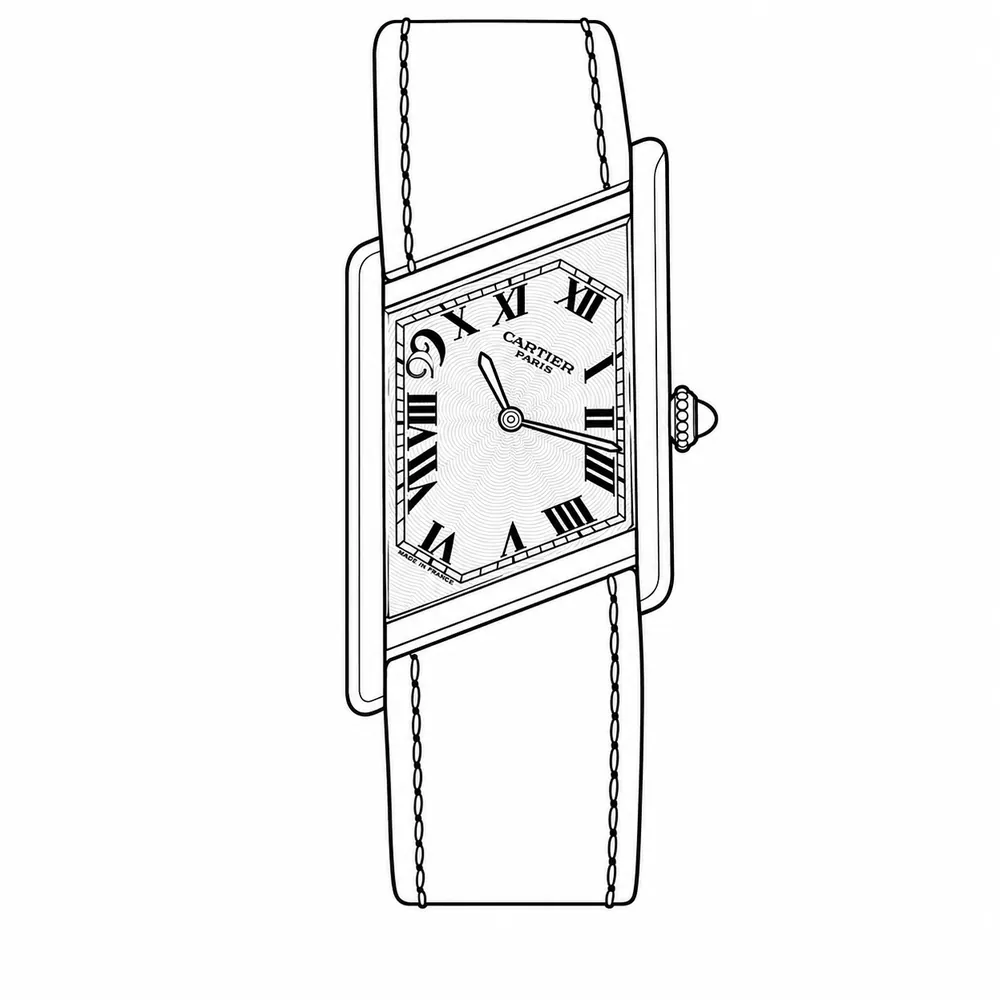
A Cartier wristwatch with a lozenge or parallelogram case in which the dial is turned about 30 degrees clockwise, so that 12 sits in the top right corner and 6 in the bottom left. It was launched in 1936, when it was also called the Tank Oblique, Parallélogramme and Losange, and it is usually described as a driver's watch. It was made in small numbers in Paris for about fifteen years, in a few pieces by Cartier London from the late 1960s, and then revived in limited editions in 1996, 1999, 2006 and 2020. It has never belonged to the main catalogue. Collectors first look at the edition, the number of lugs, the dial signature and the size.
Cartier's entries are arranged by model, not by reference number, because its reference numbers are several systems at once and many of its watches carry none. The houses are set out in Paris, London and New York.

- Made
- from c. 1936The launch year is given as 1936 in nearly every account, and production has been intermittent since, in separate limited editions rather than one continuous run.
- On record
- 88 listings17 of them give no reference
- Reference numbers
- 12 described18 seen in listings
- House named in the title
- Paris 5, New York 1most older watches are not labelled

What to look for
Details cut from photographs of watches of this line on record. Each was chosen by eye from a listing on the line and then checked again against the words beneath it. More sit beside the productions and parts they belong to, below. Select the small mark in a picture's corner for its holder and a link to its listing.


By house and period 7 described
Paris, 1936 original
Louis Cartier created the watch in 1936 as an oblique version of his 1917 Tank, and called it a bracelet montre losange; the Paris house is said to have produced these montre losange models for about fifteen years. Published descriptions of the 1936 watch do not say which house made each example: they give small numbers in yellow and white gold, off-white or black dials with Arabic numerals alternating with printed batons (triangular markers in some) and a dot below 12 and above 6, heat-blued Breguet or gladium hands, gold hands on some, and an octagonal 8-line calibre from the European Watch and Clock Company, the same calibre as in the Reverso of the day. The earliest watches have a lowered crown of minimal profile, without a cabochon. A collector's account says Cartier made versions with three and with four lugs later: the three-lug watch is very rare, with one yellow gold example in the firm's heritage department, and the author has seen only one four-lug watch, in the firm's archive photographs. Pages on the 2020 watch instead give the 1936 original three lugs (see Where accounts differ).
Signature and marks. Published accounts give no dial signature or case stamps for these watches.
- off-white or black dial with Arabic numerals and printed batons
- dot below XII and above VI
- low flat crown with no cabochon
- blued Breguet or gladium hands
- three or four lugs on the rare later versions
London, late 1960s
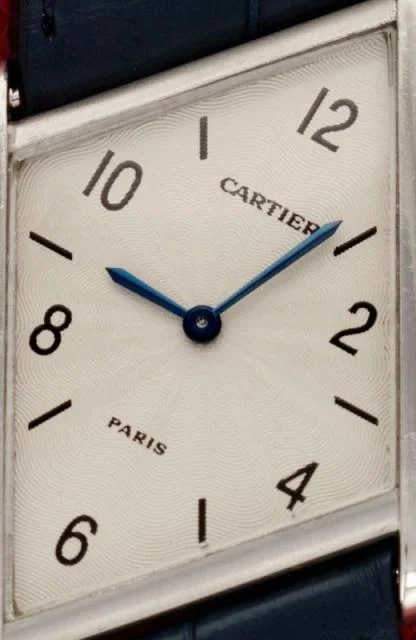
Cartier London made a few wristwatches of this shape at the end of the 1960s, with a circular, flat Jaeger-LeCoultre movement and dials of a more modern, stylised, graphic layout. Until 1966 the London house imported its watches from Switzerland and France; its own production, made by hand with the case maker Wright & Davies, is said to include an Asymétrique based on the Parallelogram of the 1930s. One account also illustrates a London Asymétrique dated 1936, with a more classical Tank-like dial of Roman numerals and a railroad minute track that follows the case outline; it does not say who made that watch (see Where accounts differ).
Signature and marks. Published accounts give no dial signature or case stamps for these watches.
- flat round Jaeger-LeCoultre movement
- graphic, modern dial layout
- a Roman-numeral dial with a railroad minute track following the case, on the example captioned as London
1996 limited edition
The first serially made Asymétrique since the 1936 watches was a numbered edition of 300 in yellow gold and 100 in platinum, made just before the Collection Privée Cartier Paris was formally launched in 1998; no pink gold was made. The case is small, 24 x 34 mm on one account and 23 x 32 mm on another, in the proportions of the 1936 watch and without the central lug, and each case back is numbered within its metal's run. The dial is off-white with a plain guilloché centre, printed Arabic numerals and painted indexes, under blued-steel hands. Inside is the hand-wound calibre 9P2, a Piaget-origin movement from the 1950s. Some accounts count this edition as part of the Collection Privée; others place it before the range (see Where accounts differ).
Signature and marks. Cartier and Paris are printed apart, one near the top and one low on the dial above VI; the Paris signature was soon dropped. Case back numbered within the run (for example x/100 in platinum, x/300 in gold).
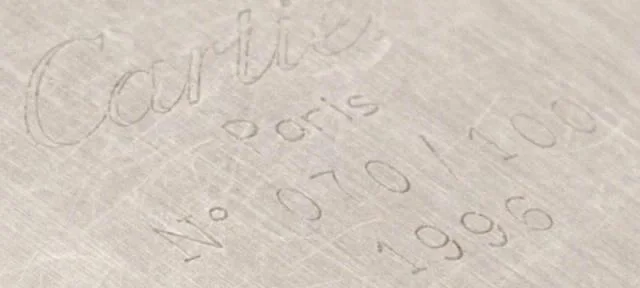

- small case, about 24 x 34 mm, no central lug
- off-white guilloché-centre dial with printed Arabic numerals
- Paris in small letters above VI
- calibre 9P2
References: 2488
Macau handover, 1999
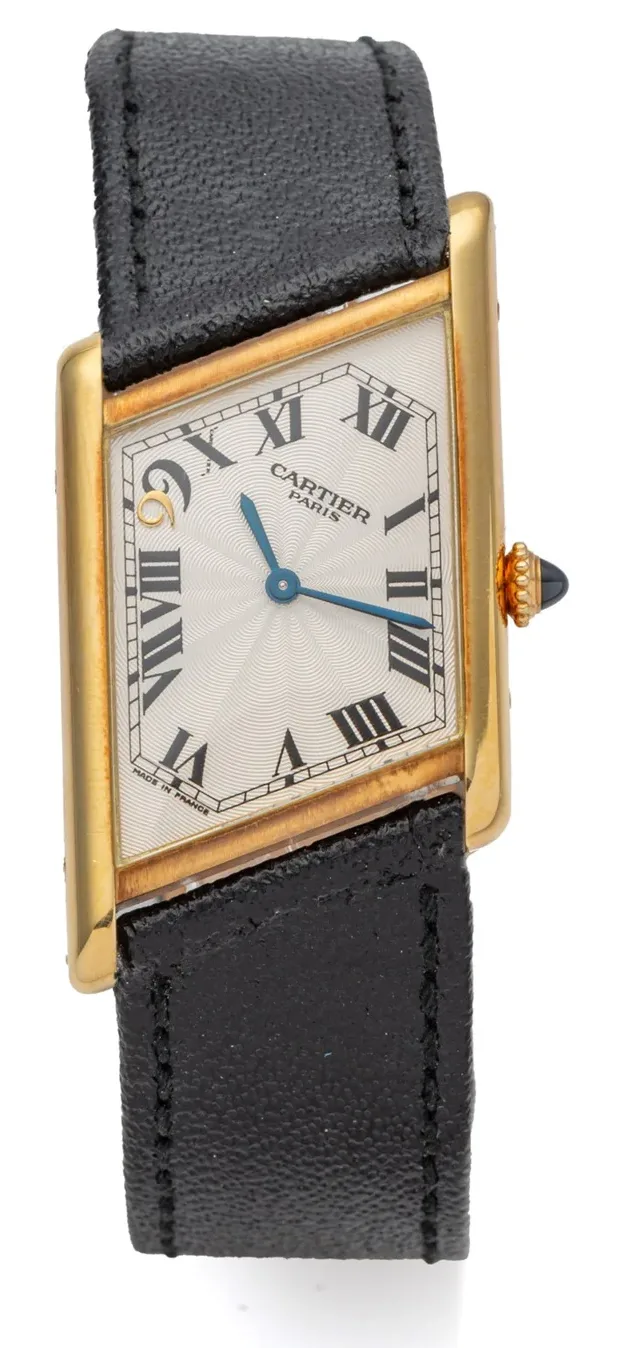
Two sets of watches, one with the crown on the left and one with it on the right, were made in 1999 for the Macau handover; published accounts limit each set to 99 pieces, while sellers give 99 in all (see Where accounts differ). The dial has Roman numerals and an applied 18-carat gold 9 placed beside the Arabic 9 so that the two read 99. They keep the original proportions, 23 x 32 mm, so they sit small on the wrist. The accounts differ on whether the added 9 is above or below the existing one.
Signature and marks. Applied gold 9 beside the 9 on the dial.
- Roman-numeral dial with an extra applied gold 9
- crown on the left in one set and on the right in the other
- 23 x 32 mm case
References: 2488
Collection Privée, 2006
This version is the one most closely tied to the Collection Privée style: a Cartier Paris signature and a rosette motif on the dial. The edition is 150 in yellow gold, plus a few platinum pieces, most of them unique. It has a third lug at each end, centred on the case, and larger proportions than the 1996 watch; one account says the size is the same as in the 2020 watch and that the Collection Privée hallmarks set it apart. One account says reference 2842 omits the Paris signature (see Where accounts differ). Sellers call reference 2842 the 'jumbo'.
Signature and marks. Cartier Paris on the dial with a rosette; Collection Privée hallmarks on the case, as one account describes them.
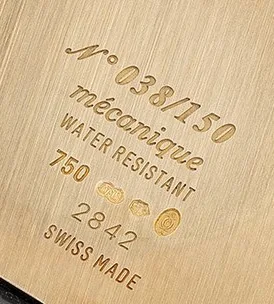

- third centred lug at each end
- Cartier Paris signature and rosette on the dial
- larger case than the 1996 watch
References: 2842
Privé, 2020
The 2020 Asymétrique was released in the Privé collection as six references of 100 watches each, 600 in all. Three have a solid dial (pink gold with grey dial, yellow gold with champagne dial, platinum with silver dial) and three are skeletonised (pink gold, platinum, and diamond-set platinum). The case is 47.15 x 26.2 mm, which Cartier calls extra-large, with a third central lug. The solid-dial watches are 6.38 mm thick, run on calibre 1917 MC and have redesigned Arabic numerals and indices; the skeleton watches are 7.82 mm thick and use calibre 9623 MC, with lacquered numerals at XII and VI and the bridges serving as hour markers. The crown carries a cabochon, a diamond on the gem-set watch. The strap is alligator, made to measure, with a pin buckle.
Signature and marks. Cartier alone on the dial, with Swiss Made in small letters in a lower corner.
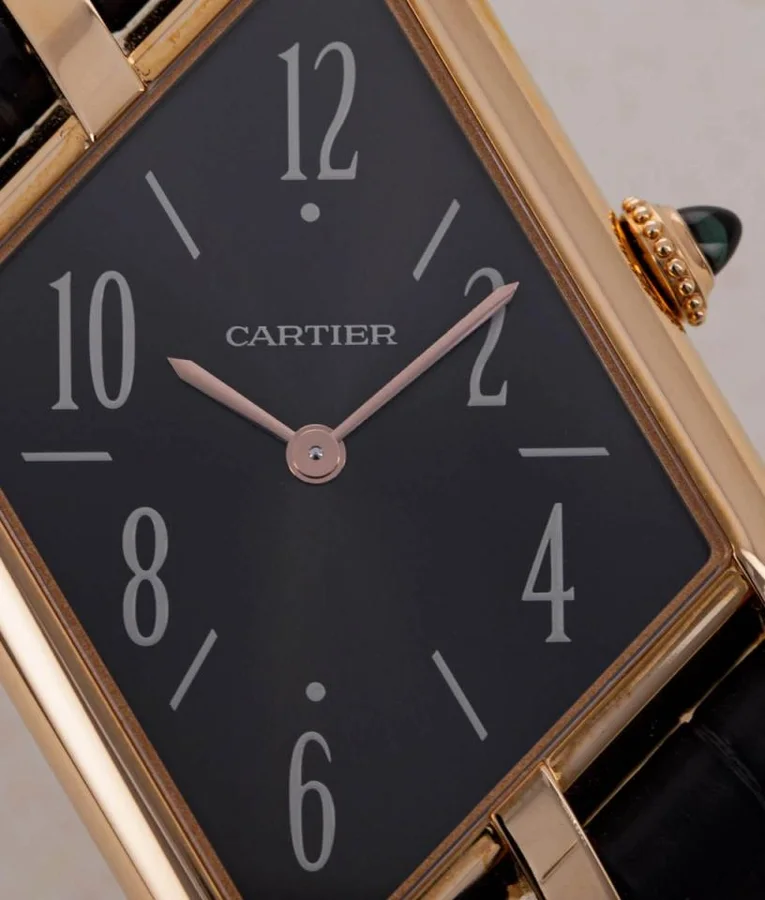

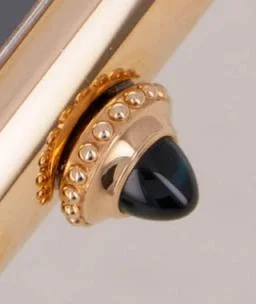



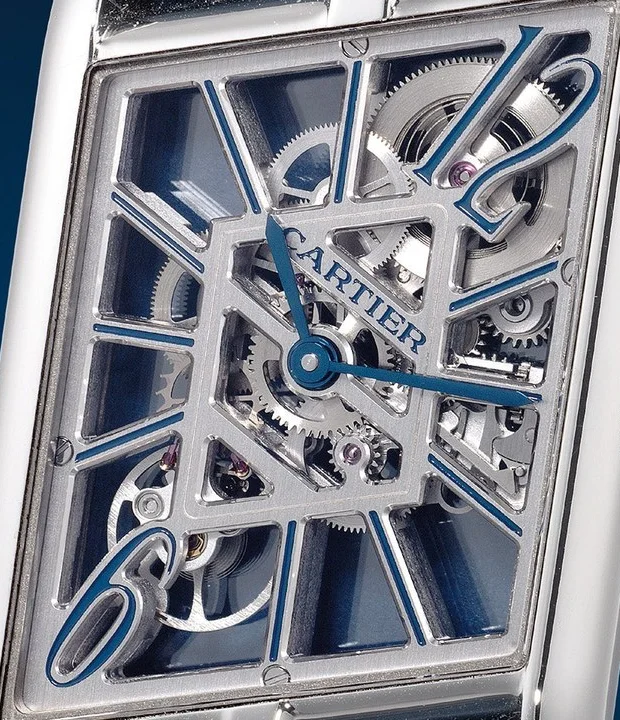

- 47.15 x 26.2 mm case with a central third lug
References: WGTA0042, WGTA0043, WGTA0044, WHTA0011, WHTA0012
Special orders and other editions
The same shape has been made as special orders and in further editions. A unique skeletonised and engraved platinum watch, commissioned at about 1997, has tiny numbers 6 and 12, a small Cartier logo and scrolling foliage engraved over the whole remaining surface, a crystal case back inscribed 1/1, and a width of 23.5 mm. A special-order platinum watch with an Eastern Arabic dial in wine red over champagne has only four numerals, with a radial soleil finish; its date is not given. Published accounts also mention versions offered with Thai numerals. Seller titles name further editions with Thai numerals, burgundy numerals, a New York Fifth Avenue name and a boutique-exclusive 'temple' edition; dated watches so described fall between 2021 and 2024.
Signature and marks. Unique watch: tiny Cartier logo engraved on the dial. Special-order watch: Swiss Made in a corner at an angle.
- Eastern Arabic or Thai numerals
- four numerals instead of six
- engraved or lacquered dial detail
- caseback inscribed 1/1 on the unique watch
Chronology
Specification
| Case | Lozenge or parallelogram case: two long side bars running along the strap, joined by two slanted ends; original in yellow or white gold, later editions in yellow gold, pink gold and platinum |
| Dial | Rotated about 30 degrees clockwise; 12 in the top right corner, 6 opposite; Arabic numerals in most versions, Roman in the 1999 edition, in one London example and, as listings of reference 2842 show, in the 2006 edition; Eastern Arabic or Thai numerals on some special pieces |
| Sizes | 1996 edition 24 x 34 mm on one account, 23 x 32 mm on another; 1999 edition 23 x 32 mm, in the proportions of the original; 2020 edition 26.2 x 47.15 mm, with the 2006 edition said to match it in proportion |
| Crown | Placed low on the right flank, at about 2 o'clock; flat in the earliest watches, set with a cabochon in the 2020 editions and, on watches in the library's records, in the 1996, 1999 and 2006 editions as well |
| Movement | Octagonal 8-line calibre in the 1936 watches; flat round Jaeger-LeCoultre calibre in the London watches; calibre 9P2 in the 1996 edition; calibres 1917 MC and 9623 MC in 2020 |
| Strap | A specially cut strap, which the slanted shape requires; in the 2020 editions made to measure, with an ardillon (pin) buckle |
Dial 8 described
On the versions described, the dial is turned about 30 degrees clockwise, putting 12 in the top right corner. The earliest dials use Arabic numerals with a dot below 12 and above 6; the 1996 and 2020 revivals return to Arabic numerals, while the 1999 Macau dial and, on watches in the library's records, the 2006 edition have Roman numerals, and special pieces carry Eastern Arabic or Thai numerals. One London example has Roman numerals.
Arabic numerals with dots
Off-white or black dials with Arabic numerals alternating with printed batons, a dot below XII and above VI, and in some examples triangular markers. The 2020 dials follow the same plan with redesigned, elongated numerals and Cartier alone on the dial.
- dot below XII and above VI
- Arabic numerals between batons
London graphic dial
London watches of the end of the 1960s have a more stylised, graphic layout. A London example dated 1936 in one account has Roman numerals and a railroad minute track that follows the case outline.
- railroad minute track
- Roman numerals
1996 guilloché dial
Off-white, with a plain guilloché centre, printed Arabic numerals and painted indexes. Cartier and Paris are separate, the Paris signature low on the dial.
- Paris signature above VI
- guilloché centre
Macau 99 dial
Roman numerals with an applied gold 9 beside the Arabic 9 to make 99; made with the crown on the left or the right, in two sets of 99 as published accounts give it.
- extra applied 9
Cartier Paris with rosette
The 2006 Collection Privée edition has a Cartier Paris signature and rosette motif on one account; another says ref. 2842 omits the Paris dial.
- rosette
- Cartier Paris
Skeleton dial
The numerals at XII and VI are built into the movement, and the bridges and indices stand in for the hour markers. Numerals and indices are filled with blue lacquer. The balance sits under VI and the barrel in the top right corner.
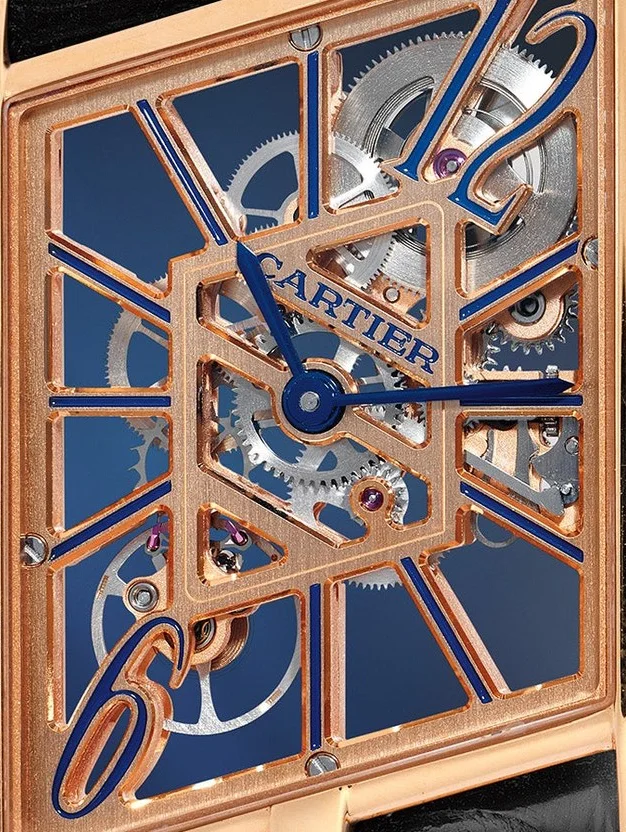

- blue lacquer numerals
Engraved unique dial
A unique platinum skeleton watch commissioned at about 1997 has tiny 6 and 12, a Cartier logo and scrolling foliage engraved across the dial.
- engraved foliage
Eastern Arabic special order
A platinum special order with wine-red Eastern Arabic numerals on a champagne radial soleil dial, four numerals only.
- four Eastern Arabic numerals
Hands 2 described
Hands are blued steel in most versions.
Original hands
Heat-blued Breguet or gladium hands; some watches have gold hands.
- Breguet or gladium hands
2020 hands
Sword-shaped hands, given as blued steel in published accounts; on the pink gold WGTA0043 in the library's records the hands are gold-coloured. One account says the 1936 watch had open-tipped hands.


Case and sizes 4 described
The case is a rectangle sheared into a lozenge, with 12 at the top right corner. Since 1996 it has been made in two sizes: small (about 23 to 24 x 32 to 34 mm) and extra-large (47.15 x 26.2 mm). The number of lugs varies.
Small case
The 1996 case is given as 24 x 34 mm on one account and 23 x 32 mm on another, and the 1999 case as 23 x 32 mm; both keep the proportions of the 1936 watch. The 1996 watches have no central lug.
- small case, no central lug on the 1996 watch
Three- and four-lug versions
Made later by Cartier as montre losange avec brides. The three-lug version is very rare, with one yellow gold example in the firm's heritage department; the four-lug version is known from a single watch in the firm's archive photographs.
- extra lugs
Third central lug
The 2006 and 2020 editions add a lug centred at each end, a feature divisive among collectors.
- centre lug
Extra-large 47.15 x 26.2 mm
The 2020 case is 6.38 mm thick for solid dials and 7.82 mm for the skeleton, with 3 bar water resistance and a sapphire crystal.
- 47.15 mm length
Crown 2 described
The crown sits low on the right flank.
Plain crown
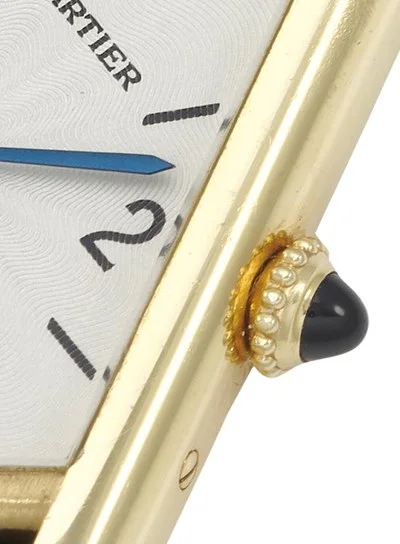
The earliest watches have a low-profile crown without the cabochon Cartier normally uses.
- no cabochon
Cabochon crown
The 2020 watches carry a sapphire cabochon on five references and a diamond on the gem-set skeleton. Some accounts give a ruby cabochon on the platinum solid-dial watch. Watches of the 1996, 1999 and 2006 editions in the library's records also have a cabochon in the crown.
- cabochon
Movement 5 described
Movements have changed with each production.
European Watch and Clock Company 8-line
An octagonal 8-line calibre, the same as the one used in the Reverso of its day.
Jaeger-LeCoultre flat round (London)
A circular flat movement in the late-1960s London watches.
Calibre 9P2
Hand-wound movement of Piaget origin from the 1950s in the 1996 edition; sellers give 18 jewels.
Calibre 1917 MC
Hand-wound, 3 Hz, 38 hours, 19 jewels, 2.9 mm thick. It was introduced in 2018 on the Tonneau de Cartier.
Calibre 9623 MC
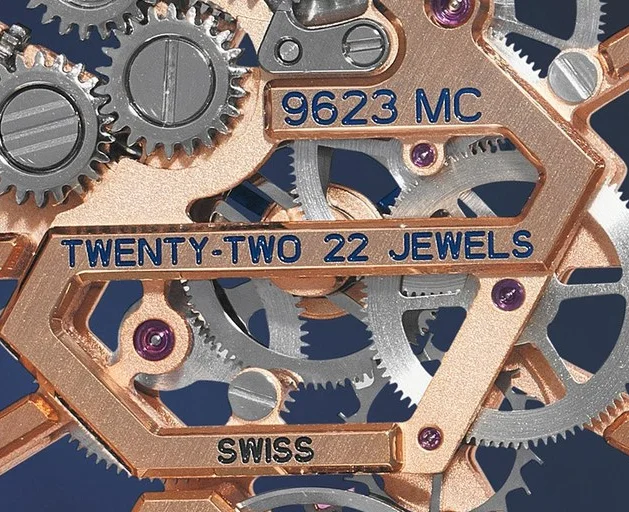
Skeletonised hand-wound movement made for the watch, 4 Hz, 48 hours, 22 jewels, 32 x 21.1 mm.

Bracelet and strap 1 described
The slanted dial needs a specially cut strap.
Made-to-measure strap with ardillon buckle
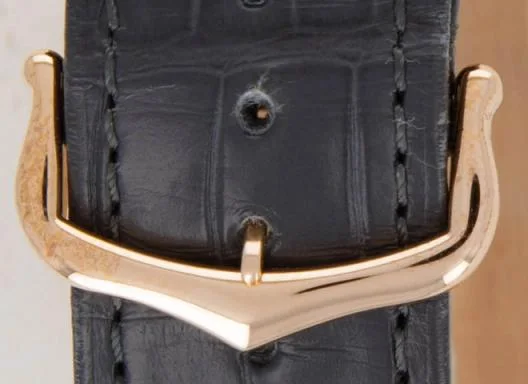
Alligator strap cut to the case and fitted with a pin buckle; colours vary by version (grey, brown, blue, black).

Reference numbers
A four-digit number is stamped on the case and covers a case; a code beginning W, or the newer letter codes, is a catalogue number for one version of it (metal, dial, strap). Many older watches carry neither. The last column is the listings on record under the number, as its own page counts them.
| Number | What it is | Listings |
|---|---|---|
| 2488 | The 1996 edition: 100 platinum and 300 yellow gold, calibre 9P2. In the library's records it appears in both yellow gold and platinum, and sellers also give it for the 1999 Macau watches. | 18 |
| 2842 | The Collection Privée edition with a third lug, in yellow gold, numbered out of 150; sellers also call it 'jumbo'. | 10 |
| WGTA0042 | 2020 Privé solid dial in platinum, as sellers describe it; 4285 appears beside it in the library's records. | 11 |
| WGTA0043 | 2020 Privé solid dial in pink gold, as sellers describe it; 4286 appears in titles beside this code. | 4 |
| WGTA0044 | 2020 Privé solid dial in yellow gold, as sellers describe it; 4287 appears in titles for an 18k gold edition numbered out of 100. | 3 |
| WHTA0011 | 2020 Privé skeleton in pink gold. | 3 |
| WHTA0012 | 2020 Privé skeleton in platinum; 4226 appears beside it in one title and as a case number in another. | 3 |
| 4285 | Appears beside WGTA0042, in one title for a possibly unique platinum special order with a dark anthracite dial, and in others for a platinum Milan boutique edition of 16 with burgundy numerals; the records do not settle which it covers. Catalogue codes seen beside it in listings: WGTA0042 | 5 |
| WGTA0071 | Platinum 'Milano' edition with burgundy numerals, as sellers describe it. | 2 |
| WGTA0085 | Platinum 'Siam' edition with Thai numerals, as sellers describe it. | 1 |
| WGTA0120 | Platinum 'Fifth Avenue' limited production, as sellers describe it. | 4 |
| CRWHTA0023 | Off-catalogue boutique-exclusive platinum skeleton, 'temple' edition, with burgundy lacquer, as sellers describe it; WHTA0023 appears for a platinum skeleton. | 1 |
Names
- Tank Oblique. An earlier name for the 1936 watch.
- Parallélogramme. Another early name, from the case shape.
- Losange. French for lozenge; the early name used with the case shape.
- Jumbo. Sellers' name for reference 2842.
- NSO. Special order: a one-off made to a client's request.
Where accounts differ
Points on which the published literature and the library's own records do not agree, or on which the literature contradicts itself.
- Launch year. One account puts the Parallélogramme in 1937; the rest say 1936. Another says the original Tank Asymétrique was first introduced in 1917, which is the date of the Tank itself.
- Size of the 1996 platinum run. One account says 150 platinum and 300 yellow gold; three others say 100 platinum and 300 yellow gold. The library's records show platinum numbered out of 100.
- 1996 edition and the Collection Privée. One account says the 1996 edition was revived by the Collection Privée; two say it came before the formal launch. In the library's records the listing titles that name the Collection Privée are for ref. 2842, a 1999 Macau watch catalogued as 2488 and the 2020 editions; none is for a watch sellers date to 1996.
- Macau 9. One account puts the applied 9 above the Arabic 9; another puts it below.
- 2006 dial signature. One account says ref. 2842 omits the Paris dial; another gives the 2006 edition a Cartier Paris signature. One of the library's titles for 2842 says signed Cartier, Paris.
- 2020 metals. One account says the 2020 watches are platinum, yellow and white gold, 300 in all; the others give pink gold, and the library's records show pink gold and no white gold.
- 2020 numerals and skeleton metal. One account gives Roman numerals and silver or anthracite dials; the others give Arabic. One account lists a yellow gold skeleton; the others pink gold.
- London watches and their dates. One account illustrates a London Asymétrique dated 1936; the same account puts London's own watches of this shape at the end of the 1960s, and another says London imported its watches until 1966. Neither says who made the 1936 London watch.
- Size of the 1996 watch. One account gives the 1996 ref. 2488 as 24 x 34 mm; another gives 23 x 32 mm for the 1996 and 1999 watches together. In the library's records 23 mm is the commonest width stated.
- Date of ref. 2842. One account dates the 150-piece yellow gold edition with a third lug to 2006. In the library's records sellers date watches numbered out of 150 as ref. 2842 between about 1997 and 2013, among them circa 1997, 2000 and 2003.
- Lugs of the 1936 watch. Three pages on the 2020 launch say the original of 1936 had three lugs and that the new central lug follows it. A collector's account says the three- and four-lug cases came later, and another account says the 1996 watches, like the originals, had no central lugs.
- Size of the Macau edition. Published accounts give two sets of 99, one left-handed and one right-handed. In the library's records Phillips, Antiquorum, Loupe This and thekeystone.com give 99 pieces in all, and Phillips and Loupe This divide them into 77 with the crown on the right and 22 with it on the left. The numbered watches among them are marked out of 99, which fits either account.
- Hands of the 2020 solid-dial watches. One account gives the 2020 watches blued steel hands. In the library's records the yellow gold and platinum watches show blue hands, but the pink gold WGTA0043, at Phillips and Loupe This, shows gold-coloured hands.
- First use of calibre 1917 MC. One account of the 2020 Asymétrique says calibre 1917 MC was introduced in 2018 on the Tonneau. Another says it was introduced in 2018 in the Tank Louis Cartier, and two more say it was created or first introduced in 2019.
In the records
Counted from 88 listings at dealers and auction houses whose title, or whose reference, places them on the line; 75 state a year. These are what sellers state, not measurements, and a count of listings is not a count of watches made.
Case metal
| Metal | Listings | Share |
|---|---|---|
| Gold, any colour | 42 | 55% |
| Yellow | 22 | 29% |
| Pink | 8 | 11% |
| Colour not stated | 12 | 16% |
| Platinum | 34 | 45% |
As sellers state it. Shares are of the 76 listings that name a metal. A listing that says "gold" or "18K gold" names no colour: it is counted under "colour not stated", not as yellow gold. Carat, where a listing of gold gives one: 18k 40.
Case size
| Size | Listings | Share |
|---|---|---|
| 23 mm | 18 | 27% |
| 47 mm | 15 | 22% |
| 26 mm | 13 | 19% |
| 26.5 mm | 4 | 6% |
| 47.15 mm | 4 | 6% |
| 31 mm | 3 | 4% |
| 23.6 mm | 2 | 3% |
| 47.2 mm | 2 | 3% |
| Other sizes | 6 | 9% |
As sellers state it. Shares are of the 67 listings that give a size. On a watch that is not round some sellers give the width and some the length, so one watch can stand under two sizes.
Movement
| Kind | Listings | Share |
|---|---|---|
| Hand-wound | 69 | 99% |
| Mechanical, winding not stated | 1 | 1% |
Shares are of the 70 listings whose description says how the watch is driven.
Listings by decade the seller gives
| Decade | Listings |
|---|---|
| 1930s | 2 |
| 1990s | 31 |
| 2000s | 5 |
| 2010s | 2 |
| 2020s | 35 |