Tank Chinoise
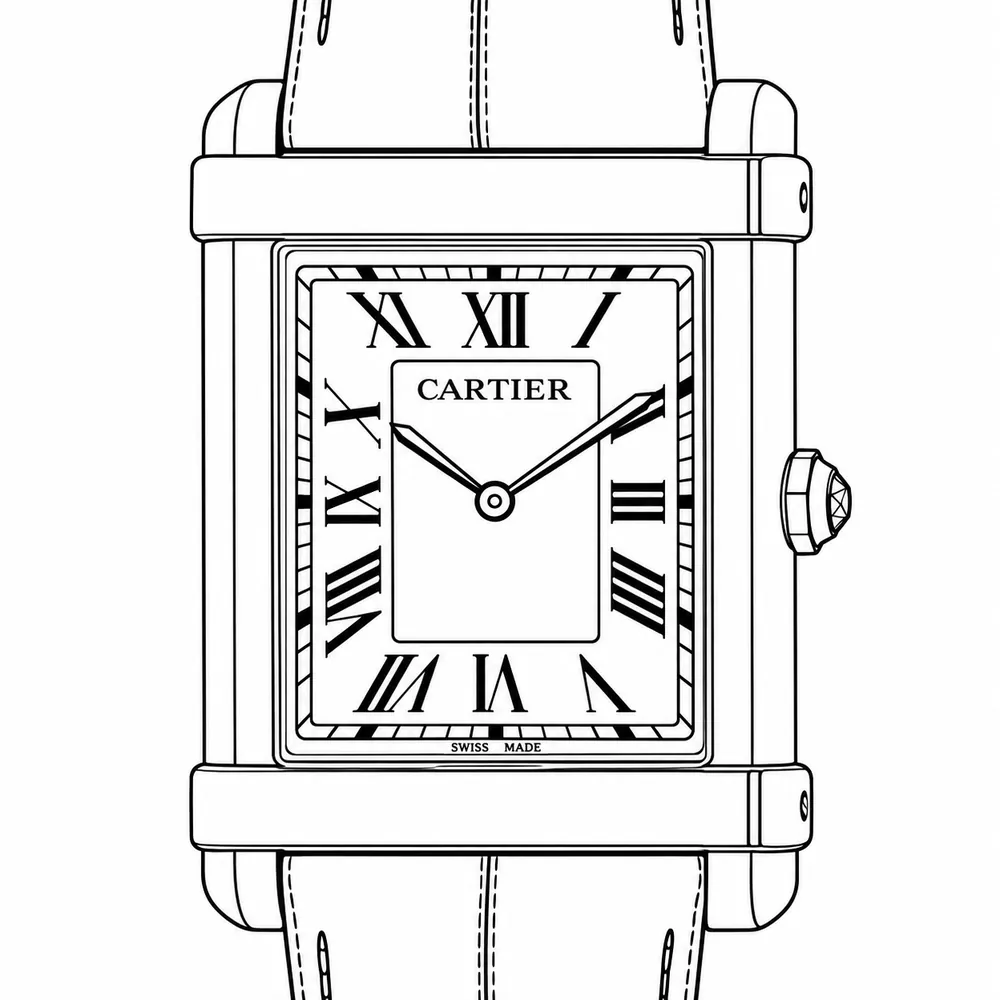
The Tank Chinoise is the square Tank with a second pair of bars, one across the top and one across the bottom of the case, set over the side brancards in the manner of the lintels of a Chinese temple portico. It is dated to 1922, the year of the Tank Louis Cartier, and the early watches are small hand-wound gold squares with no reference number. Cartier revived it as numbered references in the Collection Privée Cartier Paris, in platinum and rose gold, and again in 2022 as the Privé Tank Chinoise, now rectangular and limited in number. Collectors look first at the case, its end bars and its numbers, then at the movement, which should suit the period, and at the clasp.
Cartier's entries are arranged by model, not by reference number, because its reference numbers are several systems at once and many of its watches carry none. The houses are set out in Paris, London and New York.

- Made
- from c. 1922The launch year is given consistently; the original watches are dated only loosely by catalogues, and the revivals are separated by gaps for which published accounts give no continuous production.
- On record
- 109 listings39 of them give no reference
- Reference numbers
- 11 described29 seen in listings
- House named in the title
- Paris 8most older watches are not labelled
What to look for
Details cut from photographs of watches of this line on record. Each was chosen by eye from a listing on the line and then checked again against the words beneath it. More sit beside the productions and parts they belong to, below. Select the small mark in a picture's corner for its holder and a link to its listing.


Components
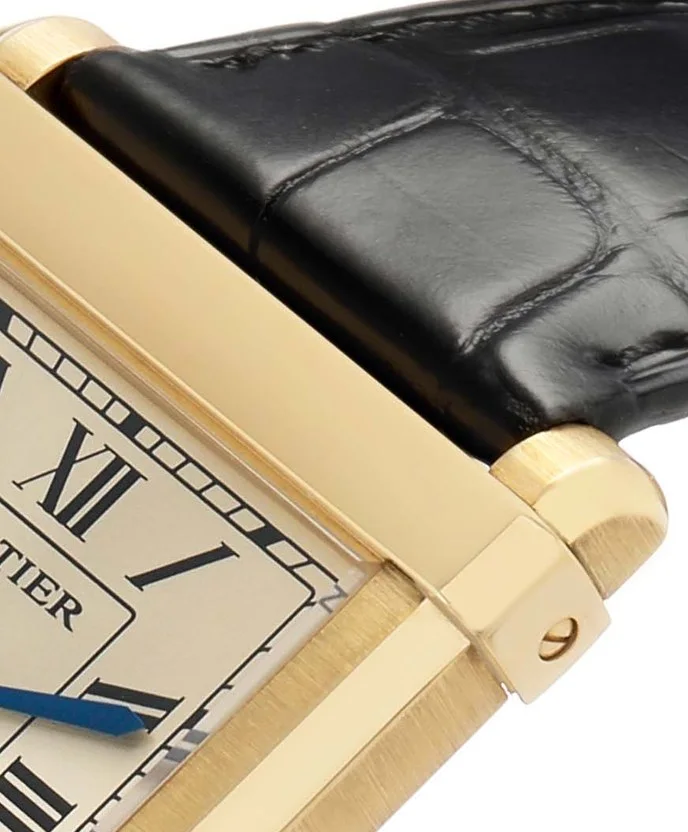
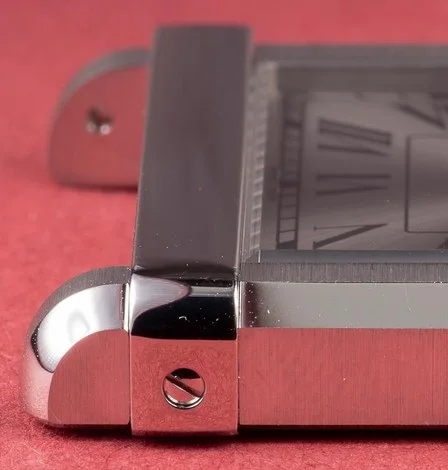
3 watches of this line, oldest first. Each photograph is turned upright and scaled so the dial is the same height, and every crop is cut from the same place on the dial, so one row shows one part across them all. A watch is shown only if its seller's title names the line and the picture has been checked by eye, twice, to show it. Years are as sellers give them. Each picture is a detail; select the small mark in its corner for its holder and a link to its listing; the whole watch is shown only for holders whose pictures may be shown whole.
| 2022 | 2022 | 2022 | |
|---|---|---|---|
| Signature under twelve |  |  |  |
| Dial above six |  |  |  |
| Numeral at twelve |  |  |  |
| Numerals at seven and eight | 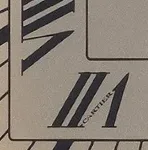 |  |  |
| Hands |  |  |  |
| Crown |  |  |  |
| Case corner and lug | 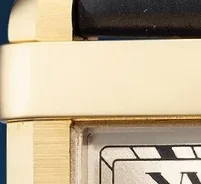 |  |  |
| Reference | WGTA0088 | WGTA0074 | WGTA0075 |


By house and period 6 described
Original, 1922 to the 1970s
The original Chinoise is a square 18k yellow gold Tank with a raised bar across each end overlapping the sides, hand-wound, made without a reference number and identified by Cartier case numbers. Most catalogued examples are about 23 mm wide, usually 23 x 30 mm or 24 x 31 mm, with some at 23 x 23 mm. Catalogue dates run from about 1923 into the 1970s and are loose: the same case numbers have been dated to different decades. The movement varies: those catalogued from the 1920s to the 1940s are signed European Watch & Clock Co., and a single watch of about 1950 has a LeCoultre. Single examples of other sizes are recorded: 21 x 28 mm of the 1950s, catalogued as made by Cartier France, and 26 x 35 mm of the 1960s, whose case and Cal. 122 movement are both signed European Watch & Clock Co. and whose engine-turned silver dial carries the secret signature. One example is catalogued as made in New York in 1946 with a Cartier certificate; published accounts say no more about New York or London for this model.
Signature and marks. Case numbers in place of a reference, and in one case two numbers on the same watch (11999 and 22017, on an example of about 1923). Movements signed European Watch & Clock Co. on early examples. Early case backs are described as secured by four screws in the band. On the 26 x 35 mm example of the 1960s, case and movement signed European Watch & Clock Co. and the secret Cartier signature on the dial.
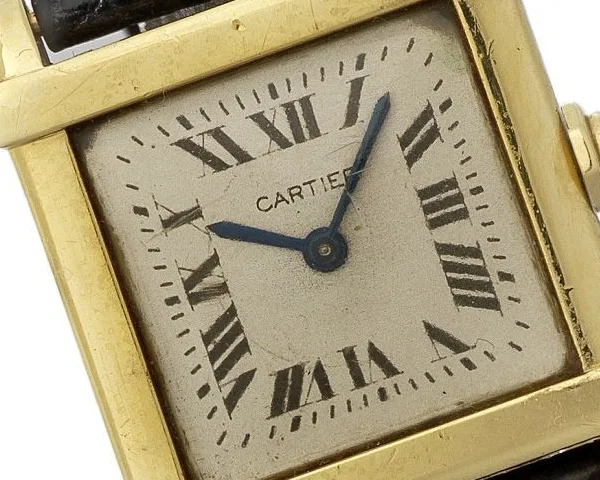

- square yellow gold case with a raised bar across each end
- no reference number, only case numbers
- sapphire-set crown, octagonal on some
- clasp and buckle that match the case
References: none: case numbers only
Paris, 1960s and 1970s
Catalogues describe Cartier Paris examples of the 1960s and into the 1970s with movements signed Cartier, of 7 3/4 or 9 lignes and 17 or 18 jewels, and dials signed Paris. One of about 1975 is given a cal. 838/1. Catalogue dating of these watches is loose: case numbers 033642 and 033646 have been put in the 1970s and at about 1960 in the same year, 034890 in the 1950s, and 031781 at about 1975. A single 19 x 26 mm example of the 1960s, with a dial signed Paris, has an eight-sided crown.
Signature and marks. Dial signed Paris on examples of the 1960s and 1970s; movement signed Cartier; Cartier case numbers in place of a reference.
- Paris on the dial
- Cartier-signed hand-wound movement
References: case numbers 031781, 033642, 033646, 034890 (no reference number)
Paris, platinum, 1997
A platinum Chinoise with a dial signed Paris, dated to 1997, falls before the official start of the Collection Privée series in 1998. It is described as keeping the original near-square character, at 25 x 21 mm, with a sapphire cabochon on the crown at three o'clock and an 18k white gold Cartier folding clasp. It is believed to belong to a very small series, of which ten earlier examples have been publicly offered.
Signature and marks. Paris on the dial; Cartier-signed folding clasp; Cartier International Certificate with the watch.
- platinum case about 25 x 21 mm
- dial signed Paris
- sapphire cabochon crown
- white gold folding clasp
Collection Privée Cartier Paris, 2004 to 2008
Cartier recreated the Chinoise within the Collection Privée Cartier Paris programme (1998 to 2008) with a slightly larger case than the original and a sapphire caseback through which the 437 MC calibre, made by Piaget, can be seen. It was offered in platinum and in rose gold, numbered 2685 and 2684 with suffix letters, at about 29 to 30.5 x 37 mm with a guilloché dial. A 2005 catalogue lists both metals. The Chinoise is believed to have been sold out by the end of the programme. Published accounts give the first appearance as 2004, though examples of the late 1990s are also described, and the last as 2007 to 2009 (see Where accounts differ).
Signature and marks. Not described in published accounts; the watches carry the numbered references 2684 (pink gold) and 2685 (platinum), with letters G, H or I after them in the library's records.
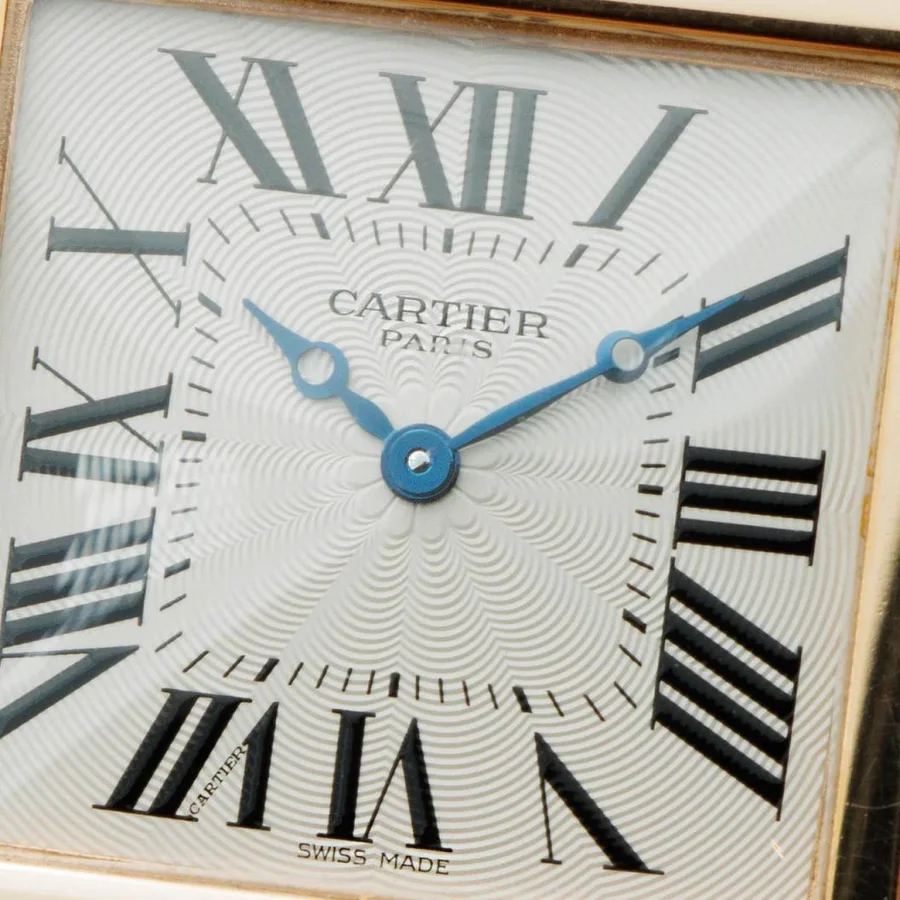

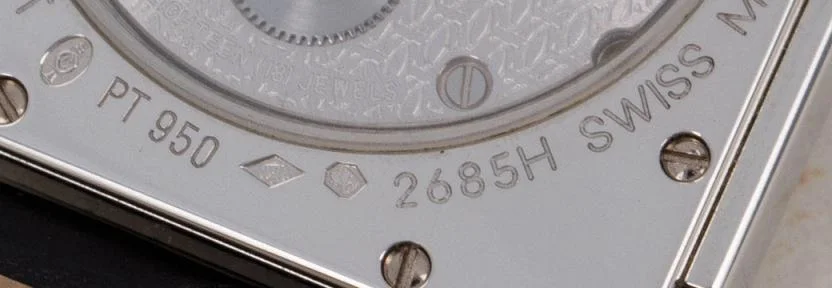

- sapphire display back showing the 437 MC
- platinum or pink gold
Privé, hand-wound 430 MC, 2022
Issued in 2022 for the model's hundredth anniversary as one of six Privé Tank Chinoise versions, this is the plain-dial group in yellow gold, rose gold and platinum, rectangular rather than square at 39.49 x 29.2 mm and 6.09 mm thick. The movement is the hand-wound 430 MC, based on the Piaget 430P, behind a closed case back. Dials are sunburst-brushed with Roman numerals and hued to match the metal; horizontal case parts are polished and the vertical sides brushed. Most accounts limit each metal to 150 pieces; one gives 125 (see Where accounts differ).
Signature and marks. Large Cartier lettering on the dial and a printed rectangle inside the Roman numerals, with no minute track within them; individually numbered.
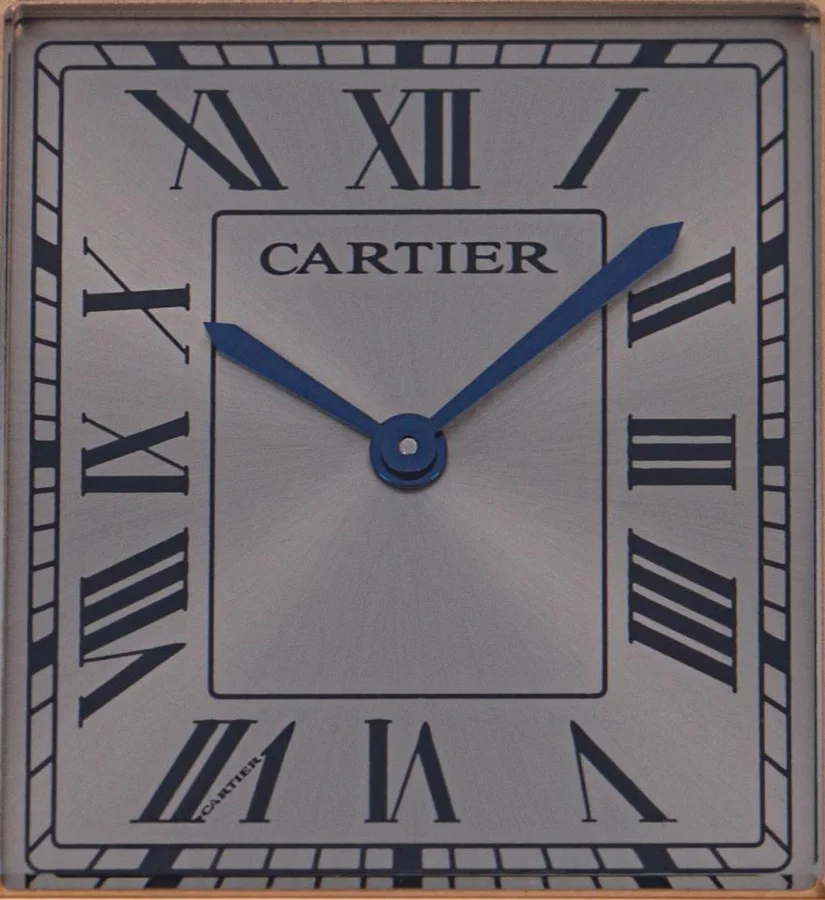

- rectangular case 39.49 x 29.2 mm
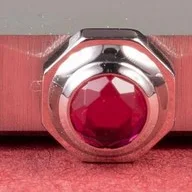
- faceted blue stone in the crown on gold, faceted red stone on platinum
- alligator strap in gray or black with matching buckle
- closed case back
Privé, open-worked 9627 MC, 2022
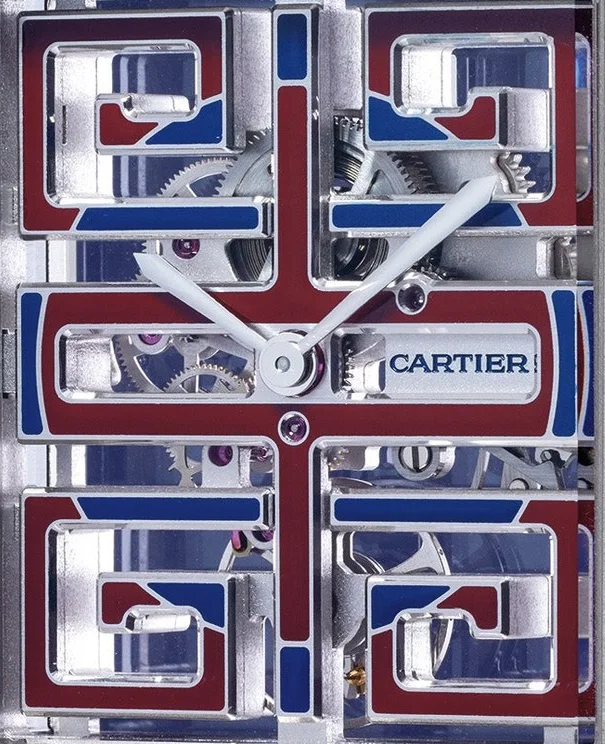
The other three 2022 versions have an open-worked dial over the new 9627 MC manual-wind skeleton calibre, made for this watch and drawn on traditional Chinese windows. The case is 39.5 x 29.2 mm and 7.7 mm thick, about 1.6 mm thicker than the plain-dial group, with the movement visible from the back. The yellow gold version has black and red lacquer, with black lacquer also on the brancards; the platinum versions have red and blue lacquer, one with polished platinum brancards and one diamond-set (161 brilliant-cut diamonds, 1.70 ct in all, across the case and buckle). The platinum and gold versions are limited to 100 pieces each; the diamond-set version is given as 20 in two accounts, but 50 in one and 100 in another (see Where accounts differ).
Signature and marks. Open-worked dial; lacquer colours as above; individually numbered (a yellow gold example in the library's records is numbered out of 100).
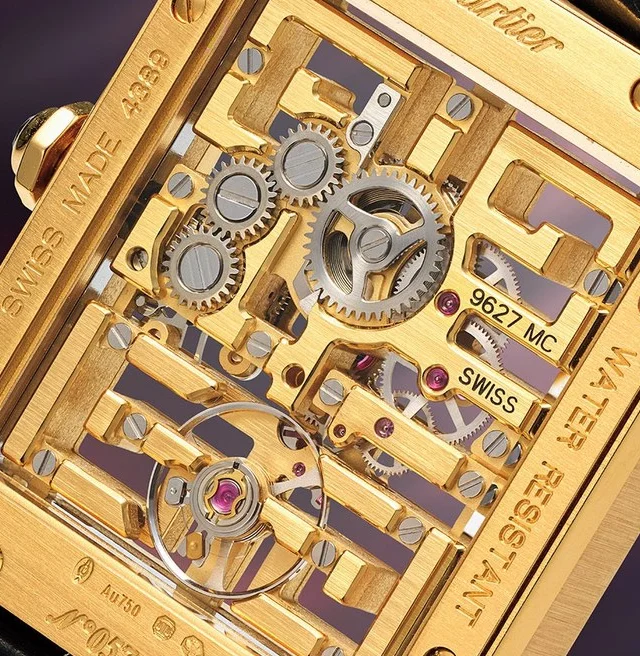

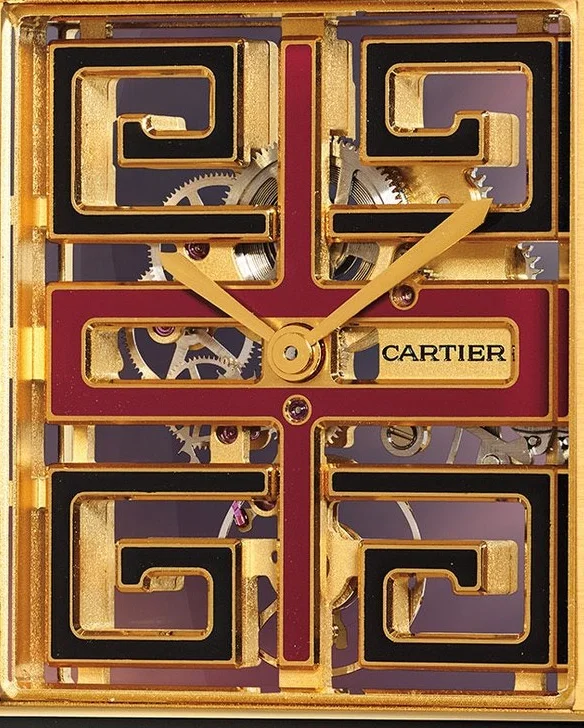

- black-lacquered brancards on the yellow gold version
- two alligator straps supplied
Chronology
Specification
| Case | Original: square 18k yellow gold, raised bar across each end, about 23 x 30 mm. Collection Privée: platinum or rose gold, about 29 to 30.5 x 37 mm. Privé 2022: platinum, yellow or rose gold, 39.49 x 29.2 mm |
| Crystal | Domed on the original in one account; sapphire on the 2022 watches |
| Dial | Roman numerals; white or silvered on the original, guilloché on the Collection Privée watches, sunburst or open-worked on the 2022 watches |
| Movement | Hand-wound on the original, Collection Privée and 2022 watches: European Watch & Clock Co., LeCoultre or Cartier-signed calibres on the original; 437 MC on the Collection Privée watches; 430 MC or 9627 MC on the 2022 watches |
| Crown | Sapphire-set on many originals and on the 1997 platinum watch; blue sapphire, ruby or diamond on the 2022 watches, by version |
| Strap | Leather with a Cartier deployant clasp on the original; alligator with a precious-metal buckle on the 2022 watches |
| Water resistance | Not rated in one account of the 2022 watches; 30 m in a dealer listing |
Dial 6 described
The original dials are white or silvered with painted Roman numerals. The Collection Privée watches have guilloché dials, and the 2022 watches either a sunburst-brushed dial or an open-worked, lacquered one.
Painted Roman numerals, white or silvered
The usual original dial, with the numerals radial on many examples. Catalogues date such watches from about 1923 into the 1970s.
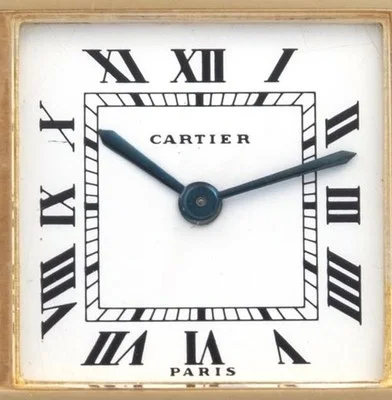

- white or silvered dial
Signed Paris
A Paris signature is recorded on examples of the 1960s and 1970s and on a platinum watch dated to 1997.
- Paris in the dial signature
Silver guilloché with secret signature
One 26 x 35 mm example of the 1960s has a silver guilloché dial carrying the secret Cartier signature. It is recorded once.
- engine-turned silver dial
- secret signature
Guilloché, Collection Privée
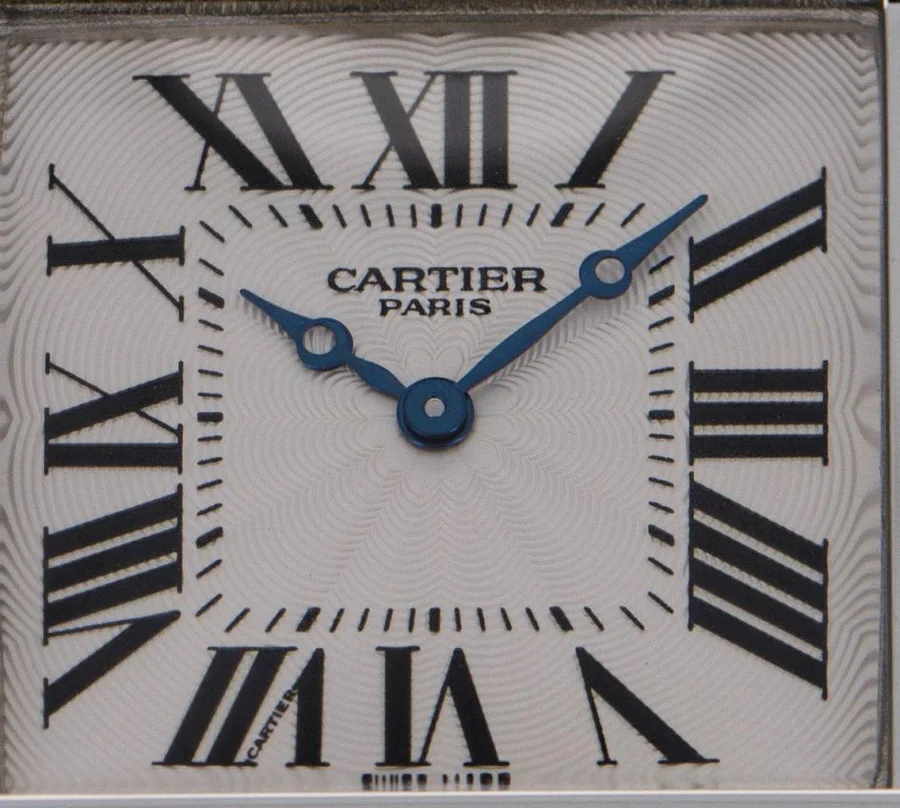
The numbered 2684 and 2685 watches have a guilloché dial.

Sunburst, hued to the metal
The three plain-dial 2022 versions have a sunburst-brushed dial in a tone matched to the case metal, with Roman numerals and a printed rectangle inside them in place of a minute track.
- radially brushed dial
- printed rectangle inside the numerals
Open-worked, lacquered
The skeleton dials are the movement itself, with black and red lacquer on yellow gold and red and blue on platinum.

Hands 2 described
Blued steel hands are normal on the original and on the gold 2022 watches; the platinum 2022 watch has silver-toned hands.
Blued steel, bâton, sword or épée
The original watches are recorded with all three shapes. One example of the 1920s has gold hands.
- blued steel hands
Blued sword hands on gold, silver-toned on platinum
On the plain-dial 2022 versions the gold watches carry blued steel sword hands and the platinum watch tone-on-tone silver or polished grey steel hands.
- sword hands
Case and sizes 5 described
The Chinoise is told by the bars across the top and bottom of the case, set over the side brancards. The original is square and small; the Collection Privée and 2022 watches are larger, and the 2022 watches rectangular.
Square, about 23 x 30 mm
The size most often catalogued: square with a raised bar at each end and rounded lugs, in 18k yellow gold. Early backs are described as held by four screws in the band.
- bars overlapping the sides
- four screws in the case band
Single odd sizes
A 21 x 28 mm example of the 1950s is catalogued as made by Cartier France; a 19 x 26 mm of the 1960s has an eight-sided crown; a 26 x 35 mm of the 1960s has a case signed European Watch & Clock Co. Each is recorded once.
Platinum, 25 x 21 mm
A small platinum case with a Paris-signed dial, dated 1997.
- platinum case, Paris dial
Collection Privée, about 29 to 30.5 x 37 mm
A slightly larger case in platinum or rose gold with a sapphire display back.
- sapphire case back
Privé, 39.49 x 29.2 mm
A rectangular case in platinum, yellow gold or rose gold, 6.09 mm thick on the 430 MC watches and 7.70 mm on the open-worked ones. Horizontal parts are polished, vertical sides brushed with polished edges.
- polished top and bottom bars
- brushed vertical sides
Crown 2 described
Sapphire-set crowns are recorded on many originals and on the 1997 platinum watch; the 2022 watches have sapphire, ruby or diamond, by version. No crown is described for the Collection Privée watches.
Sapphire-set crown, octagonal on some
Many originals have a sapphire-set crown; an eight-sided crown is recorded on a 19 x 26 mm example.
- octagonal crown
Sapphire, ruby or diamond crown on 2022 watches
On the plain-dial watches the gold versions carry a blue sapphire in the crown and the platinum a red ruby. One account calls these stones cabochons; another describes a faceted, domed crown set with a faceted ruby, sapphire or diamond by version, and the plain-dial watches in the library's records show a faceted stone in all three metals (see Where accounts differ).

Crystal 0 described
One account describes a domed crystal on the model; the 2022 watches have sapphire crystals.
Movement 6 described
The watches described in published accounts are hand-wound; the suppliers change with each production.
European Watch & Clock Co.
Signed on examples of the 1920s to 1940s, and on a 26 x 35 mm example (Cal. 122, 18 jewels) of the 1960s.
- European Watch & Clock Co. signature
LeCoultre
Recorded on one example of about 1950.
Cartier-signed, 7 3/4 or 9 lignes
Paris examples of the 1960s and 1970s, 17 or 18 jewels; one of about 1975 is given as cal. 838/1.
- Cartier signature on the movement
437 MC
The Collection Privée calibre, made by Piaget and visible through the sapphire back.
430 MC
Based on the Piaget 430P, 2.1 mm thick, 18 jewels, 21,600 vph, 131 parts; interlocking Cs etched on the bridges. Power reserve is given as 38 hours in most accounts; 43, 36 and 72 hours are also given (see Where accounts differ).
- closed case back
9627 MC
A manufacture manual-wind skeleton calibre developed for this watch, 21,600 vph, 38 hours.
- skeleton movement visible from the back
Bracelet and strap 2 described
The original is on a leather strap; the 2022 watches on alligator.
Leather with Cartier deployant clasp
The clasp is in yellow or pink gold; some originals are on an 18k gold Cartier link bracelet. Auction catalogues note a non-matching clasp on one and an associated buckle on another.
- clasp matching the case
Alligator strap and buckle
Matte black on the yellow gold plain-dial watch, matte gray on the others; the open-worked versions come with two straps. Buckles are in the case metal.
Reference numbers
A four-digit number is stamped on the case and covers a case; a code beginning W, or the newer letter codes, is a catalogue number for one version of it (metal, dial, strap). Many older watches carry neither. The last column is the listings on record under the number, as its own page counts them.
| Number | What it is | Listings |
|---|---|---|
| 2684 | Pink gold Collection Privée Chinoise, hand-wound 437 MC; letter suffixes G, H and I appear on the same description in the library's records. | 1 |
| 2685 | Platinum Collection Privée Chinoise, hand-wound 437 MC; suffixes G and H appear in the library's records. | 5 |
| WGTA0074 | Platinum Privé Tank Chinoise of 2022, 430 MC, limited to 150 in most accounts (125 in one). | 7 |
| WGTA0075 | Rose gold Privé Tank Chinoise of 2022, 430 MC, limited to 150 in most accounts (125 in one). | 7 |
| WGTA0088 | Yellow gold Privé Tank Chinoise of 2022 with a numbered limit, as sellers describe it. | 4 |
| WHTA0015 | Platinum open-worked Privé version of 2022, as sellers describe it; listing titles also give 4390 beside it. | 3 |
| WHTA0016 | Yellow gold open-worked Privé version (numbered out of 100), as sellers describe it. | 4 |
| 2305 | Yellow gold diamond-set ladies' Chinoise, as sellers describe it. | 6 |
| 2686 | Pink gold ladies' Chinoise with a diamond bezel and shoulders, as sellers describe it. | 2 |
| 8063 | Platinum Chinoise signed Cartier Paris, as one catalogue gives it. | 1 |
| 8120 | Platinum limited-edition Chinoise with a salmon dial, as one catalogue gives it. | 1 |
Originality
- A clasp or buckle that does not match the case has been noted on some originals.
- The movement should suit the period: European Watch & Clock Co. early, LeCoultre on one of about 1950, Cartier-signed on Paris watches of the 1960s and 1970s.
Where accounts differ
Points on which the published literature and the library's own records do not agree, or on which the literature contradicts itself.
- When the Collection Privée Chinoise was made. One dealer's account describes a Paris-signed platinum Chinoise dated to 1997 and Collection Privée examples of the late 1990s; others give 2004 as the revival. In the records the stated years of the Collection Privée references run from 2000 to 2010; a few platinum listings with no reference are dated to the mid-1990s.
- Last Chinoise before 2022. One account says the last appearance was in 2007, another puts dated Collection Privée examples from 2004 to 2009, and another believes the model sold out by the programme's end in 2008. The records' stated years include 2007 and 2010.
- Limits of the 2022 versions. The plain-dial versions are 150 per metal in five accounts and 125 in another; the diamond-set open-worked version is 20 in two accounts, 50 in a third, and 100 in a fourth, which gives 100 for all three open-worked versions; the open-worked gold and platinum versions are 100 in four accounts. A yellow gold open-worked watch in the library's records is numbered out of 100.
- Power reserve of the 2022 watches. The 430 MC is given 38, 43 and 36 hours by different pages, and the first look at the series gives 72 hours for both calibres; the 9627 MC is given 38 hours elsewhere.
- Crown stone of the 2022 watches. One account describes a blue sapphire cabochon in the crown of the gold plain-dial watches and a ruby-red cabochon on the platinum one. Another describes faceted, domed crowns set with a faceted stone. Photographs of plain-dial watches in the library's records, in yellow gold, rose gold and platinum, show a faceted stone.
In the records
Counted from 109 listings at dealers and auction houses whose title, or whose reference, places them on the line; 79 state a year. These are what sellers state, not measurements, and a count of listings is not a count of watches made.
Case metal
| Metal | Listings | Share |
|---|---|---|
| Gold, any colour | 57 | 66% |
| Yellow | 19 | 22% |
| Pink | 18 | 21% |
| Colour not stated | 20 | 23% |
| Platinum | 30 | 34% |
As sellers state it. Shares are of the 87 listings that name a metal. A listing that says "gold" or "18K gold" names no colour: it is counted under "colour not stated", not as yellow gold. Carat, where a listing of gold gives one: 18k 40.
Case size
| Size | Listings | Share |
|---|---|---|
| 29 mm | 10 | 17% |
| 39.5 mm | 9 | 15% |
| 28 mm | 5 | 8% |
| 30 mm | 5 | 8% |
| 31.5 mm | 4 | 7% |
| 32 mm | 4 | 7% |
| 37 mm | 4 | 7% |
| 20 mm | 3 | 5% |
| Other sizes | 16 | 27% |
As sellers state it. Shares are of the 60 listings that give a size. On a watch that is not round some sellers give the width and some the length, so one watch can stand under two sizes.
Movement
| Kind | Listings | Share |
|---|---|---|
| Hand-wound | 51 | 85% |
| Quartz | 8 | 13% |
| Mechanical, winding not stated | 1 | 2% |
Shares are of the 60 listings whose description says how the watch is driven.
Listings by decade the seller gives
| Decade | Listings |
|---|---|
| 1920s | 1 |
| 1930s | 1 |
| 1940s | 3 |
| 1950s | 1 |
| 1960s | 1 |
| 1970s | 3 |
| 1980s | 3 |
| 1990s | 7 |
| 2000s | 33 |
| 2010s | 2 |
| 2020s | 24 |