Pebble
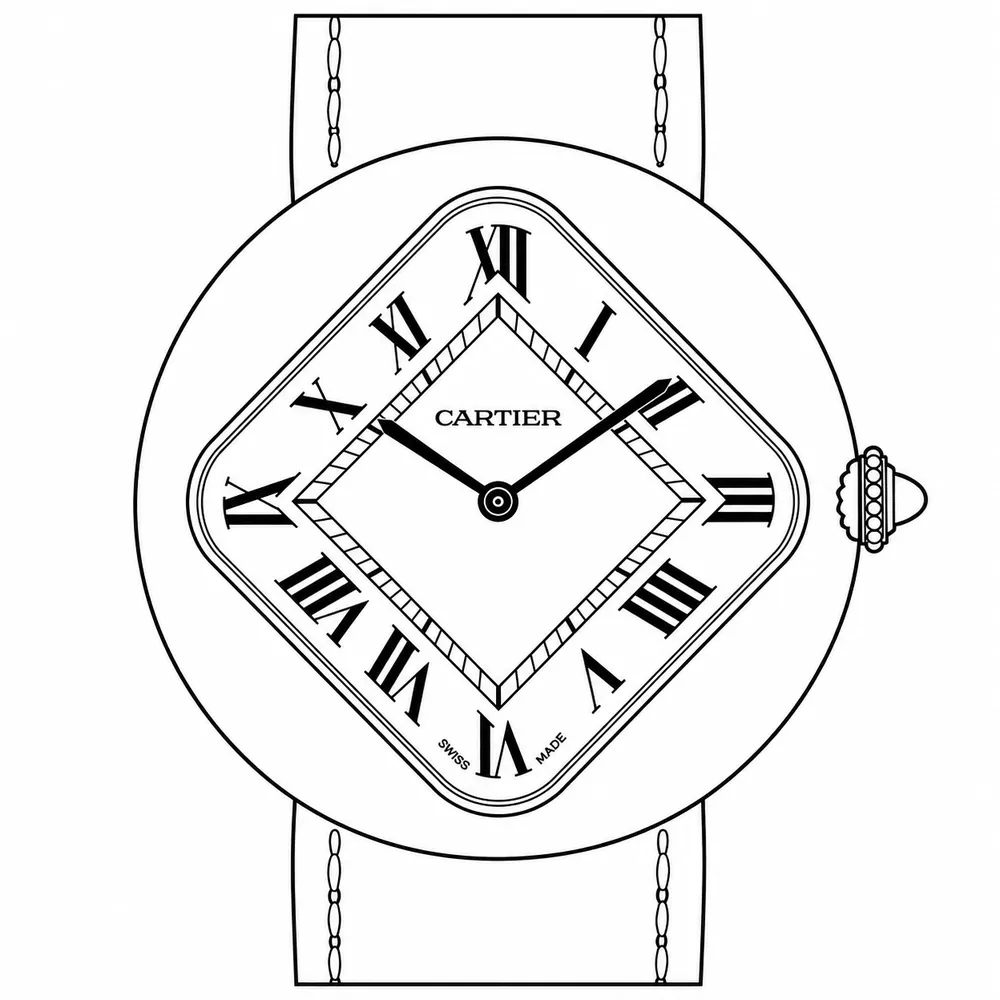
A round gold watch with a small square dial turned on its corner, so that the dial reads as a diamond inside a smooth, softly domed case. It was designed by Cartier London, then run by Jean-Jacques Cartier, and presented in 1972, and was made in a handful of watches in a large and a small size; some accounts place all of them in 1972, another dates known examples by hallmark from 1972 to 1975. The London watches have no reference number and are known by their London hallmarks and case numbers. Cartier recreated the design in 2022 as a numbered edition of 150 in yellow gold, with a modern calibre and a slightly larger case, and issued a jewelled quartz version in 2024. The name is also used by an auction house for two earlier, smaller Cartier watches of the 1940s, which are different watches.
Cartier's entries are arranged by model, not by reference number, because its reference numbers are several systems at once and many of its watches carry none. The houses are set out in Paris, London and New York.

- Made
- from c. 1972The London watches are dated by hallmark to 1972 to 1975; the re-edition followed in 2022 and a jewelled version in 2024, so the line is not continuous.
- On record
- 12 listings7 of them give no reference
- Reference numbers
- 5 described2 seen in listings
- House named in the title
- London 3most older watches are not labelled

What to look for
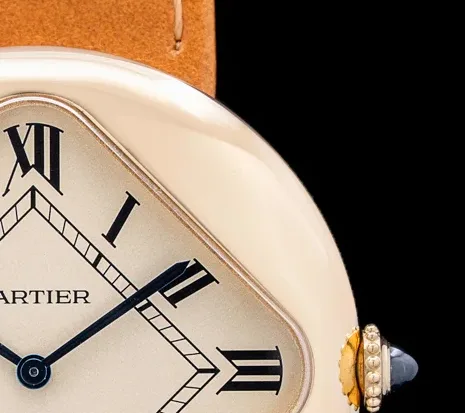
Details cut from photographs of watches of this line on record. Each was chosen by eye from a listing on the line and then checked again against the words beneath it. More sit beside the productions and parts they belong to, below. Select the small mark in a picture's corner for its holder and a link to its listing.

By house and period 3 described
London, 1972 to 1975
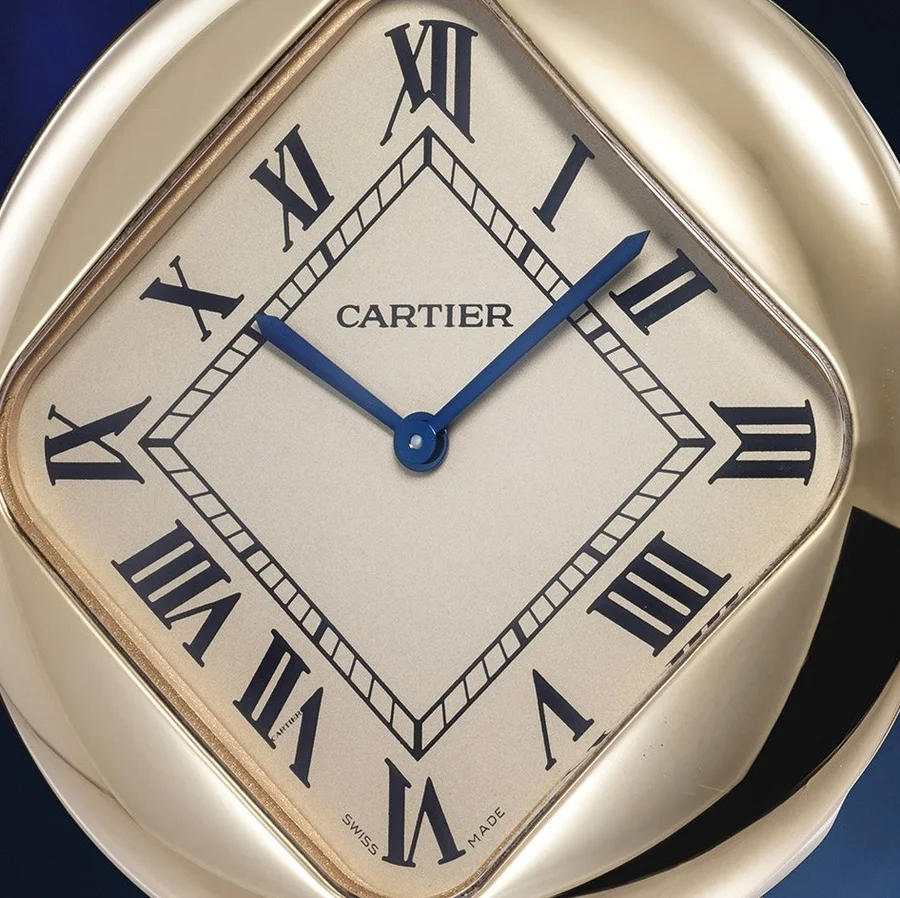
The Pebble was designed and made by Cartier London, at the New Bond Street house run by Jean-Jacques Cartier, and was presented in 1972. The case was made by hand at the Wright & Davies workshop in Clerkenwell (one account says only that the cases are believed to have been made in the Clerkenwell area); the large size, which Cartier calls Large, measures about 35 to 35.5 mm. The movement is a hand-wound Jaeger-LeCoultre, given as calibre P838. It came in a large size and a smaller size for women, and published accounts differ on how many were made: about six large watches, with the small ones uncounted (see Where accounts differ). Most are in yellow gold with cream dials; one account puts one of the six large watches in white gold, and another records one white gold example with a black dial. Accounts also differ on dates: several place all the originals in 1972, while another reads the hallmarks of the known watches as running from 1972 to 1975, and the Turtle sold at auction is dated to 1975. Two watches have exposed, rounded lugs, the Turtle, against the short lugs tucked under the case of the others. It has no reference number; a watch is identified by its marks, and the later numbered re-edition is a separate production. An auction house has also catalogued two earlier yellow gold Cartier watches, of 24 and 26 mm, under the same name; they are much smaller, carry European Watch & Clock Co. markings rather than London hallmarks, and are different watches.
Signature and marks. Dial signed Cartier on the catalogued example; one account says the original carries a script logo, replaced on the 2022 watch by the traditional one. Case marked with London hallmarks (a date letter among them), the JC punch (accounts read the JC as Jacques Cartier's mark or as Jean-Jacques Cartier's) and a Cartier London case number. On the two catalogued watches numbered 1270 and 1402, the 18k gold deployant clasp is stamped with the case number and hallmarked (English hallmarks for 1972 on 1402), and stamped JC. On the Turtle sold at auction, case back and clasp are stamped JC and the Jaeger-signed movement is stamped for Jacques Cartier; its case and clasp numbers do not match.

- round, smooth case with a square dial turned to a diamond
- short lugs tucked under the case, or exposed rounded lugs on the Turtle
- beaded crown set with a sapphire cabochon
- case back held by four screws
- London hallmarks, date letter, JC mark, case number
- the same number on the gold deployant clasp as on the case (on the two catalogued 1972 watches)
- hand-wound Jaeger-LeCoultre movement
References: No reference number, case number 1402 (hallmarked 1972, 35.5 mm), case number 1270 (hallmarked 1972, 35 mm)
Limited re-edition, 2022
Cartier issued the Pebble again in 2022 for the 50th anniversary of the London watch: 150 individually numbered watches, all in 18k yellow gold, reference WGPB0003. The case is 36 mm and 6.29 mm thick, against the original's 35.5 mm and 5.3 mm as one account gives them; the short lugs sit beneath the case and the crown carries a blue sapphire cabochon. The hand-wound calibre 430 MC, derived from the Piaget 430P, replaces the Jaeger-LeCoultre movement. The dial is eggshell with black Roman numerals and a railway minute track, with blued steel sword hands, and a light brown calfskin strap with a gold pin buckle.
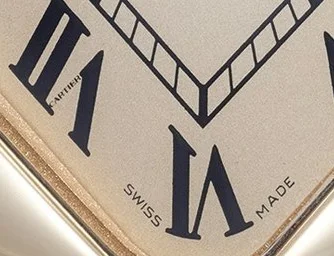
Signature and marks. Dial in the modern Cartier logo typeface, with the secret signature hidden in the VII hour marker and Swiss Made in small print at the foot of the dial. Each watch is numbered out of 150.

- calibre 430 MC behind a solid gold case back
- 36 mm case, no deployant clasp
- number out of 150
References: WGPB0003, CRWGPB0003
Pebble Tigre, 2024
The Pebble Tigre was released in 2024 in Cartier's Animalière jewellery watch line, in three versions. Each is set with diamonds, black lacquer and one other stone, and each has a quartz movement and sapphire crystal. The case is about 38.8 mm across and 10.5 mm thick, wider and thicker than the 2022 re-edition. Black calfskin strap with a second alligator strap.
Signature and marks. Not given in the literature.
- gem-set case with black lacquer
- quartz movement
- 38.8 mm case
References: HPI01615 (yellow gold, black spinels, polished onyx dial), HPI01616 (rose gold, rubies, pave diamond dial), HPI01617 (white gold, tsavorite garnets, pave diamond dial)
Chronology
Specification
| Case, London | 18k gold, mostly yellow; Cartier's Large size 35 to 35.5 mm, with a smaller size; round, with short hooded lugs set under the case (exposed rounded lugs on the two Turtles), back held by four screws |
| Dial, London | Cream, black Roman numerals, black inner minute track, square dial turned to a diamond, signed Cartier |
| Movement, London | Hand-wound Jaeger-LeCoultre, calibre P838 on the example catalogued |
| Strap, London | Leather strap; the catalogued example has a brown alligator strap and an 18k gold deployant clasp numbered to the case |
| Case, 2022 edition | 18k yellow gold, 36 mm, 6.29 mm thick, sapphire cabochon crown |
| Movement, 2022 edition | Hand-wound calibre 430 MC (derived from the Piaget 430P), 2.1 mm thick, 21,600 vibrations an hour |
| Case, 2024 Tigre | 38.8 mm, 10.5 mm thick, gold set with diamonds, black lacquer and one other stone (black spinels, rubies or tsavorite garnets); quartz |
Dial 4 described
The London dial is a square set on its corner inside a round case, cream, with black Roman numerals, an inner minute track in black and the Cartier signature. The 2022 re-edition keeps that layout in eggshell with a railway track and adds the modern logo, a hidden signature and Swiss Made. The 2024 Tigre has gem-set dials.
Cream Roman dial
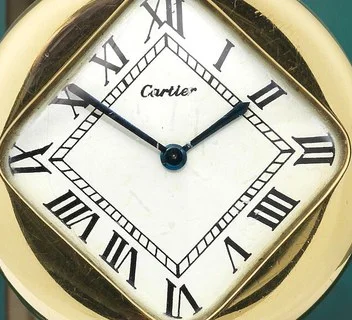
Cream dial, black Roman numerals, black inner minute track, signed Cartier; the layout of most London watches. Dated watches described this way include the one catalogued with case number 1270. One account says the original's Cartier signature is a script logo.
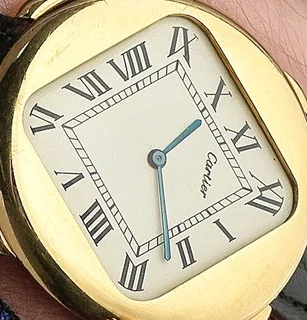

- square dial turned to a diamond
White gold, black dial
One white gold example with a black dial is recorded; its size and date are not given. Separately, one of the six large watches is said to be in white gold.
- black dial
- white gold case
Eggshell dial, 2022
Eggshell dial with black Roman numerals and a railway track, with the modern logo typeface, the secret signature in the VII marker and Swiss Made in small print at the foot, either side of the VI. One account describes the dial's corners at 12, 3, 6 and 9 as rounded at the outer edge, with an inner minute track that comes to points.


- Swiss Made at the foot
- Cartier hidden in the VII
Onyx and pave dials, 2024
The yellow gold Tigre has a polished onyx dial; the rose gold and white gold versions have diamond pave dials.
- polished onyx dial
- pave diamond dial
Hands 1 described
Blued steel sword-shaped hands on both the London watches and the 2022 re-edition.
Blued steel sword hands
Thin sword-shaped hands in blued steel, on the London watches and, in the same style, on the 2022 re-edition.
- blued steel
- sword-shaped
Case and sizes 5 described
A round case with a smooth, rounded profile. The London watches came in a large size of about 35 to 35.5 mm and a smaller size; the 2022 re-edition is 36 mm; the Tigre is about 38.8 mm.
Large size, London
Cartier calls this size Large. The case is 35 to 35.5 mm, polished, with hooded lugs and a back held by four screws; most are 18k yellow gold. Examples catalogued at auction are 35 mm and 35.5 mm; one French account gives 35.4 mm, and one account gives the thickness as 5.3 mm.
- four case-back screws
- short lugs tucked under the case
Small size, London
A smaller size, for women, was made alongside the large; its dimensions are not given and the number made is unknown.
- smaller case than the large size
Turtle, with exposed lugs
Two cases have rounded, exposed lugs, called the Turtle: one, dated to 1975, sold at auction in 2021, and the other is in Cartier's own collection. On the example sold, the case and clasp numbers do not match.
- rounded lugs standing out from the case
Re-edition case, 2022
36 mm in 18k yellow gold, 6.29 mm thick with hidden lugs and a solid gold case back. One account gives the original's thickness as 5.3 mm.
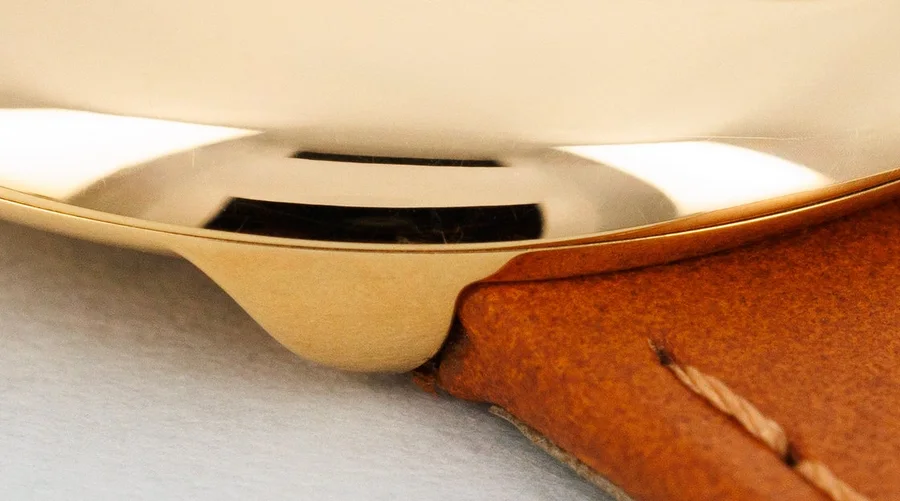

- 36 mm
- 6.29 mm thick
Tigre case, 2024
38.8 mm across and 10.5 mm thick, set with diamonds, black lacquer and spinels, rubies or tsavorite garnets.
- gem-set case
Crown 2 described
A cabochon sapphire crown on the London watches and the 2022 re-edition.
Beaded crown with cabochon, London
Beaded crown set with a sapphire cabochon.
- beaded crown
- cabochon
Fluted crown with blue sapphire, 2022
Small crown set with a blue sapphire cabochon. One account calls the crown fluted; on watches of the edition in the library's records it carries a ring of beads round the stone.
- ring of beads round the crown
- blue sapphire
Crystal 1 described
The London crystal is not stated in the auction catalogues consulted. One account calls the original crystal Plexiglass and, without having handled an original, thought the 2022 crystal less domed.
Sapphire crystal, 2022
Scratch-resistant sapphire on the 2022 re-edition; the Tigre also has sapphire.
Movement 3 described
The London watches are hand-wound on a Jaeger-LeCoultre calibre; the re-edition is hand-wound on the 430 MC, and the Tigre is quartz.
Jaeger-LeCoultre P838
Hand-wound Jaeger-LeCoultre calibre P838 with a Glucydur balance, as catalogued for the watch numbered 1270; the watch numbered 1402 is catalogued as hand-wound with 18 jewels. On the Turtle sold at auction the movement is signed Jaeger and stamped for Jacques Cartier.
- hand-wound Jaeger-LeCoultre
- movement stamped for Jacques Cartier on the Turtle
Calibre 430 MC
Hand-wound, hours and minutes, derived from the Piaget 430P, 2.1 mm thick and about 20 mm across. Accounts of the power reserve differ (see Where accounts differ).
- Cartier interlocking C on the plates
Quartz, Tigre
Quartz movement in the 2024 Pebble Tigre.
Bracelet and strap 2 described
Straps, not bracelets: leather in all productions.
Alligator strap with numbered gold clasp, London
The watch numbered 1270 has a brown Cartier alligator strap on an 18k gold deployant clasp stamped JC, hallmarked and numbered to match the case; on 1402 the clasp carries English hallmarks for 1972 and the case number. One account says the originals were often presented on a tan-beige calfskin strap. A clasp whose number differs from the case, or has none, may be a later replacement; the 1975 Turtle sold with non-matching numbers.
- JC stamp
- same number as the case
Calfskin strap with pin buckle, 2022
Light brown calfskin with tone-on-tone stitching and a gold pin buckle, with no deployant clasp.
Reference numbers
A four-digit number is stamped on the case and covers a case; a code beginning W, or the newer letter codes, is a catalogue number for one version of it (metal, dial, strap). Many older watches carry neither. The last column is the listings on record under the number, as its own page counts them.
| Number | What it is | Listings |
|---|---|---|
| WGPB0003 | The 2022 yellow gold re-edition of 150 on calibre 430 MC, 36 mm; given in published accounts and in sellers' listings. | 5 |
| CRWGPB0003 | The same 150-piece edition under the form with a CR prefix, given in one account of the announcement and in sellers' titles. | 2 |
| HPI01615 | Pebble Tigre in yellow gold with black spinels and a polished onyx dial, 2024; the form CRHPI01615 appears in one caption. | |
| HPI01616 | Pebble Tigre in rose gold with rubies and a pave diamond dial, 2024. | |
| HPI01617 | Pebble Tigre in white gold with tsavorite garnets and a pave diamond dial, 2024. |
Originality
- A clasp whose number differs from the case, or carries none, may be a later replacement on a London watch; the 1975 Turtle sold at auction had non-matching numbers.
- Polishing softens the rounded London case and can wear down the hallmarks, so the date letter should be read on the watch rather than taken from a listing.
- A Pebble on calibre 430 MC is the 2022 re-edition and is numbered out of 150; a London watch should have a hand-wound Jaeger-LeCoultre movement.
Names
- Baseball. The American name, from the square dial that recalls a baseball diamond.
- Pebble. From the case, smooth and round like a small stone; used in the United Kingdom.
- Turtle. The watch with exposed, rounded lugs.
Where accounts differ
Points on which the published literature and the library's own records do not agree, or on which the literature contradicts itself.
- How many were made. Several accounts say about six large watches were made in 1972, with the small ones uncounted, and one adds that up to six small ones may exist. One says six pieces in all were made, of which Cartier bought back three: two of regular size and one smaller. Another says fewer than ten were made. None gives a firm figure for the small size. One account counts the two Turtles in addition to the six large watches.
- Years the originals were made. Two accounts put the originals in 1972, one of those accounts writing of the first six originals from 1972. Another, as reported by a third, dates known examples by London hallmarks from 1972 to 1975, and the Turtle sold by Bonhams is dated to 1975 by two others. A hallmark later than 1972 is therefore consistent with one account and not the other. One retailer's account calls the original a watch of the 1960s.
- Diameter of the original. Auction catalogues give 35 mm and 35.5 mm; a French account gives 35.4 mm; one account puts it a little under 36 mm.
- Power reserve of the 430 MC. Accounts of the 2022 watch give 40 hours, at least 38 hours, and 36 hours; the movement is given as 20 mm and as 20.5 mm across.
- Movement type in the library's records. The literature gives calibre P838 for the London watches; one listing in the library's records gives Cal.P383 and another gives P838.
- Crown of the 2022 edition. One account describes the crown of the 2022 watch as small and fluted. Photographs of the edition in the library's records, from several sellers and an auction house, show a ring of beads round the cabochon, with a scalloped collar behind it on some.
- Marks on the 1975 Turtle. One account writes that the Jaeger-signed movement of the Turtle sold in 2021 is stamped for Jacques Cartier. The Bonhams catalogue of that watch gives the movement as signed Jaeger-LeCoultre and the case back, case and clasp as stamped for Jacques Cartier, and names no Cartier mark on the movement.
In the records
Counted from 12 listings at dealers and auction houses whose title, or whose reference, places them on the line; 7 state a year. These are what sellers state, not measurements, and a count of listings is not a count of watches made.
Case metal
| Metal | Listings | Share |
|---|---|---|
| Gold, any colour | 7 | 100% |
| Yellow | 4 | 57% |
| White | 1 | 14% |
| Colour not stated | 2 | 29% |
As sellers state it. Shares are of the 7 listings that name a metal. A listing that says "gold" or "18K gold" names no colour: it is counted under "colour not stated", not as yellow gold. Carat, where a listing of gold gives one: 18k 6.
Case size
| Size | Listings | Share |
|---|---|---|
| 36 mm | 7 | 78% |
| 27 mm | 1 | 11% |
| 35 mm | 1 | 11% |
As sellers state it. Shares are of the 9 listings that give a size. On a watch that is not round some sellers give the width and some the length, so one watch can stand under two sizes.
Movement
| Kind | Listings | Share |
|---|---|---|
| Hand-wound | 7 | 100% |
Shares are of the 7 listings whose description says how the watch is driven.
Listings by decade the seller gives
| Decade | Listings |
|---|---|
| 1970s | 3 |
| 2020s | 2 |
2 more give a year outside the years the line was made (from 1972): a later watch sold under the name, or a slip. They are left out.