Pocket, pendant and purse watches
Cartier made watches that were carried rather than worn on the wrist: open-face and hunter pocket watches, pendant watches hung from a cord, chain or brooch, and small purse and travel watches. Published accounts of the line are thin. They concentrate on the dress pocket watch with a double chapter ring, the earliest in the firm's own collection made in 1911, and on the very thin movements of the period: many of the firm's ultra-thin watches had LeCoultre movements, among them the calibre of an onyx watch of 1926. Cases range from platinum and gold to onyx, enamel and rock crystal, often gem-set. Very few carry a reference; many give a case number, and the library's records are mostly auction lots stated to the 1910s to 1930s.
This maker's early watches are described by kind of watch, not by reference number: many carry no number, and one number can cover quite different watches. The wider picture is in Early Cartier, 1904 to 1972.
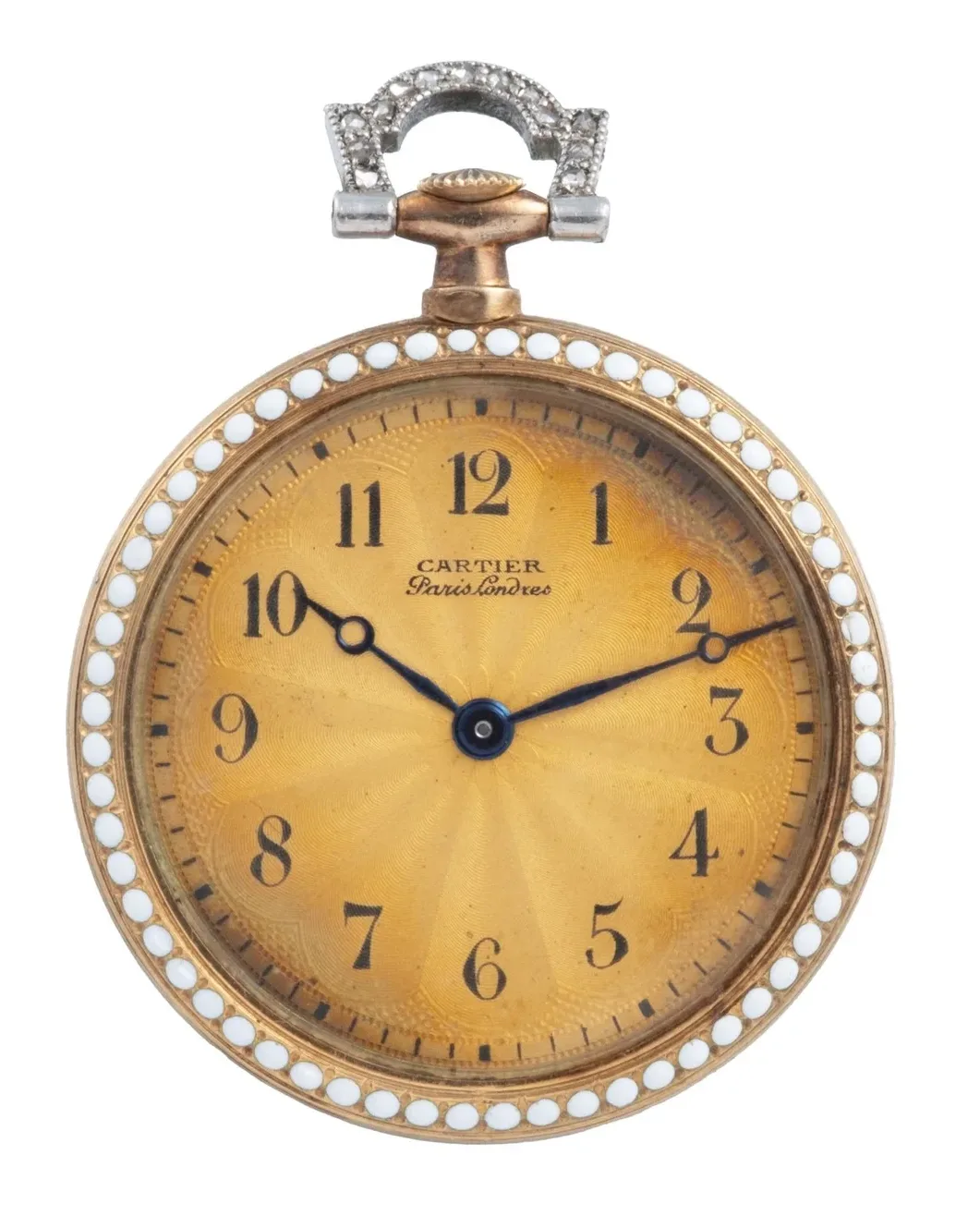

- Made
- not datedThe literature dates only a few watches of the line (1911, 1912, 1926 and a later one of 1994) and gives no start or end for it; the library's records hold watches stated to earlier years.
- On record
- 367 listings354 of them give no reference
- Reference numbers
- 0 describedmany early watches carry none

What to look for
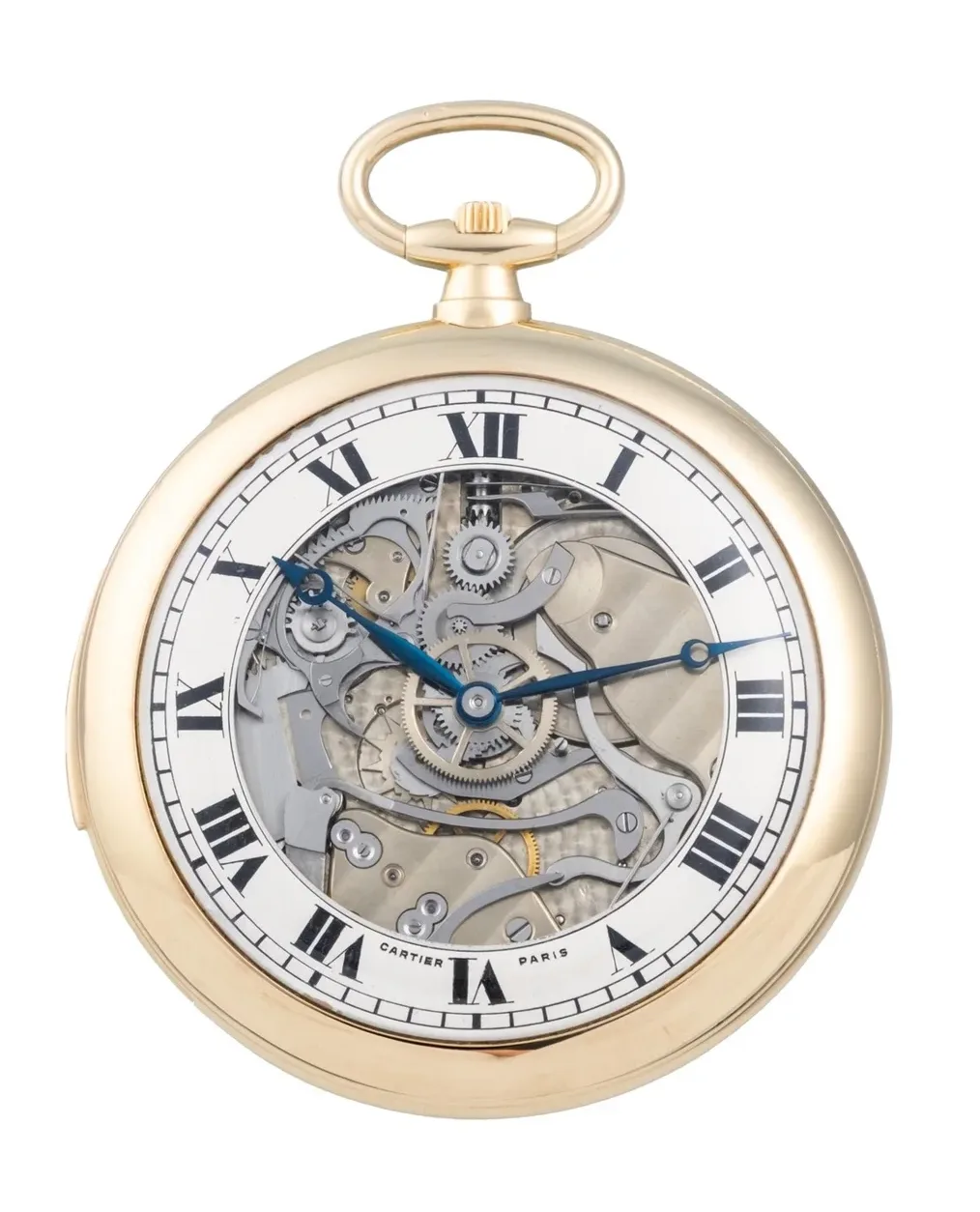
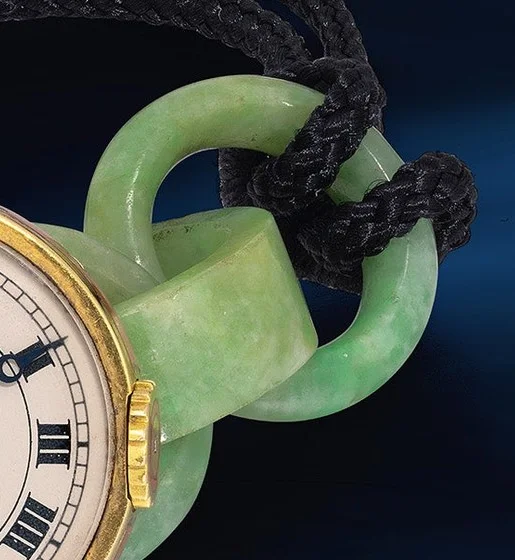
Details cut from photographs of watches of this line on record. Each was chosen by eye from a listing on the line and then checked again against the words beneath it. More sit beside the productions and parts they belong to, below. Select the small mark in a picture's corner for its holder and a link to its listing.


By house and period 3 described
Double chapter ring pocket watch, early type
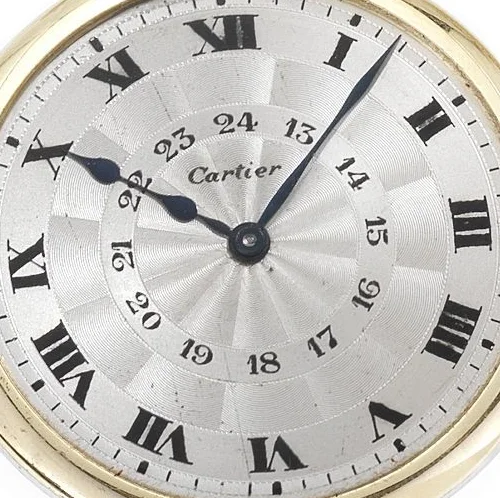
The earliest double chapter ring pocket watch in Cartier's own collection was made by Edmond Jaeger in 1911, some five years after his collaboration with LeCoultre began and made very thin movements available. The literature does not describe its dial; on the 1994 watch of the type the hours 1 to 12 are in Roman numerals on an outer ring and 13 to 24 in Arabic numerals on an inner ring, and listings in the library's records show both that arrangement and a ring of Arabic minutes paired with a ring of Roman hours. Several other examples of the design are known from the same period, and it was also used for complicated watches, among them a minute repeater sold by Cartier Paris in 1912.
Signature and marks. Not given in the literature.
- two concentric chapter rings: Roman hours outside with 13 to 24 in Arabic inside, or Arabic minutes paired with Roman hours
Onyx and platinum ultra-thin pocket watch, 1926
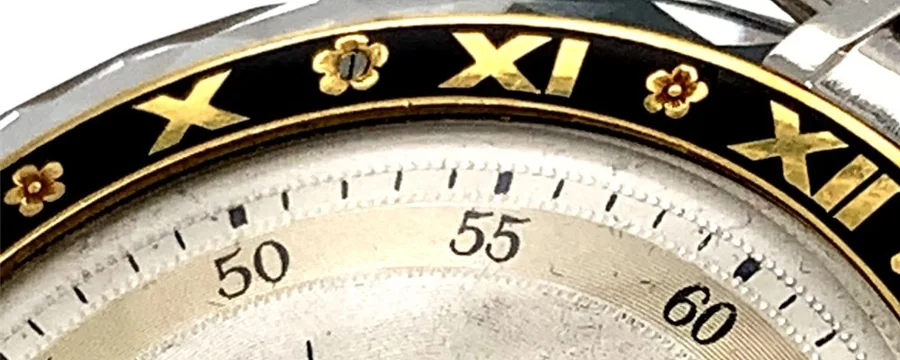
An ultra-flat pocket watch of 1926 has an onyx case with a platinum case band and is set with rose-cut diamonds. The guilloché dial has an enamel chapter ring inset with gold Roman numerals, separated by small fleurettes, in the double chapter ring layout. The movement is the ultra-thin LeCoultre calibre 139. Ultra-thin watches were in great demand at the time, many Cartier watches used LeCoultre movements, and very thin pocket watches are sometimes called knife watches.
Signature and marks. Not given in the literature.
- onyx case with platinum band
- rose-cut diamond setting
- enamel chapter ring with gold numerals and fleurettes
- LeCoultre calibre 139
Platinum double chapter ring pocket watch, 1994
A later watch of 1994 shows the type continuing. Its case, triangular bow and crown are platinum, with a single diamond in the crown and baguette diamonds set along the case edge. The dial is engine-turned silver with blued steel hands, in the white-on-white manner Cartier first made known in the 1920s. It is described as a continuation of a design first seen in the 1920s, a date that differs from the 1911 given for the earliest example in the firm's collection.
Signature and marks. Not given in the literature.
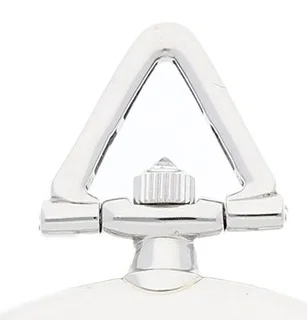

- single diamond in the crown
- baguette diamonds on the case edge
- engine-turned silver dial, blued steel hands
Chronology
Specification
| Case | Platinum, gold, or onyx with a platinum case band; some in enamel or rock crystal, many set with diamonds |
| Dial | Engine-turned or guilloché dial; on the 1994 watch the double chapter ring has Roman numerals 1 to 12 outside and Arabic 13 to 24 inside; on watches in the library's records the name also covers a ring of Arabic minutes paired with a ring of Roman hours |
| Movement | Thin keyless movements, many of them by LeCoultre; the 1926 onyx watch has LeCoultre calibre 139; the library's records most often name European Watch and Clock Co. |
| Forms | Open-face and hunter pocket watches, pendant watches on cord, chain or brooch, and purse watches |
Dial 3 described
The dial the literature dwells on is the double chapter ring, two concentric rings of numerals; it gives the layout only for the 1994 watch, Roman numerals 1 to 12 outside and Arabic 13 to 24 inside. Its earliest known example in the firm's collection is of 1911.
Double chapter ring
Two concentric chapter rings. On the 1994 watch the hours 1 to 12 run in Roman numerals on the outer ring and 13 to 24 in Arabic numerals on the inner; the literature does not give the layout of the others. The earliest example in Cartier's own collection was made by Edmond Jaeger in 1911, and the design was also used in a minute repeater sold in 1912 and in the 1926 onyx watch, whose chapter ring is enamel with Roman numerals. Listings in the library's records also show a ring of Arabic minutes paired with a ring of Roman hours.
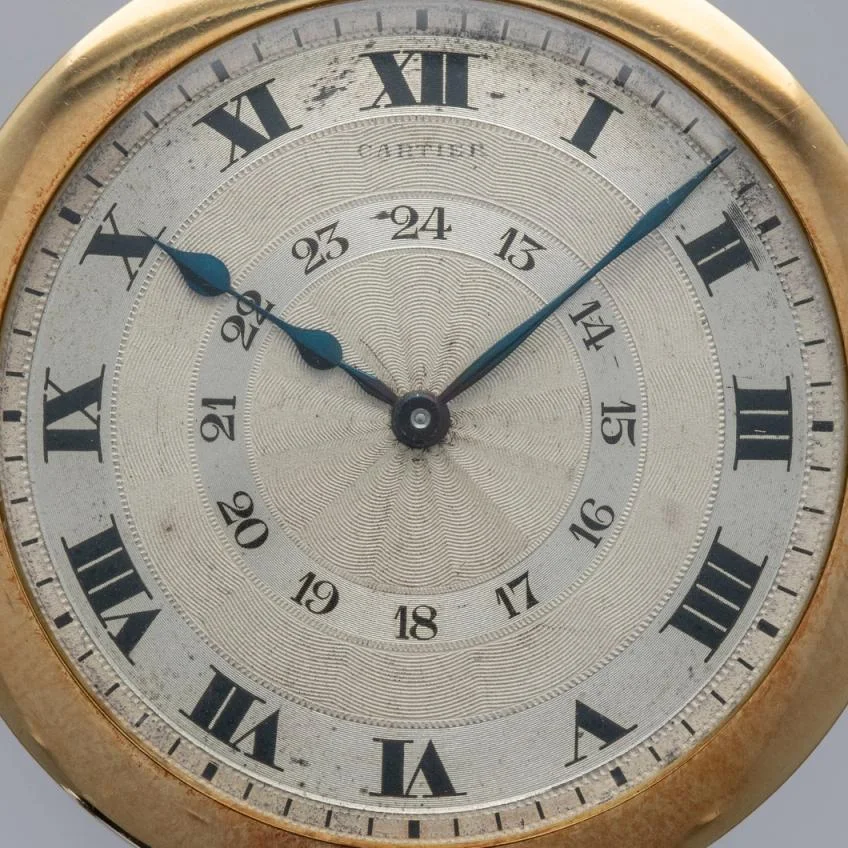

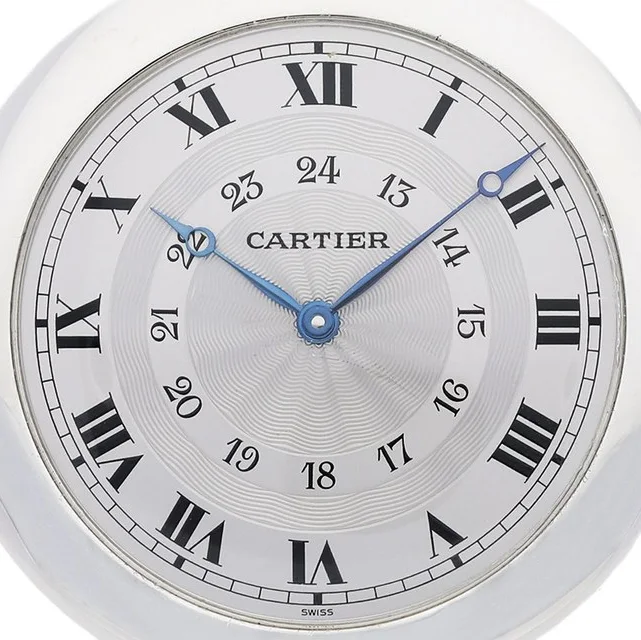

- two concentric chapter rings
- Roman outer ring with Arabic 13 to 24 inside, or Arabic minutes paired with Roman hours
Guilloché dial with enamel chapter ring
On the 1926 onyx watch the chapter ring is enamel with gold Roman numerals alternating with small fleurettes, on a guilloché dial.

Engine-turned silver dial
The 1994 platinum watch has an engine-turned silver dial with blued steel hands.
- engine-turned silver
- blued steel hands
Case and sizes 2 described
Cases described are of platinum, or of onyx with a platinum band, set with diamonds. The library's records add gold, enamel, rock crystal and other hardstones, as sellers describe them.
Onyx case with platinum band
Ultra-flat onyx case with a platinum case band, set with rose-cut diamonds.
- onyx case
- platinum case band
- rose-cut diamonds
Platinum case, triangular bow
Platinum case, bow and crown, with a single diamond in the crown and baguette diamonds along the case edge.
- triangular bow
- diamond in crown
Movement 2 described
Many of the firm's ultra-thin watches used LeCoultre movements; the very thin movements of the period came out of the collaboration between Edmond Jaeger and LeCoultre. The 1926 onyx watch has a LeCoultre calibre; the library's records most often name European Watch and Clock Co.
LeCoultre calibre 145
A 1.38 mm calibre introduced in 1907, given as an example of the thin movements the collaboration made available. The literature does not say it was fitted to a particular Cartier watch.
LeCoultre calibre 139
The ultra-thin movement of the 1926 onyx pocket watch.
- LeCoultre calibre 139
Names
- Knife watch. Ultra-thin pocket watches are sometimes called knife watches for their thinness; sellers also write couteau or knife-edge.
Where accounts differ
Points on which the published literature and the library's own records do not agree, or on which the literature contradicts itself.
- When the double chapter ring began. One account calls the 1994 watch a continuation of a design that first appeared in the 1920s, yet the same account gives 1911 for the earliest double chapter ring watch in Cartier's own collection and says the motif was first used in 1911. The earlier date is the one recorded here.
In the records
Counted from 367 listings at dealers and auction houses. These are what sellers state, not measurements, a stated year is often an estimate, and a count of listings is not a count of watches made.
Kind of object
| Kind | Listings |
|---|---|
| Pocket watches | 274 |
| Wristwatches | 93 |
Case metal
| Metal | Listings | Share |
|---|---|---|
| Gold, any colour | 185 | 70% |
| Yellow | 47 | 18% |
| White | 7 | 3% |
| Pink | 1 | under 1% |
| More than one colour | 1 | under 1% |
| Colour not stated | 129 | 48% |
| Platinum | 55 | 21% |
| Silver | 18 | 7% |
| Steel | 5 | 2% |
| Platinum and gold | 2 | 1% |
| Gold plated | 1 | under 1% |
As sellers state it. Shares are of the 266 listings that name a metal. A listing that says "gold" or "18K gold" names no colour: it is counted under "colour not stated", not as yellow gold. Carat, where a listing of gold gives one: 18k 115 · 14k 9 · 9k 3.
Case size
| Size | Listings | Share |
|---|---|---|
| 45 mm | 28 | 16% |
| 46 mm | 16 | 9% |
| 49 mm | 14 | 8% |
| 47 mm | 11 | 6% |
| 50 mm | 11 | 6% |
| 48 mm | 8 | 5% |
| 44 mm | 7 | 4% |
| 27 mm | 6 | 3% |
| Other sizes | 75 | 43% |
As sellers state it. Shares are of the 176 listings that give a size.
Listings by decade the seller gives
| Decade | Listings |
|---|---|
| 1850s | 1 |
| 1900s | 8 |
| 1910s | 44 |
| 1920s | 101 |
| 1930s | 59 |
| 1940s | 8 |
| 1950s | 3 |
| 1960s | 10 |
| 1970s | 9 |