Ceinture
The Ceinture is a Cartier wristwatch named for its case, which resembles a belt buckle: a square with cut corners, so that it reads as an octagon, with a bezel in two levels. Published accounts date the first one to 1927. The watches usually met with today come from the relaunch of 1973, when the model was reissued in 25 mm and 27 mm sizes as part of the Louis Cartier Collection, followed by a larger 31 mm automatic. Most are yellow gold with a white dial, Roman numerals and blued hands. The winding crown is flat and sits in a slot in the bezel instead of carrying the usual blue cabochon. Published accounts say nothing further about the first watches of the late 1920s.
Cartier's entries are arranged by model, not by reference number, because its reference numbers are several systems at once and many of its watches carry none. The houses are set out in Paris, London and New York.
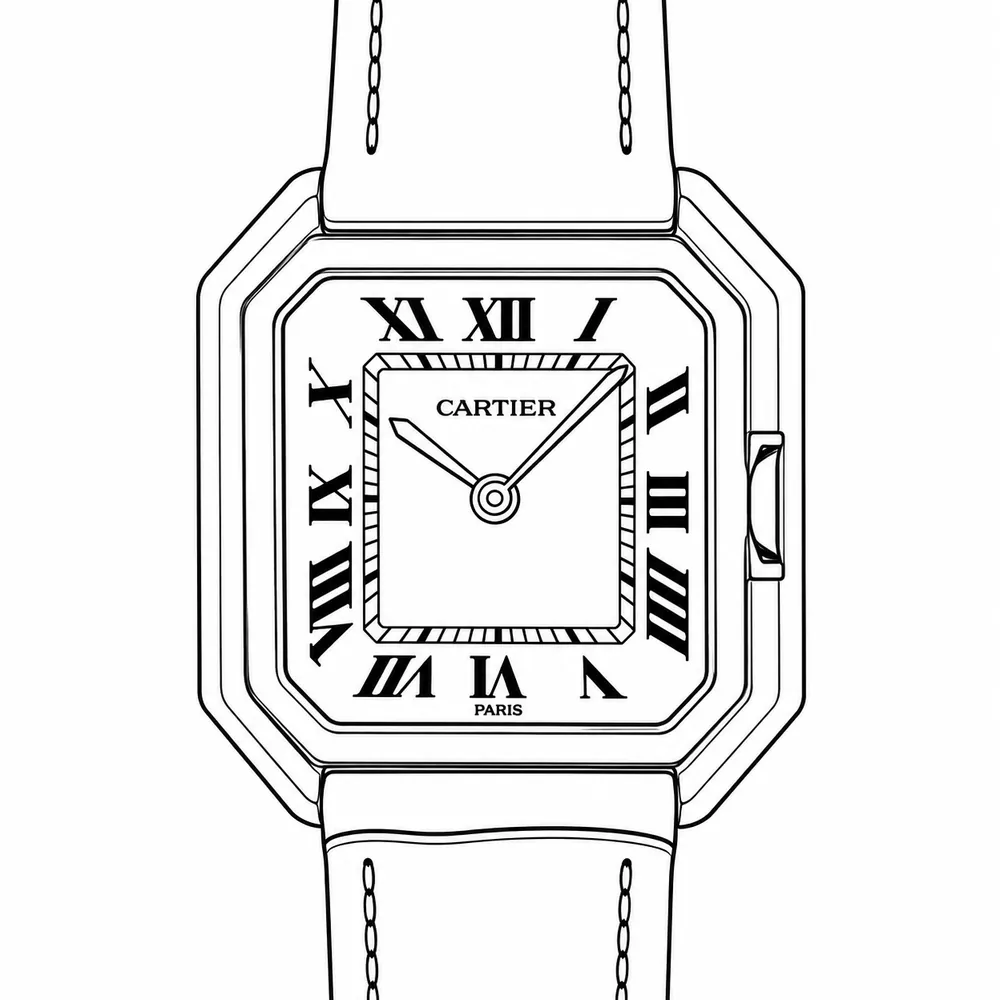

- Made
- from c. 1927The first Ceinture is dated to 1927 by several published accounts; the watches the literature describes belong to the relaunch of 1973, and accounts differ on how long that production ran.
- On record
- 223 listings128 of them give no reference
- Reference numbers
- 7 described28 seen in listings
- House named in the title
- Paris 69, London 3most older watches are not labelled
What to look for
Details cut from photographs of watches of this line on record. Each was chosen by eye from a listing on the line and then checked again against the words beneath it. More sit beside the productions and parts they belong to, below. Select the small mark in a picture's corner for its holder and a link to its listing.
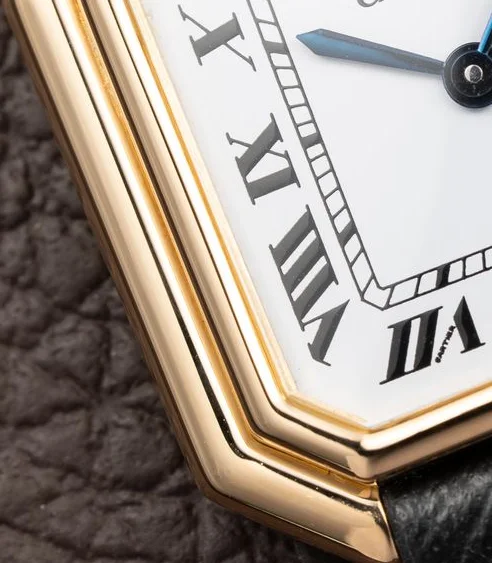

Components
2 watches of this line, oldest first. Each photograph is turned upright and scaled so the dial is the same height, and every crop is cut from the same place on the dial, so one row shows one part across them all. A watch is shown only if its seller's title names the line and the picture has been checked by eye, twice, to show it. Years are as sellers give them. Each picture is a detail; select the small mark in its corner for its holder and a link to its listing; the whole watch is shown only for holders whose pictures may be shown whole.
| 1976 | 1976 | |
|---|---|---|
| Signature under twelve |  |  |
| Dial above six |  |  |
| Numeral at twelve |  |  |
| Numerals at seven and eight | 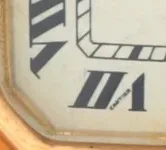 | 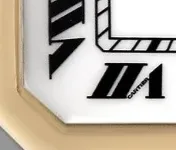 |
| Hands | 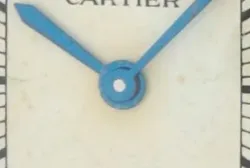 | 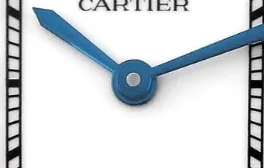 |
| Crown |  | 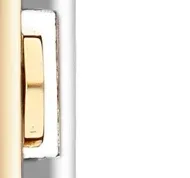 |
| Case corner and lug | 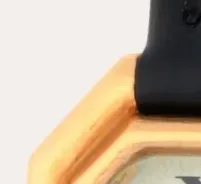 | 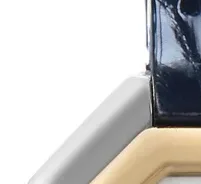 |
| Reference | 7809 | 78210 |


By house and period 4 described
The first Ceinture, from 1927
Published accounts date the first Ceinture to 1927, and one gives the late 1920s. They say nothing further about these watches: not who made the cases or movements, nor their metals, sizes or signatures. One account says the flat crown set in the bezel was designed in 1937.
Signature and marks. Not given in the literature.
Louis Cartier Collection, hand-wound, from 1973
The Ceinture was reissued in 1973 as part of the Louis Cartier Collection, in 25 mm and 27 mm sizes; one account puts the reissue in 1973 to 1974. The 25 mm is the small model (SM), reference 78100, and the 27 mm the large model (LM), reference 78099. Both are catalogued as hand-wound. One account describes the 78100 as made and cased by Cartier in Paris, but its case backs carry Swiss as well as French hallmarks, and no published account sets out which workshop made the cases or movements. Most are yellow gold; white gold was made in small numbers, as were two-tone watches, and a 27 mm two-gold version, reference 78208, is recorded. A platinum 25 x 25 mm version with a mechanical movement and red numerals is dated to 1975. Dated 78100 watches offered at auction fall mostly in the 1970s and 1980s; the 78099 is dated to the 1970s and as late as about 1990.
Signature and marks. Dials are signed Paris at six, under the minute track, or Swiss or Swiss Made; one account gives Paris as the signature of original 78100 dials, another treats Swiss as the usual signature and Paris as the exception (see Where accounts differ). On 78100 case backs the number begins with the reference and runs on into a four-digit serial, stamped under the word Paris. Of three 78100 case backs compared, two carry the S A Cartier mark in an oval with an upright cartouche in the shape of the Swiss Helvetia head, and one carries a single small cartouche in the shape of the French eagle's head; which a watch bears depends on where it was hallmarked. The movement is signed Cartier.
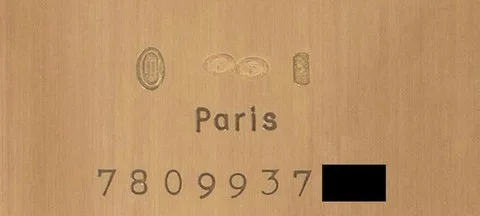

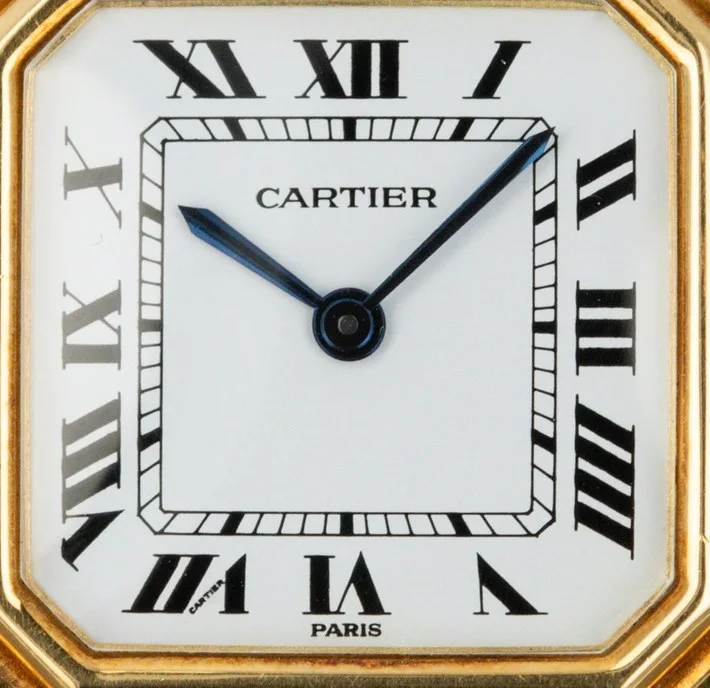

- sharp, matching cut corners and stepped edges
- flat crown sitting cleanly in its slot
Jumbo automatic
A 31 mm automatic Ceinture, reference 17001, came out the year after the 25 and 27 mm reissue; so one account has it. It is thicker than the others, with a bulge on the case back to make room for the automatic movement, though the bulge is not visible on the wrist. Fewer were made in yellow gold than of the smaller hand-wound models, and white gold is said to be almost unobtainable. Examples with a Paris dial are recorded. Jumbo is a name used by dealers and collectors, not an original Cartier catalogue name.
Signature and marks. Paris dial on the examples described; the movement is described as an ETA automatic (see Where accounts differ for the calibre number).

- about 31 mm across the case, 31 mm without the crown on one example
- bulge on the case back
References: 17001
Quartz versions, 1980s
Quartz Ceintures were made during the 1980s, and some of the smaller models are described as quartz. The literature gives no references, sizes or signatures for them. In the library's records sellers describe a number of quartz Ceintures, many of them small and several in three colours of gold under the name Trinity, with numbers such as 66002, 81045 and 8108; one seller dates a 27 mm quartz to the 1970s. These are sellers' descriptions.
Signature and marks. Not given in the literature.
- quartz rather than hand-wound movement
Chronology
Specification
| Case | Square with cut corners (often catalogued as octagonal), stepped two-level bezel; about 25, 27 or 31 mm; mostly 18-carat yellow gold, with white gold, two-tone and platinum cases also recorded |
| Dial | White, black Roman numerals, railroad minute track, signed Paris or Swiss at six; blued steel hands, sword-shaped on the 25 mm |
| Crown | Flat, set in a slot in the bezel, with no cabochon |
| Crystal | Acrylic, as recorded on one 25 mm example |
| Movement | Hand-wound on the 25 and 27 mm watches (Cal. 78-1 in most accounts); automatic on the 31 mm; quartz versions also made |
| Strap | Leather, with a folding buckle or an 18-carat gold deployant clasp |
Line 1 described
On the 78100 the case number begins with the reference digits and the serial runs on after them.
Case number run on from the reference
On 78100 watches the case back reads the reference followed by a four-digit serial, as one nine-digit number. Catalogues have printed Ref. 606 in the reference line of 78100-numbered watches, so the whole case number should be read. Published accounts do not read a year from the number, though one dealer has dated a watch to the mid-1970s from its serial.
- case number beginning 78100 followed by the serial
Dial 3 described
Ceinture dials of the relaunch are white with black Roman numerals and a railroad minute track. The signature at six varies, and a platinum version is recorded with red numerals.
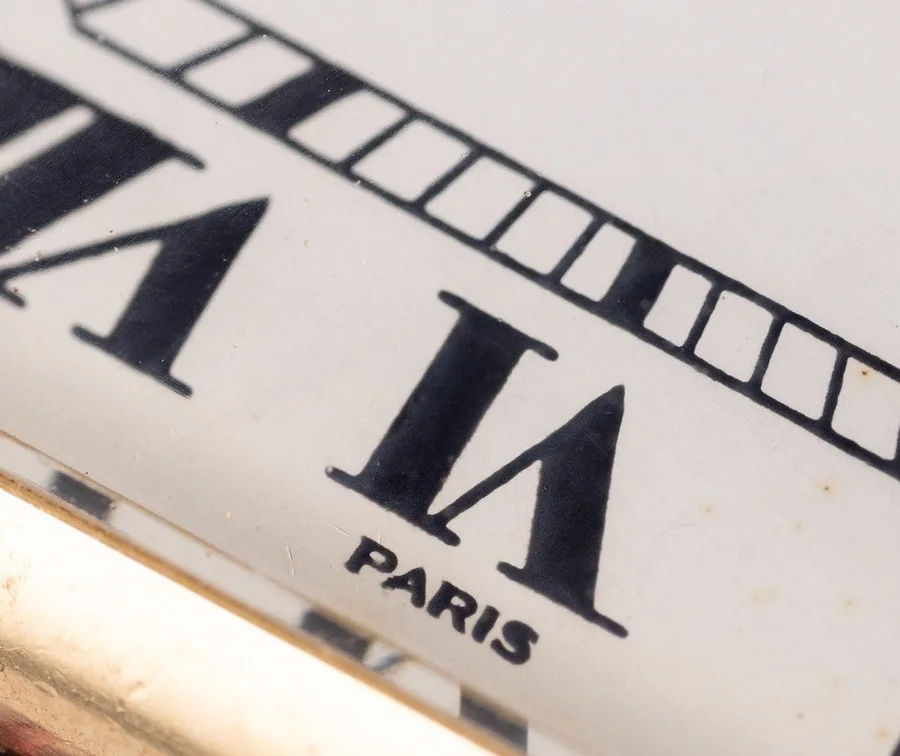
White dial signed Paris
Paris is printed at six, below the railroad track. It is said usually to mark a watch sold at the rue de la Paix boutique or from the first series of the Louis Cartier Collection, and it is recorded on 78100, 78099, 78208 and 17001. Aged lacquer can turn cream and craze; heavy or uneven printing points to a refinished dial.
- Paris below the railroad track
- black Roman numerals
- lacquer that is crisp or evenly aged
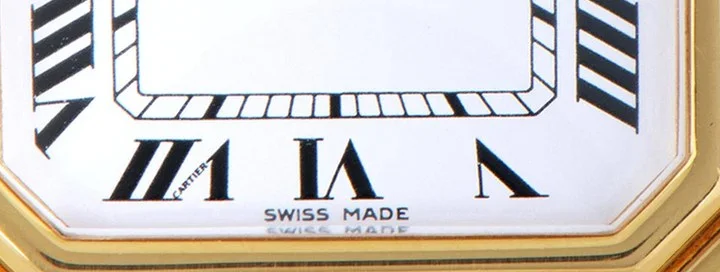
Dial signed Swiss
Swiss or Swiss Made at six is described as the usual signature, with Paris in its place on some pieces; another account gives Paris as the signature of original 78100 dials. The literature does not date the Swiss dials. One seller's title describes a 78099 with a Swiss dial.

Red numerals, platinum
A platinum Ceinture with red numerals, a mechanical movement and a 25 x 25 mm case is dated to 1975.
- red numerals
- platinum case
Hands 1 described
The hands are blued steel on the examples described, and sword-shaped on the 78100.
Blued sword hands
Blued steel sword-shaped hands are recorded on the 78100; blued steel hands are listed among the features of the hand-wound watches generally and are recorded on a 17001.


- blued steel
Case and sizes 5 described
The case is a square with its corners cut away, with a bezel in two levels. It is made in three sizes in the relaunch, in several metals.
Small model, 25 mm
The 78100 measures about 25 x 25 mm and is about 6 mm thick on one catalogued example. One auction house measured one at 24 mm and one account lists 24 x 24 mm among the sizes. Case numbers beginning 78100 belong to this size.
- about 25 x 25 mm
Large model, 27 mm
The 78099 and the two-gold 78208 measure about 27 x 27 mm. The shape, metal, dial and movement of the 78099 are otherwise those of the 78100.
- about 27 x 27 mm
Jumbo, 31 mm
The 17001 measures about 31 x 31 mm. It is thicker than the other sizes because of a bulge in the case back for the automatic movement.
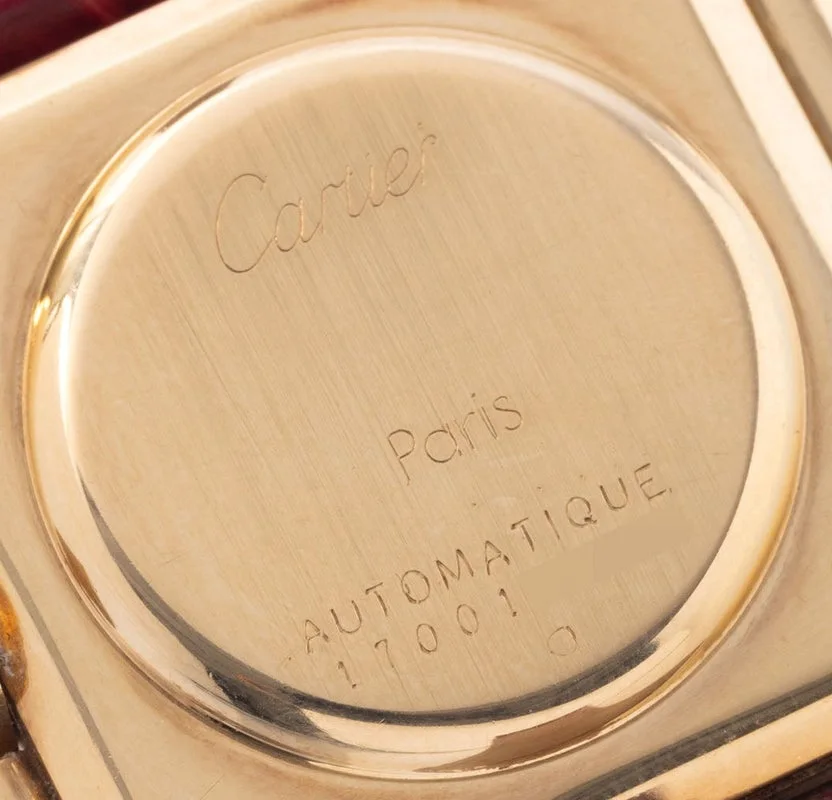

- about 31 mm
White gold and two-tone
Yellow gold was the main metal. White gold cases were made in small numbers and are called rare; two-tone cases combine yellow and white gold, the 78208 in the bezel. One example in white gold dated to the 1980s is recorded, and a white gold automatic of the 1970s has been described as unusual. Sellers' titles also use the word Trinity for a three-gold version.
- white gold case
- yellow and white gold bezel
Onyx and diamond 78100
One 25 mm yellow gold 78100 is recorded with onyx set into the bezel and stones in the middle case, and is dated by its seller to the late 1970s. Only this one example is described.
- onyx inlay in the bezel
- diamonds in the middle case
Crown 1 described
The Ceinture gives up the blue cabochon crown. The crown is flat and sits in a notch in the stepped bezel.
Flat crown in a bezel slot
The crown is usually octagonal; a few watches have a flat round crown with small notches. The arrangement is called a remontoir imperdable, or captive winding, and the design is said to date from 1937. Winding by hand is described as awkward. Auction houses have found later or non-original crowns on 78100 watches.
- octagonal flat crown set in the bezel
- no sapphire cabochon
Crystal 1 described
Little is recorded.
Acrylic
An acrylic crystal is recorded on one 78100.
Movement 3 described
The 25 and 27 mm watches are hand-wound, the 31 mm is automatic, and quartz versions were also made.
Hand-wound Cal. 78-1
Most accounts give the Cartier Cal. 78-1 for the hand-wound watches; one auction house catalogues a 78100 as Cal. 2512-1 with 17 jewels. In the library's records sellers use both names, usually with 17 jewels and several calling the 2512 an ETA calibre, and one listing gives the movement as Cal. 78-1 (ETA 2512-1). See Where accounts differ.
- hand-wound movement signed Cartier
Automatic, ETA
The 31 mm Jumbo uses an ETA automatic movement. Its calibre number is given differently; see Where accounts differ.
- automatic winding
- case back bulge
Quartz
Quartz versions were made in the 1980s; no calibre is given.
Bracelet and strap 2 described
Ceintures are recorded on leather straps.
Non-adjustable folding buckle
Most Ceintures were delivered with a non-adjustable folding buckle, because an adjustable deployant did not become available until 1989. Such watches may need a strap made to fit.
- folding buckle without adjustment
18k gold Cartier deployant clasp
Many examples are recorded with an 18-carat gold Cartier deployant clasp, and an original gold clasp is counted among the points that matter in judging a watch. The literature does not say how this relates to the folding buckle above.
- 18k gold Cartier deployant
Reference numbers
A four-digit number is stamped on the case and covers a case; a code beginning W, or the newer letter codes, is a catalogue number for one version of it (metal, dial, strap). Many older watches carry neither. The last column is the listings on record under the number, as its own page counts them.
| Number | What it is | Listings |
|---|---|---|
| 78100 | Small model, about 25 x 25 mm, 18-carat gold (usually yellow, also white and two-tone), hand-wound; described as the smaller of the two references of the 1973 relaunch. | 23 |
| 78099 | Large model, about 27 x 27 mm, otherwise like the 78100, hand-wound; one of the two references of the 1973 relaunch; dated in published accounts to the 1970s and as late as about 1990. | 26 |
| 78208 | 27 mm two-gold version with yellow and white gold worked on the bezel; also recorded by sellers in white and yellow gold. | |
| 17001 | Jumbo, about 31 x 31 mm, automatic, yellow gold in the examples described, white gold said to be almost unobtainable; dated to the 1970s, and by one account to the 1980s as well. | 12 |
| 78210 | As sellers describe it, a small two-colour Ceinture of about 25 mm with a white Roman dial, mostly in white and yellow gold; one seller calls it steel and gold. | 3 |
| 7810 | As sellers describe it, a number used on 25 mm watches in yellow gold and once in platinum; the literature does not say how it relates to 78100. | 6 |
| 81045 | As sellers give it, a quartz Ceinture Trinity in yellow, white and pink gold. | 2 |
Originality
- The cut corners and stepped edges show polishing: they should be crisp and match at all four corners.
- The crown is sometimes replaced; a later crown has been noted on 78100 watches, so check that the flat crown sits cleanly in its slot.
- A dial with heavy or uneven printing points to refinishing; original white lacquer can age to cream with fine crazing.
- An original 18-carat gold Cartier deployant clasp is valued as part of a complete watch.
Names
- Jumbo. A collectors' and dealers' name for the 31 mm automatic 17001; not a Cartier catalogue name.
- SM and LM. Abbreviations for the small and large model sizes, 25 mm and 27 mm, used in the literature and in sellers' titles.
- Deux ors. The 27 mm two-gold version with yellow and white gold on the bezel.
Where accounts differ
Points on which the published literature and the library's own records do not agree, or on which the literature contradicts itself.
- Calibre of the Jumbo. One account gives calibre 2670 and another an ETA 2670 for the 31 mm automatic; a third calls it the ETA Caliber 170. In the library's records a few listings give a 17-jewel Cal. 170, and one auction house a 25-jewel Cal. 076 for a 17001.
- Calibre of the 25 mm hand-wound watch. One account reports that auction catalogues split between Cal. 2512-1 and Cal. 78-1 for the 78100; another gives Cal. 78-1 and another Caliber 78.1. Sellers in the library's records use both names, several calling the 2512 an ETA calibre, and one listing gives the movement as Cal. 78-1 (ETA 2512-1), as if the two were one movement under two names.
- Years of manufacture. One account gives 1973 to 1976 as the years of manufacture, while another dates 78100 watches to the 1980s and the 78099 to about 1990. The library's records include listings stated as the 1980s and some in the 1990s, and a few stated as the 1950s and 1960s, earlier than the 1973 relaunch; these are sellers' statements.
- Dial finish. One account describes the dials of the collection as enamelled, while another describes the 78100 dial and a third the 17001 dial as white lacquer.
- Dial signature. One account treats Swiss or Swiss Made as the usual signature at six and Paris as found on some pieces only, while another gives Paris as the signature of original 78100 dials. In the library's records many titles name Paris, often for the dial, and one names a Swiss dial; titles that say neither tell nothing.
In the records
Counted from 223 listings at dealers and auction houses whose title, or whose reference, places them on the line; 116 state a year. These are what sellers state, not measurements, and a count of listings is not a count of watches made.
Case metal
| Metal | Listings | Share |
|---|---|---|
| Gold, any colour | 100 | 96% |
| Yellow | 34 | 33% |
| White | 6 | 6% |
| More than one colour | 2 | 2% |
| Pink | 1 | 1% |
| Colour not stated | 57 | 55% |
| Steel | 2 | 2% |
| Platinum | 1 | 1% |
| Steel and gold | 1 | 1% |
As sellers state it. Shares are of the 104 listings that name a metal. A listing that says "gold" or "18K gold" names no colour: it is counted under "colour not stated", not as yellow gold. Carat, where a listing of gold gives one: 18k 55.
Case size
| Size | Listings | Share |
|---|---|---|
| 27 mm | 22 | 24% |
| 25 mm | 16 | 17% |
| 31 mm | 10 | 11% |
| 24 mm | 8 | 9% |
| 33 mm | 6 | 7% |
| 22 mm | 5 | 5% |
| 26 mm | 5 | 5% |
| 24.5 mm | 3 | 3% |
| Other sizes | 17 | 18% |
As sellers state it. Shares are of the 92 listings that give a size. On a watch that is not round some sellers give the width and some the length, so one watch can stand under two sizes.
Movement
| Kind | Listings | Share |
|---|---|---|
| Hand-wound | 30 | 65% |
| Quartz | 10 | 22% |
| Automatic | 6 | 13% |
Shares are of the 46 listings whose description says how the watch is driven.
Listings by decade the seller gives
| Decade | Listings |
|---|---|
| 1950s | 1 |
| 1960s | 3 |
| 1970s | 72 |
| 1980s | 35 |
| 1990s | 5 |