Tortue
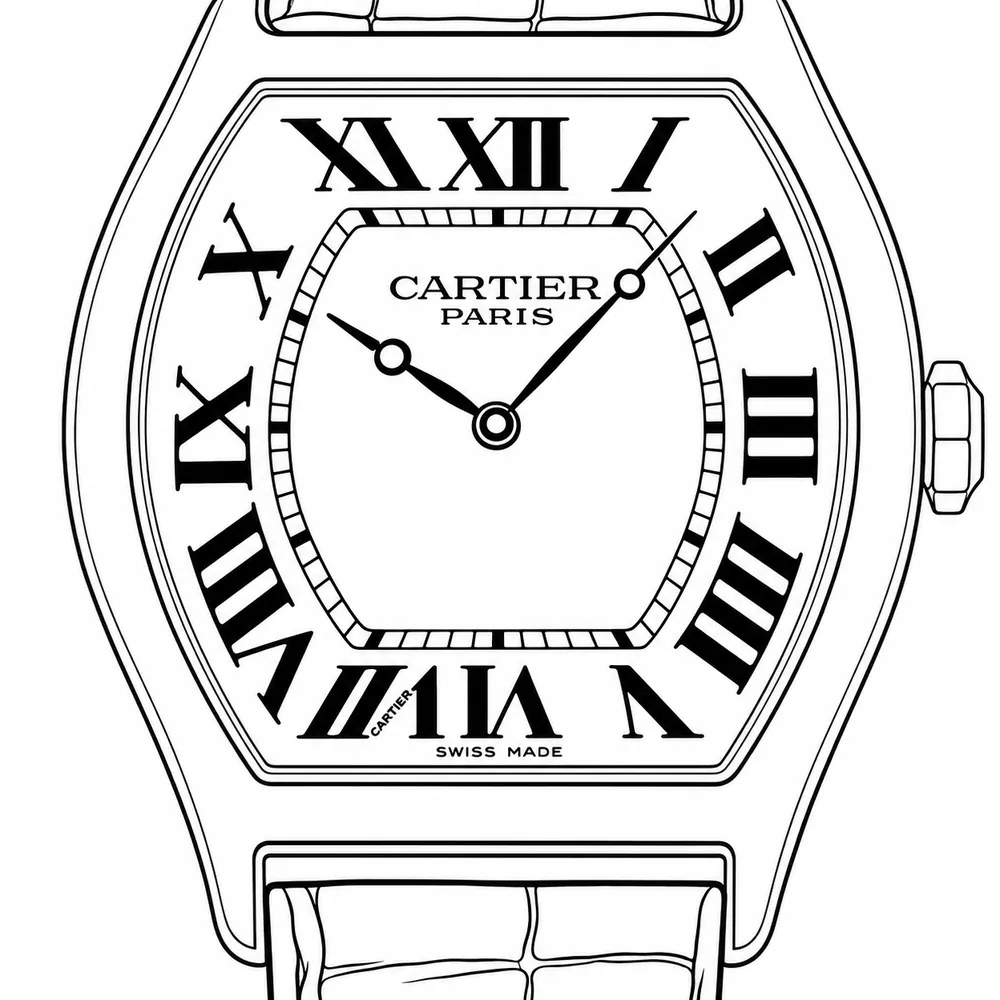
The Tortue is a tonneau-shaped Cartier wristwatch whose rounded case, with lugs flowing out of the sides, was designed in 1912 as the house's third shaped watch, after the Santos and the Tonneau. It began as a time-only watch and in 1928 gained a single-button chronograph and a minute repeater, which were made in very small numbers. The chronograph returned in 1998 or 1999 (accounts differ) in the Collection Privée Cartier Paris, on a movement made for Cartier by an outside workshop, and the case was then fitted with repeaters, tourbillons, perpetual calendars and larger sizes. Privé editions followed in 2024 and 2026, and a redesigned regular-production Tortue appeared in 2026.
Cartier's entries are arranged by model, not by reference number, because its reference numbers are several systems at once and many of its watches carry none. The houses are set out in Paris, London and New York.

- Made
- from c. 1912The design is dated to 1912 in most accounts and to 1913 in one; the line has been made in separate small runs rather than continuously, so no end date is given.
- On record
- 565 listings159 of them give no reference
- Reference numbers
- 27 described132 seen in listings
- House named in the title
- Paris 47, London 3most older watches are not labelled
What to look for
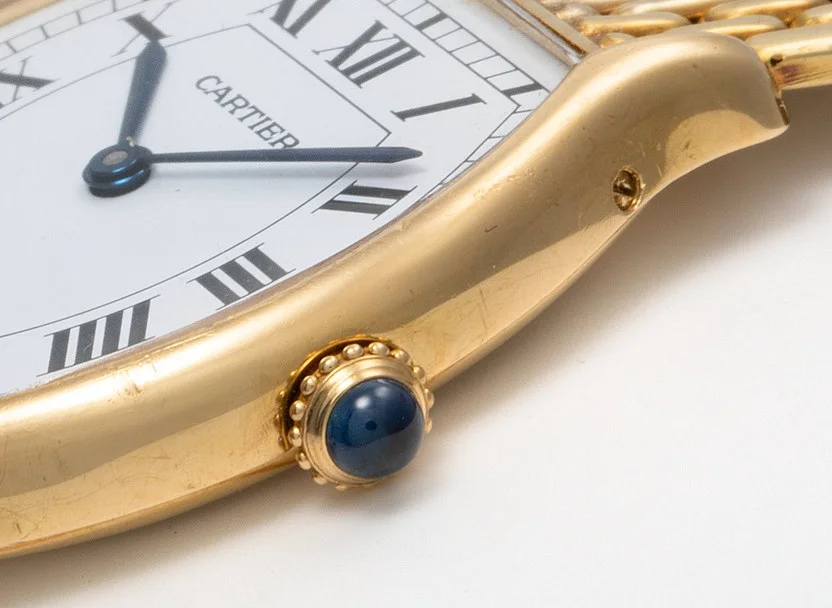
Details cut from photographs of watches of this line on record. Each was chosen by eye from a listing on the line and then checked again against the words beneath it. More sit beside the productions and parts they belong to, below. Select the small mark in a picture's corner for its holder and a link to its listing.


By house and period 9 described
Early Tortues, 1912 onward
The Tortue was designed by Louis Cartier in 1912 and was first a time-only watch; the form was a more compact, fuller take on the Tonneau, and the case was described as a tortue à pattes, a turtle on legs. From the start it was set with enamel, diamonds and other stones on the bezel and lugs, and even the earliest watches differ slightly in proportion and size. It sold to men and to women and was one of the house's most popular wristwatches between the 1910s and the 1920s. Museum captions place Tortues with Cartier Paris in 1913 and 1922 and with Cartier London in 1925, and one more of 1924 with no house given. Published accounts do not say how the watches of the three houses differ from one another, so no house is separated here.
Signature and marks. Published accounts give no dial, case or movement marks for these watches beyond naming the house of individual examples in museum captions.
- tonneau case with curved sides and lugs that continue the case line
- white dial with thick Roman numerals
- blued hands
- cabochon-set crown
- enamel or stones on the bezel and lugs on some
Tortue Monopoussoir chronograph and minute repeater, 1928 onward
In 1928 the Tortue case took its first complications: the Monopoussoir, a chronograph whose start, stop and reset all run through one pusher built into the crown, and a minute repeater in yellow gold with a slide on the left of the case. The chronograph is small, about 25 by 35 mm (about 26 by 35 mm in one account), with a traditional column-wheel movement and horizontal clutch, a slim bezel and a matte dial with chunky Roman numerals, a chemin de fer track and two subdials; the hands are flame-blued Breguet-style in two accounts and apple-shaped in another. One account dates a chronograph to 1926. The movement is the ultra-flat 11-ligne LeCoultre chronograph calibre, finished for Cartier and signed European Watch and Clock Company, a joint venture of Cartier and Edmond Jaeger. A museum caption dates a single-button chronograph by Cartier New York to 1929. Very few were made: about eleven have come to auction, and fewer than fifteen are said to survive. One account calls it Cartier's first chronograph, another one of the first. A yellow gold repeater entered in Cartier's registers in 1929 and sold in 1931 has a movement signed by the same firm. It has blued Breguet hands. It was described at its 2002 sale as the only minute repeater known from Cartier in the Art Deco years; a second Tortue minute repeater was sold at auction in 2004.
Signature and marks. Movement signed European Watch and Clock Co. on the repeater and, in the one account that says so, on the chronograph; no dial signature is given for these.
- about 25 by 35 mm tonneau case
- single pusher in the crown and no side pusher
- matte dial, Roman numerals, chemin de fer track
- two chronograph subdials
- blued hands
- slide on the left of the case (repeater)
Gold Tortues of the 1970s to 1990
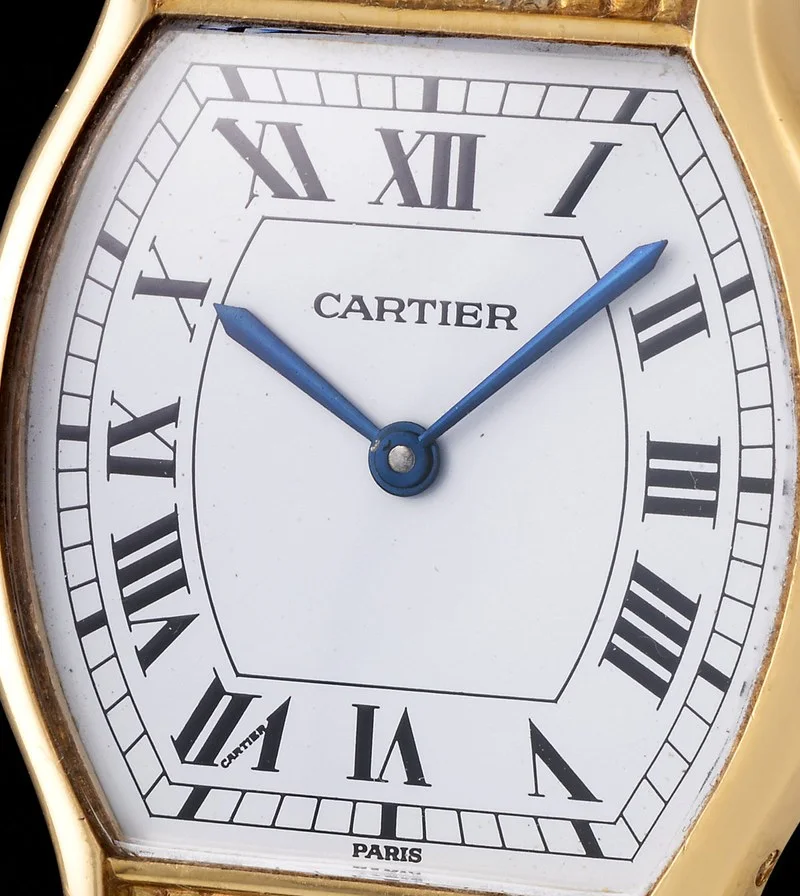
Published accounts say little of the Tortue between the 1930s and the Collection Privée. Museum pieces include a Tortue of about 1980, a large Tortue LC extra-flat of about 1984 and a small model of 1990. Ref. 10712, as catalogued, is a hand-wound 18 ct yellow gold Tortue of about 28 by 33 mm, a two-part case with a bombé sapphire crystal, white dial with black painted radial Roman numerals and blued hands, on a 17-jewel movement given as the calibre 107 or the calibre 7001. Ref. 96069 is a yellow gold hand-wound Tortue, thinner, at about 26.5 by 34.5 mm, on a Frédéric Piguet calibre 21. The 10712 is dated only to the 1970s and 1980s and the 96069 to about the 1970s; both are much smaller than the Collection Privée watches.
Signature and marks. On 10712: case, dial and movement signed; one catalogued example has a dial signed Paris; a short case number on the case back.

- about 28 by 33 mm
- bombé sapphire crystal
- 17-jewel hand-wound movement
Collection Privée Cartier Paris Monopoussoir, 1998 to 2008
Cartier revived the Tortue Monopoussoir in its Collection Privée Cartier Paris (CPCP). Accounts differ on when and in what: most put it in 1998 and say it was first shown in yellow gold, with rose and white gold soon after; one gives yellow gold ref. 2356 and white gold ref. 2396 together in 1998; one dates the yellow gold watch to April 1999, and another says it came in 1999 in all three colours of gold. The case is bigger than the 1928 watch, about 34 or 35 mm wide and 43 mm long (45 by 35 mm in two accounts), with a thicker bezel, a sapphire back and an octagonal crown in place of the fluted one. The movement is the 045 MC, made for Cartier alone by THA, a workshop of three independent watchmakers: a hand-wound column-wheel chronograph with an oscillating pinion, 22 jewels, 21,600 half-swings an hour, about 3.8 mm thick, in a movement of 24.8 or 25.6 mm. About four dial designs were made. The first two, yellow gold 2356 and white gold 2396, have Roman numerals in a circular chapter ring as on the original. Later dials are bolder: oversized numerals that lean with the case, and a modern dial with an updated guilloché, a large XII, blue printing and Cartier Paris under the six. A white gold version with a salmon dial, with a 13 at noon, was made in 13 pieces for the Paris boutique at 13 rue de la Paix. An XL followed (ref. 2762). One account says around 200 a year were made across all configurations, just under 2,000 in all; another counts about 37 appearances at auction.
Signature and marks. Cartier Paris under the six on the modern-dial white gold version; one 2026 account says the 1998 watch read Cartier Paris. Other CPCP dials' signatures are not given.
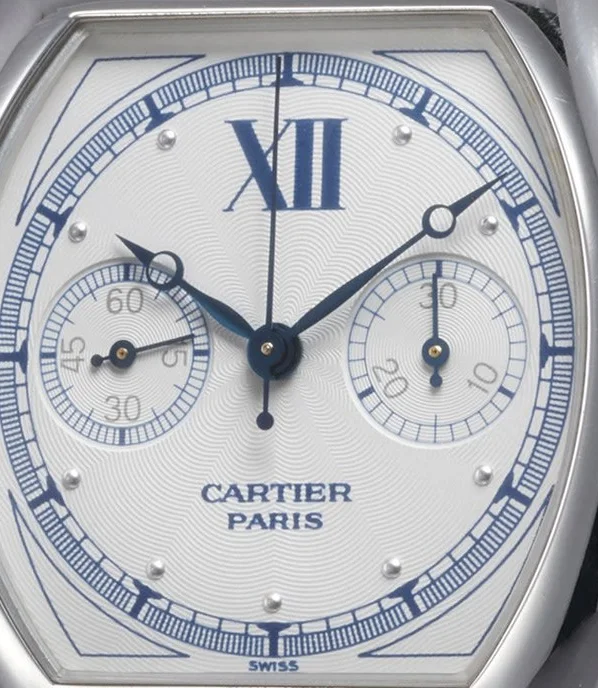

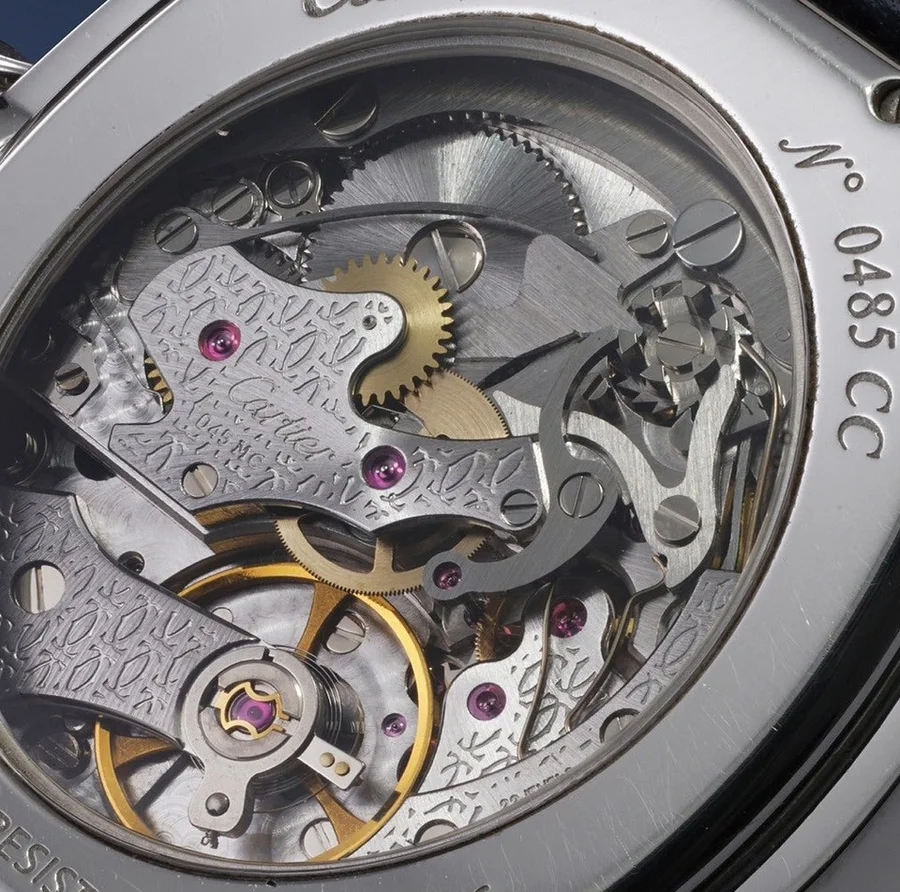

- sapphire display back showing a THA 045 MC
- octagonal crown
- blued apple hands and a seconds hand with a skeletonised counterweight
Collection Privée Tortue complications and other sizes, 1998 to 2008
The Tortue was the best-selling Collection Privée model in 1999, 2000, 2003, 2004 and 2005, and at least eight versions with complications are known, from a minute repeater to a perpetual calendar. The minute repeater, based on a 1928 design and developed with Renaud and Papi, joined in 2003 in yellow, pink and white gold, 25 of each; another account puts a Tortue minute repeater at about 2001. Renaud and Papi also made a tourbillon chronograph Monopoussoir; tourbillon watches with movements from Renaud and Papi or Jaeger-LeCoultre, a Tortue XL Day and Night with two time zones, and perpetual calendar versions are also described; a platinum perpetual calendar is said to exist in a smaller size and an XL. The Tortue XL of 2006, in platinum and pink gold, has the Jaeger-LeCoultre 9601 MC, a creamy guilloché dial with a flower rosette, blued Breguet-style hands, a domed crystal and small seconds at six; fewer than 100 were made, as a numbered run rather than a limited edition; published accounts do not say whether it belonged to the Collection Privée. A Tortue XL with a grande date and an eight-day Jaeger-LeCoultre movement is also listed among the 1998 to 2008 watches. As sellers describe them, ref. 2496 includes a limited yellow gold edition with a cloisonné enamel dragon dial, and ref. 2689 is a limited pink gold Tortue with date and power reserve.
Signature and marks. Not given for these watches in the published accounts.
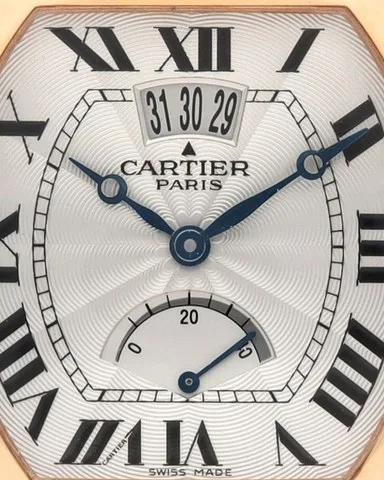

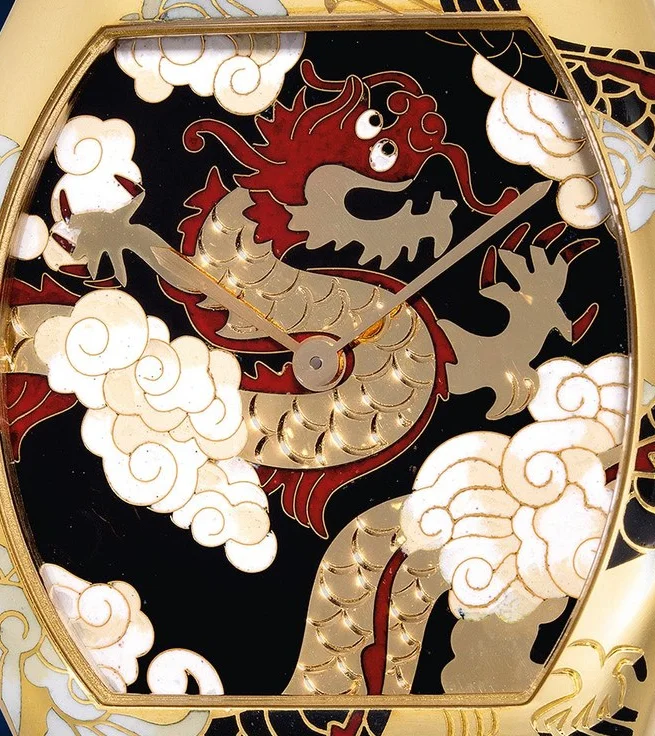

- sapphire back showing the movement; published accounts describe Collection Privée calibres as hand-wound, but the perpetual calendars in the library's records are self-winding, with a rotor
- creamy guilloché dial with a central flower rosette (XL 2006)
- small seconds at six (XL 2006)
After the Collection Privée, before the 2024 Privé
Through the 2000s and after 2008 Cartier went on making Tortues with complications, including perpetual calendars, in XL and in a larger XXL, and in smaller sizes for women. The 2011 Tortue XL, in pink and white gold, has the 9602 MC, a changed 9601 MC with a big date at 12 in place of the small seconds at six of the 2006 watch; the case shape and size are the same as the 2006 watch, with slightly fuller hands. One account adds a perpetual calendar, an XXL with several time zones and a reimagined XL to the 2012 and 2013 collections. Published accounts say little else about these years, so this entry is brief.
Signature and marks. Not given.
- big date at 12 o'clock (2011 XL)
- same case size as the 2006 XL
References: W1580003
Cartier Privé Tortue, 2024
In 2024 Cartier Privé issued three time-only Tortues and two Monopoussoir chronographs. The time-only watches are in yellow gold (200 pieces) and platinum (200), with a platinum diamond-set version in 50; the case is about 41 by 33 mm and 7.2 mm thick, and the movement is the hand-wound 430 MC on a Piaget 430P base. The two platinum watches have a silvered opaline dial with rhodium-finished Roman numerals (applied, in one account); the plain platinum watch has a ruby cabochon crown and the diamond-set one a diamond in the crown; the yellow gold watch has a grained gold dial with black numerals and a sapphire cabochon crown. The Monopoussoir, in yellow gold or platinum, 200 of each, measures 43.7 by 34.8 mm and 10.2 mm thick (10.7 mm in one account), with a sapphire back secured by eight screws. It uses the new hand-wound 1928 MC, a custom-shaped column-wheel chronograph with a horizontal clutch, 4.3 mm thick, 28,800 half-swings and about 44 hours, with small seconds at nine and a 30-minute counter at three; the THA movement of the CPCP watch is not used and the oscillating pinion is gone. The dial is flat, not guilloché, nearer the 1920s watches than the CPCP dials, with snailed subdials, blued apple hands and triangular motifs in the corners taken from the CPCP white gold watch.
Signature and marks. Not given for 2024; the 2026 Privé watch reads Cartier.
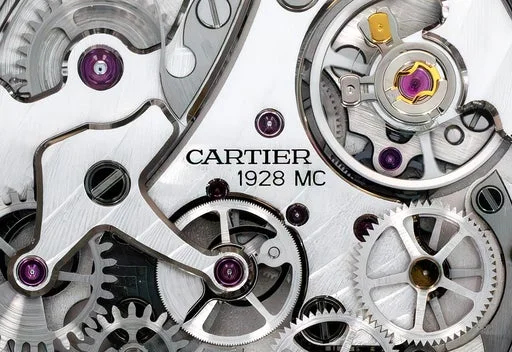

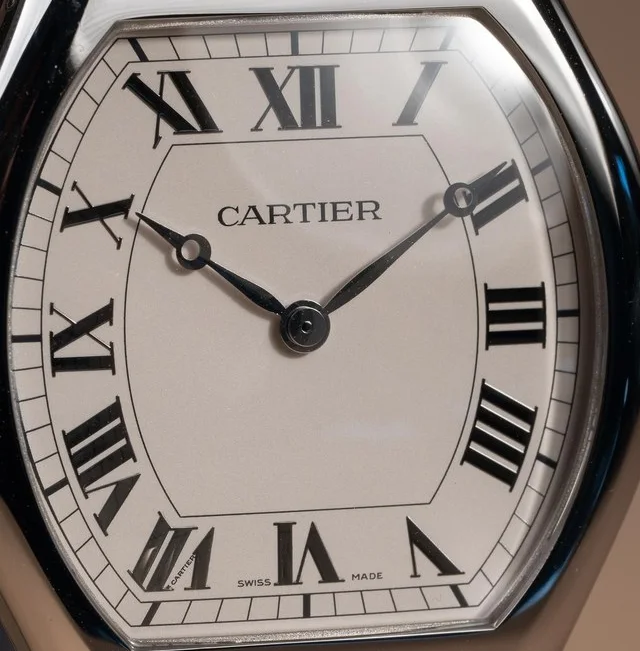



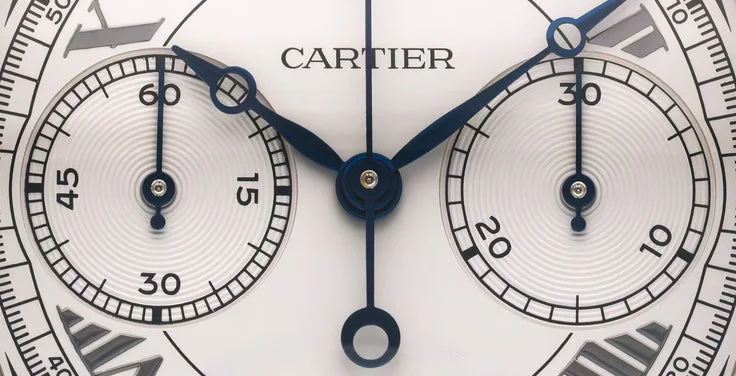

Cartier Privé Tortue Monopoussoir, platinum, 2026
Issued in 2026 as part of the tenth Privé series, with the Tank Normale and the Crash Squelette, it is platinum with burgundy accents. It takes the 1998 CPCP design as its model: a round chemin de fer track, triangular motifs in the corners and small beaded hour markers; one account adds an extra-large XII. The case is 43.7 by 34.8 mm, the movement the 1928 MC (4 Hz, 44 hours), the dial silvered opaline with snailed subdials, the strap burgundy alligator and the crown set with a ruby cabochon. Water resistance is 30 m. The signature is a plain Cartier.
Signature and marks. Cartier alone; the CPCP watch it recalls read Cartier Paris.
- burgundy minute track and strap
- beaded hour markers
- ruby cabochon crown
References: PUWA11935
Tortue regular production and Métiers d'Art, 2026
In 2026 the Tortue was added to regular production with a redesigned case, rounder and more generous. Sizes are mini (26.1 by 20.9 mm), small (33.4 by 26.7 mm) and medium (41 by 33 mm), in yellow, rose and white gold and platinum, with quartz in the smaller sizes and the manual 430 MC in the platinum large and a rose gold medium. Most of the range loses the rail track for a dotted frame, referring to a watch of 1922, has an embossed sunray dial in place of guilloché and carries the secret signature in the X; the platinum large keeps the older codes, a stamped guilloché dial, rail track and the signature at VII. Two Panthère Métiers d'Art Tortues, 43.7 by 34.8 mm, in white and yellow gold with champlevé enamel, are limited to 100 each.
Signature and marks. Secret signature in the X on the redesigned dials; at VII on the platinum large.
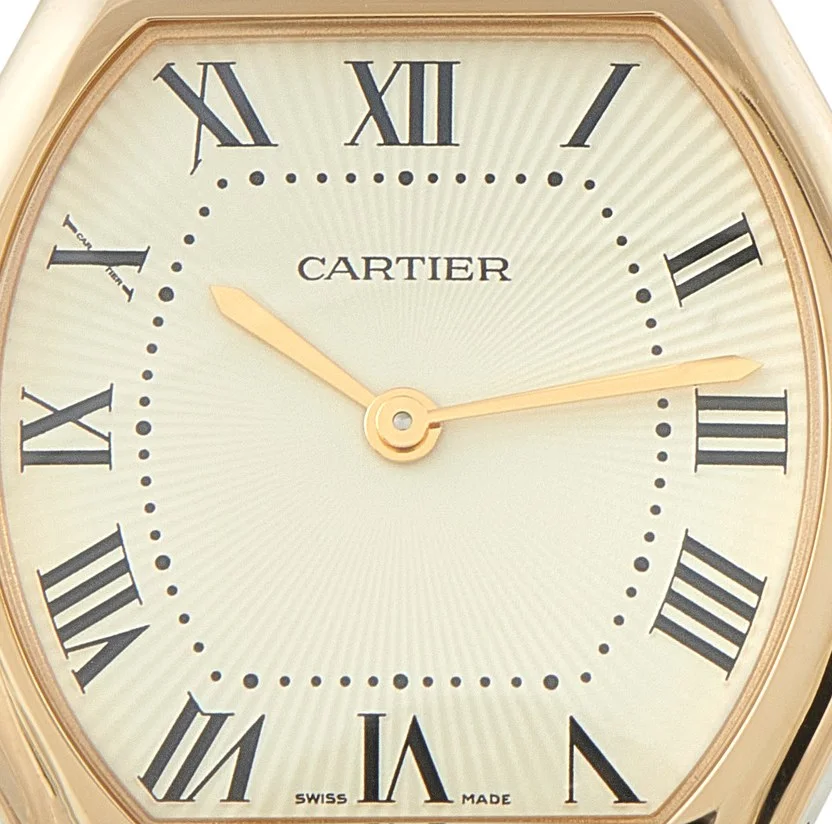

- secret signature in the X
References: WJTO0009, WJTO0011, WJTO0012, WJTO0013, WJTO0014, WGTO0015, HPI01830, HPI01811, HPI01812
Chronology
Specification
| Case shape | Barrel or tonneau case with curved sides and lugs that continue the line of the case; the shape leaves room for a larger movement than the Tank or the Santos |
| Case, early chronograph | About 25 by 35 mm (one account says about 26 by 35 mm) |
| Case, Collection Privée Monopoussoir | About 34 to 35 mm wide and 43 mm long (some accounts give 45 by 35 mm), sapphire display back; XL version about 38 mm wide, given as 43 mm or 48 mm long |
| Case, 2024 Privé | Time-only about 41 by 33 mm and 7.2 mm thick; Monopoussoir 43.7 by 34.8 mm and 10.2 mm thick (10.7 mm in one account), sapphire front and back, eight back screws, 30 m water resistance |
| Case, 2026 regular production | Mini 26.1 by 20.9 mm, small 33.4 by 26.7 mm, medium or large 41 by 33 mm; Métiers d'Art 43.7 by 34.8 mm |
| Movement | 1920s: European Watch and Clock Company calibres on LeCoultre bases. 1998 onward: THA 045 MC (Monopoussoir), Renaud and Papi and Jaeger-LeCoultre complications, 430 MC on a Piaget base, 1928 MC (2024 Monopoussoir) |
| Dial | Roman numerals on most versions, with a chemin de fer minute track on the 1928 chronograph, the Collection Privée watches and the 2024 Privé watches, replaced by a line of dots on most of the 2026 range; blued hands on most watches described, apple-shaped or Breguet-style; guilloché dials on most Tortues before 2024, some with a central flower rosette |
| Crown | Usually set with a stone (cabochon, or a diamond or inverted stone on gem-set versions); fluted on the original Monopoussoir, octagonal on the Collection Privée Monopoussoir |
| Metals | Yellow, rose and white gold and platinum; the 2026 regular range adds quartz movements in the smaller sizes |
Dial 8 described
Roman numerals run through most versions, with a chemin de fer minute track on the 1928 chronograph, the Collection Privée watches and the 2024 Privé watches. Most earlier dials are guilloché, some with a flower rosette, and Collection Privée dials range from a circular chapter ring to oversized numerals. Privé dials of 2024 are flat and the 2026 range changes the track, the pattern and the secret signature.
Guilloché dial with flower rosette
Most earlier time-only Tortues are described as having guilloché dials with a rosette in the centre and painted Roman numerals; the rosette was used on various watches of the 1920s and was revived on the 2006 XL.
- guilloché with a central flower rosette
- painted Roman numerals
1928 chronograph dial
A matte dial with blocky Roman numerals, a round chemin de fer track and two chronograph subdials; the blued hands are Breguet-style in two accounts and apple-shaped in another.
- matte dial
- round chemin de fer track
- two subdials
1970s to 1980s white dial (10712)
White dial with painted black radial Roman numerals; one catalogued 10712 has a dial signed Paris.
- radial Roman numerals
- Paris in the dial signature (one catalogued example)
CPCP circular chapter ring
The first Collection Privée Monopoussoir dials, in yellow gold 2356 and white gold 2396, keep Roman numerals in a circular track as on the original, with empty space at the four corners. A 1990s and 2000s standard yellow gold dial is guilloché.
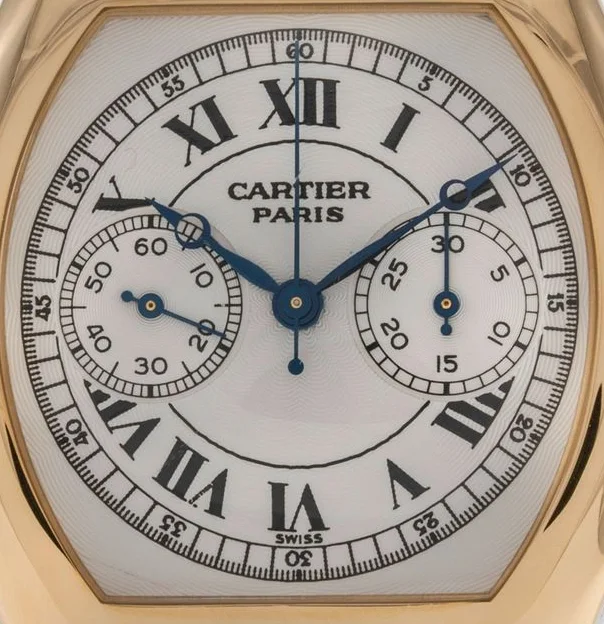

CPCP oversized numerals, modern dial
Later CPCP dials have bold numerals that are skewed to follow the case, as on ref. 2714; a modern version has an updated guilloché, an oversized XII, blue printing and Cartier Paris at six. On the white gold version, triangles are outlined in each corner. The details can be dated no closer than the CPCP period.
- oversized XII
- blue printing
- Cartier Paris under the six
- triangles in the corners
Salmon dial, 13 numeral
A white gold Monopoussoir with a salmon dial and the marker at noon replaced by 13, in 13 pieces for the Paris boutique at 13 rue de la Paix.
- salmon dial
- 13 at the top
2024 Privé dials
A flat dial in place of guilloché: silvered opaline with applied rhodium numerals on the platinum watches, grained gold with printed black numerals on the yellow gold watch. The rail track sits outside the numerals on the Monopoussoir for legibility and the subdials are snailed.
- silvered opaline or grained gold
- snailed subdials
2026 regular-production dial
A dotted frame replaces the rail track and an embossed sunray replaces guilloché; the secret signature moves from the VII to the X. The platinum large keeps a stamped guilloché dial, rail track and VII.
- dots instead of rail track
- signature in X
Hands 2 described
Blued hands are given for most Tortues described, apple-shaped (pomme) in most accounts and Breguet-style in some; the 2024 time-only hands are in the case metal.
Blued apple hands
Blued apple hands on the CPCP Monopoussoir and on the 2024 and 2026 Privé Monopoussoirs (one account calls the 2024 hands Breguet-style); on the 1928 chronograph the hands are flame-blued Breguet in two accounts and apple-shaped in another. The CPCP seconds hand has a skeletonised counterweight and, in one account, a faceted shaft.
- blued apple hands
- skeletonised seconds counterweight (CPCP)
Hands in the case metal (2024 time-only)
One account says the 2024 time-only watches have Breguet-style hands made of the case metal, not blued as on most earlier Tortues.
- unblued Breguet-style hands
Subregisters 1 described
Subdials appear on the chronographs and on the complicated watches.
Two chronograph subdials
The 1928 chronograph has two chronograph subdials. On the 2024 Monopoussoir a running small seconds sits at nine and a 30-minute counter at three, with the chronograph seconds hand in the centre; the 2024 and 2026 subdials are snailed, with blued hands and simplified scales. The CPCP 045 MC drives a running small seconds; its position is not given.
- two subdials
- small seconds at nine and 30-minute counter at three (2024)
- snailed counters (2024, 2026)
Case and sizes 6 described
The case is a barrel shape with lugs flowing from the sides. Sizes run from a mini of 26.1 by 20.9 mm to the XL and XXL; the size names in use are mini, small, medium, large, L and XL, and museum pieces of about 1984 and 1990 are described as large and small models.
1928 chronograph case
About 25 mm wide and 35 mm lug to lug (about 26 by 35 mm in one account), with a very slim bezel.
- 25 by 35 mm
- thin bezel
10712 and 96069
10712 is about 28 by 33 mm in a two-body case with a bombé sapphire crystal, other catalogue readings are 27 by 33 mm and 28 by 26 mm; 96069 is about 26.5 by 34.5 mm.
- 28 by 33 mm
- short case number following 10712 in one run of figures on the back
Large and small models, 1984 and 1990
A Tortue LC extra-flat, large model, is dated about 1984 and a small-model Tortue to 1990; no measurements are given.
- large and small model sizes
CPCP Monopoussoir case
About 34 by 43 mm (35 by 43 and 45 by 35 in other accounts) with a thicker bezel and a sapphire back; the XL is about 38 mm wide and given as 43 mm or 48 mm long.
- sapphire back
- thicker bezel
2024 Privé cases
Time-only: about 41.4 by 32.9 mm (41.1 by 32.9 in one account) and 7.2 mm thick. Monopoussoir: 43.7 by 34.8 mm and 10.2 mm thick (10.7 mm in one account), polished, sapphire front and back, eight back screws, 30 m water resistance.
- 7.2 mm thick (time-only)
- eight back screws (Monopoussoir)
2026 cases
Rounder, more generous, extending smoothly into the lugs; mini 26.1 by 20.9 by 6.9 mm, small 33.4 by 26.7 by 7.2 mm, medium or large 41 by 33 by 7.2 mm; Métiers d'Art 43.7 by 34.8 by 8.9 mm.
- rounded 2026 proportions
Crown 2 described
The crown is usually set with a stone and carries the chronograph pusher on the Monopoussoirs.
Fluted and octagonal crowns
The original 1920s Monopoussoir has a fluted crown; the CPCP Monopoussoir has an octagonal crown.
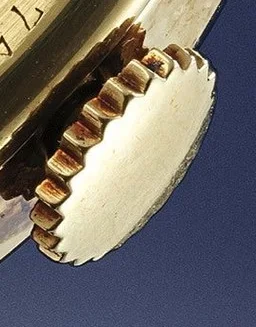

- octagonal crown
Cabochon crowns, 2024 to 2026
Sapphire cabochon on yellow gold and ruby on platinum; the diamond-set platinum time-only has a diamond; the Métiers d'Art has an inverted emerald or tsavorite.
- sapphire or ruby cabochon
Date 1 described
Date is not a feature of most Tortues; two XL versions differ on it.
Big date at 12 (2011 XL)
The 2011 XL has a big date at 12 on the 9602 MC; the 2006 XL has none and has small seconds at six instead. Another account lists, among the 1998 to 2008 watches, a Tortue XL with a grande date and an eight-day Jaeger-LeCoultre movement.
- date window at 12
Movement 6 described
Movements came from outside suppliers in each period.
European Watch and Clock Co. calibres
Ultra-flat 11-ligne chronograph on the LeCoultre 11 JCCV introduced in 1927, finished and signed by the firm that Cartier and Edmond Jaeger set up.
- EWC signature
Calibre 107 or 7001; Piguet 21
10712 is given the calibre 107 or 7001 (17 jewels); no account explains how they relate. 96069 is on the Frédéric Piguet calibre 21.
- 17 jewels
THA 045 MC
Hand-wound, column wheel with six pillars, oscillating pinion, 22 jewels, 21,600 half-swings an hour, made only for Cartier.
- 045 MC
Jaeger-LeCoultre 9601 MC and 9602 MC
9601 MC on the 2006 XL; 9602 MC, a changed version with a big date at 12, on the 2011 XL.
- small seconds at six (9601)
- big date (9602)
430 MC
Hand-wound time-only calibre on the Piaget 430P base, about 2 to 2.1 mm thick, 21,600 half-swings; the reserve is given as 36 hours, 38 hours, or 36 to 43 hours.
- 430 MC
1928 MC
Hand-wound shaped column-wheel chronograph with horizontal clutch, 4.3 mm thick, 28,800 half-swings an hour, 44 hours. One account says it is a proprietary movement made by an undisclosed partner; another takes the MC to mean Cartier makes it.
- 1928 MC
Bracelet and strap 2 described
Straps and buckles are described for a few versions.
Leather strap with pin buckle, or three-gold bracelet (10712)
10712 is catalogued on leather with an 18 ct yellow gold pin buckle, or with a three-colour gold Cartier bracelet about 185 mm long.
- three-gold bracelet
2024 alligator straps
Alligator straps in red or blue to match the crown stone, interchangeable on the Monopoussoir; the diamond-set platinum time-only has a pin buckle set with 25 stones.
- strap colour matches crown stone
Reference numbers
A four-digit number is stamped on the case and covers a case; a code beginning W, or the newer letter codes, is a catalogue number for one version of it (metal, dial, strap). Many older watches carry neither. The last column is the listings on record under the number, as its own page counts them.
| Number | What it is | Listings |
|---|---|---|
| 2356 | Yellow gold Collection Privée Monopoussoir with the 045 MC, presented 1998 or 1999; with 2396 the first of the circular-chapter-ring dials; as sellers describe it also lettered 2356B and 2356E. | 20 |
| 2396 | White gold Collection Privée Monopoussoir (2396G in one account, which dates it 1998); with its yellow gold twin 2356, the first of the circular-chapter-ring dials. | 44 |
| 2714 | Collection Privée Monopoussoir with bold, oversized numerals; one seller's title calls it XL, while the literature gives the XL as 2762. | 7 |
| 2762 | XL Collection Privée Monopoussoir, about 38 mm wide; sellers also give a W1546551 code beside it. Catalogue codes seen beside it in listings: W1546551 | 8 |
| 2763 | Rose gold XL Collection Privée Tortue as sellers describe it, with the code W1546051 beside it. Catalogue codes seen beside it in listings: W1546051 | 9 |
| 2661 | Pink gold Collection Privée Monopoussoir, as sellers describe it. | 2 |
| 2781 | Collection Privée Monopoussoir chronograph as sellers describe it; one title gives yellow gold, while the library's records most often give rose gold. | 4 |
| 2759 | Platinum monopusher chronograph with tourbillon, as sellers describe it. | 4 |
| 2610E | Yellow gold minute repeater, as sellers describe it. | 3 |
| 2646 | Platinum Collection Privée perpetual calendar with dual time, as sellers describe it. | 5 |
| 2721 | Platinum Collection Privée perpetual calendar with dual time and leap-year indication, as sellers describe it. | 2 |
| 2689 | Limited pink gold Collection Privée Tortue with date and power reserve, numbered out of 100, as sellers describe it; also seen as 2689G. | 3 |
| 2496 | Hand-wound yellow gold Collection Privée Tortue in the 34 by 43 mm case, from the literature; as sellers describe it, the number also covers a limited yellow gold edition with cloisonné dragon enamel. | 10 |
| 2497 | White gold diamond-set Tortue, with a limited edition with a cloisonné crane dial, as sellers describe it. | 5 |
| 2498 | Pink gold diamond-set Tortue, as sellers describe it; seen also as 2498E. | 4 |
| 2644 | Ladies' white gold diamond-set Tortue, as sellers describe it; the code WA507231 is seen beside it. Catalogue codes seen beside it in listings: WA507231 | 6 |
| 10712 | 18 ct yellow gold hand-wound Tortue of the 1970s or 1980s, about 28 by 33 mm, from the literature. | 7 |
| 96069 | Ultra-thin yellow gold hand-wound Tortue of about 26.5 by 34.5 mm on the Frédéric Piguet 21, 1970s. | 3 |
| W1580003 | Pink gold XL semi-skeletonised perpetual calendar, as sellers describe it. | 2 |
| WGTO0006 | Yellow gold 2024 Privé time-only, 200 pieces, from the labels in one account. | |
| WGTO0008 | Platinum 2024 Privé time-only, 200 pieces, as sellers describe it. | 3 |
| WHTO0007 | Yellow gold 2024 Privé Monopoussoir, 200 pieces, from the labels in one account. | 1 |
| WHTO0008 | Platinum 2024 Privé Monopoussoir, 200 pieces, from the labels in one account. | 2 |
| PUWA11935 | Platinum 2026 Privé Chronographe Monopoussoir with burgundy details. | |
| WJTO0009 | 2026 rose gold medium Tortue, diamond bezel; the table also lists WJTO0011 (mini) and WJTO0012 (small). | 1 |
| HPI01830 | 2026 platinum large Tortue with diamond bezel and the 430 MC. | |
| HPI01811 | 2026 white gold Panthère Métiers d'Art, 100 pieces; HPI01812 is the yellow gold twin. |
Originality
- The calibre of a 10712 is given as 107 in some catalogues and 7001 in others, so the movement should be read, not taken from the listing.
- A Tortue much larger than about 28 by 33 mm with a display back is a Collection Privée or later watch and not a 10712.
- Polishing on a tonneau case can soften its curves, and a Cartier box and guarantee add to an example's record.
Names
- CPCP. Short for Collection Privée Cartier Paris, the 1998 to 2008 range that revived the Monopoussoir.
- Tortue à pattes. Turtle on legs, said of the 1912 tonneau case with lugs.
- Monopoussoir. Single-pusher: one button in the crown runs start, stop and reset.
Where accounts differ
Points on which the published literature and the library's own records do not agree, or on which the literature contradicts itself.
- Year of the design. Most accounts give 1912; one gives 1913 and another 1910.
- Year of the first chronograph. Cartier gives 1928; one account found a chronograph of 1926 in a published book.
- Collection Privée Monopoussoir size and launch year. Cases are given as 34 by 43 mm, 35 by 43 mm and 45 by 35 mm. The XL is 38 by 43 mm in one account and 38 by 48 mm in another. The movement is 24.8 mm in one account and 25.6 mm in another. The revival is placed in 1998 by most and in 1999 (April 1999 in one) by others; one account has yellow gold 2356 and white gold 2396 together in 1998, others say yellow gold came first, and one says all three golds in 1999.
- Date of THA. THA is said to have been founded in 1989 in two accounts and in 1996 in another.
- Minute repeater and XL dates. One account dates the CPCP minute repeater to 2003; another places a Tortue repeater at about 2001. One places the big-date XL in 2011 and another in 1998 to 2008.
- Span of the Collection Privée. Accounts give 1998 to 2008. In listing titles naming the Collection Privée, stated years run from 1995 to 2026, nearly all between 1998 and 2013; the latest are 2024 Privé watches that sellers also call Collection Privée, and sellers' years are often guesses or sale years.
- Details of the 2024 watches. The 430 MC reserve is given as 36, 38 and 36 to 43 hours; the Monopoussoir is 10.2 mm thick in most accounts and 10.7 mm in one. The time-only case is 41.4 mm long in one account and 41.1 mm in another.
- Hands of the 1928 chronograph. Two accounts give flame-blued Breguet hands; another gives apple-shaped hands.
- Maker of the 1928 MC. One account says the 1928 MC is a proprietary movement made by an undisclosed partner; another says the MC shows Cartier makes it itself.
- Base movement of the 1928 chronograph. Published accounts give the 1928 single-button chronograph an ultra-flat 11-ligne LeCoultre calibre, finished and signed by the European Watch and Clock Company, and date the chronograph to 1928. Phillips catalogued one yellow gold example as signed by that firm but built on a Victorin Piguet ébauche, and dated the chronograph's presentation to 1927.
In the records
Counted from 565 listings at dealers and auction houses whose title, or whose reference, places them on the line; 357 state a year. These are what sellers state, not measurements, and a count of listings is not a count of watches made.
Case metal
| Metal | Listings | Share |
|---|---|---|
| Gold, any colour | 389 | 90% |
| White | 131 | 30% |
| Pink | 96 | 22% |
| Yellow | 92 | 21% |
| Colour not stated | 70 | 16% |
| Platinum | 41 | 10% |
| Platinum and gold | 1 | under 1% |
As sellers state it. Shares are of the 431 listings that name a metal. A listing that says "gold" or "18K gold" names no colour: it is counted under "colour not stated", not as yellow gold. Carat, where a listing of gold gives one: 18k 211.
Case size
| Size | Listings | Share |
|---|---|---|
| 34 mm | 92 | 30% |
| 38 mm | 28 | 9% |
| 48 mm | 19 | 6% |
| 30 mm | 16 | 5% |
| 43 mm | 16 | 5% |
| 35 mm | 12 | 4% |
| 39 mm | 12 | 4% |
| 27 mm | 8 | 3% |
| Other sizes | 107 | 35% |
As sellers state it. Shares are of the 310 listings that give a size. On a watch that is not round some sellers give the width and some the length, so one watch can stand under two sizes. 1 more gives a figure outside 12 to 56 mm, which is a strap, a box or a slip, and is left out.
Movement
| Kind | Listings | Share |
|---|---|---|
| Hand-wound | 289 | 87% |
| Quartz | 18 | 5% |
| Automatic | 16 | 5% |
| Mechanical, winding not stated | 8 | 2% |
Shares are of the 331 listings whose description says how the watch is driven.
Listings by decade the seller gives
| Decade | Listings |
|---|---|
| 1910s | 5 |
| 1920s | 11 |
| 1930s | 8 |
| 1960s | 2 |
| 1970s | 10 |
| 1980s | 27 |
| 1990s | 48 |
| 2000s | 176 |
| 2010s | 54 |
| 2020s | 16 |