London's shaped watches of the 1960s and 1970s
From 1966 the London house of Cartier stopped relying on watches made in Paris and Switzerland and began to make its own, in gold, by hand, in very small numbers. Besides the Crash, the Pebble and the Baignoire, which have entries of their own, the range took in stretched ovals, curved and elongated Tanks with new dials, a double-strap watch, an oblique driving watch and a group of polygonal cases. Collectors recognise them by London hallmarks, a JC punch, a case number that on some watches is repeated on the gold clasp, a movement from Jaeger-LeCoultre, and dials that in most cases do without the railway minute track, often with stretched numerals. Published accounts of the range are thin, and many names in use are the collectors'.
This maker's early watches are described by kind of watch, not by reference number: many carry no number, and one number can cover quite different watches. The wider picture is in Early Cartier, 1904 to 1972.

- Made
- from c. 1966Published accounts put the start of London's own production at 1966 and say most of it was made in the eight years to 1974; another speaks of a window of roughly fifteen years, a few were made in the 1980s, and a London Crash is hallmarked for 1990. The library's records hold London-hallmarked watches dated outside 1966 to 1974.
- On record
- 146 listings143 of them give no reference
- Reference numbers
- 1 describedmany early watches carry none


What to look for
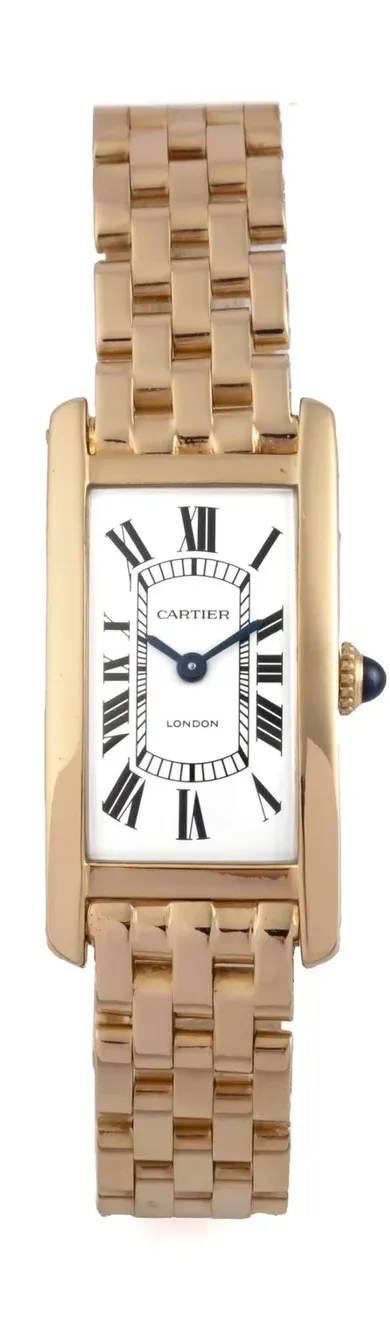
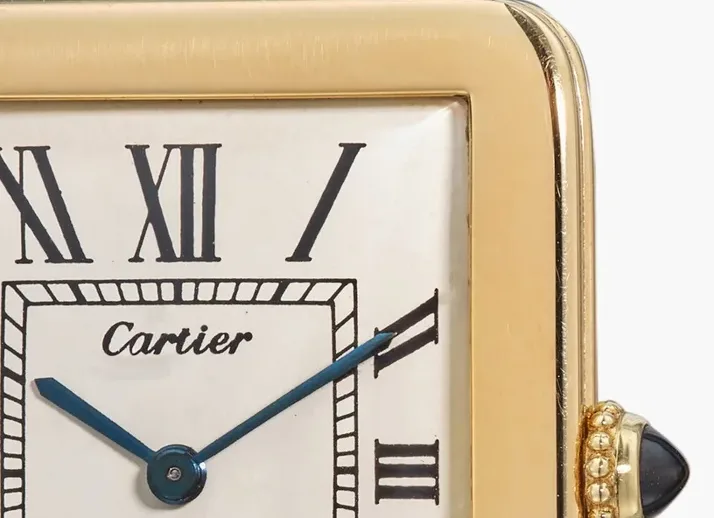
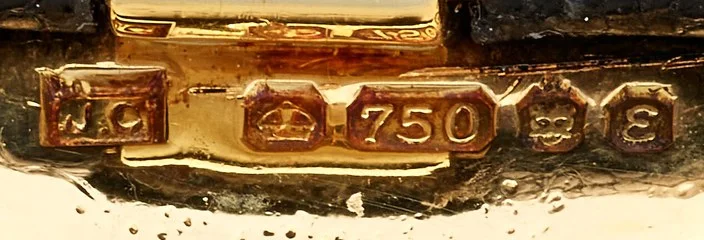
Details cut from photographs of watches of this line on record. Each was chosen by eye from a listing on the line and then checked again against the words beneath it. More sit beside the productions and parts they belong to, below. Select the small mark in a picture's corner for its holder and a link to its listing.

By house and period 8 described
Paris- and Swiss-made watches retailed in London
Before 1966 Cartier London sold wristwatches made by the parent firm in Paris or in Switzerland; in Jacques Cartier's time a watch sold in London was generally the same as one sold in Paris. Models such as the Tank and the Santos were stocked, and watches of other makers were sold beside them from 1929. Cartier also used movements by other firms in individual designs of these years. These are not London-made watches, and they are the baseline against which the later range is told. One account of the house says that it became independent in 1919; the more detailed accounts of its watches put the change in 1966. A JC stamp alone does not make a watch London-made: a Tank Cintrée with a case stamped EJ and a movement signed European Watch and Clock Co. Inc. carries a JC stamp inside the case with a Glasgow import letter for 1936.
Signature and marks. The literature gives no general rule; the Tank Cintrée of 1936 has EJ and case numbers, a European Watch and Clock Co. movement, and a JC stamp with a Glasgow import letter inside the case.
Baignoire Allongée and Maxi Oval
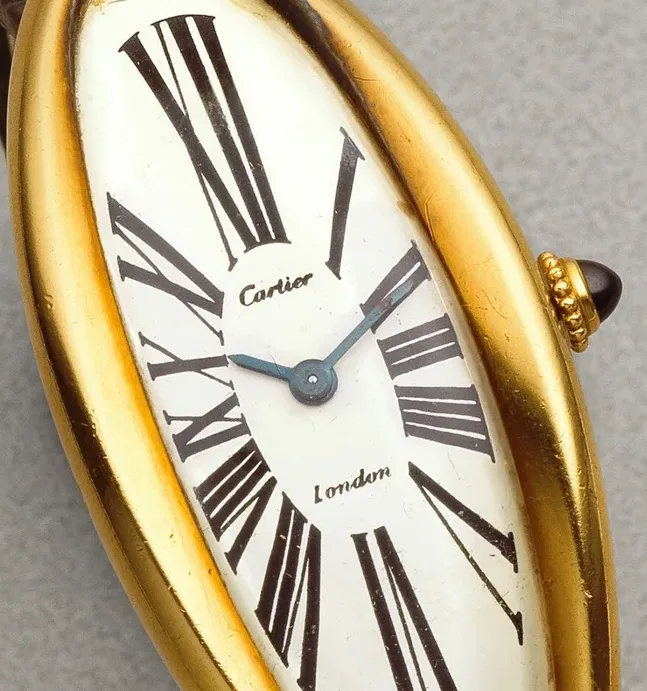
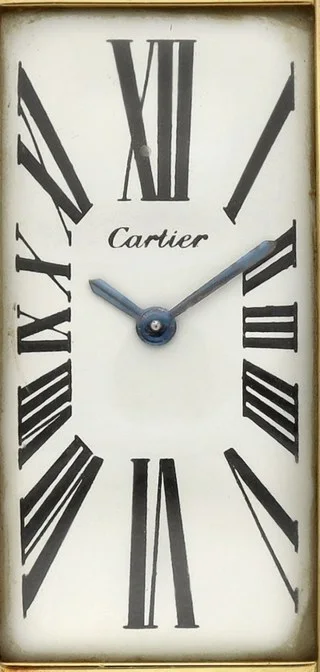
An elongated oval, the standard Baignoire stretched so that it is wider at the middle than at the strap ends, and in its largest form more than 58 mm long. The dial is cream or silvered with black Roman numerals set along the oval, the numerals at three and nine pushed apart and those at twelve and six pressed together on the longest cases; the hands are blued steel swords and the crown carries a blue sapphire cabochon at three. Sellers also record a blue-black dial and a bracelet of oval links. The form shares its geometry with the Crash and the Baignoire, one enlarging the oval and the other distorting it. One account dates the Allongée to 1958, which would put it before London began its own watches; other accounts date the Maxi Oval to 1968 and 1969, one by a London date letter. A Maxi Oval from New York is pictured beside London ovals, so the form was not London's alone. Accounts differ on whether the Maxi Oval and the Allongée are one watch: most use the two names for the same elongated oval, while one treats the Maxi Oval, at about 58 by 32 mm, as a larger watch distinct from an Allongée of about 24 by 53 mm.
Signature and marks. The literature gives a London date letter on a dated example; sellers' descriptions in the library's records give the dial signed Cartier London, a case number and, on one, a Cartier London deployant clasp.
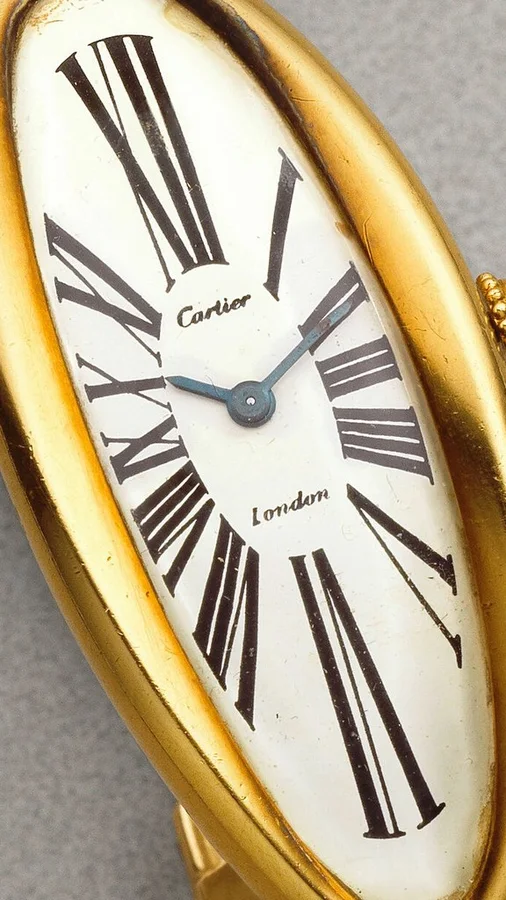



- case far longer than wide, widest at the middle
- blue sapphire cabochon crown at three
Tank Cintrée, London version
The curved Tank of 1921 reworked in London in three sizes, the largest on a 9-ligne movement and a smaller one probably on a 7-ligne. The London dial dropped the railway minute track of the Paris watches and used long, stretched Roman numerals reaching from the centre towards the edge, their feet forming a small rectangle at the middle; with it went plain blued sword hands, Breguet-style hands being judged too old-fashioned for it. The dial suits the large size best and is less lively on the small one. Not every London Cintrée has it: London-hallmarked Cintrées in the library's records also carry the traditional dial, with a railway minute track round a small central chapter ring. The 1960s London dial was also used on the less curved elongated Tank. Dated examples are of 1969 and 1970, the 1970 one in white gold, the rarer metal; the library's records also describe blue numerals and an ink-blue dial.
Signature and marks. London gold hallmarks and the JC stamp on the case, as on the London-made cases generally; the literature gives no dial signature for the model.
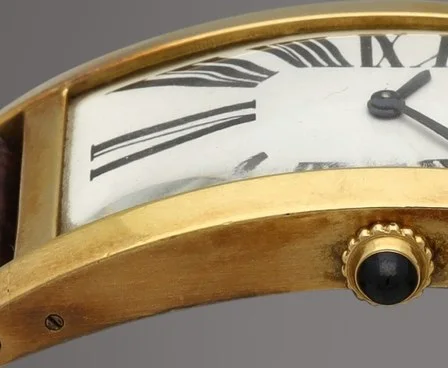

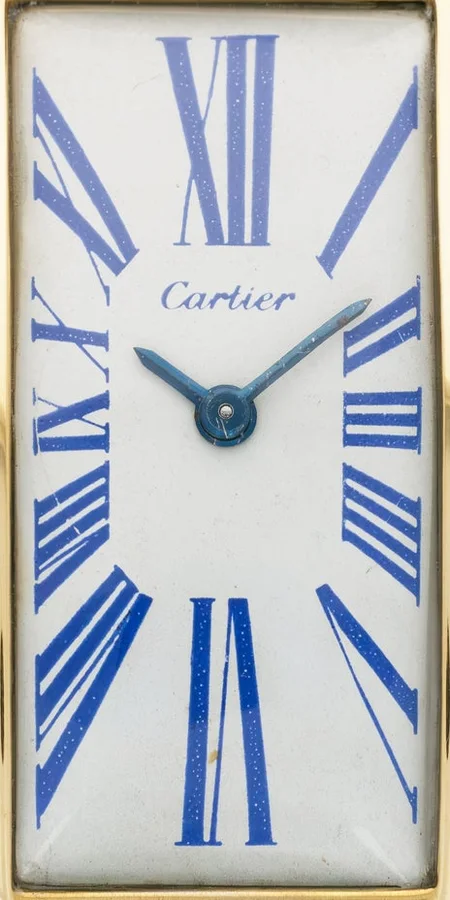

- curved case in one of three sizes
Elongated Tank
A Tank case of the same family as the Cintrée but less curved, on which London also used the stretched-numeral dial. Published accounts say little more about it. Sellers in the library's records call such watches the Tank Allongée and describe them with the London hallmark, in one case dated to 1967; watches sold under that name in the library's records also show other dials, with a railway minute track round a central chapter ring, or with Roman numerals only at twelve and six and batons between.
Signature and marks. London gold hallmarks and the JC stamp, as on the London-made cases generally.
- Tank outline lengthened and less curved than the Cintrée
- on some, stretched Roman numerals as on the Cintrée
JJC model
A reworking of the original Tank with more rounded edges, one of the most popular London styles. In one of its many variations it was among the thinnest watches in the world; Jean-Jacques Cartier liked thin watches and worked with Jaeger-LeCoultre on them. The case workshop kept a tin labelled JJC holding the steel template and instructions for it. Sellers' titles in the library's records name London watches Tank Louis, mini Tank Louis and Tank Louis ultra-thin without saying whether any is the JJC; one auction title names a lady's Tank JJC with a London hallmark for 1962.
Signature and marks. The literature gives no signature detail for the model.
- Tank with softly rounded rather than angular edges
- very thin case
Double strap
A watch worn on two straps, inspired in part by the straps of a horse's bridle. It is named as one of the principal London models, and one account dates it to 1970. The library's records hold one rectangular watch with twin straps, its case and buckles hallmarked in London for 1970 and numbered 9793.
Signature and marks. London hallmarks on the case and on the buckles, as described for the example in the library's records.
- two straps side by side
- hallmarks on case and buckles
Asymmetric driving watch
A watch whose case is set on the diagonal, with twelve at the top right and six at the bottom left, so that twelve points upward when the hands are on a steering wheel. It was a favourite of Jean-Jacques Cartier and is extremely rare. It is named the Asymmetric among the principal London models, and one account names a Tank Asymétrique among London's designs, based on the Parallelogram that Louis Cartier made in the 1930s; many such names were given by collectors, not by Cartier.
Signature and marks. London gold hallmarks and the JC stamp, as on the London-made cases generally; no dial signature is given.
- case set at an angle, with twelve toward the top right
Octagonal, Decagonal and Round cases
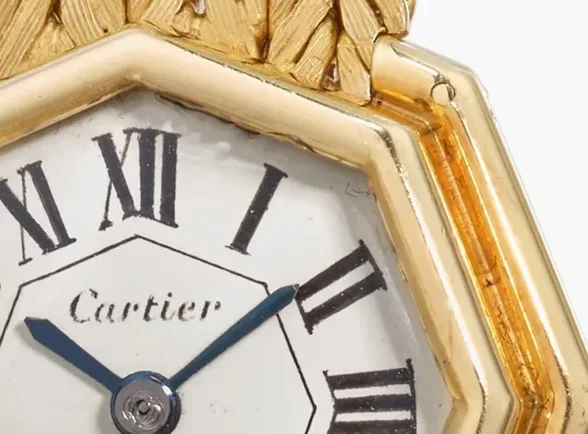

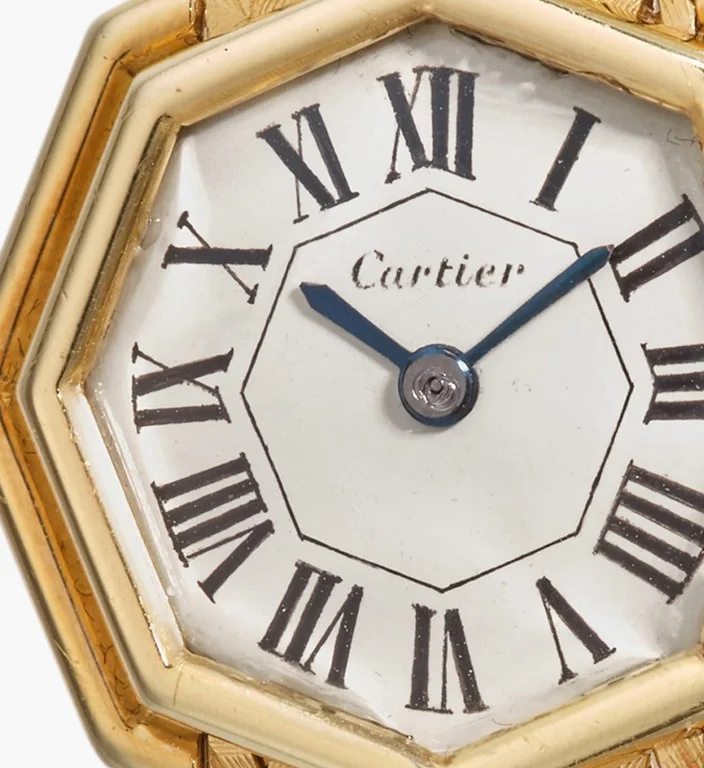
London also made watches on geometric case forms: an octagon, an elongated octagon, a ten-sided case and a round case. The decagonal has ten flat or gently curved facets, so that the dial looks nearly round and the numerals are spaced as on a round watch; its dial is cream or silvered with black Roman numerals and a fine chapter ring, and the Cartier London signature stands in the upper half. It is told from a round watch mainly by the bezel, which catches the light at each facet. The same blued sword hands and sapphire-cabochon crown are described. A 2021 sale in Monaco of eighty-eight London watches made under Jean-Jacques Cartier gave one of the fullest public views of these forms; the library's records hold a lady's octagonal hallmarked for 1976 and an elongated octagon of about 1970.
Signature and marks. Cartier London in the upper half of the dial of the decagonal; London hallmarks on the case.

Chronology
Specification
| Maker | Cartier London, 175-177 New Bond Street; cases made by the Wright & Davies workshop, Rosebery Avenue, in Clerkenwell |
| Case | 18-carat gold, made by hand; yellow gold in most records, white gold in a few; London hallmarks and a JC punch |
| Case sizes | Varied by shape; the sizes sellers state in the library's records fall mostly between 20 and 33 mm |
| Dial | Cream or silvered with black Roman numerals; on many Tanks stretched numerals without a minute track, though London-hallmarked Tanks in the library's records also carry the traditional railway-track dial; a few coloured enamel dials |
| Hands | Blued steel sword hands on the London dials described |
| Crown | Blue sapphire cabochon, made by hand |
| Movement | Hand-wound; movements were chosen with Jaeger-LeCoultre for each design, and the Crash used its calibre 841. Sellers in the library's records give calibres such as K840, 845 and P838 on London-hallmarked watches, and one London-hallmarked automatic of 1972 |
| Clasp | Folding gold deployant clasp, made at the case workshop |
Dial 3 described
The dials of the London watches were reworked as well as the cases. Most gave up the railway chapter ring of the Paris watches, and a few coloured enamel dials are known. The numerals were stretched or spaced to follow the case, and sellers record blue-black, ink-blue and blue-numeral variants.
Stretched Roman numerals, no minute track
Long Roman numerals reaching from the centre towards the case edge, with their feet forming a small rectangle at the centre and no railway minute track. It was used on the Tank Cintrée and the elongated Tank, and works best on the largest size. Accounts differ on the serifs: one says the serifs were removed and the figures made bolder and more attenuated, another describes serif numerals.

Cream or silvered dial with black Roman numerals
The ordinary London dial on the Maxi Oval and the decagonal: black Roman numerals set along the contour of the case on a cream or silvered ground; the decagonal has a fine chapter ring and the Cartier London signature in the upper half.
- numerals following the oval or polygon contour
Coloured enamel and blue dials
A few London dials were coloured enamel. The library's records add blue-black and ink-blue dials on Allongée and Cintrée watches, and a Cintrée with blue numerals, all in sellers' words.
- coloured enamel dial
Hands 1 described
The hands described on London watches are plain.
Blued steel sword hands
Flame-blued sword-shaped hands go with the stretched-numeral dial; Breguet-style hands were judged too old-fashioned for it.
- plain blued sword hands
Case and sizes 3 described
Cases were made by hand at the Wright & Davies workshop in East London, from templates kept for each model, and then taken to New Bond Street for the movement to be fitted. A standard case took a senior craftsman about thirty-five to forty hours. The marks on the case identify London manufacture.
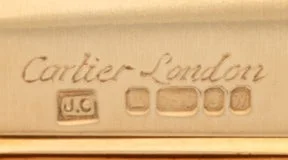
London hallmark and JC punch
Cases carry London gold hallmarks with a date letter and the punch JC. Accounts disagree on whose initials it is: Jean-Jacques Cartier on one page, Jacques Cartier on others; a JC stamp is recorded on a Tank Cintrée imported in 1936. A London import mark is a different thing: the literature records a Glasgow import letter on a Tank Cintrée cased by EJ with a European Watch and Clock Co. movement, and in the library's records import marks are given on watches such as a Tank signed Cartier Paris.

- London hallmark with date letter
- case number
Maxi Oval case
Overall length can exceed 58 mm, and the longest examples have the numerals spread to follow the shape.
- length above 58 mm
Geometric cases
Octagonal, elongated octagonal, decagonal and round cases were made together with the Tanks and ovals.
Crown 1 described
The crown is a London detail described for several shapes.
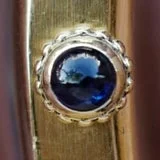
Hand-made sapphire cabochon crown
A blue sapphire cabochon set in the crown at three o'clock; a London employee of the period said even the sapphire winders were made by hand.

Movement 1 described
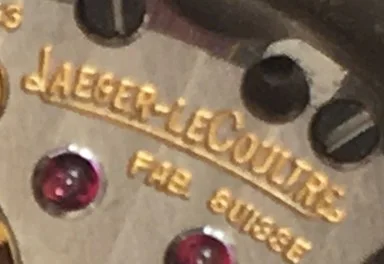
Movements were supplied by Jaeger-LeCoultre, which also supplied the thin calibres for the thinnest watches; the movement was chosen once a design had been approved.
Jaeger-LeCoultre hand-wound calibres
Movements were chosen with Jaeger-LeCoultre for each design, and the original Crash used its calibre 841. London-hallmarked watches in the library's records are given Jaeger-LeCoultre calibres such as the K840, 845, P838 and 841, and one of 1972 is described as automatic. The calibre 78-1 that sellers also give appears only on watches with London import marks or none, not on London-hallmarked cases, and a calibre 59 signed Ebel Watch Co. is given for an oblong and concave watch whose title does not name London.

- movement number in the lot description
Bracelet and strap 1 described
Straps, buckles and clasps were made in the workshop.
Gold deployant clasp
A folding gold clasp made by hand at the case workshop, its type patented by Jaeger in 1909 for Cartier's exclusive use. The blades were made by hand for each watch, so that blades from different watches do not fit together. On two documented Pebbles the clasp carries the case number, and one tonneau in the library's records is described with case and clasp numbered 1263; a clasp of another number, or none, may be a replacement, though the clasp of one Pebble of 1975 is reported not to match.
- clasp number equal to case number
- London hallmark on the clasp
Reference numbers
The numbers that belong to the line, with the listings on record under each, as its own page counts them. A number links to its own page, where the components of dated watches are set side by side.
| Number | What it is | Listings |
|---|---|---|
| 1407 | A trapezoidal watch in yellow and white gold, signed Cartier, London, dated by its seller to about 1980, as sellers describe it. | 1 |
Originality
- A clasp that is not numbered like the case, or has no number, may have replaced the original; this is documented for the Pebble, and one tonneau in the library's records is described with case and clasp numbered alike.
- The clasp blades were made by hand for each watch, so blades from another watch do not fit.
- On the rounded Pebble case, polishing softens the lines and wears the hallmarks; the London hallmark and JC punch should be legible, and the date letter read on the watch rather than taken from a listing's year.
- Published accounts warn that some imitations are very convincing, because they were made by retired London craftsmen; hallmarks and case numbers should be checked with documented examples.
Names
- Maxi Oval. A name for the oversized Baignoire Allongée, though one account keeps it for a separate, larger oval; many London names were given by collectors.
- Tank Asymétrique. A name used for a London design based on the Parallelogram of the 1930s, apparently the oblique driving watch.
- Driving watch. The diagonal case puts twelve upward when the hands are on a steering wheel.
Where accounts differ
Points on which the published literature and the library's own records do not agree, or on which the literature contradicts itself.
- When London began making its own watches. One account says the London house became independent in 1919, yet the same page, and others, say London sold Paris and Swiss watches until 1966, when its own line began. The library's records hold watches whose titles give London hallmarks for years from 1957 to 1965, before 1966, among them a Tank JJC hallmarked for 1962. A guide to the London Baignoire also dates documented examples from about 1964, one of them hallmarked in London for 1965.
- Date of the Baignoire Allongée. One account puts the Allongée in 1958, and captions an example as of 1957; the pages that describe London's own watches say that production began in 1966, and others date the Maxi Oval to 1968 and 1969. Guides to the Baignoire put the Allongée at about 1968.
- Serifs on the London Roman numerals. One account says the London numerals lost their serifs; a second page, on the Cintrée, describes the 1960s London dial as having serif Roman numerals.
- Whose initials JC stands for. One account says the stamp is for Jean-Jacques Cartier; other accounts, including an auction description of a London Crash, say it is for Jacques Cartier.
- End of London production. One account says most London watches were made in the eight years from 1966 to 1974 and that a handful more followed in the 1980s; another speaks of a production window of roughly fifteen years, and an auction house records a London Crash hallmarked for 1990. The library's records hold watches with London hallmarks stated as of 1976 and 1977, and watches signed Cartier London stated as of about 1979 and 1980.
- Maxi Oval and the Allongée. Most accounts use Maxi Oval as another name for the Baignoire Allongée, one of them calling the watch the Baignoire Allongée “Maxi Oval”. A guide to the Allongée says the Maxi Oval, catalogued at 58 x 32 mm, is a different and larger watch than the Allongée of about 23 to 24 x 52 to 53 mm.
In the records
Counted from 146 listings at dealers and auction houses. These are what sellers state, not measurements, a stated year is often an estimate, and a count of listings is not a count of watches made.
Case metal
| Metal | Listings | Share |
|---|---|---|
| Gold, any colour | 140 | 98% |
| Yellow | 52 | 36% |
| White | 5 | 3% |
| Pink | 1 | 1% |
| Colour not stated | 82 | 57% |
| Gold plated | 1 | 1% |
| Platinum | 1 | 1% |
| Silver | 1 | 1% |
As sellers state it. Shares are of the 143 listings that name a metal. A listing that says "gold" or "18K gold" names no colour: it is counted under "colour not stated", not as yellow gold. Carat, where a listing of gold gives one: 18k 108.
Case size
| Size | Listings | Share |
|---|---|---|
| 23 mm | 12 | 11% |
| 26 mm | 8 | 8% |
| 21 mm | 7 | 7% |
| 25 mm | 7 | 7% |
| 20 mm | 5 | 5% |
| 24 mm | 5 | 5% |
| 31 mm | 5 | 5% |
| 33 mm | 4 | 4% |
| Other sizes | 52 | 50% |
As sellers state it. Shares are of the 105 listings that give a size. 3 more give a figure outside 12 to 56 mm, which is a strap, a box or a slip, and are left out.
Listings by decade the seller gives
| Decade | Listings |
|---|---|
| 1950s | 8 |
| 1960s | 60 |
| 1970s | 69 |
| 1980s | 2 |
7 more give a year outside the years the line was made (from 1966): a later watch sold under the name, or a slip. They are left out.