Baignoire
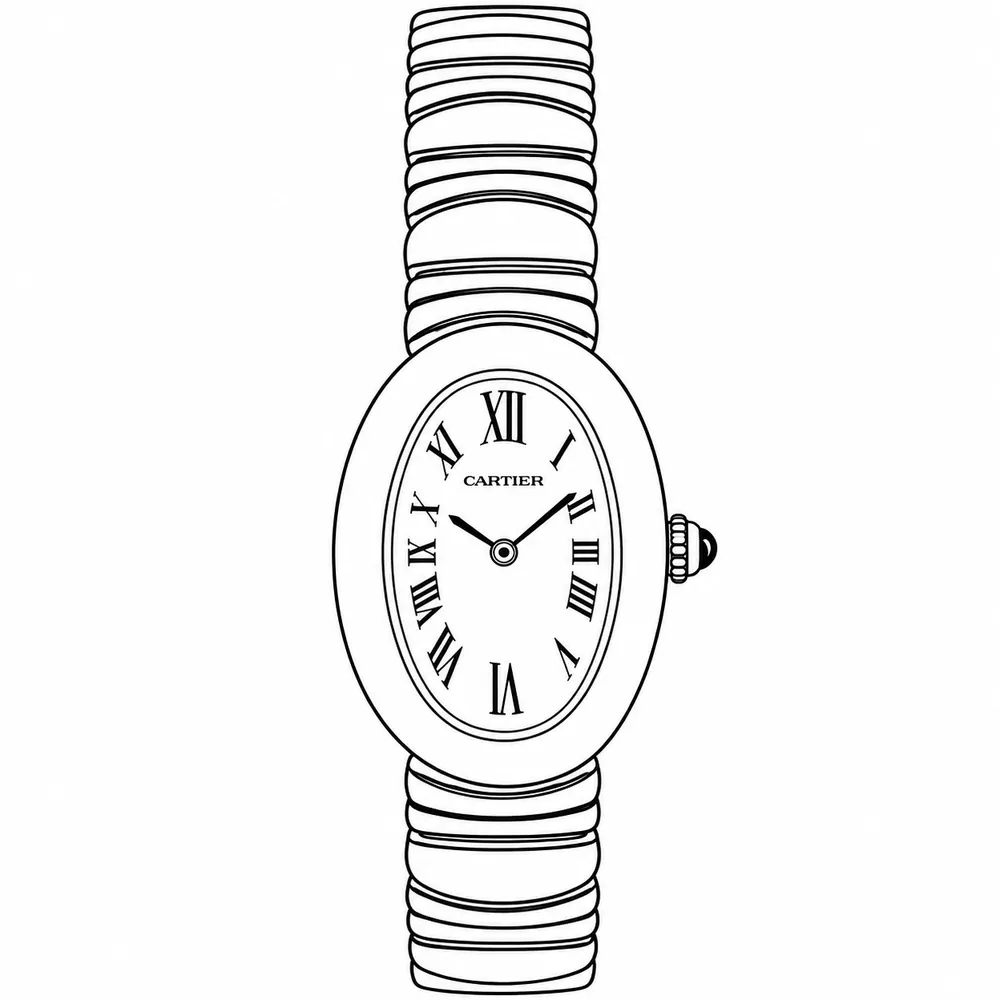
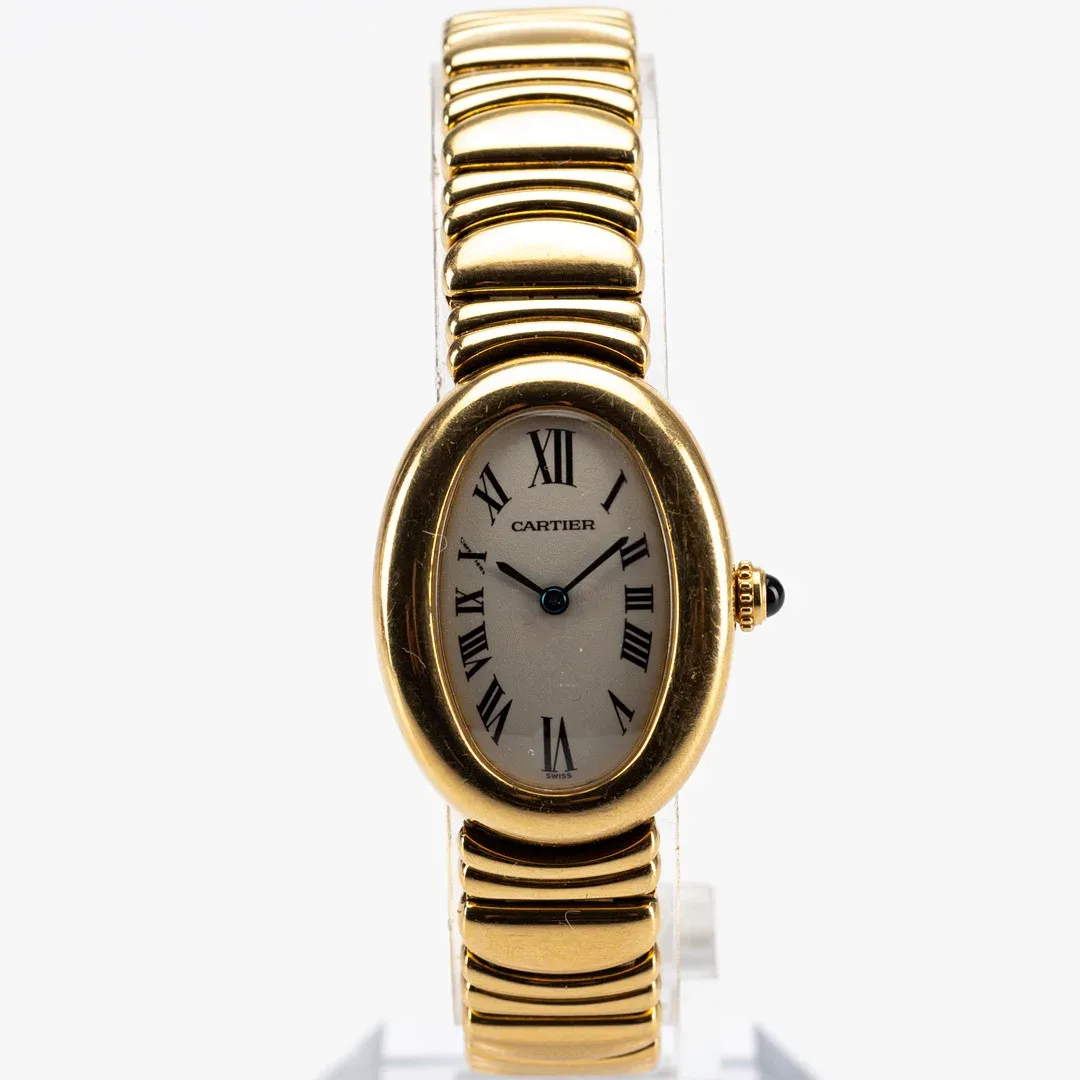
The Baignoire is Cartier's curved oval wristwatch, with Roman numerals, blued sword-shaped hands and a cabochon in the crown. The first oval design is dated 1912, the watch is generally said to have reached production in the late 1950s, and the name Baignoire is said to have come only in 1973. The London watches of the 1960s and early 1970s are the best documented: hand-wound LeCoultre movements, English hallmarks and stock numbers in place of a reference, in three sizes, and the very long Baignoire Allongée. Later come a numbered Allongée of 1991, quartz and hand-wound versions in gold, jewelled variants and the current Mini, Small and Allongée models.
Cartier's entries are arranged by model, not by reference number, because its reference numbers are several systems at once and many of its watches carry none. The houses are set out in Paris, London and New York.

- Made
- from c. 1958Accounts date the first production watch to 1956, 1957 or 1958, most often 1958; the line is still in the catalogue, so there is no end date.
- On record
- 845 listings327 of them give no reference
- Reference numbers
- 13 described169 seen in listings
- House named in the title
- London 41, Paris 24most older watches are not labelled


What to look for
Details cut from photographs of watches of this line on record. Each was chosen by eye from a listing on the line and then checked again against the words beneath it. More sit beside the productions and parts they belong to, below. Select the small mark in a picture's corner for its holder and a link to its listing.

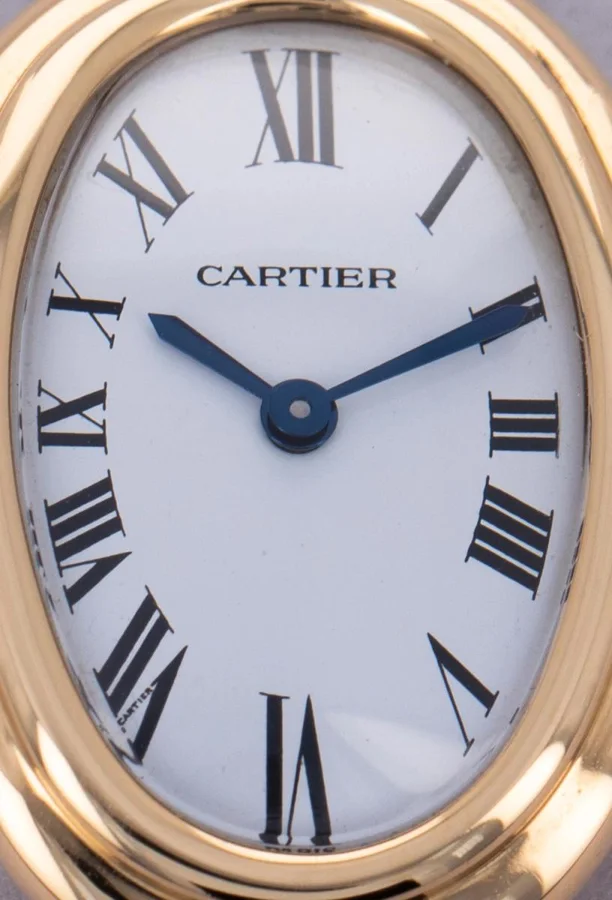

By house and period 6 described
London Baignoire, 1960s to early 1970s
The London Baignoire is an 18k gold oval retailed by Cartier London, hand-wound on a LeCoultre calibre; a London hallmark is taken to mean the watch was sold through the Bond Street boutique. Yellow gold is usual and white gold rare. Documented examples run from about 1964 to 1973 or 1974, the latest date coming from a hallmark letter on a large example; the earliest, one catalogued as about 1964 and one hallmarked in London for 1965, come before 1966, the year accounts of the London house give for the start of its own watchmaking. Three sizes are recorded: about 25 x 19 mm, the most common; about 31 to 31.5 x 23 mm, dated by examples to about 1967 to 1969; and about 35 to 36 x 23 mm, dated about 1972 to 1974, said to have been made by request in batches of three, with fewer than six known. Size names are not consistent: one dealer calls the 31 mm size large, while an auction house calls the 35 to 36 mm size the gentleman's, so the measurement is the safer guide. One white gold example of 31.5 x 23 mm, hallmarked 1967, has a black dial. The watches are identified by their English hallmarks and stock numbers, not by a reference number; not every one has domestic hallmarks, and one of 1970 has London import marks. The only number printed as a reference, 7672, belongs to a 31 x 23 mm oval first catalogued as a Paris Baignoire and then corrected to a Cartier London watch with hallmarks inside the case: the marks, not the shape, decide which house sold an oval.
Signature and marks. Inside the case back: the 18k mark, an English hallmark with its date letter (or, on one example of 1970, London import marks), a JC punch (accounts read the JC as Jacques Cartier's mark or as Jean-Jacques Cartier's) and a Cartier London stock number, which is often repeated on the clasp. Some dials are signed Cartier London, among them the largest size. The movement is signed Jaeger-LeCoultre or LeCoultre Co.

- 18k mark, London date letter, JC punch and stock number inside the case back
- the same stock number on the gold deployant clasp; a clasp without it may be a later replacement
- a hooded-lug case on a leather strap with 18k gold Cartier deployant clasp, or a gold bracelet made for the watch
- hand-wound LeCoultre movement under the case back
References: 7672
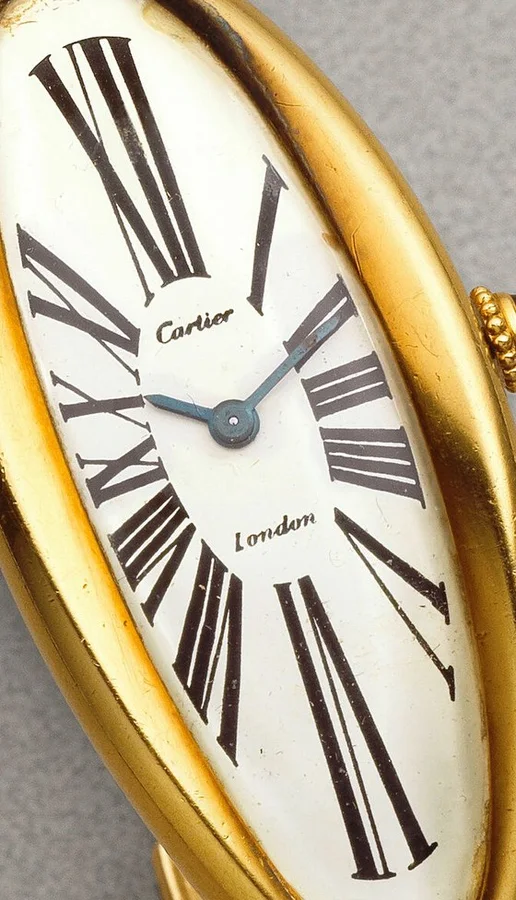
London Baignoire Allongée, late 1960s to mid-1970s
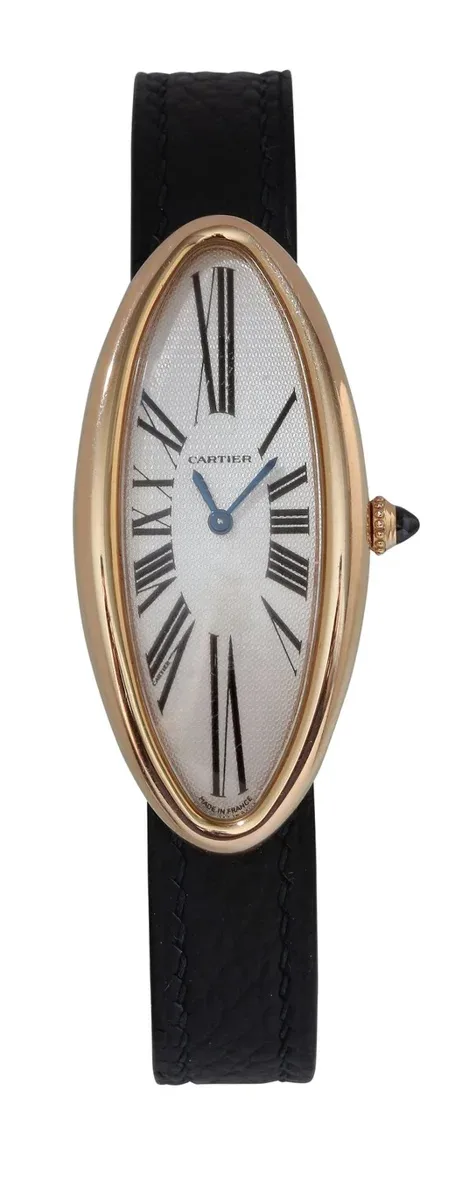
The Allongée is the Baignoire stretched: about 23 to 24 mm wide, 52 to 53 mm long and 8 mm thick, so its length is over twice its width. It was retailed by Cartier London from the late 1960s; one account dates the elongation to 1958 and captions a London Allongée as of 1957. Its making is put two ways: entirely by hand in Cartier's London workshop, or by the London and New York workshops only; no New York example is described. Dated examples cluster in 1969 by their London hallmarks, and later ones run into the 1970s (a white gold watch of 1971, a yellow gold one of about 1976). The case is 18k gold, mostly yellow, with a cabochon sapphire crown, and the movement is Jaeger-LeCoultre, one given as the 8¼-ligne calibre with 17 jewels. No production figure is given. Auction records do not give it a reference number: each is known by case number (9145, 9148, 9180 and 9181 on examples hallmarked 1969).
Signature and marks. Dial signed Cartier London; London hallmarks inside the case. On one example the clasp carries the case number, hallmarks dated 1969 and JC. Movement signed Jaeger-LeCoultre; one white gold watch of 1971 has a movement signed LeCoultre & Co and a dial printed London at 6 o'clock.
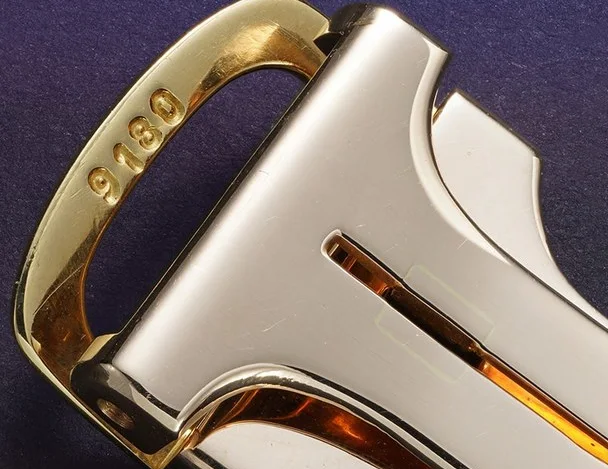


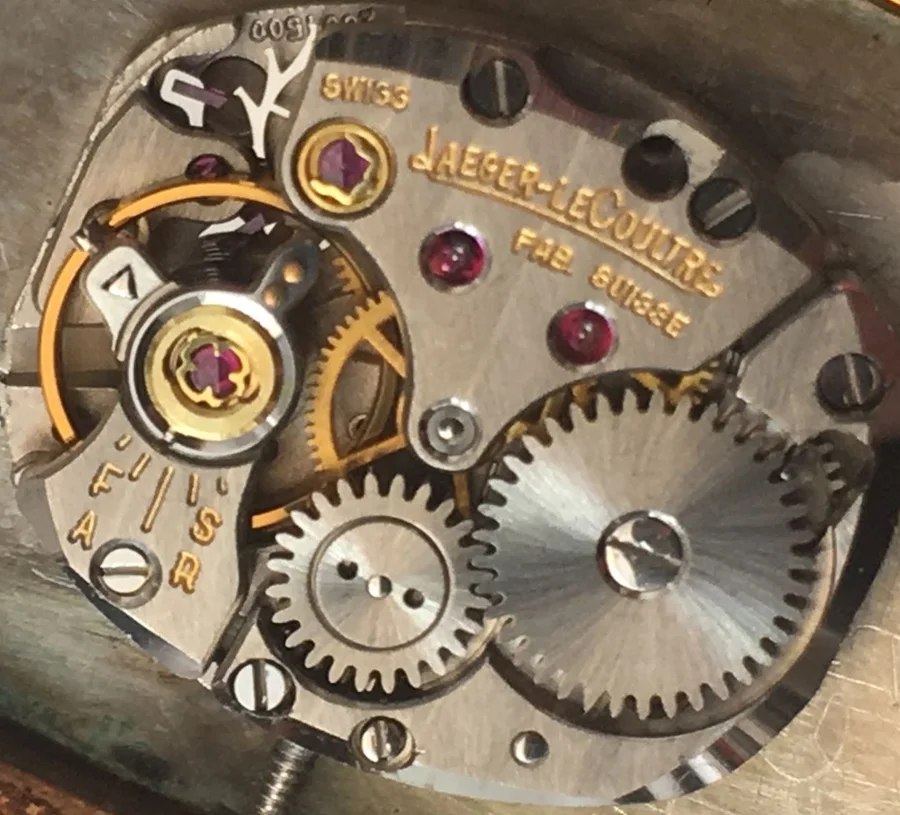

- case number matching the clasp, with hallmarks of 1969 and JC on the clasp
- case about 23 to 24 x 52 to 53 mm
Allongée limited edition, 1991
In 1991 Cartier reissued the Allongée as a numbered edition of 400, reference W1507451. One account describes the edition as made for the Collection Privée, though the Collection Privée Cartier Paris is dated from 1998 by most accounts, seven years after it. The case is 18k yellow gold, roughly 23 to 24 by 52 to 54 mm; the dial is guilloché and the movement is Cartier's Cal. 78-1. Unlike the London originals, which carry case numbers and Jaeger-LeCoultre movements, it carries a reference. In the library's records numbered pieces appear as, for example, 009-91 and 314/400; the title of the second calls it part of the Paris 1991 edition.
Signature and marks. Reference W1507451 with an individual number out of 400; dial signature not described in the literature.
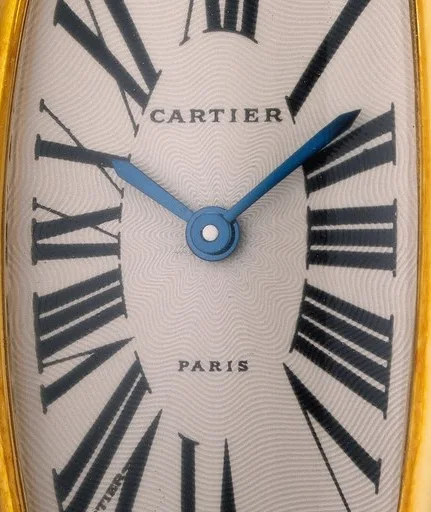

- edition number out of 400
- Cartier calibre rather than Jaeger-LeCoultre
References: W1507451
Gold Baignoire and Allongée references, 1970s to 2000s
Published accounts list gold Baignoires and Allongées of the later decades by reference. The Allongée was made in white gold (2514), pink gold (2515) and yellow gold (2604 in one list, 2605 with a quartz movement in another), and an ivory guilloché dial with painted black Arabic numerals is described on a yellow gold quartz Allongée. The Baignoire appears as reference 1954 in yellow gold, reference 1967 in yellow gold with a quartz movement on an oval-link bracelet, and reference 78094 in yellow gold, hand-wound, placed about 1970 to 1991. Most of the library's listings with a stated year fall in the 1990s and 2000s; those years do not date the watches.
Signature and marks. Not described in the literature.

- reference number on the paperwork
- quartz or hand-wound movement
Cartier Libre series
Four limited, numbered jewelled watches of the Cartier Libre collection take the Baignoire as their starting point, all in grey gold with quartz movements: Débordante (50 pieces), Infinie (20, from the Allongée's curve, with mother-of-pearl), Étoilée (15, on a stone-set bracelet) and Interdite (50, with the dial turned across the wrist and black ADLC bands). The fifth piece of the collection is a Crash. The literature gives no years.
Signature and marks. Not described.
- numbered limited edition
- grey gold case set with diamonds, on three of the four with black spinels
Current collection
The present catalogue has the Baignoire in Mini (24.6 x 18.7 x 7.2 mm) and Small (31.4 x 23.1 x 6.9 mm) sizes (the leather-strap model is also listed in a medium size), quartz, in yellow, white and rose gold, plain or diamond-set, on leather or a bangle bracelet, plus the Allongée Medium (47 x 21 x 8 mm), hand-wound on the 1917 MC, in rose or white gold. A Medium (36 x 26 x 8.5 mm) and an Allongée Extra-Large (52 x 23 x 8 mm) are listed as discontinued. A reissue of the 1958 watch in yellow gold with quartz movement was shown in 2019. An earlier generation with facetted case sides and a chiselled crystal, in a small quartz and a large model on the 430 MC hand-wound calibre, was described as new in 2009. A bangle version is described in accounts of 2023, and a diamond-set gold bracelet watch in 2025.
Signature and marks. Not described in the literature.
- Mini and Small sizes on a bangle
- 1917 MC hand-wound calibre on the Allongée; 430 MC on the large models of 2009
- sunray silvered dial
References: WGBA0021, WGBA0041, WJBA0006, WJBA0007, CRWJBA0064
Chronology
Specification
| Case | Curved oval in 18k gold, mostly yellow; white and rose gold also occur. No visible lugs as the 1958 case is described; hooded lugs on the London watches |
| Sizes | London Baignoire about 25 x 19 mm, 31 to 31.5 x 23 mm and 35 to 36 x 23 mm; Allongée about 23 to 24 x 52 to 53 mm; current Mini 24.6 x 18.7 mm, Small 31.4 x 23.1 mm |
| Crown | Cabochon, usually a blue sapphire; a diamond on some |
| Dial | Roman numerals on most; some without markers; early Arabic-numeral versions are rare |
| Hands | Blued steel, sword-shaped on most; baton-shaped on some London watches |
| Crystal | Domed on the first 1973 watches as described; mineral glass on the London Allongée |
| Movement | London watches of the 1960s and early 1970s: hand-wound LeCoultre calibres. Later: hand-wound or quartz |
| Strap or bracelet | Leather strap on a gold deployant clasp or buckle; gold bracelets; bangles on the newest watches |
| Water resistance | 30 m on the current watches |
Line 4 described
The naming and the first productions are dated unevenly: the first oval design is put in 1912, the first production watch in 1956, 1957 or 1958, and the formal name Baignoire in 1973.
Ovale Cintrée
The curved oval watch released in 1958 was first called Ovale Cintrée. Accounts also put the production start at 1956 or 1957, so the date is approximate; it was named Baignoire only in 1973.
Baignoire name
The name Baignoire is French for bathtub. Some accounts take it from the bathtub-like oval of the case, others from the opera boxes of the same name in Paris; the origin is not settled. Production is said to have moved to Switzerland at about the time of the naming.
Allongée edition of 1991
A numbered edition of 400 Allongées, reference W1507451, is dated 1991. One account places it in the Collection Privée, which most accounts date from 1998.
- number out of 400
Reissue of the 1958 watch
A reissue of the 1958 watch in yellow gold with a quartz movement was shown in 2019, very close to the original design.
Dial 7 described
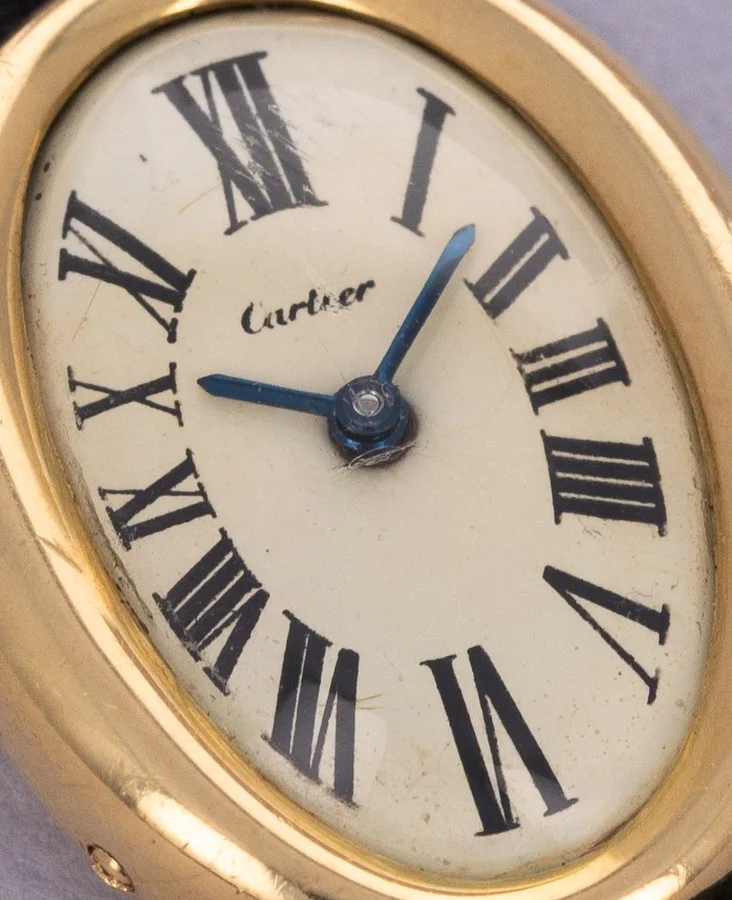
Most dials have Roman numerals under blued hands and no seconds hand or lume. The London watches have cream, silvered or white dials with numerals stretched toward the edge; rarer dials are dark blue, grey or black; later watches have guilloché or sunray dials.
Cream, silvered or white, Roman numerals
The usual London Baignoire dial is cream, silvered or white with black Roman numerals that are often stretched toward the edge. On the largest size the dial is signed Cartier London. One London example has a painted watchmaker's four.
- stretched numerals
- painted watchmaker's four on one London example
Black dial, white gold London
A white gold London Baignoire of 31.5 x 23 mm, hallmarked 1967, has a black dial and a Cal. 845; only one example is documented.
- black dial
- 18k pink gold clasp
Dark blue dial, Allongée
Two Allongées of 1969, Nos. 9180 and 9181, have dark blue dials and are the only two recorded with this dial; No. 9181, hallmarked London 1969, is described with white Roman numerals and white gold baton hands.
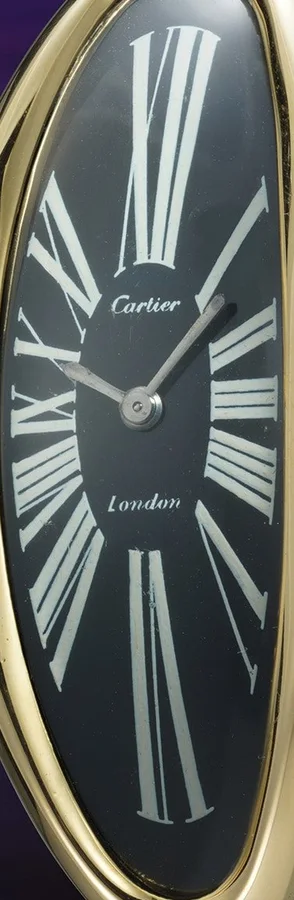

- white gold baton hands on No. 9181
Grey dial, white gold Allongée
A white gold Allongée of 24 x 52 mm dated 1971 has a grey Roman numeral dial printed London at 6 o'clock and a movement signed LeCoultre & Co; it is described as possibly unique.
- London printed at 6 o'clock
- grey dial
Guilloché dial
The 1991 Allongée has a guilloché dial. An ivory guilloché dial with painted black Arabic numerals is also described on a yellow gold quartz Allongée, and a guilloché dial appears in a seller's title for reference 2515.
- guilloché pattern
- painted black Arabic numerals on one quartz example
Arabic numerals or no markers
Some early Baignoires have Arabic numerals and are among the rarest; some have no markers at all. No dates are given.
Sunray and flinqué finishes
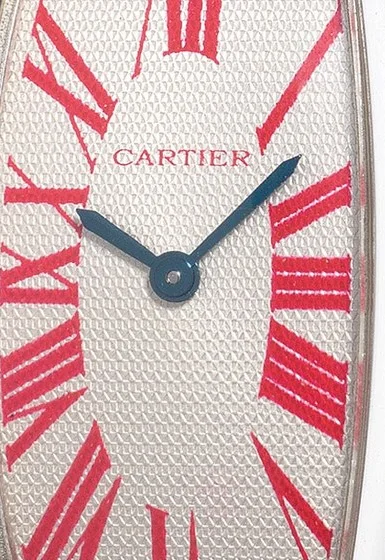
The generation described as new in 2009 has silvered sunray dials on the small models and on a diamond-set white gold large model, and a flinqué finish on the other large hand-wound models, with Roman numerals and a dotted railway track. The 2025 bracelet watch also has a sunray dial.
- sunray dial
- flinqué dial
Hands 2 described
Blued steel hands are the rule, sword-shaped on most; the London watches also have baton-shaped hands.
Blued steel, sword-shaped
Sword-shaped blued steel hands are the Baignoire's usual pair, with baton hands on some London watches.
- blued sword hands
White gold baton hands
White gold baton hands are described on the dark blue dial Allongée No. 9181.
Case and sizes 7 described
The case is a curved oval in 18k gold, mostly yellow. London sizes run from 25 x 19 mm to 36 x 23 mm and the Allongée to about 24 x 53 mm; a Maxi Oval of 58 x 32 mm is a separate watch in one account, though others use the name for the Allongée; the current catalogue names Mini, Small and Medium.
London Baignoire, about 25 x 19 mm
The most common London size, in cream or white dial and yellow gold; dated examples run from about 1964 into the 1970s.
- hallmarked case back
London Baignoire, about 31 to 31.5 x 23 mm
A second London size, called large by some, dated by examples to about 1967 to 1969. One 1969 example measures 31.5 x 23.5 mm and has a bracelet made for it, with the same number on case, clasp and band.
- 31.5 mm oval
- bracelet fixed by a pin, not welded
London Baignoire, about 35 to 36 x 23 mm
A gentleman's size in one auction catalogue, with the dial signed Cartier London and the Cal. K840; said by one dealer to have been made by request in batches of three, with fewer than six known.
- 36 mm oval
- dial signed Cartier London
Baignoire Allongée, about 23 to 24 x 52 to 53 mm
A curved oval about 8 mm thick, with hooded lugs. Some catalogues and articles measure it at 52 x 22 mm.
- more than twice as long as wide
Maxi Oval, about 58 x 32 mm
A larger oval catalogued at 58 x 32 mm, described in one account as a different watch from the Allongée; other accounts use Maxi Oval as another name for the Allongée. Nothing is said of who made or sold it, or when.
- case about 58 x 32 mm
Current Mini, Small, Medium, Allongée sizes
The catalogue lists Mini 24.6 x 18.7 x 7.2 mm, Small 31.4 x 23.1 x 6.9 mm, Medium 36 x 26 x 8.5 mm (discontinued), Allongée Medium 47 x 21 x 8 mm and Allongée Extra-Large 52 x 23 x 8 mm (discontinued). Another account, writing of references 2604, 2514 and 2515, gives the Allongée as 21.5 mm wide and 7.8 mm thick. Among the older watches of the 1960s to 1990s, a mini without a crown is mentioned.
- Mini without crown on some older minis
Facetted case sides
A generation described as new in 2009 replaces the domed case of the original with facetted cut sides and a chiselled crystal.
- facetted flanks
Crown 1 described
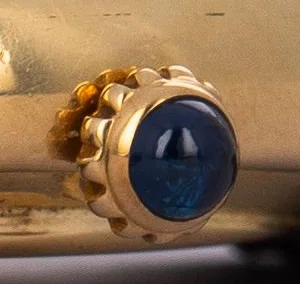
The crown is set with a cabochon, usually a blue sapphire, a diamond on some.
Beaded cabochon crown
A beaded crown with a cabochon is recorded on a 1969 London Baignoire; the Allongée has a cabochon sapphire crown.
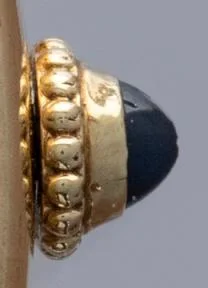

- beaded surround on London 31.5 mm
Crystal 1 described
The crystal is glass; the London Allongée is described as mineral glass, and the type is not stated for the London Baignoire.
Domed crystal
The watches of 1973 are described with a domed crystal, a Roman numeral dial and a smooth gold ribbon case.
Movement 5 described
The London watches are hand-wound LeCoultre; later versions are quartz or hand-wound on Cartier calibres.
LeCoultre Cal. 840, K840 and 845
Recorded London Baignoire movements are the Cal. 840 on a small example, hallmarked 1966 to 1967, the K840 on a large one and the 845 on the white gold black dial watch, each with 17 jewels, signed Jaeger-LeCoultre or LeCoultre Co.
- 17 jewels
- hand-wound LeCoultre
Allongée, Jaeger-LeCoultre 8¼-ligne
The London Allongée movement is Jaeger-LeCoultre, given as the calibre 8¼ ligne with 17 jewels.
Cartier Cal. 78-1
The 1991 limited edition Allongée carries the Cartier Cal. 78-1.
Quartz
Quartz powers the current Mini and Small, most current watches and earlier gold ones, among them reference 1967 and the Allongée 2605.
430 MC and 1917 MC
A large model of the generation described in 2009 is on the hand-wound 430 MC, and the current Allongée on the hand-wound 1917 MC.
Bracelet and strap 3 described
London watches come on leather with an 18k gold deployant clasp, or on gold bracelets; later bracelets have oval links, bow-tie links or bangles.
Gold deployant clasp numbered to the case
On many London watches the clasp is hallmarked and carries the case stock number, so a mismatch may mean replacement. One watch has a bracelet made for it and joined by a pin.
- matching numbers on clasp
Oval-link, stacked-link and bow-tie bracelets
Reference 1967 is on an oval-link gold bracelet, a single-link bracelet of stacked links was made in gold or gold and steel, and reference 1950 has bow-tie links with diamond pavé. None is dated.
Bangle
A bangle bracelet that swings open is described for Mini and Small sizes, in yellow, rose or white gold, plain or diamond-set, in accounts of 2023; a separate 2025 gold bracelet watch is described.
- oval bangle
Reference numbers
A four-digit number is stamped on the case and covers a case; a code beginning W, or the newer letter codes, is a catalogue number for one version of it (metal, dial, strap). Many older watches carry neither. The last column is the listings on record under the number, as its own page counts them.
| Number | What it is | Listings |
|---|---|---|
| 7672 | A 31 x 23 mm yellow gold oval, movement signed Jaeger-LeCoultre, printed in one catalogue and corrected in a saleroom notice to a London piece; the only number tied to a London watch. | |
| W1507451 | The 1991 Allongée limited edition of 400, 18k yellow gold, Cal. 78-1, guilloché dial. | 6 |
| 2514 | Allongée in white gold, about 2000 to 2005 in one account. | 25 |
| 2515 | Allongée in pink gold, about 2000 to 2010 in one account; sellers' titles mention a guilloché dial, and one calls a 2515 yellow gold. | 13 |
| 2604 | Allongée in yellow gold in one account; a second account gives 2605 as the yellow gold quartz Allongée of about 1999 to 2005. | 2 |
| 2605 | Allongée in yellow gold with quartz movement, about 1999 to 2005. | |
| 1954 | Baignoire in yellow gold, about 1990s to 2000s. | 30 |
| 1967 | Baignoire in yellow gold, quartz, on an oval-link gold bracelet, about 1990s. | 4 |
| 78094 | Baignoire in 18k yellow gold, hand-wound, about 1970 to 1991 in one account; sellers often describe it with a 'Paris' dial. | 30 |
| 1960 | Baignoire joaillerie, a yellow gold diamond-set bracelet watch as sellers describe it; sellers give the catalogue codes W15109D8, WB5047D8, WB504331 and W1510956 beside it. Catalogue codes seen beside it in listings: W1510956, W15109D8, WB5047D8, WB504331 | 31 |
| 2369 | Mini Baignoire in white gold set with pink sapphires, as sellers describe it. | 26 |
| WJBA0006 | Current Allongée medium in rose gold with diamonds and leather, hand-wound. | 3 |
| WGBA0021 | Current Baignoire bangle Mini in yellow gold, quartz. | 6 |
Originality
- A clasp that lacks the case's stock number on a London Baignoire may be a later replacement.
- On a London watch the date letter inside the case back gives the year within two years; heavy polishing softens the curve of the oval and can wear the hallmarks.
- On used gold Baignoires of the 1960s to 1990s, check that the gold buckle is original; the strap often needs replacing.
Names
- Bathtub. Baignoire is French for bathtub.
- Black Baignoire. A catalogue name for the white gold London watch with a black dial of 1967.
- Maxi Oval. The name given to a larger oval, about 58 x 32 mm, that one published account treats as a separate watch; others use the name for the Allongée.
Where accounts differ
Points on which the published literature and the library's own records do not agree, or on which the literature contradicts itself.
- Start of production. One account says the curved oval was already a house classic in 1956, another that it became a produced model in 1957; most others give 1958. The first design is dated 1912 throughout.
- Span of London production. The page on the London Baignoire gives about 1964 to 1974. The library's records hold titles naming London hallmarks or import marks for 1961, 1975 and 1977, and one Maxi Oval of about 1979.
- Maxi Oval and the Allongée. The page on the Allongée says the Maxi Oval is a different, larger watch; other accounts call the Maxi Oval another name for the Baignoire Allongée; titles in the library's records equate 'maxi' with the Allongée, as in a title for an 'Allongée Maxi Oval' with a London signature.
- Allongée size. One page measures the Allongée at 52 x 22 mm; the catalogues record 23 to 24 x 52 to 53 mm.
- Yellow gold Allongée reference. One account gives 2604 for the yellow gold Allongée; another lists 2605 as yellow gold quartz Allongée and has no 2604.
- Which workshops made the Allongée. One account cites an auction house describing the Allongée as made entirely by hand in Cartier's London workshop; another cites the same house saying it was only ever produced by the London and New York workshops. No New York example is described.
- Date of the Allongée. Pages on the Baignoire put the elongated version at 1968 or about 1968, or simply in the 1960s. One page on the Crash says Jean-Jacques Cartier elongated the Baignoire into the Allongée in 1958, and captions a London Allongée as of 1957.
- London Baignoires before 1966. The page on the London Baignoire dates documented examples from about 1964, one catalogued circa 1964 and one hallmarked London 1965. Accounts of Cartier London say it sold watches made in Paris or Switzerland until 1966, when it began its own line.
- The 1991 edition and the Collection Privée. One account dates the numbered Allongée edition of 400 to 1991 and reports it as made for the Collection Privée. Accounts of the Collection Privée Cartier Paris date its launch to 1998, and one to 1997, so the edition comes some years before the Collection on either dating. The literature on the Baignoire does not explain the difference.
- The Baignoire before the 1950s. One account of the Cartier houses lists the Baignoire among the shapes the Paris workshop made from the Tank in the 1920s, and another has it introduced in 1912 alongside the Tortue. Accounts of the Baignoire itself date only the first oval design to 1912 and put production in the late 1950s.
In the records
Counted from 845 listings at dealers and auction houses whose title, or whose reference, places them on the line; 502 state a year. These are what sellers state, not measurements, and a count of listings is not a count of watches made.
Case metal
| Metal | Listings | Share |
|---|---|---|
| Gold, any colour | 498 | 97% |
| Yellow | 147 | 29% |
| White | 114 | 22% |
| Pink | 69 | 13% |
| More than one colour | 1 | under 1% |
| Colour not stated | 167 | 32% |
| Steel | 8 | 2% |
| Platinum | 6 | 1% |
| Silver | 2 | under 1% |
| Steel and gold | 1 | under 1% |
As sellers state it. Shares are of the 515 listings that name a metal. A listing that says "gold" or "18K gold" names no colour: it is counted under "colour not stated", not as yellow gold. Carat, where a listing of gold gives one: 18k 320.
Case size
| Size | Listings | Share |
|---|---|---|
| 22 mm | 47 | 13% |
| 23 mm | 42 | 12% |
| 31 mm | 33 | 9% |
| 18 mm | 25 | 7% |
| 21 mm | 23 | 7% |
| 30 mm | 15 | 4% |
| 24 mm | 14 | 4% |
| 47 mm | 14 | 4% |
| Other sizes | 137 | 39% |
As sellers state it. Shares are of the 350 listings that give a size. On a watch that is not round some sellers give the width and some the length, so one watch can stand under two sizes. 3 more give a figure outside 12 to 56 mm, which is a strap, a box or a slip, and are left out.
Movement
| Kind | Listings | Share |
|---|---|---|
| Quartz | 173 | 53% |
| Hand-wound | 148 | 46% |
| Mechanical, winding not stated | 3 | 1% |
| Automatic | 1 | under 1% |
Shares are of the 325 listings whose description says how the watch is driven.
Listings by decade the seller gives
| Decade | Listings |
|---|---|
| 1950s | 3 |
| 1960s | 47 |
| 1970s | 39 |
| 1980s | 46 |
| 1990s | 137 |
| 2000s | 126 |
| 2010s | 68 |
| 2020s | 32 |
4 more give a year outside the years the line was made (from 1958): a later watch sold under the name, or a slip. They are left out.