Tank à Guichets
The Tank à Guichets is a Tank with the dial closed off: the front is a plain metal plate pierced by two small windows, one showing the hour on a disc that jumps at the top of each hour and one showing the minutes on a disc that moves slowly, with no hands. It is dated to 1928 and was made in very small numbers. Cartier returned to it in 1996, in 1997 for its 150th anniversary, in 2005 for the Collection Privée Cartier Paris and in 2025 for the Cartier Privé collection. The 1997 and 2005 editions share the Piaget-based calibre 9752 MC. Collectors first look at the crown position and its stone, the case back and the metal, because these separate the editions.
Cartier's entries are arranged by model, not by reference number, because its reference numbers are several systems at once and many of its watches carry none. The houses are set out in Paris, London and New York.

- Made
- from c. 1928The first watch is dated to 1928 and later pieces appear in the 1930s; the modern editions follow in 1996, 1997, 2005 and 2025, so production has been intermittent rather than continuous.
- On record
- 38 listings24 of them give no reference
- Reference numbers
- 5 described5 seen in listings
- House named in the title
- Paris 5most older watches are not labelled

What to look for
Details cut from photographs of watches of this line on record. Each was chosen by eye from a listing on the line and then checked again against the words beneath it. More sit beside the productions and parts they belong to, below. Select the small mark in a picture's corner for its holder and a link to its listing.

By house and period 7 described
Paris, the original of 1928
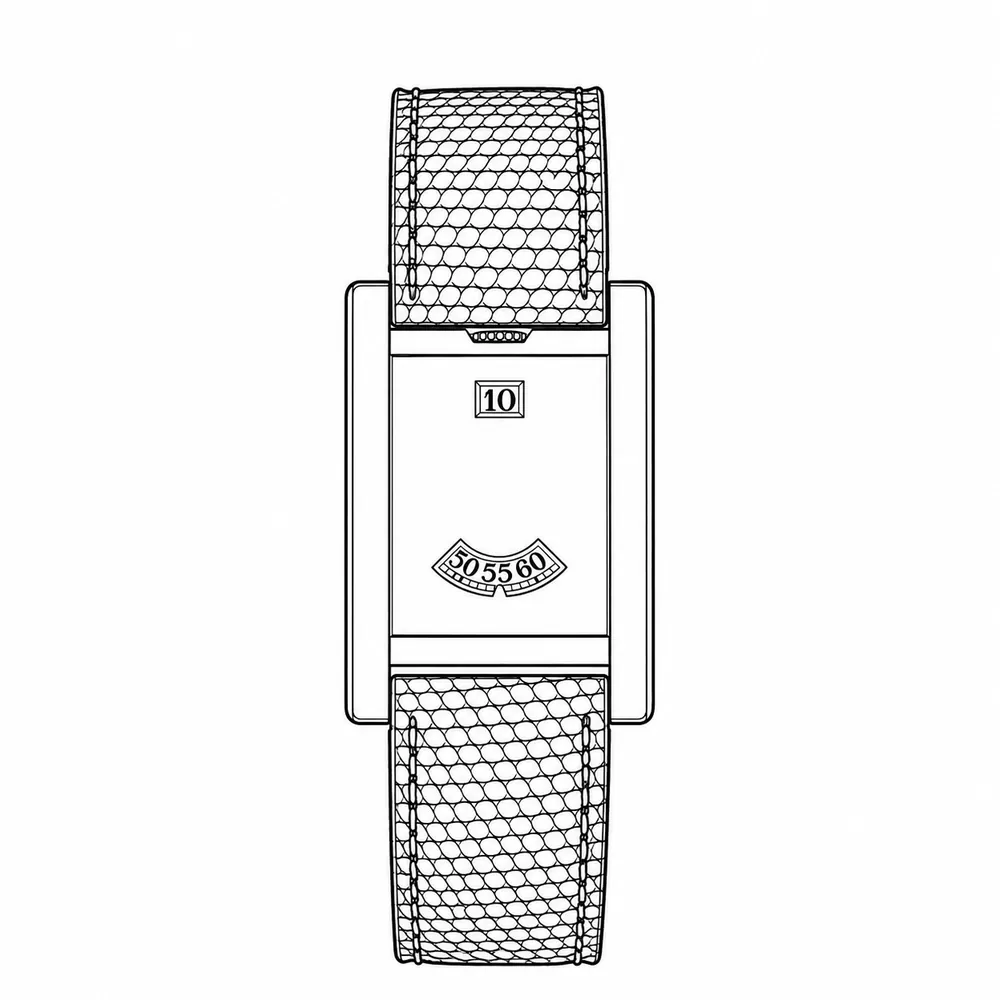
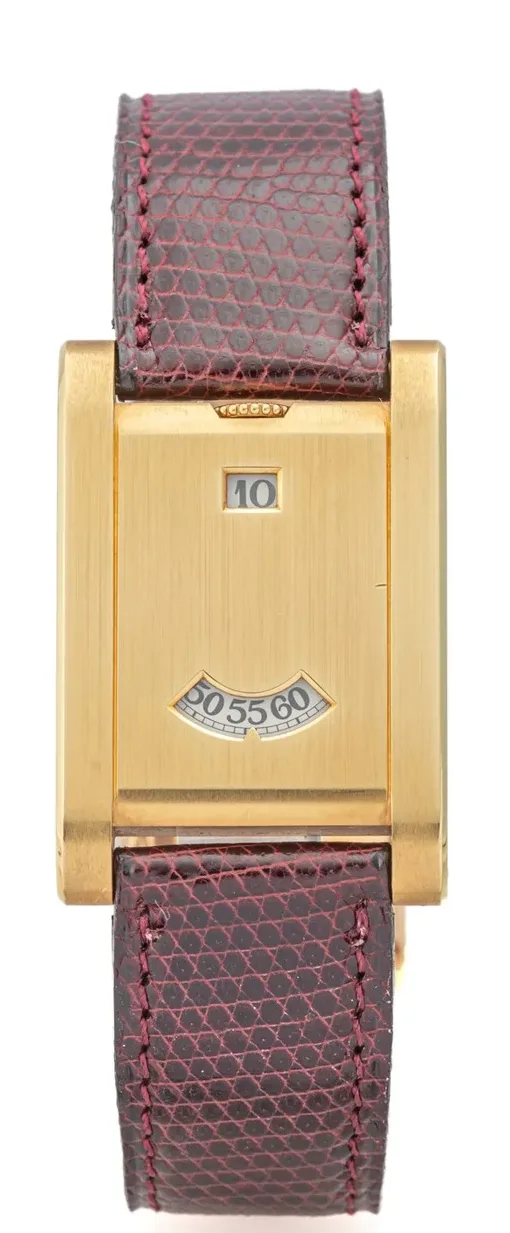
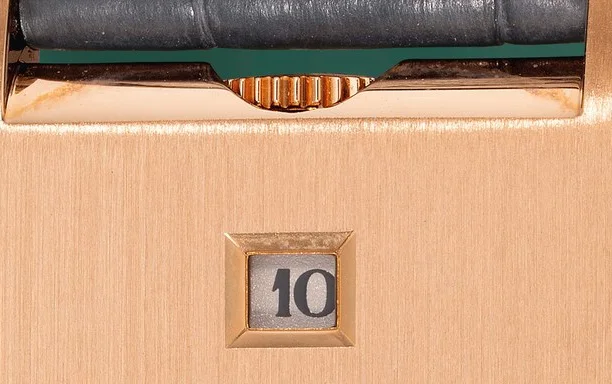
The first Tank à Guichets is dated to 1928 and is credited to Cartier's Parisian workshop, which in the 1920s reworked the Tank into a range of shapes. It replaced the dial with a closed, all-gold case: a flat brushed top with an hour window at 12 and a curved minute window at 6, and the crown at 12. The hours jump and the minutes are shown on a slow disc. It was made in strictly limited numbers for a small clientele, and the size of the first run is not documented; one account suggests it may have begun as a special order. Published accounts give no case-maker, movement supplier, dial signature or case stamps for these watches.
Signature and marks. Not given in published accounts.
- solid brushed gold front with only two windows
- hour window at 12, curved minute window at 6
- crown at 12 o'clock
The unique pieces of the 1930s
Through the 1930s Cartier made several Tank à Guichets watches, each described as unique. They explored the shape of the windows, how the brancards join the case, where the crown sits and the choice of metal. A watch dated to 1931 has the crown at 3 o'clock and an engraved case back. The 2025 platinum edition with diagonal windows is presented as a reference to the experimental layouts of this decade. Published accounts do not say which house made these watches.
Signature and marks. Not given in published accounts.
- window shape, brancard join and crown position differ from piece to piece
The limited editions of 1996
In 1996 Cartier made a few Tank à Guichets watches with the crown at 12, as on the 1928 original. Most accounts give six, three in yellow gold and three in platinum, and one describes the 1996 watch as smaller. One auction report instead gives three each in yellow gold, pink gold and platinum, the yellow gold ones made for a themed auction of Cartier watches, and says the yellow gold looks most like the original. Sellers' titles show pink gold watches described as limited to three or as probable special orders. Published accounts name no house and no movement for these watches.
Signature and marks. Not given in published accounts.

- edition number out of three
The 150th anniversary edition, 1997
Made to mark the 150th anniversary of the firm, this is a platinum watch limited to 150, about 26 x 37 mm, with the crown at 3 set with a ruby, which most accounts call a cabochon and one describes as faceted. The movement is the manual-wind 9752 MC, 19 jewels, described as based on a Piaget ebauche. The case is described as having flatter, more squared-off brancards and a thin polished bevel between the middle case and the brancards. The case back carries the LC logo with 1847-1997 below it and the edition number. The dial is described as silvered. Papers vary: one example has been sold with a limited-edition certificate stamped by the retailer, others with a box alone, and one with a Collection Privée Cartier Paris presentation box; it is widely attributed to that collection though it predates it by a year.
Signature and marks. Sellers' titles give 'signed Cartier, Paris'. Case back: LC logo, 1847-1997 and the number out of 150; PLATINE, MADE IN FRANCE and MECANIQUE; hallmarks of two lozenges, a pair of small head-shaped marks and a rounded mark below them, too small to read in published photographs.
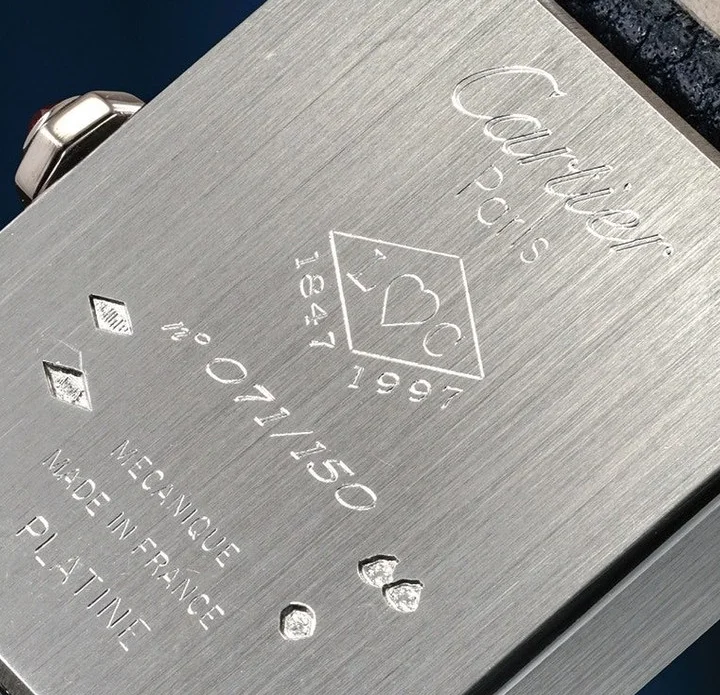

- faceted red stone in the crown at 3
- platinum case with signed 18k white gold deployant clasp
Collection Privée Cartier Paris, pink gold, 2005
The Collection Privée Cartier Paris edition is in pink gold and limited to 100, reference 2817. The crown is at 3, octagonal, set with a blue stone that published accounts call a cabochon, and is slightly larger than the 1997 crown. The movement is the same 9752 MC. Accounts differ on the case: some say the proportions are slightly larger than in 1997, others give the same size, about 26 x 37 mm, and one gives 27 mm. The edition is dated 2005 in most accounts and 2004 in one. It is described as the last run before 2025 and as rarer than the platinum edition. Like the collection's other limited pieces it is numbered within the edition, and the collection's watches were delivered in larger leather boxes signed Collection Privée Cartier Paris.
Signature and marks. The case back is described as engraved 1847-1997, for the 150th anniversary. Sellers' titles give 'signed Cartier, Private Collection' with the number out of 100.
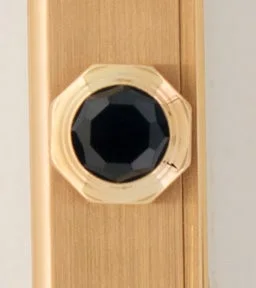

- pink gold case
- octagonal crown at 3 with a faceted stone that can look near black
- limited edition number out of 100
References: 2817, W1546451
Cartier Privé, 2025
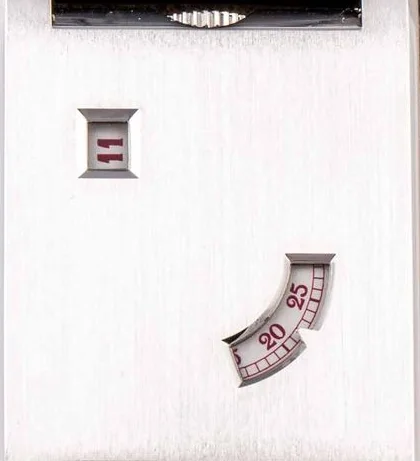
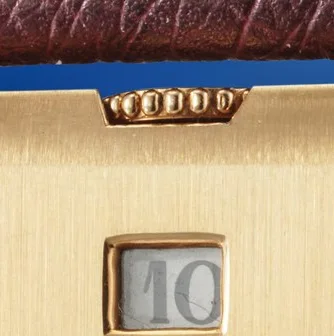
Three versions, in yellow gold, rose gold and platinum, return to the 1928 layout with the hour window at 12 and the minute window at 6. They are 37.6 x 24.8 mm and 6 mm thick, not water resistant, with vertically brushed faces, polished horizontal brancards and a calibre 9755 MC. The crown is back at 12, described in one account as plain with no cabochon and in another as a small beaded cylinder with a cabochon, and the brancards are again part of the case with no separating bevel. The brancards are thinner and more curved than in the earlier editions and the lugs longer. Numerals, minute scales and alligator straps are matched in green, grey or burgundy. These three are not announced with a limited number.
Signature and marks. No dial and no logo on the face; the front is a plain metal plate with the two windows.

- green, grey or burgundy numerals on golden discs
- 37.6 x 24.8 mm, 6 mm thick
References: WGTA0235
Cartier Privé, 2025, diagonal windows
A platinum edition of 200 numbered pieces places the hour window at about 10 o'clock and the minute window at about 4, rotated 90 degrees. It has burgundy Arabic numerals and minute track on golden discs, a black alligator strap and the same 9755 MC. It refers to layouts of the 1930s.
Signature and marks. Not given in published accounts.

- edition number out of 200
- black alligator strap
Chronology
Specification
| Display | Two windows in a closed metal face, no hands and no seconds: on the 1928 watch, the 1997 and 2005 editions and three of the 2025 versions the hour shows on a jumping disc in a window at 12 o'clock and the minutes on a slowly moving disc in a curved window at 6; the 2025 limited edition places them at about 10 and 4, and the 1930s pieces varied |
| Case, 1997 and 2005 editions | About 26 x 37 mm, platinum (1997) or pink gold (2005); catalogues give 25.5 x 37 to 37.5 mm for the 1997 watch |
| Case, 2025 editions | 37.6 x 24.8 mm (one account gives 24.6 mm wide), 6 mm thick, platinum, yellow gold or rose gold; not water resistant |
| Movement, 1997 and 2005 | Manual-wind calibre 9752 MC, 19 jewels, described as based on a Piaget ebauche |
| Movement, 2025 | Manual-wind calibre 9755 MC, developed for these watches |
| Crown | At 12 o'clock on the 1928 watch, the 1996 editions and the 2025 editions; at 3 o'clock on the 1997 and 2005 editions |
| Strap | Crocodile with a signed 18k white gold deployant clasp (1997); colour-matched alligator straps (2025) |
Dial 4 described
The Tank à Guichets has no dial in the usual sense: a closed metal face carries two windows, with hours on a jumping disc and minutes on a slowly moving disc, and no hands. The layout of the first watch, hour at 12 and minutes at 6, is repeated in 1997, 2005 and the main 2025 versions.
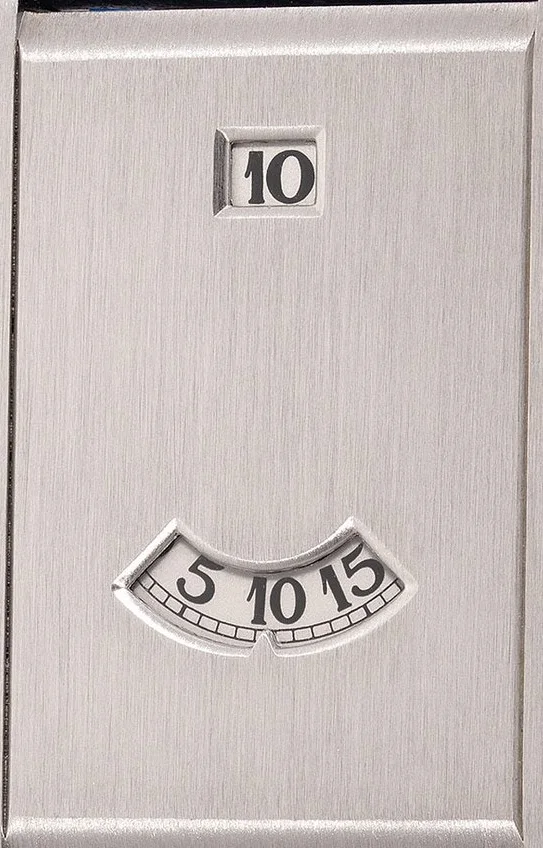
Hour window at 12, curved minute window at 6
A square or rectangular hour aperture at 12 and a curved, semicircular minute window at 6, in a flat brushed metal face. The 2025 watches keep a small gold arrow in the minute window to mark the current minute.
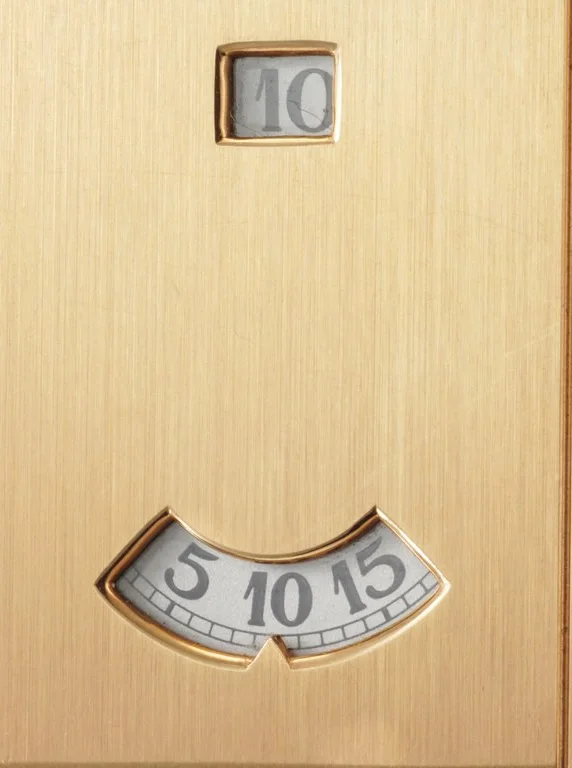

- small gold arrow in the minute arch (2025)
Silvered, 1997
The 1997 platinum edition is catalogued as silvered, with the hour shown at 12 and the minutes in a curved window at 6.
- silvered dial surface
Coloured numerals on golden discs, 2025
The 2025 discs have a light golden grained finish with Art Deco Arabic numerals and minute scales printed in green on yellow gold, grey on rose gold and burgundy on platinum.
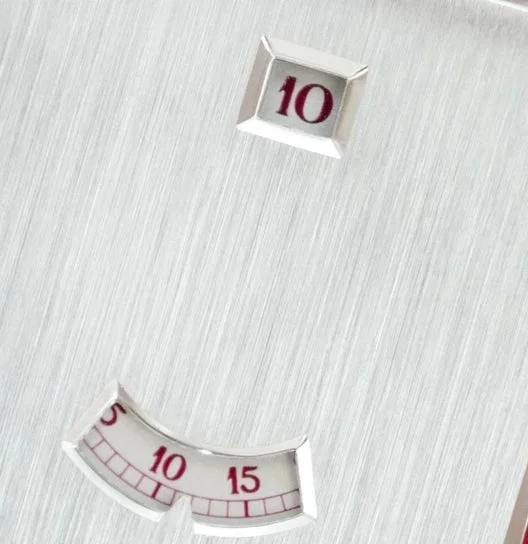

Diagonal windows, 10 and 4
On the 200-piece platinum edition the hour aperture is at about 10 o'clock and the minute arch at 4, rotated 90 degrees.
- windows off axis
Case and sizes 4 described
The case is a rectangular Tank with brancards, closed by a solid front. Accounts differ on the sizes by a millimetre or so.
Flat brushed all-gold case, 1928
The first watch has a solid gold case with a flat brushed top, a crown at 12 and brancards that merge with the case.
- flat brushed top
26 x 37 mm, bevelled brancards, 1997 and 2005
About 26 x 37 mm, with flatter, more squared-off brancards and a thin polished bevel between middle case and brancards on the 1997 watch. Catalogues give 25.5 x 37 to 37.5 mm for the 1997 platinum watch. Accounts disagree whether the 2005 case is the same size or slightly larger; one gives 27 mm.
- polished bevel between case and brancards
37.6 x 24.8 mm, 6 mm thick, 2025
Thinner, more curved brancards give a width of 24.8 mm; lugs are longer, the surface between them polished, the brancards integral with no separating bevel, and the faces vertically brushed with polished horizontal edges. Case back is closed, water resistance none. Metals are 750 gold or 950 platinum.
- no bevel line along the brancards
Case back engraving 1847-1997
On the 1997 platinum edition the LC logo and 1847-1997 are engraved on the case back with the edition number out of 150. One account says the 2005 pink gold edition is also engraved 1847-1997.
- LC logo, 1847-1997 and number
Crown 3 described
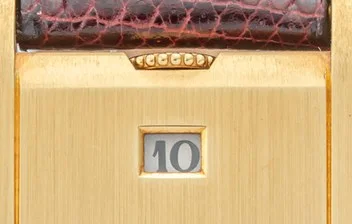
The crown position and stone separate the editions. Earlier versions are described as having crowns of many shapes, from hexagonal to a fluted cabochon, some on top and some on the right side; a watch of 1931 has the crown at 3.
Crown at 12
Used on the 1928 watch, the 1996 editions and all four 2025 watches. On the 2025 crown one account sees no cabochon, as on the first watch; another describes a small beaded crown with a cabochon.

Crown at 3, ruby cabochon
On the 1997 platinum edition; faceted ruby, described as exclusive to the platinum version and slightly smaller than the 2005 crown.
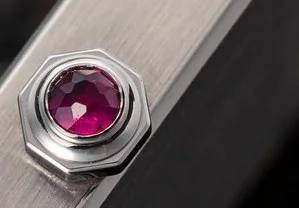

Crown at 3, octagonal, blue cabochon
On the 2005 pink gold edition, slightly larger than the 1997 crown, octagonal and set with a blue stone that published accounts call a cabochon; on watches in the library's records the stone is faceted and looks near black.
- octagonal crown with a faceted dark stone
Movement 2 described
Two calibres are named, for the 1997 and 2005 editions and for 2025. Published accounts give no movement for the 1928 watch, the 1930s pieces or the 1996 editions.
Calibre 9752 MC
Manual-wind, 19 jewels, jumping hour, described as made by Piaget for Cartier and based on a Piaget ebauche. Used in 1997 and in the 2005 edition. Some auction catalogues give another calibre number, or 17 jewels, for watches of these editions.
- calibre 9752 MC on movement
Calibre 9755 MC
A manual-wind movement developed for the 2025 watches, with reworked mechanics for the jumping hour and a dragging minute.
Bracelet and strap 2 described
Straps are given for 1997 and 2025 only.
Crocodile strap, signed 18k white gold deployant
The 1997 platinum edition is catalogued with a crocodile strap and a Cartier 18k white gold deployant clasp.
- signed white gold deployant
Matched alligator straps
Green on yellow gold, dark grey on rose gold, burgundy on platinum, black on the 200-piece edition.
Box and papers 1 described
Papers and boxes vary.
Collection Privée Cartier Paris box and papers
Watches of the collection came in larger leather boxes signed Collection Privée Cartier Paris with additional literature. A 1997 watch has also been sold with such a box. A 1997 lot carried a certificate stamped by a retailer in Osaka on 16 July 1997.
- box signed Collection Privée Cartier Paris
Reference numbers
A four-digit number is stamped on the case and covers a case; a code beginning W, or the newer letter codes, is a catalogue number for one version of it (metal, dial, strap). Many older watches carry neither. The last column is the listings on record under the number, as its own page counts them.
| Number | What it is | Listings |
|---|---|---|
| 2817 | The 2005 pink gold Collection Privée Cartier Paris edition of 100, as given in published accounts; sellers' titles describe it as 18k pink or rose gold, numbered out of 100. Catalogue codes seen beside it in listings: W1523451 | 4 |
| W1546451 | The code a dealer gives for the 2005 pink gold edition; no seller in the library's records gives a catalogue code for a pink gold watch. | |
| WGTA0235 | The 2025 rose gold version, as sellers describe it. | 4 |
| WGTA0236 | A 2025 platinum Tank à Guichets, as sellers describe it; most titles say only platinum and one calls it a limited edition, so whether it is the 12-and-6 platinum or the 200-piece edition is not plain. | 4 |
| W1523451 | Printed with 2817 in one auction title for a platinum 150th-anniversary watch numbered out of 150; no published account gives it, so which edition it belongs to is not plain. | 1 |
Originality
- On the 1997 platinum edition the crown should carry a red stone, faceted on the watches in the library's records, the case back an LC logo, the engraved years 1847 and 1997 and an edition number, and the clasp should be signed 18k white gold.
- Numbers beginning A on 1997 watches sit beside the edition numbers and appear to be case numbers; do not take them for a reference.
- Papers vary widely among documented 1997 watches: a stamped certificate and box, or a box alone.
- The 2025 brushed faces mark easily.
Where accounts differ
Points on which the published literature and the library's own records do not agree, or on which the literature contradicts itself.
- The 1996 editions. Most accounts give six watches, three in yellow gold and three in platinum. One auction report describes three each in yellow gold, pink gold and platinum, the yellow ones made for a themed auction of Cartier watches. The library's records show listings from sellers describing pink gold watches of 1996, limited to three or as probable special orders, and one seller describing a platinum watch as one of three made for that themed auction.
- Year of the pink gold edition. One account dates the pink gold Collection Privée edition to 2004; most give 2005. In the library's records sellers state 2006 for most pink gold watches of reference 2817, one of them with a certificate dated January 2006, and one seller states 1997.
- Size of the 2005 case. One page and a dealer say the 2005 case has slightly larger proportions than the 1997 case; two others give the same dimensions; another gives reference 2817 as 27 mm.
- Catalogue code of the pink gold edition. A dealer gives W1546451 for the pink gold edition. The library's records show W1523451 only once, printed with 2817 for a platinum 150th-anniversary watch numbered out of 150, so 2817 is not given for the pink gold edition alone.
- Cabochon on the 2025 crown. One account says the 2025 crown has no cabochon, like the 1928 original; another describes a small beaded crown with the Cartier cabochon.
- Cut of the 1997 crown stone. Most accounts call the stone in the crown of the 1997 platinum edition a ruby cabochon; one page captions its own photograph as a faceted ruby cabochon. Photographs of 1997 watches in the library's records show a faceted red stone.
- Stone in the 2005 crown. Published accounts give the pink gold edition of 2005 a blue cabochon in the crown. Photographs of pink gold watches in the library's records, from several sellers, show a faceted stone that looks near black.
In the records
Counted from 38 listings at dealers and auction houses whose title, or whose reference, places them on the line; 28 state a year. These are what sellers state, not measurements, and a count of listings is not a count of watches made.
Case metal
| Metal | Listings | Share |
|---|---|---|
| Platinum | 17 | 61% |
| Gold, any colour | 11 | 39% |
| Pink | 10 | 36% |
| Yellow | 1 | 4% |
As sellers state it. Shares are of the 28 listings that name a metal. Carat, where a listing of gold gives one: 18k 10.
Case size
| Size | Listings | Share |
|---|---|---|
| 25.5 mm | 9 | 43% |
| 24.8 mm | 3 | 14% |
| 25 mm | 3 | 14% |
| 26 mm | 3 | 14% |
| 24 mm | 1 | 5% |
| 27 mm | 1 | 5% |
| 35 mm | 1 | 5% |
As sellers state it. Shares are of the 21 listings that give a size. On a watch that is not round some sellers give the width and some the length, so one watch can stand under two sizes.
Movement
| Kind | Listings | Share |
|---|---|---|
| Hand-wound | 25 | 100% |
Shares are of the 25 listings whose description says how the watch is driven.
Listings by decade the seller gives
| Decade | Listings |
|---|---|
| 1990s | 18 |
| 2000s | 5 |
| 2020s | 5 |