Jewellery and cocktail watches, 1910 to 1960
The small, gem-set and decorative wristwatches that Cartier made for women between about 1910 and 1960. Published accounts treat the cocktail watch as a general type that appeared early in the twentieth century and was widely worn from the 1920s to the 1960s: a small case in an unusual shape, a refined bracelet, sometimes stones, and a dial that matters less than the object. The library's records for Cartier run from platinum and diamond watches that sellers place in the 1910s, through the platinum, onyx and diamond watches of the 1920s and 1930s, to gold bracelet watches of the 1940s to 1960. The literature on the watches themselves is thin, so this entry rests partly on those records. The points to examine are the metal, the signatures on dial and movement, the case and movement numbers, and whether case, bracelet and stones belong together.
This maker's early watches are described by kind of watch, not by reference number: many carry no number, and one number can cover quite different watches. The wider picture is in Early Cartier, 1904 to 1972.

- Made
- not datedPublished accounts give the cocktail watch as a type of the 1920s to the 1960s and call 1910 to 1940 a high point for the firm, but they date only a handful of single pieces, so no firm span is given.
- On record
- 215 listings201 of them give no reference
- Reference numbers
- 6 describedmany early watches carry none

By house and period 3 described
Paris, platinum and diamond watches before 1914
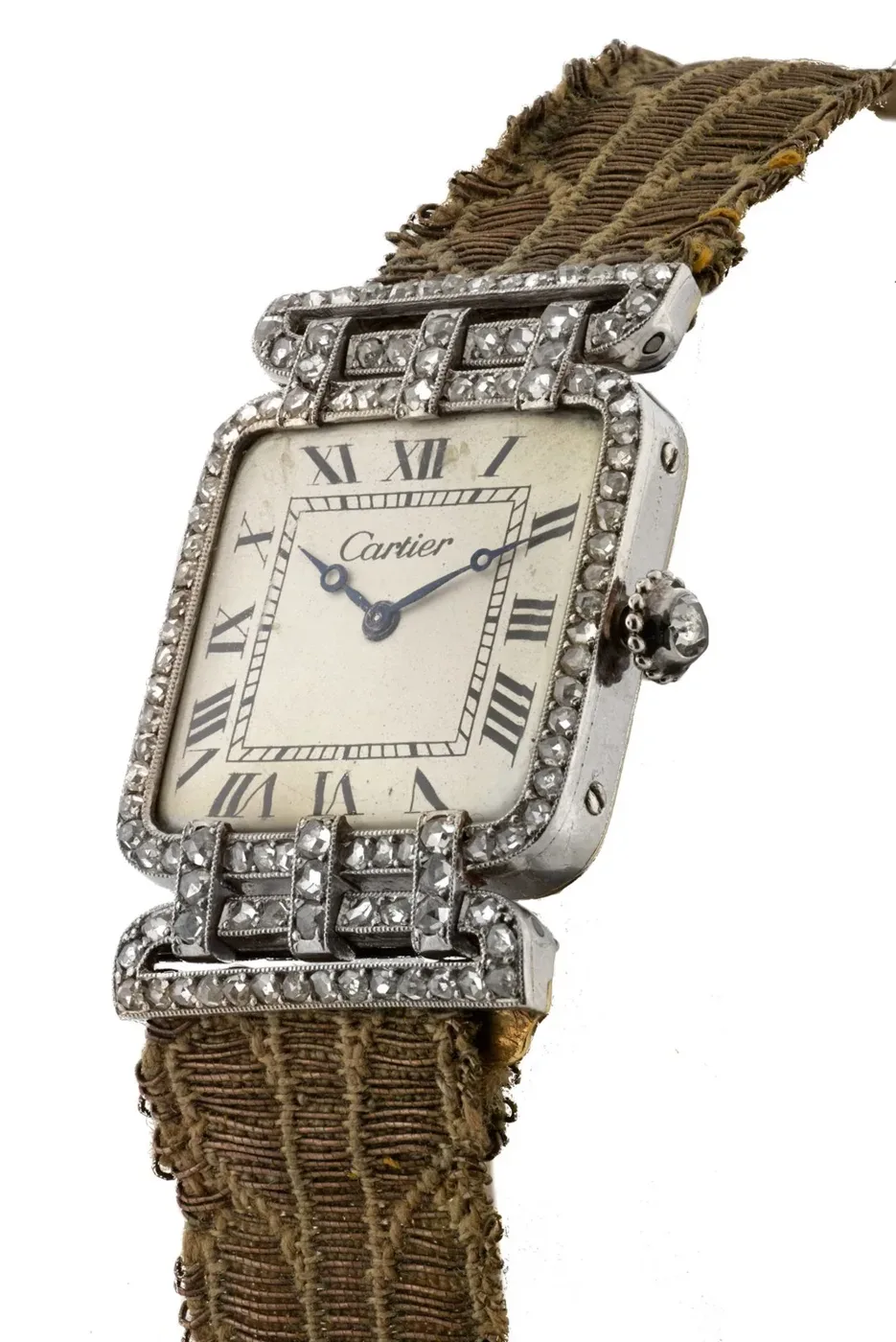
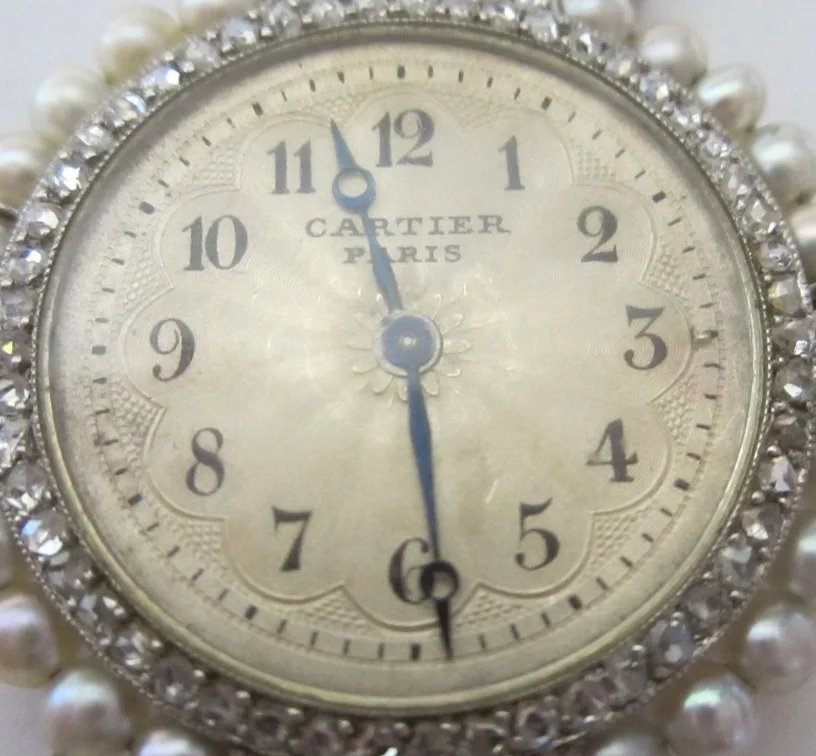
Cartier's jewellery from about 1895 to 1914 is described as the Garland style: swags, bows and foliage in white diamonds on platinum, the settings made so fine that the stones seem to float, with millegrain borders and pavé surfaces. The literature does not say how far the watches of those years follow it. Two gem-set wristwatches of the period are dated: a Tortue of 1913 in platinum and gold with diamonds and onyx, and a round lady's wristwatch of 1914 with an onyx shape and brilliant-cut pavé on the bezel, the firm's first panther decoration. The library's records hold watches that sellers date to about 1910 to 1915, described as platinum or white gold with diamonds, onyx or seed pearls; one has movable lugs and a top-winding crown, and one has a case stamped EJ with a movement signed Cartier Paris. These dates are the sellers' own.
Signature and marks. The literature gives no signature for these watches. Sellers' descriptions give Cartier, Paris for a few early pieces, and one quotes a case stamped EJ with a movement signed Cartier Paris, circa 1915.

- platinum case set with diamonds, with onyx or seed pearls
- movable lugs and a top-winding crown, on one piece as a seller describes it
- round case with onyx and pavé on the bezel for the 1914 panther watch
Paris, Art Deco jewellery watches
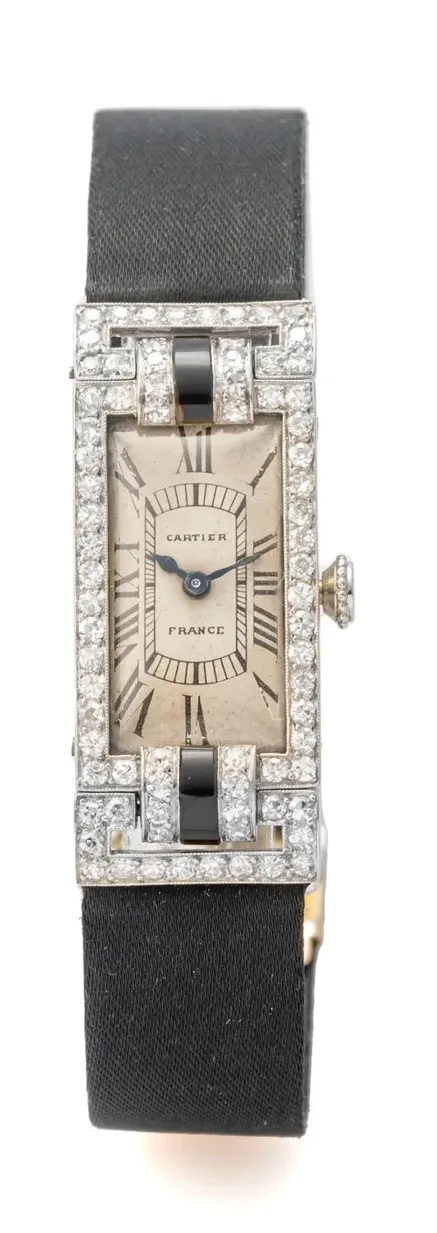
Art Deco is generally dated from the 1925 Paris exhibition, though some place its start as early as 1915, and the years 1910 to 1940 are called a high period for the firm. Of Cartier's jewellery in the early 1920s the literature records pairings the previous generation had not made: coral with diamonds, lapis with onyx, jade with platinum, and carved Indian stones beside European-cut diamonds. Of Art Deco jewellery in general it records small brilliant-cut diamonds in place of large stones, and rock crystal set beside diamonds. Jacques Cartier's journey to the Delhi Durbar in 1911 began the Indian connections behind the carved-stone work, and the first documented Tutti Frutti sale, a bracelet, was made in 1925; a bracelet watch in that style is recorded, but undated. Watches were also built into small objects, such as a lipstick holder of 1935. The literature does not describe the Art Deco watches themselves; the library's records hold several platinum, onyx and diamond watches that sellers date to the 1920s and 1930s, some with concealed dials or back-winding movements.
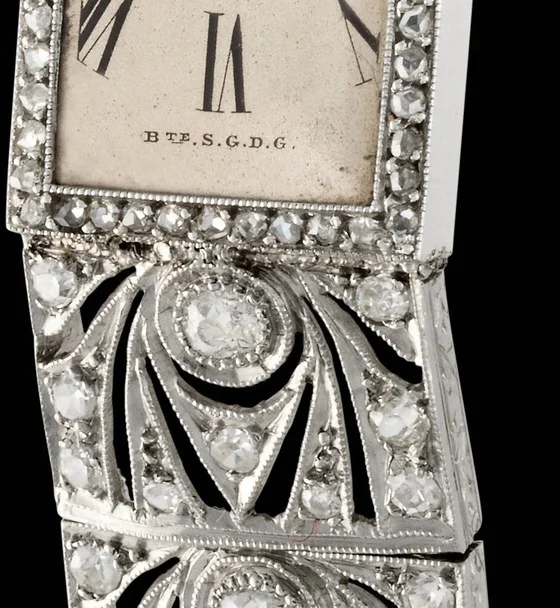
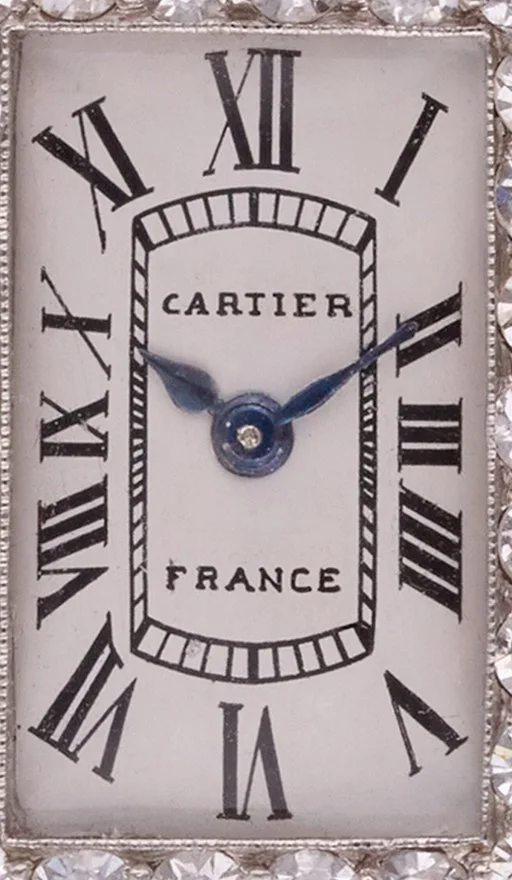
Signature and marks. Sellers' descriptions give the dial signed Cartier, sometimes with Paris or France, and in many cases a movement signed by the European Watch and Clock Co.; two case numbers are often quoted together. Of the firm's period jewellery the literature says that French-market pieces carry the eagle's head mark for platinum and the dog's head for 18 carat gold, and that the marks of the Paris branch's two principal goldsmiths appear on most pieces of the Garland and early Art Deco years; it does not say this of the watches.

- platinum and diamond case with onyx, coral, lapis, jade or enamel
- a concealed dial
- crown on the back of the case in the back-winding pieces
- the signature on dial and movement, and the case numbers
London, Cartier London watches
Jacques Cartier took charge of the London shop in 1906. For the New Bond Street branch, cases and settings were made by English Art Works and later by Wright & Davies. The literature gives no description of London jewellery watches as such. Sellers tie a few watches in the library's records to London: a platinum and diamond watch of about 1924 retailed by Cartier London, with a dial signed France; gold watches carrying London import marks for 1929 and 1952; a yellow gold and enamel watch dated circa 1936; and a steel watch of about 1934 with a LeCoultre movement. They do not say where any of them was made.
Signature and marks. The literature gives none. Sellers' titles name London on a few watches, among them one retailed by Cartier London and a gold and enamel watch; two describe London import marks on the case, for 1929 and 1952.

- enamel on gold in the 1936 piece
- a London import mark on the case
References: 7564
Chronology
Specification
| Case | Small cases, often under 34 mm in the general type, in oval, rectangular, cushion or asymmetric shapes; sellers also describe square and star-shaped Cartier cases |
| Metals | Platinum and gold, often together in one watch; silver or steel in a few. Gold and platinum are both common in the library's records for this line, gold somewhat the more often |
| Stones | Diamonds, with onyx, sapphires, rubies, seed pearls, jade or rock crystal in various pieces, as sellers describe them |
| Movement | Hand-wound, as sellers describe them; some wind from the back of the case, and some have a concealed dial |
| Bracelet | In the general type the bracelet is part of the design: chain, bangle, cuff or metal ribbon, often integrated with the case |
| Signature | Signed Cartier, in some descriptions with Paris or France; many movements are described as signed by the European Watch and Clock Co. |
Bezel 1 described
The one bezel the literature dates in this line is that of the 1914 panther watch.
Onyx and pavé panther bezel
The firm's first panther decoration was made in 1914: an onyx shape and brilliant-cut pavé around the bezel of a round lady's wristwatch. The motif was taken up widely by the firm afterwards, but the literature dates no later jewellery watch of this period with it.
- onyx shape on the bezel
- pavé of brilliant-cut diamonds around the dial
Case and sizes 3 described
Cases are small, shaped and richly made. The literature describes the general type; Cartier's own cases are known here mainly from sellers' descriptions.
Platinum case set with stones
Platinum and gold are the two common metals in the library's records for these watches, gold somewhat the more often. The literature gives two accounts of when platinum became usual in the firm's jewellery (see Where accounts differ). Sellers describe cases set with diamonds, with onyx, sapphires, seed pearls, rock crystal or enamel, and often in two metals, such as platinum with 18 carat gold.
- platinum body with gold parts
- diamond, onyx or sapphire settings
- enamel sides on some pieces
Concealed dial
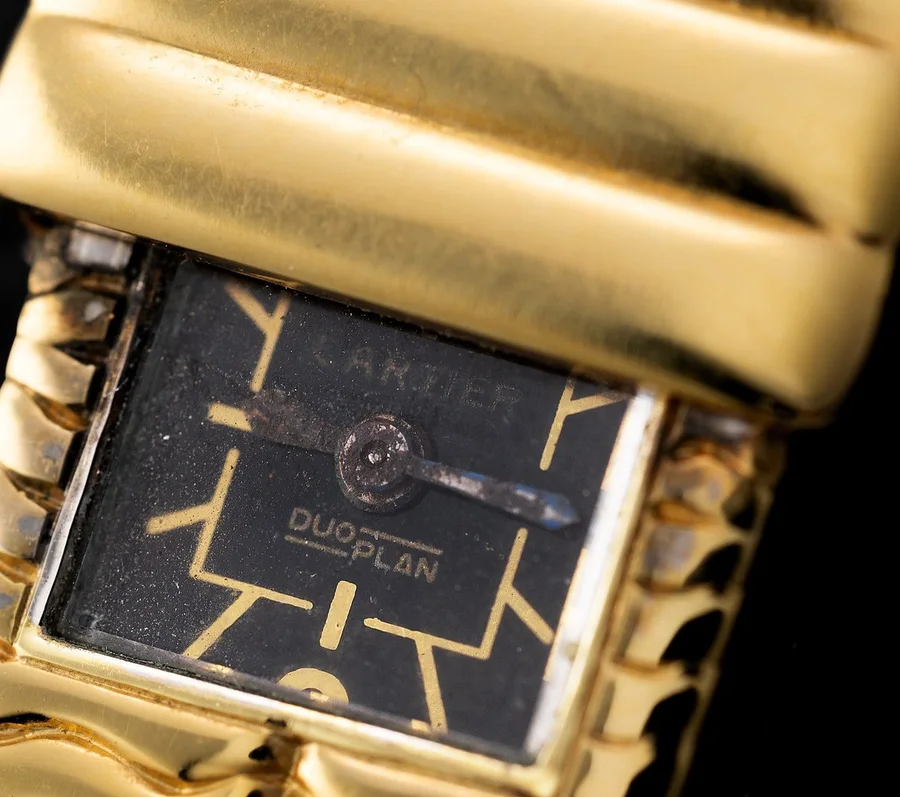
Sellers describe a number of watches with a concealed dial: back-winding Duoplan watches, gold bracelet watches, among them a 14 carat gold watch by J. Schulz retailed by Cartier, and gem-set watches whose diamond-set cover hides the dial. The literature does not describe or date them. Sellers date those in the library's records from about 1930 to about 1960.

- no dial visible on the closed watch
Converted or re-fitted watches
One seller describes a watch as having a converted diamond-set case. It is recorded as such and is not a production.
- case, bracelet and clasp that do not agree in style, metal or finish
Crown 1 described
The crown is a point of originality.
Blue cabochon crown
A crown set with a dark blue cabochon is a style associated with Cartier, and it was copied on at least one cheaper watch of 1933 by another maker. The literature dates none on Cartier's own jewellery watches. In the back-winding watches the crown is on the case back and cannot be seen from the front.
- blue cabochon at the end of the crown
- crown milling as crisp as the rest of the watch
Movement 2 described
Movements are hand-wound, as sellers describe them. The records show several kinds of movement signature, and the literature links one family of back-winding movements to a Swiss maker.
Back-winding (Duoplan) watches
In a back-winding watch the crown sits on the case back, so the case sides stay clean. A family of such movements was made by Jaeger-LeCoultre at Cartier's request, at a time when the two firms were closely linked between the wars. Sellers use the name Duoplan for several Cartier back-winding watches, square and rectangular, and some Duoplans are described with movements by the European Watch and Clock Co. Sellers date the watches they call Duoplan to the 1930s and 1940s, and other back-winding watches in the library's records from the mid-1920s to about 1960.
- no crown on the side of the case
- crown on the case back
Movement signed by another maker
The name most often given for the movement in the library's records is the European Watch and Clock Co., written in several forms (E.W. & C. Co., EWC); a few descriptions give a movement signed Cartier Paris. The literature does not discuss the firm. One watch is described as made by J. Schulz and retailed by Cartier. Several auction descriptions quote a movement number beside the case numbers.
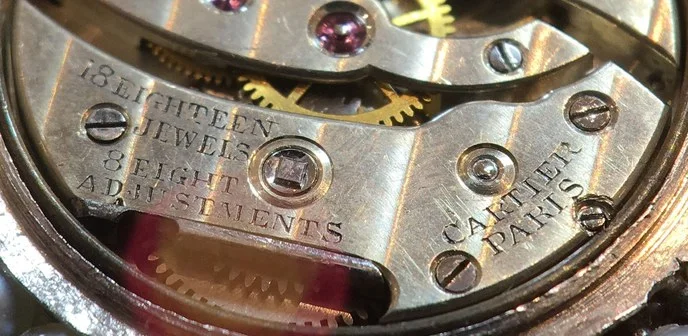

- movement and case numbers recorded together
Bracelet and strap 1 described
In this line the bracelet is part of the object.
Gem-set or integral bracelet
The general account of cocktail watches describes a refined bracelet, in chain, bangle, cuff or metal ribbon, that blurs the line between watch and jewel. The library's records hold platinum and diamond bracelet watches, gold bracelet watches, and one described with a Vendôme bracelet and dated 1946 by the seller. The literature dates no bracelet pattern for Cartier.
- bracelet set with stones or in solid gold
- bracelet joined to the case
- case, bracelet and clasp in the same metal and finish
Box and papers 1 described
Some watches were made as parts of other objects.
Watch set into an object
A Cartier Paris lipstick holder of 1935 carries a watch and is made of silver, platinum, black lacquer, coral and rose-cut diamonds. The library's records also class with these watches a number of objects that are not wristwatches: cigarette boxes and cases, a beauty box, a beauty set, a lipstick case, a powder compact, a mechanical pencil with a concealed watch, a leather watch case and jabot pins.
- watch set into a case made for another use
Reference numbers
The numbers that belong to the line, with the listings on record under each, as its own page counts them. A number links to its own page, where the components of dated watches are set side by side.
| Number | What it is | Listings |
|---|---|---|
| 1737 | As sellers describe it: a lady's platinum, 18 carat gold, onyx and diamond square cocktail watch, dated circa 1910 by the seller. | 2 |
| 01186 | As sellers describe it: a lady's 18 carat gold manual-wind bracelet watch, dated circa 1920 by the seller. | 1 |
| 23657 | As sellers describe it: an 18 carat gold back-winding Duoplan bracelet watch, dated to the 1940s by the seller. | 1 |
| 8514 | As sellers describe it: a lady's 18 carat gold and diamond manual-wind bracelet watch, dated circa 1950 by the seller. | |
| 7564 | As sellers describe it: a lady's 18 carat gold manual-wind watch carrying a London import mark for 1952. | 1 |
| 19476.2.68 | As sellers describe it: a lady's 18 carat gold square manual-wind watch titled Cartier for Bueche Girod, dated circa 1960 by the seller. |
Originality
- A worn crown on an otherwise unworn watch suggests parts that do not belong together; a blue cabochon crown is associated with Cartier but was copied by other makers, so it proves nothing alone.
- A case described as converted to take stones shows that the parts of a jewel watch were sometimes changed; the library's records mark it as such.
- On a gem-set watch the stones should match in size, colour and alignment, none should be missing or chipped, and the setting should agree with the original model.
- A movement signed by the European Watch and Clock Co. rather than Cartier is common in the library's records; the movement and case numbers quoted in auction descriptions are the points to compare.
Names
- Duoplan. A model name sellers give to several back-winding Cartier watches, square and rectangular.
- Nain jaune. A model name in sellers' titles, given to a square platinum, gold, onyx and diamond watch and to a star-shaped white gold, diamond and onyx watch.
- Carré. Sellers' word for square watches, in some titles given as a model name and spelt Carrée.
- Triptyque. A model name in sellers' titles for an onyx, diamond and gold watch with a European Watch and Clock Co. movement.
Where accounts differ
Points on which the published literature and the library's own records do not agree, or on which the literature contradicts itself.
- When platinum became the firm's metal. One account places the firm's decision to work mainly in platinum in the Garland period, from about 1895 to 1914. Another says platinum was still fairly new to fine jewellery in the 1920s. Both speak of jewellery, not watches. Platinum and gold are both common in the library's records for these watches, but their years are stated by sellers and do not settle the question.
In the records
Counted from 215 listings at dealers and auction houses. These are what sellers state, not measurements, a stated year is often an estimate, and a count of listings is not a count of watches made.
Case metal
| Metal | Listings | Share |
|---|---|---|
| Gold, any colour | 94 | 51% |
| Yellow | 22 | 12% |
| White | 12 | 7% |
| Pink | 3 | 2% |
| More than one colour | 2 | 1% |
| Colour not stated | 55 | 30% |
| Platinum | 77 | 42% |
| Silver | 5 | 3% |
| Platinum and gold | 4 | 2% |
| Steel | 3 | 2% |
As sellers state it. Shares are of the 183 listings that name a metal. 1 more names a stone, a wood or the shape of the case instead. A listing that says "gold" or "18K gold" names no colour: it is counted under "colour not stated", not as yellow gold. Carat, where a listing of gold gives one: 18k 62 · 14k 3.
Case size
| Size | Listings | Share |
|---|---|---|
| 25 mm | 9 | 11% |
| 13 mm | 8 | 10% |
| 15 mm | 6 | 8% |
| 16 mm | 6 | 8% |
| 23 mm | 6 | 8% |
| 14 mm | 5 | 6% |
| 20 mm | 5 | 6% |
| 19 mm | 4 | 5% |
| Other sizes | 31 | 39% |
As sellers state it. Shares are of the 80 listings that give a size. 15 more give a figure outside 12 to 56 mm, which is a strap, a box or a slip, and are left out.
Listings by decade the seller gives
| Decade | Listings |
|---|---|
| 1910s | 22 |
| 1920s | 66 |
| 1930s | 73 |
| 1940s | 27 |
| 1950s | 16 |
| 1960s | 11 |