Clocks and mystery clocks
The table, desk, strut and travel clocks that Cartier made from the first years of the twentieth century, and above all the mystery clocks, in which the hands seem to float on transparent discs with no visible link to a movement. The urn clocks began in 1901, the planet, comet and first mystery clocks in 1912, and the Portique, Screen and animal clocks followed in the 1920s. Many were made in small numbers or as unique pieces, so the literature describes them by model rather than by reference number. What a collector looks at first is the transparent dial and its hidden drive, the materials of the case, and the condition of the crystal.
This maker's early watches are described by kind of watch, not by reference number: many carry no number, and one number can cover quite different watches. The wider picture is in Early Cartier, 1904 to 1972.

- Made
- from c. 1901Urn clocks are dated from 1901 and the first mystery clock to 1912; one account says mystery clocks have never stopped being made, another records a pause from 1914 to 1919.
- On record
- 673 listings622 of them give no reference
- Reference numbers
- 0 describedmany early watches carry none

By house and period 11 described
Urn clocks, Paris, from 1901
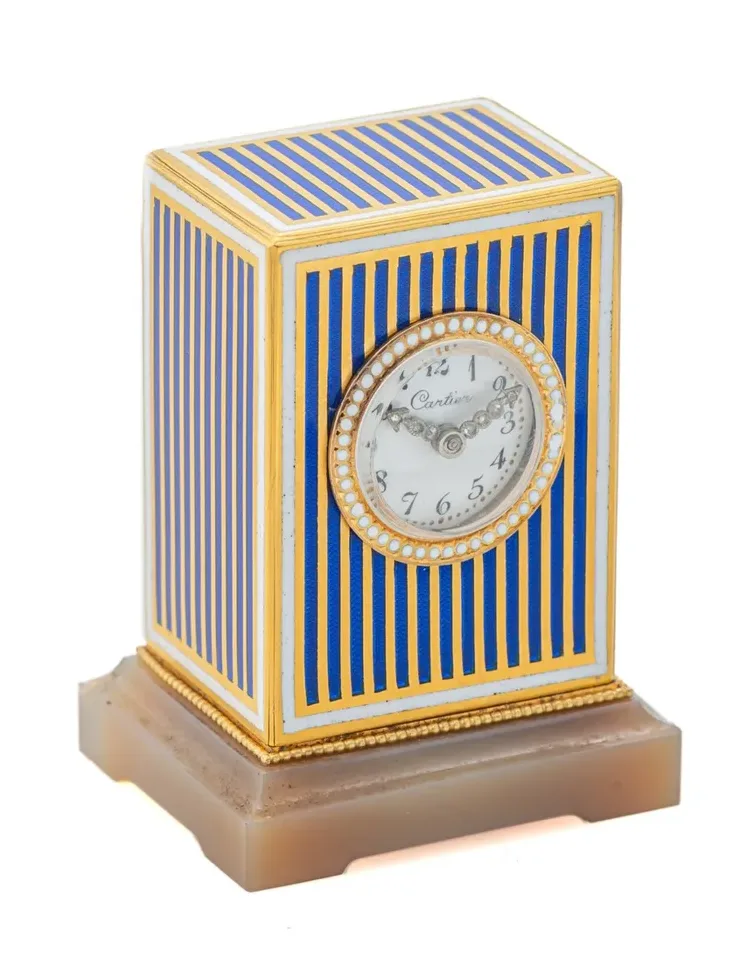
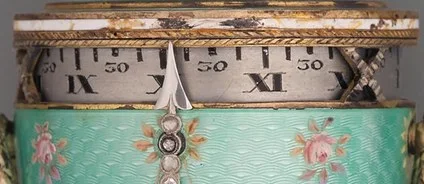
Urn clocks were made by others before Cartier, but the house became known for them. They are dated from 1901. The movement lies horizontally inside the body of the urn and turns a rotating band dial, in the manner of the rotating-ring clocks of the late eighteenth century. The body may be marble, hardstone, porcelain or glass. An example of 1904 has a dark-blue opaline glass body with silver-gilt mounts and a movement by Prévost, a firm that supplied movements to Cartier.
Signature and marks. One of 1904 is signed Cartier Paris and has a movement by Prévost; no other signature is given.
- urn-shaped body
- rotating hour and minute rings
- horizontal movement
Planet and comet clocks, Paris, from 1912
These are semi-mystery clocks: they show the time in an unusual way but are not transparent. The first, made in 1912, are strut clocks, named for the hinged support at the back. The planet clock has a round or angular case with two superimposed dials; the lower dial, usually in light or dark blue enamel, turns to stand for the day or night sky, and a diamond crescent moon may mark the night. The comet clock has a circular enamel dial with a diamond-set comet-shaped hand turning within it, the minutes read from a marquise diamond travelling round a concentric ring. Comet clocks were made between 1912 and 1920. Dated examples include a day-and-night clock in an agate case, with sun and moon for the hours, dated 1913; another account, apparently of the same clock, dates it 1915 and gives it an eight-day movement. Others are of about 1918 (onyx) and about 1920 (rock crystal); some rock-crystal examples have a diamond-set circle outside the bezel. Many were unique or made in very small numbers.
Signature and marks. The literature gives no signature; the dial of the clock of 1913 carries a Latin inscription meaning that the hours are not counted unless they are bright.
- two superimposed dials
- blue enamel lower dial
- diamond crescent moon
- diamond comet-shaped hand
- marquise diamond minute marker
Model A mystery clock, Paris, from 1912
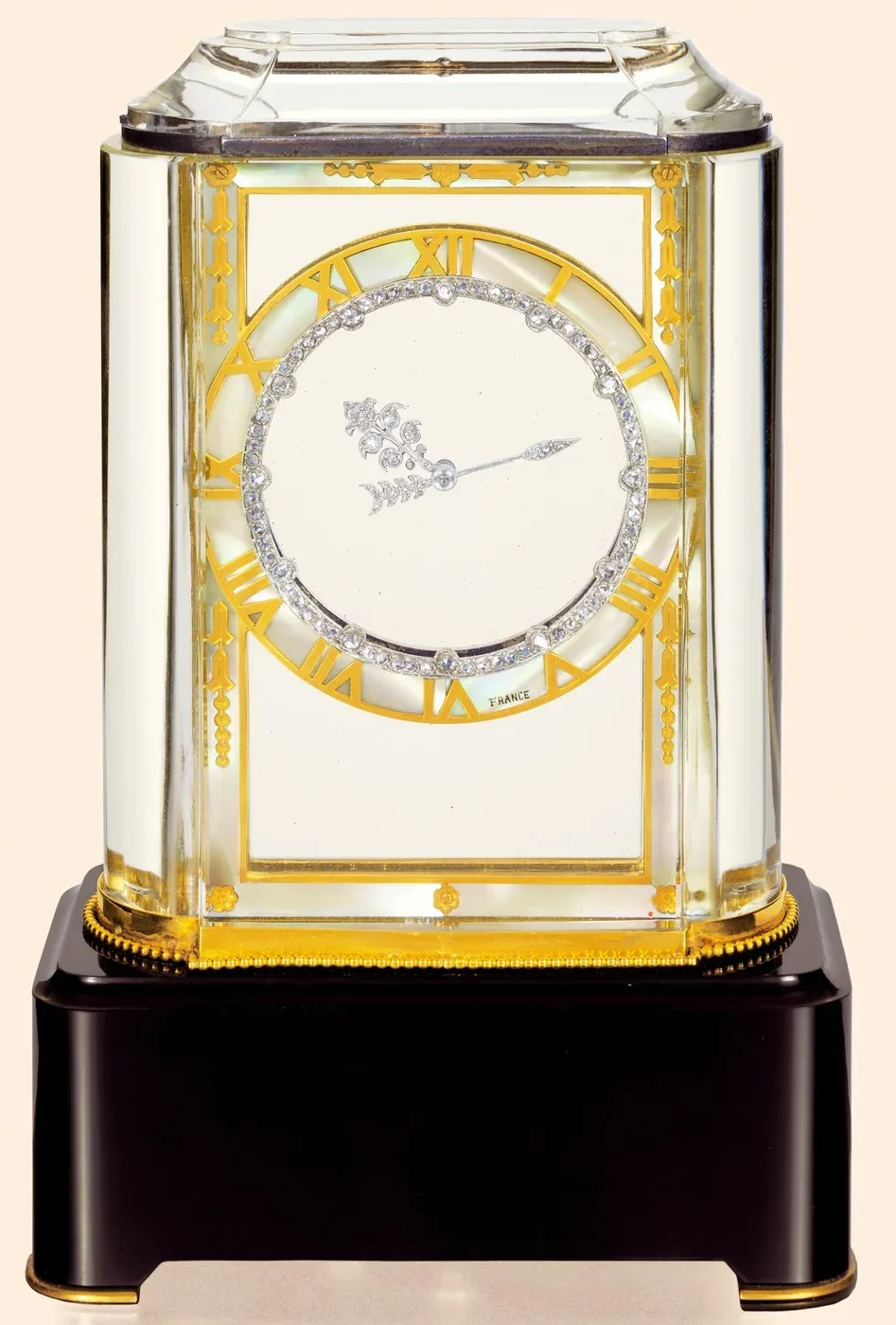
The first mystery clock, in the form of a roadside milestone: a rock-crystal case, with two columns, carries a circular dial in which the hands appear to float. Each hand is fixed to its own glass disc with a toothed metal edge, one disc turning at the speed of the minutes and the other of the hours, and the edges are hidden by the hour track. The movement is in the base and drives the discs through hidden racks or axles at the sides; accounts differ on the exact link. The firm's clockmaker, its exclusive supplier from 1911, produced the first in 1912. A Model A sold in 1913 is the first recorded sale of a Cartier mystery clock. The first example had a rectangular eight-day movement wound from under the base, so the back is smooth; one of 1912 has a base of white agate. The case is rock crystal on a base most often of black onyx or obsidian, but agate, nephrite or gold also occur. The dial, frame and hands vary, white enamel and mother-of-pearl being the most frequent decoration. The earliest Model A in the firm's collection is of 1914, and one in rock crystal and onyx is dated about 1935. The model is recorded in production into the late 1940s, longer than any other mystery model.
Signature and marks. Model A clocks of about 1914 are described as Cartier Paris; the literature gives no stamps for the model as a whole.
- two crystal columns
- dial of two floating discs
- base of onyx, obsidian or agate
- on the first example of 1912, a smooth back and winding under the base
Chronoscope desk clocks, Paris, from 1919
From 1919 the firm's clockmaker designed desk clocks after the seventeenth-century chronoscope. Three hidden arms, each bearing four numerals, turn on an axis. One arm enters the dial from the left each hour, marks the minutes as it crosses and disappears at the right. The series also served as photograph frames. In the same year Cartier set up a clock-making workshop at 53 rue Lafayette in Paris.
Signature and marks. The literature gives no signature detail for this series.
- three hidden arms with four numerals each
- arm crossing the dial each hour
- photograph frame
Central axis mystery clocks, Paris, from 1920
Where the Model A drives its two discs by two axes, one on each side, the central axis clock uses a single axle, so that the firm had more freedom of design. Where the pedestal is a clear crystal column, the axle inside it is of glass and the support seems to hold nothing, but not every column is transparent. At least twenty-one variations are recorded, making it the most numerous mystery group. Among them are tall black onyx columns with dials in turquoise enamel, shorter columns whose chapter rings are in the Chinese manner, cases of ebony of rectangular form, and a tiny model of 1931 with an aquamarine dial. The latest mystery clock in the firm's collection, a pedestal clock, is of 1967. Clocks of this kind were made to order for royalty and film stars.
Signature and marks. The literature gives no signature detail for the group.
- single column or pedestal under the dial
- glass axle inside a clear crystal column
- onyx or ebony pedestal
Animal mystery clocks, Paris, 1922 to 1931
The most sculptural group, in which the clock is carried by or set into carved animals and figures. Twelve variants are recorded between 1922 and 1931, built around carved jade elephants and lions, mandarin ducks, crystal turtles and figures of Chinese goddesses; the group is also called Chimera. An elephant clock is dated 1928, and one example of a sleeping jade elephant was owned by a Maharajah of Nawanagar; another account counts a series of fourteen stone animals and figures and numbers that one tenth. A Chimera clock was being made in the Cartier workshop in 1927, and one stood in the window of 13 rue de la Paix that year.
Signature and marks. The literature gives no signature detail for the group.
- carved jade or crystal animal as the base or support
- elephant, duck, turtle, lion or goddess
Portique mystery clocks, Paris, 1923 to 1925
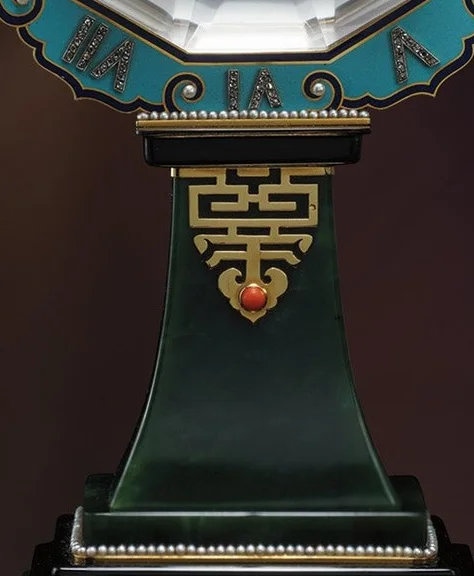
Six were made, each over fourteen inches tall, in the form of an oriental doorway: a large rock-crystal dial hangs from a black-enamelled gold lintel between two crystal columns, as if on a chain or like a gong. Four are alike, with round columns and twelve-sided crystal dials, and differ only in the figure on the lintel; one has square rose-quartz columns with enamel dogs at their feet; one has square crystal columns and Art Deco motifs in jade and diamond. The first, of 1923, is topped by a figure called a Billiken; one account likens its design to the gateway of a Shinto shrine. The movement is at the top, not in the base, and the drive is hidden: the 'chain' conceals the axle, which crosses a rock-crystal bar behind a small coral cabochon, and even the keyhole is concealed. The Grande Portique of 1923 has a square eight-day gilt movement with double barrel, thirteen jewels, lever escapement, bimetallic balance and Breguet balance spring, is set and wound by key, is reached by lifting off the statuette, and measures 35 x 23 x 13 cm. One example is known as No. 3 and dated 1924. One was shown in 1925 at the Paris exhibition of decorative arts, the year a fashion journal called the mystery clocks marvels of the clockmaker's art. Cartier bought a Portique of 1923 at auction in 1973, and the Cartier Collection was first shown in 1983.
Signature and marks. The literature gives no signature detail for the Portique clocks.
- rock-crystal dial hung from a lintel
- pair of massive crystal columns
- figure on the lintel
- coral cabochon over the axle
- hidden keyhole
Screen mystery clocks, Paris, 1923 to 1928
The shape echoes ornamental fire screens, hence the second name Enseigne. A decorative frame surrounds the crystal dial. Seven were made between 1923 and 1928; five have coral batons, one has jade and one moonstone. They are described as compact display pieces, in comparison with the Portique.
Signature and marks. The literature gives no signature detail for the Screen clocks.

- coral, jade or moonstone batons
Art Deco desk, strut and purse clocks, Paris, 1920s and 1930s
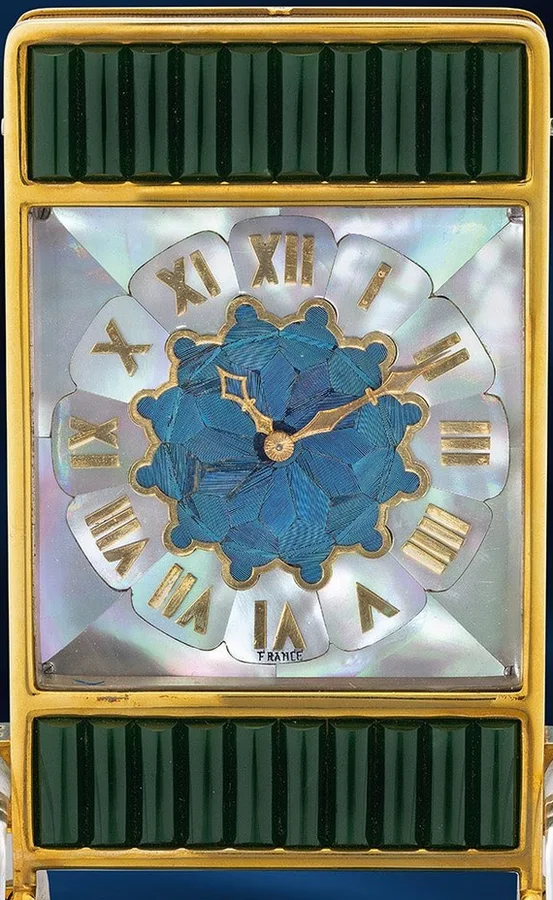
Clocks of the 1920s and 1930s are usually square and combine onyx, nephrite, enamel and precious stones. Many follow Asian and Persian models: gold hands, enamelled or diamond-set, in the shape of hearts, arrows or Persian tulips; sapphires and rubies in place of diamond stars on the base; dials of lapis lazuli, carved jade or mother-of-pearl; and, on exceptional examples, iridescent kingfisher feathers, used on dials from the early twentieth century. Borne clocks stand on a folding strut. An Altar desk or purse clock of 1925 has shuttered doors in Persian decoration and a pivoting support, and the time can be read with the shutters open or closed; a miniature example measures 4 x 2 x 1 cm. A desk clock of 1926 signed Cartier Paris Londres, no. 2027, has laque burgauté, mother-of-pearl panels under the numerals, turquoise and moonstone cabochons. A desk clock of 1925 has a carved onyx case, jade plaques on the base, a mother-of-pearl dial and a red enamel ring. A rose-quartz desk clock in the style of the 1930s, 11 x 7.5 cm, has four sapphires, a gilt guilloché dial with Roman numerals painted in black, diamond-set arrow hands and an eight-day hand-wound movement. A multi-gem minute-repeating Cube table clock is of the 1930s; in the library's records a minute-repeating eight-day cube clock from the workshop of the firm's clockmaker is dated by its seller to 1920.
Signature and marks. One of 1926 is signed Cartier Paris Londres and numbered 2027; the literature gives no other signature detail for these clocks.
- square case of onyx or jade
- kingfisher feather dial
- hands shaped as hearts, arrows or tulips
- hinged strut
- shuttered purse clock
Prism clocks, Paris, from 1937
The firm's watchmaker invented the prism clock in 1937, and the design was patented that year. It was inspired by an underwater periscope: the dial is reflected through prisms. The clocks are travel clocks, some small enough to carry in a pocket. The idea was later used on a few Cartier wristwatches and returned to favour in the 1980s.
Signature and marks. The literature gives no signature detail for the prism clocks.
- dial seen through prisms
Gifts and later mystery clocks
Accounts say Cartier has made mystery clocks more or less continuously since 1912, though one gives a pause between 1914 and 1919, and another puts the height of production in the two decades up to the Depression. Mystery clocks went to rulers and statesmen: Queen Mary was given one in 1924, others were owned by an American collector, the Queen of Spain and the Maharajah of Patiala, some of them more than one, and General de Gaulle presented one to Stalin in 1945. At Christmas 1943 Pierre Cartier gave President Roosevelt a Victory clock. A clock called the Soliman, case no. 633,165 and dated about 1990, is of portico form, with a faceted crystal dial between two fluted rectangular crystal columns, yellow-diamond and emerald hands, and two yellow-diamond panthers on the base; it is 230 mm high, with a manual movement wound and set through the base. Two new Model A clocks of 2013, one with mother-of-pearl and one with obsidian marquetry, took between 800 and 1,000 hours of work and use an in-house eight-day calibre.
Signature and marks. Case signed and numbered on the Soliman clock.
- signed and numbered case, as on the Soliman
Chronology
Specification
| Forms | Urn, desk, table, strut, travel and purse clocks; mystery clocks as columned, pedestal, portico, screen and animal models |
| Mystery principle | Each hand is fixed to its own transparent disc with a toothed metal rim hidden by the hour track; the movement drives the discs from a hidden position |
| Case materials described | Rock crystal with a base of onyx, obsidian, agate, nephrite or gold; enamel, jade, coral, lapis lazuli, mother-of-pearl, kingfisher feathers |
| Movement | Eight-day movements are recorded on many, wound by key or through the base; the first Model A is described with a rectangular gilt eight-day movement, Swiss lever escapement, bimetallic balance and Breguet balance spring |
| Sizes noted | Portique over 14 inches tall, one of 1923 35 x 23 x 13 cm; Altar purse clock 4 x 2 x 1 cm; rose-quartz desk clock 11 x 7.5 cm |
| Signature | Cartier, with Paris or Paris Londres on some; movements stamped with Cartier numbers or the name of a movement supplier |
Dial 7 described
Dials run from rotating rings on the urn clocks to the transparent disc dials of the mystery clocks, with day and night indications in between.
Rotating band dial
On urn clocks the hours and minutes are shown by rotating rings turned by a horizontal movement in the body.

Day and night enamel dial
A rotating lower dial, usually in blue enamel, stands for the day or night sky; the comet clock has a diamond comet-shaped hand and a diamond minute marker. These dials are not transparent.
- blue enamel disc
- comet hand
Floating disc dial
Two transparent discs carry the hands and are driven from toothed rims hidden by the hour track. The effect is of hands turning with no link to a movement.
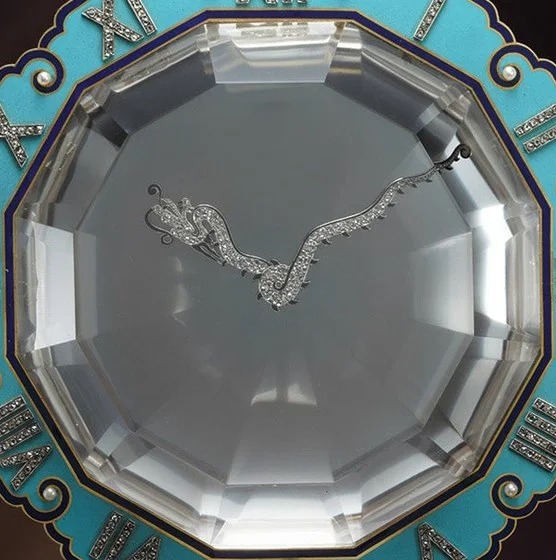

- hidden toothed rims
Chronoscope dial
Three hidden arms with four numerals each enter the dial in turn, one an hour.
- numeral arm crossing the dial
Kingfisher feather dial
Iridescent blue, green and black feathers decorate the dials of exceptional clocks, a practice the literature dates from the early twentieth century; one is a Borne strut clock of about 1926.
- iridescent feather dial
Hard stone and mother-of-pearl dials
Asian-inspired Art Deco clocks have dials of lapis lazuli, carved jade or mother-of-pearl inlay; a rose-quartz clock has a gilt guilloché dial with Roman numerals painted in black.
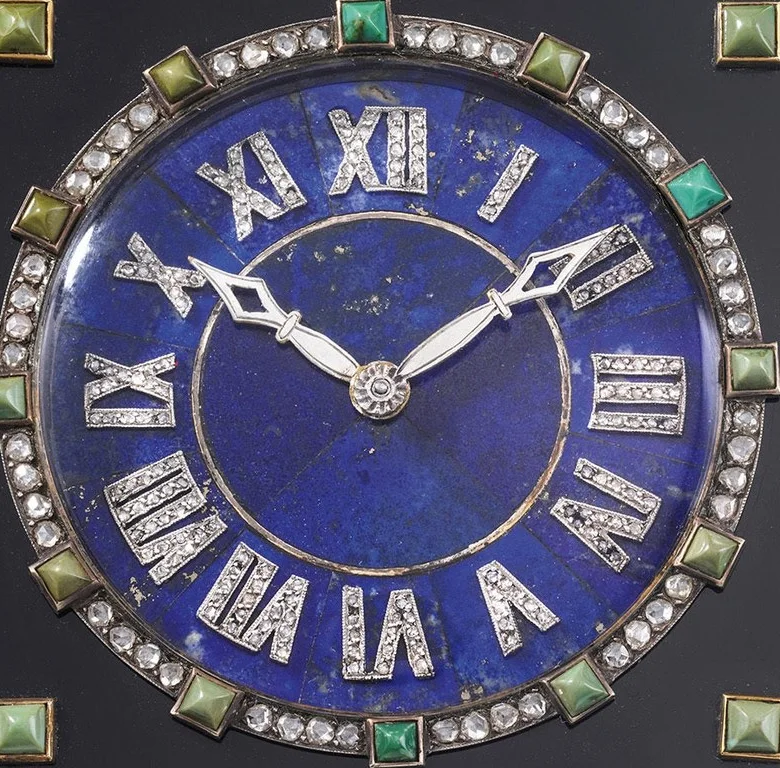

- black painted Roman numerals
Prism dial
The dial is reflected through prisms, after an underwater periscope.
- prism viewing window
Hands 1 described
Hands on the better clocks are set with stones and are shaped to the style.
Diamond-set hands
Hands of platinum or gold set with diamonds appear on the Model A and later clocks; Art Deco clocks have hands shaped as hearts, arrows or Persian tulips, in gold, enamel or diamonds. Mystery clocks fix each hand to its own disc.
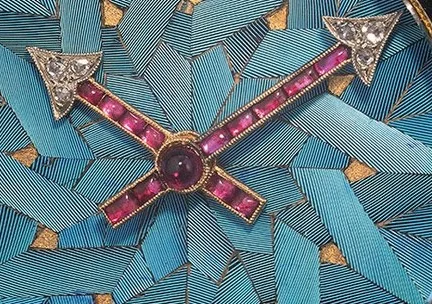

Case and sizes 4 described
Cases are of rock crystal and hardstones and vary with the model.
Urn body
Urns of marble, hardstone, porcelain or opaline glass, one of 1904 with silver-gilt mounts; the movement lies horizontally within.
- urn shape
Rock crystal with onyx or obsidian base
The Model A case is rock crystal on black onyx or obsidian; bases of agate, nephrite or gold also occur.
- crystal block or columns on a dark base
Portico frame
A black-enamelled gold lintel with crystal columns and a suspended dial, with a figure on top; Billiken on one.
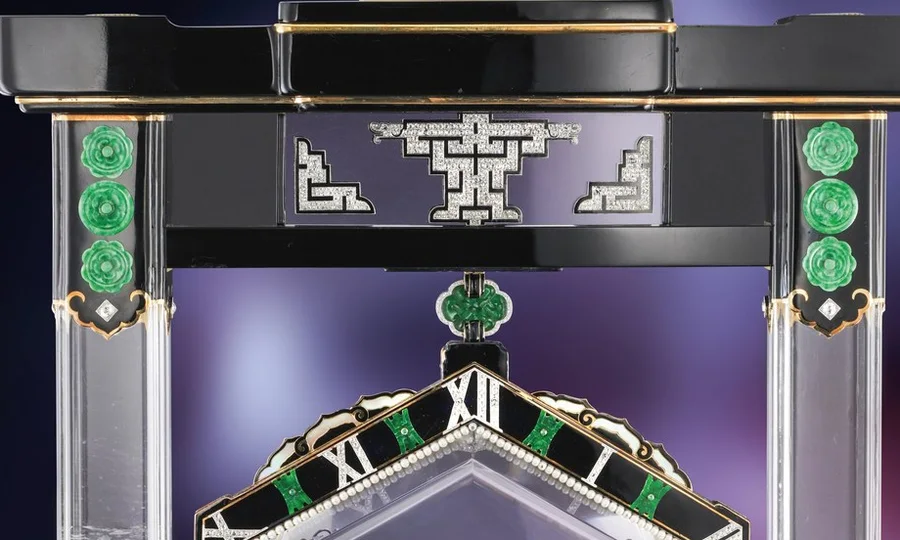

- lintel and figure
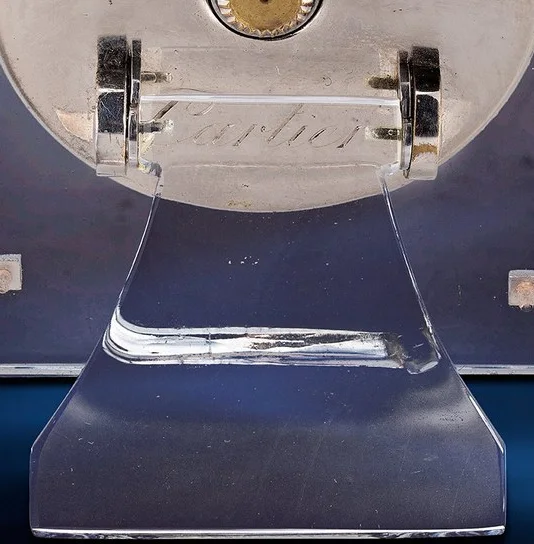
Hinged strut
Small desk clocks stand on a hinged support at the back. The Altar purse clock has shutters and a pivoting support.

Movement 6 described
Mystery movements are hidden, and the drive differs by model: racks or axles at the sides, a glass axle, or a drive from the top.
Eight-day gilt lever movement
A rectangular gilt eight-day movement with Swiss lever escapement, bimetallic balance and Breguet balance spring is described on the first Model A, and a square one with thirteen jewels and a double barrel on the Grande Portique of 1923. A unique mystery clock of 1921, in ebonite, enamel, gold, platinum and two large citrines, has an eight-day movement, gold-plated, with a Swiss lever escapement and Breguet balance spring.
- eight-day winding by key or at the base
Movement in the base, two axes
The Model A movement is in the base and drives the discs through two columns.
- a winding hole under the base, as on the first example of 1912
Single glass axle
A glass axle inside the pedestal drives both discs.

Drive from the top
In the Portique the movement is above, the axle passes through the crossbar under a coral cabochon, and a removable statuette gives access.
- coral cabochon on crossbar
Movement by a supplier
An urn clock of 1904 has a movement by Prévost, a firm that supplied Cartier with movements. On a desk timepiece of about 1922 topped by a rock-crystal Billiken, not a mystery clock, base and movement each bear a plaque with the number 747, the name of the European Watch and Clock Co., Inc. and the jewel count, and are hand-stamped with Cartier numbers.
- Cartier numbers hand-stamped on the movement
- supplier's name
In-house calibre 6002MC
A calibre developed in-house for two new Model A clocks, with an eight-day reserve.
- calibre 6002MC
Box and papers 1 described
Boxes and cases are named in sale descriptions.
Fitted box and travelling case
Fitted Cartier presentation boxes and wooden travelling cases accompany some clocks, as on the Soliman clock; the library's records note a fitted box on a number of desk clocks.
- Cartier fitted box
Originality
- Condition of the crystal discs is among the first things examined, because chips or crazing affect the drive as well as the look.
- The hidden gearing must be precise enough for the hands to sweep without wobble, and the condition of the movement is judged with that of the crystals and of the case and stones.
- On one desk timepiece of about 1922 the base, movement, support and underside of the chapter ring all carry the same hand-stamped Cartier number, 1505, and the movement a second number, 95076.
Names
- Billiken. A luck-bringing figure: it tops the first Portique mystery clock of 1923, and a rock-crystal Billiken tops a desk timepiece of about 1922.
- Chimera. The name used for the animal mystery clocks.
- Enseigne. Another name for the Screen clocks, from the shape of a fire-screen panel.
Where accounts differ
Points on which the published literature and the library's own records do not agree, or on which the literature contradicts itself.
- A pause in mystery clock production. One account says no mystery clocks were made from 1914 to 1919 because of the war. Others say Cartier has never stopped making them, and the firm's collection includes a Model A of 1914.
- How many mystery clocks were made. One 1984 count gave ninety, a later one just over a hundred, another account says about a hundred from 1912 to 1930, and a further one that no record survives from which a total could be given.
- Number of animal clocks. One account lists twelve animal variants between 1922 and 1931; another describes a series of fourteen stone animals and figures and places the Nawanagar elephant as the tenth.
- How the Model A works. Most accounts give toothed crystal discs driven through racks or axles in the columns; one says a dial set above two prisms is reflected to seem to float.
- How many mystery clocks the Cartier Collection holds. One account counts twenty mystery clocks in the firm's collection, nineteen of which were shown in 2018; two others, from about 2013, count seventeen.
- Date of a sun-and-moon day-and-night clock. One account dates a day-and-night semi-mystery clock in agate, with sun and moon for the hours, to 1913 and calls it a planet clock; another, apparently describing the same clock and the same 2008 sale, dates it 1915 and calls it a comet clock.
- Which Model A was the first. One published account calls the Model A of 1912 the first of the mystery clocks and describes it with a base of white agate, and another illustrates a Model A of 1912 in white agate. A Phillips catalogue offers a Model A on a nephrite base, its base plate engraved Cartier Paris 395, as the very first mystery clock Cartier made, the one sold in 1913. A Bonhams catalogue also gives 395 as the number of the clock sold in 1913. The library's records do not settle whether the first clock made and the first clock sold are the same.
In the records
Counted from 673 listings at dealers and auction houses. These are what sellers state, not measurements, a stated year is often an estimate, and a count of listings is not a count of watches made.
Kind of object
| Kind | Listings |
|---|---|
| Clocks | 635 |
| Wristwatches | 36 |
| Pocket watches | 2 |
Case metal
| Metal | Listings | Share |
|---|---|---|
| Gold, any colour | 103 | 52% |
| Yellow | 34 | 17% |
| Pink | 5 | 3% |
| White | 4 | 2% |
| More than one colour | 1 | 1% |
| Colour not stated | 59 | 30% |
| Silver | 53 | 27% |
| Gold plated | 16 | 8% |
| Steel | 15 | 8% |
| Brass | 5 | 3% |
| Bronze | 3 | 2% |
| Base metal | 1 | 1% |
| Gilded brass | 1 | 1% |
As sellers state it. Shares are of the 199 listings that name a metal. 4 more name a stone, a wood or the shape of the case instead. A listing that says "gold" or "18K gold" names no colour: it is counted under "colour not stated", not as yellow gold. Carat, where a listing of gold gives one: 18k 36 · 14k 3.
Case size
| Size | Listings | Share |
|---|---|---|
| 75 mm | 5 | 6% |
| 80 mm | 5 | 6% |
| 55 mm | 4 | 5% |
| 60 mm | 4 | 5% |
| 74 mm | 4 | 5% |
| 42 mm | 3 | 4% |
| 65 mm | 3 | 4% |
| 95 mm | 3 | 4% |
| Other sizes | 51 | 62% |
As sellers state it. Shares are of the 82 listings that give a size.
Listings by decade the seller gives
| Decade | Listings |
|---|---|
| 1890s | 1 |
| 1900s | 9 |
| 1910s | 20 |
| 1920s | 63 |
| 1930s | 31 |
| 1940s | 8 |
| 1950s | 21 |
| 1960s | 10 |
| 1970s | 9 |