Perpetual Calendar Chronograph
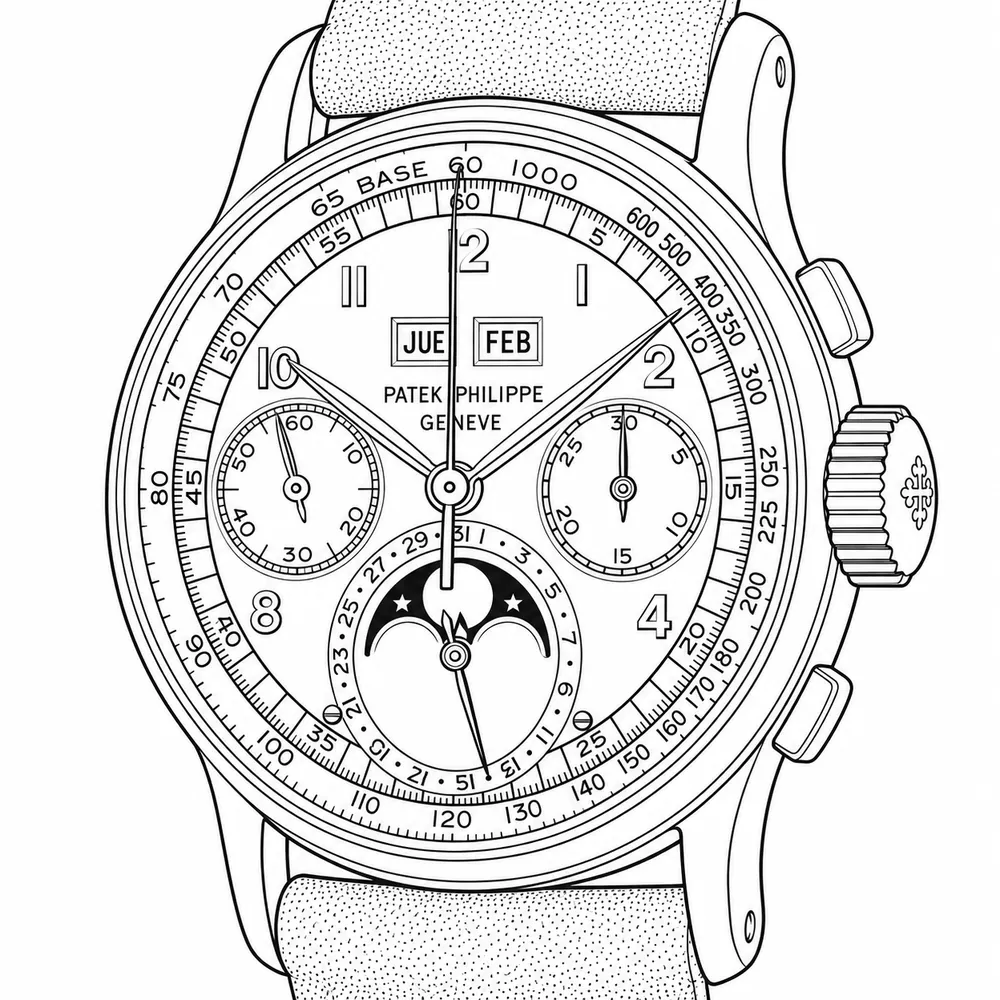
The first perpetual calendar chronograph wristwatch made in series, launched by Patek Philippe in 1941 alongside the perpetual calendar 1526 and made to 1954, 281 in all. It has a 35 mm case, rectangular chronograph pushers, a silvered or pink dial with day and month at 12, running seconds at 9, a 30-minute counter at 3 and moon phase and date at 6, and a hand-wound calibre built on a Valjoux 13-ligne base with a calendar module. Most are yellow gold, fewer than 60 pink gold, and four steel. The 2499 replaced it. Collectors look first at metal, dial colour, signature form and case maker.

- Made
- 1941–1954dates approximate
- Seen in the library
- 1942–1951nine in ten in 1943–1951 · by years sellers state
- Case
- 35 mm · gold (98%)as sellers state
- Movement
- Calibre 13-130hand-wound
- On record
- 85 listings258 photographs · 6 holders
Components
2 watches, oldest first, each straightened and cut the same way so that one row shows one component across them all. Chosen from 258 photographs on file for sharpness and for a face typical of the reference. A year marked c. is one its holder gives only roughly. Each picture is a detail cut from a listing photograph. Select the small mark in its corner for its year, its holder, a link to the listing it came from, and a way to report it.
| 1950 | 1951 | |
|---|---|---|
| Face | 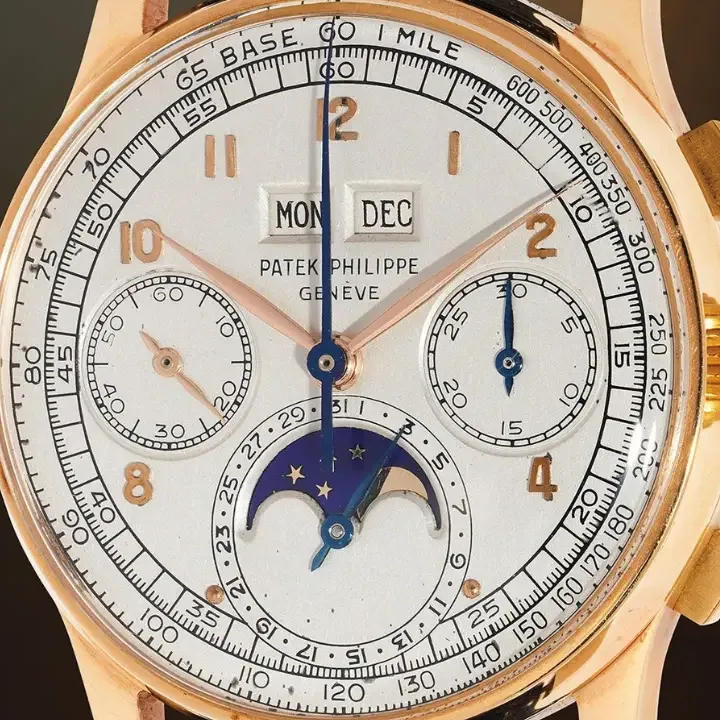 | 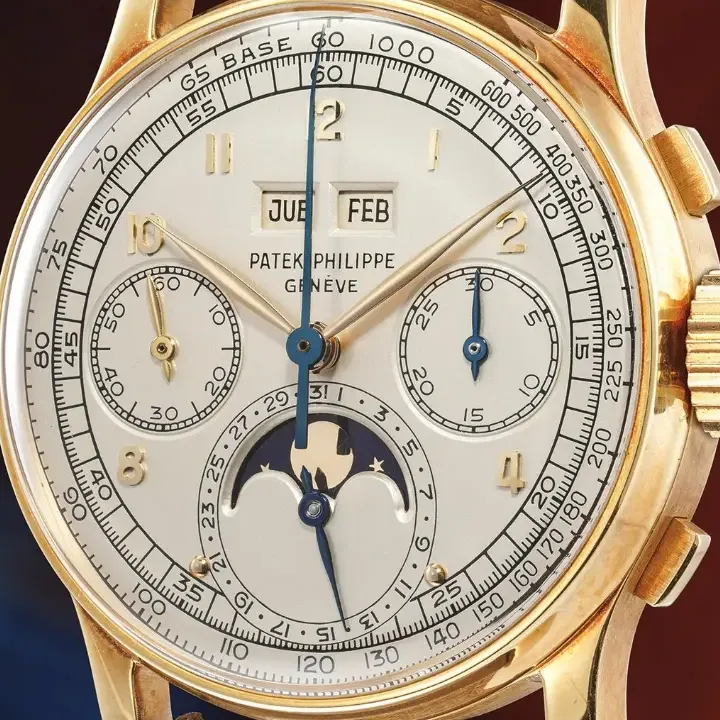 |
| Signature at twelve | 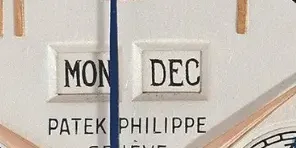 | 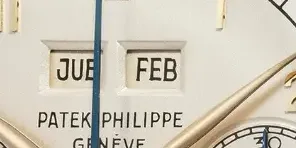 |
| Register at nine | 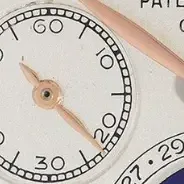 | 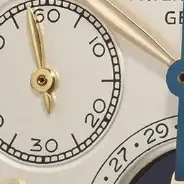 |
| Register at three | 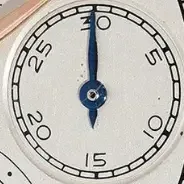 | 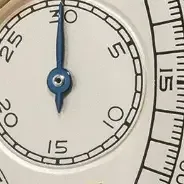 |
| Register at six | 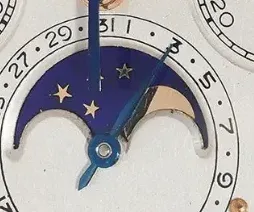 | 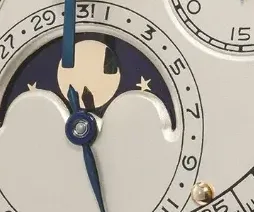 |
| Hands | 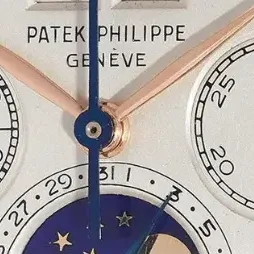 | 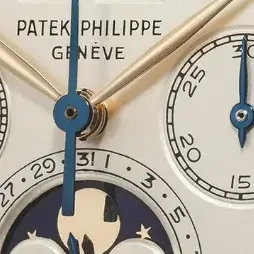 |
| Bezel at twelve | 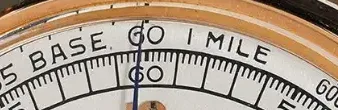 | 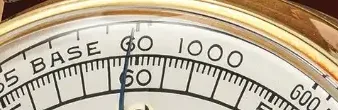 |
| Crown and pushers | 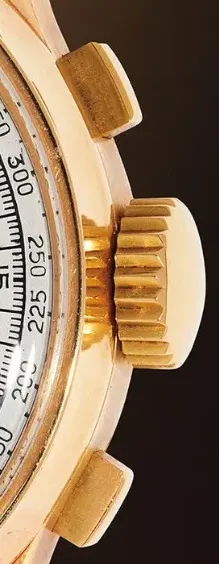 | 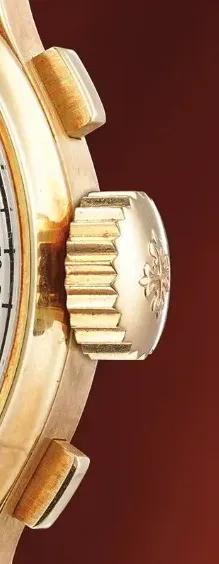 |
| Lug | 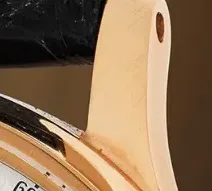 | 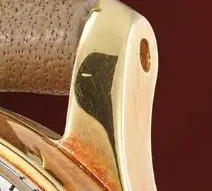 |


Chronology
Published accounts agree on 1941 to 1954. The years sellers and auction houses state in the library's records cover the middle of that run only, and Patek's own records date watches by manufacture and by sale.
Every dated variant: what is written, and what the records show
For the reference the marks are every dated watch; for a variant, the watches a seller names as that variant, so a variant sellers do not name has none.
Specification
| Case | 35 mm round case in three pieces, thin curved lugs, slightly concave bezel, large fluted crown, rectangular chronograph pushers; slight dome to the back |
| Metals | Yellow gold (most), pink gold (fewer than 60), steel (four known) |
| Dial | Silvered, or in pink gold watches sometimes a matching pink or salmon dial; applied gold numerals; enamelled scales; leaf hands |
| Layout | Day and month apertures under 12, running seconds at 9, 30-minute counter at 3, date with moon phase at 6; no leap year indication |
| Scales | Tachymeter on the outer edge (base 1000) and a railway track in fifths of a second inside it |
| Movement | Hand-wound calibre 13-130 Q, a Valjoux 13-ligne base reworked by Patek, with a perpetual calendar module by Victorin Piguet |
| Strap and bracelet | Leather strap as standard; a bracelet in the case metal by Gay Freres could be chosen at purchase; a Gay Freres steel mesh bracelet is recorded with a steel watch |
| Production | 281 watches |
Dial 8 described
Every 1518 follows one layout, with the tachymeter and railway track around the edge, two calendar windows at 12, small seconds at 9, the 30-minute counter at 3 and the date hand with moon phase at 6. Details changed after the war: the long signature gave way to a short one around 1947, the apertures became a little smaller and the tachymeter scale was spaced more openly. Dials were made by Stern Freres, enamelled rather than printed.
Long signature
Early dials carry the long form Patek, Philippe & Co., engraved and enamelled, with commas between the names and an accent over the e of Geneve. These marks are delicate and lose their outline if the dial is cleaned. A late first-series Mark 3 dial of this type is recorded for a watch of about 1946.
- Patek, Philippe & Co. with commas
- accent on Geneve
Short signature
From about 1947 or 1948 the dial reads Patek Philippe only, with the apertures a little smaller and the tachymeter more widely spaced.
- Patek Philippe without Co.
- smaller day and month windows
Silvered dial
The usual dial, satin opaline silver with applied gold numerals, enamelled black scales raised on the surface, recessed subregisters and a moon phase painted on a gold plate. Calendar language is English on watches for the US market, French on many others, and Spanish is also seen.
- silvered satin finish
- applied gold Arabic numerals
Pink dial (pink on pink)
A salmon or copper-pink dial paired with a pink gold case. Counts differ: about 12, 14 and 15 are quoted, out of the fewer than 60 pink gold watches, so most pink gold 1518s still have silvered dials.
- salmon or copper dial
- pink gold case
Tachymeter in kilometres or miles
The outer scale is calibrated in kilometres or in miles; miles, with English day and month, point to a watch made for the US market.
- tachymeter wording km or miles
Calendar magnifier
A rectangular magnifier over the day and month on the crystal, which customers could ask for. At least two pink gold watches are known with one, and it is thought to be original to them.
- small rectangular magnifier at 12
Signed for Cartier
A first-series Mark 3 watch of 1945 or 1946 signed Cartier at 6 below the moon phase, the only known with this signature and a Cartier certificate; the case has a five-figure Cartier number under the left lug and the US import mark on the movement. Another Cartier-sold watch of 1944 is numbered but unsigned.
- Cartier signature at 6
Special-request dials
Some watches carry a special-order dial, among them one made for Charles Stern.
Hands 1 described
Leaf (feuille) hands in gold for hours and minutes, with a gold subsidiary seconds hand; a centre chronograph seconds hand sits on the same axis.
Gold leaf hands
Gold leaf hands, with the hour and minute hands sharing their axis with the chronograph seconds hand.
- leaf-shaped hour and minute hands
Subregisters 1 described
Two recessed registers with a date and moon phase window at 6.
Register layout
Running seconds at 9, 30-minute chronograph counter at 3, and at 6 a date hand pointing round a date ring, with the moon phase in an upper aperture painted on a gold disc. The date ring may be fully closed on the outside. The 1518 has no leap year indicator although the movement keeps track of leap years.
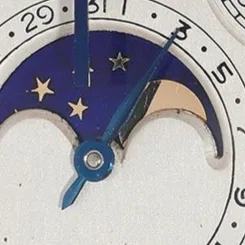
- recessed registers
10 listings on record under the name.
Case 5 described
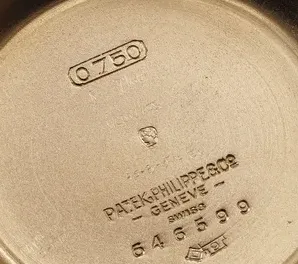
A 35 mm case with fine, extended, curved lugs. Early cases were thicker and later thinner, with the corrector positions adjusted. The back has a slight dome that later references lose, and inside carries serial number, reference and the case maker's stamp. A bezel and back that snap on are recorded on one example measured at 34.5 mm.
Vichet gold cases
Most gold cases were made by Emile Vichet, key number 9, in a key-shaped mark denoting gold made in Geneva; the same maker later made early 2499 cases.
- key with 9 inside the back
Croisier early cases
Georges Croisier, key number 5, supplied the first cases and three of the four steel cases; his steel work was known for stainless casings.
- key number 5
Steel cases
Only four are known. Three were made in 1943 by Croisier, the firm later known as Genevor S.A., with consecutive case numbers, the first marked 1 on the inside back; the fourth, of 1947, has a Wenger case with different lugs. The first was sold new in Budapest in 1944, and one of the steel three was delivered on a rice-grain mesh steel bracelet.
- steel case
- case numbers from 508473 on the three of 1943
Pink gold cases
Fewer than 60 known, counted as 58, 44 and about 60 by different accounts. The pink gold watches are mostly silvered and sometimes pink-dialled.
- pink gold
Integrated-bracelet case
One unique pink gold watch has a case without lugs and an integrated bracelet, its shape compared to a flying saucer.
- lugless case, integrated bracelet
Crown and pushers 1 described
A large fluted crown, with rectangular chronograph pushers either side of it.
Rectangular pushers and fluted crown
Rectangular pushers throughout and a prominent fluted crown; one well-preserved pink gold watch is described as still having its original crown.
- rectangular pushers
- fluted crown
Movement 1 described
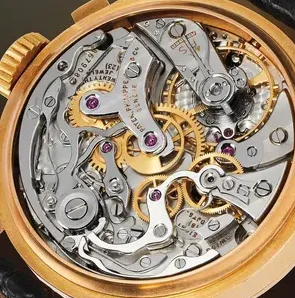
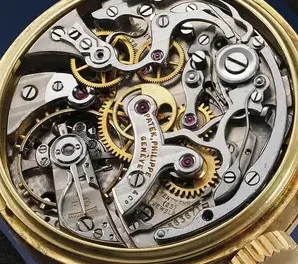
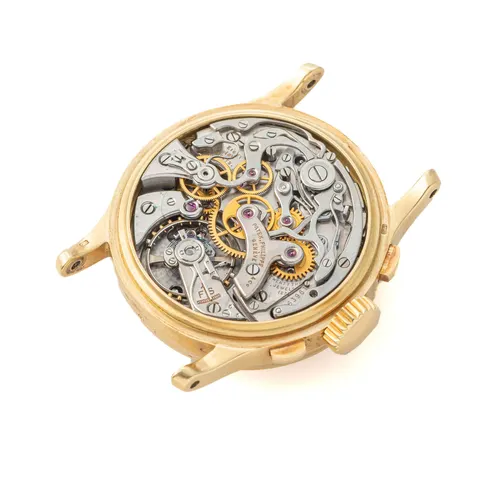
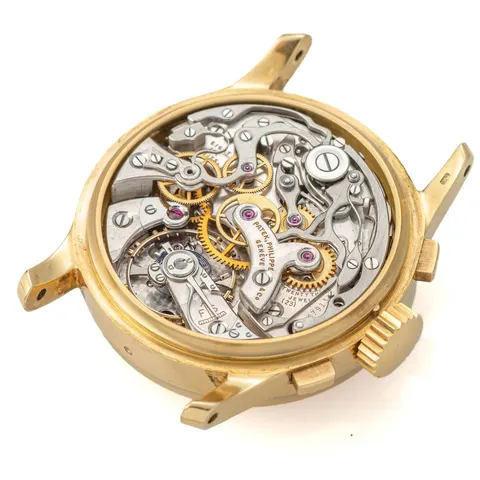
Calibre 13-130 Q, 13 lignes, Q for the calendar. The base is the Valjoux 13-ligne chronograph, reworked and decorated by Patek, with the perpetual calendar module added by Victorin Piguet. The same movement powered the 1518's successor, the 2499.
Calibre 13-130 Q
Hand-wound with a column wheel capped, an index with swan neck spring, a reworked chronograph bridge and separate cocks for several wheels, and Geneva Seal finishing. The rate is given as 18,800 vibrations an hour in some accounts and 18,000 in another, and the seconds track is divided in fifths. Watches for the US market carry an import mark such as PXP or HOX on the movement.
- signed movement
- PXP or HOX import stamp on US watches
Bracelet 2 described
Buyers chose between a leather strap and a bracelet in the case metal, made by Gay Freres.
Gay Freres bracelet
A bracelet is original only if the archive extract says it was delivered with the watch. The extract of one pink gold watch sold in 1948 records its matching pink gold bracelet; one steel watch left the factory on a rice-grain mesh bracelet. Few survive.
- Gay Freres bracelet in the case metal
- Gay Freres steel mesh bracelet on a steel watch
Leather strap
Most were sold on a strap.
- leather strap
Originality
- The enamelled dial signature and the commas and accents are fine and are damaged by cleaning, so a dial that looks too fresh may have been washed or retouched.
- Applied numerals and indexes can be refixed after cleaning; oxidation seen through the lacquer on the underside is a sign the dial has not been retouched.
- A metal bracelet counts as original only when the archive extract records it as delivered with the watch.
- Polished cases lose the sharp edges and hallmarks on the lugs; the strength and symmetry of the lugs should be checked.
- A provenance claim resting only on a caseback engraving needs documentary support; one such claim, for a yellow gold watch, has been publicly questioned.
Names
- Pink on Pink. A pink gold case with a matching pink or salmon dial.
Where accounts differ
Points on which the published literature and the library's own records do not agree, or on which the literature contradicts itself.
- Count of pink gold watches. Guides give fewer than 60, 58, 44 known and about 60, and the number with matching pink dials as 12, 14 or about 15.
- Rate of the movement. Two accounts give 18,800 vibrations an hour; another gives 18,000 for the Valjoux base, which is the rate that fits the fifth-second graduation on the dial.
- Start and end of production. Guides date the reference from 1941 to 1954. The years sellers and auction houses state in the library run from 1943 to 1951 (5th to 95th percentile, median 1948), with no listing stated later than 1951 in that range and none in 1941. The stated years are mostly the year of manufacture given by the auction house, so the guides' 1941 and 1954 may be launch and last-sale dates rather than manufacture.
- Number of steel watches. Published accounts state four steel cases. The steel watches in the library's records are all stated as made in 1943; the records are listings rather than a count of watches, so they fit the four.
- Year of the Cartier-signed watch. One published account dates the Cartier-signed watch to 1946, with its case of about 1946; the auction house's description in the library's records gives 1945.
Back and movement
From listings of this reference, each confirmed by eye to show what it is filed under. A picture on which a person's name or a personal engraving can be read is not shown. From most holders a detail from the middle of the photograph is shown; the mark in its corner gives its holder and a link to the listing.
Inside the caseback

Movement




Catalogue versions 1 listed
The full numbers under which holders list this reference, with what their listings say of each. Each has a page of its own.
| Version | Metal | Dial | Years seen | Records |
|---|---|---|---|---|
| 1518J thin | Gold | Silver | 1943 | 2 |
In the records
Counted from 85 listings at 6 holders between 16 October 2005 and 13 November 2026. These are what sellers and auction houses state, not measurements.
Fainter bars are the 2 outside the main run of 1943–1951 (the middle nine-tenths): the earliest is 1942. They are early and late examples, and now and then a seller's slip. Not on the scale: 2000 (1). A year more than ten from all the rest is usually a model name or a founding date, not the year of the watch.
Case metal
| Gold, any colour | 79 | |
| Yellow | 27 | |
| Pink | 23 | |
| Colour not stated | 29 | |
| Steel | 2 |
A listing that says "gold" or "18K gold" names no colour: it is counted under "colour not stated", not as yellow gold.
Dial colour
| Silver | 10 | |
| Pink | 8 | |
| Gold | 1 |
Case size
| 35 mm | 51 | |
| 36 mm | 1 |
Calibre named
| 13-130 | 4 |
Bracelet or strap
| Leather strap | 38 | |
| Metal bracelet, kind not stated | 7 |
Each table counts the listings that state the thing, in the seller's own terms. A size, metal, colour or calibre that cannot belong to this reference is a seller's slip or a listing filed under the wrong number.