Rotonde de Cartier
The Rotonde de Cartier is a round wristwatch line introduced in 2006, first as a men's time-only watch with a large date. It was meant as a plain, flat, discreet case able to take any movement, and it became the line in which Cartier's own manufacture shows its complications: chronographs, calendars, power-reserve and second-time-zone watches, tourbillons, minute repeaters and the 'mysterious' watches whose hands appear to float. Cases are mostly 40 to 45 mm in steel, rose or white gold, with platinum for many of the limited series. Roman numerals, blued steel hands and a beaded crown with a cabochon are the common signs. Little is said of any maker other than Cartier itself.
Cartier's entries are arranged by model, not by reference number, because its reference numbers are several systems at once and many of its watches carry none. The houses are set out in Paris, London and New York.
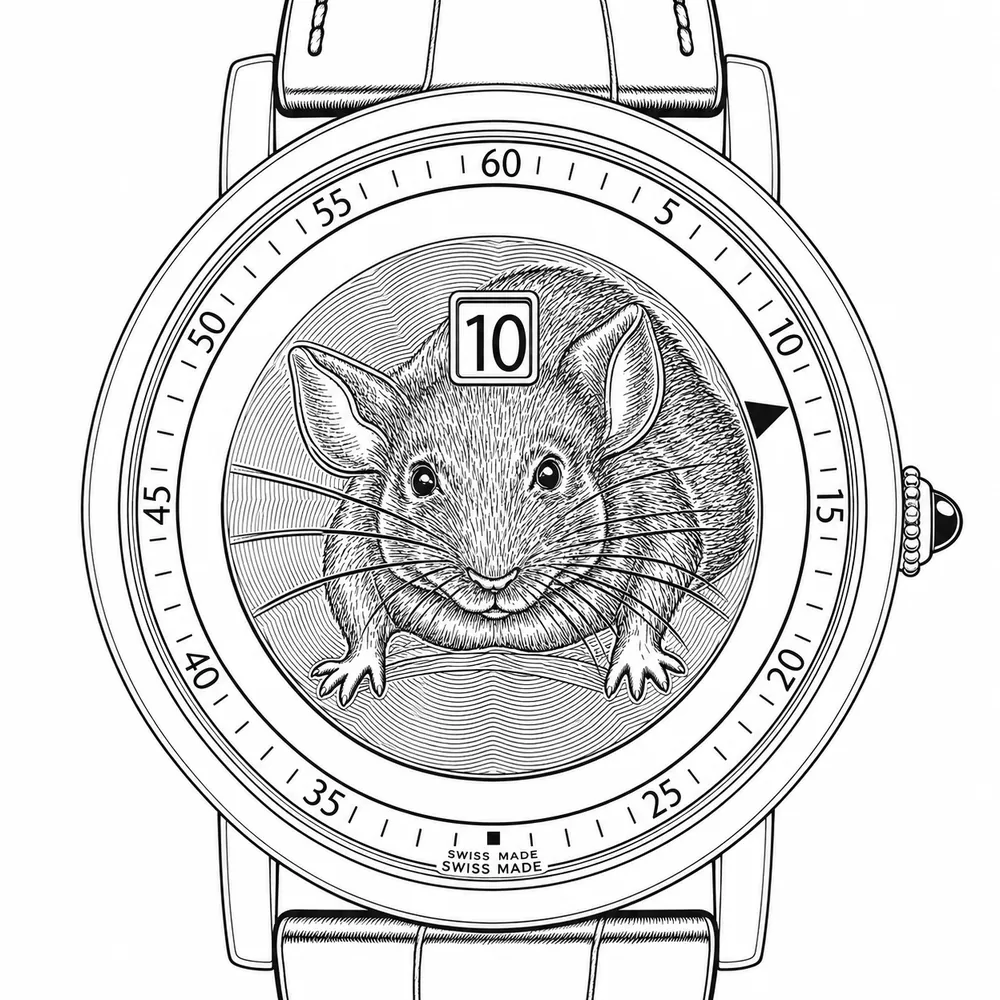

- Made
- from c. 2006Published accounts agree that the line began in 2006 and is still in production; later models are dated by the salon at which they were shown, and some of those dates are given by only one account.
- On record
- 216 listings24 of them give no reference
- Reference numbers
- 38 described76 seen in listings
- House named in the title
- Paris 6the line is later than the three houses; a title naming one is quoting the dial
What to look for
Details cut from photographs of watches of this line on record. Each was chosen by eye from a listing on the line and then checked again against the words beneath it. More sit beside the productions and parts they belong to, below. Select the small mark in a picture's corner for its holder and a link to its listing.

By house and period 4 described
Collection Privée Cartier Paris, from 2006
The Rotonde was shown at the 2006 Geneva salon as a new round watch that added to the Collection Privée Cartier Paris. Published accounts name the line's first two watches as a time-only Grande Date (hand-wound calibre 9602, 42 mm in white or pink gold, with a 35 mm size also made) and a Day & Night (hand-wound 9903 MC, 42 mm, white or pink gold, under 200 pieces in each colour). They do not say which of the two carried the Collection Privée label. In the library's records, titles that say Collection Privée or CPCP describe watches in pink or white gold with retrograde minutes and a day and night display, or with a large or digital date display; sellers quote individual numbers on them, some very low.
Signature and marks. Not given in the published accounts. Sellers' titles name the Collection Privée Cartier Paris (CPCP) and give a number for the individual watch.
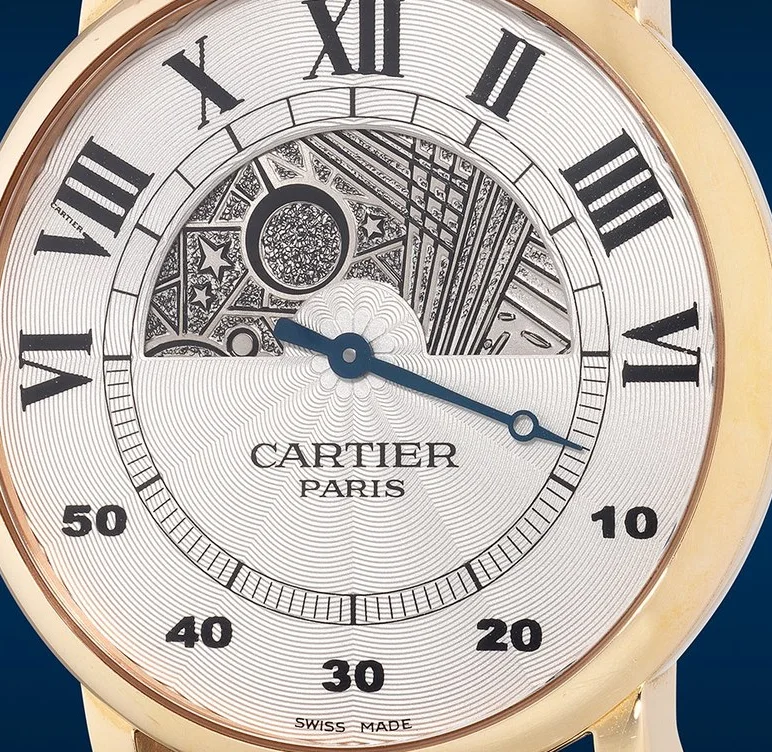

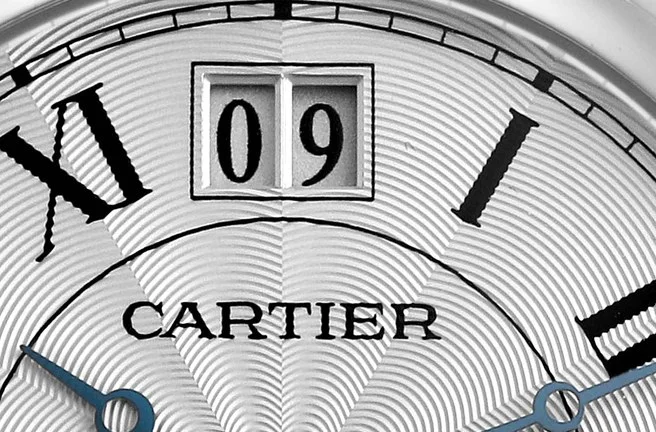

- Collection Privée Cartier Paris or CPCP in the catalogue description
- a short individual number quoted for the watch
- pink or white gold case
Rotonde de Cartier collection: dress and mid-range models
Alongside the small series, the main collection carries watches with a single complication and a classic Roman-numeral dial. Published accounts describe a chronograph on the in-house 1904-CH MC (40 mm, introduced 2015), a central chronograph on the hand-wound 9907 MC, a calendar and power reserve watch on the 9753 MC, an eight-day hand-wound watch on the 9910 MC, an annual calendar on the 9908 MC, a Large Date Two Time Zone on the 8011 MC, a second-time-zone Day/Night (the Retrograde GMT, 2014) and a 40 mm Day and Night with moon phases for women (2016). By early 2013 the collection was said to hold about twenty-five watches, most added in the preceding three years. The accounts do not say where the cases were made.
Signature and marks. Not given in the published accounts, except that the rotor of the 40 mm Day and Night carries two Cs.
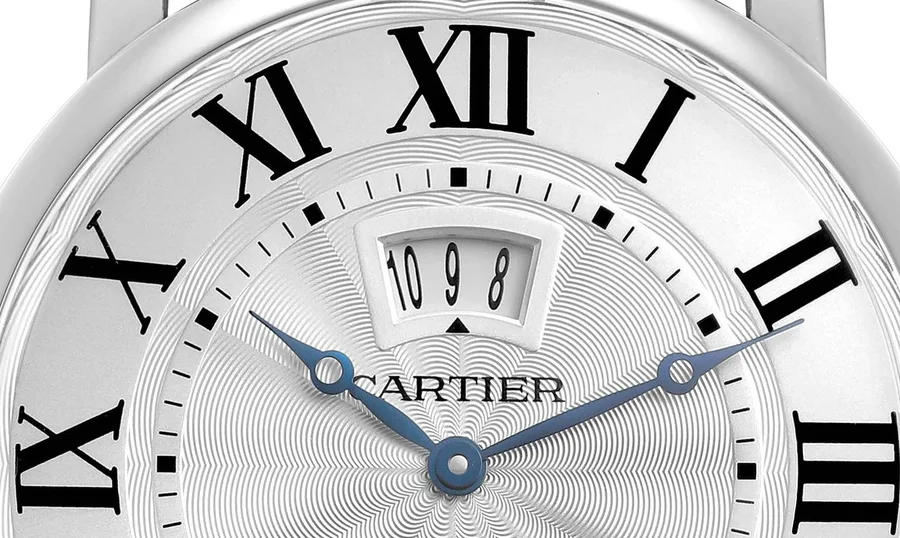


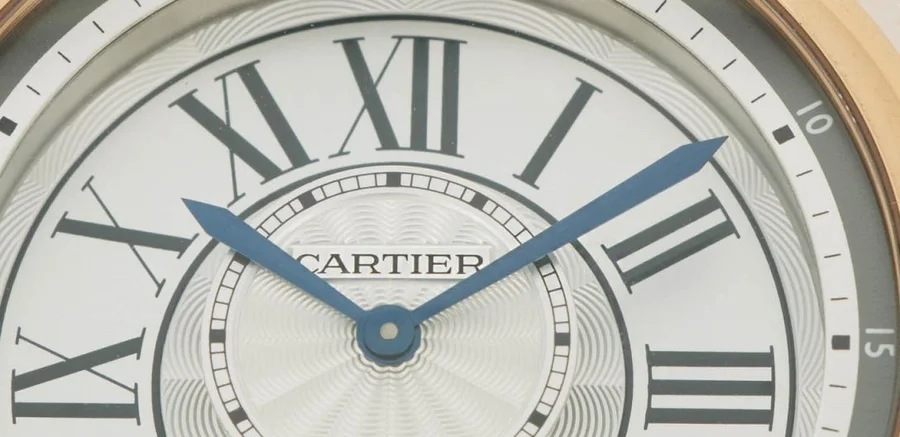
- asymmetrical dial with the Cartier name off centre (eight-day)
- date window at 12 in a fan-shaped aperture (calendar and power reserve)
References: WSRO0002, W1556238, W1556239, W1555951, W1556252, W1556203, W1556202, W1556368, W1556240, W1556369, 3773
Rotonde de Cartier collection: tourbillons and grand complications
The collection's high complications are mostly limited series, some of them described as developed and made at the Cartier manufacture in La Chaux-de-Fonds. They include a skeleton flying tourbillon (9455 MC, 45 mm, 100 in white gold in 2010 and 100 in pink gold the year after), the Tourbillon Cadran Lové (9458 MC, 46 mm, 100 pieces, 2012), a 40 mm tourbillon on the 9552 MC, a minute repeater with flying tourbillon (9402 MC, 45 mm), a perpetual calendar (9422 MC, 45 mm), the Astrorégulateur (9800 MC, 50 pieces), the Astrotourbillon, the Astrocalendaire (9459 MC, platinum, 45 mm, 100 pieces in one account and five in another) and the Grande Complication, shown in 2010 and again, as a different watch, in 2015. Several carry the Geneva Seal.
Signature and marks. Not given in the published accounts, except that the Astrocalendaire carries the Geneva Seal on a bridge and movements of the Cadran Lové are individually numbered.
- flying tourbillon visible through the dial or skeletonised bridges
- Geneva Seal, shown on a bridge of the Astrocalendaire
- individually numbered movement and a limited-edition number
- sapphire case back
References: W1556215, W1556216, W1556204, 3308, 3388, 2874, W1556217, W1556225, CRW1556209, W1580046, WHRO0065
Rotonde de Cartier collection: mysterious watches, from 2013
In mysterious watches the hands, or in the latest ones the whole movement, appear to float, carried on sapphire discs that are driven from the edge of the dial. The first Cartier mystery clock is usually dated to 1912 (one account says 1913), and Cartier presented the first wrist version in this line in 2013: the Mysterious Hour (9981 MC, 42 mm, white or rose gold) and the Mysterious Double Tourbillon (9454 MC, 45 mm, platinum). Later come the Astromystérieux (2016), the Minute Repeater Mysterious Double Tourbillon (2017), the Mysterious Day & Night (2018), the openworked trio of 2021 and the Masse Mystérieuse (2022). Several are limited editions in platinum or gold.
Signature and marks. Not given in the published accounts.
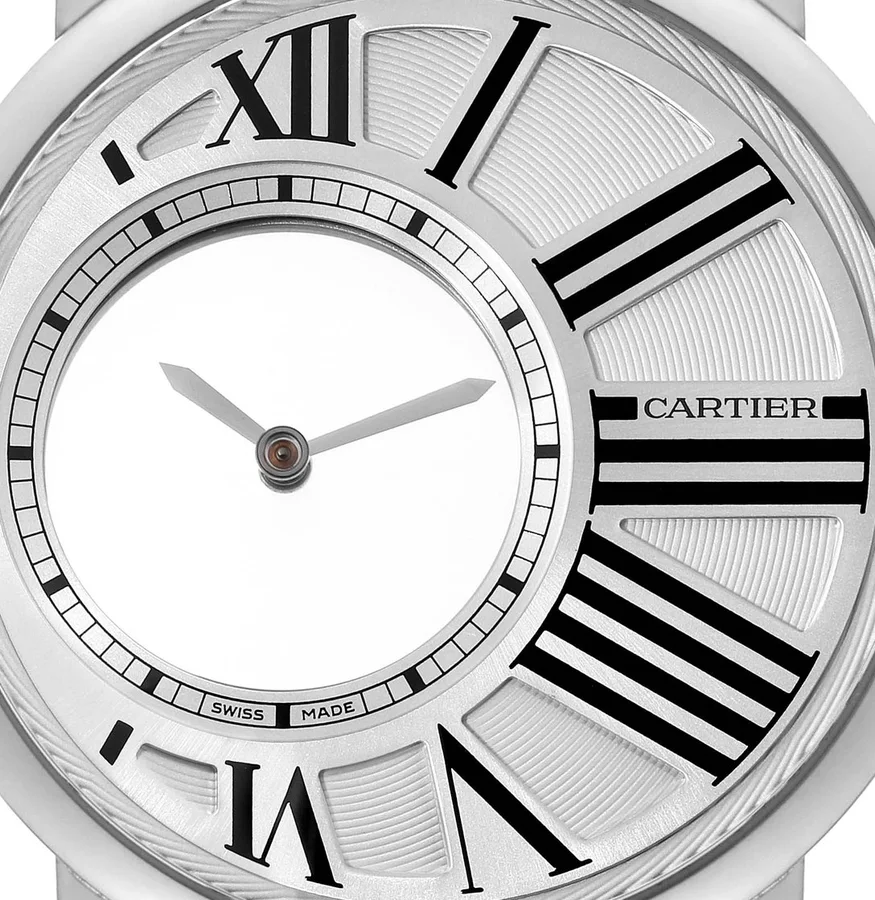

- sapphire display back
Chronology
Specification
| Case | Round, flat and smooth, tapering slightly from the base to the bezel, with curved lugs; sizes of 35, 40, 42, 43.5, 45, 46 and 47 mm are named; steel, 18k rose or white gold, platinum, and for some limited series palladium or titanium |
| Dial | Mostly Roman numerals, often over a guilloché or sunburst centre, and in many models an asymmetrical layout; skeleton dials use the bridges as numerals |
| Hands | Blued steel Breguet-style (pomme) hands on the dress models; sword-shaped hands on several models; gold apple-shaped hands with baton and hammer-shaped hands on the Grande Complication Skeleton; blued steel hands on some of the mysterious watches |
| Crown | Beaded where described, usually set with a cabochon; sapphire, spinel, ruby, aquamarine, aventurine or jade are named, and a diamond on one gem-set model |
| Crystal | Sapphire where described, with a sapphire exhibition back on most of the models described |
| Movement | Cartier manufacture calibres, hand-wound or automatic, from the 9602 and 9903 MC of 2006 to tourbillon, repeater and mystery calibres; a few are built on other makers' bases |
| Water resistance | 30 m on the models for which it is given |
| Strap | Alligator leather with a folding buckle or deployant clasp, in gold on the precious-metal models for which the clasp is described |
Dial 13 described
Rotonde dials are Roman-numeral dials, usually over a guilloché or sunburst finish, and many are asymmetrical, with the date, a second time zone or a power reserve set off centre. Complication models change the layout of the centre; the mysterious and skeleton watches replace it with an open aperture.
Grande Date, time only
The first Rotonde, a time-only watch with a large date, in a 42 mm case in white or pink gold; a 35 mm size was also made. Both sizes were out of production by early 2013.
- large date
- 42 mm or 35 mm case
Day & Night
Made from 2006 in 42 mm white or pink gold, in fewer than 200 pieces in each colour, with a day and night display on the hand-wound 9903 MC. Sellers' titles describe Collection Privée Day and Night watches (references 28721, 28731 and 2873) with retrograde minutes and a guilloché dial; the published accounts do not say these are the same watch.
- day and night indicator
Large Date Two Time Zone
A pink gold 42 mm watch on the 8011 MC with a guilloché dial, a 24-hour hand, a large date and a Day & Night display. The date window was changed from square to round between the first showing and release, so the round window is the final form. The accounts do not say whether it is the same watch as the Second Time Zone Day/Night of 2014.
- round large-date window
- 24-hour hand
Eight-day, asymmetrical dial
A 42 mm rose or white gold hand-wound watch with an asymmetrical silver guilloché dial, the Cartier name set off centre, black Roman numerals, blued hands, a seconds sub-dial, a date aperture and a power reserve indicator at 11 o'clock.
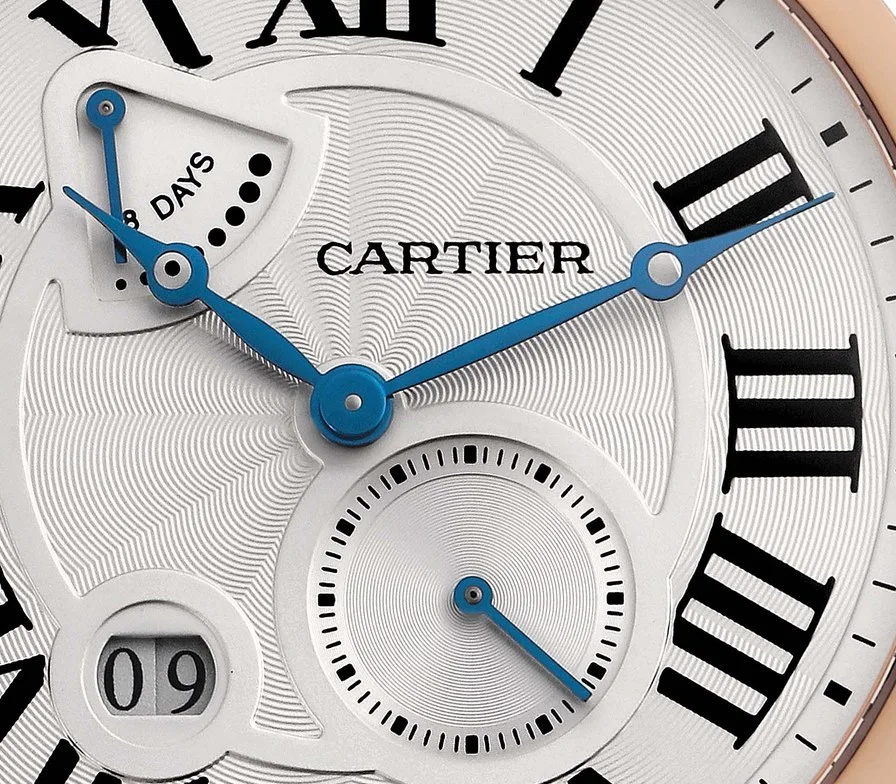

Calendar and power reserve
A 40 mm watch with a silvered guilloché dial, a date at 12 shown in a fan-shaped aperture that displays three dates and an arrow for the current one, and a power reserve indicator at 6. The hands are blued steel Breguet-style, and the case back is solid.
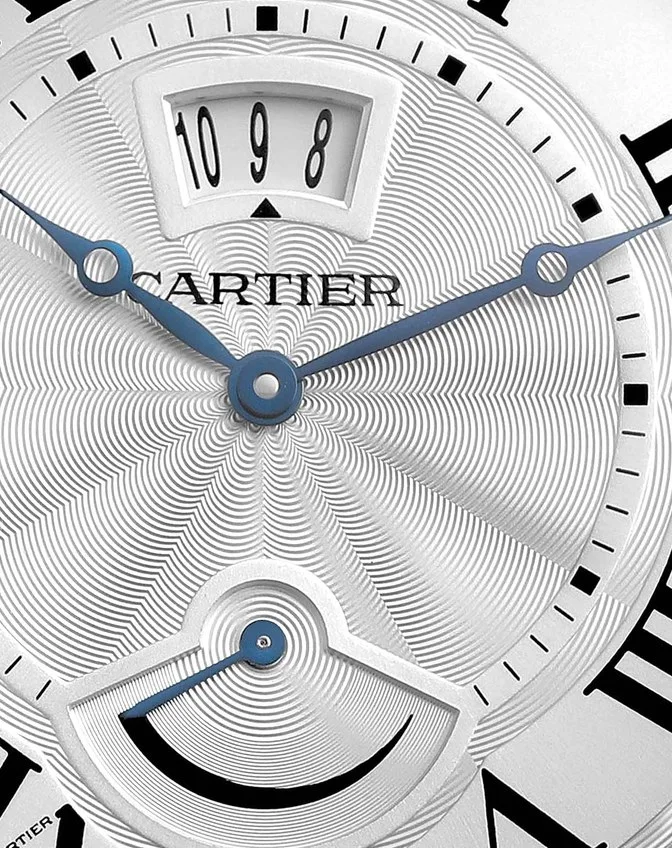

Second Time Zone Day/Night (Retrograde GMT)
Released in 2014 in steel, white gold and rose gold. The asymmetrical dial has an oversized date below 12, a small seconds sub-dial above 6, a fan-shaped retrograde second time zone at 10 marked only at 1 and 12 and divided into four-hour sections, and a day and night display at 4 with a sun and a moon. The white gold version is a limited edition of 200 with a blue guilloché dial.
- fan-shaped second time zone at 10
- oversized date below 12
- sun and moon at 4
Chronograph dial
A symmetrical dial; on the steel watch it has a lightly textured silvered surface, black Roman numerals, an applied chapter ring, a silvered outer minute track and blued pomme hands; no luminous material is used. There is a window at 6, which one published account calls a day window; on watches in the library's records it shows a number, the date. The chronograph counts to twelve hours with two sub-dials and no running seconds hand. The steel and rose gold versions have silver dials; a limited white gold version has a blue and silver 'panda' dial (the accounts give its edition as 300 or as 500).
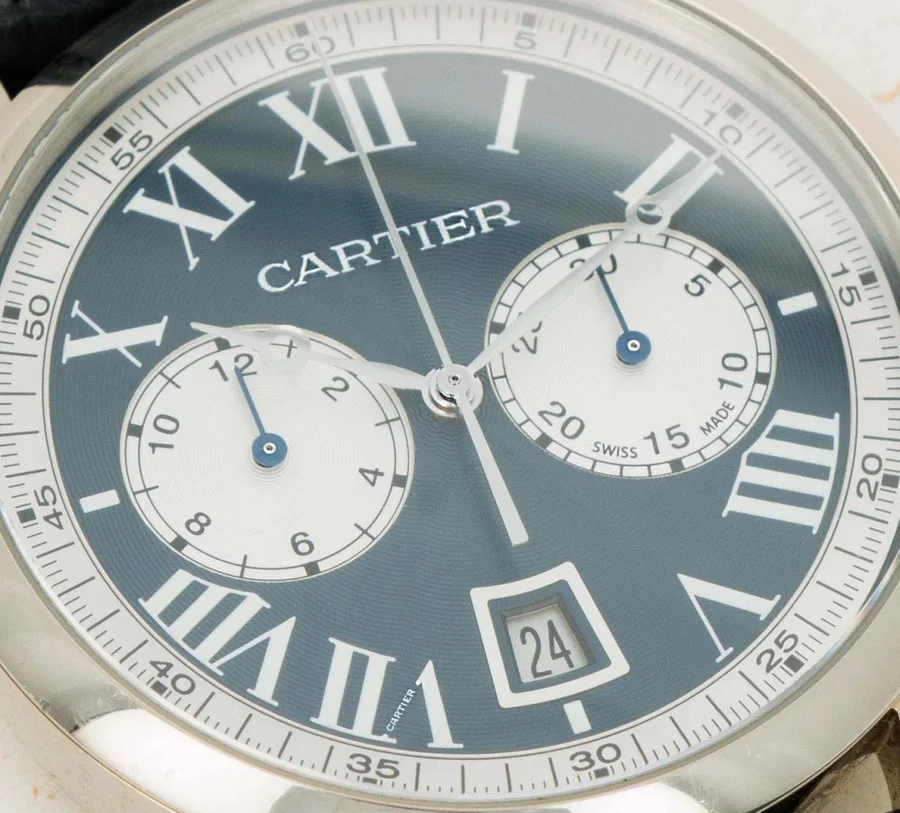

- window at 6, showing the date on watches in the library's records
- two sub-dials, no running seconds
Central chronograph
The chronograph display sits in the centre as a raised slate-coloured area within a silver outer dial, with a track around its edge and a minute disc inside it; only the tips of the hour and minute hands are meant to be read. Painted radial Roman numerals and blued hands are described on the rose gold watch.
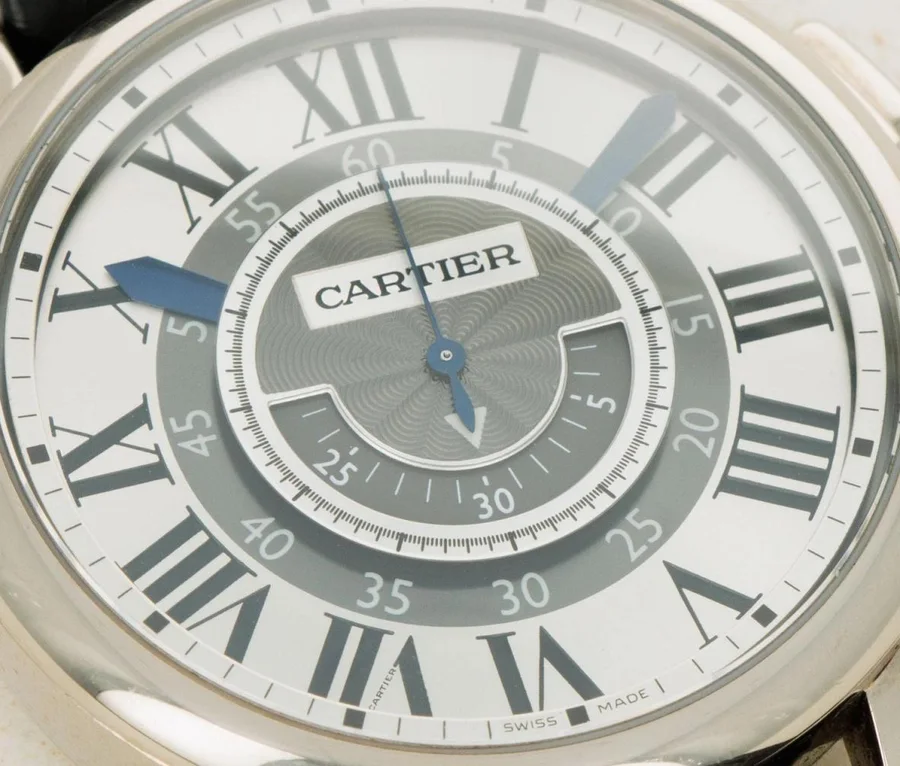

- raised central chronograph display
Mysterious dial with off-centre aperture
In the Mysterious Hour the hands are mounted on two sapphire discs seen through an off-centre transparent aperture, with a deeply engraved dial, blackened sections and numerals in a skewed treatment around the opening. A pavé version is also made.
- transparent off-centre aperture
- engraved concentric rings
Mysterious Day & Night
A semicircular insert holds a rotating crystal disc with a sun and a moon motif that point to the hours on the Roman-numeral chapter ring, with retrograde minutes in the lower half. The chapter ring is brushed and the inner bezel fluted. Made in pink or white gold, 40 mm.
- sun and moon on a crystal disc
- brushed chapter ring
- fluted inner bezel
Day and Night with moon phases, gem-set
A 40 mm gold watch for women with a lacquered dial set with 118 brilliant-cut diamonds and 28 blue sapphires marking the day and night display, a bezel set with 68 diamonds and a retrograde moon-phase hand.
- retrograde moon-phase arc
- gem-set lacquered dial
Openworked dials with numeral bridges
The skeleton mysterious watches replace the dial with an openwork structure in which the bridges form Roman numerals. The Skeleton Mysterious Double Tourbillon has numerals in large size around an empty space for the tourbillon; the Mysterious Astrotourbillon has oversized numerals at 12 and 6 and a Cartier-signed bridge at 3; the Mysterious Hour Skeleton has seven pink gold bridges forming numerals and an off-centre white dial at 9.
- bridges shaped as Roman numerals
Concentric calendar dial
On the Astrocalendaire the calendar is shown on concentric rings, each cut deeper than the one before, around a flying tourbillon at the centre. The date, month and day show through blued apertures.
- concentric stepped rings around a tourbillon
Hands 3 described
Hands follow the dial: blued steel on the dress models and on some mysterious watches, gold or gold and steel on several high complications.
Blued steel Breguet-style or pomme hands
The chronograph and the calendar and power reserve watch have blued steel hands of Breguet or pomme type; the eight-day watch and the rose gold central chronograph have blued hands, their shape not given.


Sword-shaped hands
Sword-shaped hands are described on the Mysterious Hour Skeleton and the Minute Repeater Mysterious Double Tourbillon (off-centre, pink gold) and on the gem-set Day and Night, where the minute hand is rhodium-plated steel.
- sword-shaped hands
Apple, baton and hammer-shaped hands
The Grande Complication Skeleton reads in several ways: apple-shaped gold hour and minute hands, baton-shaped hands for day and date and hammer-shaped hands for the month (the month hands are called axe-shaped in one account).
- apple-shaped hour and minute hands
Case and sizes 7 described
The Rotonde case is a smooth, fairly flat round case designed to take many movements. It tapers a little from the base to the bezel and has curved lugs and a thickness that keeps a moderate diameter from looking small. Sizes are given in millimetres.
35 mm
A 35 mm case is named for the early Grande Date, and a few listings in the library's records give 35 mm.
40 mm
Used for the chronograph (12.15 mm thick, steel, 30 m water resistant), the calendar and power reserve watch, the Mysterious Day & Night and the Day and Night with moon phases. A 40 mm tourbillon was the smallest Rotonde and Cartier's smallest tourbillon when it was described in 2013.
42 mm
The commonest size in the library's records. Used for the Grande Date, the Day & Night, the eight-day watch, the Large Date Two Time Zone, the Mysterious Hour and the Mysterious Hour Skeleton (11.9 mm thick), and described on the central chronograph W1555951.
43.5 mm
Used for the Astromystérieux (12 mm thick in palladium, 11.9 mm in the platinum version) and the Masse Mystérieuse (12.64 mm, platinum).
45 mm
Used for the perpetual calendar, the minute repeater with flying tourbillon, the skeleton flying tourbillon, the Mysterious Double Tourbillon, the Skeleton Mysterious Double Tourbillon, the Astrocalendaire, the Grande Complication Skeleton and the Minute Repeater Mysterious Double Tourbillon.
46 mm and larger
The Tourbillon Cadran Lové is 46 mm and the Mysterious Astrotourbillon 47 mm (14.9 mm thick, platinum). One account gives 46.6 mm for the central chronograph, where another account gives 42 mm for the rose gold W1555951.
Steel and precious-metal cases
Steel is used for the chronograph, the Retrograde GMT and a power reserve model (W1556369); gold, in rose, pink or white, for most others; platinum for the limited high complications; 950 palladium for the first Astromystérieux. One account says the three newest models of its date are in rose gold and titanium, while another puts all three in rose gold.
Crown 2 described
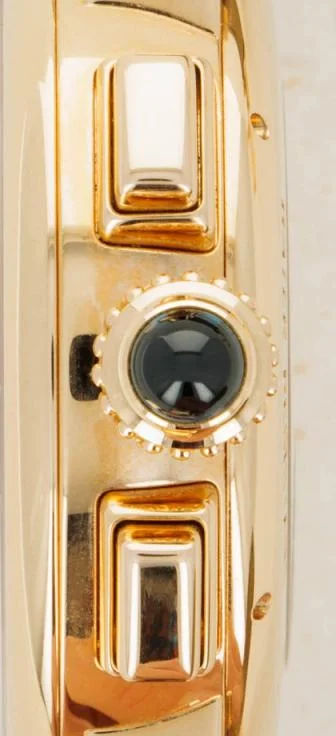
The crown is beaded and carries a cabochon, with the stone chosen to match the model or its strap.
Blue spinel or sapphire cabochon
The chronograph has a beaded crown with a blue spinel cabochon, a stone very like the blue sapphire used on some other watches; both are synthetic. A blue sapphire cabochon is described on the central chronograph W1555951 and on the Cadran Lové.
- beaded crown with blue cabochon
Coloured stones matched to the strap
On the platinum trio of 2021 the cabochon is aquamarine (Astromystérieux, teal strap), aventurine (Mysterious Astrotourbillon, blue strap) and jade (Skeleton Mysterious Double Tourbillon, green strap). The Masse Mystérieuse has a tall ruby cabochon.
- aquamarine, aventurine or jade cabochon
Crystal 1 described
Crystals are sapphire where the material is given.
Sapphire front and exhibition back
The central chronograph and several complications have sapphire crystal on the front and the back; the chronograph shows its movement through a sapphire back. The calendar and power reserve watch is the exception described, with a solid back.
- sapphire display back
Movement 14 described
Most movements described are Cartier manufacture calibres; the manufacture at La Chaux-de-Fonds has brought its watchmaking trades together on one site since 2001, and some Rotonde calibres are said to have been designed and made there. A few are built on other makers' bases. Some movements are individually numbered.
9602 and 9903 MC, hand-wound
The first Rotonde calibres, from 2006: the 9602 in the Grande Date and the 9903 MC in the Day & Night.
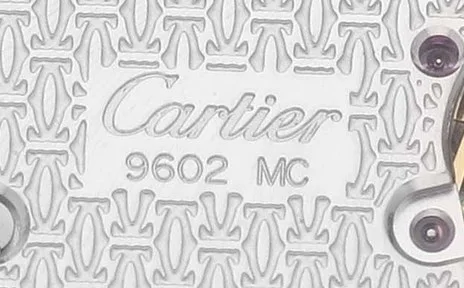

9455 MC skeleton flying tourbillon
A hand-wound skeletonised flying tourbillon with the Geneva Seal in a 45 mm case; shown in white gold in 2010, in pink gold in 2011, each in an edition of 100. A news item of December 2009 already describes the watch.
- skeletonised movement with flying tourbillon
9458 MC flying tourbillon, Cadran Lové
A hand-wound calibre of 39 mm (17½ lignes) and 5.58 mm with 167 parts, 19 jewels, a rate of 21,600 an hour and about 50 hours of power reserve, with the Geneva Seal, individually numbered. The watch is a 46 mm men's version of a women's tourbillon watch that shares its movement. It was officially presented in Geneva in 2012, though a news item of November 2011 already describes it.
8011 MC, reworked Jaeger-LeCoultre base
The automatic calibre of the Large Date Two Time Zone, said to be a reworked Jaeger-LeCoultre calibre that Cartier also uses in a Pasha model.
1904-CH MC and 9908 MC, from the 1904 family
The 1904-CH MC is an automatic column-wheel chronograph of 269 parts, 5.72 mm thick, 28,800 an hour, with 48 hours from two barrels and a 12-hour counter; it is said to have first appeared in 2013 in another Cartier line. The chronograph came to the Rotonde in 2015. The annual calendar 9908 MC, already in the collection by early 2013, is built on the 1904 calibre and corrected through the crown, with one correction a year. A calibre called the 1904-FU MC was used first in the Rotonde.
9981 MC mystery calibre
The hand-wound calibre of the Mysterious Hour: 158 parts, 4.61 mm, 48 hours, 27 jewels, with the hands on two toothed sapphire discs driven at the edge. The discs turn on light pivots, like wheels in a gear train, rather than on the system of the old mystery clocks.
9454 MC mysterious double tourbillon
A hand-wound calibre in a 45 mm platinum case with the Geneva Seal: 242 parts, 35.5 by 5 mm, 21,600 an hour, 52 hours. The flying tourbillon with a 0.28 g titanium cage turns once a minute and also travels round once every five minutes on a sapphire disc.
9907, 9910, 9753 and 9912 MC
The 9907 MC is the hand-wound central-chronograph calibre; the 9910 MC the eight-day hand-wound calibre; the 9753 MC the calendar and power reserve calibre, said to be an extra-thin Piaget 430P; and the 9912 MC the automatic 30 mm, 6.44 mm calibre of 290 parts and 44 jewels in the gem-set Day and Night, numbered and with a rotor engraved with two Cs.
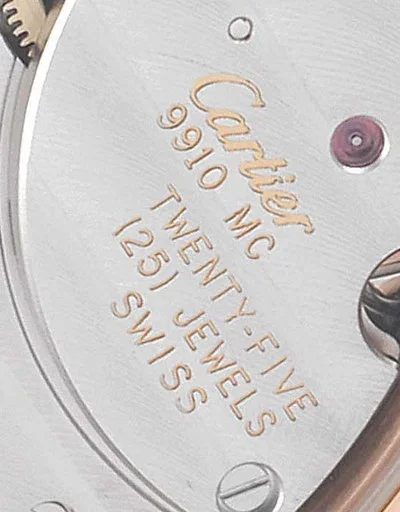

Grande Complication calibre
The first Grande Complication appeared in 2010. The 2015 watch is a different one, with a perpetual calendar, minute repeater and flying tourbillon in a skeletonised automatic calibre, 9406 MC, with a double platinum micro-rotor and the Geneva Seal; it is put at 578 parts and five years of development. A rose gold 45 mm Grande Complication Skeleton (WHRO0065) with the same three complications is described on the automatic 9506 MC, also of 578 parts, with the Geneva Seal and 50 hours, in an edition of 15. The accounts do not say whether the two numbers are one calibre.
9462 MC Astromystérieux
A hand-wound calibre that floats in the dial on four stacked sapphire discs that divide hours, minutes, winding and time-setting with the tourbillon. The 2016 watch is 43.5 mm in 950 palladium, in an edition of 100. The 2021 watch is platinum, with 25 jewels, 21,600 an hour and 55 hours, in an edition of five.
Calibres of the platinum trio
The Mysterious Astrotourbillon is on the 9461 MC (48 hours, 23 jewels, tourbillon above the movement, rotation axis at its centre); the Skeleton Mysterious Double Tourbillon on the 9565 MC (52 hours, 26 jewels, one turn a minute and one every five minutes). Each is a five-piece edition.
Minute Repeater Mysterious Double Tourbillon
A 45 mm repeater with mysterious double tourbillon of 448 parts and 45 jewels with the Geneva Seal, its repeater regulator and hammers visible on the dial side. The 2017 watch is described on the 9407 MC; the rose gold WHRO0061 on the 9507 MC, with 84 hours, in a numbered edition of 20. The accounts do not say whether these are one calibre or two versions.
9801 MC Masse Mystérieuse
An automatic calibre of 43 jewels, 28,800 an hour and 42 hours in which the whole movement is the winding rotor, pivoting round a fixed central gear carried on a sapphire disc and driving the hands through a differential. Platinum, 43.5 mm: 30 plain, 10 baguette-set and 10 fully set with a bracelet.
Astrorégulateur 9800 MC
A calibre of five years' development, with four patent applications, that offsets the effect of gravity on the regulator in vertical positions, in an edition of 50.
Bracelet and strap 1 described
The Rotonde is mostly sold on an alligator strap.
Alligator strap with folding clasp
Alligator straps with a Cartier folding buckle or deployant are described, in gold on the precious-metal models, and several limited series ship with a spare or interchangeable strap in another colour. The deployant lets the strap be sized exactly.
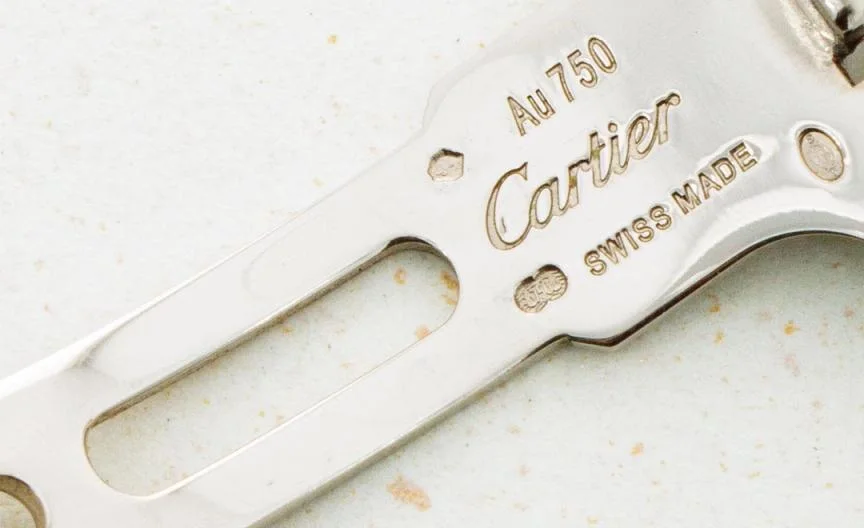

- alligator strap with folding buckle
Reference numbers
A four-digit number is stamped on the case and covers a case; a code beginning W, or the newer letter codes, is a catalogue number for one version of it (metal, dial, strap). Many older watches carry neither. The last column is the listings on record under the number, as its own page counts them.
| Number | What it is | Listings |
|---|---|---|
| W1556368 | Steel Retrograde GMT (Second Time Zone Day/Night), named in an illustrated caption; the most listed reference in the library's records. | 19 |
| W1556240 | Retrograde GMT in rose gold, named in a caption; the number 3771 is given as a reference beside it in the library's records, on a lot described as a calendar with moon phase and power reserve. | 5 |
| W1556369 | Steel Rotonde with a power reserve, as a caption and sellers name it; the literature does not say it is the model of the rose gold calendar and power reserve W1556252. | 16 |
| WSRO0002 | Steel 40 mm Rotonde Chronograph (also written CRWSRO0002). | 13 |
| W1556238 | Rotonde Chronograph in 18k rose gold. | 3 |
| W1556239 | Rotonde Chronograph in white gold with a blue and silver dial, a limited edition. | 5 |
| W1555951 | Central Chronograph in rose gold with a slate dial, 42 mm, hand-wound. | 5 |
| W1556051 | Central chronograph in white gold, as sellers describe it. | 6 |
| W1556252 | Calendar and power reserve watch in rose gold, 40 mm, named in a caption. | 4 |
| W1556202 | Eight-day power reserve watch in white gold, named in a caption. | 4 |
| W1556203 | Eight-day power reserve watch in rose gold, 42 mm, named in a caption. | 4 |
| W1556223 | Rotonde de Cartier Mystery watch (Mysterious Hour) in pink gold, 2013 model. | 3 |
| W1556224 | Rotonde de Cartier Mystery watch (Mysterious Hour) in white gold, 2013 model. | 3 |
| W1556215 | 40 mm flying tourbillon in pink gold. | |
| W1556216 | 40 mm flying tourbillon in white gold. | 1 |
| WHRO0061 | Minute Repeater Mysterious Double Tourbillon, 45 mm, 18k rose gold, edition of 20. | |
| WHRO0060 | Mysterious Hour Skeleton, 42 mm, 18k rose gold. | |
| WHRO0065 | Grande Complication Skeleton, 45 mm, 18k rose gold. | |
| W1556204 | Astrotourbillon in white gold with a guilloché dial, as sellers describe it. | 4 |
| 3308 | Astrotourbillon in 18k rose gold, as sellers describe it. | 2 |
| 3388 | Astrorégulateur in niobium-titanium, a numbered limited edition, as sellers describe it. | 1 |
| 2874 | Platinum limited edition with a tourbillon, perpetual calendar and single-button chronograph, as sellers describe it. | 1 |
| W1556217 | Perpetual calendar, as sellers describe it. | 1 |
| W1556225 | Perpetual calendar chronograph in rose gold, as sellers describe it. | 1 |
| CRW1556209 | Minute repeater with flying tourbillon in titanium, a limited edition, as one seller describes it. | 1 |
| W1580046 | Flying tourbillon in rose gold, as one seller describes it. | 1 |
| WHRO0047 | Skeleton with red enamel, as sellers describe it. | 1 |
| W1553751 | Jumping-hour watch in 18k rose gold, as sellers describe it. | 3 |
| 3574 | Jumping-hour watch in platinum, as a seller describes it. | 4 |
| 3773 | Steel dual-time watch with a day and night indicator and date, as an auction house describes it. | 6 |
| W1550751 | Grand date watch in white gold, as sellers describe it. | 3 |
| 28721 | Collection Privée Day and Night in rose gold, hand-wound, with retrograde minutes and a guilloché dial, as sellers describe it. | 5 |
| 28731 | The same Collection Privée Day and Night in white gold, as sellers describe it. | 3 |
| 2873 | Collection Privée night and day watch in white gold with retrograde minutes, as sellers describe it. | 4 |
| 2872 | Collection Privée watch in rose gold; the one title that carries it says no more. | 1 |
| 2922J | Collection Privée watch in 18k white gold; the one title that carries it says no more. | 1 |
| 2942 | Collection Privée watch in white gold with a digital date display, as an auction house describes it. | 4 |
| W1552851 | Collection Privée watch in white gold with a digital date display and a low individual number, as sellers describe it. | 2 |
Originality
- The Large Date Two Time Zone was first shown with a square date window; the version released has a round one.
Names
- CPCP. The initials of the Collection Privée Cartier Paris, used in sellers' titles for the small-series Rotondes.
- Mystery watch. The hands or the whole movement appear to float with no visible connection to the case.
- Jour et Nuit. The French name of the Day and Night watches.
Where accounts differ
Points on which the published literature and the library's own records do not agree, or on which the literature contradicts itself.
- Edition of the white gold Chronograph. One account says the blue-dial white gold Rotonde Chronograph was made in 500 pieces; another says 300. The library's records show listings of its reference W1556239 but not the number made.
- Size of the central chronograph. One account gives 46.6 mm in pink or white gold for the central chronograph (9907 MC); another gives 42 mm for W1555951. The library's sizes run 35, 37, 40, 40.5, 42, 43, 45, 47 and 50 mm, with 42 mm the commonest, and nothing at 46.6 mm; sellers give 42 mm for the white gold central chronograph W1556051.
- Skeleton Mysterious Double Tourbillon: edition and calibre. One account gives an edition of 30 and calibre 9465 MC; two others give 5 pieces and calibre 9565 MC for the platinum 45 mm watch. They may describe different editions, but neither says so.
- Calibre of the Minute Repeater Mysterious Double Tourbillon. One account gives 9407 MC for the 2017 watch; two others give 9507 MC for the rose gold reference WHRO0061 (448 parts in two others); neither says whether it is the 2017 watch. One of those accounts' text calls the 9507 MC hand-wound and its data table says automatic; it also lists the 9983 MC as automatic in the table, and gives 28,800 an hour in the table for the 9506 MC where its text gives 3 Hz.
- Calibre of the Grande Complication. One account names the 2015 Grande Complication's calibre 9406 MC with a double platinum micro-rotor; two others give 9506 MC, with 578 parts, for the rose gold Grande Complication Skeleton WHRO0065. A 2015 news item in another also gives 578 components for the Grande Complication. No account says whether the two numbers name one calibre.
- Metal of the three newest haute horlogerie models. One account says the three models of 42 and 45 mm are in rose gold and titanium; another says all three are in 18k rose gold and gives no titanium.
- Development of the Astrotourbillon. One account says in 2021 that the Astrotourbillon movement was imagined and developed in 2016 after five years' work, while its own earlier news items present a Rotonde Astrotourbillon and its five-year development much earlier. The accounts do not reconcile the two.
- First mystery clock. Three accounts date the first Cartier mystery clock, the Model A, to 1912; another says the first Pendule Mystérieuse was presented in 1913, and one captions a Model A clock as of 1914. This concerns the clocks before the line, not the Rotonde.
- Stated years before the line began. All the literature dates the Rotonde to 2006 and the Mystery watch to 2013. The library's records include listings stating 1998 for a rose gold Collection Privée day and night watch, 2000 for a reference 2872 Collection Privée watch, reference 28731 with stated years from 2000 to 2010, and a Mystery watch W1556224 with stated years from 2005. Sellers' years are often guesses.
- Edition of the Astrocalendaire. One account gives the platinum Astrocalendaire as a 45 mm limited edition of 100 pieces, while one captions it as limited to five, apparently within its sets of three watches. Neither account says whether the two figures describe different editions.
- Window at 6 on the Chronograph. One account describes the window at 6 on the Rotonde Chronograph as showing the day. Photographs of watches in the library's records, in steel, rose gold and white gold and from several sellers, show a number in that window, the date.
- Year and size of the first flying tourbillon. One account says Cartier presented the flying tourbillon calibre 9452 MC in 2007, in a 47 mm Ballon Bleu case. Most other accounts date the Ballon Bleu Flying Tourbillon to 2008 and one to 2009; its case is given as 47 mm by another account and as 46.5 mm by a third.
In the records
Counted from 216 listings at dealers and auction houses whose title, or whose reference, places them on the line; 124 state a year. These are what sellers state, not measurements, and a count of listings is not a count of watches made.
Case metal
| Metal | Listings | Share |
|---|---|---|
| Gold, any colour | 127 | 64% |
| White | 71 | 36% |
| Pink | 51 | 26% |
| Yellow | 1 | 1% |
| Colour not stated | 4 | 2% |
| Steel | 52 | 26% |
| Platinum | 12 | 6% |
| Titanium | 7 | 4% |
| Palladium | 1 | 1% |
As sellers state it. Shares are of the 199 listings that name a metal. A listing that says "gold" or "18K gold" names no colour: it is counted under "colour not stated", not as yellow gold. Carat, where a listing of gold gives one: 18k 81.
Case size
| Size | Listings | Share |
|---|---|---|
| 42 mm | 97 | 58% |
| 40 mm | 49 | 29% |
| 45 mm | 8 | 5% |
| 47 mm | 6 | 4% |
| 35 mm | 2 | 1% |
| 43 mm | 2 | 1% |
| 37 mm | 1 | 1% |
| 40.5 mm | 1 | 1% |
| Other sizes | 1 | 1% |
As sellers state it. Shares are of the 167 listings that give a size. On a watch that is not round some sellers give the width and some the length, so one watch can stand under two sizes.
Movement
| Kind | Listings | Share |
|---|---|---|
| Hand-wound | 89 | 56% |
| Automatic | 68 | 43% |
| Mechanical, winding not stated | 1 | 1% |
Shares are of the 158 listings whose description says how the watch is driven.
Listings by decade the seller gives
| Decade | Listings |
|---|---|
| 2000s | 17 |
| 2010s | 97 |
| 2020s | 6 |
4 more give a year outside the years the line was made (from 2006): a later watch sold under the name, or a slip. They are left out.