Ballon Bleu
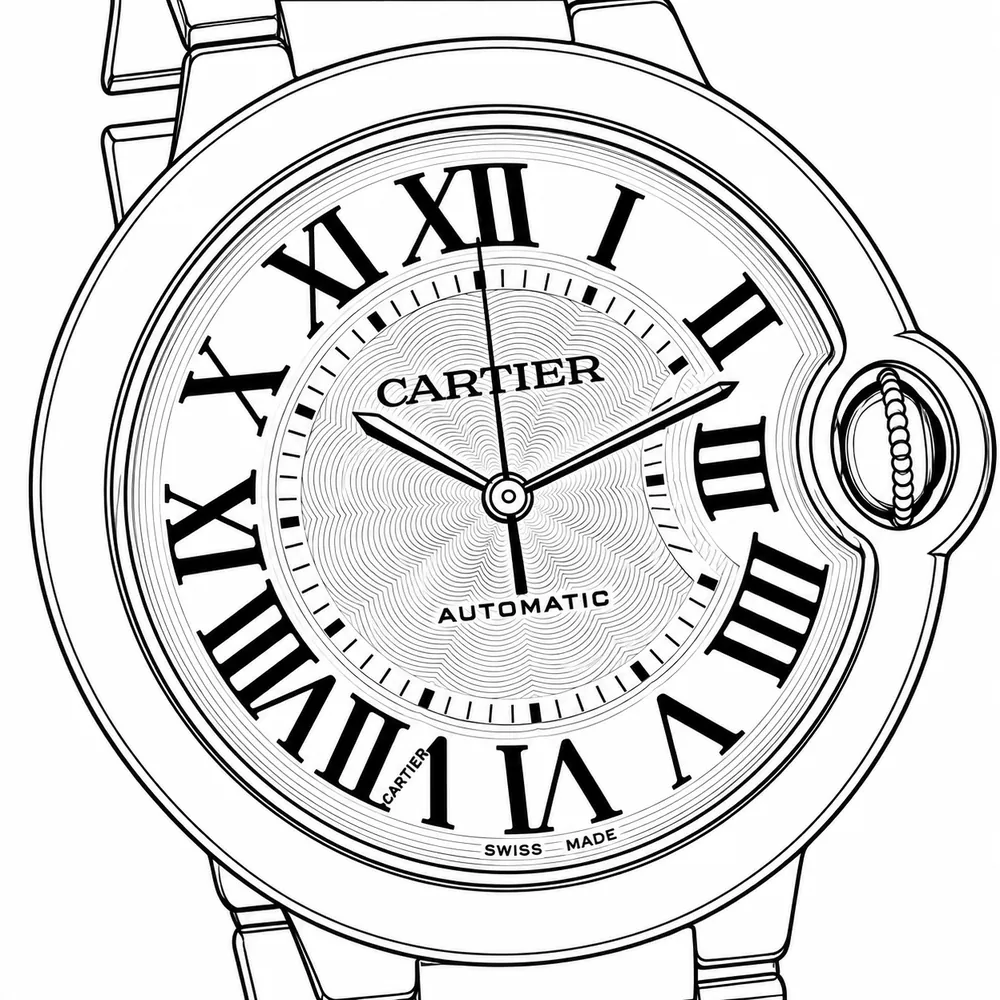
The Ballon Bleu de Cartier is a round watch launched in 2007, unusual for a maker known for rectangular and square cases. The case is a rounded, domed pebble with short lugs, and the crown, set with a blue cabochon, sits inside a protective arc that grows out of the case on the right. The dial keeps Cartier's Roman numerals, railway minute track and blued sword hands. It has been made in steel, two-tone, gold and diamond-set versions, mostly in sizes from 28 mm upward, with quartz and automatic movements. Complicated versions followed from 2008 and 2009. Published accounts disagree on several dates and on which calibre sits in which size.
Cartier's entries are arranged by model, not by reference number, because its reference numbers are several systems at once and many of its watches carry none. The houses are set out in Paris, London and New York.

- Made
- from 2007Nearly every published account gives 2007 for the launch, and the line is still in production; one German-language article's standfirst gives 2000, while its text gives 2007.
- On record
- 1,686 listings151 of them give no reference
- Reference numbers
- 38 described289 seen in listings
What to look for
Details cut from photographs of watches of this line on record. Each was chosen by eye from a listing on the line and then checked again against the words beneath it. More sit beside the productions and parts they belong to, below. Select the small mark in a picture's corner for its holder and a link to its listing.


By house and period 10 described
Core three-hand watch, 2007 onward
This is the central production: a time-only or time-and-date watch with the round pebble case, Roman-numeral dial and blued sword hands. It is described in 28, 33, 36 and 42 mm, with 40 mm added later, and in steel, steel and gold, and yellow, rose and white gold. The automatic versions first used ETA-based movements; in most current watches the movement is stated to be the 1847 MC, made with a Swiss manufacturer owned by the same group. Accounts name different calibres for the 33 and 36 mm sizes, and the point is unsettled. References are catalogue codes beginning W, sometimes written with a CR prefix, or four-digit numbers.
Signature and marks. A secret CARTIER is micro-printed in a numeral: in the VII at seven o'clock on most watches, and sellers place it in the X on the small 28 and 29 mm watches. SWISS MADE is printed at six o'clock on the outer ring of the 36 mm steel watch described. A published account says the caseback is engraved with the Cartier name, the reference, the metal, the water-resistance rating and a serial number; on watches in the library's records steel backs read STAINLESS STEEL, gold backs carry Au 750, and where the words WATER RESISTANT appear no depth is given.
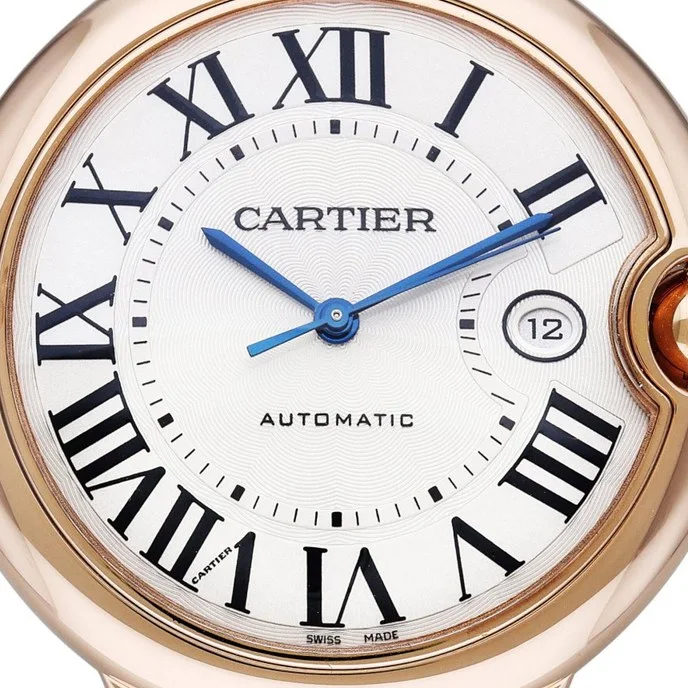

- round domed case with short lugs
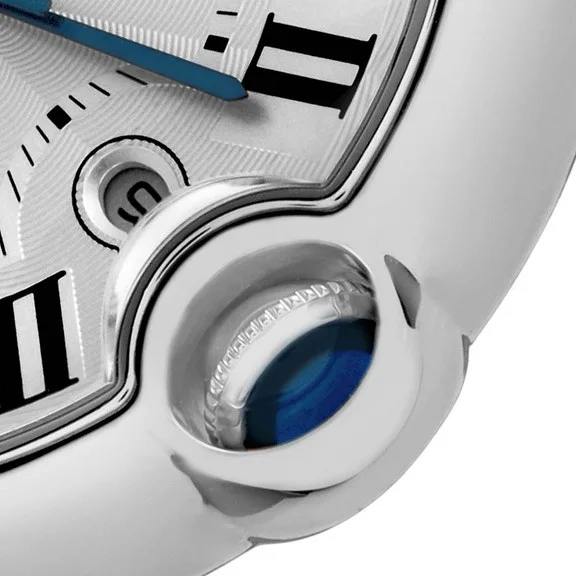
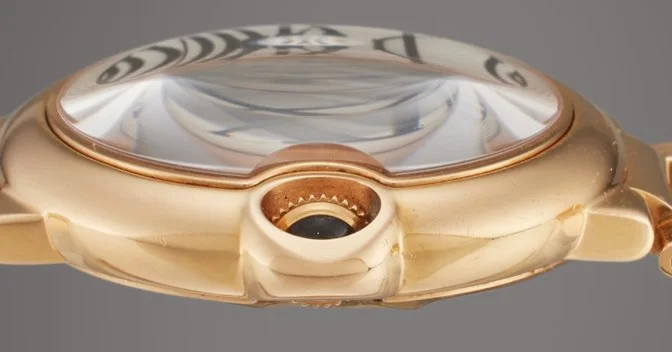
- blue cabochon crown inside an arc machined as part of the case
- heat-blued sword hands
- domed sapphire crystal flush in the bezel
References: W69012Z4, W69009Z3, W6920071, W6920097, WSBB0040, WSBB0044, WSBB0036, WJBB0072, W2BB0003, 2999, 3003, 3001
Quartz
Quartz watches are described in sizes from 28 to 42 mm, with a silver opaline dial, blue steel hands and either a metal bracelet or a leather strap; one account adds a date at three o'clock, but quartz watches photographed in the library's records, of 28 and 36 mm, show no date window. Quartz is said to be used mostly in the smaller watches. One account gives the 28 mm quartz as calibre 057, and sellers' listings of 28 mm quartz watches name it too. One dealer's listings of 28 mm quartz watches give calibre 049, which other sellers and one account give as an automatic in the 42 mm watches. A 28 mm quartz reference, W4BB0030, is described as apparently discontinued by 2026, and all but one 28 mm model is said to have been withdrawn recently, leaving a single steel watch.
Signature and marks. The literature gives none.
- silver opaline dial
- 28 mm case
- battery movement; seconds hand ticks
Diamond-set watches
A diamond-set version is described as sharing the automatic watch's features but with a diamond bezel and diamond hour markers on a silver opaline dial. It is listed in 28 to 42 mm, in steel or rose gold, on leather or on a matching bracelet. One account says it has a mechanical movement, manual or automatic by model, with a power reserve of 38 to 42 hours, and not quartz; the same account also offers diamond-set cases on the quartz watch, another lists diamond-set watches as quartz or automatic, and an auction title in the library's records describes a diamond-set quartz watch. Dials set with diamonds and mother-of-pearl are described for the women's sizes. Sellers' titles use diamond bezel, diamond dial and diamond indexes for different arrangements.
Signature and marks. The literature gives none.
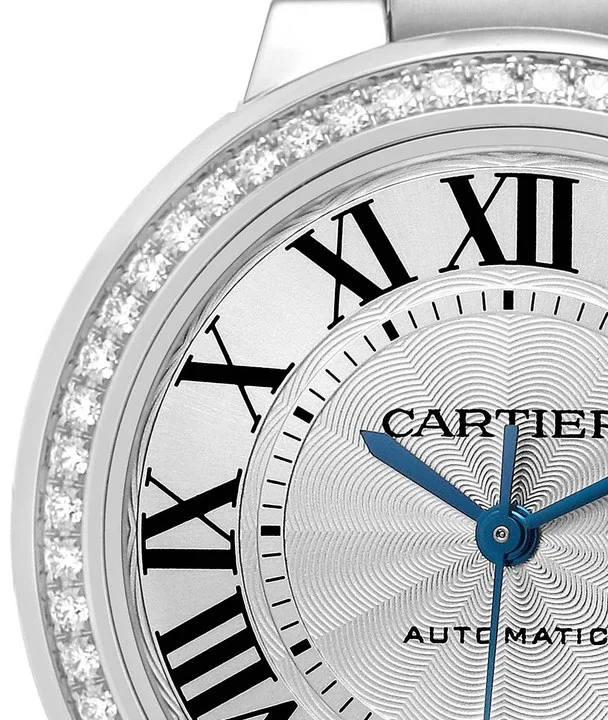

- diamond hour markers in place of numerals
- mother-of-pearl dial on some
References: W4BB0015, W4BB0016, W4BB0017, WE902050, WE902025
Ballon Blanc
The Ballon Blanc is a smaller range, 24 to 30 mm, in steel or rose gold with a fluted crown. In place of the usual Ballon Bleu arrangement a single diamond is set in the case at four o'clock. The dial is silver opaline with Roman numerals and blue sword-shaped hands. The one account that describes it gives an automatic movement and no dates; listings of the range in the library's records, from a dealer and from auction houses, describe it as quartz.
Signature and marks. The literature gives none.
- single diamond set in the case at 4 o'clock
- 24 to 30 mm case
References: WE902057
Tourbillon, 2008 or 2009
Two accounts date a tourbillon to 2008; one of them describes a 46.5 mm case, a flying tourbillon in a cage shaped as a Cartier C, and a partly openworked dial in silver and ruthenium. A third dates the Flying Tourbillon to 2009 and calls it the maker's first tourbillon with an in-house movement, the 9452 MC, certified with the Geneva Hallmark. A fourth describes a deep blue enamel dial with a flinqué pattern, silver sword hands and an opening at the bottom for the carriage, with the hand-wound 9452 MC (19 jewels, 50 hours). The second of the 2008 accounts gives 39 mm for the Flying Tourbillon. Accounts of other Cartier lines mostly give 2008 for the first Flying Tourbillon, though one dates its calibre to 2007; two give the first case as 47 mm, and one says a 39 mm Flying Tourbillon on the same calibre had followed by 2014. On that account these are two watches, a large one and a later, smaller one.
Signature and marks. The literature gives none; one account says the 9452 MC carries the Geneva Hallmark.
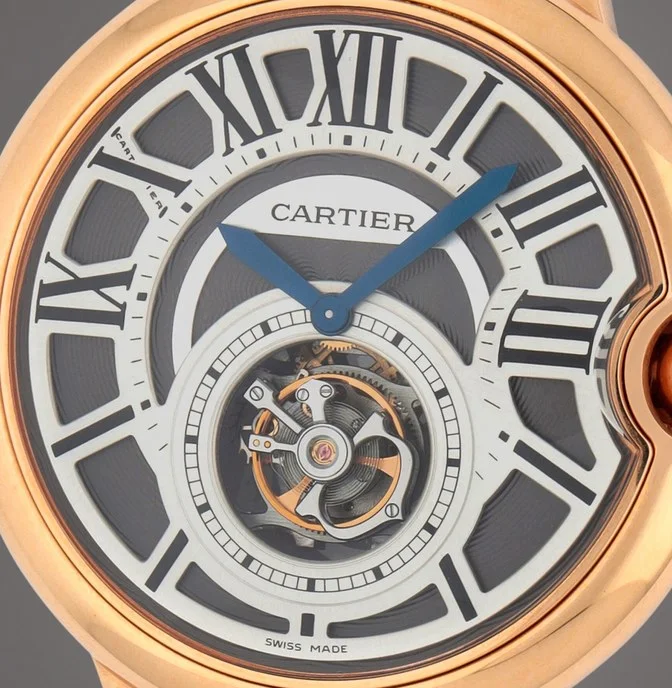

- blue enamel dial on one version
References: 3088
Chronograph, 2009
The chronograph came in two sizes, a 44 mm Large and a 47 mm XL, both about 15 mm thick. Its 30-minute counter is at three o'clock and its seconds counter at six, with an oval date at nine, and the pushers flank the crown arc. The movement is the 8101 MC, built on a Jaeger-LeCoultre base, with a column wheel and vertical clutch; one account gives a 65-hour reserve, two give 42 hours. A 44 mm steel example is given as 14.8 mm thick. The chronograph is described as phased out in recent years.
Signature and marks. The literature gives none; one account describes a sapphire exhibition caseback.
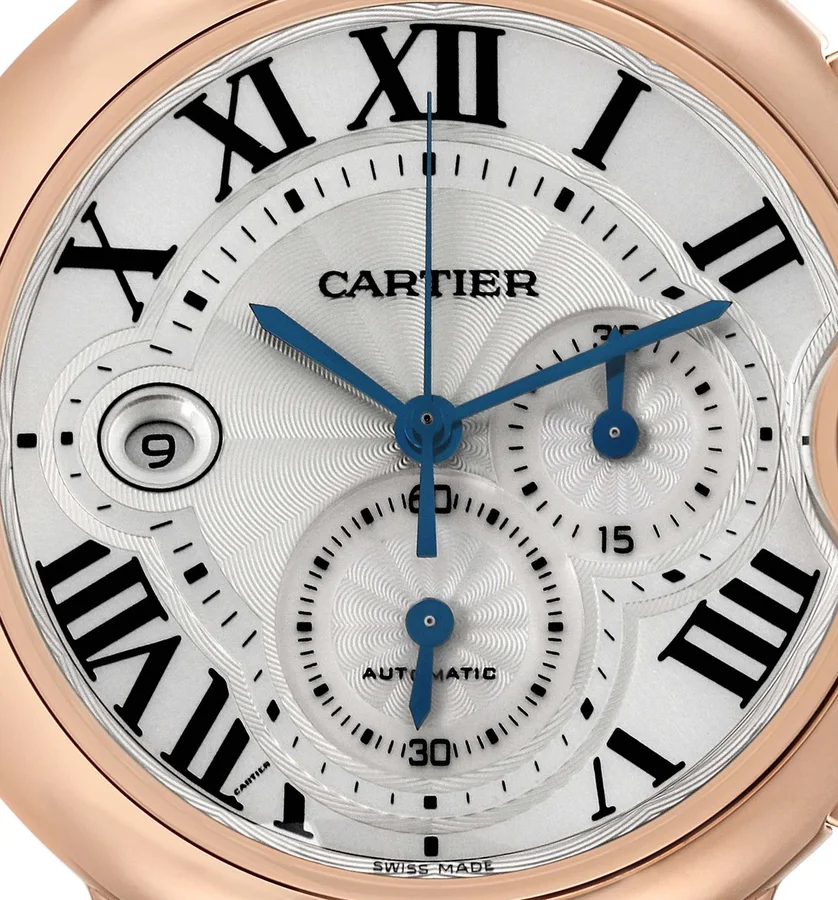

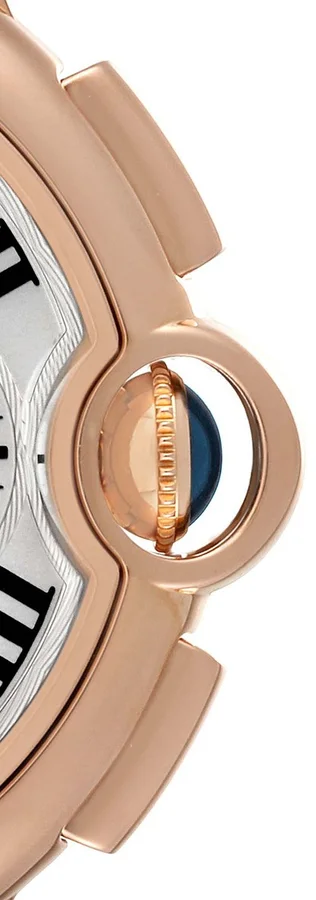

- 44 or 47 mm case about 15 mm thick
References: W6920079, W6920076, W6920009, W6920010, W6920052
ID One concept, 2009
A one-off concept watch built in a Ballon Bleu case, developed in 2009, said to address regulation, lubrication and escapement efficiency with materials new to watchmaking. It was not made in series, and the account doubts that its solutions will reach production.
Signature and marks. The literature gives none.
Extra Flat
The Extra Flat has a 46 mm case but is about 7 mm thick (7.05 mm), against about 13 mm for the standard watch. It uses the hand-wound 430 MC, and the lugs curve slightly. It is in rose and white gold, with a silver guilloche and sunburst dial and black numerals; a platinum reference is the only one with a blue dial. One account puts its introduction two years after the 2009 models; the other accounts give no date.
Signature and marks. The literature gives none.
- 46 mm case about 7 mm thick
- hand-wound
- blue dial on the platinum reference only
Moon-phase, 2016
The first Ballon Bleu moon-phase was a 37 mm watch in steel or pink gold, some with diamond bezels, on an ETA 2671 automatic with a 38-hour reserve. The moon-phase sits in a large aperture at nine o'clock that breaks the curve of the numeral ring. There is no date window, and the III at three is squeezed by the crown arc. One account describes it as available in rose or white gold and shows a steel example, WSBB0021, which sellers list at 37 mm. The dial has blue and yellow accents and alternating guilloche.
Signature and marks. The literature gives none.
- moon-phase aperture at 9
- no date window
- 37 mm case
- compressed III at three
References: WSBB0021
Day/Night, 2025
The Day/Night is a simplified successor to the moon-phase: 36 mm, in red gold with a mother-of-pearl dial or white gold with aventurine, both with a diamond-set bezel and no date. A 24-hour aperture at ten o'clock shows a starlit sky. It uses the 1847 MC.
Signature and marks. The literature gives none.
- aperture at 10 o'clock
- diamond bezel
- no date
Chronology
Specification
| Case | Round domed case with short lugs, domed back, solid screwed caseback; 28, 33, 36, 40 and 42 mm in the regular range, with 36 mm measured by one account at 36.6 mm |
| Crystal | Sapphire, domed on the classic models |
| Crown | Fluted crown set with a blue cabochon, recessed under an arc of the case; described as sapphire by most accounts and as spinel by two, one of them calling it synthetic |
| Dial | Roman numerals, railway-track minute ring running in from the edge, blued sword-shaped hands; silvered, guilloche, coloured, mother-of-pearl and diamond-set versions |
| Movement | Quartz mostly in the smaller sizes; automatic calibres including the 076 (ETA 2671 base) and the 1847 MC; the hand-wound 430 MC and 9452 MC, and the chronograph 8101 MC, in the special versions |
| Bracelet | Steel or gold bracelet with a concealed double-deployant clasp, or leather strap; straps and bracelets described as quick-change |
| Water resistance | 30 m by most accounts; one account says the watch has no water resistance |
Dial 9 described
The dial is laid out around the crown. Roman numerals follow the curve of the case, the minute track runs in from the outer edge, and the three o'clock position gives way to the crown arc. Finishes and colours vary widely; the complications each change the layout.
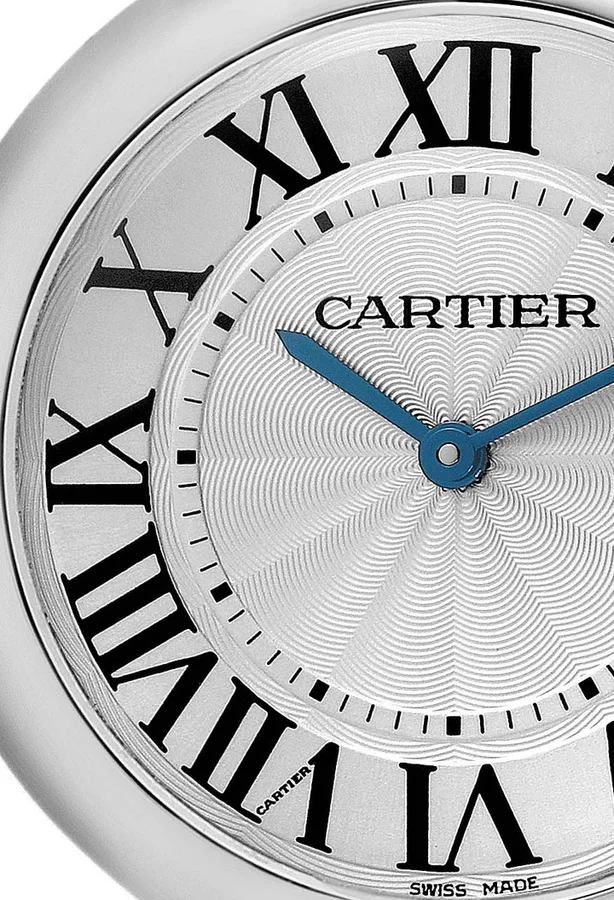
Roman numerals and railway-track minute ring
Roman numerals, slightly curved, sit on a railway-track minute ring that is pulled in from the outer edge rather than running at the rim. Hands are blued steel sword shapes. Applied silvered numerals and diamond-set markers are described as variations.

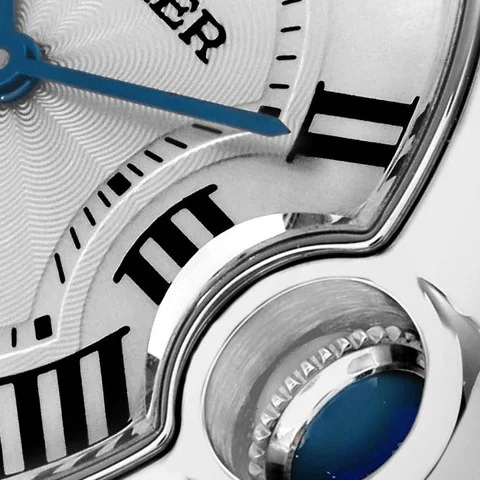
Recess at three o'clock
The minute track and the three o'clock numeral or index bend toward the centre to make room for the oval bulge around the crown. Accounts describe the III as indented, recessed or pushed inward.

Secret signature in a numeral
The word CARTIER is micro-printed in a numeral, visible only under about ten times magnification: in the VII at seven o'clock on most watches, usually in the VII and sometimes in the X by one account, and sellers place it in the X on the small 28 and 29 mm watches. One account says the dial's CARTIER lettering is cut into the dial rather than printed on it.
- tiny CARTIER in a stroke of the VII, or of the X on the small 28 and 29 mm watches
Guilloche and sunburst silvered dial
On the 36 mm steel watch described in one account, the silver opaline dial has a sunburst finish and a guilloche pattern that alternate over the numeral ring, and SWISS MADE is printed on the narrow outer ring at six o'clock. Another account describes a guilloche centre on most dials.
- alternating guilloche and sunburst
- SWISS MADE at 6
Coloured dials
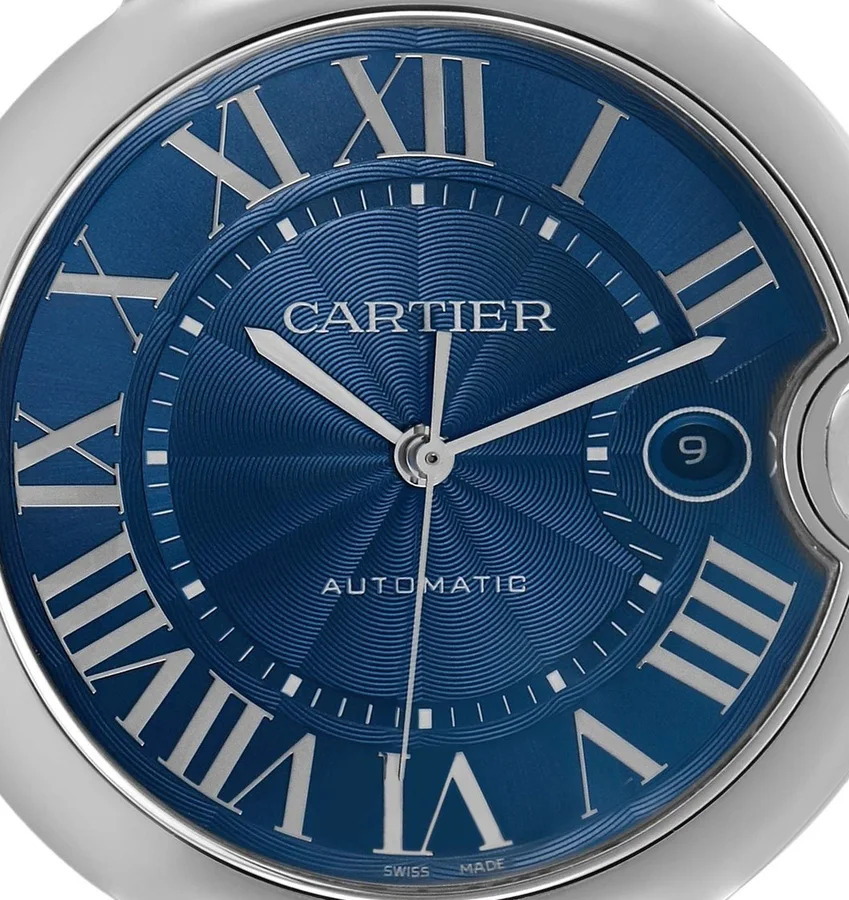
Blue, pink, dark grey, green and red dials are described, as are lacquered blue and enamel blue; sellers also write grey, black and chocolate. One account says the quartz watch comes only with silver opaline.

Mother-of-pearl and diamond dials
A few women's watches are described with mother-of-pearl dials, diamond hour markers or diamond-set dials.
- mother-of-pearl dial
- diamond indexes
Chronograph layout, 2009
The Roman numerals are partly tucked beneath the two registers at three and six, the three o'clock marker is dropped for symmetry, and the date is at nine.
- registers at 3 and 6
- date at 9
Moon-phase layout, 2016
The moon-phase aperture at nine breaks the numeral ring, and the III at three is compressed by the crown arc. The date is dropped.
- moon aperture at 9
Day/Night layout, 2025
A 24-hour aperture at ten o'clock replaces the moon-phase, and there is no date.
- day-night aperture at 10
Hands 2 described
The hands are sword-shaped.
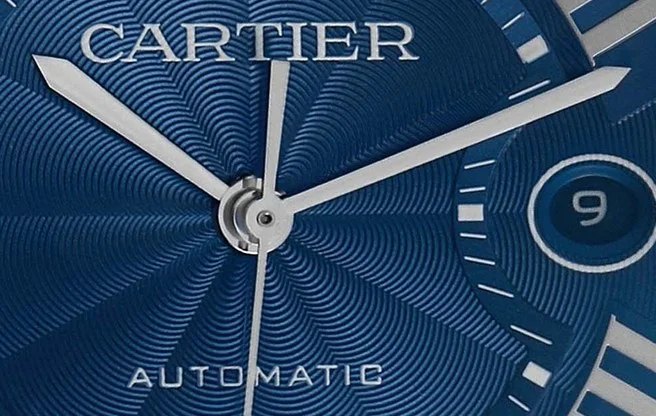
Blued steel sword hands
The hands are heat-blued steel with polished, bevelled edges. One account says genuine blueing moves between royal blue and purple as the light changes and that painted imitations hold a single flat blue; another account from the same source, on Cartier watches generally, says the reverse: genuine thermal blueing holds one even blue and imitations shift toward purple. One account notes the blue is harder to see away from the light.
- polished bevelled edges
White steel hands
The automatic watches are described with a choice of blue or white steel hands. Gold Extra Flat watches are described with dark sword hands.

Case and sizes 7 described
The case is a domed pebble with a short lug-to-lug length. It is described in a large run of sizes, and different accounts list different ones.
Pebble case
The case is rounded and convex in front and behind, with short lugs, a screwed solid caseback and no hard edges. The crown sits inside a bulge on the right. One account gives the 36 mm as about 12.1 mm thick and another gives the standard watch as about 13 mm.
- short lugs
- convex caseback
- single curve in profile
28 and 33 mm
These are the women's sizes in most accounts. The 28 mm is largely quartz and has mostly been withdrawn. A 24 mm to 30 mm range is the separate Ballon Blanc, and one account gives 26 mm as the smallest.
- 28 or 33 mm
36 mm
The 36 mm is called versatile and unisex, and one account measures it at 36.6 mm. Sellers' records hold many listings at 36 and 36.6 mm.
- 36 or 36.6 mm
37, 39 and 40 mm
A 37 mm is the moon-phase and a 39 mm is given for the flying tourbillon, which one account says had been released by 2014, after the larger first watch. A 40 mm was added in 2020 by one account and in 2021 by another. It is said no longer to be in the US range.
- 40 mm automatic
42 mm
The 42 mm is described as the men's size and as the largest in the standard range, with the 1847 MC given for it by two accounts.
- 42 mm
44, 46 and 47 mm
The chronograph is 44 mm (Large) and 47 mm (XL). The Extra Flat is 46 mm. The first tourbillon is 46.5 mm in one account and 47 mm in two others. One account says the original line ran from 28 mm to 46 mm; others put the 46 mm in the Extra Flat.
- 44 to 47 mm
Metals
Steel, steel with yellow or rose gold, and yellow, rose and white gold are described, with platinum for an Extra Flat reference and limited-edition platinum watches. Black PVD-coated steel watches and a Carbon line with a carbon-based coating are mentioned, without dates, references or sizes. Steel and yellow gold watches have a yellow gold crown under the steel arc.
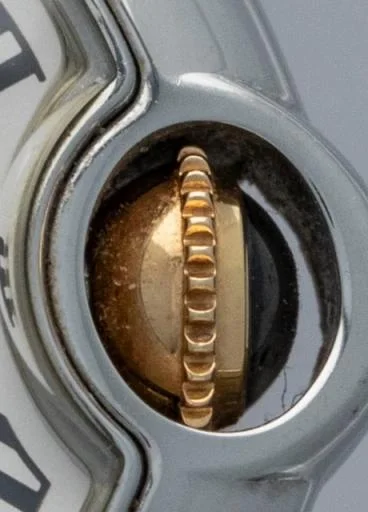

- black coated case
Crown 1 described
The crown is the watch's best-known part.
Blue cabochon inside an arc
A fluted crown carries a blue cabochon recessed under an arc of case metal that extends from the case. Most accounts call the stone a sapphire; two call it spinel, one of them synthetic spinel. The arc is cut from the case itself; counterfeits fit it as a separate piece, and the join shows.
- no seam between arc and case
- cabochon not standing proud
- crown drops under the arc when pushed in
Crystal 1 described
The crystal is sapphire.
Domed sapphire crystal
The crystal is sapphire, gently domed on the classic watches and flush in the bezel. The caseback is also domed.
- domed crystal flush with the bezel
Date 1 described
Date placement depends on the model.
Oval date beside the crown
The date window on the three-hand watch is oval and next to the crown. One account describes the quartz watches with the date at three, though quartz watches photographed in the library's records have no date. It is at nine on the chronograph and dropped on the moon-phase and Day/Night.
- oval date at three
Movement 9 described
The movement depends on size and version. Published accounts disagree about which calibre belongs to which size.
Calibre 076 (ETA 2671 base)
The 076 is an automatic based on the ETA 2671, 17.2 mm across and 4.8 mm high, with 25 jewels, 4 Hz and a 38-hour reserve, Glucydur balance, Incabloc shock protection and Etachron regulator. It is described in the 36 mm steel watch, and in one account in the 33 mm; sellers' listings give it for both sizes.
Calibre 049
One account gives the 049 as an automatic with about 38 hours in the 42 mm watches, and most listings in the library's records that name it agree, from several sellers and auction houses. One dealer's listings of 28 mm quartz watches also give calibre 049.
Calibre 057 quartz
One account gives the 28 mm quartz as calibre 057.
Calibre 1847 MC
The 1847 MC is an automatic with 23 jewels, 4 Hz and about 42 hours (one account says 40). It is described as made with a Swiss manufacturer owned by the same group, replacing the earlier ETA-based movements in most current watches. It is given for the 42 mm, for the Day/Night, and by one account for the 36 mm.
Calibre 1853 MC
One account gives the 1853 MC as the automatic in the 33 and 36 mm watches.
Calibre 1904-PS MC
One account gives a 42 mm in-house version with the 1904-PS MC and a 48-hour reserve.
Calibre 430 MC
The 430 MC is a hand-wound extra-thin calibre, said to have been developed in 1996, used in the Extra Flat.
Calibres 9452 MC and 8101 MC
The hand-wound 9452 MC powers the flying tourbillon and the 8101 MC the chronograph.
ETA 2671 in the moon-phase
The 2016 moon-phase uses the ETA 2671, an automatic with a 38-hour reserve.
Bracelet and strap 2 described
Metal bracelet or leather strap, both described as interchangeable.
Steel or gold bracelet
The bracelet mixes polished and brushed links and closes on a concealed double-deployant clasp engraved Cartier. End links follow the case closely. The straps are described as quick-change.
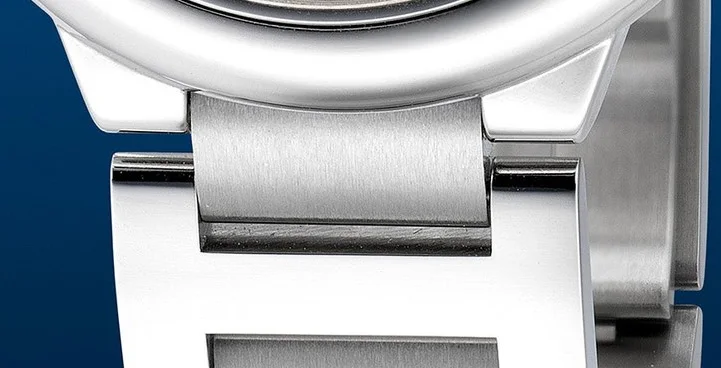

- engraved clasp
Leather strap
A leather strap, including crocodile, is described as the alternative.
Reference numbers
A four-digit number is stamped on the case and covers a case; a code beginning W, or the newer letter codes, is a catalogue number for one version of it (metal, dial, strap). Many older watches carry neither. The last column is the listings on record under the number, as its own page counts them.
| Number | What it is | Listings |
|---|---|---|
| W69012Z4 | 42 mm steel on a steel bracelet, silver Roman dial, date at three; paired with 3001 and an automatic 049 in one account; the library's records usually hold it as stainless steel. | 64 |
| W69009Z3 | 42 mm steel and yellow gold, silver dial with date at three; one account gives it the automatic 049 and pairs it with 3001, the same four-digit number as the steel watch. | 23 |
| W69010Z4 | 28 mm steel with a silver dial, as sellers describe it, with quartz; its listings are usually stainless steel. | 65 |
| W69007Z3 | 28 mm steel and yellow gold, as sellers describe it; the records hold it as two-tone. | 77 |
| W69011Z4 | 36 mm steel with quartz, as sellers describe it; one auction title describes a diamond-set example on a bracelet. | 31 |
| W6920071 | 33 mm steel, from one account's photograph caption and text. | 26 |
| W6920097 | 33 mm rose gold, from one account's photograph caption. | 8 |
| W6920034 | 28 mm steel and gold with a quartz movement, from a seller's listing; one dealer listing gives 42 mm. | 25 |
| W6920079 | 44 mm steel chronograph, 14.8 mm thick, 8101 MC, 30-minute register at three and seconds at six, date at nine. | |
| W6920076 | 44 mm chronograph, as one dealer's caption gives it. | 2 |
| W6920009 | Chronograph XL, as one seller's title gives it. | 1 |
| W6920010 | Rose gold chronograph, as one seller's title gives it. | 2 |
| W6920052 | Given in one dealer's description as a 44 mm steel automatic with a silvered guilloche dial; listings in the library's records describe it as a steel chronograph, some as the XL. | 10 |
| WSBB0021 | Steel moon-phase automatic (ETA 2671), from one account's photograph caption. | 5 |
| WSBB0040 | 40 mm steel, from one account's caption; the 40 mm size was added in 2020 or 2021. | 4 |
| WSBB0044 | 33 mm steel with a silver Roman dial, as one listing gives it. | 7 |
| WSBB0036 | 36 mm, named as one of the modern core references. | |
| WJBB0072 | 42 mm, named as one of the modern core references. | |
| W2BB0003 | Given as 42 mm steel with a silvered dial in a list of current references; listing titles in the library's records give 36 mm steel and rose gold, and another published account a 37 mm steel moon-phase. | 3 |
| WSBB0046 | 33 mm steel, automatic; a list of current references gives a silvered guilloche dial, while listing titles give a pink dial. | 7 |
| WSBB0048 | 36 mm steel, silvered guilloche dial, automatic, in one list; another account's caption calls it a red-dial steel ladies' watch, while listing titles in the library's records give a silver dial. | 6 |
| WSBB0025 | 36 mm steel with a blue dial, automatic, from a list of current references; listings in the library's records give 42 mm. | 9 |
| WE902077 | 36 mm steel and rose gold, silvered dial, automatic, in one list; sellers list it as a 33 mm steel and rose gold watch with diamond hour markers. | 17 |
| W4BB0016 | 33 mm steel with a diamond bezel, ladies', from one account's caption. | 11 |
| W4BB0015 | Steel with a diamond bezel, ladies', as one seller's title gives it. | 17 |
| W4BB0017 | 36 mm steel with a diamond bezel, ladies', as one seller's title gives it. | 9 |
| WE902050 | 28 mm rose gold with diamonds, ladies', from one account's caption. | 9 |
| WE902025 | 28 mm rose gold with a diamond dial, from one account's caption. | 4 |
| WE902057 | Ballon Blanc, rose gold with mother-of-pearl and diamonds, from one account's caption. | 2 |
| W4BB0030 | 28 mm quartz, described as apparently discontinued by 2026. | |
| 3088 | Rose gold flying tourbillon, as one auction title gives it. | 3 |
| 2999 | 42 mm in 18 carat rose gold, called Large, as sellers describe it. | 14 |
| 3000 | 42 mm in 18 carat white gold, from one listing. | 2 |
| 3003 | 36 mm in 18 carat rose gold, automatic, as one seller's title gives it. | 15 |
| 3009 | 28 mm quartz, as one dealer describes it. | 17 |
| 3006 | 28 mm in 18 carat gold, from one listing. | 7 |
| 3001 | A four-digit number paired in one account with both the steel W69012Z4 and the two-tone W69009Z3, both 42 mm; a dealer listing also gives 42 mm; the library's records hold it mostly as stainless steel, with some titles describing steel and gold. | 24 |
| 3284 | Four-digit number held as stainless steel, seen beside catalogue codes W2BB0012, WE902031, W6920046 and W6920033 in the library's records. Catalogue codes seen beside it in listings: W6920033, W6920046, WE902031, W2BB0012 | 22 |
Originality
- The reference engraved on the caseback should agree with the watch's size, metal and dial colour; a mismatch points to mixed parts or a counterfeit.
- A crown arc that shows a join with the case, or a crown that stands proud of the arc, is described as a sign of a counterfeit.
- Published accounts disagree on how genuine blued hands look: one says they change shade with the light and painted ones do not, another says genuine blueing stays one even blue and painted hands shift toward purple.
Names
- Blue balloon. The French name translates this way, from the rounded case and the blue crown inside its ring.
- Ballon Bleu de Cartier. The full name used by the maker and by most dealers.
- Midsize. Sellers write this for 33 and 36 mm watches.
Where accounts differ
Points on which the published literature and the library's own records do not agree, or on which the literature contradicts itself.
- Year of launch. One German-language article's standfirst gives 2000 for the launch while its own text gives 2007, like every other page. In the library's records some references carry seller-stated years from 2000 to 2005, before 2007. A seller's year is often a guess.
- Year the 40 mm was added. One account puts the 40 mm in 2020 and calls its movement 1847 MV; another puts it in 2021.
- Date and size of the tourbillon. Two accounts give 2008 for a tourbillon; one of them gives a 46.5 mm case, the other 39 mm for the Flying Tourbillon. A third gives 2009 for the Flying Tourbillon. The dials described also differ: silver and ruthenium openworked on one, deep blue enamel on another.
- Chronograph power reserve. One account gives 65 hours for the 8101 MC; two give 42 hours.
- Calibre 049. One account gives the 049 as an automatic in the 42 mm watches, as most listings naming it in the library's records do; one dealer's listings give calibre 049 for 28 mm quartz watches.
- Movements by size. The 33 and 36 mm watches are given the 076, the 1853 MC or the 1847 MC by different pages.
- The crown stone. Most accounts say sapphire cabochon; two say spinel, one of them synthetic spinel.
- Water resistance. One account says the watch has none; the others give 30 m.
- Sizes at launch. One account says the 2007 range ran from 28 to 46 mm, whereas others give 46 mm to the later Extra Flat; one gives 33 mm as the smallest automatic and another 26 mm as the smallest size.
- WE902077 size. A list of current references gives 36 mm; the library's seller titles give 33 mm.
- How genuine blued hands look. The site's Ballon Bleu guide says genuine heat-blued hands shift between royal blue and purple and painted fakes stay one flat blue; its general Cartier guide says genuine thermal blueing holds one even blue and painted or plated hands shift toward purple.
- Movement of the diamond-set watches. One account says the diamond-set line is mechanical rather than quartz, though it offers diamond-set cases on its quartz watch; another lists diamond-set watches as quartz or automatic, and an auction title in the library's records describes a diamond-set quartz W69011Z4.
- In-house or ETA and Sellita movements. One account says most current automatics use the 1847 MC, made with ValFleurier, in place of the earlier ETA-based movements; another says the volume Ballon Bleu runs Cartier-modified ETA and Sellita bases rather than manufacture calibres.
- Ballon Blanc movement. One account gives the Ballon Blanc an automatic movement; the listings of the range in the library's records, from a dealer and auction houses, give quartz.
- References in a list of current models. A list of current references gives W2BB0003 as 42 mm steel with a silvered dial; listing titles in the library's records give it as 36 mm steel and rose gold, and another saved guide as a 37 mm steel moon-phase. The same list gives WSBB0046 a silvered guilloche dial and WSBB0025 a 36 mm case; listing titles give WSBB0046 a pink dial and WSBB0025 42 mm.
- Date on the quartz watch. One account describes the quartz watch with a date window at three o'clock. The quartz watches photographed in the library's records, of 28 and 36 mm and from several sellers and auction houses, have no date window.
- Caseback engraving. One account says a genuine caseback carries ACIER or the metal and the water-resistance rating. Backs photographed in the library's records read STAINLESS STEEL on steel and Au 750 on gold, and, where the words WATER RESISTANT appear, no depth.
- The first Flying Tourbillon in accounts of other lines. Accounts of other Cartier lines mostly date the first Ballon Bleu Flying Tourbillon to 2008, and a news item on it is dated October 2008; one account dates its calibre, the 9452 MC, to 2007. Two accounts give the first case as 47 mm, against 46.5 mm in one account of the Ballon Bleu, and one says a 39 mm Flying Tourbillon on the same calibre had followed by 2014.
In the records
Counted from 1,686 listings at dealers and auction houses whose title, or whose reference, places them on the line; 737 state a year. These are what sellers state, not measurements, and a count of listings is not a count of watches made.
Case metal
| Metal | Listings | Share |
|---|---|---|
| Steel | 585 | 42% |
| Gold, any colour | 434 | 31% |
| Pink | 289 | 21% |
| White | 64 | 5% |
| Yellow | 53 | 4% |
| Colour not stated | 28 | 2% |
| Steel and gold | 361 | 26% |
| Silver | 3 | under 1% |
| Platinum | 1 | under 1% |
As sellers state it. Shares are of the 1,384 listings that name a metal. A listing that says "gold" or "18K gold" names no colour: it is counted under "colour not stated", not as yellow gold. Carat, where a listing of gold gives one: 18k 128.
Case size
| Size | Listings | Share |
|---|---|---|
| 33 mm | 301 | 21% |
| 28 mm | 300 | 21% |
| 36 mm | 252 | 18% |
| 42 mm | 232 | 16% |
| 36.6 mm | 66 | 5% |
| 29 mm | 54 | 4% |
| 40 mm | 44 | 3% |
| 44 mm | 41 | 3% |
| Other sizes | 128 | 9% |
As sellers state it. Shares are of the 1,418 listings that give a size. On a watch that is not round some sellers give the width and some the length, so one watch can stand under two sizes. 3 more give a figure outside 12 to 56 mm, which is a strap, a box or a slip, and are left out.
Movement
| Kind | Listings | Share |
|---|---|---|
| Automatic | 766 | 63% |
| Quartz | 412 | 34% |
| Hand-wound | 35 | 3% |
| Mechanical, winding not stated | 3 | under 1% |
Shares are of the 1,216 listings whose description says how the watch is driven.
Listings by decade the seller gives
| Decade | Listings |
|---|---|
| 2000s | 92 |
| 2010s | 467 |
| 2020s | 165 |
13 more give a year outside the years the line was made (from 2007): a later watch sold under the name, or a slip. They are left out.