Pasha de Cartier
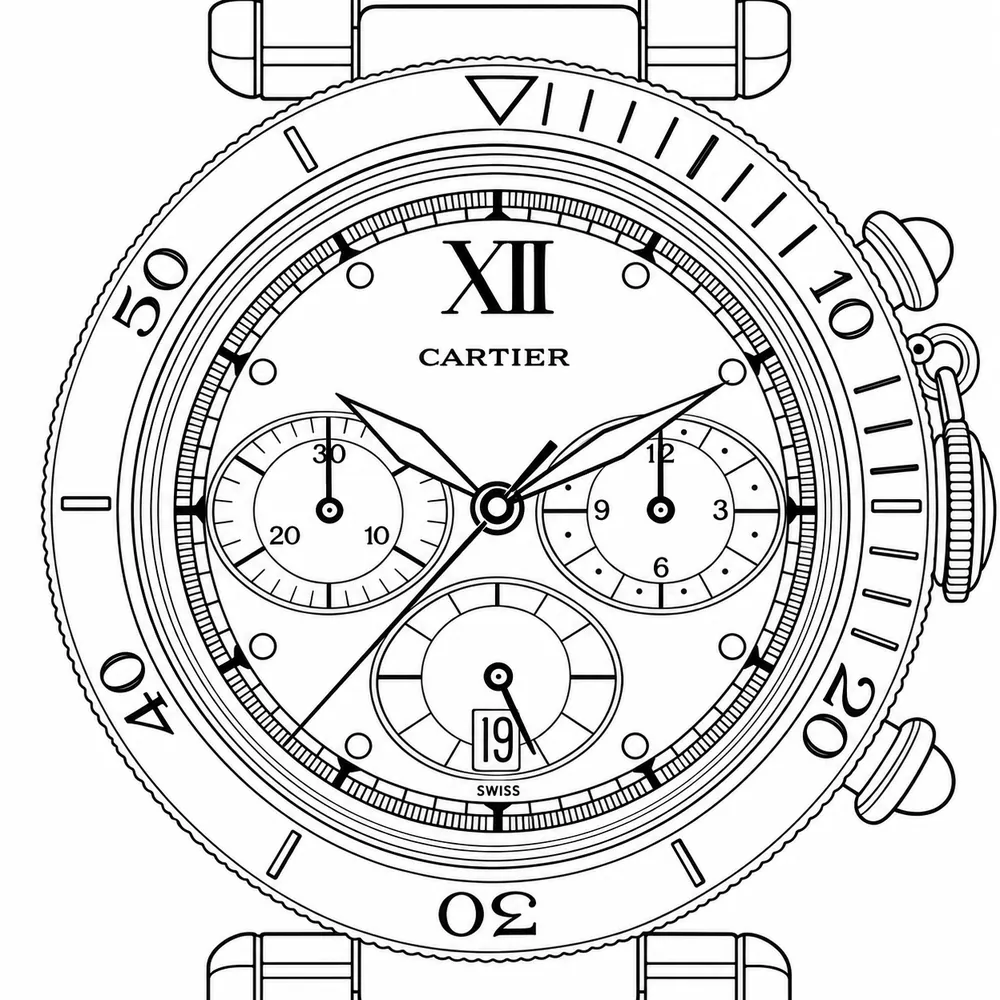
The Pasha de Cartier is a round watch with a screw-down cap over the crown, held to the case by a small chain, a square minute track inside the circle of the dial and four large Arabic numerals. It was launched in 1985 in yellow gold at 38 mm, became a broad range of steel, gold, chronograph, calendar and complicated watches, left the collection around 2011 or 2012, and returned in 2020 at 41 mm and 35 mm. Published accounts trace its look to a water-resistant watch with a dial grille photographed in 1943 and disagree on the older story of a watch made for the Pasha of Marrakesh. The Pasha C and the Pasha Seatimer have their own entries.
Cartier's entries are arranged by model, not by reference number, because its reference numbers are several systems at once and many of its watches carry none. The houses are set out in Paris, London and New York.

- Made
- from c. 1985Published accounts agree on 1985 for the launch; the end of the first run is put at about 2011 or 2012, and the line returned in 2020.
- On record
- 1,563 listings431 of them give no reference
- Reference numbers
- 53 described292 seen in listings
- House named in the title
- Paris 6, London 1the line is later than the three houses; a title naming one is quoting the dial
What to look for
Details cut from photographs of watches of this line on record. Each was chosen by eye from a listing on the line and then checked again against the words beneath it. More sit beside the productions and parts they belong to, below. Select the small mark in a picture's corner for its holder and a link to its listing.


By house and period 7 described
Gold Pasha, from 1985
The Pasha de Cartier was shown in 1985 as a round 38 mm watch in yellow gold, large for a man's watch of its day and unlike the rectangular and oval shapes Cartier was known for. Early production is described as very limited and sold only through Cartier's own boutiques. The first watches had a broad bezel, Vendôme lugs, a sealed case back and a date window without a magnifier. The first generation grew to include chronographs, GMT watches, a moon phase and a perpetual calendar; published accounts also list a golf watch, a minute repeater with perpetual calendar, dated to 1990 in one account and catalogued from about 1987, and a diver with a one-way bezel. Both quartz and automatic movements were used, the automatic ones often based on ETA calibres. A yellow gold watch with a grille over the dial and a five-link Figaro bracelet is the version collectors single out; the bracelet was available only briefly. Published accounts do not name a case maker, and they disagree on the part played by the designer, who is credited with the look in most accounts and with a movement in one.
Signature and marks. The literature gives no dial signature. The catalogued automatic perpetual calendar (0975) has its reference on the case back with a case number in an M or MG series; the minute repeater (W30012) carries its reference with a small individual number in place of a serial.
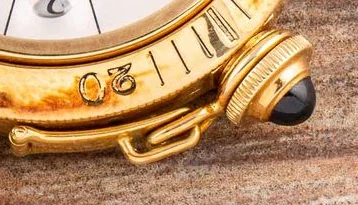

- 38 mm round yellow gold case
- square minute track with four Arabic numerals, or Roman numerals on some
- date window with no magnifier, at 4 o'clock in the first watches
- five-link Figaro bracelet with hidden clasp on early gold watches
- luminous hands in the 1980s watches
References: 820901, 820903, 820904, 1021, 0975, W30012, W30026, 30003, 0570, 30010
Steel Pasha, from 1990
In 1990 the Pasha was made in steel for the first time, keeping the 38 mm size, the screw-down crown cover and the choice of bezels of the gold watches. A published account describes the movement as an ETA calibre that is easy to service. Catalogues list steel chronographs, a grille version and a 36 mm size in later years; the 35 mm Pasha C is dealt with in its own entry. The library's records show steel as the commonest case material for the line.
Signature and marks. Not given in the literature.

- 38 mm steel case
- bezel options as on the gold watches
150th anniversary edition, 1997
For Cartier's 150th anniversary in 1997 a steel Pasha was made with a grille over the dial and a red spinel in the crown cap, limited to 1847 pieces. One account says its movement was finely decorated and that a regular steel version with a blue spinel came shortly afterwards; another calls it the first steel Pasha with a grille, says it sold out quickly, and says a serially made steel grille Pasha followed. A third account mentions a 1997 Pasha with a diver's bezel and a gold grille, and does not say whether it is the same watch.
Signature and marks. Not given in the literature.
- steel case with grille
- red spinel in the crown cap (limited edition) against blue in the regular watch
- limited to 1847 pieces
Collection Privée Cartier Paris, 1998 to 2008
The Collection Privée Cartier Paris was a run of limited watches, typically of a hundred pieces or fewer, and the Pasha was part of it, mostly in complicated forms such as a perpetual calendar. One account singles out two Pashas of the series as the most desirable: the tourbillon and the Day & Night. Four tourbillon editions were made, each described as limited to ten pieces, with a semi-skeletonised tourbillon on a three-bridge movement from Girard-Perregaux. The Day & Night, limited to twenty in yellow gold, reads the hours on a single central hand with a sun at one end and a moon at the other, over a clous de Paris dial, on a reworked Frédéric Piguet calibre; another account calls it a jumping-hour watch with a day and night indicator. The 38 mm case suited the depth of the tourbillon movement. One account says the series used calibres from other makers in the same group, Cartier not yet making its own; another speaks of in-house calibres developed with Frédéric Piguet and Girard-Perregaux. Listing titles in the library's records that name the Collection Privée include references 2406, 2495, 2508 and 2578.
Signature and marks. Not given in the literature, beyond a double-C logo laid over the dial of the first tourbillon. In the library's records, three auction titles for limited Pashas (a Day and Night numbered 15, a jumping-hour Jour et Nuit numbered 07/25 and a tourbillon numbered 18/20, reference 2628) read 'signed Cartier, Paris'; none of the three is titled Collection Privée.
- semi-skeletonised tourbillon
- blued hands and double-C logo in pink gold across the dial (1998)
- bridge shaped like the square minute track over the tourbillon (1999 onward)
- blue enamel inset in the logo (2000)
- one central hand with sun and moon ends on a clous de Paris dial (Day & Night)
Pasha 42 and the last complications, from 2005
The 42 mm Pasha was brought out in 2005 for the twentieth anniversary of the line, four millimetres larger than the original. A published account gives it the calibre 8000 MC, made for Cartier by Jaeger-LeCoultre, and says the dial gained a little guilloché while keeping the circle around a square and the Arabic numerals. Models in gold were followed by models in steel, and more complicated Pashas were released up to about 2012. At the end two 46 mm watches are named, a skeletonised flying tourbillon and an eight-day tourbillon chronograph. The end of the run is not agreed: about 2011 in one account, 2012 in two, and a few years after about 2012 in another.
Signature and marks. Not given in the literature.
- 42 mm case
- square track and Arabic numerals, with guilloché on some dials
References: W31072M7
Relaunch, from 2020
The Pasha returned in 2020, after an absence of eight to ten years by the accounts, in 41 mm and 35 mm sizes and in steel and several golds, presented as a watch for men and women. The three-hand watches use the manufacture calibre 1847 MC, an automatic at 4 Hz with about 40 hours of reserve (42 in one account), behind a sapphire case back. They have blued hands, sword-shaped in most accounts and diamond-shaped in one, a date between 4 and 5 without a magnifier on the 41 mm (the 35 mm has no date), and on the steel 41 mm a stamped guilloché silvered dial that darkens towards the edge and a flat bezel that does not rotate. A small plate under the crown cap can be engraved, and a second cabochon beneath the cap helps with handling the crown. The strap and bracelet attach through QuickSwitch and the bracelet is sized with SmartLink. The collection was announced as not limited in number. Skeleton watches (9624 MC) and skeleton tourbillons (9466 MC), one diamond-set, were shown at the same time.
Signature and marks. Not given in the literature.
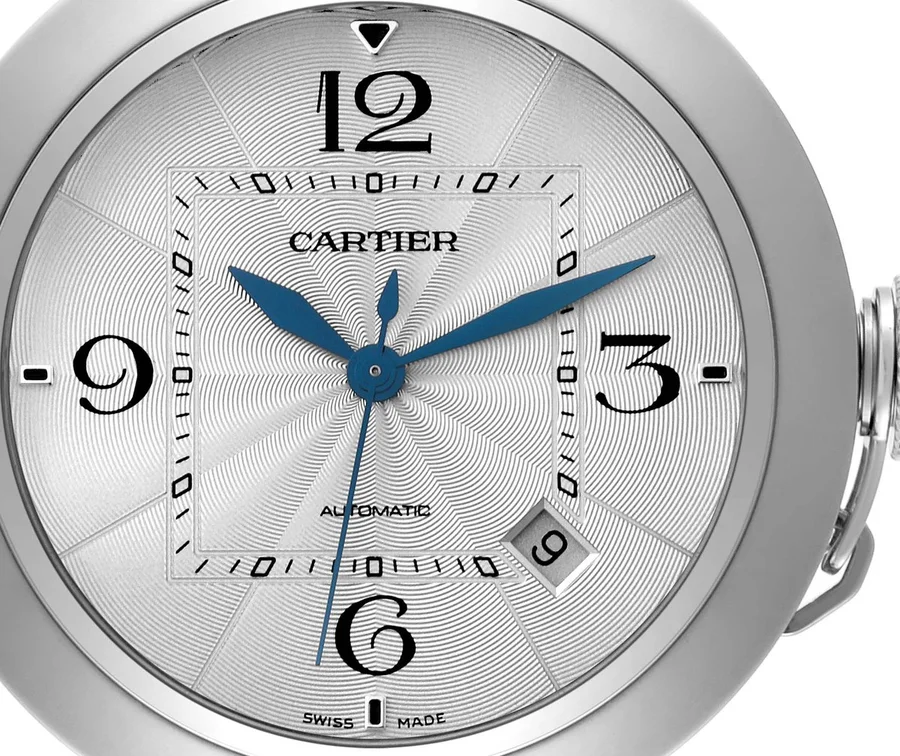

- 41 mm or 35 mm case with sapphire back
- blue synthetic spinel in the crown cap, a second cabochon underneath
- blued sword hands
- engraving plate beneath the cap
References: WSPA0009, WSPA0010, WSPA0012, WJPA0013, WSPA0040, WSPA0045, WSPA0046, WHPA0007, WHPA0006, HPI01435, WHPA0010, WJPA0015, WJPA0014
Additions of 2021 and 2022
In 2021 a 30 mm quartz Pasha, in steel or gold with or without diamonds, and a 41 mm chronograph were added. The chronograph uses calibre 1904-CH MC and has a rotating graduated bezel, two pushers with cabochons, three subdials and a date at about 4.30; it drops the square minute track and keeps only a stylised Arabic 12. In 2022 came a removable grille, made with a system of four small pawls, in all-gold at 41 mm and in diamond-set versions at 30 and 35 mm, and charms in the shape of a double C, a heart and an eye that clip to the crown cap. The same year brought a moon phase on calibre 1904 LU MC in rose gold and in steel, and a black-coated steel skeleton, its calibre given as the automatic 9624 MC in one account and as the 9524 MC in another, and a limited white gold version set with 2.95 carats of diamonds. A flying tourbillon (9552 MC) in pink gold at 41 mm has its crown wound directly, without unscrewing the cap. Owners of the earlier 41 mm yellow gold watch could exchange the bezel for the new grille version.
Signature and marks. Not given in the literature.
- removable grille on the 41 mm yellow gold watch
- clip-on charms on the crown cap
- chronograph with rotating graduated bezel and no square track
- moon phase dial with a night-blue planisphere
References: WJPA0039, WJPA0033, WJPA0019
Chronology
Specification
| Case | Round; 38 mm in the first watches of 1985; later 35, 36, 42 and 46 mm in published accounts, and 41, 35 and 30 mm from the 2020 relaunch; Vendôme lugs |
| Case material | Yellow gold at launch; steel from 1990; other golds, diamond-set versions and a black-coated steel case in later years |
| Crown | Screw-down cap with a sapphire or synthetic spinel cabochon, tethered by a chain; the crown itself sits beneath |
| Dial | Square railway minute track within a round dial; four Arabic numerals at 12, 3, 6 and 9 in published accounts, though some time-only watches in the library's records have Roman numerals instead; blued hands in the 2020 watches |
| Movement | Quartz and automatic in the range of 1985 to about 2012, many automatics on ETA calibres; manufacture calibre 1847 MC (automatic) in the 35 and 41 mm time-only watches from 2020, quartz in the 30 mm |
| Water resistance | 100 m for the 1985 watch and, as stated, unchanged for the 2020 watches (10 bar) |
| Bracelet | A five-link 'Figaro' gold bracelet in the early years; later bracelets and straps; QuickSwitch and SmartLink on the 2020 watches |
Dial 9 described
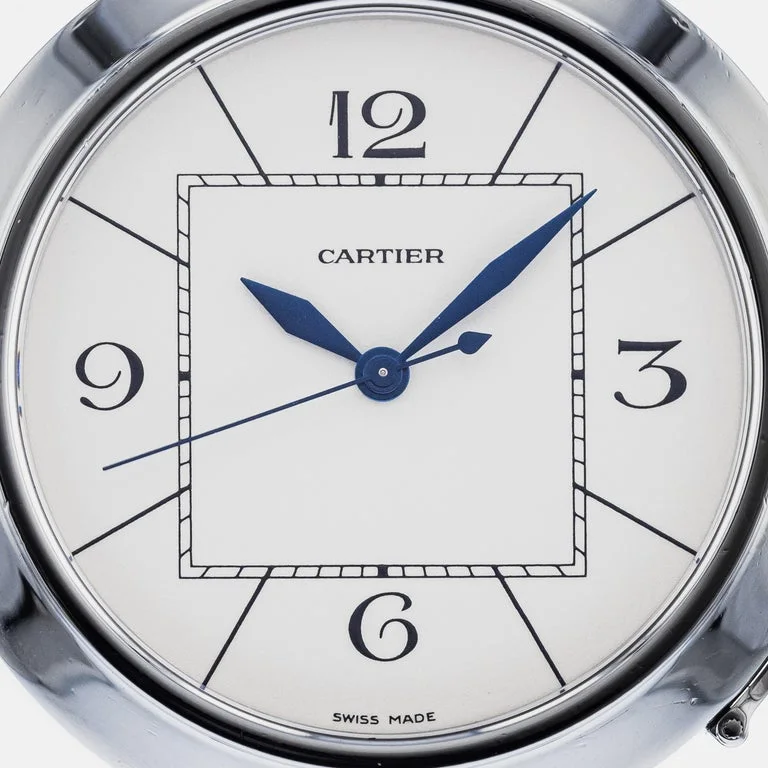
From 1985 the Pasha dial has been built on a circle holding a square: a railway-style minute track in the centre and four large Arabic numerals at 12, 3, 6 and 9, in place of the Roman numerals usual on Cartier watches. Complicated watches vary this, with sub-dials and, on some, Roman numerals, and listings in the library's records show Roman numerals on time-only watches as well, grille watches among them. The limited editions of 1998 to 2001 have their own dials, and the steel 41 mm of 2020 adds guilloché and a darkening towards the edge.
Square track and four Arabic numerals
The original layout: a square minute track set within a round dial, with numerals at 12, 3, 6 and 9 in an Art Deco face. It was kept in the 2020 watches, where the numerals of one watch have serifs with curled ends on the 12, 6 and 9.
- railway square in the centre
- four Arabic numerals only
- no Roman numerals
Perpetual calendar dial
The automatic perpetual calendar 0975 shows day, date and month with leap year on three subsidiary dials and the moon phase in an oval aperture at 12. Most of its dials are silver with applied batons; single examples are known with painted Roman numerals and with an engine-turned mother-of-pearl dial. The repeater W30012 has four subsidiary indications and a moon aperture; its earliest examples have matte silvered dials with painted radial Roman numerals, and white and mother-of-pearl dials follow, the mother-of-pearl ones on some diamond-set cases.
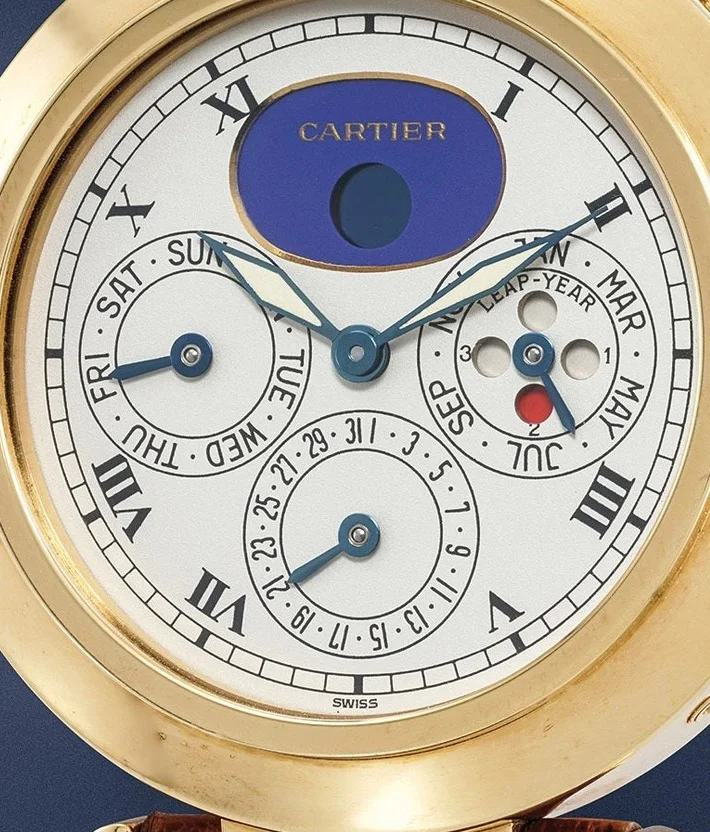

- mother-of-pearl dial in some
First Collection Privée tourbillon dial, 1998
The first of the four tourbillon editions has blued hands, a hand-engraved dial and a double-C logo in pink gold that fills most of the dial, around a semi-skeletonised tourbillon.
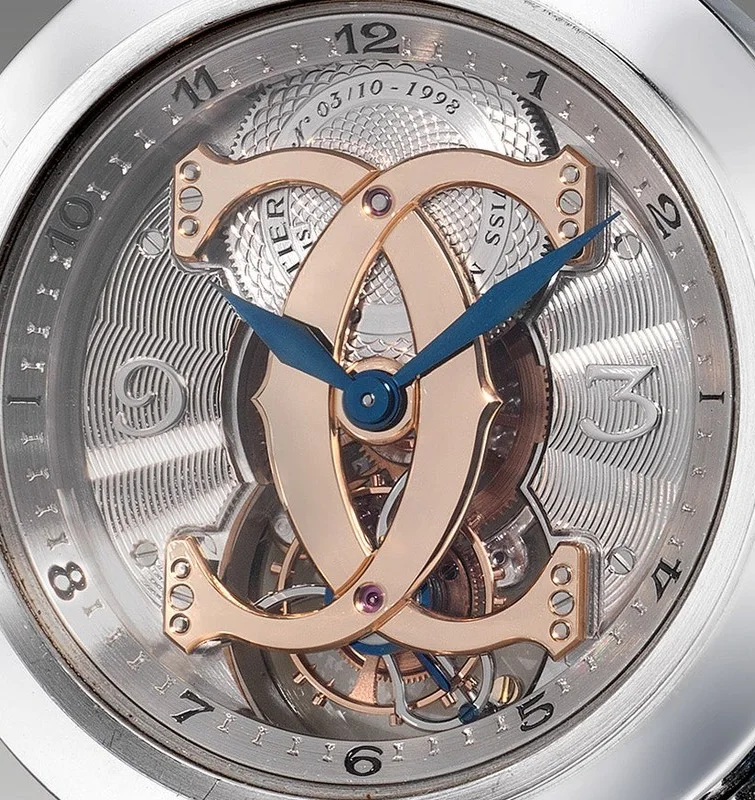

- hand-engraved dial
Square-track bridge tourbillon dial, 1999 to 2001
The 1999 edition has a more conventional dial with a bridge in the shape of the square minute track laid over the tourbillon. The editions of 2000 and 2001 vary this design; in 2000 the interwoven double-C logo is inset with blue enamel.
- bridge shaped like the square track
- blue enamel in the logo (2000)
Day & Night dial
A yellow gold limited edition of twenty, dated 1999 in one account and 1998 in another, in which a single central hand carries a sun at one end and a moon at the other, read against a day arc and a night arc, with running seconds at the foot and a clous de Paris pattern. Another account describes it as a jumping-hour watch with a day and night indicator. It is described as inspired by an early Cartier clock. An auction title in the library's records describes a white gold 'Pasha Jour et Nuit heures sautantes' numbered out of 25.
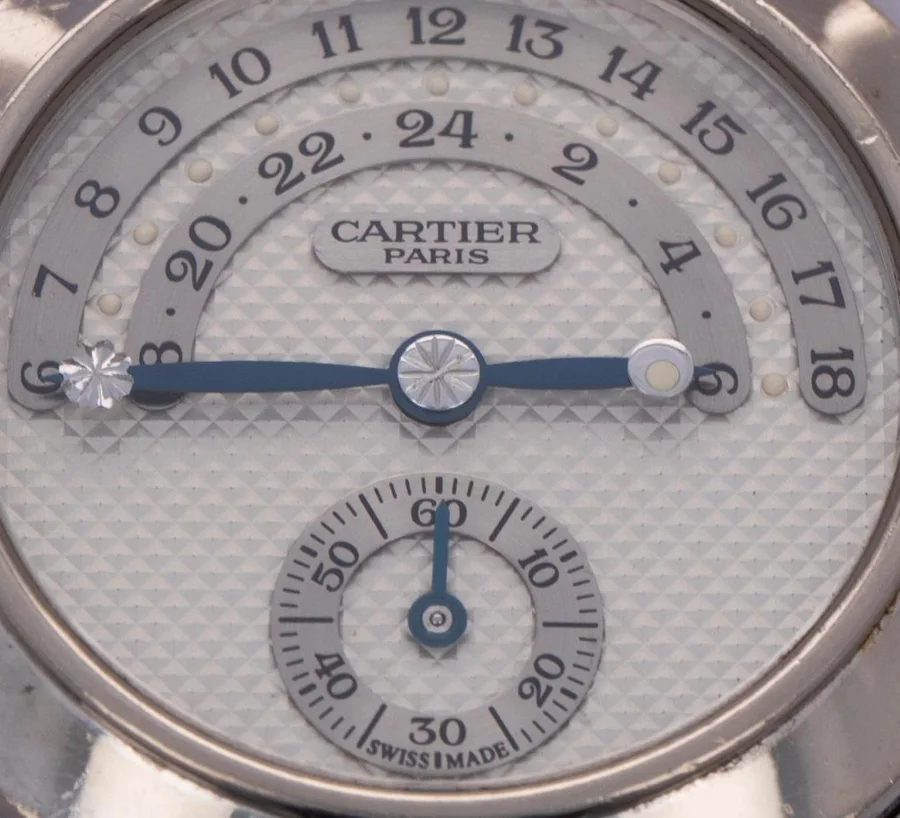

- central hand with sun and moon ends
Enamel and stone dials, as sellers describe them
Sellers and auction houses list limited Pashas with cloisonné or champlevé enamel dials (a parrot, an imperial guardian lion, a phoenix, tiger stripes), two of them titled Collection Privée, and, on references 2313 and 2332, green marble and lapis lazuli dials with a removable grid. The parrot and lion watches carry stated years around 2005. The literature does not describe or date them.
- enamel scene on the dial
- stone centre dial with a removable grid
Guilloché dial of the 42 mm Pasha
One published account says the 42 mm Pasha has a little guilloché on its dial, while the circle around a square and the Arabic numerals stay as before.
- guilloché areas on the dial of some watches
Stamped guilloché dial with darkened edge, 2020
The silvered dial of the 2020 steel 41 mm has a stamped, scallop-shaped guilloché and a discreet darkening towards the edge, with the date between 4 and 5. A salmon version has crisp engraved lines and a minute track whose blocks are filled with luminous material.
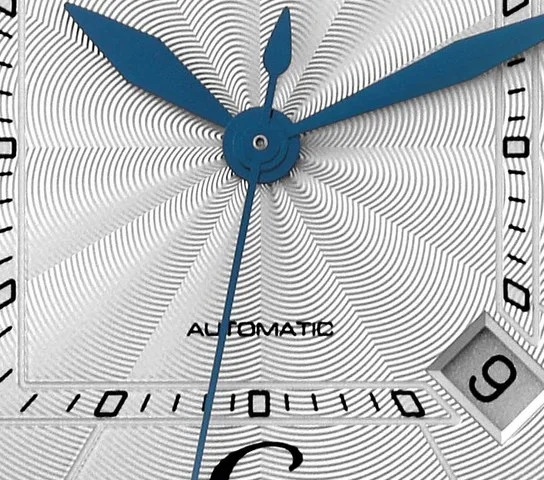

- edge darker than the centre
Chronograph dial, 2021
The 41 mm chronograph has three subdials and a date at about 4.30; it omits the square minute track and keeps only the Arabic 12. An anthracite dial is described as well.
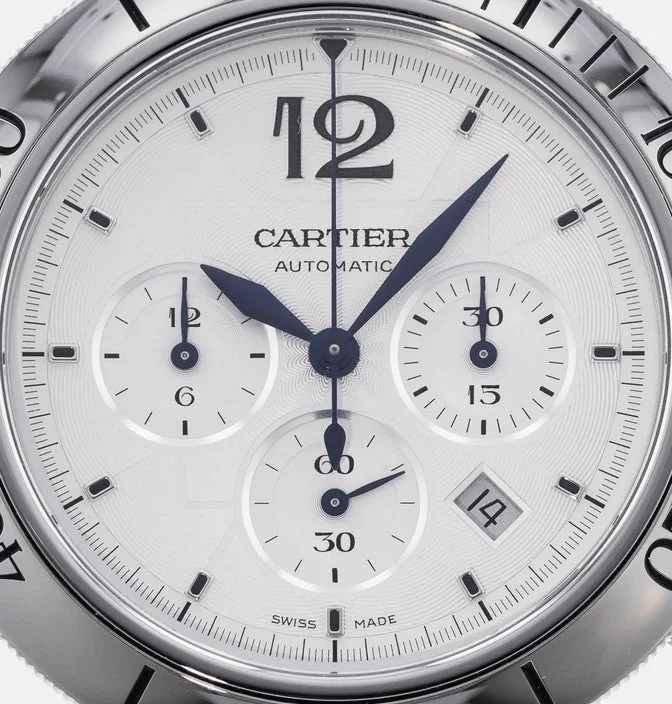

- three subdials, no square track
Hands 2 described
Hands change with the period: mostly luminous in the 1980s range, luminous blued steel lozenges on the gold perpetual calendars and repeater, and blued on the watches of the 2020 line.
Luminous hands, 1980s range
The watches of the 1980s mostly have luminous hands. The perpetual calendar and repeater are catalogued with luminous blued steel lozenge hands.
- luminous lozenge hands
Blued sword hands, 2020
The watches of the 2020 line are described with blued hands: sword-shaped on the time-only models in most accounts, diamond-shaped in one, and diamond-shaped on the skeleton and tourbillon versions. The 2022 black-coated skeleton has hands and bridges in Super-LumiNova.
- blued sword hands
Bezel 3 described
The bezel is broad from the 1985 watch to the 2020 watches; whether it turns, and how it is graduated, varies with the reference.
Graduated bezel, 1980s gold
Catalogued on reference 820903, a yellow gold watch with a graduated bezel. Reference 820901 is catalogued with a smooth bezel.
- graduated bezel
- smooth bezel
One-way rotating bezel
A 38.5 mm yellow gold Pasha, reference 1021, is catalogued with a unidirectional rotating bezel and dated by the cataloguer to about 1990. A Pasha diver with a one-way bezel and 100 m water resistance is also described.
- one-way rotating bezel
Flat fixed bezel, 41 mm of 2020
The 2020 41 mm watch has a flat, thick bezel that does not rotate; an account of it says the 1985 watch had a rotating bezel. The 2021 chronograph has a rotating graduated bezel.
- thick flat bezel, fixed
Case and sizes 8 described
The case is round, with a sealed back in 1985, Vendôme lugs and a broad bezel. Size names run 38 mm, then 35, 36 and 32 mm, 42 mm in 2005, 46 mm for two late tourbillon watches, then 41, 35 and 30 mm. Yellow gold came first, steel in 1990, and gold in several colours and diamond-set cases followed.
38 mm
The size of the 1985 launch and of the steel watches from 1990, described as large for its day.
- 38 mm round case
Vendôme lugs
The bars that cross the strap or bracelet end in rounded pyramid shapes; the arrangement is described as patented by Louis Cartier in 1934 and is shared by the 1985 and 2020 watches.
- rounded pyramid ends to the bars
Steel case
Steel was added in 1990 after five years in which the Pasha was made only in precious metal.
- steel case, 38 mm
32 mm
A 32 mm size offered from 1998 with gem-set options and softer strap colours, aimed at women.
- 32 mm case, gem-set in some
42 mm
Introduced in 2005 as a four-millimetre increase on the original.
- 42 mm case
46 mm
Two 46 mm tourbillon watches mark the last years before the Pasha left the collection.
- 46 mm case
41 mm, 35 mm and 30 mm, from 2020
The relaunch offers 41 mm and 35 mm with a sapphire back and 100 m water resistance; the 41 mm is about 10 mm thick (9.95 mm in one review, 9.55 mm in another). A 30 mm quartz size followed in 2021.
- sapphire case back
Black-coated steel, 2022
The skeleton in steel with black ADLC coating.
- black coated case
Crown 4 described
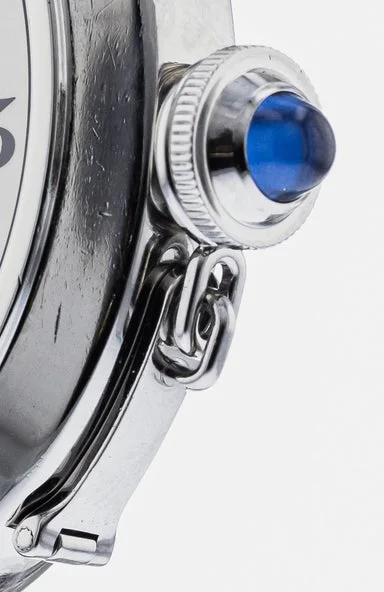
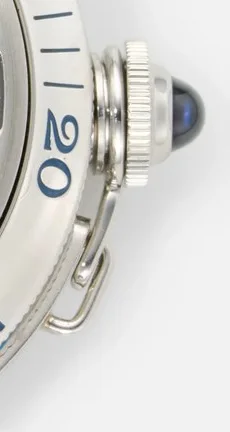
The capped crown runs through the line from 1985 to the 2020 watches: a screw-down cap over the real crown, fixed to the case by a chain, topped with a cabochon.
Capped crown with cabochon and chain
In 1985 the screwed cap with its chain provided the water resistance. A sapphire is named on the early watches and a blue synthetic spinel on the modern ones; the crown beneath is small. A cabochon is also set in the pushers of the chronographs.
- cap on a chain
- cabochon on top
Red spinel cap, 1997
The limited steel edition for the 150th anniversary has a red spinel, where the regular watch that followed has a blue one.
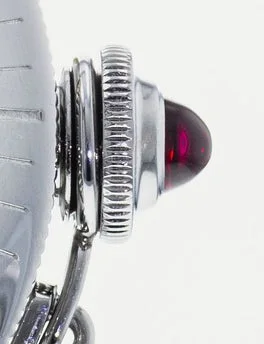

Second cabochon and engraving plate, 2020
In 2020 a second cabochon was added under the cap to help with winding, and the case side beneath the cap can be engraved with initials, except on the chronograph.
- second cabochon under the cap
Charms for the cap, 2022
Pendants shaped as a double C, a heart or an eye clip onto the crown cap.
- pendant on the cap
Crystal 2 described
A grid over the crystal, the grille, belongs to the best-known gold Pashas and returned in a new form in 2022.
Grille, 1985 or late 1980s
Accounts differ on when the grille came. One says some models had a grille at the 1985 launch; another says it came in the late 1980s, in early gold watches; a third links it with the first years of the Figaro bracelet. A yellow gold watch described as reference 1021 has a grille that is removed by turning it counterclockwise.
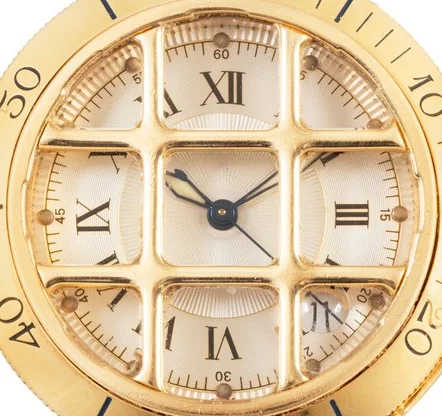

- grille turns off
Removable grille, 2022
The 41 mm yellow gold watch with a grille of 2022 uses a different and more solid fitting, four small pawls, with a hand-polished grille; owners of the earlier 41 mm yellow gold watch could swap the bezel.
- grille clicks on and off
Date 1 described
The date window changes with the generation.
Date without magnifier
The 1985 watches have a date window with no magnifying lens, at 4 o'clock; some later models had a lens; the 2020 41 mm has its window between 4 and 5, again without one. The 35 mm of 2020 has no date.
- date window at 4, no magnifier
Movement 7 described
Movements are quartz and automatic in the first range, many automatic ones on ETA-based calibres; the gold perpetual calendars and the repeater have their own calibres; the Collection Privée tourbillons use a Girard-Perregaux three-bridge movement; the 42 mm uses a Jaeger-LeCoultre calibre; and from 2020 the mechanical watches have Cartier manufacture calibres, with quartz in the 30 mm.
Quartz and ETA-based automatic
The first generation used both quartz and automatic movements, the automatic ones often ETA calibres or based on them, including in some complicated watches.
Calibre 039 perpetual calendar
The automatic perpetual calendar, reference 0975, has the Cartier calibre 039, which one catalogue puts on a Jaeger-LeCoultre 889/1 base; another prints 889/2 with 36 jewels. A transparent back is held by eight screws.
- transparent back with eight screws
Minute repeater with perpetual calendar
The W30012 has 26 jewels, a repeater on gongs started by a sapphire button at 9 and an individual number; one example is stamped GG. Catalogues print three different calibre numbers (179, 303, 362), so the number does not settle whether the movement is correct. One account dates the watch to 1990 while catalogued examples go back to about 1987.
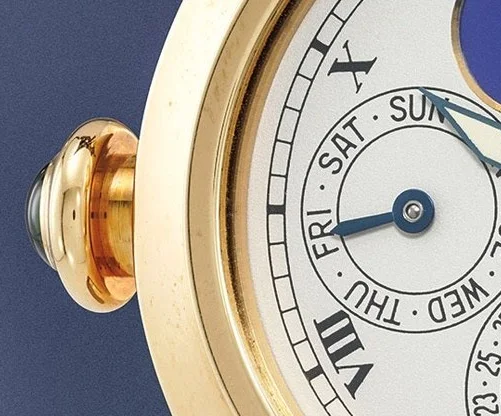

- individual number
Girard-Perregaux tourbillon, 1998 to 2001
The four tourbillon editions use a semi-skeletonised tourbillon on a Girard-Perregaux three-bridge movement, called the 490 MC in one account and the 492 MC in another for the 2000 watch.
- semi-skeletonised tourbillon
Calibre 8000 MC, 2005
The 42 mm has the 8000 MC, which one account says was made for Cartier by Jaeger-LeCoultre.
Calibre 1847 MC, 2020
The automatic of the three-hand watches is made at Valfleurier, beats at 4 Hz, runs about 40 hours (42 in one account), has escapement parts in a non-magnetic nickel-phosphorus alloy and a shield against magnetism, and is about 3.8 mm high.
- sapphire back showing Côtes de Genève
Skeleton and tourbillon calibres, 2020 to 2022
The skeleton is the 9624 MC, with bridges that form the track and numerals; it is called hand-wound in three accounts and automatic in one, in a caption and in a retailer's listing, and one account of the 2022 skeleton prints 9524. The skeleton tourbillon of 2020 is the 9466 MC with the tourbillon at 6; the flying tourbillon of 2022 is the 9552 MC; the chronograph is the 1904-CH MC and the moon phase the 1904 LU MC.
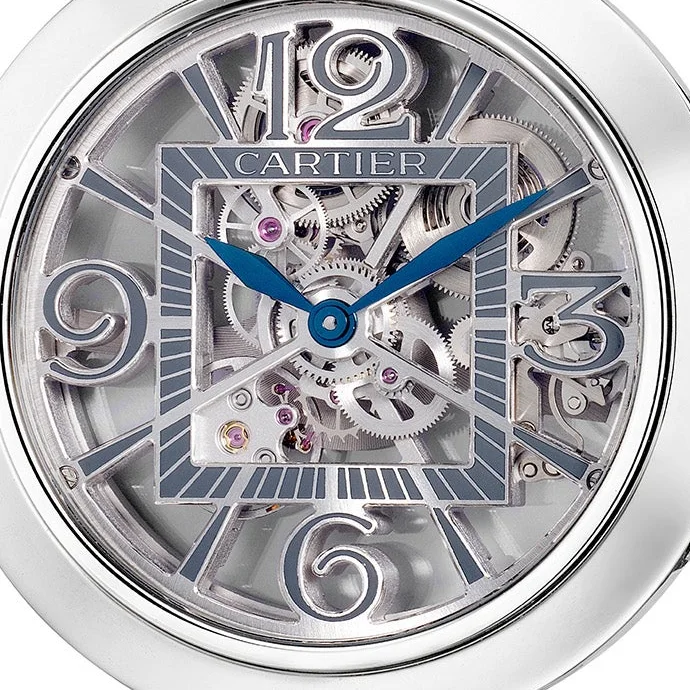

Bracelet and strap 3 described
Bracelets run from the gold Figaro of the early years to the interchangeable systems of 2020.
Figaro bracelet
A yellow gold bracelet of five smooth-shouldered links with a hidden clasp, fitted with the lugs of the early gold Pasha. It was offered only for a short time, five years in one account and the first few years in another.
- five smooth links
- hidden clasp
Gold link bracelets of the complicated watches
The perpetual calendar and repeater are catalogued on gold Cartier link bracelets, one a brick link with a concealed double deployant clasp, or on leather with a gold deployant clasp.
- brick links
- concealed clasp
QuickSwitch and SmartLink, 2020
A button at the back of the lugs releases the bracelet or strap, and links of the steel bracelet can be added or removed without tools. The steel watch comes with both a bracelet and an alligator strap with a folding buckle.
- button under the lugs
Reference numbers
A four-digit number is stamped on the case and covers a case; a code beginning W, or the newer letter codes, is a catalogue number for one version of it (metal, dial, strap). Many older watches carry neither. The last column is the listings on record under the number, as its own page counts them.
| Number | What it is | Listings |
|---|---|---|
| 820901 | Catalogued as a yellow gold Pasha with a smooth bezel, with years given as about 1986 to 1990. | 4 |
| 820903 | Catalogued as a yellow gold Pasha with a graduated bezel, with years given as about 1985 to 1989. | 4 |
| 820904 | Catalogued as an automatic yellow gold Pasha, with years given as about 1987 to the 1990s. | 2 |
| 1021 | A 38.5 mm yellow gold Pasha with a one-way rotating bezel, one example dated to about 1990; a yellow gold watch of this number with a grille and Figaro bracelet is described. | 6 |
| 0975 | A 38 mm yellow gold automatic perpetual calendar with moon phase on the Cartier calibre 039, catalogued from the 1990s to around 2000, with a case number in an M or MG series; no catalogue gives its introduction. | 1 |
| W30012 | A 38 mm yellow gold automatic minute repeater with perpetual calendar and moon phases, individually numbered, catalogued from about 1987 to about 2005, with no figure for how many were made. | 11 |
| W30026 | A 38 mm yellow gold automatic perpetual calendar, one dated 1991 with a four-digit case number; no catalogue ties it to the 0975. | |
| 30003 | A 38 mm yellow gold quartz perpetual calendar, on the quartz calibre 616, catalogued from about 1988. | 7 |
| 0570 | A quartz perpetual calendar Pasha, one example of 1989. | |
| 30010 | The Pasha golf watch, with four buttons set with different coloured stones to tell the players apart and keep score. | 4 |
| 1032 | A 38 mm chronograph in steel and yellow gold, quartz, catalogued about 1990 to 2000. | 11 |
| 1033 | A power reserve Pasha in steel and yellow gold, automatic, catalogued in the 1990s. | 10 |
| 1050 | A 38 mm steel quartz chronograph, catalogued from about 1990 into the 2000s. | 27 |
| 1353 | A 35 to 36 mm yellow gold quartz chronograph, called Chronoreflex in the catalogue, about 1990 to 2010. | 12 |
| 2111 | A 38 mm yellow gold automatic chronograph, catalogued from the 1990s to 2002. | 20 |
| 2113 | A 38 mm steel automatic chronograph, catalogued about 1998 to 2005. | 36 |
| 2412 | A 36 mm steel automatic chronograph, catalogued about 2000 to 2005. | 22 |
| 30009 | A yellow gold quartz chronograph, catalogued about 1990 to 1995. | 8 |
| 2379 | A steel Pasha with a grille, catalogued from the 1990s to 2003. | 17 |
| 2475 | A steel automatic Pasha Grande Date, catalogued in the 2000s; no size is given. | 47 |
| 1035 | A 35 mm yellow gold automatic, catalogued from about 1997 into the 2010s; sellers' titles add a date window and diamond-set versions. | 28 |
| 1040 | A steel Pasha with applied indexes, which sellers describe as an automatic with a date; the catalogue dates it from the 1980s, earlier than the 1990 introduction of steel given elsewhere. | 15 |
| 2308 | An automatic Pasha in white gold, catalogued from the 1990s to 2010. | 10 |
| 2406 | As sellers and auction houses describe it, the Collection Privée tourbillon in white gold, semi-skeletonised and limited, one titled 09/20. | 5 |
| 2628 | As one auction title describes it, a semi-skeletonised automatic tourbillon in white gold numbered 18/20, signed Cartier, Paris. | 2 |
| 2578 | As one auction title describes it, a Collection Privée tourbillon in rose gold with a one-minute tourbillon. | 2 |
| 2495 | As sellers describe it, a limited Collection Privée white gold Pasha with a cloisonné enamel parrot dial. | 4 |
| 2508 | As sellers describe it, a limited edition in white gold with diamonds and a cloisonné enamel dial of an imperial guardian lion; one auction title gives the edition as 25 pieces, another numbers its watch out of 20. | 4 |
| 2536 | As one auction title describes it, a limited white gold and diamond-set automatic with a champlevé enamel tiger-stripe dial. | 4 |
| 2313 | As one auction title describes it, a white gold Pasha with a green marble centre dial and a removable grid. | 4 |
| 2332 | As one auction title describes it, a white gold Pasha with a lapis lazuli dial and a removable grid. | 5 |
| 2389 | A Pasha de Cartier Jour et Nuit, named in one picture caption. | 2 |
| 2550 | A Pasha GMT, named in one picture caption; the literature says no more. | 3 |
| HPI00365 | A white gold Pasha with a hand-wound calibre 9613 MC in one retailer's page; sellers' stated years run from 2010 to 2019. | 4 |
| W31072M7 | As sellers describe it, a 42 mm steel Pasha with a silver dial and an exhibition case back. | 4 |
| WSPA0009 | A 41 mm steel Pasha of the relaunch on a link bracelet, as described in one account. | 7 |
| WSPA0010 | A 41 mm steel Pasha of the relaunch on a leather strap, as described in one account. | 2 |
| WSPA0012 | A 35 mm steel Pasha of the relaunch on a leather strap, as described in one account. | |
| WJPA0013 | A 35 mm rose gold Pasha of the relaunch set with diamonds, as described in one account. | 1 |
| WSPA0040 | A 41 mm steel automatic of the 2020 collection with a salmon dial, calibre 1847 MC and a sapphire back. | |
| WSPA0045 | As a retailer lists it, a 41 mm steel Pasha of the relaunch. | |
| WSPA0046 | As a retailer lists it, a 41 mm steel Pasha of the relaunch. | |
| WHPA0007 | A 41 mm steel skeleton with two straps: hand-wound on calibre 9624 MC in one account, automatic in a retailer's listing. | 7 |
| WHPA0006 | As a retailer lists it, a 41 mm hand-wound rose gold skeleton tourbillon with two straps. | 1 |
| WHPA0010 | As a retailer lists it, a 41 mm rose gold Pasha of the relaunch. | 1 |
| WJPA0015 | As a retailer lists it, a 35 mm automatic rose gold Pasha with diamonds and two straps. | |
| WJPA0014 | As a retailer lists it, a 35 mm automatic white gold Pasha. | |
| WJPA0039 | As a retailer lists it, a 30 mm rose gold Pasha with diamonds. | |
| WJPA0033 | As a retailer lists it, a 30 mm rose gold Pasha with diamonds. | |
| WJPA0019 | As a retailer lists it, a 30 mm white gold Pasha with diamonds. | |
| HPI01575 | As a retailer lists it, a 41 mm rose gold tourbillon with diamonds. | |
| HPI01435 | As a retailer lists it, a 41 mm hand-wound white gold skeleton tourbillon with diamonds and two straps. | |
| W31037H3 | As sellers describe it, a steel Pasha power reserve GMT, with stated years from 2001 to 2004. | 21 |
Originality
- On the gold perpetual calendars and the repeater, make sure the crown cap still screws home and keeps its cabochon and chain, and on the repeater that the button at 9 keeps its sapphire.
- Catalogue calibre numbers for the minute repeater differ from one sale to the next, so the number alone does not show whether the movement is original; ask for a photograph of the movement.
- On the gold perpetual calendar 0975, the deployant clasp should be Cartier's, in gold.
- An earlier 41 mm yellow gold watch may carry the 2022 grille bezel, since owners could exchange the bezel at Cartier.
- Auction catalogues print the reference and the case number in different positions, so a listing that gives a case number such as M204646 as the reference may be describing a 0975.
Names
- Figaro. The five-link gold bracelet of the early yellow gold watches.
- Grille. The removable grid that covers the crystal on certain gold and steel watches.
- CPCP. Collection Privée Cartier Paris, the limited series of 1998 to 2008.
- Day & Night. The limited watch reading hours on one hand with a sun and a moon.
Where accounts differ
Points on which the published literature and the library's own records do not agree, or on which the literature contradicts itself.
- The watch made for the Pasha of Marrakesh. Accounts place the commission in 1931 or 1932 and the delivery in 1932 or 1933, and most say no proof exists that the watch looked like the Pasha. One account says that no Pasha was ever made for the Pasha, and that the round water-resistant watch of 1943 was an unnamed forerunner. Another says the first watch used a repurposed Tank case and entered the collection in 1943; a third says it was designed in 1943 for a submarine officer; a fourth says experts point to the water-resistant Tank Étanche.
- End of the first run. Two accounts give 2012 as the year the Pasha left the collection; a third puts the end at around 2011, and a fourth says complicated Pashas came out around 2012 and the line was dropped a few years later. The library's records carry sellers' stated years up to 2022 on reference 1035 and up to 2019 on W3140008 and HPI00365, which sellers may have guessed or which may belong to related watches.
- When the grille appeared. One account says some Pashas had a grille over the crystal at the 1985 launch and speaks of a 38 mm grille version of 1985; another says Cartier introduced the grille in the late 1980s.
- Year of the Day & Night. One account dates the Pasha Day & Night to 1999 and another to 1998; the library's records hold auction titles that state 1998 for a Day and Night and 1999 for a jumping-hours Jour et Nuit. Two accounts describe it as read by one hand with a sun and a moon; a third calls it a jumping-hour watch with a day and night indicator.
- Collection Privée tourbillons. One account says four tourbillon editions were made, each limited to ten pieces, on the 490 MC; another calls the calibre of the 2000 watch the 492 MC. Auction titles in the library's records for the semi-skeletonised white gold tourbillon disagree among themselves: reference 2406 is titled Collection Privée and numbered 09/20 and 16/20 in some, and number 3 of an edition of ten in another, while reference 2628 is numbered 18/20.
- The skeleton calibre. Four accounts call the skeleton calibre 9624 MC and one, of the 2022 black-coated skeleton, 9524 MC. Three accounts describe the 9624 MC as hand-wound; one account describes it as automatic, as do a caption on one of the hand-wound pages and a retailer's listing for WHPA0007.
- Dating the minute repeater. One account dates the automatic minute repeater with perpetual calendar to 1990; catalogue entries give examples from about 1987.
- Who designed the Pasha. Most accounts credit a Swiss designer with the 1985 watch; one account says he developed a movement and that the look was taken from the older design, and another says Cartier's chief executive found the model in the archives.
- Small figures. The 41 mm steel watch is 9.95 mm thick on one page and 9.55 mm on another; the power reserve of the 1847 MC is 42 hours on one page and about 40 on four. The Figaro bracelet was made for five years on one page and for the first few years on another.
- Dates the sellers state. The library's records include a few listings with stated years in the 1840s, 1930s and 1940s, before the 1985 launch given in published accounts; those of the 1840s are limited editions, so the figure is probably the edition size of 1847 read as a year.
- Arabic or Roman numerals. Published accounts describe the Pasha dial as four large Arabic numerals at 12, 3, 6 and 9, setting it apart from the Roman numerals of other Cartier watches. Listings in the library's records show time-only Pashas of the 1990s and 2000s with Roman numerals, in steel and in gold, with and without a grille, among them the steel grille edition for the 150th anniversary and a yellow gold grille watch of reference 1021; other grille watches, such as reference 2379, have Arabic numerals.
- The dial of the Pasha 42. One account says the Pasha 42 of 2005 gained a little guilloché on its dial. Photographs of steel 42 mm watches in the library's records (references W31072M7, W3107255 and 2730) show a plain centre with no pattern to be seen, while gold examples show a radiating pattern inside the square.
In the records
Counted from 1,563 listings at dealers and auction houses whose title, or whose reference, places them on the line; 756 state a year. These are what sellers state, not measurements, and a count of listings is not a count of watches made.
Case metal
| Metal | Listings | Share |
|---|---|---|
| Steel | 530 | 49% |
| Gold, any colour | 529 | 48% |
| Yellow | 164 | 15% |
| White | 152 | 14% |
| Pink | 45 | 4% |
| Colour not stated | 168 | 15% |
| Steel and gold | 22 | 2% |
| Platinum | 5 | under 1% |
| Steel and platinum | 2 | under 1% |
| Ceramic | 1 | under 1% |
| Palladium | 1 | under 1% |
| Silver | 1 | under 1% |
As sellers state it. Shares are of the 1,091 listings that name a metal. A listing that says "gold" or "18K gold" names no colour: it is counted under "colour not stated", not as yellow gold. Carat, where a listing of gold gives one: 18k 369.
Case size
| Size | Listings | Share |
|---|---|---|
| 38 mm | 386 | 38% |
| 35 mm | 198 | 19% |
| 36 mm | 76 | 7% |
| 32 mm | 75 | 7% |
| 42 mm | 69 | 7% |
| 27 mm | 53 | 5% |
| 41 mm | 49 | 5% |
| 39 mm | 26 | 3% |
| Other sizes | 95 | 9% |
As sellers state it. Shares are of the 1,027 listings that give a size. On a watch that is not round some sellers give the width and some the length, so one watch can stand under two sizes.
Movement
| Kind | Listings | Share |
|---|---|---|
| Automatic | 424 | 76% |
| Quartz | 114 | 21% |
| Hand-wound | 14 | 3% |
| Mechanical, winding not stated | 3 | 1% |
Shares are of the 555 listings whose description says how the watch is driven.
Listings by decade the seller gives
| Decade | Listings |
|---|---|
| 1980s | 48 |
| 1990s | 237 |
| 2000s | 334 |
| 2010s | 83 |
| 2020s | 50 |
4 more give a year outside the years the line was made (from 1985): a later watch sold under the name, or a slip. They are left out.