Clé de Cartier
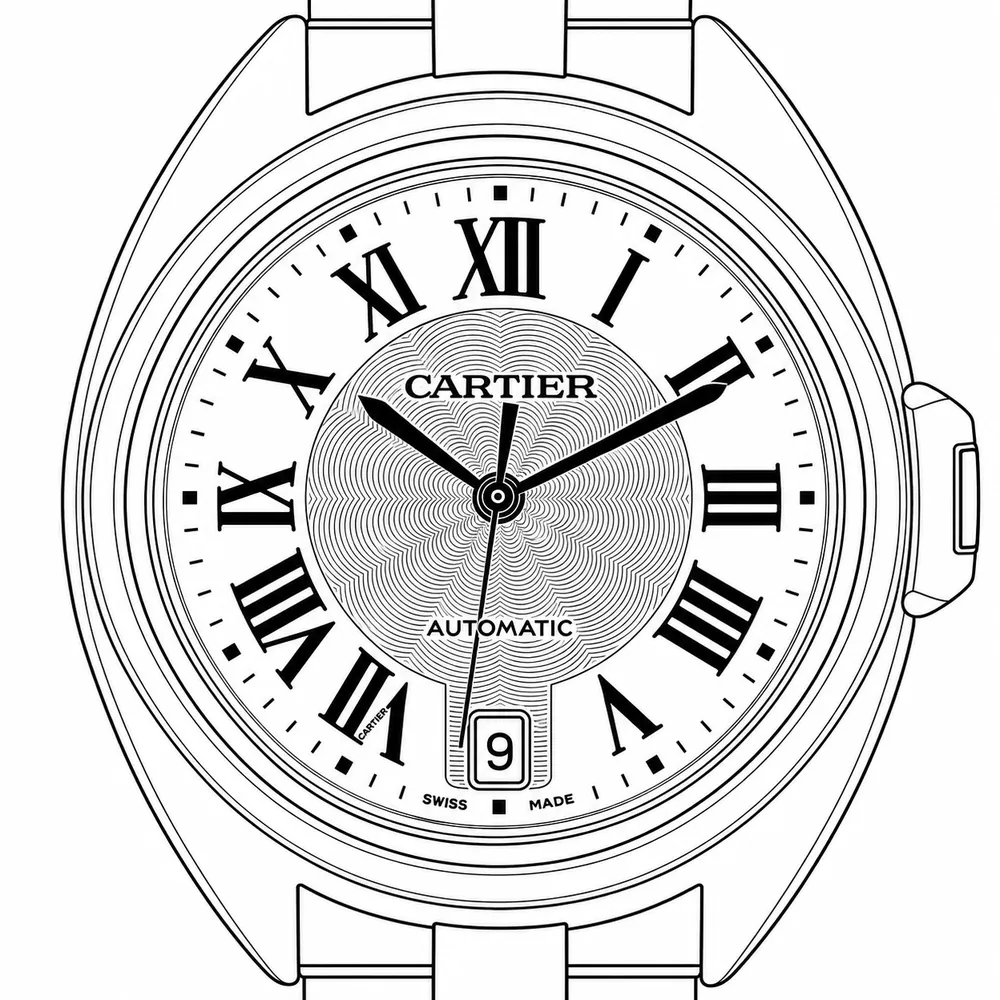
A round-dialled Cartier introduced in 2015 in a new rounded, ovoid case, with a rectangular winding crown, set with a blue cabochon, that gives the line its name (clé is French for key). It was shown first in 18 carat gold in 40 mm for men and 35 mm and 31 mm for women, with Roman numerals, a guilloché dial centre, blued sword hands and a date at six. It was the first watch to use the in-house automatic calibre 1847 MC. A steel version followed, and the case was then used for a mystery-hour watch and a flying-tourbillon watch.
Cartier's entries are arranged by model, not by reference number, because its reference numbers are several systems at once and many of its watches carry none. The houses are set out in Paris, London and New York.

- Made
- from c. 2015The line was announced at the January 2015 watch fair; published accounts give no end date.
- On record
- 51 listings10 of them give no reference
- Reference numbers
- 12 described19 seen in listings

What to look for
Details cut from photographs of watches of this line on record. Each was chosen by eye from a listing on the line and then checked again against the words beneath it. More sit beside the productions and parts they belong to, below. Select the small mark in a picture's corner for its holder and a link to its listing.

By house and period 4 described
Gold collection, 2015 launch
The line was announced in 2015 in 18 carat gold only. The men's watches were 40 mm, in white, pink and yellow gold, on an alligator strap or the bracelet; accounts differ on whether yellow gold was in the first announcement. The women's watches were 35 mm or 31 mm, and the launch accounts describe all of them with a diamond-set bezel; one 35 mm white gold watch was set with diamonds on the case, the bracelet and part of the dial as well. The line was counted as 22 models in one account, and as 21 women's variations in another. The 40 mm and 35 mm watches carry the in-house calibre 1847 MC; the movement of the 31 mm watch was not given at launch.
Signature and marks. The word Cartier is printed under 12 o'clock and the word Automatic on the dial, and the dial carries the secret signature. Auction listings give the case, dial and movement as signed, and the rotor carries the Cartier name.
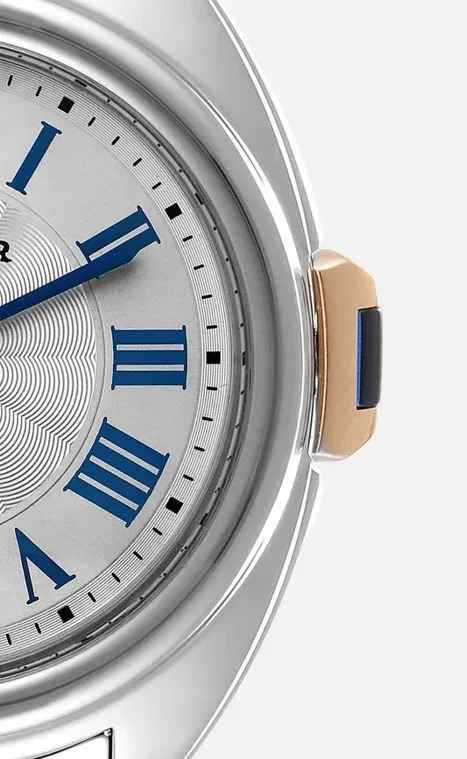
- rounded ovoid case with a rectangular crown set with a blue stone
- blue Roman numerals with no VI, a date aperture at six
- sapphire case back showing a full-size rotor
- pavé diamond bezel on the 35 mm and 31 mm watches
References: WGCL0005, WJCL0013, WJCL0032
Steel
A steel version was added to the line after the gold models, which had been the only metal at launch. The steel watch described in published accounts is 40 mm, with the same finishes as the white gold watch and the same calibre 1847 MC, on a matching steel bracelet in the same style as the gold ones. Its crown is set with a blue synthetic spinel; one account notes that spinel has replaced sapphire in some less costly Cartier models. A dealer's page also lists 35 mm models in steel and in rose gold and steel. A review of 2016 presents the 40 mm steel watch as that year's release, after accounts of 2015 had described the line as offered in gold only.
Signature and marks. The dial carries the secret signature; no other signature or stamp is given.
- steel case and bracelet with brushed centre links and alternating wide and narrow outer links
- blue stone in the crown described as synthetic spinel
Mysterious Hour, 41 mm
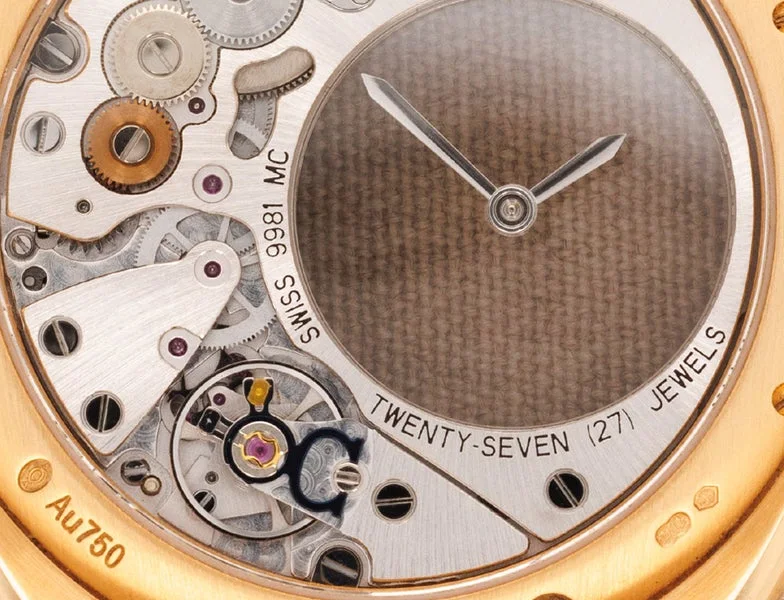
This watch joins the Clé case to the 9981 MC mystery movement, first shown in 2013 in a Rotonde de Cartier watch. The case is 41 mm, a millimetre wider than the standard men's watch, and 11.25 mm thick; it was offered at launch in 18 carat pink gold and in 950 palladium. The hours and minutes are carried on transparent sapphire discs, so that the hands appear to float, and the movement is a crescent beside the disc module. The dial is openwork with blue Roman numerals, a railway minute track and sword-shaped hands.
Signature and marks. Not given in the published accounts.
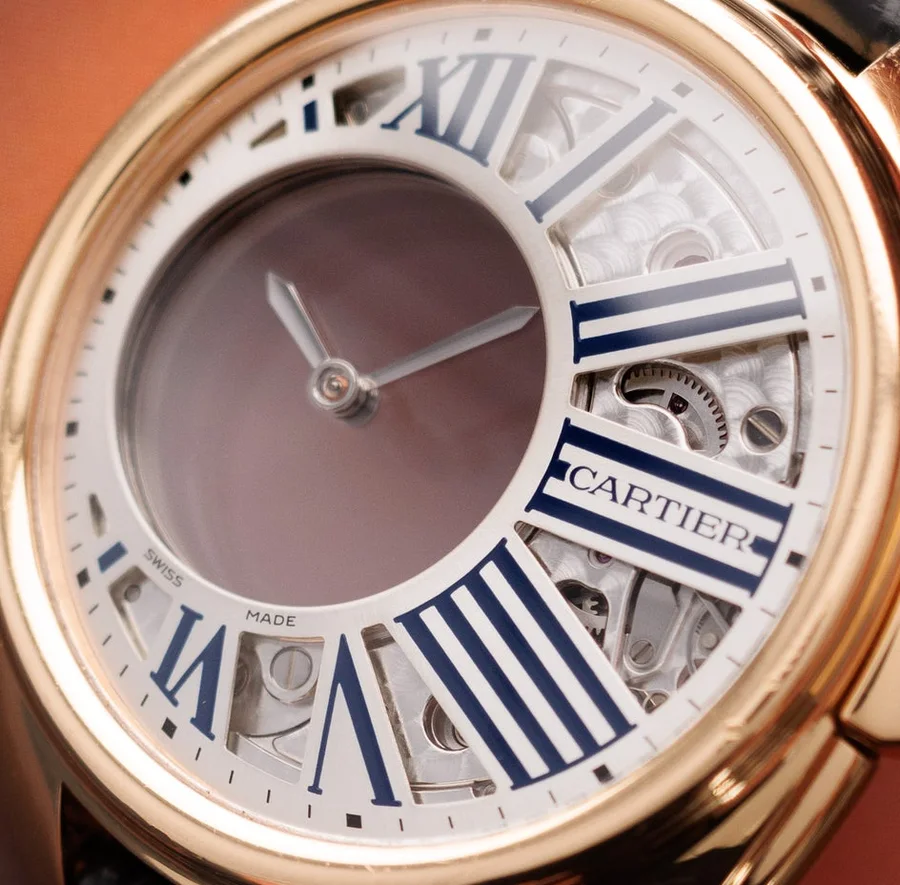

- 41 mm case in pink gold or palladium
Flying Tourbillon, 35 mm
The Clé case was used in 2015 for a 35 mm watch set with 3.56 carats of brilliant-cut diamonds and powered by the hand-wound flying-tourbillon calibre 9452 MC, a movement that carries the Geneva Seal. The tourbillon bridge serves as the small seconds. The dial has concentric rose guilloché, blued sword hands and Roman numerals.
Signature and marks. The secret Cartier signature is hidden in the X hour marker.
- fully diamond-set case
- tourbillon visible on the dial
Chronology
Specification
| Case | Rounded, ovoid case with curved lugs; 40 mm (men's), 35 mm and 31 mm (women's) at launch; 41 mm for the mysterious-hour watch |
| Metal | 18 carat white, pink and yellow gold at launch; steel added afterwards; 18 carat pink gold and 950 palladium for the mysterious-hour watch |
| Crystal | Sapphire, with a sapphire case back showing the movement |
| Crown | Rectangular key-shaped crown set with a blue stone (sapphire on the gold watches, synthetic spinel on the steel), guarded by the case band on the right |
| Dial | Guilloché centre, Roman numerals, date aperture in place of the VI at six |
| Movement | Calibre 1847 MC, automatic, 42-hour power reserve (35 mm and 40 mm; the 31 mm movement was not stated at launch) |
| Bracelet | New-design bracelet with a hidden clasp, or alligator strap |
Dial 3 described
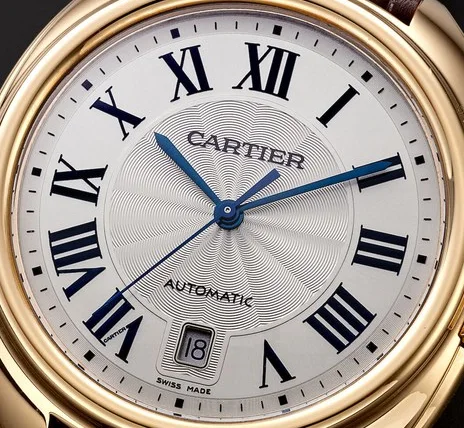
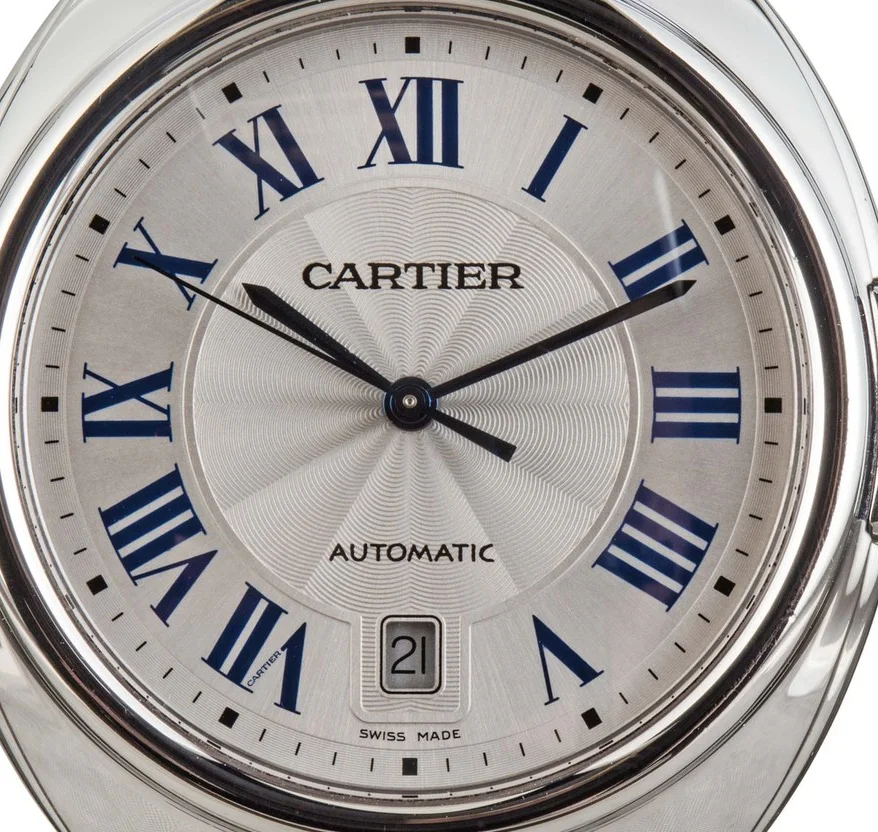
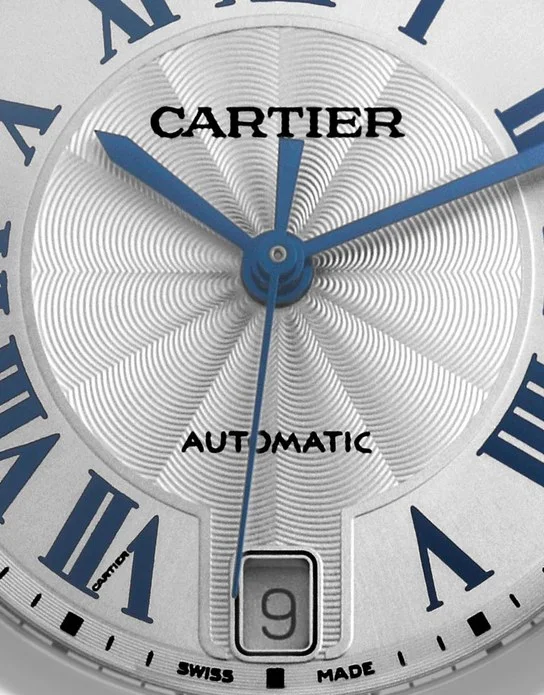
The time-only dials follow one pattern: a guilloché centre inside a pearl-white outer ring, Roman numerals, a date at six and a Cartier signature below 12. The accounts disagree on the colour of the numerals and hands in the men's watches.
Time-only dial
The centre is guilloché, in one account with a keyhole-shaped outline, and is surrounded by a pearl-white or lightly grained outer ring. One hour marker, the VI, is missing at six, where the date aperture sits inside a wavy guilloché border. A minute track runs round the edge with a bolder mark every five minutes; one account describes it as black. The secret signature is part of the design. Cartier is printed below 12 and Automatic on the dial. The colour of the numerals is disputed: most accounts give deep blue, one gives black on the men's watches and blue on the women's.


Diamond-set dial
The women's watches with diamonds on the dial are the exception to the usual pattern. At launch one 35 mm white gold watch was set with diamonds on the case, bracelet and part of the dial. The diamond-bezel versions otherwise keep the silvered guilloché dial with large blue numerals.
- pavé diamonds on dial, case and bracelet
Mysterious Hour dial
Openwork dial with blue-filled Roman numerals, a railway minute track and sword-shaped hands. The time display is off-centre.
- transparent centre with floating hands
Hands 1 described
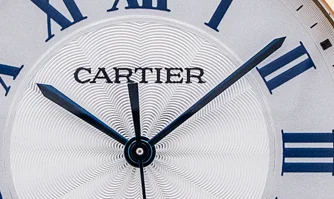
The time-only watches described have sword-shaped hours and minutes hands and a central seconds hand, in blued steel.
Blued sword hands
The hands are sword-shaped and blued steel. One account says it first took them for black, and in the same passage gives the hands and numerals of the men's watches as black and those of the women's as blue; the other accounts give blue for the men's watches.

Case and sizes 4 described
The case is a circle set into curved, horn-shaped lugs, which give it an ovoid, roughly tonneau outline; it curves to sit low on the wrist. It was announced in three diameters in gold.
31 mm
A women's size, in pink gold with a bracelet and a diamond-set bezel at launch. The movement was not named at launch.
35 mm
A women's size with calibre 1847 MC, in white and pink gold in the launch accounts, with diamond-set bezels; the flying-tourbillon watch also uses this size.
40 mm
The men's size, in white, pink and yellow gold at launch and later in steel. It has a sapphire case back.
- sapphire case back
41 mm
The Mysterious Hour case: 11.25 mm thick, in pink gold or 950 palladium, with water resistance given as 30 metres.
Crown 2 described
The crown is the feature that names the line: a rectangular key-shaped crown with a blue cabochon, based on the winding keys of old clocks and pocket watches.
Key crown with blue sapphire cabochon
In its resting position the crown sits along the case; one account says it does not rotate freely there but aligns to a horizontal or vertical axis, and still winds the watch by hand. Pulled out, it sets the time and date. A twist pivots it back with an audible click, and the case band on the right acts as a guard. The stone is blue sapphire on the gold models.
- rectangular crown with a blue stone, guarded by the case band
Key crown with blue synthetic spinel
The steel watch is described with a blue synthetic spinel in the crown. One account notes, of Cartier models in general, that spinel has replaced sapphire in some less costly ones.
Crystal 0 described
The front crystal is sapphire, softly domed, and the case back has a sapphire window.
Date 1 described
The date is in a window at six, with the Roman numeral VI omitted.
Date window at six
The date is semi-instantaneous in calibre 1847 MC. The aperture is framed by an extension of the guilloché centre.
- date at six within a wavy guilloché frame
Movement 3 described
The line introduced a new in-house automatic, calibre 1847 MC. Two other in-house calibres appear in versions of it.
Calibre 1847 MC
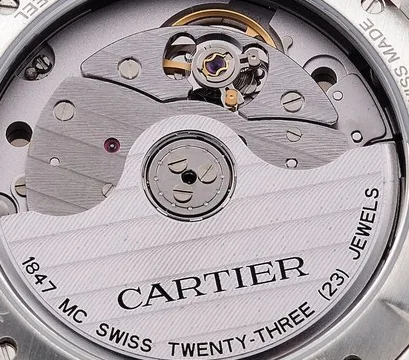
Automatic with hours, minutes, central seconds and date, a rotor winding in both directions, a 42-hour reserve, 4 Hz, and 23 jewels as sellers specify it. The rotor is finished with a wave pattern and carries the Cartier name; the movement is plainly finished by Cartier's standards, with a simple guilloché decoration on the bridges. It was described as taking over from movements Cartier had bought in for such watches. It was used in the 40 mm and 35 mm watches; the 31 mm watch was said at launch to have a different automatic movement.

Calibre 9981 MC
Mystery-hour calibre with a crescent-shaped movement; 158 parts, 4.61 mm thick, 4 Hz, 48-hour reserve. First shown in 2013 in another line.

Calibre 9452 MC
Hand-wound flying tourbillon, Cartier's first in-house movement with the Geneva Seal, first used in the Ballon Bleu, in 2008 by most accounts and in 2007 or 2009 by others, and used in this line in the 35 mm diamond-set watch.
Bracelet and strap 2 described
The line was designed on a bracelet, and straps are also offered.
Clé bracelet
A new, thin design with a hidden clasp. On the steel watch it has brushed centre links and alternating wide and narrow outer links.
- alternating wide and narrow outer links
Alligator strap
Offered on alligator in 35 mm and 40 mm. A dealer's page gives a rose gold pin buckle on one 35 mm rose gold watch; another account suggests a strap with a deployant buckle as an alternative to the bracelet.
Reference numbers
A four-digit number is stamped on the case and covers a case; a code beginning W, or the newer letter codes, is a catalogue number for one version of it (metal, dial, strap). Many older watches carry neither. The last column is the listings on record under the number, as its own page counts them.
| Number | What it is | Listings |
|---|---|---|
| WGCL0005 | 40 mm white gold on leather strap, named in a published account of the 2015 launch. | |
| WJCL0013 | 35 mm red gold with diamond-set bezel, on leather strap, named in a published account of the 2015 launch. | 1 |
| WJCL0032 | 35 mm rose gold with silver dial on purple alligator strap and rose gold pin buckle, calibre 1847 MC; a dealer's page gives 2015 as the launch year. | |
| 3856 | Stainless steel, and steel and pink gold, with date, as sellers describe it. Catalogue codes seen beside it in listings: W2CL0003 | 7 |
| WSCL0018 | Steel on leather, as sellers describe it. | 3 |
| W2CL0003 | Steel and pink gold, on bracelet, described by some sellers as a lady's or midsize watch. | 8 |
| W2CL0004 | Described by sellers as stainless steel. | 5 |
| 3962 | Pink gold with date, as sellers describe it. | 3 |
| WGCL0019 | 18 carat pink gold with centre seconds and date, as sellers describe it. | 2 |
| WGCL0003 | Yellow gold with silver dial, as sellers describe it. | 3 |
| 3867 | Lady's stainless steel automatic with calendar, as sellers describe it. | 4 |
| WJCL0016 | Lady's pink gold and diamond-set automatic with centre seconds and date, as sellers describe it. | 2 |
Where accounts differ
Points on which the published literature and the library's own records do not agree, or on which the literature contradicts itself.
- Colour of numerals and hands. Several guides give blue Roman numerals and blued hands on the men's 40 mm watch. One states that the men's numerals and hands are black and the women's blue, and in the same passage says the hands are in fact blued steel.
- Metals at launch. One guide gives white and pink gold for the 40 mm watch at launch; others add yellow gold on a bracelet.
- Number of models. One guide counts 22 models in the line; another counts 21 women's variations alone.
- Launch year against stated years. Published accounts place the launch in 2015. Dealers and auction houses in the library's records state circa 2010 for references 3853, 3856 and 3867, and 2011 for one W2CL0003, among them lady's steel watches, although published accounts say steel followed the gold models. The stated years are often guesses.
- When steel was added. Accounts of 2015 describe the line as offered only in gold, and a review of October 2016 presents the 40 mm steel watch as released that year. In the library's records a steel and pink gold watch, ref. 3850, came with papers giving a purchase date of December 2015.
- First use of calibre 9452 MC. One account of the Clé says the Ballon Bleu was the first watch to carry calibre 9452 MC, in 2008, and most other accounts agree on that year. One account of the Ballon Bleu dates its Flying Tourbillon to 2009, and one account of the Rotonde dates the calibre to 2007.
In the records
Counted from 51 listings at dealers and auction houses whose title, or whose reference, places them on the line; 35 state a year. These are what sellers state, not measurements, and a count of listings is not a count of watches made.
Case metal
| Metal | Listings | Share |
|---|---|---|
| Steel | 22 | 51% |
| Gold, any colour | 14 | 33% |
| Pink | 8 | 19% |
| Yellow | 3 | 7% |
| White | 1 | 2% |
| Colour not stated | 2 | 5% |
| Steel and gold | 5 | 12% |
| Palladium | 2 | 5% |
As sellers state it. Shares are of the 43 listings that name a metal. A listing that says "gold" or "18K gold" names no colour: it is counted under "colour not stated", not as yellow gold. Carat, where a listing of gold gives one: 18k 4.
Case size
| Size | Listings | Share |
|---|---|---|
| 35 mm | 10 | 33% |
| 40 mm | 7 | 23% |
| 31 mm | 5 | 17% |
| 36 mm | 3 | 10% |
| 32 mm | 1 | 3% |
| 38 mm | 1 | 3% |
| 39 mm | 1 | 3% |
| 41 mm | 1 | 3% |
| Other sizes | 1 | 3% |
As sellers state it. Shares are of the 30 listings that give a size. On a watch that is not round some sellers give the width and some the length, so one watch can stand under two sizes.
Movement
| Kind | Listings | Share |
|---|---|---|
| Automatic | 26 | 96% |
| Hand-wound | 1 | 4% |
Shares are of the 27 listings whose description says how the watch is driven.
Listings by decade the seller gives
| Decade | Listings |
|---|---|
| 2010s | 22 |
| 2020s | 6 |
7 more give a year outside the years the line was made (from 2015): a later watch sold under the name, or a slip. They are left out.