Drive de Cartier
The Drive de Cartier is a men's line with a cushion-shaped case, shown in Geneva in January 2016 and built around Cartier's own movements. The first model told the time with small seconds and a date, in steel or pink gold. A large-date model with a second time zone and a flying tourbillon followed in the same year, a moon phase model in 2017, and a very thin hand-wound Extra-Flat model in 2017 in gold and 2018 in steel. The dials keep Cartier's familiar Roman numerals and railway minute track; most are guilloché, while the Extra-Flat has a plain opaline dial. One account says the line left the catalogue around 2022 or 2023. Published accounts name no workshop or house, so the line is set out by model.
Cartier's entries are arranged by model, not by reference number, because its reference numbers are several systems at once and many of its watches carry none. The houses are set out in Paris, London and New York.

- Made
- from c. 2016The January 2016 launch is firm; the only account of the end of production gives around 2022 to 2023 and calls it unofficial, so no end year is given.
- On record
- 162 listings4 of them give no reference
- Reference numbers
- 11 described21 seen in listings
What to look for
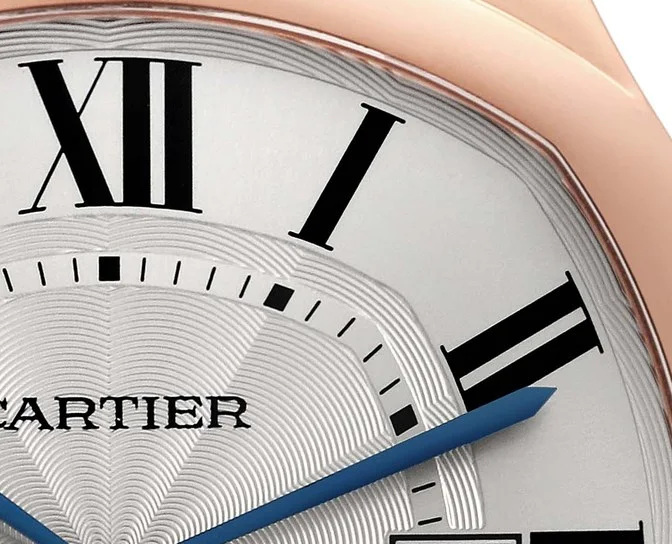
Details cut from photographs of watches of this line on record. Each was chosen by eye from a listing on the line and then checked again against the words beneath it. More sit beside the productions and parts they belong to, below. Select the small mark in a picture's corner for its holder and a link to its listing.

By house and period 5 described
Time-only with small seconds and date, from 2016
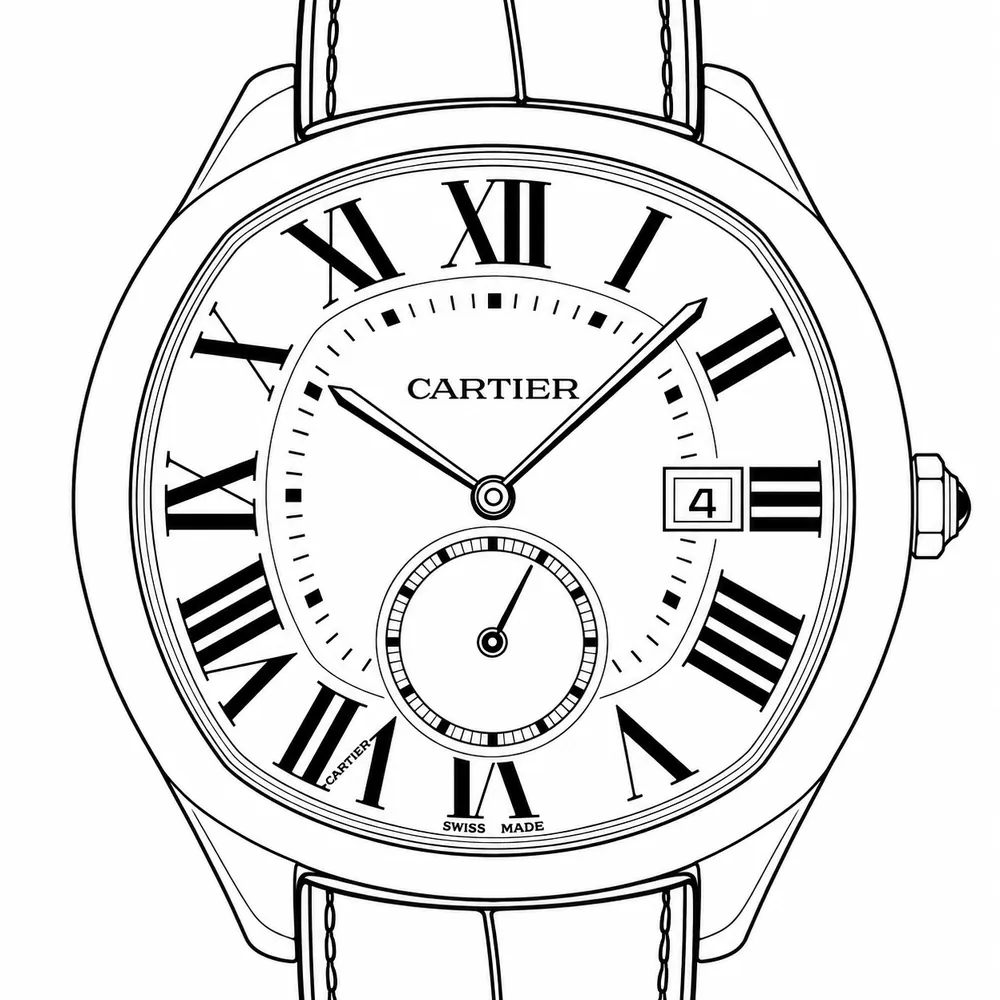
This is the model shown in January 2016 and the base of the line. It has a cushion case of 40 by 41 mm and 11.25 mm thick, in steel or 18 ct pink gold, with a domed sapphire crystal; the back is sapphire on the models described, though one account says some series have a solid back. It is powered by the automatic 1904-PS MC, introduced in 2010, with small seconds at 6 o'clock and a date at 3. Dials are given as silver or anthracite in one account and as white, black and grey for the launch collection in another. Accounts differ slightly on the width and height, giving 40 by 41 mm in most places, 41 mm across in some, and 40 by 40 mm in one; a long-term review of a steel example gives about 12 mm thick, part of it the domed crystal.
Signature and marks. Cartier's secret signature is in the VII; the dial does not carry the word 'automatic'. No case-back marking is recorded in the literature.

- cushion case with the lugs formed as part of the case middle
- octagonal crown with a blue cabochon
- silver flinqué dial with black Roman numerals, or a black dial with white numerals
- date window at 3 in a marked patch of dial that lines up with the III
- sapphire case back showing the rotor
Large date, second time zone and day/night, from 2016
A second model, in steel and pink gold, used the 1904-FU MC to add a large date at 12, a retrograde second time zone and a day/night indicator while keeping small seconds at 6. It reached reviewers about seven months after the January launch and boutiques from the first week of September 2016. The case keeps the 40 by 41 mm size and is given as 12.6 mm thick in one account, slightly thicker than the time-only model to house the module. The movement shows through the back and its functions are set from the crown.
Signature and marks. No dial or case-back marking for this model is recorded in the literature.

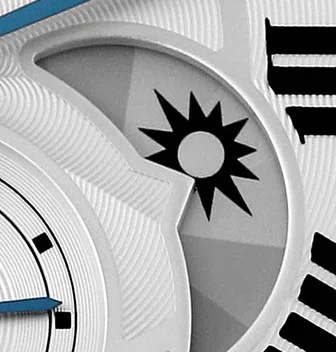

- retrograde twelve-hour second time zone scale at 10 or 11 o'clock
- small seconds at 6
- blue hands against a silver dial
Flying tourbillon, 2016
The flying tourbillon was part of the line in 2016, in a pink gold case of 40 by 41 mm. It uses the hand-wound calibre 9452 MC with a one-minute flying tourbillon, certified with the Geneva seal and assembled in Cartier's Geneva workshops in the rue du Rhône. Its dial has a more pronounced guilloché with the numerals and minute track on a separate frame. One account classes it as haute horlogerie. One account calls it a 40 mm watch.
Signature and marks. The movement is certified with the Geneva seal. No dial or case marking is recorded in the literature.
- more pronounced guilloché under a separate frame carrying the numerals and minute track
Moon phase, from 2017
The moon phase model was presented at the Geneva salon in January 2017, in steel and in pink gold, with the new automatic calibre 1904-LU MC. The moon is shown at 6 o'clock in place of the small seconds, and there is no date. The phase is described as astronomical, needing a one-day correction only every 125 years. The model keeps the 40 by 41 mm case of the time-only watch. The dial is guilloché, called white in one account and silvered in others.
Signature and marks. The dial carries the word 'automatic', which the time-only dial leaves out; the secret signature is at 7. No case-back marking is recorded.
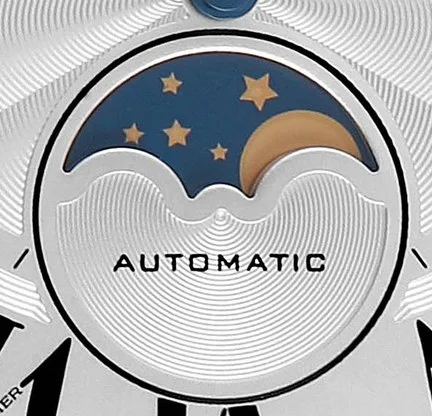

- no date window
- guilloché dial, silvered or white
Extra-Flat, from 2017
The Extra-Flat is a smaller, hand-wound, two-hand model with a case 6.6 mm thick and 39 mm across. It appeared in gold in 2017 (white and rose gold are named) and in steel in 2018, when a yellow gold version is also reported. It has no seconds hand and no date. The calibre 430 MC is based on a Piaget movement and has a 36-hour reserve. The steel model has a synthetic spinel in the crown and a pin buckle on a matt blue alligator strap; a yellow gold model is reported with a genuine blue sapphire instead, on a grey strap. The white gold model of 2017 is reported as limited to 200 pieces.
Signature and marks. On the steel model the dial carries only Cartier and Swiss Made, with the secret signature in the VII; the case back is closed, with eight screws.
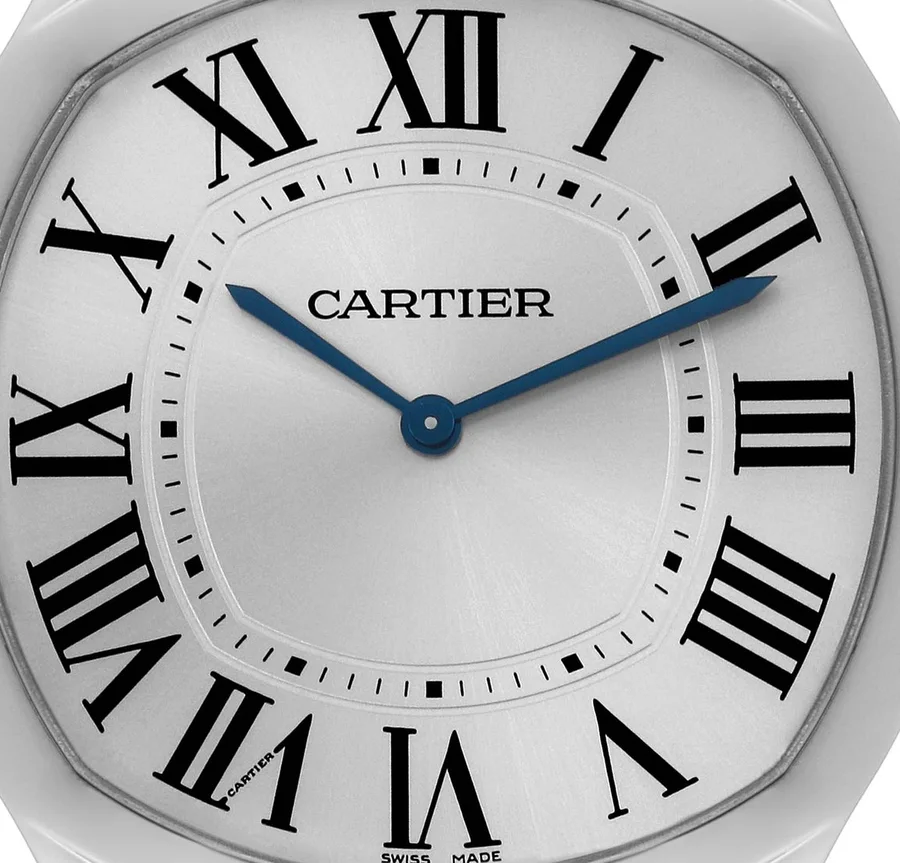

- very thin cushion case
- silver opaline dial with sunbrushed centre
- on the steel model, a blue spinel cabochon less prominent than on other Cartier crowns
- case back with eight screws
References: WSNM0011
Chronology
Specification
| Case | Cushion shape; 40 by 41 mm and 11.25 mm thick in the time-only model, in steel or 18 ct pink gold; the Extra-Flat is 39 mm across and 6.6 mm thick |
| Crystal | Domed sapphire, cushion-shaped to follow the case |
| Crown | Octagonal, set with a blue cabochon |
| Dial | Guilloché on most models, silver opaline with a sunbrushed centre on the Extra-Flat; Roman numerals with IIII, railway minute track, blued hands on the silver dials |
| Movement | Cartier manufacture calibres: 1904-PS MC (automatic, small seconds and date), 1904-FU MC (large date, second time zone, day/night), 1904-LU MC (moon phase), 430 MC (hand-wound, Extra-Flat), 9452 MC (hand-wound flying tourbillon) |
| Water resistance | 30 m in the time-only and Extra-Flat models |
| Strap | Alligator, with a folding clasp on the standard models and a pin buckle on the steel Extra-Flat |
Dial 7 described
The dials keep Cartier's long-used Roman numerals and railway minute track. Most are guilloché, and the guilloché pattern is said to recall a radiator grille; the Extra-Flat has a plain opaline dial instead. The main differences are the colour and finish, and the extra displays that the complicated models fit into the same dial.
Silver flinqué dial, time-only
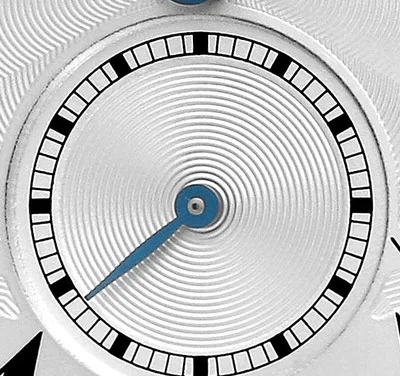
The silver dial has a guilloché centre in the flinqué manner, black Roman numerals, and alternating tracks of guilloché and printed minutes. The seconds sub-dial has a concentric pattern of its own. The date sits in its own marked area at 3.
- black Roman numerals
- guilloché centre with concentric circular pattern in the seconds dial
Black or anthracite dial
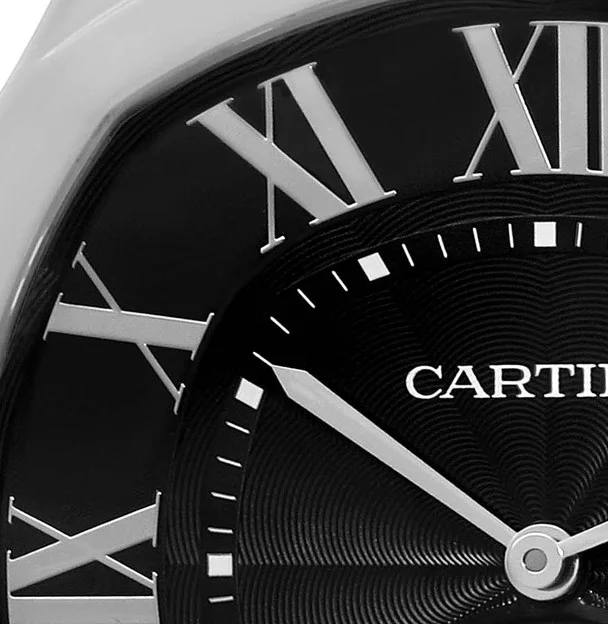
A dark dial is described as black or very dark anthracite, with white numerals and white minute track. One account gives it polished steel rather than blued hands. Another gives white, black and grey as the dial colours of the launch collection, and the steel time-only in white or black.

Large-date dial
The date moves to 12 in a double aperture, and the dial adds a retrograde second time zone and a day/night display. It is described as less traditional than the time-only dial yet still balanced. The position of the time zone scale is given as 11 o'clock in one account and 10 o'clock in another.
- large double date aperture at 12
- retrograde twelve-hour scale
- day/night indicator, in blue-grey tones
Moon phase dial
The moon phase model carries a lunar display at 6 o'clock in place of the small seconds, on a guilloché dial with no date.
- moon phase at 6 o'clock
Extra-Flat dial
As described on the steel model: a silver opaline dial with a sunbrushed centre inside the minute track, large, slightly raised black Roman numerals, a railway track and two blued hands, with no date, no seconds and no printing beyond Cartier and Swiss Made.
- opaline silver dial, sunbrushed centre
- no printing but Cartier and Swiss Made
IIII for IV
The four is written IIII, which is said to balance the VIII opposite it and read more clearly.
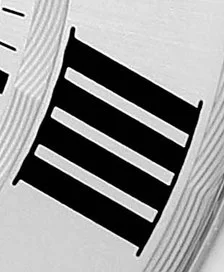

Secret signature
Cartier's name is hidden in the numeral VII, on the V, at about 7 o'clock.
- small signature in the VII
Hands 2 described
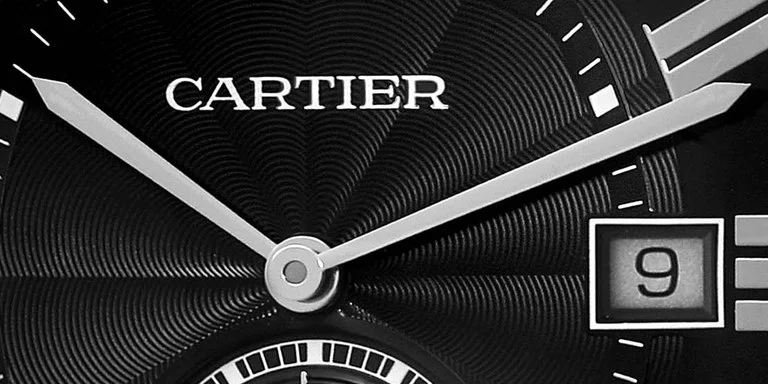
On the silver dials the hands are blued steel, sword-shaped on the time-only model, and they can look black until the light catches them. On the dark dial they are described as plain steel.
Blued sword hands
Blued steel sword hands go with the silver dials, for hours, minutes and small seconds in the time-only model. The large-date model has blued hands, its second time zone hand included. On the Extra-Flat there are two blued hands only.
- blue colour that changes with light
Rhodium-toned steel hands
On the dark dial the hands are described as polished steel and not blued, so that the watch keeps an all-steel look. This rests on one account.

Subregisters 2 described
The time-only and large-date models have small seconds at 6 o'clock; the moon phase model has its lunar display at 6 o'clock.
Small seconds at 6
A small seconds dial with a radial or concentric guilloché sits at 6. It is kept in the large-date model too.
- circular guilloché in the seconds dial
Retrograde second time zone and day/night
A retrograde scale shows a second time zone over twelve hours, and a separate day/night indicator shows whether it is day or night there. The time zone is changed with a push of the crown. Accounts place the scale at 11 o'clock and at 10 o'clock.
- retrograde hand over a twelve-hour scale
- blue-grey day/night disc
Case and sizes 4 described
The case is a cushion, a square with softened corners, with the lugs formed as part of the case middle. It is polished on the bezel and brushed on the sides and lugs, and its thin sides make it look slimmer than its measurements. The Extra-Flat is a smaller, much thinner case of the same pattern.
Standard case, 40 by 41 mm
The time-only case is 40 by 41 mm and 11.25 mm thick, in steel or 18 ct pink gold, with 30 m water resistance. It is called 41 mm in some accounts and 40 by 40 mm in one. A long-term review of a steel example gives about 12 mm thick, part of it the domed crystal.
- 11.25 mm thickness
- brushed case band against polished bezel
Complication cases
The large-date case is given as 12.6 mm thick in one account, thicker than the time-only to make room for the module. The moon phase model keeps the 40 by 41 mm case. Another account gives around 12 mm for the standard models, depending on the complication.
- slightly thicker case
Extra-Flat case, 39 mm
The Extra-Flat case is 6.6 mm thick and 39 mm across, with short curved lugs, brushed band and a closed back held by eight screws, and 30 m water resistance. One account gives it as 38 mm high by 39 mm wide.
- 6.6 mm thickness
Sapphire back or closed back
The time-only and large-date models show their movement through a sapphire back, though one account says some time-only series have a solid back. The steel Extra-Flat has a plain steel back.
- sapphire back versus solid back
Crown 2 described
The crown is octagonal, said to resemble a bolt, and set with a blue cabochon.
Blue sapphire cabochon
A blue faceted sapphire is described in the crown of the pink gold time-only model, a photograph caption names a sapphire cabochon on a steel time-only model, and another account lists a sapphire in the crown among the line's usual features. One account instead gives a blue spinel in the crown of the steel large-date model.
- octagonal crown with blue stone
Synthetic spinel cabochon
The steel Extra-Flat has a synthetic spinel cabochon, less prominent than on other Cartier models. A yellow gold Extra-Flat of the same year is reported to have a genuine blue sapphire.
- flatter blue stone
Crystal 1 described
The crystal is sapphire and domed.
Cushion-shaped domed sapphire
On the steel time-only model the crystal is not a plain round dome but a cushion shape with edges that follow the case, and its height contributes to the case thickness.
- dome following the cushion outline
Date 2 described
The date appears in two forms.
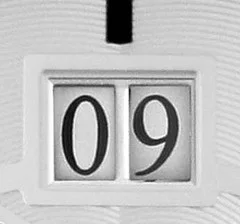
Date at 3
On the time-only model the date is in an aperture at 3, framed by its own patch of dial.
- aperture lining up with the III
Large date at 12
On the large-date model the date is shown in a double aperture at 12.
- two-digit window at 12
Movement 5 described
The movements are Cartier manufacture calibres, though the 430 MC is based on a Piaget movement. The number 1904 in three of the names is said to refer to the date Cartier began making watches, and PS in the first stands for small seconds.
1904-PS MC
The time-only calibre was introduced in 2010. It is automatic, 4 Hz (28,800 vibrations an hour), with about 48 hours of reserve, two barrels, a stop-second and a rotor on ceramic ball bearings. Accounts give 27 jewels and 186 parts, and Geneva stripes on bridges and rotor. It is described as the first automatic calibre built in Cartier's manufacture at La Chaux-de-Fonds, though not the first Cartier made itself.
- Geneva stripes on bridges and rotor
- C-shaped regulator
1904-FU MC
First presented in 2014 and used first in the Rotonde de Cartier. It adds large date, retrograde second time zone and day/night display to the base design, with 28 jewels, and sets the functions from the crown.
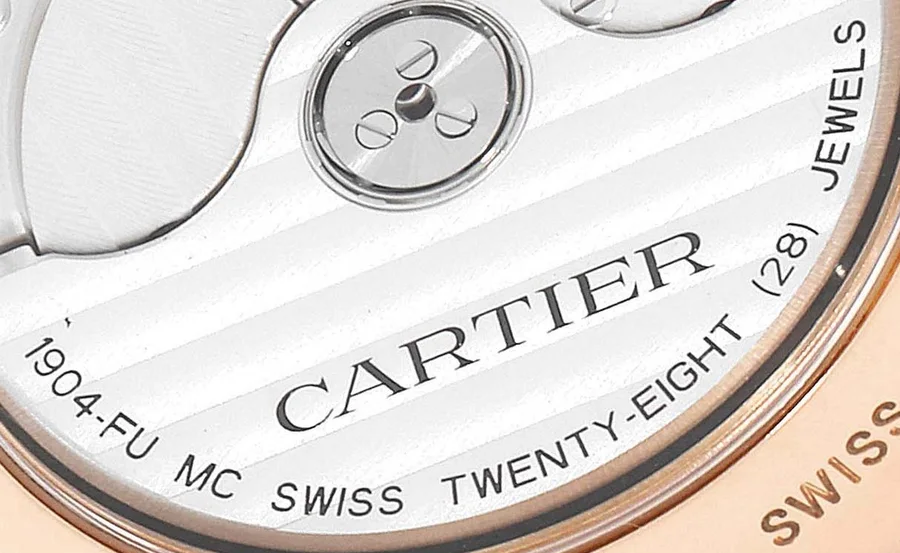

- Geneva stripes on bridges and rotor through the back
1904-LU MC
The moon phase calibre, automatic, new when it was shown in January 2017.
430 MC
A hand-wound ultra-thin calibre based on a Piaget movement, with 131 parts, 21,600 vibrations an hour and 36 hours of reserve. It is used in the Extra-Flat.
9452 MC
A hand-wound flying tourbillon calibre with a one-minute carriage, certified with the Geneva seal.
Bracelet and strap 2 described
All the models described in the literature are on straps.
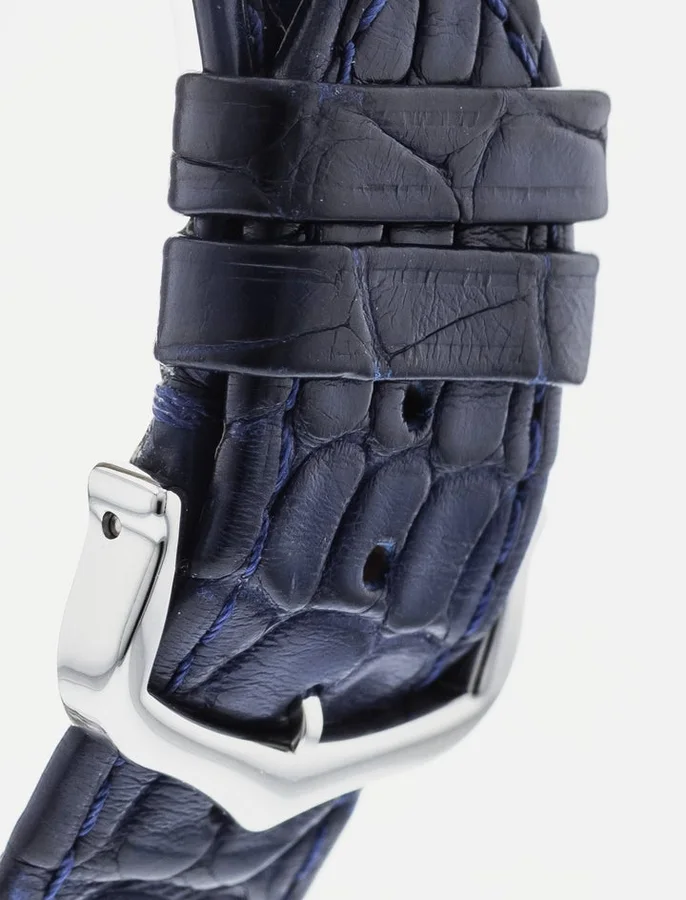
Alligator strap, folding clasp
The standard models come on alligator straps in midnight blue, black or brown, with a folding clasp in steel or pink gold to match the case. Calf straps in several colours were shown at the Hong Kong launch.
- folding clasp in case metal
Matt blue strap, pin buckle
The steel Extra-Flat comes on a matt blue alligator strap with a steel pin buckle. A yellow gold Extra-Flat is reported on a grey strap.

Reference numbers
A four-digit number is stamped on the case and covers a case; a code beginning W, or the newer letter codes, is a catalogue number for one version of it (metal, dial, strap). Many older watches carry neither. The last column is the listings on record under the number, as its own page counts them.
| Number | What it is | Listings |
|---|---|---|
| WSNM0004 | Steel time-only model with silver dial, small seconds and date, calibre 1904-PS MC; the commonest reference in the library's records. | 48 |
| WSNM0009 | Steel time-only model with black dial, described by sellers as black dial; calibre 1904-PS MC. | 28 |
| WGNM0003 | Pink gold time-only model with silver dial and calibre 1904-PS MC; sellers list it as rose gold. | 3 |
| WSNM0005 | Steel large-date model with second time zone and day/night indicator, calibre 1904-FU MC. | 23 |
| WGNM0005 | Pink gold counterpart of the WSNM0005 large-date model. | 9 |
| WSNM0008 | Steel moon phase model, as sellers describe it in their titles; one authentication page instead lists it as a steel time-only with small seconds. | 24 |
| WGNM0008 | Rose gold moon phase model, as sellers describe it in their titles. | 3 |
| WSNM0011 | Steel Extra-Flat model, hand-wound 430 MC, 39 mm. | 10 |
| WSNM0006 | As sellers describe it, a steel Drive with black dial; the records do not say how it differs from WSNM0009. | 3 |
| WGNM0004 | Pink gold time-only model with anthracite dial, named in one published account; it does not appear in the library's records. | |
| 3967 | As sellers describe it, a pink gold Drive; one auction listing calls it an extra-flat with the hand-wound 430 MC. | 3 |
Originality
- Published accounts say nothing about parts commonly replaced at service for this line.
Names
- Drive GMT. A name used for the large-date model with second time zone, which published accounts also call the small complication model.
- Extra-Plate. The French name for the Extra-Flat model.
Where accounts differ
Points on which the published literature and the library's own records do not agree, or on which the literature contradicts itself.
- References and calibres on one authentication page. A page on spotting fakes lists WSNM0004 as an 18 ct rose gold model, WSNM0011 as a rose gold Extra-Flat, WSNM0015 as a steel watch with a calibre 1847 MC, and WSNM0008 as a steel watch with small seconds. Other accounts give WSNM0011 as steel with the 430 MC and 36 hours of reserve, and the library's records show WSNM0004 as steel, WSNM0008 as the moon phase in the sellers' titles, and WSNM0015 only once, as a steel automatic with no calibre named. The entry follows the other accounts and the records.
- Position of the second time zone. One account puts the retrograde second time zone at 11 o'clock; another puts it at 10 o'clock and the day/night indicator at 4. Neither is confirmed by the records.
- Year of the Extra-Flat. Several accounts put the first Extra-Flat models, in white and pink gold, in 2017 and the steel model in 2018. A long-term review written in 2018 says the Extra-Flat was launched that year, without separating the gold and steel models.
- Stated years in the records. The accounts date the launch to 2016, but sellers' stated years for WSNM0004, WSNM0009, WSNM0005, WSNM0008 and WSNM0011 begin in 2015, and several sample listings from one dealer carry 2015. The Extra-Flat in steel is dated to 2018 in the literature, yet WSNM0011 has a stated year of 2015. Sellers' years are often guesses.
In the records
Counted from 162 listings at dealers and auction houses whose title, or whose reference, places them on the line; 97 state a year. These are what sellers state, not measurements, and a count of listings is not a count of watches made.
Case metal
| Metal | Listings | Share |
|---|---|---|
| Steel | 126 | 82% |
| Gold, any colour | 28 | 18% |
| Pink | 21 | 14% |
| Yellow | 6 | 4% |
| White | 1 | 1% |
As sellers state it. Shares are of the 154 listings that name a metal. Carat, where a listing of gold gives one: 18k 8.
Case size
| Size | Listings | Share |
|---|---|---|
| 40 mm | 113 | 80% |
| 41 mm | 14 | 10% |
| 39 mm | 8 | 6% |
| 45 mm | 3 | 2% |
| 47.1 mm | 2 | 1% |
| 37.5 mm | 1 | 1% |
| 38 mm | 1 | 1% |
As sellers state it. Shares are of the 142 listings that give a size. On a watch that is not round some sellers give the width and some the length, so one watch can stand under two sizes.
Movement
| Kind | Listings | Share |
|---|---|---|
| Automatic | 126 | 88% |
| Hand-wound | 17 | 12% |
Shares are of the 143 listings whose description says how the watch is driven.
Listings by decade the seller gives
| Decade | Listings |
|---|---|
| 2010s | 76 |
| 2020s | 15 |
6 more give a year outside the years the line was made (from 2016): a later watch sold under the name, or a slip. They are left out.