Calibre de Cartier
The Calibre de Cartier is a round, large-cased sports line introduced in 2010 around the 1904 MC movement, the first automatic movement Cartier developed and built itself in series. It began as a 42 mm time-and-date watch with a running-seconds register, grew in 2011 to include bracelet versions, and was joined by a chronograph, a certified 300 metre Diver and, in 2015, a 38 mm model with an all-Roman dial. Cases come in steel, two-tone steel and pink gold, and pink gold. Accounts disagree on the launch years of the chronograph and the Diver, and on when the line ended, which is put variously at 2017, 2018 and 2020.
Cartier's entries are arranged by model, not by reference number, because its reference numbers are several systems at once and many of its watches carry none. The houses are set out in Paris, London and New York.

- Made
- from c. 2010The start in 2010 is stated consistently; the end is given as 2018 and 2020 in different published accounts, and a third puts it seven years after launch, so no closing year is set here.
- On record
- 522 listings18 of them give no reference
- Reference numbers
- 39 described62 seen in listings
- House named in the title
- Paris 2the line is later than the three houses; a title naming one is quoting the dial
What to look for
Details cut from photographs of watches of this line on record. Each was chosen by eye from a listing on the line and then checked again against the words beneath it. More sit beside the productions and parts they belong to, below. Select the small mark in a picture's corner for its holder and a link to its listing.

By house and period 4 described
Calibre de Cartier 42, time and date
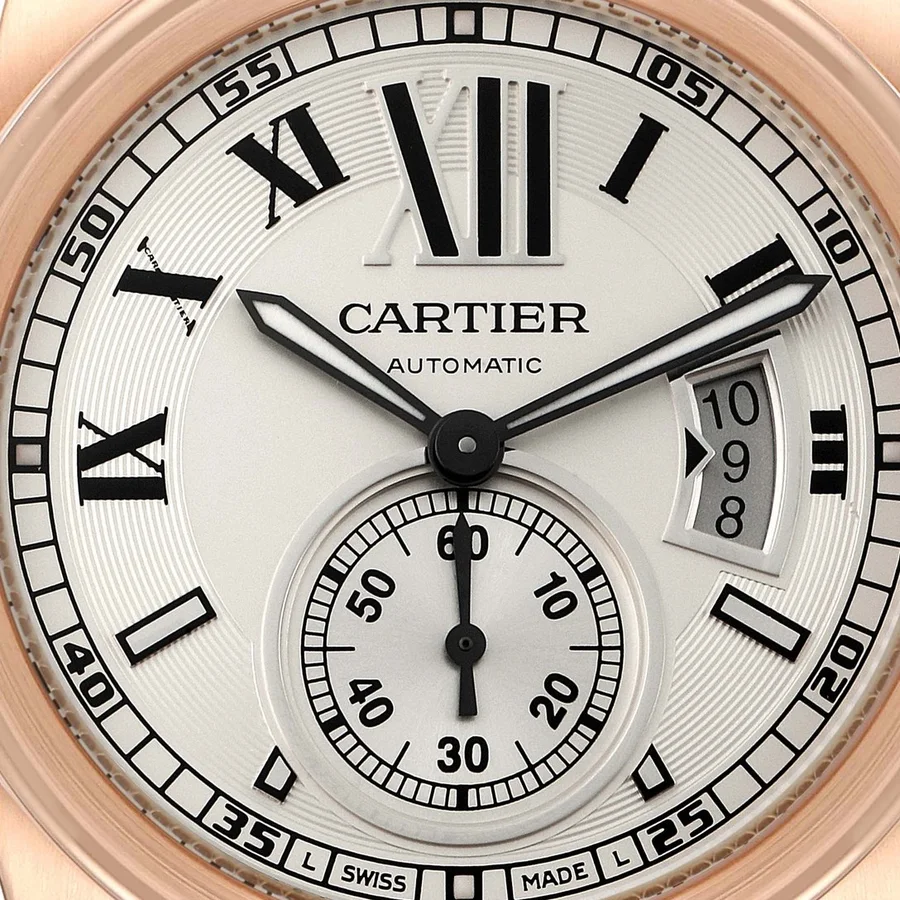
The original watch of the line, introduced in 2010 on leather straps in a 42 mm case of steel, two-tone steel and pink gold, or pink gold. Metal bracelets followed in 2011 in the same case, giving steel, two-tone and pink gold watches. The movement is the 1904-PS MC, developed and built at Cartier's workshop in La Chaux-de-Fonds. The dial carries hours, minutes, a running-seconds register at 6 and a date window at 3, and the dials are silver, black or chocolate brown. No published account ties this line to a Paris, London or New York house.
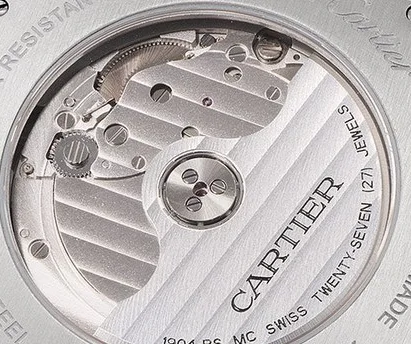
Signature and marks. Published accounts give no dial signature or case-stamp detail for this version beyond a sapphire caseback showing the movement.


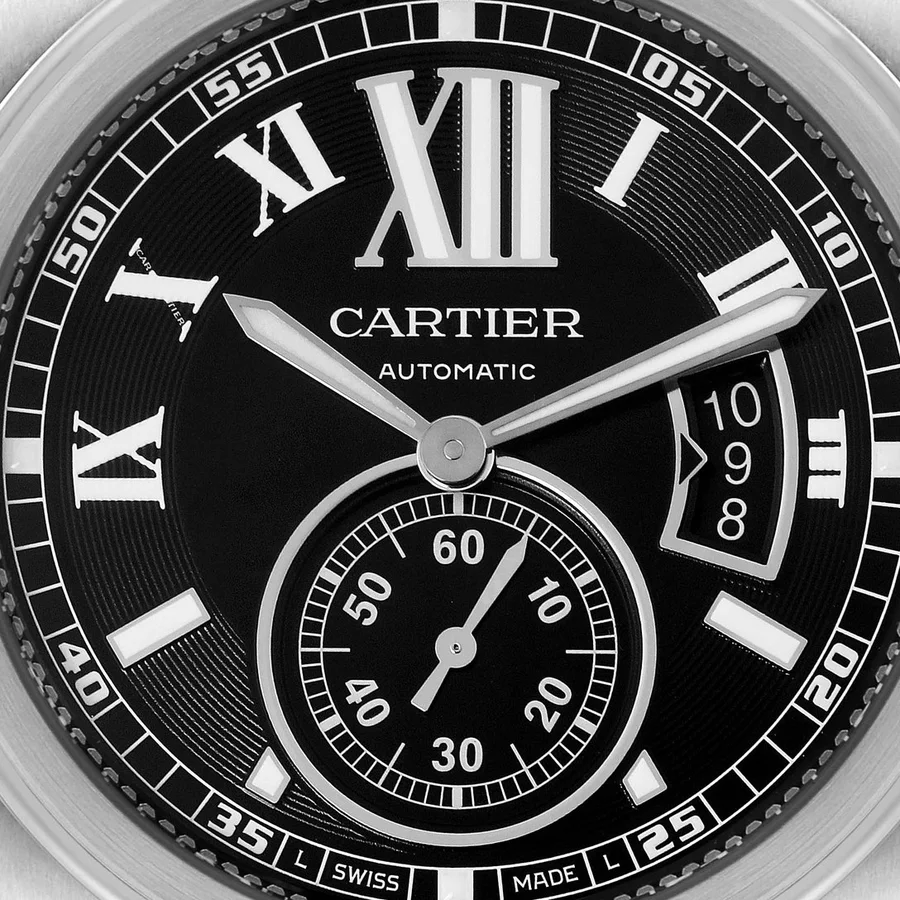

- 42 mm round case with a bezel falling steeply to the dial
References: W7100041, W7100037, W7100039, W7100051, W7100009, W7100007, W7100015, W7100016, W7100036, W7100040, W7100018
Calibre de Cartier Chronograph
A chronograph on the same 42 mm case, with two elongated pushers either side of the crown. It is powered by the 1904-CH MC, a column-wheel chronograph with a vertical clutch. Its dial has registers at 3 and 9 and a date window moved to 6, and the fixed bezel carries a scale. The introduction is put in 2012 by some accounts and 2013 by others. Published accounts count six versions in one place and eight in another, in steel, two-tone and pink gold, with leather or bracelet; the account that counts eight also names a gem-set white gold version.
Signature and marks. On the steel watch with a silvered dial that was examined, the word Cartier is printed diagonally across the X numeral, visible only under magnification; the same account says XII is stamped while the other six numerals are printed.
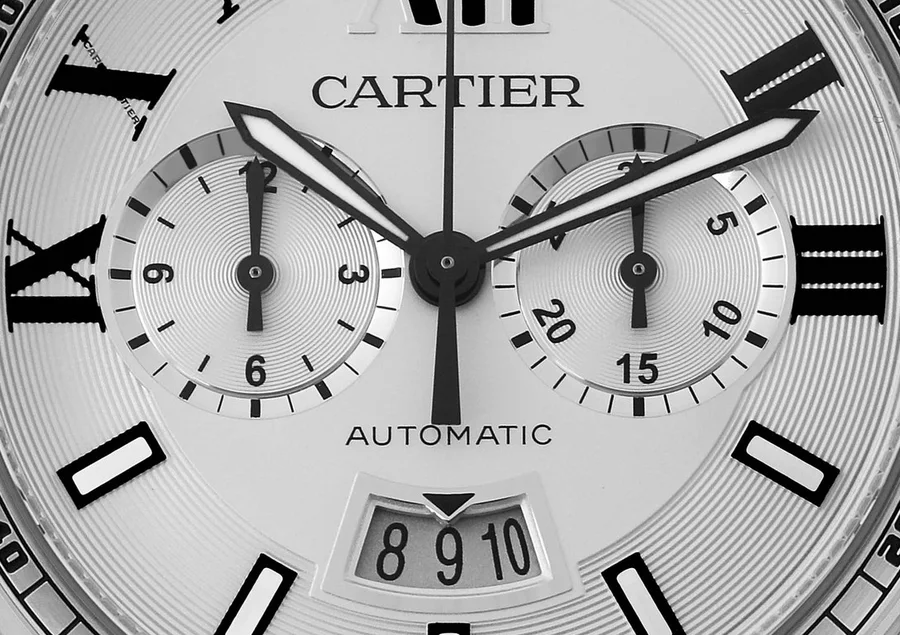

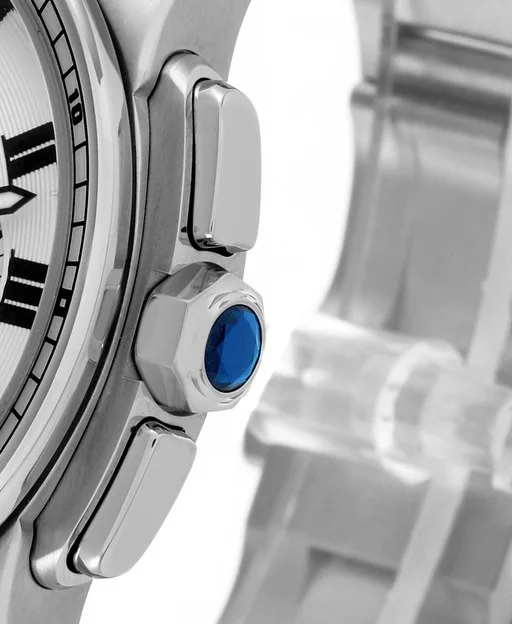

- scale on the fixed bezel
- four lume plots on the minute track on the two-tone example described
References: W7100046, W7100060, W7100045, W7100061, W7100042, W7100043, W7100047, W7100044
Calibre de Cartier Diver
A dive watch certified to ISO 6425, with a 300 m rating, a 42 mm case about 11 mm thick, a screwed crown and caseback, a 120-click unidirectional bezel and luminous dial. It was shown early in 2014 and described as coming to boutiques from May 2014 on rubber, with steel and two-tone bracelets expected from around September 2014; other accounts date the launch to 2013. It comes in steel, two-tone, pink gold and black carbon versions, with blue or black dials. The 1904-PS MC powers it.
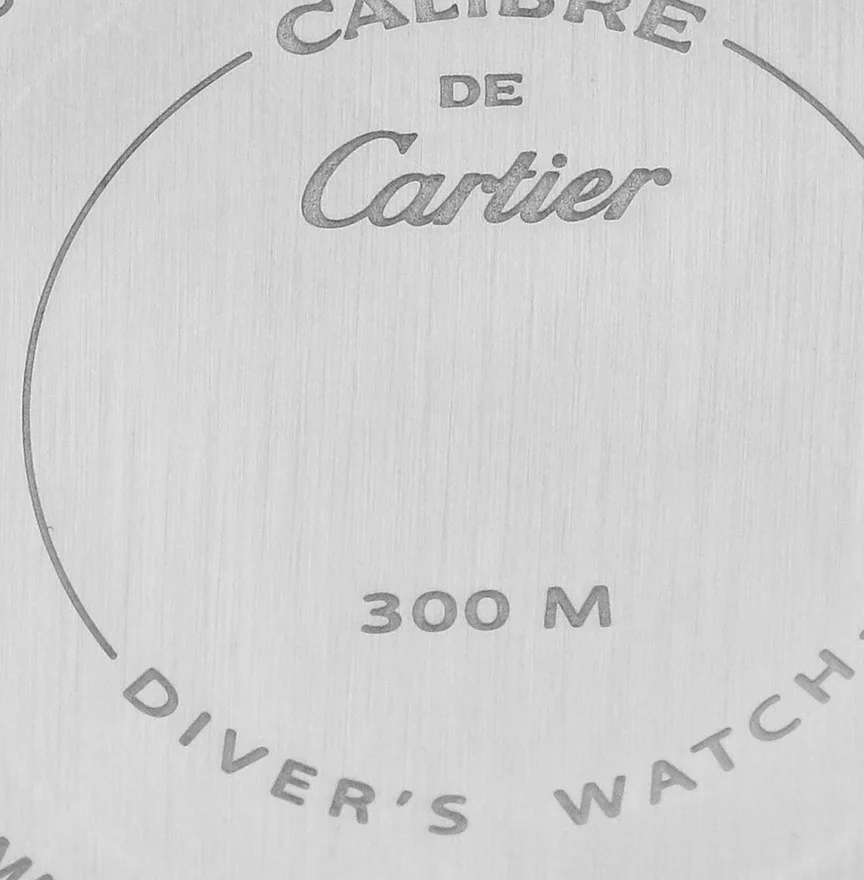
Signature and marks. Published accounts say the caseback carries the four-digit case number, such as 3729 for a Diver, and a serial number, but never the full W reference such as W7100056.
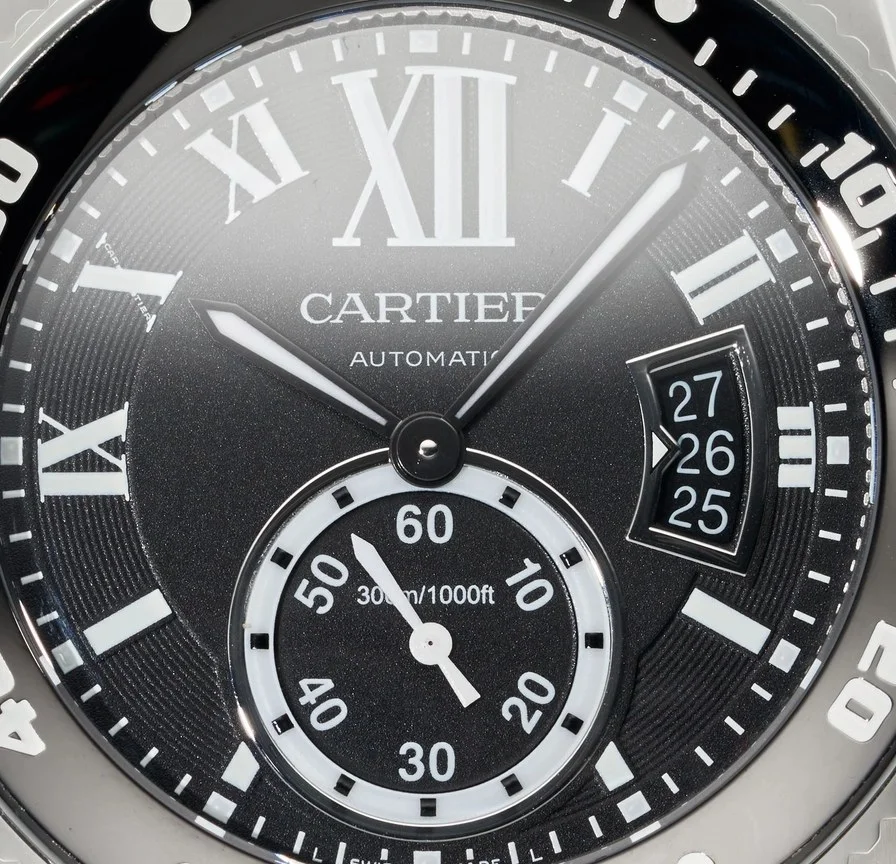


- unidirectional bezel with 120 notches
- dial with large luminous XII
- screwed crown and closed caseback
- rubber strap with pin buckle or steel bracelet
References: 3729, 3730, W7100056, W7100057, WSCA0011, WSCA0010, W7100055, W7100054, W2CA0009, W2CA0008, WGCA0010, W7100052, WSCA0006, W2CA0004
Calibre de Cartier 38
A 38 mm version of the time-and-date watch, introduced in 2015 for both men and women. It has the same 1904-PS MC movement and the same case design, but the dial is changed: all hour numerals are Roman, XII is the same size as the others, the date window at 3 holds a single numeral and the hands are blued. The case is about 9.3 mm thick with a rating of 3 bar. Steel, two-tone and pink gold versions exist, as do diamond-set bezels and a diamond-paved dial.
Signature and marks. Published accounts give no signature or stamp detail.
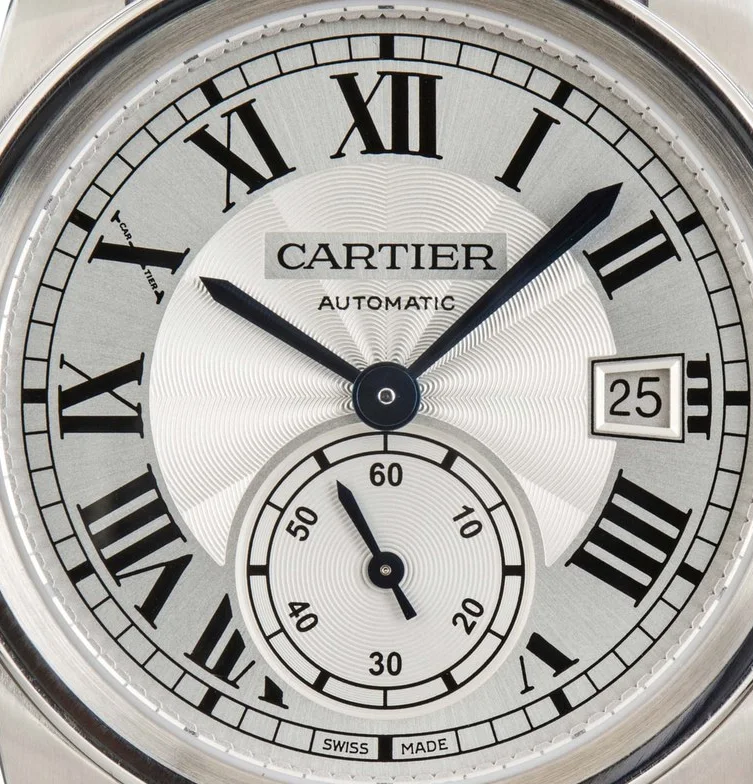

- 38 mm case
- alligator strap with double-adjusting deployant on the version described
References: WSCA0003, W2CA0002, WGCA0003, WF100013, WF100015
Chronology
Specification
| Case | Round; 42 mm on the original, chronograph and Diver (Diver about 11 mm thick, chronograph listed at 12.6 mm); 38 mm on the 2015 model (about 9.3 mm thick). Steel, two-tone, pink gold; some Divers in black carbon |
| Crystal | Sapphire; a sapphire caseback window on the time-and-date watch, chronograph and 38, a closed back on the Diver, whose crystal is thicker than on the time-and-date watch |
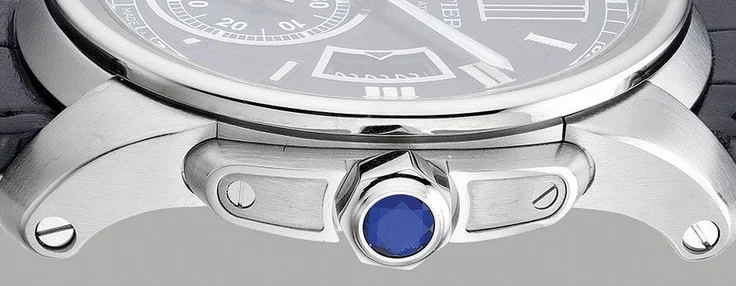
| Crown | Faceted, set with a stone (on the chronograph seven-sided, with a blue synthetic spinel cabochon on steel and a faceted sapphire on gold); broad crown guards |
| Dial | Roman numerals on the upper half and baton markers on the lower half of the 42 mm time-and-date and chronograph watches; sword-shaped hands; railway-style minute track |
| Movement | Cartier manufacture automatic: 1904-PS MC (time, small seconds, date) or 1904-CH MC (chronograph); 28,800 vibrations an hour, about 48 hours of power reserve |
| Water resistance | About 30 m on time-and-date versions described, 100 m on the chronograph, 300 m on the Diver |
| Bracelet | Leather or alligator strap with deployant buckle; steel, two-tone or pink gold bracelet with butterfly clasp; rubber strap on the Diver |
Dial 6 described
The 42 mm time-and-date and chronograph watches mix Roman numerals on the upper half of the dial with baton markers on the lower half, and carry a railway-style minute track at the edge. The 38 mm model drops the batons for all-Roman numerals. Dial colours named are silver or white, black, chocolate brown and, on Divers, blue.
Seven Roman numerals and four batons
The 42 mm time-and-date layout has seven Roman numerals over the top and baton markers below. On the 2010 pink gold watch with chocolate dial, the numerals are gold-coloured transfers and four indices are luminous. The XII is oversized and slightly raised on the first watches. Accounts of the chronograph differ: one says XII is stamped and the other six numerals printed, another describes seven stamped numerals with five rectangular indexes on a two-tone example.
- XII larger than the other numerals
- luminous batons at the lower half
Silvered opaline dial
Described on the chronograph as silvered opaline, partly snailed. On the two-tone example described it has a concentric pattern towards the rim and a smooth centre.
- white-looking dial with patterned outer ring
Chocolate brown dial
Offered on pink gold and two-tone versions of the time-and-date watch, on strap and on bracelet.
Diver dial
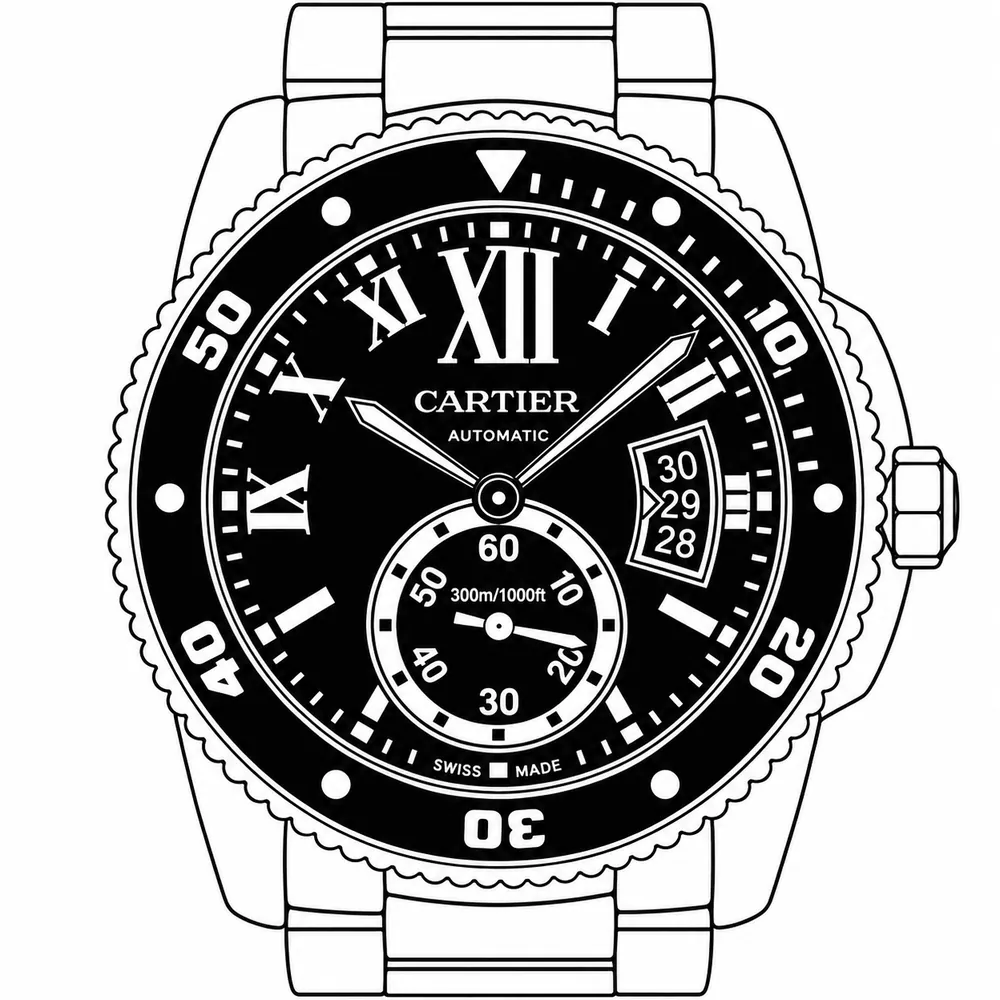
Described as deep black, partly snailed, with a luminous XII, luminous hands and a prominent running-seconds register. Blue dials with blue bezels also exist.
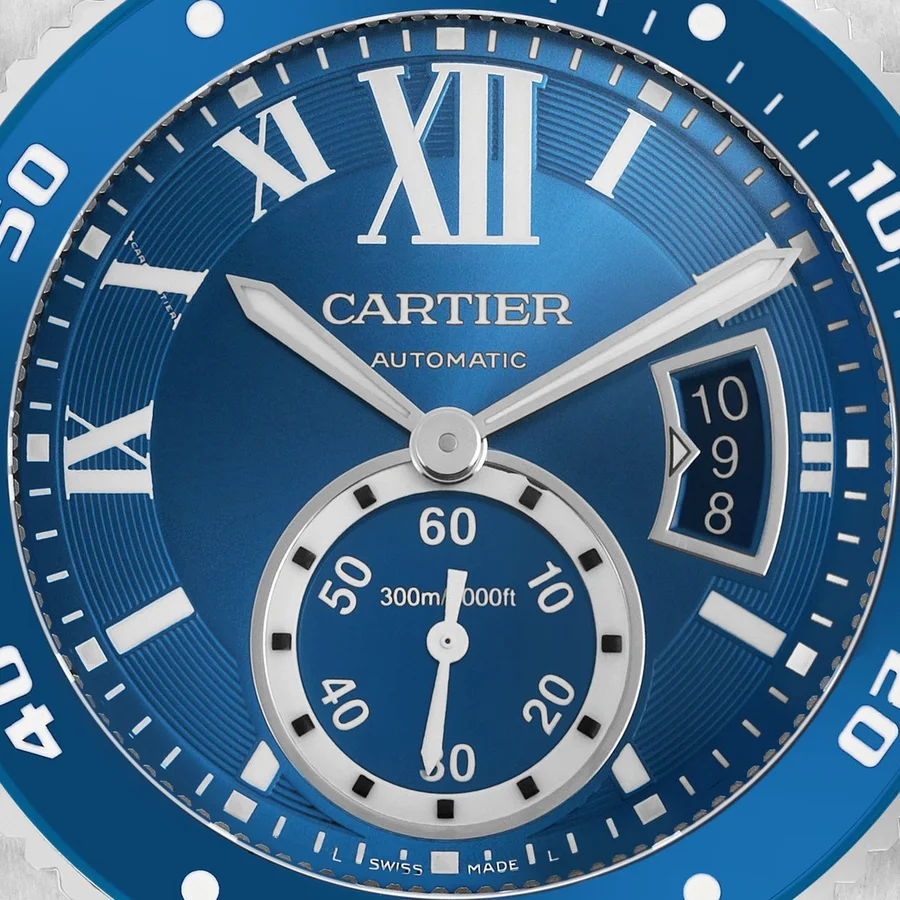

- luminous XII
All-Roman dial of the 38
On the 38 mm model every hour is a Roman numeral and the XII is the same size as the others. The dial is silvered, with a sunray finish on the example described in the literature, and the date window at 3 holds one numeral.
- eleven Roman numerals plus date window at 3
Cartier printed across the X
The word Cartier is printed diagonally across the X on the steel chronograph with silvered dial that was examined. It could be seen only with a loupe or macro lens. Published accounts do not say whether other versions have it.
- Cartier across the X numeral under magnification
Luminous material 2 described
Luminous material appears on the hands and the lower hour markers of the 42 mm watches, and more heavily on the Diver.
Luminous markers and hands on the chronograph
On the chronograph the baton markers and the hour and minute hands are luminous. The central seconds and counter hands are black with no lume. The two-tone example described also has four lume plots on the outer track.
- lume on the batons and the two main hands only
Diver luminous dial
The Diver has a luminous XII and luminous hands, and the dial is described as strongly luminous for visibility underwater.
- luminous XII and hands
Hands 2 described
Sword-shaped hands are described on every version of the line. Their finish is given as black oxidised steel on the 42 mm chronograph and blued steel on the 38.
Black oxidised sword hands
On the chronograph the sword-shaped hour and minute hands are black oxidised steel with a luminous coating; one account says they match those of the time-and-date watch.
- black sword hands
Blued sword hands of the 38
The 38 mm model has blued steel sword-shaped hands.


Subregisters 2 described
Time-and-date watches and Divers have one running-seconds register at 6. The chronograph has two registers.
Running seconds at 6
The time-and-date watch, the Diver and the 38 carry a small seconds register at 6. On the Diver it doubles as a visible sign that the watch is running.
- small seconds at 6
Chronograph registers at 3 and 9
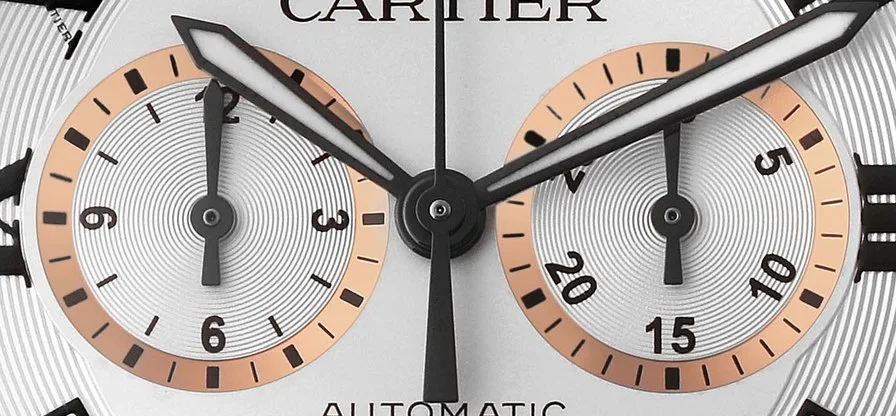
Most accounts give a 30-minute counter at 3 and a 12-hour counter at 9, with a snailed finish and bevelled rings. One account names a running-seconds register and a 30-minute register in its text but hour and minute counters in its specification. Another says the date has taken the place of the seconds register.

Bezel 3 described
Bezels differ by version: a smooth bezel with a steep inner fall on the time-and-date watch, a scaled fixed bezel on the chronograph and a rotating one on the Diver.
Time-and-date bezel with 120-notch fluting
The bezel is soft and polished on the outside and falls at 28 degrees towards the dial, ending in a fluted edge of 120 notches meant to recall gear teeth.
- fluted inner edge
Chronograph scale bezel
The fixed bezel is fluted and carries a scale; most accounts call it a tachymeter, one review a 0 to 60 second scale, and one a rail track.
- engraved scale on a fixed bezel
Diver unidirectional bezel
A 120-click bezel turning one way only, with five-minute marks. Accounts describe the insert as ceramic in some places and as an ADLC-treated aluminium ring in another; ADLC is also said to coat the bezel inside and out.
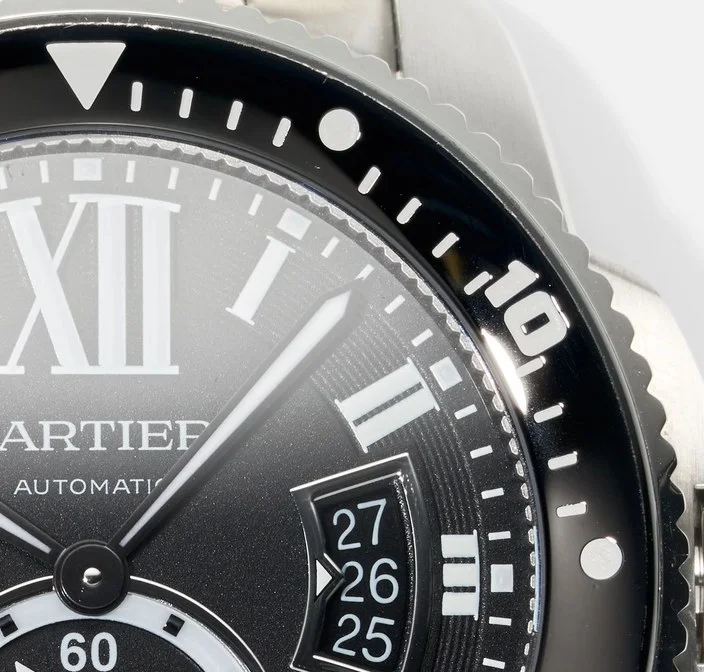

- bezel with 120 clicks
Case and sizes 4 described
The case is round, large and broad, with four curved lugs and a double shoulder protecting the crown. Sizes run 42 mm for the original, chronograph and Diver, and 38 mm for the 2015 model.
42 mm case
Looks larger than its width because of the heavy crown guard and widely set lugs. Brushed and polished surfaces alternate. Steel, two-tone steel and pink gold, or pink gold; water resistance is given as 30 m for the pink gold watch with chocolate dial.
- broad crown guard
- curved lugs
Chronograph case
The same 42 mm diameter. Listed as 12.6 mm thick and rated to 100 m; a measurement of the steel watch gave about 12 mm in thickness and about 43.5 mm across the diagonal. Steel caseback with a flat sapphire window and eight screws.
- eight-screw caseback with sapphire window
Diver case
A 42 mm case about 11 mm thick, in steel or 18 ct pink gold, with a screwed crown, a screwed closed back and a thicker sapphire crystal. Water resistance is 300 m. Black carbon versions are listed. Sellers describe Diver casebacks in steel, DLC-coated steel and pink gold alike as held by eight screws.
- thin 11 mm case for a diver
38 mm case
38 mm in diameter, about 9.26 mm thick, water resistant to 3 bar; the version described has a faceted sapphire in the crown. Steel, two-tone and pink gold, plus diamond-set bezel versions.
- smaller case with all-Roman dial
Crown 1 described
The crown is faceted and set with a stone; on the chronograph it is described as seven-sided, and the stone differs by metal.
Blue cabochon crown
The first watches are described with a blue synthetic spinel cabochon in a faceted crown. On the chronograph the seven-sided crown has a synthetic blue spinel cabochon on steel and a faceted sapphire on gold. The 2010 pink gold watch is given a gold crown set with a sapphire cabochon, and the 38 described, with a silvered dial on an alligator strap, a faceted crown with a faceted sapphire.
- faceted crown with blue stone
Crystal 2 described
Sapphire crystals are used, with a sapphire window in the caseback except on the Diver, which has a closed back.
Diver crystal
Described as 1.2 mm thicker than on the time-and-date watch to withstand 300 m.
Chronograph crystal
Slightly curved sapphire with an anti-reflective treatment, on the steel watch examined.
Date 3 described
The date window moves with the version: vertical at 3 on the 42 mm time-and-date watch, at 3 on the Diver, at 6 on the chronograph, and single-numeral at 3 on the 38.
Vertical date at 3
A vertical panoramic window at 3 on the 42 mm time-and-date watch. The Diver also has its date at 3; its shape is not described.
- vertical window at 3
Horizontal date at 6
On the chronograph the window sits at 6 and is horizontal, showing three consecutive dates.
- three dates at 6
Single-numeral date at 3
On the 38 the window at 3 shows one numeral, in the traditional manner.
- single numeral at 3
Movement 2 described
Two Cartier manufacture automatics drive the line, both made in La Chaux-de-Fonds. The 1904 in the name refers to the year of the watch made for an aviator friend of Louis Cartier.
1904-PS MC
Automatic, 11½ lignes (25.6 mm) by 4 mm, 27 jewels and 186 parts, two barrels, 28,800 vibrations an hour, about 48 hours of power reserve. It has a stop-seconds device, a ceramic ball bearing at the rotor centre, a two-way winding rotor, fine regulation by a C-shaped adjuster and Côtes de Genève finishing. It drives the time-and-date watch, the Diver and the 38. It is also named as the movement of the Tank Anglaise and Tank MC.
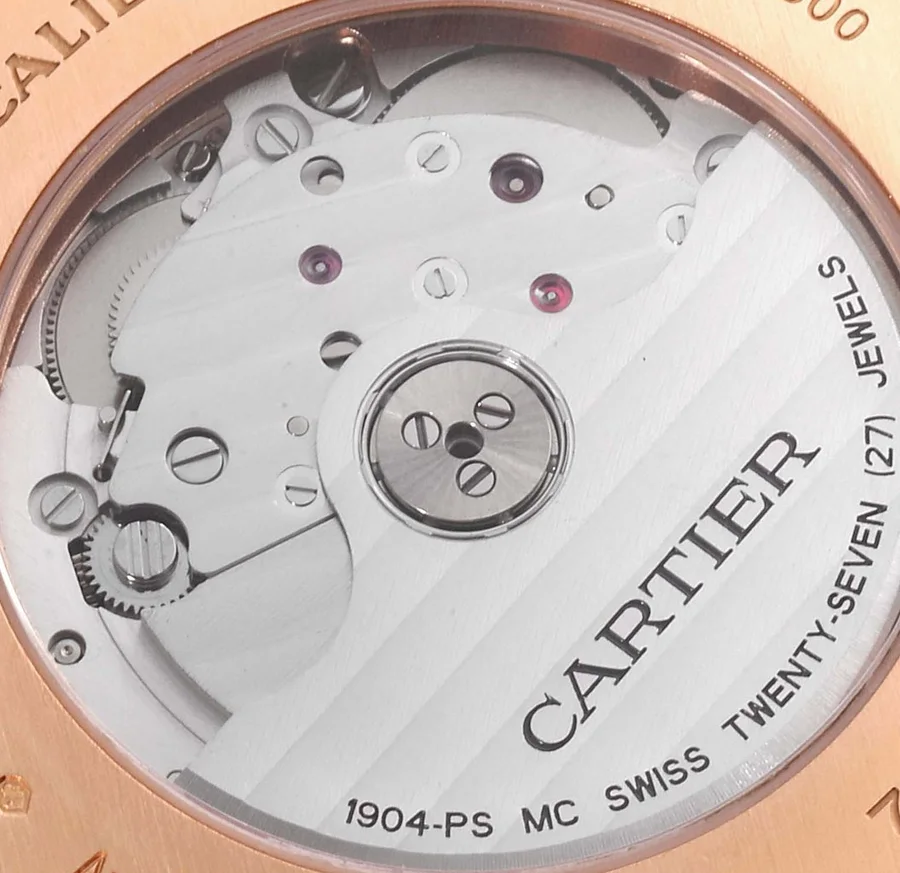

1904-CH MC
Automatic chronograph with a column wheel, vertical clutch, linear zero-reset hammer, 35 jewels, 269 parts, two barrels, 4 Hz and 48 hours. Côtes de Genève on bridge, balance cock and rotor, circular graining on the plate. The column wheel is visible through an opening in the bridge on one account.
- circular-grained plate
- column wheel visible through aperture
Bracelet and strap 3 described
Straps and bracelets came first as leather in 2010 and metal in 2011. The Diver adds rubber.
Leather and alligator strap
Cushioned leather straps in neutral colours at the start; the pink gold watch is given an alligator strap and a double-adjusting deployant in 18 ct pink gold.
Metal bracelet
A bracelet described as an evolved version of an older Cartier sports bracelet, with a locking butterfly clasp. On the steel chronograph it measures about 23 mm at the crown, tapering to about 20 mm, with polished centre links, pierced lugs and screwed links. The Diver's bracelet is the same as the Calibre one.
- polished centre links on a brushed bracelet
Diver rubber strap
The Diver was to be sold on rubber with a pin buckle from May 2014, with steel and two-tone bracelets expected from around September 2014.
- rubber strap
Box and papers 1 described
Little is recorded.
Diver certificate
A certificate summarising the ISO 6425 tests accompanies the Diver when sold new.
Reference numbers
A four-digit number is stamped on the case and covers a case; a code beginning W, or the newer letter codes, is a catalogue number for one version of it (metal, dial, strap). Many older watches carry neither. The last column is the listings on record under the number, as its own page counts them.
| Number | What it is | Listings |
|---|---|---|
| W7100041 | 42 mm steel time-and-date watch with black dial on leather strap, 2010 launch group. | 18 |
| W7100037 | 42 mm steel, silver dial, leather strap. | 27 |
| W7100039 | 42 mm two-tone, silver dial, leather strap. | 3 |
| W7100051 | 42 mm two-tone, chocolate brown dial, leather strap. | 6 |
| W7100009 | 42 mm pink gold, silver dial, leather strap. | 16 |
| W7100007 | 42 mm pink gold, chocolate brown dial, leather strap. | 13 |
| W7100015 | 42 mm steel on steel bracelet, silver dial. | 41 |
| W7100016 | 42 mm steel on steel bracelet, black dial. | 44 |
| W7100036 | 42 mm two-tone on bracelet, silver dial. | 14 |
| W7100040 | One published list gives this code twice, once for a two-tone chocolate-dial watch on bracelet and once for the pink gold chocolate-dial watch on bracelet; the library's records show it mostly as pink gold. | 8 |
| W7100018 | 42 mm pink gold on bracelet, silver dial. | 4 |
| W7100046 | Steel chronograph, silver dial, leather strap. | 8 |
| W7100060 | Steel chronograph, black dial, leather strap. | 5 |
| W7100045 | Steel chronograph, silver dial, steel bracelet. | 14 |
| W7100061 | Steel chronograph, black dial, steel bracelet. | 9 |
| W7100042 | Two-tone chronograph, silver dial, two-tone bracelet. | 10 |
| W7100043 | Two-tone chronograph, silver dial, leather strap. | 13 |
| W7100047 | Pink gold chronograph, silver dial, pink gold bracelet. | 2 |
| W7100044 | Pink gold chronograph, silver dial, leather strap. | 2 |
| WSCA0011 | Steel Diver with blue dial and bezel on blue rubber. | 12 |
| WSCA0010 | Steel Diver with blue dial, as a published caption and sellers describe it; how it differs from WSCA0011, the blue steel Diver of a published list, is not stated. | 26 |
| W7100056 | Steel Diver with black dial and bezel on black rubber; its case number is 3729. | 55 |
| W7100057 | Steel Diver with black dial and bezel on steel bracelet. | 13 |
| W7100055 | Two-tone Diver, black, on rubber. | 22 |
| W7100054 | Two-tone Diver, black, on two-tone bracelet. | 7 |
| W2CA0009 | Two-tone Diver, blue, on rubber. | 14 |
| W2CA0008 | Two-tone Diver with blue dial, as published captions describe it; how it differs from W2CA0009 is not stated. | 11 |
| WGCA0010 | Pink gold Diver, blue, on rubber. | 3 |
| W7100052 | Pink gold Diver, black, on rubber. | 8 |
| WSCA0006 | Black carbon Diver in black; sellers' titles describe it as black ADLC. | 12 |
| W2CA0004 | Black carbon and pink gold Diver. | 9 |
| WSCA0003 | 38 mm steel Calibre de Cartier 38. | 3 |
| W2CA0002 | 38 mm two-tone Calibre de Cartier 38. | |
| WGCA0003 | 38 mm pink gold Calibre de Cartier 38. | |
| WF100013 | 38 mm with diamond-set bezel. | 1 |
| WF100015 | 38 mm with diamond-paved dial. | |
| 3729 | Four-digit case number that identifies a Diver without telling steel from two-tone or the bezel colour; it is the case number of W7100056, and the library's records show it beside WSCA0010. Catalogue codes seen beside it in listings: WSCA0010 | 12 |
| 3730 | Case number sellers give for the pink gold Diver, whose caseback they describe as held by eight screws. | 6 |
| W7100029 | Pink gold Calibre de Cartier perpetual calendar, as one auction title describes it; the published accounts do not cover it. | 1 |
Where accounts differ
Points on which the published literature and the library's own records do not agree, or on which the literature contradicts itself.
- Launch year of the Chronograph. Two guides on one dealer site and a further guide put the Calibre de Cartier Chronograph in 2012. A dealer blog says 2013, a news item dated November 2012 says Cartier fitted the movement in 2013, and a report written before the 2014 Geneva fair calls the chronograph the previous year's introduction.
- Launch year of the Diver. Two guides give 2013. A report written before the 2014 Geneva fair says the Diver would be available later in 2014, a report from that fair gives boutiques from May 2014 with bracelets from around September, and an Italian review places its presentation at the Geneva fair. A further review says it was first shown to a small group of professionals the previous November. The library's records show stated years from 2011 for W7100056, of 2010 in several auction listings for case numbers 3729 and 3730, and of the 2000s in one, all before either date; these are sellers' statements.
- End of production. One guide says the line was discontinued in 2020, another says production ceased in 2018, and an auction listing says it was discontinued seven years after the 2010 launch. The library's records show sellers stating years up to 2023 for a few references, which is not a production date.
- Diver bezel material. Two guides call the Diver bezel ceramic; an Italian review says it is an aluminium ring treated with ADLC, not ceramic, and a trade report says the bezel is coated with ADLC inside and out.
- Chronograph registers. Most guides give a 30-minute and a 12-hour counter at 3 and 9. One blog's text says the two registers are running seconds and a 30-minute counter, though its own specification lists hour and minute counters and it gives the date at 6.
- Number of chronograph versions. One review counts six versions; a guide lists eight references and another blog says eight versions.
- W7100040. One guide lists W7100040 both as a two-tone chocolate-dial bracelet watch and as the pink gold chocolate-dial watch. The library's records give it as pink gold.
- W7100037. An auction listing for W7100037 describes a rose gold bracelet, while a guide gives it as steel with a silver dial on a leather strap; the library's records show it mostly as stainless steel.
- Year of the Ballon Bleu Flying Tourbillon. Two accounts of the Calibre de Cartier date the Ballon Bleu Flying Tourbillon to 2008, and a news item on it is dated October 2008. One account of the Ballon Bleu gives 2009, and one account of the Rotonde dates its calibre, the 9452 MC, to 2007.
In the records
Counted from 522 listings at dealers and auction houses whose title, or whose reference, places them on the line; 278 state a year. These are what sellers state, not measurements, and a count of listings is not a count of watches made.
Case metal
| Metal | Listings | Share |
|---|---|---|
| Steel | 314 | 65% |
| Steel and gold | 86 | 18% |
| Gold, any colour | 79 | 16% |
| Pink | 75 | 16% |
| White | 4 | 1% |
| DLC | 2 | under 1% |
As sellers state it. Shares are of the 481 listings that name a metal. Carat, where a listing of gold gives one: 18k 22.
Case size
| Size | Listings | Share |
|---|---|---|
| 42 mm | 437 | 92% |
| 45 mm | 13 | 3% |
| 43 mm | 8 | 2% |
| 44 mm | 7 | 1% |
| 38 mm | 3 | 1% |
| 39 mm | 1 | under 1% |
| 40 mm | 1 | under 1% |
| 41 mm | 1 | under 1% |
| Other sizes | 3 | 1% |
As sellers state it. Shares are of the 474 listings that give a size. On a watch that is not round some sellers give the width and some the length, so one watch can stand under two sizes.
Movement
| Kind | Listings | Share |
|---|---|---|
| Automatic | 429 | 99% |
| Hand-wound | 3 | 1% |
| Quartz | 1 | under 1% |
Shares are of the 433 listings whose description says how the watch is driven.
Listings by decade the seller gives
| Decade | Listings |
|---|---|
| 2000s | 1 |
| 2010s | 270 |
| 2020s | 4 |
3 more give a year outside the years the line was made (from 2010): a later watch sold under the name, or a slip. They are left out.