Vendôme
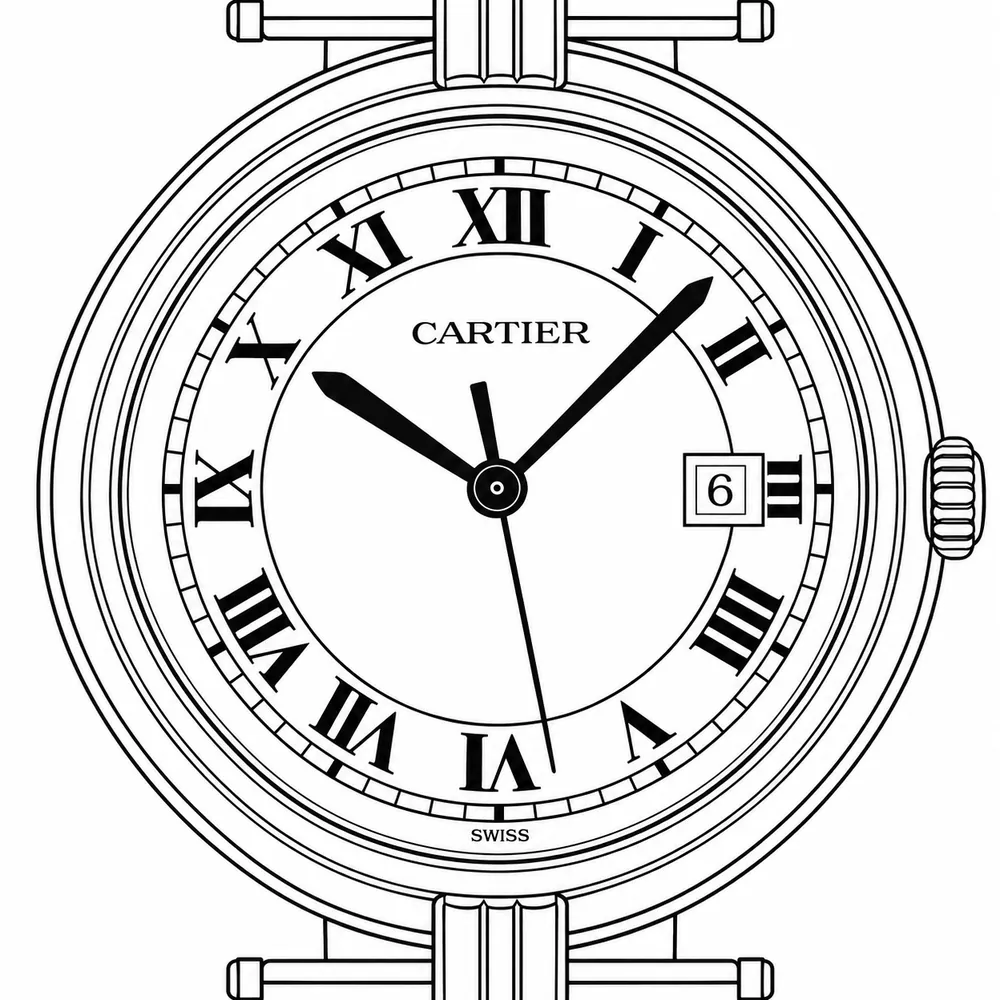
The Vendôme is a flat round Cartier wristwatch whose strap is held by a bar passing through a single central loop on each side of the case, an attachment Louis Cartier patented in 1934 and the firm brought back in 1973 on a flat round watch called the Vendôme Louis Cartier. The documented versions are hand-wound 18k gold watches catalogued from about 1973, the Must de Cartier Vendôme in vermeil with a quartz movement, solid-gold quartz Vendômes including the three-gold Trinity, and the hand-wound Vendôme Bi-Plan. Published accounts date these loosely and disagree on when the Must version began, so this entry keeps them apart and says where a date rests only on catalogued examples.
Cartier's entries are arranged by model, not by reference number, because its reference numbers are several systems at once and many of its watches carry none. The houses are set out in Paris, London and New York.

- Made
- from c. 1973The year 1973 is given for the first round Vendôme, though one account gives it, as about 1973, for the Must version; the end is not firm: one account ends the Must version in the mid-2000s and a catalogue dates the gold Bi-Plan to about 1990 to 2010.
- On record
- 633 listings345 of them give no reference
- Reference numbers
- 13 described89 seen in listings
- House named in the title
- Paris 51most older watches are not labelled
What to look for
Details cut from photographs of watches of this line on record. Each was chosen by eye from a listing on the line and then checked again against the words beneath it. More sit beside the productions and parts they belong to, below. Select the small mark in a picture's corner for its holder and a link to its listing.


By house and period 4 described
Vendôme Louis Cartier, from 1973
The first round Vendôme was shown in 1973 as a flat round watch called the Vendôme Louis Cartier, introduced alongside the oval Ellipse with that year's Louis Cartier Collection. The round watches of these years in the literature are in 18k yellow gold with a hand-wound movement: reference 78090 at 33 mm and reference 67080 at 26 mm, catalogued as c. 1973 to the 1980s and c. 1980s to the 1990s respectively. Their numbers sit beside those of the Ellipse (78091 and 67081), which came from the same collection with similar dials and movements. Sellers also describe an automatic 33 mm version, reference 17003, as a Vendôme; the literature does not mention it.
Signature and marks. The literature does not describe the dial or case markings of these watches. Sellers' titles for 78090, 67080 and 17003 often say 'Paris dial'; what that signature looks like is not described.
- round flat case with central bar lugs
- 18k yellow gold
- 33 mm or 26 mm
- number on the case back to tell it from the oval Ellipse
Must de Cartier Vendôme (vermeil, quartz)
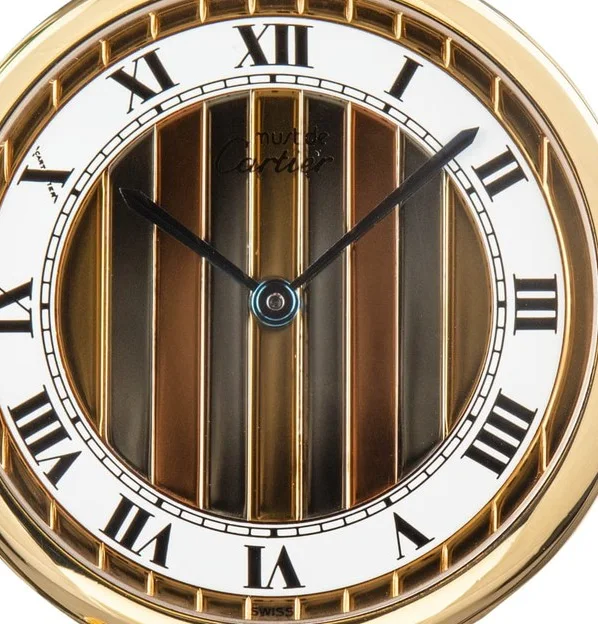
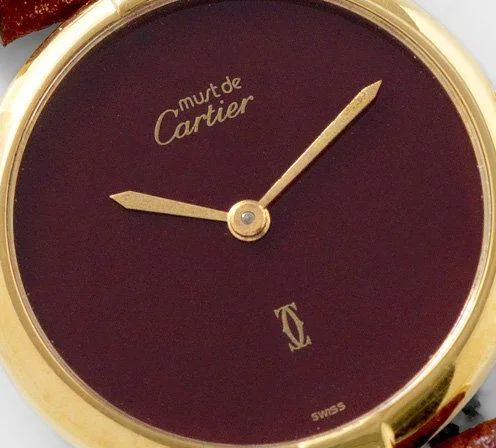
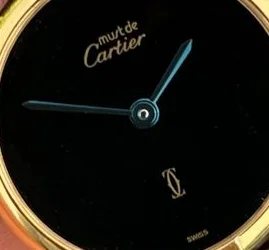
Within the Must collection the Vendôme is the round partner of the Tank; it is in vermeil, with a quartz movement. One account puts its start at about 1973, calls it Cartier's first quartz watch and ends it in the mid-2000s; others give 1973 as the year of the flat round Vendôme Louis Cartier, and the catalogued examples run from the late 1980s into the 1990s, so the start is not settled. The dials were released in dark blue, wine red, black and striped three-tone gold, and lacquer finishes are mentioned for the Must collection as a whole. Reference 590003 is the 30 mm large model and 590004 the 24 mm; one account gives quartz cal. 90 for the Trinity-dial examples it lists in both, while another catalogue gives cal. 690 for the 590003 and cal. 90 for the 590004.
Signature and marks. The literature does not describe the dial or case markings of these watches.

- vermeil case (silver with a gold layer)
- quartz movement
- 30 mm large or 24 mm small
Quartz Vendôme in 18k gold, including the three-gold Trinity
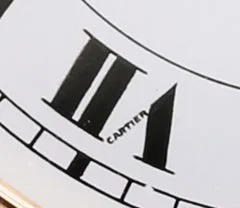
A group of solid 18k gold quartz Vendômes is catalogued from the 1980s and 1990s; one account places the three-gold Vendôme in the Louis Cartier line. The Vendôme Trinity, reference 881003 (also printed 81003), is 30 mm with a bezel in yellow, white and pink gold, a white dial with painted Roman numerals, a railway-track minute track, the secret signature at VII and a blue cabochon crown; catalogues give its movement as cal. 81 quartz and date examples to the 1990s, with no production range. The 881002 is the 24 mm in yellow gold and a 25 mm Trinity also exists; reference 881001 is catalogued as a 30 mm quartz in yellow gold. A different watch, reference 8100, is catalogued once as a 30.5 mm Vendôme Trinity with a date and a three-colour gold bracelet, dated to the 2000s; sellers also give 8100 for plain gold Vendômes and state years for it in the 1980s and 1990s.
Signature and marks. The case back of the 881003 is stamped 81003 run into the serial number (for example 810030983), with an 18k stamp and hallmark noted on one example; the secret signature is at VII on the dial.

- case back reading 81003 and a serial
- three golds in the bezel
- blue cabochon crown
Vendôme Bi-Plan
The Bi-Plan is a Vendôme in 18k yellow gold with a hand-wound movement, reference 2220, catalogued as c. 1990 to 2010. The literature says nothing more about it or how it differs from the other Vendômes. Sellers also give 2200 for a Bi-Plan.
Signature and marks. The literature gives no markings for this version.


- 18k yellow gold
- hand-wound movement
References: 2220
Chronology
Specification
| Case | Round and flat, with central bar lugs; 33 mm and 26 mm in the 18k gold hand-wound watches, 30 mm and 24 mm in the quartz gold and vermeil watches; a 25 mm Trinity and a 30.5 mm Trinity with date also catalogued |
| Metals | 18k yellow gold; three-colour (yellow, white and pink) gold in the Trinity; vermeil (925 sterling silver with a gold layer) in the Must version |
| Dial | White with painted Roman numerals, a railway-track minute track and a secret signature at VII on the three-gold 30 mm; Must dials in dark blue, wine red, black and striped three-tone gold |
| Crown | Blue cabochon on the three-gold 30 mm 881003 |
| Movement | Hand-wound in the 18k gold references 78090, 67080 and the Bi-Plan 2220; quartz in the 18k gold 881001, 881002 and 881003, the last catalogued as Cartier cal. 81; quartz in the vermeil Must Vendôme, with cal. 90 given on the Trinity-dial examples one account lists, and cal. 690 in the 590003 and cal. 90 in the 590004 in another catalogue |
| Strap | Leather straps, often on the vermeil watches; a leather strap with pin buckle or a three-colour gold bracelet with deployant buckle catalogued on the 881003 |
Dial 4 described
The dials run from painted white Roman-numeral dials on the solid-gold watches to the coloured and striped dials of the Must watches. The Trinity dial, with three gold tones, is the best documented. Sellers name many colours but the literature gives few dated changes.
White dial, Roman numerals, railway track, signature at VII
Described for the 30 mm three-gold Vendôme Trinity: painted Roman numerals, a railway-track minute track and the secret signature at VII on a white dial. The literature describes it for that watch only.
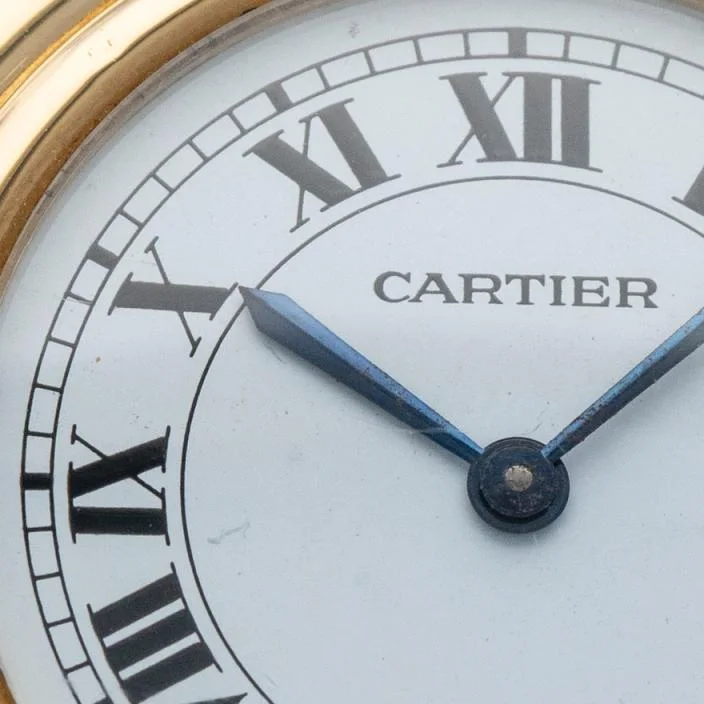

- secret signature at VII
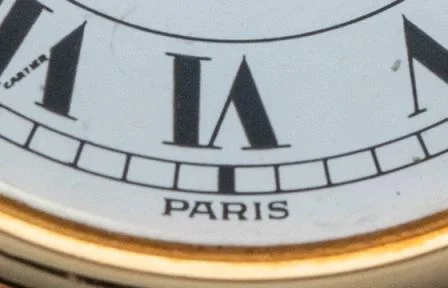
Dial said to be signed Paris
Sellers' titles describe a 'Paris' dial on references 78090, 67080 and 17003. Which Paris signature this is, and from when, the literature does not say. Under a tenth of the listings in the library's records say Paris in the title, some of them on quartz watches.

Trinity dial (Must Vendôme)
The Trinity dial carries the three tones of the 1924 Trinity ring, yellow, white and rose gold, and was introduced on Must de Cartier watches around 1980, the earliest examples being Must Tanks. On the round Must Vendôme it shows as stripes across the dial, with Roman numerals and a railway track on some. Examples catalogued are of about 1989 to 1993, in references 590004 (24 mm) and 590003 (30 mm). The tones are not three solid golds.
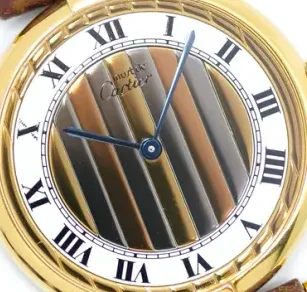

- Roman numerals and railway track on some
Coloured Must dials
The Must Vendôme was released with dials in dark blue, wine red, black and striped three-tone gold, and a 590003 with a lemon dial and Roman numerals is described. Sellers' titles also give burgundy, champagne and a red deco dial; none of these is dated in the literature.


Hands 1 described
Almost nothing is said of the hands.
Black hands
Black hands are described on one catalogued 881003; the other catalogues consulted do not describe the hands.
- black hands
Case and sizes 5 described
The case is round and flat, with the strap held by a bar through one central loop on each side. Sizes in the literature are given in millimetres; the library's records add a few more. Metals run from 18k gold to vermeil.
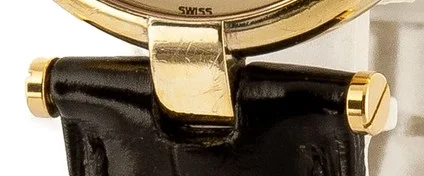
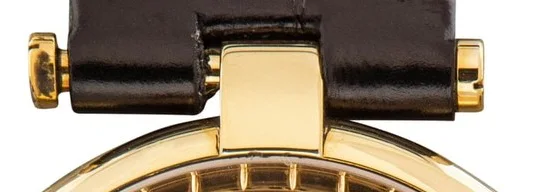
Central bar lugs
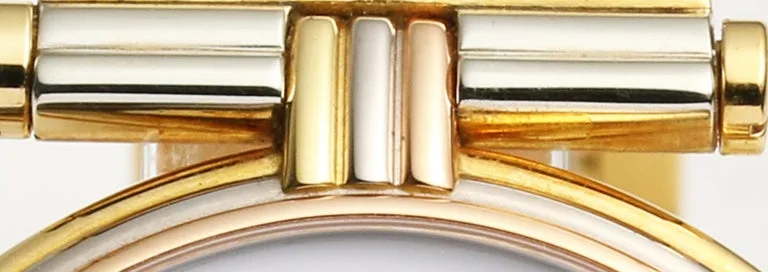
Louis Cartier patented the fixing in 1934: a bar passes through a central loop fixed to each side of the case. It was used only occasionally then. The patent expired in 1949 and the idea was used at Van Cleef & Arpels the same year; Cartier brought it back in 1973 on the Vendôme, and later used it on the Pasha de Cartier. Collector lore, which one account says to treat as no more than that, has the two lugs stand for the two streets that lead into Place Vendôme, the rue de la Paix and the rue de Castiglione.

33 mm and 26 mm hand-wound
References 78090 (33 mm) and 67080 (26 mm), in 18k yellow gold. The round Vendôme is told from the oval Ellipse of the same numbers by shape and by the number on the case back.
- round case, not oval
- number on the case back
30 mm and 24 mm quartz
The solid-gold quartz Vendômes are 30 mm (881001, 881003) and 24 mm (881002); a 25 mm Trinity also exists, and one 881003 was measured at 29 mm. The Must vermeil Vendômes are 30 mm (590003, the large model) and 24 mm (590004). Sellers state other sizes too in the library's records.
- 30 mm
- 24 mm
Three-gold Trinity bezel
On the 30 mm 881003 the bezel combines yellow, white and pink gold; one catalogue calls it reeded, with T-bar lugs. The case back runs 81003 into the serial, with an 18k stamp and hallmark noted on one example.
- three golds in the bezel
- case back 81003 plus serial
Vermeil
The Must Vendôme case is vermeil, 925 sterling silver with a layer of gold electroplated on top. Plating wear shows around the strap attachments, and a replated case looks new but is no longer original.
- gold layer over silver
- plating wear around the strap attachments
Crown 1 described
Only one crown detail is given for the line.
Blue cabochon crown
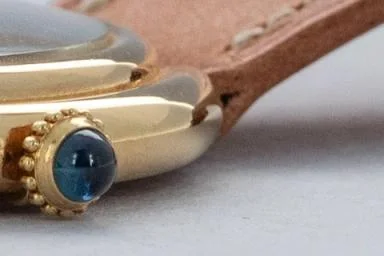
A blue cabochon is set in the crown of the 30 mm 881003.

Movement 3 described
The gold watches of the early line are hand-wound; the later gold and vermeil watches are quartz.
Hand-wound
References 78090, 67080 and the Bi-Plan 2220 are catalogued as hand-wound. Sellers describe 17003 as automatic.
Cartier cal. 81 quartz
The quartz movement of the 30 mm three-gold 881003 is catalogued as cal. 81; one catalogue gives it as 9-jewelled.
Quartz cal. 90
Given for the Must Vendôme Trinity examples one account lists, of about 1989 to 1993, in the 590004 and the 590003; another catalogue gives it for the 24 mm 590004 and cal. 690 for the 30 mm 590003, though some listings give cal. 90 for it too.
Bracelet and strap 2 described
Straps and bracelets are noted on a few catalogued watches.
Leather strap with pin buckle
Catalogued with a pin buckle on an 881003 of about 1990, and on leather on another of the 1990s; one example was on an unsigned strap. The vermeil Vendômes are often found on leather straps.
Three-colour gold bracelet, deployant buckle
Catalogued on one 881003.
Reference numbers
A four-digit number is stamped on the case and covers a case; a code beginning W, or the newer letter codes, is a catalogue number for one version of it (metal, dial, strap). Many older watches carry neither. The last column is the listings on record under the number, as its own page counts them.
| Number | What it is | Listings |
|---|---|---|
| 78090 | 33 mm round Vendôme in 18k yellow gold, hand-wound, catalogued as c. 1973 to the 1980s. | 21 |
| 67080 | 26 mm round Vendôme in 18k yellow gold, hand-wound, catalogued as c. 1980s to the 1990s. | 13 |
| 17003 | As sellers describe it: a 33 mm automatic in 18k yellow gold, often titled with a Paris dial. | 11 |
| 881003 | 30 mm Vendôme Trinity in three golds, quartz cal. 81, c. 1990s; also printed 81003, which is what the case back reads. | 10 |
| 81003 | The number on the case back of the 881003, run into the serial; catalogues describe the same watch under both. | 10 |
| 881002 | 24 mm Vendôme in 18k yellow gold, quartz, c. 1990s. | 2 |
| 881001 | 30 mm Vendôme in 18k yellow gold, quartz, catalogued as c. 1980s to the 1990s. | 6 |
| 81001 | As sellers describe it: an 18k yellow gold Vendôme; whether it is the same watch as 881001 is not stated. | 6 |
| 2220 | Vendôme Bi-Plan in 18k yellow gold, hand-wound, catalogued as c. 1990 to 2010. | 6 |
| 590003 | Must de Cartier Vendôme in vermeil, quartz, 30 mm large model, c. 1990s. | 66 |
| 590004 | Must de Cartier Vendôme in vermeil, quartz, 24 mm, catalogued as c. late 1980s to the 1990s. | 56 |
| 8100 | In one catalogue a 30.5 mm Vendôme Trinity with a date and a three-colour bracelet, dated to the 2000s; a different watch from 881003. Sellers also give 8100 for plain gold Vendômes, with stated years in the 1980s and 1990s. | 24 |
| WF5030B9 | As sellers describe it: a lady's 18k gold and diamond-set quartz bracelet Vendôme, sold with box and papers and stated as about 2010. | 4 |
Originality
- A strap or bracelet on a Vendôme may not be the one it left Cartier with: one catalogued 881003 was on an unsigned strap, so it is worth asking whether the strap or bracelet came with the watch.
- On the 881003 the case back should run 81003 into a serial, with an 18k stamp, and the quartz movement should be the cal. 81; a photograph of the movement is worth asking for.
Names
- Ellipse Vendôme. One catalogue used this name for a round gem-set 67080; the Ellipse is a separate oval watch.
- Vendôme Trinity. The catalogue name of the three-gold Vendômes, the 881003 and the 8100; sellers also use it for the vermeil Must Vendôme with the Trinity dial.
Where accounts differ
Points on which the published literature and the library's own records do not agree, or on which the literature contradicts itself.
- When the Must Vendôme began. One account says the Must Vendôme was introduced around 1973 and was the first Cartier quartz watch. Another gives 1973 as the year Cartier presented the flat round Vendôme Louis Cartier; a third catalogues the hand-wound gold 78090 from c. 1973 and the vermeil Must references from the late 1980s, and reports that one auction house dates the Vendôme's introduction to the late 1970s; another dates the Trinity dial on Must watches to about 1980 and the Must Vendôme examples it lists to about 1989 to 1993. The library's records also hold a 78090 stated as 1970, earlier than any published date.
- Date of the 8100. One account reports one auction catalogue dating a ref. 8100 Vendôme Trinity to the 2000s. In the library's records sellers give 8100 for Vendômes in plain and three-colour gold, with stated years from 1983 to 2005.
In the records
Counted from 633 listings at dealers and auction houses whose title, or whose reference, places them on the line; 320 state a year. These are what sellers state, not measurements, and a count of listings is not a count of watches made.
Case metal
| Metal | Listings | Share |
|---|---|---|
| Gold, any colour | 215 | 64% |
| Yellow | 72 | 21% |
| White | 9 | 3% |
| Pink | 6 | 2% |
| Colour not stated | 128 | 38% |
| Silver | 65 | 19% |
| Steel | 34 | 10% |
| Gold plated | 12 | 4% |
| Platinum | 8 | 2% |
| Steel and gold | 2 | 1% |
As sellers state it. Shares are of the 336 listings that name a metal. A listing that says "gold" or "18K gold" names no colour: it is counted under "colour not stated", not as yellow gold. Carat, where a listing of gold gives one: 18k 109.
Case size
| Size | Listings | Share |
|---|---|---|
| 30 mm | 107 | 28% |
| 24 mm | 88 | 23% |
| 33 mm | 43 | 11% |
| 27 mm | 23 | 6% |
| 32 mm | 23 | 6% |
| 26 mm | 21 | 6% |
| 25 mm | 19 | 5% |
| 23 mm | 12 | 3% |
| Other sizes | 44 | 12% |
As sellers state it. Shares are of the 380 listings that give a size. On a watch that is not round some sellers give the width and some the length, so one watch can stand under two sizes. 1 more gives a figure outside 12 to 56 mm, which is a strap, a box or a slip, and is left out.
Movement
| Kind | Listings | Share |
|---|---|---|
| Quartz | 81 | 68% |
| Hand-wound | 33 | 28% |
| Automatic | 5 | 4% |
Shares are of the 119 listings whose description says how the watch is driven.
Listings by decade the seller gives
| Decade | Listings |
|---|---|
| 1970s | 18 |
| 1980s | 108 |
| 1990s | 138 |
| 2000s | 32 |
| 2010s | 5 |
| 2020s | 4 |
15 more give a year outside the years the line was made (from 1973): a later watch sold under the name, or a slip. They are left out.