AVI / Co-Pilot 765
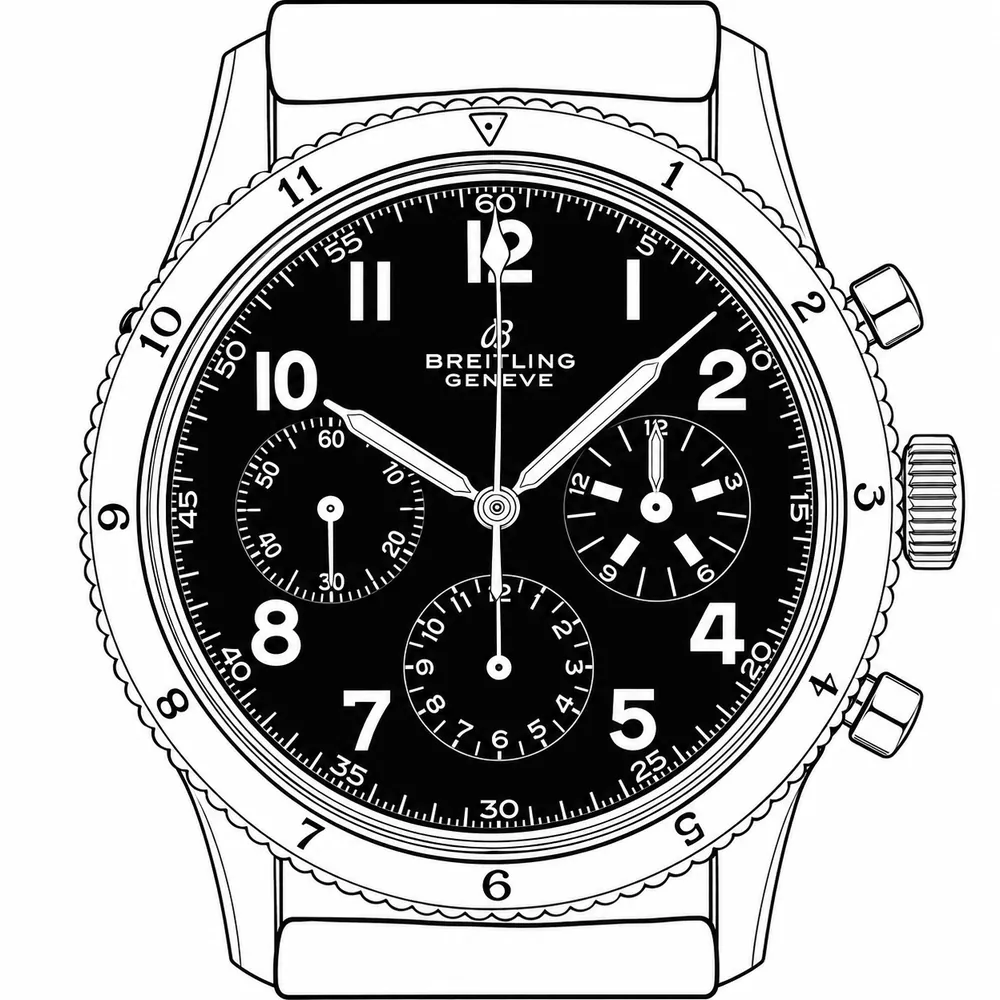
Reference 765 covers a family of Breitling chronographs rather than one watch. It began as a tri-compax Premier chronograph in the late 1930s and became in 1953 the large AVI or Co-Pilot, with a rotating 12-hour bezel, oversized luminous numerals and a 15-minute chronograph counter. The first AVIs showed elapsed minutes in a window at 3 o'clock, called the Digital, and an analogue 15-minute register followed. Black dials gave way to reverse panda dials from 1962 or so, and the AVI was substantially changed in late 1964. The number was also used for the unbezelled AOPA-dial Premier of about 1964 to 1966, the last of the Premier line. Venus 178 powered the originals. Limited re-editions followed in 2020 and 2023.
- Made
- 1953–1966dates approximate
- Seen in the library
- 1953–1968by years sellers state
- Case
- 41 mm · steelas sellers state
- Movement
- Calibre 178hand-wound
- On record
- 56 listings86 photographs · 19 holders
Components
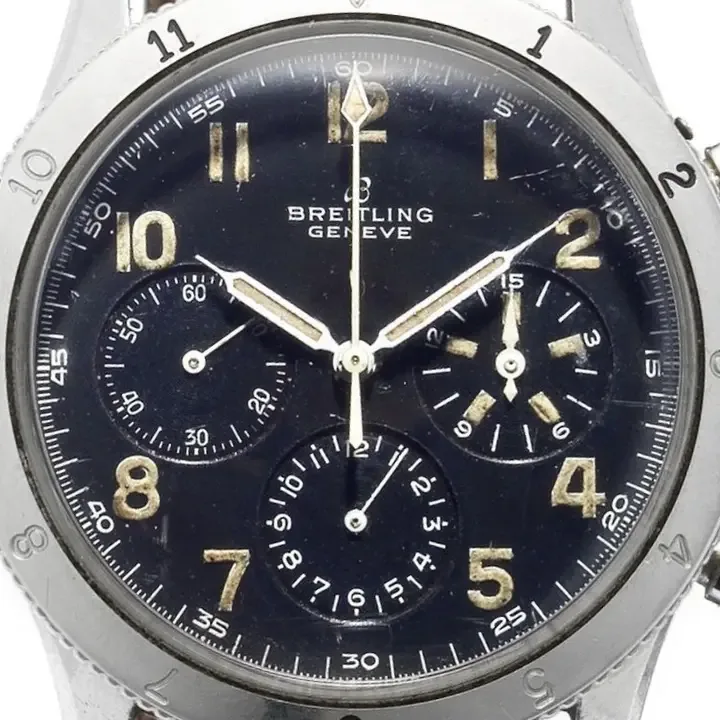
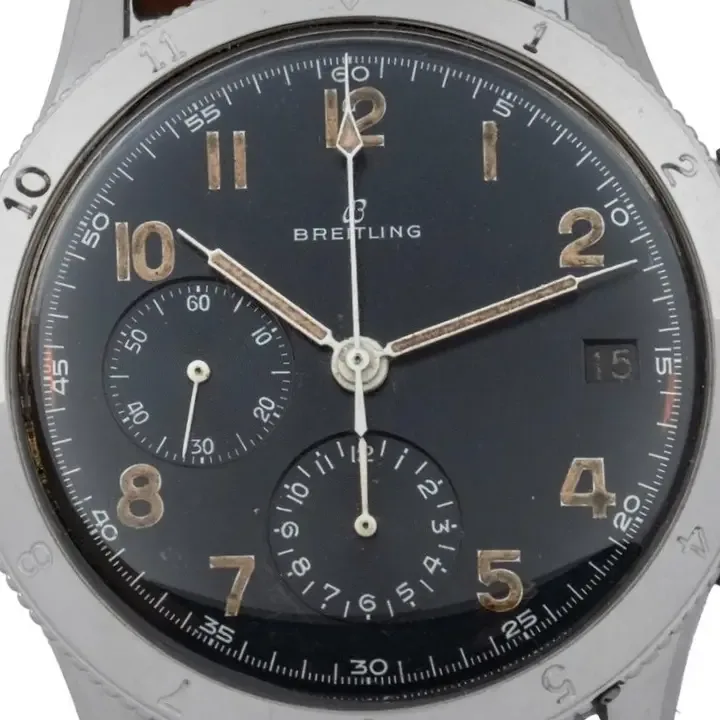
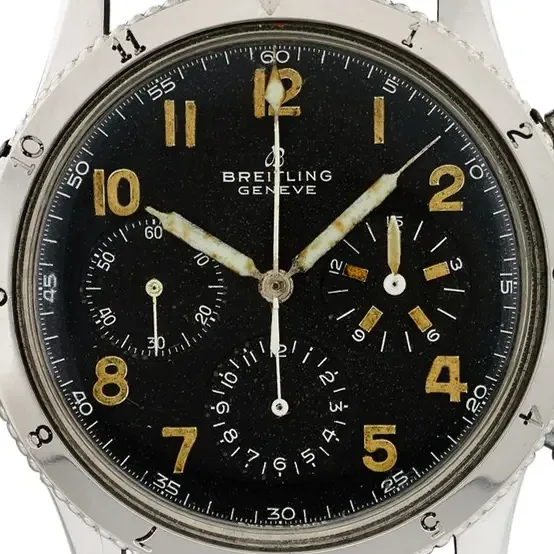
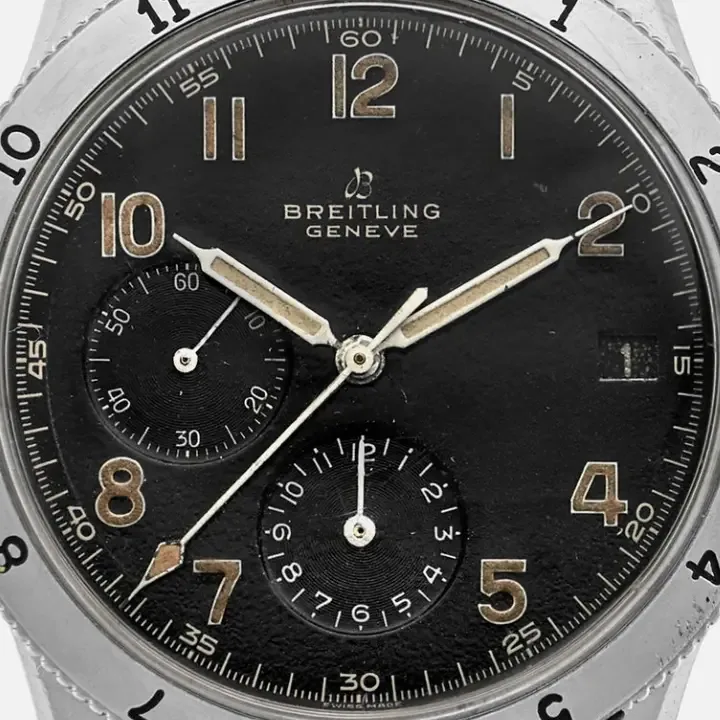
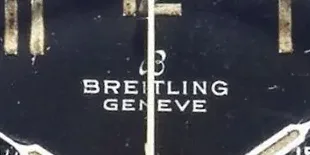
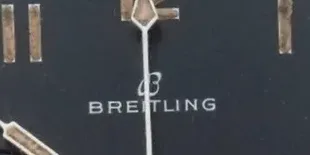
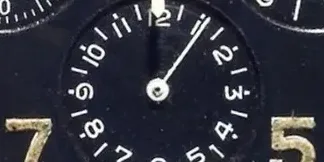
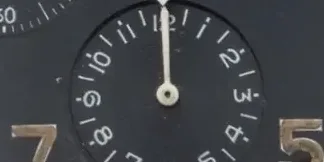
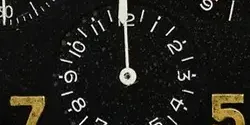
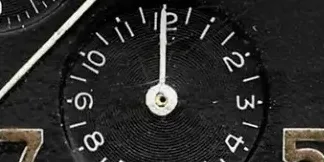
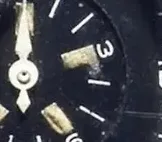
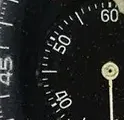
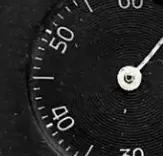
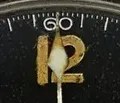
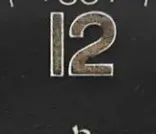
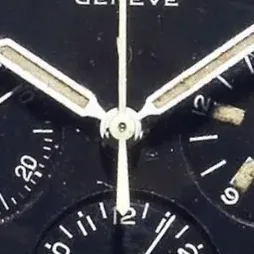
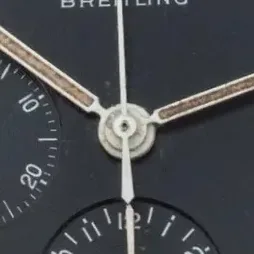
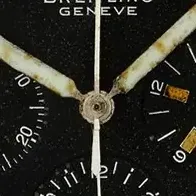
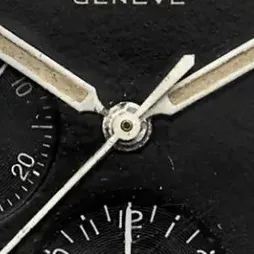
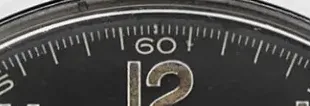
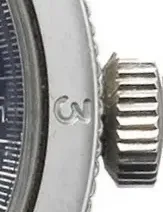
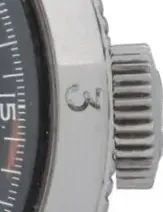
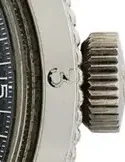
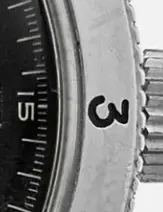
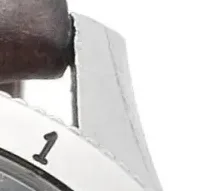
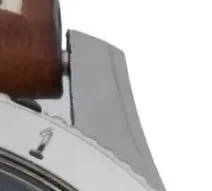
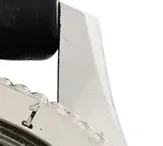
4 watches, oldest first, each straightened and cut the same way so that one row shows one component across them all. Chosen from 86 photographs on file for sharpness and for a face typical of the reference. A year marked c. is one its holder gives only roughly. Each picture is a detail cut from a listing photograph. Select the small mark in its corner for its year, its holder, a link to the listing it came from, and a way to report it.










Chronology
The AVI dates from 1953 and its first generation ran to late 1964, when it was changed; the literature gives no end for the later AVI. The end year is that of the AOPA-dial Premier, put at about 1964 to 1966. A Premier-line 765 also existed in the late 1930s.
Every dated variant: what is written, and what the records show
For the reference the marks are every dated watch; for a variant, the watches a seller names as that variant, so a variant sellers do not name has none.
Specification
| Case | Steel; AVI about 40 mm with a bezel of about 41 mm and 22 mm lugs; the AOPA-dial Premier is 38 mm with 21 mm lugs |
| Dial | Matte or glossy black; early all-black, later reverse panda with white registers; large luminous Arabic numerals |
| Bezel | Bi-directional steel bezel with an engraved 12-hour scale and a beaded edge on the AVI; none on the AOPA-dial Premier |
| Crystal | Domed acrylic |
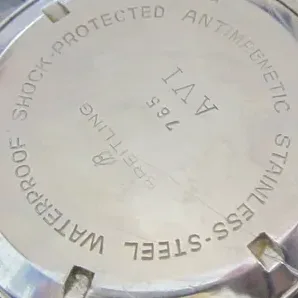
| Caseback | Screw-down steel back; on the AOPA-dial watch it carries the model number |
| Movement | Venus 178 hand-wound chronograph, modified to give a 15-minute counter (17 jewels, 18,000 vibrations per hour, about 45 hours reserve) |
| Crown | Large signed B crown, angled on its inner side to clear the bezel |
| Bracelet | Strap, or a tapered fine mesh steel bracelet on the AOPA-dial watch |
| Water resistance | Not stated for the originals; the 2020 re-edition is rated to 30 m |
Reference 6 described
The number 765 was used for several different watches, so the era matters when identifying one. The sequence runs from the Premier tri-compax of the late 1930s, to the AVI of 1953, to the AOPA-dial Premier of the mid-1960s, and the re-editions.
Premier 765 (late 1930s and 1940s)
Described as a tri-compax chronograph in the Premier line with an inner tachymeter scale and the Venus 178, and attributed to the Huit Aviation division's first wristwatch. The name Premier is on the dial by the early 1940s.
- tri-compax layout
- tachymeter scale inside the dial
AVI Digital
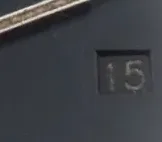
The first AVI of 1953 is a large chronograph with a rotating 12-hour bezel and a matte black dial with luminous Arabic numerals. Its elapsed minutes appear in a window at 3 o'clock where a date window would normally be, and it uses a modified Venus 178. The window counts 15 minutes, which looks like a blurred date until the chronograph is started.
- numbered window at 3
- bi-compax registers at 6 and 9
AVI analogue
From 1955 a version has a conventional circular 15-minute register at 3 in place of the window, giving a 3-6-9 tri-compax dial. It was made after a request from the French air force, and closely resembles the Breguet Type 20. Collectors disagree about which design came first.
- 3-6-9 registers
- lume dashes every third minute
765 AOPA (bezel-less Premier)
A Premier made around 1964 to 1966 that ended the Premier line. It has a bezel-less 38 mm case, a matte black reverse panda dial with a winged AOPA logo and no Breitling name, large luminous Arabic numerals and white registers and hands. A white-dial version exists, as does one with 'Breitling' printed in place of AOPA.
- AOPA logo with no Breitling name
- white hands and registers
- 38 mm case
AVI Ref. 765 1953 Re-Edition (AB0920131B1X1)
A 2020 limited re-edition of the 1953 watch in 1,953 steel pieces engraved ONE OF 1953, with 253 in red gold (RB0920131B1X1) and 153 in platinum (LB0920131C1X1). It has a 41.1 mm case, a hesalite crystal and the B09 movement modified for a 15-minute counter. The only visible dial change is the loss of the word Geneve.
- ONE OF 1953 engraving
- no Geneve on the dial
AVI Ref. 765 1964 Re-Edition (AB09451A1B1X1)
A 2023 re-edition limited to 164 pieces, engraved One of 164, in a 41 mm by 14 mm steel case with a hesalite crystal and a black ADLC-coated bezel. Its black dial has a tri-compax layout with white registers, baton indexes and pencil hands, and it is sold only through Breitling's own shops.
- black ADLC bezel
- white registers
Dial 8 described
Dials run from matte black with black registers, through a Geneve-signed version, to glossy black reverse pandas. Size and form of the numerals stayed large throughout.
Pre-Geneve dial (Mk1.1)
The first 50 cases were assembled in March 1953, before Breitling moved to Geneva, so the dial carries only the company name. The chronograph seconds hand on these is fully lumed and found only on this version.
- Breitling with no Geneve
- fully lumed chronograph seconds hand
Breitling Geneve dial (Mk1.2 to Mk1.4)
From late 1953 the dial reads Breitling and Geneve. Details of the hands and the bezel bead count are the most reliable ways to date an early Digital.
- Geneve under the Breitling name
Black Digital dial
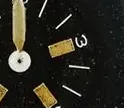
A matte black dial with large luminous Arabic numerals, black registers at 6 and 9 and the minutes window at 3. The lume is a creamy soft yellow rather than white, and aged dials turn sandy.
- all-black dial
- window at 3
Kronometer Stockholm dial
Some AVIs carry a Kronometer Stockholm signature under the Breitling and Geneve text. Published accounts mention them alongside the Digitals of the early 1960s but give no years for them.
- extra signature under the Breitling text
Reverse panda dial
Somewhere between 1962 and 1964 the AVI moves from an all-black dial to a reverse panda one; the earliest known has a 1962 case number. Registers become silvery or white and the large register at 3 is the dominant feature of a glossy black dial.
- glossy black dial
- silver registers
- large 15-minute register
Lip co-signed dial
A 765 AVI dated to 1965 is described with a third signature, Lip, above the pivot of the hands under the Breitling logo. The signature relates to a French distribution partnership between Lip and Breitling, which is dated to 1966 or 1967, so the dial may have been stamped after the watch was made and before it was sold. The literature gives no end date for the Lip dials.
- Lip above the hand pivot
AOPA dial
A matte black dial with a winged AOPA logo in place of the Breitling name, large lumed Arabic numerals and white registers, which gives the watch a military look. A white dial and a Breitling-signed version of the same layout were also made.
- AOPA wings logo
- no Breitling name on dial
2020 Re-Edition dial
Reproduced from scans of the 1953 dial: matte black and slightly grained for steel and red gold, and matte blue for platinum. It has large Arabic numerals and thin syringe hands in cream Super-LumiNova, and 'Geneve' is omitted.
- blue dial on platinum
- no Geneve
Luminous material 1 described
The original lume was a cream to soft yellow radioactive paint. The re-editions use Super-LumiNova of a matching colour.
Cream lume
The lume of the original is a soft creamy yellow rather than white, as on most Breitlings of the time; the re-edition copies the shade with a non-radioactive paint.
- cream-yellow numerals and hands
Hands 4 described
Syringe hands are used throughout, and their width and lume helps place an early AVI.
Mk1.1 slim syringe hands, lumed seconds
Slim lumed syringe hands, with a chronograph seconds hand that is lumed along its whole length.
- slim lumed syringe hands
- fully lumed seconds hand
Mk1.2 teardrop seconds hand
The central seconds hand becomes white with a teardrop-shaped lume tip, with slim lumed syringe hands for hours and minutes.
- white seconds hand with teardrop tip
Mk1.3 wider syringe hands
The syringe hands are wider, with a shorter needle on the hour hand, and the seconds hand keeps its teardrop tip.
- shorter needle on hour hand
Thicker 1960s syringe hands
The 1960 Digitals have thicker hour and minute hands, and late 1962 watches have even fatter syringe hands. The AOPA-dial watch has white main hands like those on the Top Time 810.
- fatter syringe hands
Subregisters 3 described
The 15-minute counter is the defining feature, first as a window and then as a register.
Digital window at 3
A numeric window at 3 o'clock shows the elapsed chronograph minutes up to 15, with registers at 6 and 9.
- window at 3
15-minute analogue register
A circular register with a hand takes the 3 position, with lume dashes marking every third minute. A pre-flight check lasted 15 minutes, which is the reason given for the counter. The Venus 178 was altered to count 15 minutes instead of 30; the re-edition does the same.
- lume dashes every third minute
- large register at 3
Silvery registers
Black registers were the first configuration. They later turned silver or white, as on the Navitimer and Top Time.
- silver or white registers
Bezel 3 described
The AVI has a bi-directional bezel engraved with a 12-hour scale and clicking at each hour. The edge and bead count changed over time.
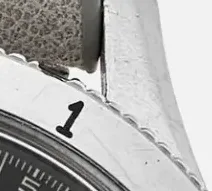
Beaded bezel, 126 small beads (Mk1.1 to Mk1.3)
The bezel has an engraved 12-hour scale in a distinctive typeface and a ring of 126 small beads. It clicks into place at each hour. Small screws on the side secure it and should be original, and the crown has an angled inner side to clear the bezel.
- 126 small beads
- tiny screws on bezel side
Mk1.4 bezel, 96 larger beads
From 1960 the Digital has a similar bezel with only 96 larger beads. A later Mk2 bezel has a coin edge and does not belong on a Digital.
- 96 larger beads
Re-Edition bezel
The 2020 bezel is polished steel with a 12-hour scale filled with black and a beads-of-rice edge, secured by three screws in the original positions. The 2023 bezel is black ADLC.
Case 3 described
The AVI case is oversize for its time, with thin bevelled lugs. The Premier-line AOPA watch is smaller and more elaborately finished.
AVI case
A steel case of about 40 mm, with a 41 mm bezel and 22 mm lugs, thin bevelled lugs and mushroom-shaped pushers. The back is screwed down.
- 41 mm size
- 22 mm lugs
AOPA-dial Premier case
The case is 38 mm with 21 mm lugs, chevron chamfers, a matte channel and a machined ring between the lugs and the polished bezel ring, brushed sides and polished chamfers. The back is screwed down and carries the model number, the only sign of Breitling on the watch.
- 38 mm
- chevron lug chamfers
- flat channel around the crystal
Re-Edition case
A 40 mm case with a 41.1 mm bezel, a thin large crown, solid steel back and 30 m water resistance. The lugs are slightly broader than on the original and the pushers more prominent.
Crown 1 described
A large crown signed with the B can be turned with gloves on.
Large signed B crown
The original crown is large, signed with the B and angled on its inner side to turn freely around the beaded bezel. The re-edition crown has no screw lock.
- signed B crown
Crystal 1 described
The crystal is domed acrylic throughout.
Domed acrylic or hesalite crystal
The original has a domed acrylic crystal. Re-editions keep a domed hesalite of the same shape rather than sapphire.
Movement 2 described
The Venus 178 powered the originals, modified for 15 minutes in the AVI.
Venus 178
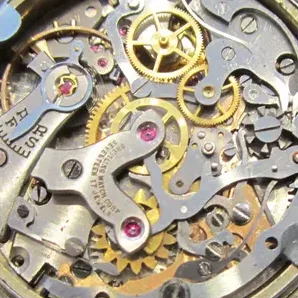
A hand-wound, 14 ligne column-wheel chronograph with 17 jewels, 18,000 vibrations per hour and about 45 hours of reserve. It normally counts 30 minutes and was altered to count 15 on the AVI. Early US-export movements are marked BOW (Mk1.2) or WOG (Mk1.3), and others carry no import code.
- BOW or WOG import code
Breitling B09
The re-editions use the hand-wound B09 (based on the B01), chronometer-certified, with column wheel, vertical clutch, 28,800 vibrations per hour and 70 hours of reserve. The 2020 watch's version has a 15-minute counter.
Bracelet 1 described
Straps are usual. A mesh bracelet is recorded on the AOPA-dial watch.
Tapered fine mesh bracelet
One AOPA-dial watch is described on its original Breitling tapered fine mesh steel bracelet; generic mesh bracelets of similar look are also found on these watches.
- fine mesh bracelet
Originality
- Main hands for the AOPA-dial watch are harder to find than sub-register hands, crowns or pushers. On a Digital, the hands and bezel must suit the Mk the watch belongs to, and incorrect ones are a known trap.
- On a Digital the bezel needs checking: a Mk2 bezel with a coin edge does not belong, the bead count (126 or 96) should suit the Mk, and the small screws on its side should be original.
- Sub-register hands, crowns and pushers can be found, and Venus 178 parts are widely available.
Names
- Co-Pilot. The name of the AVI line, tied to its rotating bezel and big numerals.
- Lucy. A nickname for the 765 AVI, used to settle arguments over whether it came before the Breguet Type 20.
- Lucy Digital. The 1953 version with the window counting 15 minutes at 3 o'clock.
- Digital. The first AVI, whose elapsed minutes appear in a window.
Where accounts differ
Points on which the published literature and the library's own records do not agree, or on which the literature contradicts itself.
- When the tri-compax AVI began. An account from this publication says a 3-6-9 AVI with a 15-minute counter was on offer from the 1953 launch; an earlier account from the same publication says the analogue version reached general sale in 1955 after a French request.
- Lip signature and its date. A 765 AVI dated 1965 carries a Lip signature, though the Lip and Breitling partnership is dated 1966 or 1967. The writer offers two possible explanations: that the partnership began earlier, or that the dial was stamped after manufacture and before sale.
Back and movement
From listings of this reference, each confirmed by eye to show what it is filed under. A picture on which a person's name or a personal engraving can be read is not shown. From most holders a detail from the middle of the photograph is shown; the mark in its corner gives its holder and a link to the listing.
Caseback

Movement

Catalogue versions 1 listed
The full numbers under which holders list this reference, with what their listings say of each. Each has a page of its own.
| Version | Metal | Dial | Years seen | Records |
|---|---|---|---|---|
| 765-CP thin | 1965 | 1 |
In the records
Counted from 56 listings at 19 holders between 13 December 2012 and 14 November 2026. These are what sellers and auction houses state, not measurements.
Fainter bars are the 2 outside the main run of 1950–1967 (the middle nine-tenths): the earliest is 1945 and the latest 1968. They are early and late examples, and now and then a seller's slip. The head of the page gives 1953–1968: the years that listings from two holders bear out.
15 listings dated long after the reference ended are set aside and not counted here: a year that late belongs to a later watch sold under the old number, or to a listing filed under the wrong one.
Case metal
| Steel | 13 |
Dial colour
| Black | 3 | |
| Silver | 1 |
Case size
| 41 mm | 12 | |
| 38 mm | 6 | |
| 42 mm | 2 |
Calibre named
| 178 | 14 | |
| B09 | 11 |
Bracelet or strap
| Leather strap | 7 | |
| Mesh bracelet | 1 |
Each table counts the listings that state the thing, in the seller's own terms. A size, metal, colour or calibre that cannot belong to this reference is a seller's slip or a listing filed under the wrong number.