Wristwatches before 1970
Published accounts of Breguet wristwatches before 1970 deal almost entirely with one watch: the oblong repeater for a bracelet, number 2639, ordered by Caroline Murat, Queen of Naples, on 8 June 1810 and finished on 21 December 1812. The firm's registers describe a very flat oblong repeater with a thermometer, worn on a wristlet of hair and gold thread. It was serviced in 1849 and 1855 and has not been traced since, so no example, drawing or measurement survives. The accounts drawn on here say nothing of the firm's twentieth-century wristwatches; its pilot's chronographs of the 1950s and 1960s have an entry of their own. The library's records hold about 200 listings labelled wristwatch, most of them given years from 1920 to 1969 by their sellers.
This maker's early watches are described by kind of watch, not by reference number: many carry no number, and one number can cover quite different watches. The wider picture is in Early Breguet, 1775 to 1970.
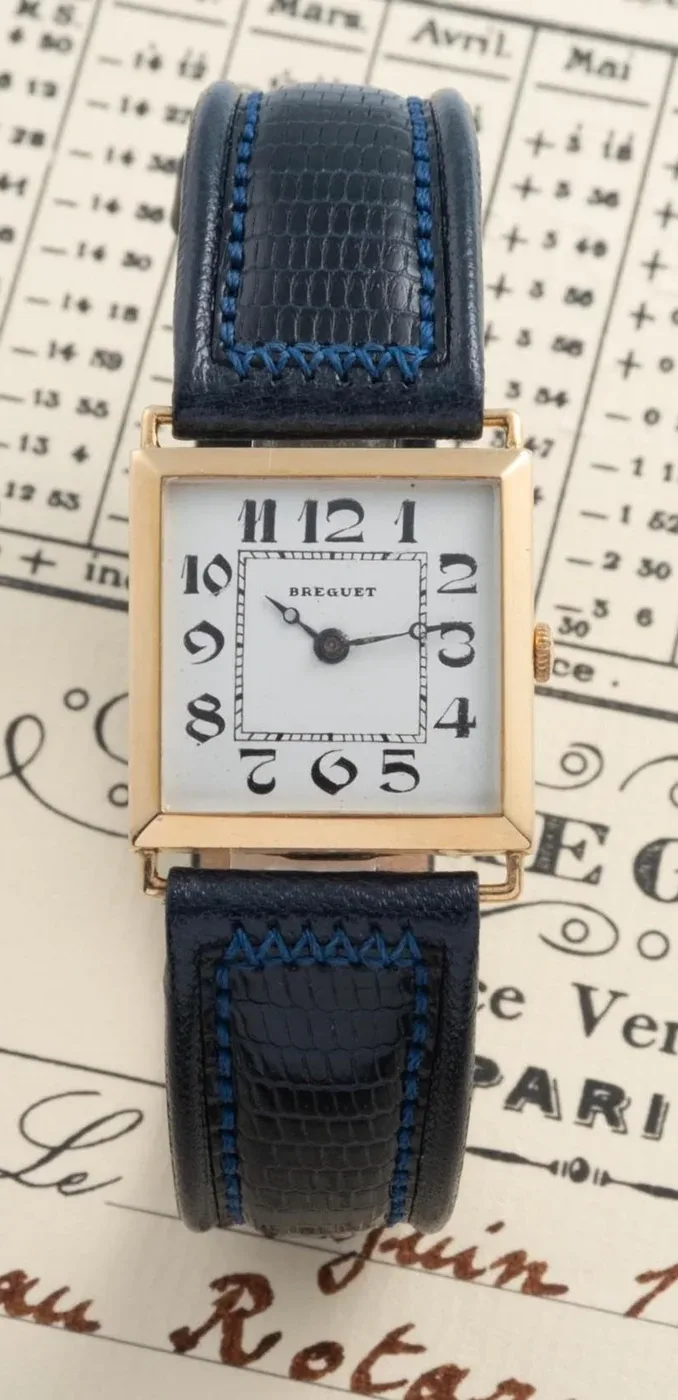

- Made
- from c. 1810The first wristwatch is dated by the literature: ordered in 1810 and finished in 1812. The span of the firm's later wristwatches is not given, so no end year is set.
- On record
- 201 listings185 of them give no reference
- Reference numbers
- 0 describedmany early watches carry none
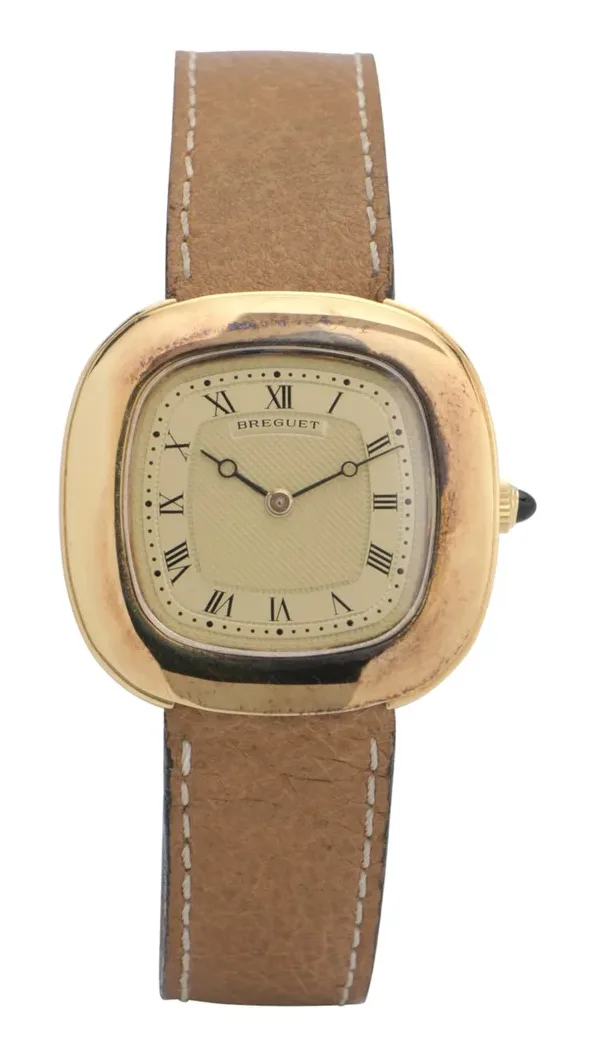

Production by production 1 described
Oblong repeater for a bracelet, number 2639
The watch was ordered on 8 June 1810 by Caroline Murat, sister of Napoleon I and Queen of Naples, together with a carriage watch with great complications. The firm's register of special orders priced the bracelet repeater at 5,000 francs, and its register of manufacture entered it as a repeater of oblong form for a bracelet, a description not used before. It is a repeater, of the quarters in two accounts, with a lever escapement of the kind the firm called free, a thermometer, and a regulator index placed outside the dial. The register records 34 operations by 17 people. Work began on 11 August 1810; the watch was invoiced at 4,800 francs in December 1811, then held back while the motion-work was changed and the dial replaced, and finished on 21 December 1812. No sketch of it has been found, its dimensions and the way the bracelet was fixed are not recorded, and it has not been seen since 1855. The firm and later writers call it the first wristwatch known to have been designed as one; one account cautions against the claim, noting an earlier bracelet watch.
Signature and marks. Nothing is recorded about what was printed or engraved on the dial, case or movement; the register gives only the production number 2639.
Chronology
Specification
| Watch described in the firm's registers | Number 2639, entered as a repeater of oblong form for a bracelet |
| Case | Gold, guilloché, oval and very thin; dimensions not recorded |
| Dial | Guilloché silver with Arabic numerals (a guilloché gold dial was first intended) |
| Movement | Repeater (two accounts read it as a quarter repeater) with a lever escapement of the kind the firm called free, a thermometer, and a regulator index outside the dial |
| Bracelet | Wristlet of hair interwoven with gold thread; a second gold-trimmed bracelet is also listed |
| Surviving examples | None known; last recorded in 1855 |
Dial 2 described
The register gives two states of the dial for this watch. No description of the layout beyond the points below survives.
Guilloché gold dial
The first dial intended for number 2639 was of guilloché gold, and the watch was invoiced in December 1811 before it was changed.
Guilloché silver dial with Arabic numerals
The gold dial was replaced, probably at the queen's request, by a guilloché silver dial with Arabic numerals. Arabic numerals were normal on enamel dials but very rare on gold or silver ones. The 1849 repair entry still describes a silver dial with Arabic numerals, a thermometer and a regulator index outside the dial, and records that the dial was renewed.
Case and sizes 1 described
The case is known only from the register of manufacture and the repair entries.
Oblong gold case
The register calls the watch oblong, which one account reads as oval; others call it egg-shaped. The 1849 entry calls it very flat, and the August 1855 entry gives a gold guilloché case and a large broken gold ring. No dimensions are given.
Movement 1 described
The register of manufacture lists the mechanism but no calibre or drawing.
Quarter repeater with lever escapement and thermometer
A repeater of the quarters, as is usual for the firm in one account's reading (another account says a minute repeater), with a lever escapement of the kind the firm called free, a thermometer and a regulator index outside the dial. The motion-work was changed before delivery. At the 1849 repair the pivots were repolished, the thermometer restored (one account says replaced), the repeater restored, and the watch cleaned and regulated, at a cost of 80 francs.
Bracelet and strap 1 described
The watch was made to be worn on a wristlet.
Wristlet of hair and gold thread
The first description is a wristlet of hair interwoven with gold thread, into which the watch fitted at will. The 1849 entry lists a second bracelet, also trimmed with gold. Its fastening and form are not recorded.
Box and papers 1 described
The repair entries list what went with the watch.
Red morocco case and keys
In 1849 the watch came with a simple gold key and a red morocco case. In August 1855 two new keys were made, one for winding and one for setting the hands.
Where accounts differ
Points on which the published literature and the library's own records do not agree, or on which the literature contradicts itself.
- How the first wristwatch is dated. Accounts of number 2639 give 1810 for the watch (the year of the order), 1812 (the year of delivery), or 1810 to 1812. The register entries cited by the firm give order on 8 June 1810, start of work on 11 August 1810, invoice on 5 December 1811 and completion on 21 December 1812. One account says the work took until 5 December 1811, the invoice date, and that a further year was then spent on the dial and motion-work before it was finished. Another says the watch was paid for in 1811 and delivered in 1812.
- Whether it was the first wristwatch. Most accounts, following the firm, call number 2639 the first wristwatch known. One account says this is shaky ground because an earlier bracelet watch is recorded for Queen Elizabeth I. Another notes that the Geneva house of Patek Philippe long claimed a bracelet watch commissioned in 1868, which would be about sixty years later, and that earlier pieces were watches fixed to bracelets afterwards, which that account sets aside. A popular timeline credits the same 1868 watch as the first Swiss wristwatch.
- Caroline Murat's purchases. The accounts agree that she bought 34 clocks and watches, but give different spans: from 1808 to 1814, over nine years, and a first purchase in 1805 or in 1806 at the age of 23. One account also gives the watch's number as 2839 in one place and 2639 in the rest; the register number is 2639.
- Kind of repeater. Two accounts read the register as describing a quarter repeater and most others say only a repeater; one account, in a caption on a modern movement, says it was made as a minute repeater in 1812.
- The bracelet. The register and repair entries describe a wristlet of hair trimmed with gold, and a second gold-trimmed bracelet; one account says the watch was most likely attached to a string of pearls.
In the records
Counted from 201 listings at dealers and auction houses. These are what sellers state, not measurements, a stated year is often an estimate, and a count of listings is not a count of watches made.
Case metal
| Metal | Listings | Share |
|---|---|---|
| Gold, any colour | 58 | 62% |
| Yellow | 31 | 33% |
| White | 8 | 9% |
| Pink | 1 | 1% |
| Colour not stated | 18 | 19% |
| Steel | 25 | 27% |
| Platinum | 4 | 4% |
| Silver | 4 | 4% |
| Gold plated | 2 | 2% |
As sellers state it. Shares are of the 93 listings that name a metal. 1 more names a stone, a wood or the shape of the case instead. A listing that says "gold" or "18K gold" names no colour: it is counted under "colour not stated", not as yellow gold. Carat, where a listing of gold gives one: 18k 49 · 9k 2.
Case size
| Size | Listings | Share |
|---|---|---|
| 35 mm | 21 | 19% |
| 38 mm | 16 | 15% |
| 33 mm | 6 | 6% |
| 50 mm | 6 | 6% |
| 30 mm | 5 | 5% |
| 34.5 mm | 4 | 4% |
| 36 mm | 4 | 4% |
| 37 mm | 4 | 4% |
| Other sizes | 43 | 39% |
As sellers state it. Shares are of the 109 listings that give a size. 17 more give a figure outside 12 to 56 mm, which is a strap, a box or a slip, and are left out.
Listings by decade the seller gives
| Decade | Listings |
|---|---|
| 1900s | 9 |
| 1910s | 8 |
| 1920s | 34 |
| 1930s | 19 |
| 1940s | 23 |
| 1950s | 57 |
| 1960s | 40 |
| 1970s | 11 |