Watches of Breguet's lifetime
The watches made by Abraham-Louis Breguet and his workshop from 1775, when he set up on the Quai de l'Horloge in Paris, to his death in 1823. Nearly all are pocket watches, each with its own production number; a small oval wristwatch made for the Queen of Naples is documented but has not been found. The literature describes them by kind: the self-winding perpetuelle, the repeater and complicated piece, the single-handed souscription watch, the silent tact watch and the tourbillon. Pomme hands appear from about 1783, engine-turned dials from 1786 and the secret signature from 1795, though the signature is missing from some genuine watches. No two watches were quite alike, and the firm's records for watches made before 1787 do not survive.
This maker's early watches are described by kind of watch, not by reference number: many carry no number, and one number can cover quite different watches. The wider picture is in Early Breguet, 1775 to 1970.
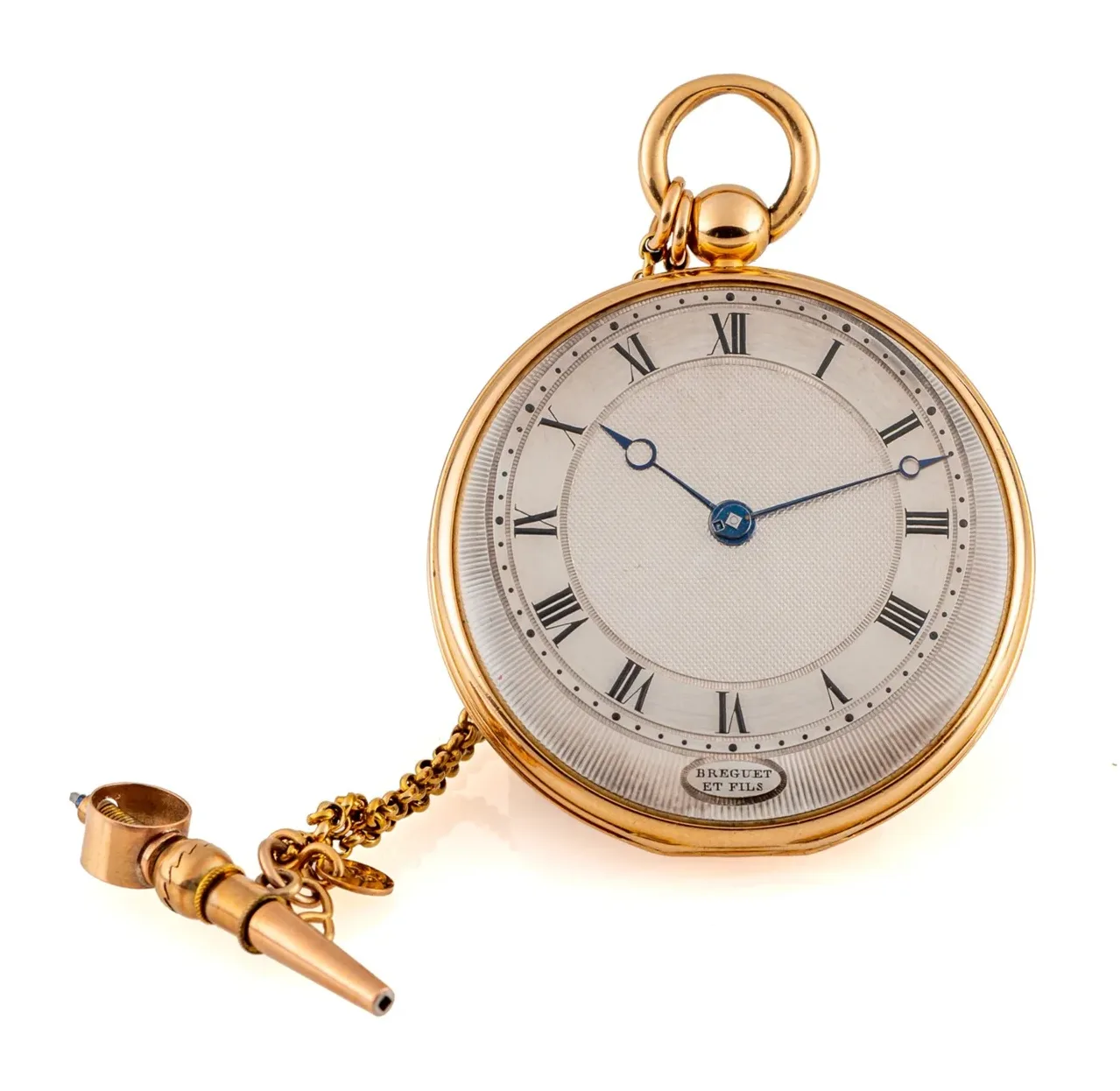

- Made
- c. 1775–1823The span runs from the opening of the workshop in 1775 to the founder's death in 1823; the firm's records for watches made before 1787 do not survive, and some pieces begun in his lifetime were finished after it, the watch numbered 160 in 1827 and tourbillons up to 1829.
- On record
- 76 listings75 of them give no reference
- Reference numbers
- 0 describedmany early watches carry none
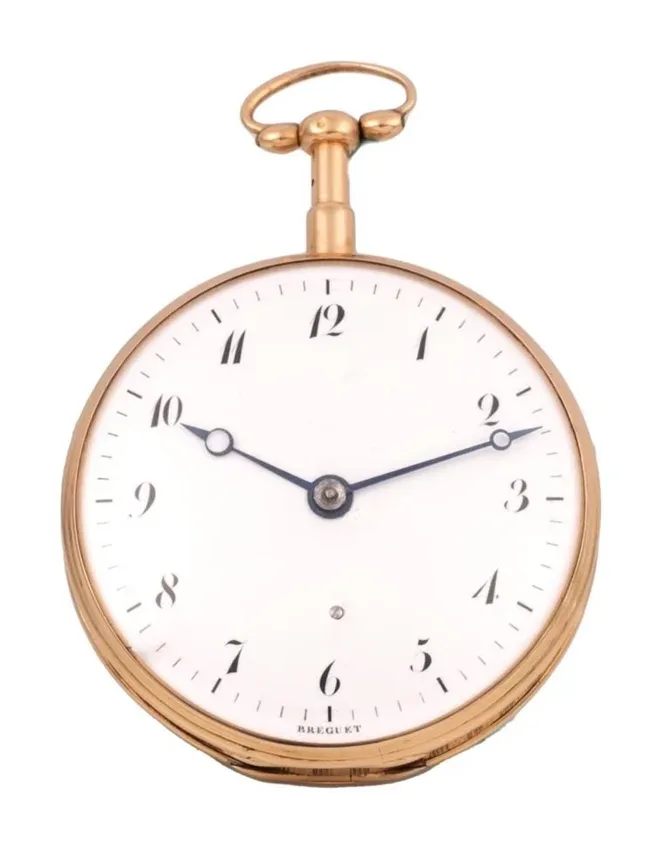

Production by production 6 described
Perpetuelle (self-winding watch)
Breguet's self-winding watch used a heavy platinum weight pivoted to swing and buffered by springs at the edge of the back plate, and it stored power in two mainspring barrels, giving a reserve of up to about sixty hours; when fully wound the weight was locked. It was made so that it need not be opened for winding or regulation, the regulator sitting under the bezel, and a sector on the dial showed the reserve. Most were also repeaters, and nearly all the early ones used a lever escapement, though one sold in 1791 has a chronometer escapement. Early examples usually had white enamel dials with italic Arabic numerals and blued steel hands. They were among the most costly watches the firm sold, and one could take up to two years to make; one estimate puts the total made between 1780 and 1823 at about eighty. Breguet himself said that examples were owned at court by about 1780, but no records survive for his watches before 1787. One account calls it the first self-winding watch; others say self-winding watches had just appeared and that Breguet, who never claimed the principle, perfected his own version.
Signature and marks. The literature gives no signature wording for these watches beyond the production number; a perpetuelle of 1787 is numbered '47, 6/87'.
- a weight pivoted over the back plate
- a power-reserve sector on the dial
- regulation under the bezel rather than through the back
- blued steel hands and italic Arabic numerals on white enamel
Repeaters, calendars and grand complication pieces
Breguet is credited with inventing, or at least decisively developing, the repeater that sounds on a slim wire gong round the edge of the movement instead of a bell above it, which kept the watch thin; in a perpetuelle of 1787 the hours and quarters strike a block fixed inside the caseband (a toc) while a separate hammer sounds the minutes on a short gong. Work on the most complicated watch of all, later numbered 160 and said to hold 823 parts, began in 1783; accounts differ on whether the queen of France ordered it, and it was not finished until 1827, four years after Breguet's death. No. 92, sold in 1805, has two dials, a lever escapement, independent centre seconds, a minute repeater, a perpetual calendar with a month dial and retrograde date and weekday, equation of time, thermometer, an indication of the state of winding, and moon phases. An earlier piece of 1791 combines a minute-repeating perpetuelle with a chronometer escapement, calendar and thermometer. Simple calendars show a zero after the thirtieth, where the date hand waits until it is moved on by hand; the perpetual calendar, which allows for month lengths and leap years, is dated from 1795. The literature gives no starting year for this production as a whole, and records of watches made before 1787 do not survive.
Signature and marks. Not given beyond the production numbers named here.
- a zero after 30 on a simple calendar
- a thermometer, moon phase or equation-of-time dial on the larger pieces
Souscription watch
A plainly built watch conceived to be reliable, repairable by watchmakers of ordinary skill and cheaper than the firm's other work. It has a large enamel dial with a single central hand that reads to within about five minutes (one account says to the minute), a central barrel meant to draw on the middle of the mainspring, a running time of about thirty-six hours, a steel connection from balance to train on ruby bearings and the shock protection. Breguet fixed the price at 600 livres, with a part paid in advance and delivery in order of subscription; most accounts say a quarter was paid first, though one says half. The first appears in the archive in 1796 and was launched in a brochure of 1797; the first was sold on 1 April 1796. About seven hundred were made and sold, and in 1798 they made up 40 of the firm's 105 watches. Early movements were crude and grew more refined; the escapement is a ruby cylinder, in which the acting half is of ruby and open to take the escape wheel teeth. They stayed an important part of production well into the nineteenth century.
Signature and marks. The brochure promised a special machine-made mark on each dial, which the literature identifies with the secret signature; a watch of about 1805 shows the signature and serial number.
- a single long central hand
- a large enamel dial with five- and ten-minute divisions
- a ruby half-cylinder escapement
- a frosted, symmetrical movement with the pare-chute
Tact watch (montre a tact)
A silent watch read by touch: the usual form has an arrow pointer fixed to a caseback that turns freely until an internal mechanism stops it, and the time is felt against fixed hour markers on the band. It is credited to Breguet between 1796 and 1800, and four types are known. Some were richly decorated, with translucent guilloche enamel or touch pins set with pearls or large diamonds; gem-set cases sold for up to five times the price of a plain one. No. 1106, sold on 14 May 1804 for 1,320 francs to a British peer, who intended it for a Russian general, is silver and gold with a rotating silver back carrying a gold arrow, and has a ruby cylinder escapement.
Signature and marks. Not given.
- a caseback that rotates with an arrow or pin
- hour markers on the caseband
Tourbillon watch
The tourbillon carries balance and escapement in a rotating cage to cancel the effect of position; it is dated to about 1795 and was patented on 26 June 1801 for ten years. Breguet and his associates made forty successful pieces between 1796 and 1829, with nine more written off or lost; thirty-five are watches, all of them pocket watches by one account and most of them by another, and the rest include a sympathique, a marine chronometer, a travelling clock and a large demonstration piece. The first tourbillon pocket watch is put at 1805 by one account; another says sales were slow to begin and only got going about six years after the patent. It was shown at the national exhibition of 1806; one account says Breguet also showed it at the exhibitions of 1802 and 1819. More than half by one account, and about half by another, have a cage turning once in four or six minutes instead of the patent's one minute, and about a quarter were used as working timekeepers, at sea or by scientists. Each dial is different; some show running seconds, a seconds hand started on demand, a power reserve or a thermometer. Cases are gold or silver, and the tourbillon is not seen from the dial side. Nos. 1176 and 1188 belong to the first series of six; no. 1297 is the only one with an English inscription and probably the only one with a Robin escapement; no. 2567 has a one-minute cage.
Signature and marks. No. 1297 is inscribed in English, 'whirling about regulator'; the literature gives no other wording.
- a tourbillon not visible from the front
- blued steel hands on a guilloche dial
- a stated cage period of one, four or six minutes
Watches for the Ottoman market
In the first decade of the nineteenth century, as the Napoleonic Wars cut Breguet off from Britain, from Spain after 1808 and from Russia after 1810, trade with the Ottoman Empire grew in importance. The Ottoman ambassador to France, who kept up a correspondence with Breguet after returning to Constantinople in 1802, brought him clients and advised him on their taste: white enamel dials with Turkish numerals and cases richly decorated in enamel, above all in red, which differ from his usual style.
Signature and marks. Not given.
- Turkish numerals on a white enamel dial
- red enamel decoration on the case
Chronology
Specification
| Kind | Pocket watches, key-wound or self-winding; a wristwatch for the Queen of Naples is documented |
| Cases | Gold or silver, some with translucent enamel or set with pearls or diamonds |
| Dials | White enamel, or engine-turned (guilloche) gold or silver; Arabic numerals, or Turkish numerals for the Ottoman market |
| Hands | Pomme hands in blued steel or gold; the souscription watch has a single hand |
| Escapements | Lever, ruby cylinder, chronometer, the échappement naturel and, in one tourbillon, the Robin escapement |
| Numbering | Each watch carries its own production number; the firm's archive lists buyers and dates of sale, but nothing survives for watches made before 1787 |
Dial 4 described
Dials vary between enamel and engine-turned metal. The literature records the first guilloche dial in 1786 and a secret signature from 1795; no two watches were quite alike.
White enamel dial with Arabic numerals
Early perpetuelles had white enamel dials with finely painted italic Arabic numerals, now called Breguet numerals. The souscription watch has a large enamel dial with a single central hand.
- italic Arabic numerals
- a large open white dial
Guilloche dial
Breguet is said to have taken the idea of engine turning from furniture and ivory he saw in London, and the first watch with a guilloche dial dates from 1786. Besides making counterfeiting harder, the relief helps keep dust from showing and reflects light less harshly. Engine turning had been used on watch cases since the late seventeenth century; Breguet made it a feature of the dial. Tourbillon no. 1188 first had a guilloche gold dial, replaced in 1841 by enamel with Turkish numerals.
- engine-turned gold or silver dial
- a redial on a watch described as originally guilloche
Secret signature
A signature about three millimetres wide, cut into the white enamel with a pantograph, which shows only under a lens. It was introduced in 1795 against imitators, and the souscription brochure promised a mark on each dial made by a machine whose effects were hard to copy. Watches without it were long held to be forgeries, but some that are shown to have come from the workshop lack it, perhaps by oversight; its absence is therefore not proof of a forgery.
- a tiny signature near the numerals seen only under magnification
Turkish numerals
White enamel dials with Turkish numerals were made for Ottoman clients, to the taste described by the ambassador in Paris.
- Turkish numerals on a white enamel dial
Hands 1 described
The pomme hand is the shape most closely tied to the maker.
Pomme hands
In 1783 Breguet gave up the English hands then used and adopted a hand with a slender stem and an off-centre open disc (the pomme) near a sharp point, in gold or blued steel; accounts put the date at about 1783. The long slender hands against a plain white dial replaced the ornate hands of the time.
- a thin hand with an open circle near the tip
- blued steel or gold
Case and sizes 2 described
The literature says little of the cases of ordinary watches; it names those with the tact mechanism and the gem-set and enamelled covers, and the cases of Ottoman watches.
Tact caseback
The caseback turns freely and carries an arrow or a pin, sometimes set with pearls or diamonds, and stops against an internal mechanism so that the time is felt on the band.
- a rotating back with an arrow
Enamelled and gem-set cases
Some cases carry translucent enamel over engine turning, or touch pins set with pearls or large diamonds, and the cases of Ottoman watches are richly enamelled, most often in red.
- translucent enamel over guilloche
- gem-set touch pins
Movement 6 described
The movements show the firm's long run of experiments in escapements and protection. The dates given are those the literature states for each device.
Echappement naturel
A double-wheel chronometer escapement, intended to need no oil. It had faults, notably play in the wheels, and could stop with shocks and not restart, which made it unsuited to a watch for a wide public. It appears in tourbillon no. 1176.
Pare-chute shock protection
The balance staff, or the ruby cylinder, sits in bearings carried on fine steel springs that give under a blow. Trial pieces are put at 1790, and another account puts the introduction at 1790 to 1791; an improved form was first shown in public in 1806. It was used in many models, including the souscription watch.
- a spring-mounted bearing under the balance
Overcoil balance spring
A spring with a raised outer end, which makes it breathe more concentrically and so keep better time.
- a raised outer end to the spring
Ruby cylinder escapement
In Breguet's version the lower half of the steel cylinder is of the usual form and the acting part is ruby, left open to take the escape wheel teeth, so the escapement works under the dial in no more depth than the motion work needs. Together with a Lepine-style plate with the parts hung from it, this gave thin watches. It is the escapement of the souscription watch and of tact watch no. 1106 of 1804.
- a ruby cylinder
- a single-plate calibre
Lever escapement
Nearly all the early perpetuelles use the detached lever, in a form Breguet developed himself; no. 92 of 1805 also has a lever escapement.
Tourbillon regulator
Patented in 1801. The patent describes a cage turning once a minute, but more than half the pieces made, or about half by another account, turn it once in four or six minutes. Nos. 1188 and 1297 have four-minute cages, and no. 2567 one of one minute.
- a cage under the dial, not seen from the front
Originality
- Dials were sometimes changed by the firm itself after the founder's time: tourbillon no. 1188 had its engine-turned gold dial replaced in 1841 by an enamel one with Turkish numerals, so a dial may not be the one first fitted.
- Some watches were finished or sold after Breguet's death, as no. 160 was in 1827 and the experimental tourbillon no. 282 was by his son, so a number alone does not date the work to the founder's hand.
- Imitations began in his lifetime and probably run to several thousand; the firm's archive, which lists the watches and their buyers, is used to separate them, though nothing survives for watches made before 1787.
- The secret signature, once taken as proof, is missing from some watches shown to be genuine, so it cannot be the only test; false Breguet signatures are common on imitations.
Names
- Marie-Antoinette. The popular name of the watch numbered 160, also called the Queen; accounts differ on whether the queen ordered it.
Where accounts differ
Points on which the published literature and the library's own records do not agree, or on which the literature contradicts itself.
- How much was paid in advance for a souscription watch. One account says clients paid a quarter of the 600-livre price up front, with delivery in order of subscription; another also gives about a quarter, with the rest paid in instalments while the watch was made; a third says a portion was paid first and the rest on delivery; a fourth calls it a watch ordered in advance and half paid beforehand.
- The first tourbillon and the gift to the son of a London chronometer maker. One account names two experimental tourbillons, no. 169, given to the London maker's son in 1809, and no. 282, finished in 1800 but sold by Breguet's son much later, and puts the first tourbillon pocket watch at 1805. Another dates the first working tourbillon to 1800, says that trial piece found a buyer only in 1832, and puts the gift to the London maker's son, a tourbillon fitted to an early movement by his father, in 1808. Another counts nos. 1176 and 1188 in the first series of six and calls no. 1297, delivered in 1808, the third sold. The gift is dated 1808 or 1809, and the pages do not agree on which piece was first.
- Who ordered the watch numbered 160. One account says the queen of France sent an officer of her guard to Breguet in 1783 to order the most complicated watch possible, with no delivery date and no price limit. Another says the watch was not commissioned by the queen and that an admirer of hers is rumoured to have ordered it; both put the start of work in 1783.
- How complete the firm's archive is. One account describes a complete archive recording all of the firm's work, by which genuine watches can be told from imitations. Another says a significant part of the archive was destroyed during the French Revolution and that no records survive for watches made before 1787. This matters for any watch thought to predate 1787.
- How closely the souscription hand reads. One account says the large dial let the time be read to the nearest five minutes, and another likewise speaks of placing the hand to the nearest five minutes; a third says the large diameter let one hand show the time to the minute.
- When tourbillons were first sold. Two accounts put the first tourbillon pocket watch on sale in 1805; two others say sales began only about six years after the patent of 1801.
- Share of tourbillons with slow cages. Two accounts say more than half have a cage turning in four or six minutes; another says roughly half.
- What the thirty-five tourbillon watches were. One account counts all thirty-five as pocket watches; another calls them watches, predominantly pocket pieces.
- Whether the perpetuelle was the first self-winding watch. One account calls it the world's first automatic watch. Another says Breguet took up a new discovery and made his own version; a third says he was not the first but made the first truly reliable one; another says the principle was not his and that a rival patented a self-winder in 1780.
In the records
Counted from 76 listings at dealers and auction houses. These are what sellers state, not measurements, a stated year is often an estimate, and a count of listings is not a count of watches made.
Case metal
| Metal | Listings | Share |
|---|---|---|
| Gold, any colour | 31 | 94% |
| Yellow | 11 | 33% |
| Pink | 2 | 6% |
| Colour not stated | 18 | 55% |
| Gold plated | 1 | 3% |
| Silver | 1 | 3% |
As sellers state it. Shares are of the 33 listings that name a metal. A listing that says "gold" or "18K gold" names no colour: it is counted under "colour not stated", not as yellow gold. Carat, where a listing of gold gives one: 18k 21 · 20k 2.
Case size
| Size | Listings | Share |
|---|---|---|
| 55 mm | 7 | 12% |
| 53 mm | 6 | 10% |
| 54 mm | 6 | 10% |
| 49 mm | 5 | 8% |
| 52 mm | 4 | 7% |
| 56 mm | 3 | 5% |
| 59 mm | 3 | 5% |
| 48 mm | 2 | 3% |
| Other sizes | 24 | 40% |
As sellers state it. Shares are of the 60 listings that give a size.
Listings by decade the seller gives
| Decade | Listings |
|---|---|
| 1800s | 27 |
| 1810s | 24 |
| 1820s | 25 |