Type 20 and Type XX chronograph, first generation
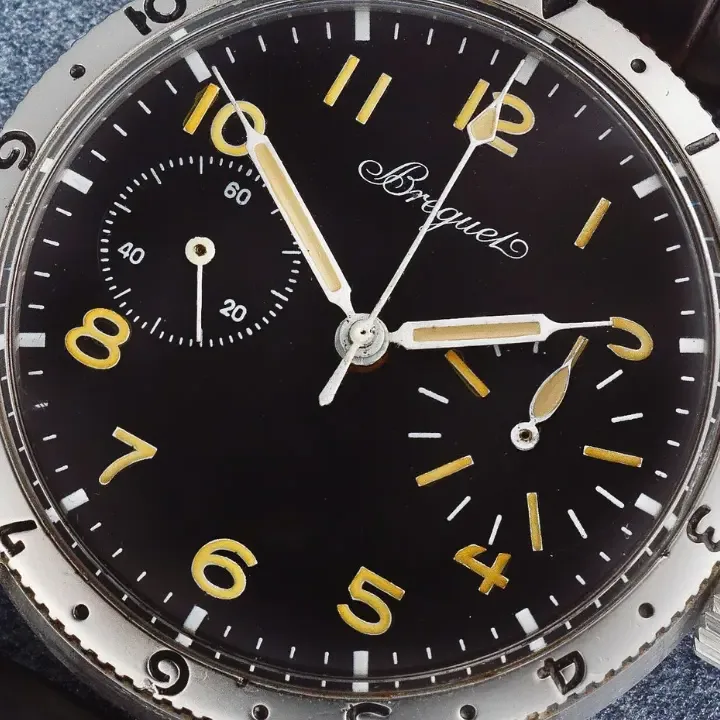
The first generation of Breguet's flyback pilot's chronograph: a steel wristwatch of about 38 mm with a Valjoux 22-based hand-wound movement, a bi-directional bezel and a black dial. The name Type 20 comes from the French defence specification of the early 1950s, and the watches made to it for the French Air Force, the Naval Aviation arm (Aéronavale) and the flight-test centre (CEV) are the military Type 20 or Type XX. Civilian watches, signed on the dial, were sold under the name Type XX from the mid-1950s. Numbered pre-series of 1949 to 1952 came before, and the line gave way to a larger second generation in 1971.
This maker's early watches are described by kind of watch, not by reference number: many carry no number, and one number can cover quite different watches. The wider picture is in Early Breguet, 1775 to 1970.
- Made
- c. 1953–1970The first Type 20 numbers appear in 1953 and the literature says the watch changed little until 1970; military deliveries ran from 1955 to 1960, and the dates of civilian watches are less exact.
- On record
- 92 listings70 of them give no reference
- Reference numbers
- 2 describedmany early watches carry none
Production by production 8 described
Numbered pre-series before the Type 20
Before the Type 20 name existed Breguet made small numbered series of wrist chronographs for pilots. In 1949 these were fitted with Lemania movements; a single 14-line watch, number 460, went to the French air ministry, and a series of five with a 13-line movement is given the numbers 456 to 460, which as published overlap the single watch. Six watches numbered 409 to 414, made in 1949 and 1950, had a rotating bezel and a chronograph that reset and restarted in one press. Six more, numbers 832 to 837 (October 1950 to November 1951), added a 30-minute register, and twelve, numbers 983 to 994 (July 1951 to October 1952), added a twelve-hour register but no flyback. From 1952 a Valjoux 22 with a flyback module replaced the Lemania.
Signature and marks. Not given in the literature.
- numbers in the published series: 409 to 414, 456 to 460, 832 to 837 and 983 to 994
- rotating bezel from numbers 409 to 414 on
- Lemania movement before 1952, Valjoux after
Prototypes and first Type 20 numbers
The French air force's technical service issued a tender in 1952 asking for a black dial with Arabic numerals, a 38 mm case, a bezel turning both ways, a flyback chronograph, a daily variation of no more than eight seconds and a reserve of at least 35 hours. Breguet delivered numbers 1200 to 1202 on 23 July 1952 and the prototypes were approved in 1953; the firm's own history, as quoted elsewhere, puts the design and its approval in 1954. Numbers 1530, 1531 and 1532, finished on 27 April 1953 and sold to the defence ministry in July, were the first with Type 20 in their designation. The last watches outside the Type 20 series, twenty-four numbered from 1163 to 1412 that came out in December 1952, include the first gold-cased pilot's chronograph.
Signature and marks. Type 20 appears in the maker's records against numbers 1530 to 1532; no dial or case marking is described.
- numbers 1200 to 1202 and 1530 to 1532
- a gold case with a silver dial and tachymeter scale on number 1408
Gold Type XX, three watches
Three pilot's chronographs were made in gold: number 1408 of 1952, with a silver dial and tachymeter scale, and numbers 1781 and 1780 of February and March 1955, with a satin silver dial, gold hands and a tachymeter scale. Number 1780 is recorded as Type XX and 1781 as Type 20. The dial of 1780 was silver at first and was later replaced by a black one, as the maker's archive records. The case of 1780 is given as 38.3 mm. All three are also put in 1955, in yellow gold.
Signature and marks. 1780 is recorded as Type XX and 1781 as Type 20.
- gold case
- tachymeter scale
- silver dial, or on 1780 the later black dial
French Air Force Type 20, order 5101/54
The main military production was an order of 1,100 watches placed by the Air Force in 1954. The watch has a 38.3 mm steel case (38.5 mm in another description), a 30-minute register, a knurled bezel without a scale but with a small arrow, a large pear-shaped crown and a Valjoux 222 with flyback. The dial is unsigned: the earliest military Breguets had no brand on it, and the name came later and mostly on civilian watches. The first 250 were delivered on 17 June 1955 and the last 120 in 1959. With the 500 Aéronavale and 80 CEV watches they make up the roughly 1,700 military watches of the first generation. The size of the order is also given as 2,000. The first-generation Type 20s in general, not only these, are said to have been made for Breguet under subcontract by Mathey-Tissot, which also sold identical chronographs to civilians under its own name.
Signature and marks. Case back engraved BREGUET - TYPE 20 - 5101/54; the dial is not signed. Many carry FG (fin de garantie) engravings with the date of the next service.
- unsigned (sterile) black dial
- 30-minute register and small seconds
- bezel without scale and with a small arrow
- pear-shaped crown
- FG service dates on the case back
References: 5101/54
Civilian Type XX, signed on the dial
Civilian watches were sold from 1954 and carry the Breguet signature on the dial, which sets them apart from the unsigned Air Force watches. A series of twenty-seven plain chronographs numbered 498 to 524 opens with 498 and 499, sold in 1954 to the Louis Breguet aircraft company; three of the series are recorded as Type 20, and number 519 was bought by the last emperor of Vietnam. In 1955 a civilian watch with a twelve-hour register at 6 o'clock, number 1888, was shown; twenty-five were made. In all about 2,300 civilian watches were made; the figure is elsewhere put at more than 2,000. They use the Valjoux 225, later the 230 and 720, with an oversized 15-minute register at 3 divided into five three-minute sections, small seconds at 9, a twelve-hour register at 6 and a scaled bezel; a 38 mm steel watch with a black dial and 30-minute and twelve-hour registers was sold in November 1959 to an aeronautical firm in Algiers. Buyers included the Aéro-Club de France, the civil aviation school (ENAC), the Gendarmerie nationale and the Office général de l'air. Dial, hands and bezel vary in small ways.
Signature and marks. Breguet signature on the dial.
- Breguet signature on the dial
- three registers with a 12-hour counter at 6
- oversized 15-minute register at 3
- scaled bezel, 0 to 60 on some
Flight-test centre (CEV) watches
The Centre d'Essais en Vol took eighty watches, delivered in 1956 and 1957. They have a 15-minute register in place of the 30-minute one, and fifty of them also have a twelve-hour register at 6 o'clock. The case back is engraved CEV and a number from 1 to 80. The large 15-minute register made for the CEV and the Aéronavale is the arrangement collectors call the Big Eye, although one described CEV watch, dated 1962, is said to take the name from a large 30-minute register. The order is also given as five hundred watches with two registers and fifty with three, with a bezel carrying time markers.
Signature and marks. Case back engraved CEV followed by a number from 1 to 80.
- CEV and a number engraved on the back
- large 15-minute register
- twelve-hour register at 6 on fifty of them
Type 20 of September 1957
After 1955 the maker called its pilot's chronographs Type XX, with one exception: eight watches made in September 1957, with 15-minute and twelve-hour registers, which still bore the name Type 20. The literature does not say who they were made for.
Signature and marks. Recorded under the name Type 20; no marking on the watch is described.
- 15-minute register with a twelve-hour register at 6
Aéronautique Navale Type XX
The Marine ordered 500 watches in 1958 for the naval air arm, numbered from 4100 and delivered together on 13 January 1960. They differ from the Air Force watches in having a large 15-minute register (the Big Eye) with luminous marks every three minutes, a signed dial, a signed case back and an unmarked bezel. An internal anti-magnetic case is also described. The name is given as Type XX in some accounts and Type 20 in others.
Signature and marks. Case back engraved BREGUET - MARINE NATIONALE - AERONAUTIQUE NAVALE and a number out of 500; the dial is signed.
- signed dial
- enlarged 15-minute register with luminous marks every three minutes
- case back engraved Marine Nationale, with FG service dates
References: 2977
Chronology
Specification
| Case | Stainless steel, screw-down back, about 38 mm (given as 38.3 mm and as 38.5 mm for the same Air Force watch); three watches were made in gold |
| Dial | Black, luminous numerals and hands; two or three registers; the earliest military dials carry no signature |
| Bezel | Rotating, both ways as the specification asked; unmarked on the Air Force and Aéronavale watches, scaled on civilian ones |
| Chronograph | Flyback (retour en vol), start and stop by the upper pusher, reset and restart by the lower |
| Movement | Hand-wound Valjoux 222 (two registers) or 225 (three registers), the Valjoux 22 with a flyback module; 17 jewels, 18,000 vibrations an hour; later 230 and 720 |
| Crown | Large pear-shaped (onion-style) crown on the early military watches |
Dial 4 described
The early Air Force dials carry no signature and are black with luminous Arabic numerals. The Breguet name appears on civilian and Aéronavale watches. Dials vary in small ways; a few are coloured, and some have aged to a brown tone described as tropical.
Unsigned military dial
Black dial with no maker's name, on the Air Force watches of order 5101/54. The Breguet logo appeared later and mostly on civilian watches.
- no signature
- 30-minute register
Signed dial
Civilian watches and the Aéronavale watches carry the Breguet signature. Civilian dials with three registers have a 12-hour counter at 6.
- Breguet signature
Tropical dial
A black dial that has aged to brown, seen on watches of the first generation; dated watches so described in the library's records fall mostly between 1955 and 1967. The literature does not date it.
- brown, degraded dial and hands
Coloured dial
A few watches have a dial in a colour other than black; number 5096, sold in January 1960, is given as one of these rare examples.
- dial in a colour other than black
Hands 1 described
Luminous hands of two kinds are described on early watches.
Pencil hands and feuille seconds
A pencil hour and minute hand set with a feuille seconds hand is given as the signature of the early models. The hands are also described as varying between syringe and baton shapes.
- pencil hour and minute hands
- feuille seconds hand
Subregisters 3 described
The registers follow the customer: 30 minutes for the Air Force, chiefly 15 minutes for the CEV, the Aéronavale and civilian watches, with a twelve-hour counter on three-register watches.
30-minute register at 3
First on numbers 832 to 837 of 1950 and 1951; standard on the 1,100 Air Force watches, with small seconds at 9, and found on some civilian watches.
- 30-minute counter
15-minute Big Eye register
A larger 15-minute register at 3, on the CEV, Aéronavale and civilian watches. On the Aéronavale watches it has luminous marks every three minutes. On civilian watches it is divided into five three-minute sections. One described CEV watch is called Big Eye for a large 30-minute register instead.
- oversized register at 3
Twelve-hour counter at 6
First on the twelve chronographs numbered 983 to 994 of July 1951 to October 1952, which had it with a 30-minute register but no flyback. A civilian watch with it at 6, number 1888, was shown in 1955, and one caption gives 1955 as the year it was introduced. Found on fifty of the CEV watches, the eight Type 20 of 1957 and later civilian watches.
- third register at 6
Bezel 2 described
The specification asked for a bezel turning both ways. The scale depends on who the watch was made for.
Unmarked bezel with arrow
Air Force and Aéronavale watches have a bezel with no scale; the Air Force bezel is described as knurled with a small arrow.
- no numerals on the bezel
Scaled bezel
Civilian and CEV bezels carry markers; one civilian example is marked 0 to 60.
- 0 to 60 scale
- hour markers
Case and sizes 3 described
The case is steel with a screw-down back, near 38 mm. The case back carries the engraved identification of the order.
Steel case, 38.3 to 38.5 mm
The Air Force watch is given as 38.3 mm and also as 38.5 mm; other descriptions say 38 mm. The specification asked for a case of about 38 mm and under 14 mm thick. All but three of the roughly 1,700 military and 2,300 civilian watches were steel, although one account calls steel very rare in Breguet watches as a whole.
- 38 mm steel case
Case-back engravings
BREGUET - TYPE 20 - 5101/54 on the Air Force watches, CEV and a number to 80 on the CEV watches, and BREGUET - MARINE NATIONALE - AERONAUTIQUE NAVALE with a number out of 500 on the Aéronavale watches. FG stamps, for fin de garantie, followed by a date of next service, mark military issue; a collector reports repair stamps on some up to 1985. A watch with no engraving may still be military.
- FG and a date
- number out of 500
- CEV and number
Gold case
Three watches only, numbers 1408, 1780 and 1781.
- gold case
Crown 1 described
The early military watches have an oversized crown.
Pear-shaped (onion) crown
Large and pear-shaped on the Air Force watches, with more than one shape of crown described across the run.
- large pear-shaped crown
Movement 4 described
Lemania movements in the first small series; from 1952 a hand-wound Valjoux with a flyback module, in several calibres that followed one another.
Lemania, 13 and 14 lines
Used in the pre-series wrist chronographs.
Valjoux 222
A Valjoux 22 with a flyback module, with a 15 or 30-minute register, a column wheel, 17 jewels, 18,000 vibrations an hour and a reserve of 35 to 40 hours.
- Valjoux 222, 17 jewels
Valjoux 225
As the 222 with a twelve-hour register, used in the three-register watches.
- Valjoux 225
Valjoux 230 and 720
These replaced the 222 and 225 from 1963, with Incabloc shock protection and a balance with a plain rim. The change of 1963 is also described as the replacement of the 14-line Valjoux by a modernised 13-line one.
- Valjoux 230 or 720
Reference numbers
The numbers that belong to the line, with the listings on record under each, as its own page counts them. A number links to its own page, where the components of dated watches are set side by side.
| Number | What it is | Listings |
|---|---|---|
| 5101/54 | The order number of the 1954 Air Force purchase of 1,100 Type 20 chronographs, engraved on the case back. | |
| 2977 | As sellers describe it, an Aéronavale watch; the literature does not give this number, and it may be the number of a single watch rather than a model reference. | 4 |

Originality
- Replaced dials are recorded: the gold number 1780 had a silver dial first and a black one later.
- A military watch with a clean, unengraved case back may still be military issue.
- A unit name or an engraving does not by itself prove a watch's service; the number, movement, case back and any documents need to agree.
Names
- Big Eye. The oversized 15-minute register at 3 o'clock.
- Sterile dial. The early Air Force dials carry no brand name.
Where accounts differ
Points on which the published literature and the library's own records do not agree, or on which the literature contradicts itself.
- Size of the Air Force order. Most accounts give 1,100 watches ordered in 1954 under reference 5101/54. Two others say 2,000 watches were ordered or made.
- Size of the CEV order. Most accounts say eighty watches, 1956 to 1957. One says five hundred with two registers and fifty with three.
- When all became Type XX. One account says Breguet called all its pilot's chronographs Type XX from 1955, with the one exception of 1957; another says Type XX has been used for every variant only since 1957.
- First deliveries to the French military. Two accounts say Breguet and Vixa first supplied Type 20 chronographs to the French military in 1950. The fuller history puts Breguet's first deliveries to the Air Force on 23 July 1952 (numbers 1200 to 1202), after a single watch for the air ministry in 1949, and the first Type 20 designation in 1953.
- When the Type 20 was designed and approved. Most accounts have prototypes submitted in 1952, approved by the air force's technical service in 1953, and the order of 1,100 placed in 1954. The firm's own history, as one account quotes it, has the watch designed and quickly approved in 1954.
- The first pilot's wrist chronographs. One account says the first wrist chronographs Breguet developed for combat pilots appeared in 1949; another describes a steel pilot's chronograph wristwatch sold in December 1948.
- How rare steel is in Breguet watches. The accounts of this line describe nearly all of some 4,000 first-generation pilot's chronographs as stainless steel. Another account calls steel very rare in Breguet watches, with only a handful known.
- Dates of the Air Force deliveries. Two accounts have the 1,100 Air Force watches ordered in 1954 and delivered from 1955 to 1959. One has them delivered between 1950 and 1959, and adds that the firm continued to supply Type 20 watches well into the 1980s.
In the records
Counted from 92 listings at dealers and auction houses. These are what sellers state, not measurements, a stated year is often an estimate, and a count of listings is not a count of watches made.
Case metal
| Metal | Listings | Share |
|---|---|---|
| Steel | 65 | 97% |
| Gold, any colour | 2 | 3% |
| Yellow | 1 | 1% |
| Colour not stated | 1 | 1% |
As sellers state it. Shares are of the 67 listings that name a metal. A listing that says "gold" or "18K gold" names no colour: it is counted under "colour not stated", not as yellow gold. Carat, where a listing of gold gives one: 18k 2.
Case size
| Size | Listings | Share |
|---|---|---|
| 38 mm | 44 | 66% |
| 38.5 mm | 17 | 25% |
| 40 mm | 3 | 4% |
| 36 mm | 1 | 1% |
| 38.3 mm | 1 | 1% |
| 40.5 mm | 1 | 1% |
As sellers state it. Shares are of the 67 listings that give a size.
Listings by decade the seller gives
| Decade | Listings |
|---|---|
| 1950s | 47 |
| 1960s | 33 |
| 1970s | 12 |