Tourbillon watches to 1970
The tourbillon is a regulator in which the balance, hairspring and escapement sit in a small carriage that turns on its own axis, devised by Abraham-Louis Breguet around 1795 and patented in 1801 to average out the effect of gravity on a pocket watch. His workshop made about forty tourbillon pieces between about 1796 and 1829, most of them pocket watches. After his death the firm made very few: one or two in every twenty years by one account, while another names only a tourbillon travel clock commissioned in 1890 and a small run of pocket tourbillons in the middle of the twentieth century. The literature records no Breguet tourbillon wristwatch in this period. The early pieces are known by their production numbers and differ in the turning period of the cage, the escapement and the dial.
This maker's early watches are described by kind of watch, not by reference number: many carry no number, and one number can cover quite different watches. The wider picture is in Early Breguet, 1775 to 1970.

- Made
- from c. 1796Published accounts date the founder's tourbillons from about 1796 to 1829; the literature gives no end date for the later pocket tourbillons, which it places only in the mid-twentieth century.
- On record
- 6 listings6 of them give no reference
- Reference numbers
- 0 describedmany early watches carry none
Production by production 4 described
Experimental pieces and the first series, 1800 to about 1811
The invention took years to reach a saleable watch. One account names two experimental watches, no. 169, given in 1809 to the son of a London watchmaker (another account dates that gift to 1808), and no. 282, completed in 1800 and sold much later by the founder's son, and heads its list of tourbillons with no. 1252, an experimental tourbillon with a constant-force escapement, which another account dates to 1800. The first sale is put in 1805 by one account and about six years after the patent by others. A first series of six followed over roughly ten years. No. 1176 was begun in July 1802 and finished in February 1809; it is a 64 mm pocket watch with a four-minute tourbillon, the natural escapement, running seconds, observation seconds and a power-reserve indication, and one account dates it 1806. No. 1188, begun about 1803 and sold in 1808, is a four-minute tourbillon; no. 1297, a four-minute tourbillon with a Robin escapement and an engine-turned dial, is described as the third tourbillon watch sold and went to King George III.
Signature and marks. Not given in the literature, except that no. 1297 alone is said to carry an inscription in English, 'Whirling about regulator'.
- cage turning once in four minutes rather than one
- engine-turned gold dial
- natural escapement on no. 1176
- Robin escapement on no. 1297
The founder's tourbillons, 1805 to 1823 and the ledger to 1829
Thirty-five tourbillon watches were sold between 1805 and 1823 by one account. Another counts forty tourbillon pieces made between about 1796 and 1829, with nine more begun and never finished that survive only as ledger entries. Of the forty, thirty-five were watches, mostly pocket watches by one account and all of them by another; the other five were clocks and demonstration pieces, including a sympathique clock with a tourbillon regulator, a marine chronometer and a large teaching model, with a travel clock named in another list. About a quarter were bought for navigation at sea or for scientific use, and buyers included monarchs and aristocrats. No. 2567, made from October 1809 to December 1812, is a 61 mm hunter-case watch with a silvered engine-turned dial, Roman numerals, blued steel hands and a one-minute cage. No two dials were alike; the cases were gold or silver.
Signature and marks. The literature gives no detail of signatures or marks.
- gold or silver case
- hunter case on no. 2567
- engine-turned silvered or gold dial with Roman numerals
- blued steel hands
- extra indications such as observation seconds or power reserve
- four- or six-minute cage on about half the watches
After the founder: a few pieces in each generation, 1823 to the twentieth century
After 1823 the tourbillon became a specialist's complication. One account says the firm made one or two in every twenty years through the nineteenth century and the first half of the twentieth, and credits the Brown family, later owners of the firm, with continuing to make some. Another gives only a tourbillon travel clock commissioned in 1890 and a small run of pocket tourbillons in the middle of the twentieth century. The literature gives no list of these pieces. A later dial on an older piece is recorded: no. 1188 received an enamel dial with Turkish numerals in 1841.
Signature and marks. Not given in the literature.
Pocket tourbillons signed Breguet, about the 1930s to the 1950s
A small run of pocket tourbillons is placed in the middle of the twentieth century. Auction descriptions of watches signed Breguet in the library's records call them keyless, openface, one-minute tourbillons, some with a Guillaume balance, a power reserve or an observatory bulletin from Besancon. Cases are described as yellow gold, two-tone gold, silver and gold, or silver. Some descriptions credit the movement to a named outside maker. Sellers state years for these watches from the 1930s to the 1950s, and a skeletonised one-minute tourbillon with minute repeater and split seconds is stated 1962; the literature does not date any of them.
Signature and marks. Auction descriptions in the library's records call them signed Breguet and give production numbers such as 1389. Further marks are not given in the literature.
- keyless openface case
- one-minute cage
- Guillaume balance
- power-reserve indication
- observatory bulletin
Chronology
Specification
| Type | Tourbillon regulator in pocket watches, with a few clocks, a marine chronometer and a demonstration model |
| Cage rotation | One minute in the patent; about half the early pieces, or more than half by another account, turn once in four or six minutes |
| Case | Gold or silver; a 61 mm hunter case and a 64 mm pocket watch among the documented early pieces |
| Dial | Engine-turned gold or silvered dials on the documented early pieces, with markings picked out in gold, silver or enamel; indications vary from watch to watch |
| Escapement | Natural, Robin, lever and detent escapements are all recorded; one experimental piece has a constant-force escapement |
| Extra indications | Running seconds, observation seconds on demand, power reserve; a thermometer on occasion |
Dial 2 described
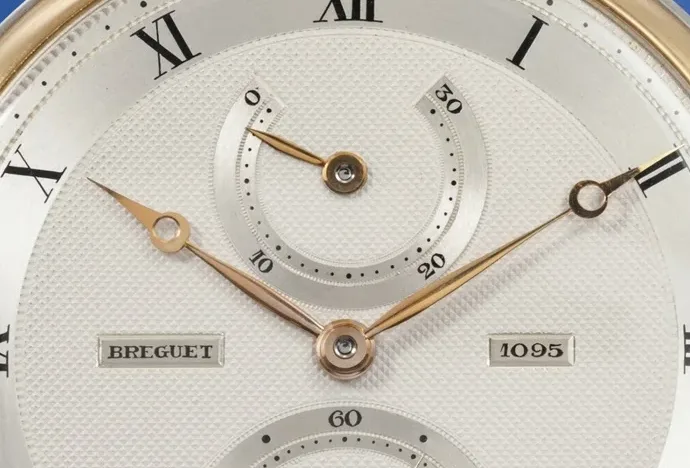
The founder's tourbillon dials followed the plain neoclassical taste of his time: roomy and legible, with the function marks picked out in gold, silver or enamel. No two were alike, because the mechanism could be combined with different escapements and indications.
Engine-turned gold or silvered dial
No. 1188 first had an engine-turned gold dial, and no. 1297 has an engine-turned dial; no. 2567 has a silvered engine-turned dial with Roman numerals and blued steel hands. The literature calls the dials of the tourbillon watches generally clear and neoclassical in spirit.
- engine-turned surface
- Roman numerals
- blued steel hands
Replacement enamel dial
No. 1188 was altered in 1841, when its gold dial was replaced by an enamel dial with Turkish numerals.
- Turkish numerals on an early watch
Hands 1 described
The literature mentions the hands only for one watch.
Blued steel hands
No. 2567 has blued steel hands of the kind typical of the firm.
- blued steel
Case and sizes 3 described
The cases of the founder's tourbillons were gold or silver. Two documented watches differ in size and form; the literature gives no general rule.
Hunter case, 61 mm
No. 2567, finished in 1812, is a hunter-case pocket watch of 61 mm.
- hunter case
Pocket watch, 64 mm
No. 1176, finished in 1809, measures 64 mm.
Openface keyless case
The twentieth-century pocket tourbillons are described by sellers as openface and keyless, in gold, two-tone gold or silver and gold.
- openface keyless case
Movement 6 described
The tourbillon carries the balance, spring and escapement in a carriage turned by the train around a fixed wheel. The patent describes a one-minute carriage, but about half the early pieces, or more than half by another account, turned in four or six minutes. The escapement varied from watch to watch.
One-minute cage
The patent describes a cage turning once a minute, and no. 2567 has one. One account says the one-minute cage was new to the maker at the time of no. 2567; the patent itself describes a one-minute cage.
- cage turning in sixty seconds
Four- and six-minute cages
About half the early tourbillons, or more than half by another account, turn in four or six minutes, a compromise between driving force, inertia and the escapement. No. 1176, no. 1188 and no. 1297 are four-minute pieces.
- four-minute or six-minute cage
Natural escapement
The double-wheel natural escapement, devised in 1789 to avoid oil, was fitted to no. 1176. It was prone to play in the wheels.
Robin escapement
No. 1297 has a Robin escapement, thought to be the only Breguet tourbillon with one. It was easily upset by shock.
Lever, detent and constant-force escapements
The tourbillons vary in frequency, rotation speed and escapement, and lever, detent and natural escapements are all recorded. No. 1252 is an experimental regulator with a constant-force escapement.
One-minute tourbillon with Guillaume balance
The twentieth-century pocket tourbillons are described in auction descriptions in the library's records as one-minute tourbillons, some with a Guillaume balance and a power reserve, and some with an observatory bulletin. Some listings credit the movement to an outside maker.
- Guillaume balance
- observatory bulletin
Box and papers 1 described
The literature mentions only a clock.
Tourbillon travel clock
A tourbillon travel clock was commissioned in 1890.
Originality
- At least one early watch has a later dial: no. 1188 received an enamel dial with Turkish numerals in 1841, replacing the original engine-turned gold one.
- The literature does not say how a replaced dial or movement shows on these watches.
Names
- Whirling about regulator. The English rendering of the French name, inscribed in English on one early watch, no. 1297.
Where accounts differ
Points on which the published literature and the library's own records do not agree, or on which the literature contradicts itself.
- How many tourbillons Breguet made. Two accounts put the number at forty pieces from about 1796 to 1829, with nine more unfinished; another says thirty-five watches were sold between 1805 and 1823; an interview says thirty to thirty-five were sold over twenty to twenty-five years. The German article calls the five pieces that were not pocket watches wristwatches, but then lists them as a sympathique clock, a clock set, a marine chronometer, a travel clock and a demonstration model; the English account lists them as clocks and demonstration pieces. The German article counts all thirty-five watches as pocket watches; the English account says they were predominantly pocket pieces. The library's records hold no tourbillon from the founder's time.
- Patent date. Two accounts give 26 June 1801 for the grant; one article says the patent was submitted on 23 December 1800 and that the idea dates from about 1795.
- First sale. One account says the first tourbillon was put on sale in 1805; others say sales began about six years after the patent, in about 1807.
- Date and cage of no. 1176. One account says no. 1176 was begun in July 1802 and finished in February 1809, and another that it was sold in 1809; a third dates it 1806 and calls it a four-minute tourbillon. The others do not give its cage period.
- Share of slow cages. One account says roughly half the early tourbillons have four- or six-minute cages; another says more than half.
- Year of the gift to the London maker's son. One account says experimental watch no. 169 was given to the son of the London maker in 1809; another, citing an engraving on the piece, puts the gift of a tourbillon to him in 1808.
In the records
Counted from 6 listings at dealers and auction houses. These are what sellers state, not measurements, a stated year is often an estimate, and a count of listings is not a count of watches made.
Case metal
| Metal | Listings | Share |
|---|---|---|
| Gold, any colour | 4 | 67% |
| More than one colour | 2 | 33% |
| Yellow | 1 | 17% |
| Colour not stated | 1 | 17% |
| Silver | 1 | 17% |
| Silver and gold | 1 | 17% |
As sellers state it. Shares are of the 6 listings that name a metal. A listing that says "gold" or "18K gold" names no colour: it is counted under "colour not stated", not as yellow gold. Carat, where a listing of gold gives one: 18k 4.
Case size
| Size | Listings | Share |
|---|---|---|
| 51 mm | 2 | 50% |
| 57 mm | 1 | 25% |
| 66 mm | 1 | 25% |
As sellers state it. Shares are of the 4 listings that give a size.
Listings by decade the seller gives
| Decade | Listings |
|---|---|
| 1930s | 3 |
| 1950s | 2 |
| 1960s | 1 |