Souscription watches
The souscription watch was a plain, large, single-hand pocket watch that Abraham-Louis Breguet first sold in 1796 and put on the market through a printed prospectus in 1797. A quarter of the price was paid with the order, by nearly every account, which let him buy materials for a standardised series. It has a white enamel dial, one blued steel hand, a central barrel and a ruby cylinder escapement; published accounts count about 700 made, in gold and silver. It stands behind the later tact watches and the modern Tradition movement layout, and in 2025 the firm issued a 40 mm wristwatch modelled on it. The secret signature engraved into the enamel was meant to mark a genuine watch from the workshop and to make forgeries harder.
This maker's early watches are described by kind of watch, not by reference number: many carry no number, and one number can cover quite different watches. The wider picture is in Early Breguet, 1775 to 1970.

- Made
- from c. 1796The first sale is dated to 1796 and the marketing push to 1797; most of the roughly 700 watches are put between 1798 and 1805, but accounts give the whole run as more than twenty or more than thirty years and no end year is given.
- On record
- 41 listings40 of them give no reference
- Reference numbers
- 2 describedmany early watches carry none

Production by production 3 described
Single-hand souscription pocket watch, founder's lifetime
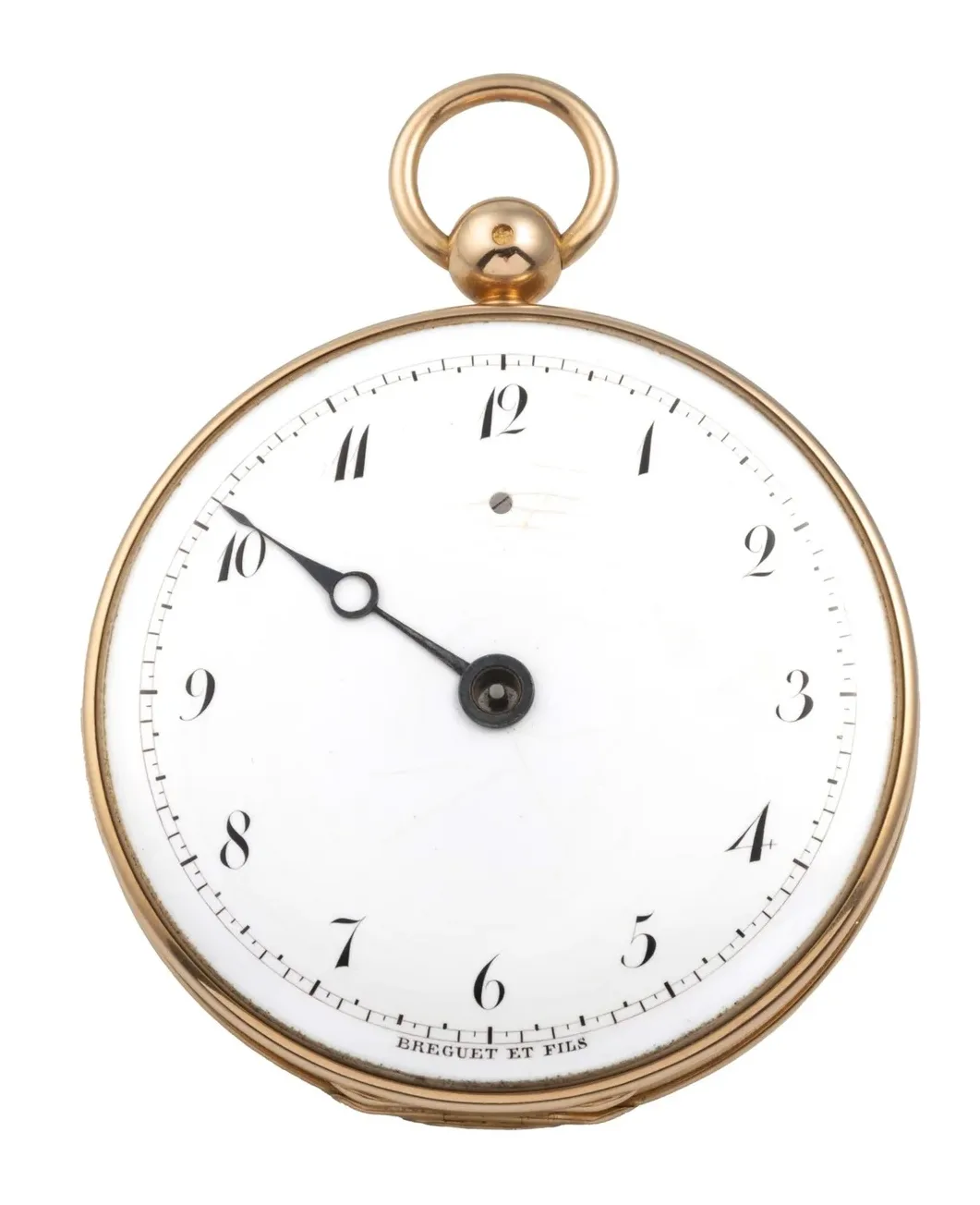
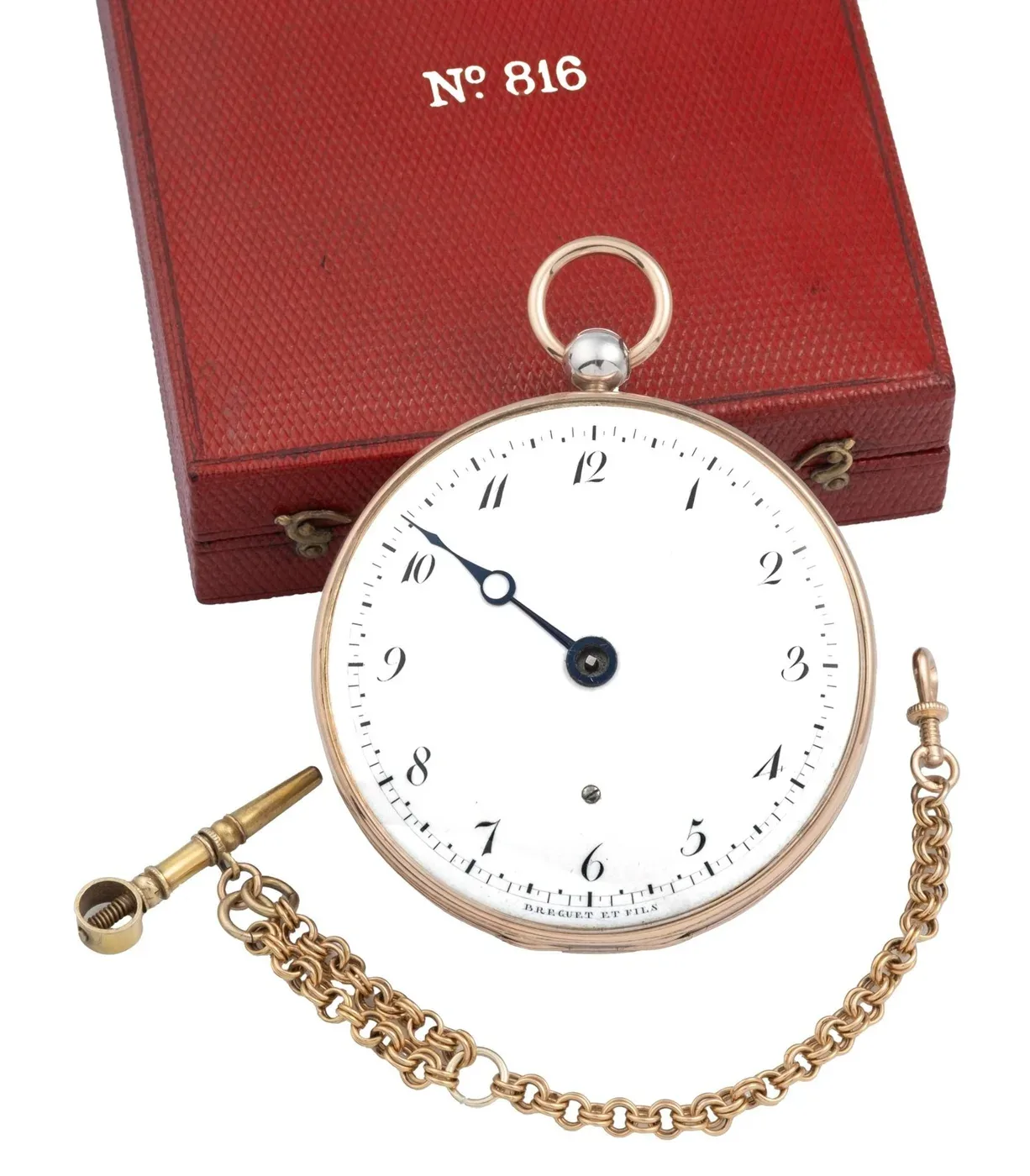
This is the original watch: a large pocket watch of about 60 to 61 mm with a white enamel dial and one hand, built on a deliberately simple movement so that it could be made in a series and serviced by any skilled watchmaker. It was offered in gold or silver cases, most of them gold, and published accounts count about 700 made, with some technical variations. The first sale is put in 1796 and the prospectus in 1797, though most of the watches are placed between 1798 and 1805. The firm numbered its watches of these years in series (one begun in 1791 ran to no. 5121); beyond one account placing no. 1836, sold in 1807, in a second souscription series, the literature does not say how the souscription numbers sit within them. One account says later examples gained refinements such as the pare-chute and the échappement isolé, described as Breguet's own version of the ruby cylinder escapement; others describe the pare-chute and the ruby cylinder as features of the movement without dating them.
Signature and marks. A secret signature engraved into the enamel with a pantograph, found between the numeral 12 and the blued dial screw beneath it, and hard to see even with a loupe. In one watch described in detail the number stamped on the mainplate is repeated on the inner caseback and under the balance cock; sellers also describe case, cuvette and movement bearing the same number.
- one blued steel hand over a white enamel dial
- a single blued screw below 12 holding the dial
- five-minute divisions on the minute track
- engine-turned case sides and back
- central barrel with stepped triangular bridges and a ruby cylinder
- the same number on mainplate, inner caseback and balance cock
Montre à tact on the souscription layout
The tact watch is described as the direct descendant of the souscription watch: it keeps the same movement layout and adds a hand or pointer on the outside of the case, with touch marks around the edge (gold dots, pearls or diamonds), so the time can be felt without opening the watch. Some have a small dial at 12 on the movement side, above the barrel, so the time can also be read by eye; different varieties were made. Some tact watches carry a subscription-type dial with the hand on the tube through the front; in others the hand is on a revolving back. The first was sold in 1799. A tact watch bought in 1800 by the future empress Joséphine, no. 611, is held by the firm's museum. Only the link to the souscription watch is described here; the tact watch is a line of its own.
- touch marks set around the case edge
- an outer pointer on the front or back cover
- on some, a small dial at 12 on the movement side
Classique Souscription 2025 wristwatch
Issued for the firm's 250th anniversary, this is a 40 mm wristwatch that reduces the pocket watch from about 60 mm. It has a case of 40 mm by 10.8 mm in Breguet gold, an 18-carat alloy with silver, copper and palladium, with a satin-finished middle in place of the usual coin-edge fluting and curved lugs. The grand feu enamel dial has black petit feu numerals, a Breguet signature at 12 and a single hand. The hand-wound calibre VS00 has a 96-hour reserve and sits behind a sapphire back. It is not a limited edition, and buyers confirm an order with a deposit, as in the original scheme.
Signature and marks. On the dial the word Souscription, the individual number and the secret signature are engraved with a diamond-point pantograph between the centre and 6, and the Breguet signature stands at 12 in black enamel. The movement is numbered and signed, and the ratchet wheel carries the founder's own wording from his prospectus.
- Breguet signature at 12 where the old dial screw was
- inscriptions visible only at an angle between centre and 6
- satin-finished case middle without fluting
- guilloché case back and gilded shot-blasted movement
- navy alligator strap with a Breguet gold pin buckle
References: 2025BH/28/9W6
Chronology
Specification
| Kind | Single-hand pocket watch, hours with five-minute divisions; sold on subscription, with a quarter of the price paid at the order |
| Case (pocket watch) | About 60 to 61 mm; gold or silver, most in gold; sides and back engine-turned; bezel and back hinged |
| Dial | White enamel, slightly domed and enamelled on both faces; Breguet numerals; five-minute track; one blued steel hand; secret signature engraved in the enamel |
| Movement | Large central going barrel (with double stop-work in the watch described in detail); stepped triangular bridges; gilt finish; ruby cylinder escapement; pare-chute for the balance pivot; temperature compensation by a bimetallic curb at the index; 36-hour power reserve |
| Winding | Key, at the centre; the hand sits on a tube over the winding square, and winding continues from the movement side once the time is set |
| Quantity | About 700 in gold and silver cases, with technical variations |
| Wristwatch of 2025 | Reference 2025BH/28/9W6: 40 mm by 10.8 mm case in 18-carat Breguet gold; hand-wound calibre VS00 with 96-hour reserve; grand feu enamel dial; single hand |
Dial 3 described
The original dial is white enamel, slightly domed, with one blued hand over a track divided in five-minute steps. The large size lets a single hand give the time closely: to the minute by two accounts, while one account of the modern dial speaks of placing the hand to the nearest five minutes. The Breguet hand and numerals were first drawn in 1783, before this watch. The modern watch repeats the layout with enamel fired in two stages.
Original single-hand enamel dial
White enamel, enamelled on both faces so the tensions balance, with Breguet numerals and a circular track marked at five minutes. A single blued steel screw below 12 locks the dial in place. One account says the majority of the watches had enamel dials, without saying what the others had.
- Breguet numerals
- five-minute marks
- blued dial screw below 12
Secret signature engraved in the enamel
The signature was worked out in 1795, the year of the founder's return to Paris, and is engraved into the enamel with a pantograph to make forgeries harder. On the pocket watch it is usually below 12; on one watch described in detail it sits between the numeral 12 and the dial screw below it and is hard to find even with a loupe. It is described as general on the souscription watch, and one watch's secret signature is shown together with its number.
- faint engraved marks in the enamel between 12 and the dial screw
2025 grand feu dial with petit feu markings
White grand feu enamel on a gold base; the numerals, minute track and Breguet signature at 12 are black petit feu enamel. The signature takes the place of the visible screw of the pocket watch, the minute track is restyled to show every fifth minute more clearly, and the engraved inscriptions (the word Souscription, the individual number and the secret signature) sit between the centre and 6.
- Breguet signature at 12
- engraved inscriptions between centre and 6
Hands 2 described
Both the pocket watch and the 2025 wristwatch use one open-tipped Breguet hand in blued steel.
Hand on a tube over the winding square
In the pocket watch the hand is mounted on a hollow tube that passes through the front plate and surrounds the winding square. The tube is serrated so that it grips tightly but can still be turned by hand once the front bezel is opened. Setting the hand in one direction also winds the watch.
- open-tipped blued steel hand
- hand fixed on a central tube
2025 flame-blued hand
The wristwatch hand is steel, open-tipped, blued in the flame and curved by hand so that its tip floats above the minute track. It makes one turn in twelve hours, and there is no port for a key.
Case and sizes 2 described
The pocket watch is about 60 to 61 mm, in gold or silver; the wristwatch is 40 mm and in a new gold alloy.
Pocket watch case, gold or silver
Most cases are gold with a finely engine-turned band, and silver cases were also made. The bezel and the back are hinged and open without a case knife. One account describes the sides as worked in clous de Paris; the engine turning is said to serve for grip as well as looks. There is no outer cover over the dial, only a crystal.
- engine-turned sides and back
- hinged bezel and back
- gold or silver
2025 case in Breguet gold
A three-part case of 40 mm by 10.8 mm in 18-carat Breguet gold (75 per cent gold with silver, copper and palladium). The case middle is satin-brushed, not fluted; the firm says the founder's souscription watch was not fluted, though the original cases have engine-turned sides. The lugs are integral and curved. Water resistance is 30 metres.
- satin case middle, no coin-edge fluting
- curved integral lugs
Crystal 1 described
Only the modern watch has a crystal the literature describes in detail.
2025 sapphire crystal, chevé profile
A sapphire crystal with the chevé profile, thin and nearly flat with a gentle curve toward the edge; the firm credits the form to the founder. The back is a slightly domed sapphire. The specification printed in one account lists a crystal engraved BREGUET 250 YEARS, and another specification puts that engraving on the edge of the case back, beside the hand-finished guilloché.
- BREGUET 250 YEARS engraved on a crystal or at the edge of the case back
Movement 2 described
The souscription movement is symmetrical, with the barrel in the centre and the balance and second wheel on either side. Its layout is the model for the tact watches, the 2005 Tradition collection and the 2025 calibre VS00.
Souscription calibre
A gilt movement with a large central going barrel, wound from the movement side once the time is set, and stepped triangular bridges. The ruby cylinder escapement has a ruby half-cylinder and a hardened steel escape wheel. The balance has a pare-chute shock protection for the upper pivot, and a pin on the balance rim stops it turning too far after a shock. Temperature is compensated by a bimetallic curb at the index regulator, acting on the carbon steel balance spring; one account instead speaks of a bimetallic compensation balance. The power reserve is 36 hours, and the watch described in detail has a double stop-work in the barrel. The finish is frosted, and the bridges for the third and fourth wheels are filed to give a folded look. The watch is wound by key at the centre square.
- central barrel with symmetrical train
- gilt plates, blued screws
- ruby cylinder under the balance
- parachute balance protection
- bimetallic index regulator
Calibre VS00, 2025
A hand-wound calibre of 16 lignes and 5.7 mm with 144 parts and 21 jewels, beating at 3 Hz with one barrel and a 96-hour reserve. It has a blued Nivachron hairspring with a Breguet overcoil, gilded brass in the shade of Breguet gold, shot-blasted plate and bridges, and a modern shock device shaped like the pare-chute. The ratchet wheel carries the founder's prospectus text in his cursive hand. It shares its technical base with the Tradition collection but is seen from the back, not the dial.
- engraved ratchet wheel
- shot-blasted plate
- Quai de l'Horloge guilloché on the case back
Box and papers 1 described
The founder kept his watches in red Moroccan leather cases; the 2025 box recalls them.
2025 presentation box
A red calf-leather box in a pebble shape, with a push-button, a hinge plated in Breguet gold and the wording BREGUET 250 YEARS embossed in gold; it carries the individual number of the watch. It recalls the red Moroccan leather cases the founder used.
Reference numbers
The numbers that belong to the line, with the listings on record under each, as its own page counts them. A number links to its own page, where the components of dated watches are set side by side.
| Number | What it is | Listings |
|---|---|---|
| 2025BH/28/9W6 | The Classique Souscription 2025 wristwatch in Breguet gold, given as its reference in published accounts of the release; sellers write it as 2025BH. | |
| 4723 | One seller gives it as the reference of an 18-carat gold automatic jump-hour wristwatch called Saltarello souscription, numbered 48 of a series of 50. Another listing of a watch numbered 48 gives 4723 as its individual number beside the reference 3420BA, and other watches of the series carry numbers of the same kind, so it is probably a watch number, not a reference. Published accounts do not describe it. | 1 |
Originality
- A souscription movement can be found in a later case: the records list one movement in a case numbered 963, so case and movement numbers should be compared.
- In one watch described in detail the same number sits on the mainplate, the inner caseback and under the balance cock, so a mismatch between them is worth noting.
- The secret signature is faint and hard to find even with a loupe, so its absence should be judged with care.
- On the enamel-dialled watches described, the dial is held by one blued screw below 12, so a dial without that screw is a change from the arrangement described.
Names
- Montre de souscription. The French name for the subscription watch, from the way it was sold.
- Montre simple à une aiguille. Auction wording for the single-hand simple watch known as the souscription watch.
- Subscription watch. The English form of the name, used for the watch sold with a quarter paid at the order.
Where accounts differ
Points on which the published literature and the library's own records do not agree, or on which the literature contradicts itself.
- How long the watches were made. Several accounts say about 700 watches were made over more than thirty years; one Italian account says over twenty years; two others say most were made between 1798 and 1805, and one says the 700 were sold between those years. The library's records of sellers include watches described as made around 1817 and around 1822, and one sold in 1819, which fit the longer span.
- Launch year. Most accounts place the first sale in 1796 and the marketing with a prospectus in 1797; one gives 1796 as the year the watch was launched.
- Which original the 2025 watch follows. One account says the 2025 wristwatch is a version of pocket watch no. 3424 of 1797, which it calls the earliest known; the firm's release as printed elsewhere says its dial echoes nos. 246, 324 and 383.
- How the barrel is wound. These accounts say the barrel can be wound from the front and from the back. Most auction catalogue entries in the library's records that describe the calibre say the central barrel is wound from the front only, though one describes winding from the front or back.
- Size. Published accounts give about 61 mm, and the firm's chief executive speaks of 60 mm; one account gives the movement itself as 61 mm. Most listings in the library's records that give a size say 61 or 62 mm, a few fall between about 55 and 63 mm, and auction catalogue entries give movements of 52 to 58 mm.
- Metal of the 2025 wristwatch. Published accounts agree on 18-carat Breguet gold of 75 per cent gold with silver, copper and palladium, but some describe its colour as a muted yellow and others as warm and subtly pink. Sellers' listings of the reference give the case as rose gold or as white gold.
- Case sides. One account describes the sides of the 1797 watch as clous de Paris, another as a finely engine-turned band, and a third as engine-turned on the sides and back; the firm's chief executive says it was not fluted, and in an interview that the sides of the original were entirely smooth.
- Case styles. One account says the souscription watch came in one style of case only; the firm's head of heritage says the museum's examples are in silver and in gold and of different sizes.
- How much was paid at the order. Four accounts and others give a quarter of the price, paid with the order; another describes the watch as ordered in advance and half paid beforehand.
- How closely the single hand reads. Two accounts say the large diameter let one hand show the time to the minute, the second as the founder himself suggested; another, writing of the 2025 dial, speaks of placing the hand to the nearest five minutes, and the firm's chief executive gives the 2025 watch a reading good to about one or two minutes.
- Years of Breguet's exile. Three accounts put his stay in Switzerland from 1793 to 1795. Another, writing of the watch numbered 160, has him in exile in Switzerland and England for the seven years from 1789 to 1795.
In the records
Counted from 41 listings at dealers and auction houses. These are what sellers state, not measurements, a stated year is often an estimate, and a count of listings is not a count of watches made.
Kind of object
| Kind | Listings |
|---|---|
| Pocket watches | 26 |
| Wristwatches | 15 |
Case metal
| Metal | Listings | Share |
|---|---|---|
| Gold, any colour | 18 | 75% |
| Yellow | 2 | 8% |
| Pink | 1 | 4% |
| Colour not stated | 15 | 62% |
| Silver | 5 | 21% |
| Silver and gold | 1 | 4% |
As sellers state it. Shares are of the 24 listings that name a metal. A listing that says "gold" or "18K gold" names no colour: it is counted under "colour not stated", not as yellow gold. Carat, where a listing of gold gives one: 18k 10.
Case size
| Size | Listings | Share |
|---|---|---|
| 61 mm | 6 | 25% |
| 62 mm | 5 | 21% |
| 36 mm | 4 | 17% |
| 55.4 mm | 2 | 8% |
| 60 mm | 2 | 8% |
| 51.5 mm | 1 | 4% |
| 56 mm | 1 | 4% |
| 58 mm | 1 | 4% |
| Other sizes | 2 | 8% |
As sellers state it. Shares are of the 24 listings that give a size.
Listings by decade the seller gives
| Decade | Listings |
|---|---|
| 1800s | 9 |
| 1810s | 4 |
| 1820s | 4 |
| 1830s | 1 |
| 1900s | 1 |