Repeating watches
A repeating watch strikes the time on request, by a slide or a push on the pendant, so that it can be told in the dark. The striking work goes back to the rack and snail devised for clocks in the 1670s; the first repeating watches of the 1680s struck hours and quarters on a bell, and minute repeaters were made in numbers in London from about 1750. Breguet is generally credited with replacing the bell by coiled steel gong springs, fitted to his repeaters from about 1783, which allowed much slimmer cases, and with an all-or-nothing piece that stops a partial strike, dated about 1820 or the early 1800s. The library's records hold 105 listings of repeating pocket watches under this line, most stated as of 1800 to 1839; not all of them are Breguet's work.
This maker's early watches are described by kind of watch, not by reference number: many carry no number, and one number can cover quite different watches. The wider picture is in Early Breguet, 1775 to 1970.

- Made
- not datedPublished accounts give no span for Breguet's repeaters: the earliest date they tie to them is about 1783, when Breguet was already fitting gong springs to his repeaters, and they give no end; the years sellers state in the library's records are not used here.
- On record
- 105 listings104 of them give no reference
- Reference numbers
- 0 describedmany early watches carry none

Production by production 1 described
Gong-spring repeaters, from about 1783
Before Breguet, repeating watches struck a bell in the back of the case, which made them deep, or struck the case itself (à toc) so that the time was felt rather than heard. Breguet is generally credited with the gong spring, a hardened steel wire coiled round the inside of the case band, and was fitting it to his repeaters from about 1783; by the early 1800s the gong had replaced the bell altogether. Placing the gongs and other parts of the striking work round the edge of the movement allowed slim repeaters, and his changes are also said to have improved their reliability and the way they were made. He is further credited with the all-or-nothing piece, dated about 1820 in one account and the early 1800s in another, which holds the striking train back unless the slide is pressed fully home. Published accounts do not set out how the repeaters changed under his son, grandson or the later owners of the firm.
Signature and marks. Not given in the literature. Breguet-signed repeaters in the library's records are signed Breguet, Breguet et fils or Breguet & fils, many with a number, and one adds horloger de la marine royale; published accounts do not say which form belongs to which years, and sellers describe Swiss watches the firm did not make that are signed Breguet, Breguet et fils or Breguet & fils.
- hammers striking coiled steel gongs round the movement
- a slim case with no bell in the back
- signed Breguet or Breguet et fils, with a number, though sellers describe Swiss watches of the period with the same signatures, so the signature alone settles nothing
Chronology
Specification
| Kind of watch | Pocket watch; the library's records hold no wristwatch of this line |
| Striking | Hours and quarters, with half-quarters or minutes on some, struck on request by a slide or, on early watches, by pressing the pendant |
| Striking parts | Hammers on coiled steel gong springs; some watches in the library's records strike à toc, on the case |
| Case metals | Mostly gold as sellers state it, 18 carat above all, some 20 carat; a few silver or gold-plated |
| Diameter | Sellers most often give 50 to 58 mm, with 54 mm the commonest single figure |
| Escapements named in listings | Cylinder (some with a ruby cylinder), duplex and lever on Breguet-signed watches, and a verge on some signed Breguet or Breguet & fils |
Dial 1 described
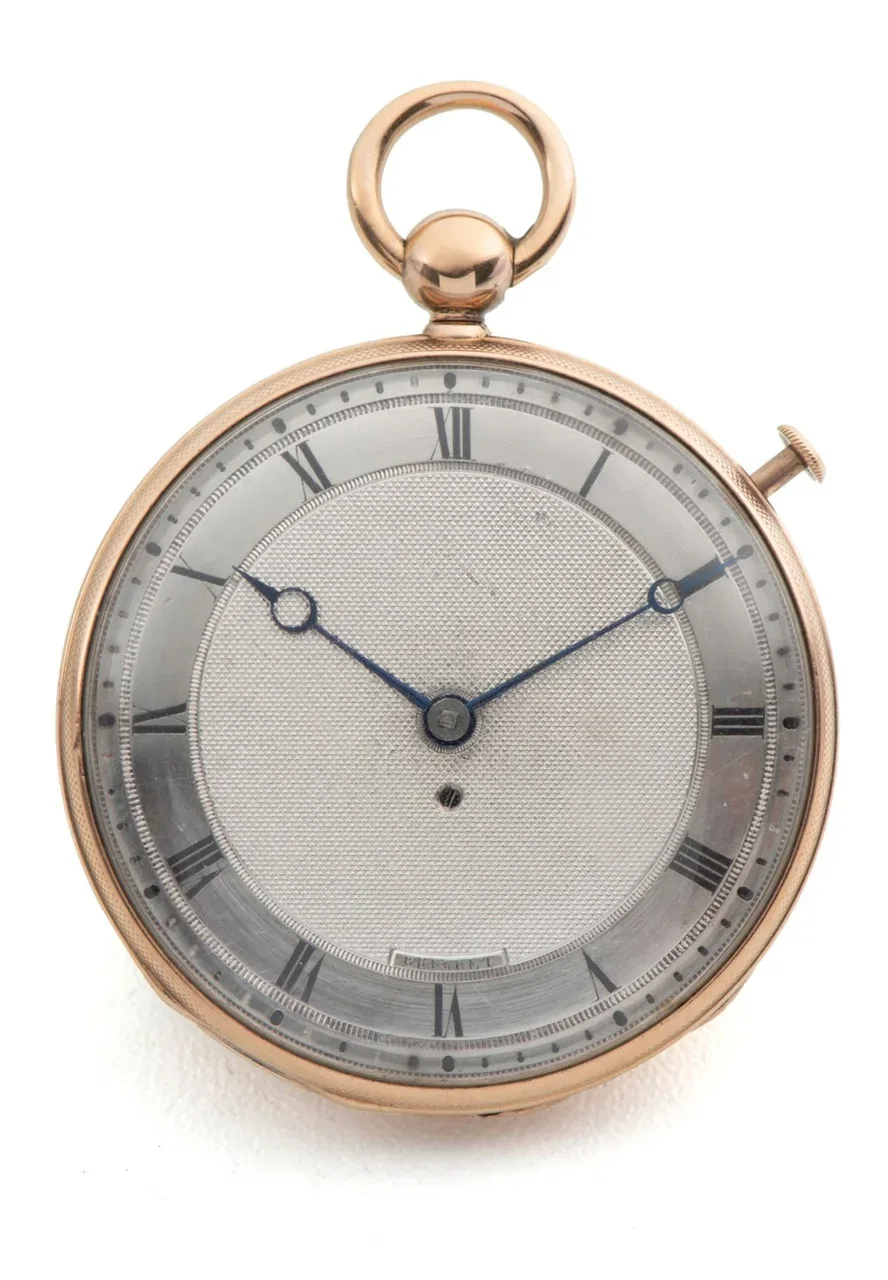
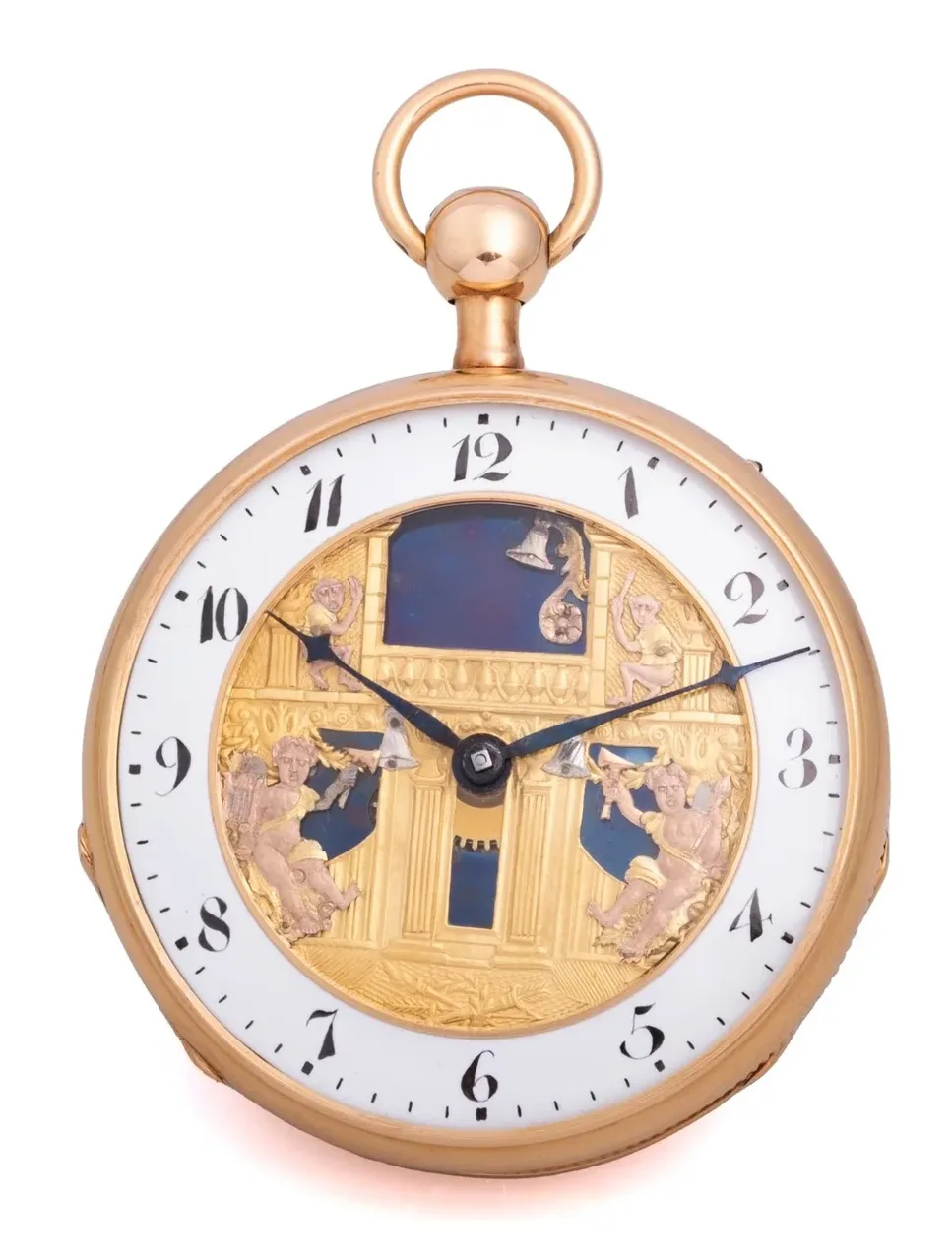
Published accounts say nothing of the dials of Breguet repeaters. The library's records show open-face and hunter watches, enamel on some cases, gold or gilt dials on a few and several watches with a jump hour hand.
Jump hour
Several Breguet quarter and half-quarter repeaters described by sellers have a jump hour hand. Their stated years run from 1800 to 1846, most of them before 1830. The literature does not describe or date the feature.
- jump hour hand
Case and sizes 2 described
Published accounts say repeating pocket watches were always costly and rare, and that the gong springs of Breguet's design lie round the inside of the case band, allowing a thinner case than the bell did. The library's records show mostly gold, with silver in a few.
Open face and hunter cases
Sellers describe both open-face and hunter (covered) watches, the hunters called savonnette in German and French titles. Hunter cases are described for a few watches stated as of 1806 to 1820, one of them a later case, and more often for the keyless repeaters stated as of 1881 to 1900.
- hinged cover over the dial
Pair case
A few Breguet repeaters are described as pair-cased or double-cased, several of them enamelled and made for the Turkish market. Their stated years fall between 1804 and 1829.
- enamelled outer case
- second inner case
Movement 7 described
The striking work rests on the rack and snail devised for clocks in the 1670s: stepped cams turning with the hands fix how many blows are struck. Eighteenth-century repeaters struck a bell in the back of the case; Breguet's coiled gong springs had replaced it by the early 1800s. The library's records give the escapements for many watches.
À toc
The hammers strike the case or a block instead of a bell or gong, so the time is felt in the hand. Published accounts place such dumb repeaters, in general, between about 1750 and 1820. Several Breguet repeaters in the library's records are described as à toc, stated as of 1805 to 1824; another, stated as of 1802, is described as striking the hours on a block in the case and the tens of minutes on a gong.
- no bell or gong
- a dull blow felt through the case
Gong springs
A hardened steel wire coiled round the inside of the case band, which the hammers strike. Breguet is credited with it from about 1783, and by the early 1800s it had displaced the bell. Two gongs tuned to different notes, often the two ends of one wire, give the low, high and two-note strikes. Movements in the library's records are described with two polished hammers striking one gong or two.
- coiled gongs round the movement
- two polished hammers
All-or-nothing piece
Breguet's safeguard against mis-striking, which holds the striking train out of action unless the slide has been pressed fully down, so the watch strikes the full sequence or nothing. Dated about 1820 in one account and the early 1800s in another. It cannot be seen from outside, and published accounts give no way to date a watch by it.
- no partial strike when the slide is half pressed
Cylinder escapement
Sellers name a cylinder escapement for many Breguet repeaters stated as of 1803 to 1840, often a ruby cylinder and once a sapphire one; those with a ruby cylinder are stated as of 1805 to 1830. The literature does not describe it.
- cylinder escapement
- ruby cylinder
Duplex escapement
Named for a few Breguet repeaters, some made for the Turkish market. The literature does not describe it.
- duplex escapement
Lever escapement
Named in the library's records for a number of Breguet repeaters, the earliest of them sold in 1817, and for the later keyless ones. The literature does not describe it.
- lever escapement
Key winding and keyless winding
Sellers describe the earlier watches as key wound and the later ones as keyless. Key-wound repeaters in the library's records have stated years from 1800 to 1840, with one of 1864; keyless ones from 1847 onwards. The literature does not date the change.
- winding square
- winding crown at the pendant
Box and papers 1 described
Published accounts say Breguet used red morocco leather cases in the 1800s, without saying which watches came in them. Some watches in the library's records come with a presentation box and certificate, or a key and short chain.
Box, certificate and key
A few listings of Breguet repeaters state an original presentation box, a key and chain, or a certificate; several of the certificates named were issued by the firm long afterwards, in the twentieth century or later. The literature does not say what Breguet supplied with a repeater.
- presentation box
- certificate
- key and chain
Originality
- A repeater may have been put in a later case: one listing in the library's records describes a gilded brass Breguet movement in a later 18 carat gold hunter case.
- Breguet's name appears on repeaters he did not make: the library's records include Swiss watches bearing the signature Breguet & fils, one Swiss minute repeater signed with a double name ending in Breguet, one described as made for Breguet by another maker, and two by makers whom sellers describe as pupils of Breguet.
- The literature gives no test for a replaced gong, hammer or dial in this line.
Where accounts differ
Points on which the published literature and the library's own records do not agree, or on which the literature contradicts itself.
- When Breguet changed the repeater. Most accounts give Breguet the gong spring from 1783 and the all-or-nothing piece later. One guide instead places the first minute repeaters in the mid-eighteenth century, when Breguet designed a mechanism striking hours, quarters and minutes on coiled gongs; Breguet was born in 1747, and the other accounts credit the first minute repeaters in numbers to a London maker about 1750.
- Date of the all-or-nothing piece. One guide says Breguet perfected the all-or-nothing piece about 1820; another says it was added in the early 1800s; a third gives no date.
- The earliest repeating watches. One account says the first repeating watches of the 1680s struck the hour on a bell, and places dumb repeaters striking the case between about 1750 and 1820; another says the first were dumb repeaters striking the inside of the case, and that the bell came later.
In the records
Counted from 105 listings at dealers and auction houses. These are what sellers state, not measurements, a stated year is often an estimate, and a count of listings is not a count of watches made.
Case metal
| Metal | Listings | Share |
|---|---|---|
| Gold, any colour | 71 | 90% |
| Yellow | 8 | 10% |
| Pink | 7 | 9% |
| White | 1 | 1% |
| Colour not stated | 55 | 70% |
| Silver | 6 | 8% |
| Gold plated | 1 | 1% |
| Silver and gold | 1 | 1% |
As sellers state it. Shares are of the 79 listings that name a metal. A listing that says "gold" or "18K gold" names no colour: it is counted under "colour not stated", not as yellow gold. Carat, where a listing of gold gives one: 18k 48 · 20k 5 · 14k 1.
Case size
| Size | Listings | Share |
|---|---|---|
| 54 mm | 13 | 18% |
| 55 mm | 8 | 11% |
| 52 mm | 7 | 10% |
| 57 mm | 7 | 10% |
| 53 mm | 6 | 8% |
| 51 mm | 4 | 5% |
| 56 mm | 4 | 5% |
| 46 mm | 3 | 4% |
| Other sizes | 21 | 29% |
As sellers state it. Shares are of the 73 listings that give a size.
Listings by decade the seller gives
| Decade | Listings |
|---|---|
| 1800s | 22 |
| 1810s | 24 |
| 1820s | 23 |
| 1830s | 11 |
| 1840s | 5 |
| 1860s | 2 |
| 1880s | 6 |
| 1890s | 5 |
| 1900s | 2 |
| 1910s | 3 |
| 1930s | 1 |
| 1940s | 1 |