Clocks, carriage clocks and marine chronometers
Besides its watches the Breguet firm made timekeepers that were not worn: table clocks, travelling and carriage clocks, and marine chronometers. The best described are the Sympathique clocks, each with a cradle for a pocket watch that the clock set to time and, depending on the system, wound or regulated. The founder described the idea to his son in 1795 and first showed it in 1798; the literature counts only a handful made in his lifetime, several of them for kings and princes, and a few more under his son and grandson. The firm's marine chronometers and carriage clocks are hardly treated in published histories and are known mainly from sale records, where the maker's name and the number of each piece are what identify it.
This maker's early watches are described by kind of watch, not by reference number: many carry no number, and one number can cover quite different watches. The wider picture is in Early Breguet, 1775 to 1970.

- Made
- from c. 1798The first Sympathique was shown in public in 1798; the literature dates single clocks and chronometers from then into the 1830s but gives no end for the line, and the firm's later clocks are known only from sale records.
- On record
- 107 listings99 of them give no reference
- Reference numbers
- 0 describedmany early watches carry none

Production by production 4 described
Sympathique clocks of the founder's lifetime
The Sympathique is a table clock with a recess or cradle at the top for a pocket watch, which the owner left in it overnight; the clock brought the watch to its own time and, depending on the system, wound it or corrected its rate. The founder told his son of the idea in a letter of 1795 and first showed it at a national exhibition in Paris in 1798. Each clock was a one-off and they became more elaborate as he went on: the very first showed only hours and minutes, and only the last original is reported to have had a second hand. Owners named in the literature include the Prince Regent, later George IV, whose clock no. 666, in plain mahogany and bronze, was delivered in 1814, and Mahmud II, Sultan of the Ottoman Empire. A clock made by one of his pupils, paired with a watch by the founder numbered 722, was sold about 1812 to a buyer whose name is not recorded. How many were made in his lifetime is not settled (see Where accounts differ).
Signature and marks. The literature gives no signature for the clocks; they are known by their numbers, such as 666, and by the number of the watch that goes with them, such as 722.
- a recess or cradle at the top of the clock for a pocket watch
- hours and minutes only on the very first clock
- a plain mahogany and bronze case, as on no. 666
Sympathique clocks after 1823
After the founder's death in 1823 his son ran the firm, and one account says the son sold a single Sympathique, in 1830. Clock no. 430 was sold in 1830 to a prince: the clock only releases a mechanism in the watch at 12.00, after which steel blocks on the setting wheels move the minute hand if it is out and pawls shift the balance-spring index by up to about three minutes either way. The most complex system known is in the quarter striking no. 128, made for the Duc d'Orleans about 1835 and sold to him in 1836, in an ornate case with tortoiseshell and gold work: once a day, at 3 a.m., its strike train winds the watch and drives both hands to 3.00, a stopwork ends the winding after four turns, and a pin locks the clock when no watch is in place. Accounts differ on whether it also regulates the watch. A grandson named Louis is credited with adding a winding function, and one account has a Louis Breguet making fifty winding and setting clocks in 1850 (see Where accounts differ). A modern Sympathique built for the firm in 1991 lies outside this entry.
Signature and marks. Not given in the literature; the clocks are known by their numbers, such as 430 and 128.
- a quarter striking train that drives the winding and setting
- a winding shaft in the cradle that engages a square in the watch
- a state-of-wind indicator inside the watch of no. 128
Marine chronometers
Marine chronometers were part of the founder's work, and the large private collection of his pieces lent for the 1923 exhibition included some. Published accounts say he turned to them in earnest only after his appointment as Horloger de la Marine in 1815. The earliest that survive are nos. 104, 105 and 106, of which 106 was sold first, in 1816; they drew partly on John Arnold's compensation balances and helical balance springs, and added a detachable escapement platform and gimbal-mounted boxes in mahogany cases with brass mounts. No. 104, a two-day double-boxed chronometer sold in 1818, is given under the name Breguet et Fils. One of 1820 survives in a mahogany case with the timepiece hung on a silver gimbal. The library's records add pieces as sellers describe them: an eight-day brass and mahogany chronometer with a power reserve, signed Breguet neveu & comp. and numbered 3219; a two-day single-barrel chronometer with a regulator dial, whose movement, numbered 5028, has a detent escapement, a two-arm bimetallic compensation balance and a blued steel helical hairspring; and a mahogany two-day chronometer numbered 868, put at about 1860, which the seller describes as signed Breguet.
Signature and marks. A published account gives no. 104 of 1818 under the name Breguet et Fils; sellers give Breguet neveu & comp. on no. 3219, Breguet neveu & cie. on others and Breguet on no. 868.
- a mahogany box with the movement hung on a gimbal
- a detent escapement with a bimetallic compensation balance
- a helical hairspring
- a regulator dial on some pieces
Carriage clocks and travelling clocks
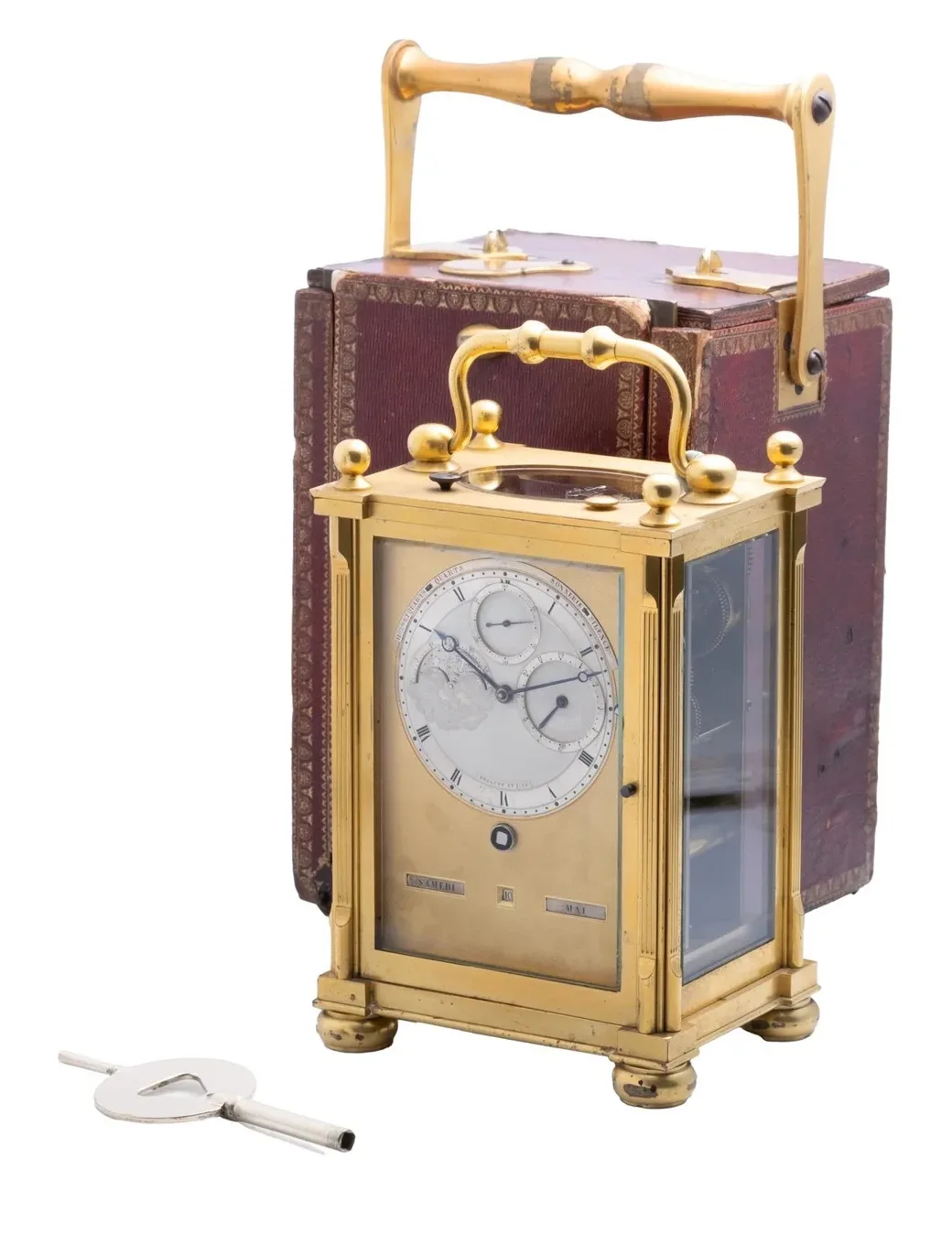
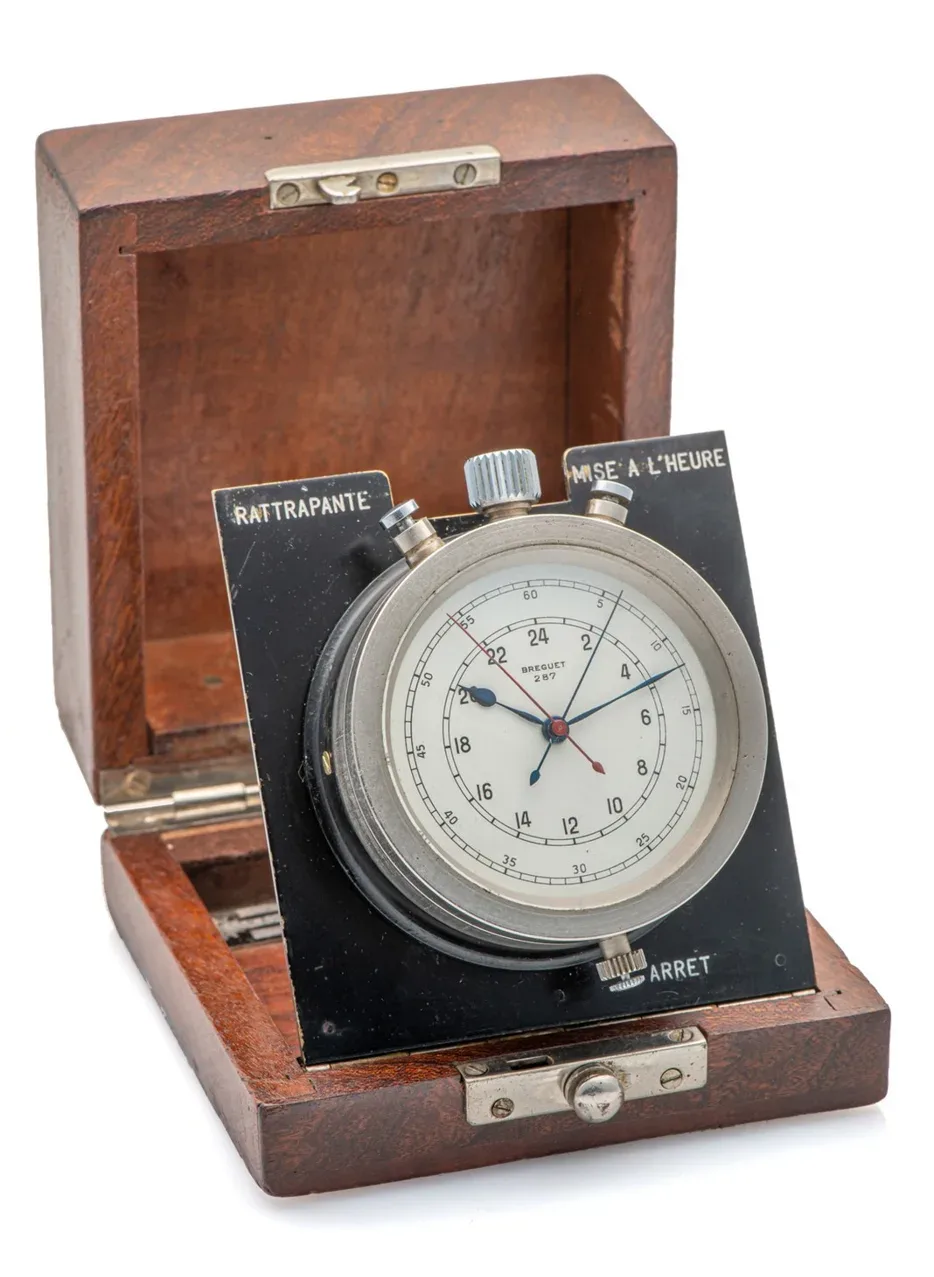
The founder's clock cases are described as generally plain or in the Empire style of the time, and many silver-cased carriage clocks were made with chains in place of handles, the explanation given being that a handle would be in the way when the clock was fixed at its top to keep it steady in a carriage. A published account describes a pendule de voyage, no. 2607, sold in December 1811: a gilt-brass eight-day clock only 120 mm high, in the Empire style, with alarm, full calendar and moon phase, and a pusher at the top that strikes the quarters on a bell. The library's records hold clocks named for Breguet, many with striking, repeating and alarm work: a gilt bronze eight-day carriage clock numbered 4768 with hour repeating, hour and half-hour striking and alarm; a silvered bronze and lapis lazuli carriage clock with hour repeating and alarm; a small gilt bronze quarter repeating travelling clock with a full-year calendar and alarm, numbered 2458 and called a pendule de voyage a almanach; and an astronomical eight-day carriage clock by Breguet & fils with a jewelled lever escapement and grande and petite sonnerie, which the seller says was built on the principles of the garde-temps. Sellers' stated years for the carriage and travelling clocks run from 1809, the almanac travelling clock, to the late 1930s, most of them between the 1850s and the 1920s.
Signature and marks. Signed Breguet on no. 4768 and Breguet & fils on the astronomical carriage clock, as sellers give them; a published account gives no. 2607 of 1811 under the name Breguet et Fils.
- a silver case with a chain in place of a carrying handle
- a plain or Empire-style case
- striking, repeating and alarm work
- a number on the clock, such as 4768
Chronology
Specification
| Kinds of piece | Sympathique clocks (a table clock with a cradle for a pocket watch), marine chronometers, and travelling and carriage clocks; the library's records add striking, repeating and alarm clocks and some twentieth-century desk and dashboard clocks |
| Sympathique, founder's lifetime | Each clock a one-off; two of the three functions (winding, setting, regulating) in any one clock; the very first showed hours and minutes only, and only the last is reported to have had a second hand |
| Sympathique, after 1823 | No. 430 (sold 1830) sets and regulates its watch; no. 128 (sold 1836) winds and resets it once a day |
| Marine chronometers | Eight-day and two-day movements; mahogany or walnut boxes; named Breguet neveu & comp. or Breguet neveu & cie. in the records; a piece of 1820 hangs on a silver gimbal in a mahogany case |
| Carriage clocks | Gilt bronze, brass or silvered bronze cases, eight-day where stated; hour repeating, hour and half-hour striking, grande and petite sonnerie and alarm work in the pieces the records describe; many silver-cased clocks had a chain in place of a handle |
| Clock cases | Generally plain or in the Empire style of the day |
| Numbering | Clocks in the records are known by numbers such as 2458, 3219, 4768 and 5028; the literature does not set out how the clocks were numbered |
Dial 3 described
The literature describes dials only for the Sympathique clocks: the first showed hours and minutes alone, and an undated gilt bronze Sympathique carries a full set of calendar and astronomical indications. For chronometers the records give one regulator dial.
Sympathique dial, hours and minutes
The very first Sympathique showed only hours and minutes, and only the last of the founder's original clocks is reported to have had a second hand.
- hours and minutes only
- no seconds hand except on the last of the founder's clocks
Sympathique dial with calendar, equation of time and thermometer
A gilt bronze Sympathique with a constant-force chronometer escapement shows day, month, date, moon phases and the equation of time, and has a Celsius thermometer. The literature does not date it, and the same set of indications is described on the Sympathiques made for the firm from 1991, so it should not be taken for an early clock without other evidence.
- day, month and date indications
- an equation of time indication
- a thermometer
Regulator dial on a marine chronometer
A two-day single-barrel chronometer with the movement number 5028 has a regulator dial, as the seller describes it; the literature does not describe the dials of the firm's chronometers.
- regulator dial layout
Case and sizes 4 described
Clock cases followed the taste of the day, from plain to very ornate; for a chronometer the box and its gimbal are part of the case.
Plain or Empire-style clock case
The founder's clock cases are described as generally plain or in the Empire style of decoration.
- plain finish
- Empire ornament
Sympathique cases, plain to ornate
The cases of the Sympathique clocks vary widely, from the plain mahogany and bronze of no. 666, delivered in 1814, to the ornate tortoiseshell and gold work of the clock made for the Duc d'Orleans about 1835.
- plain mahogany and bronze
- tortoiseshell with gold mounts
Silver carriage clock with chains
Many silver-cased carriage clocks were made with chains in place of handles to lift them by; the published explanation is that a handle could be in the way if the clock was to be fixed at its top to keep it steady in a carriage.
- chain for lifting
- no carrying handle
Mahogany box with silver gimbal
A chronometer of 1820 has its timepiece hung on a silver gimbal inside a mahogany case.
- silver gimbal ring
- mahogany box
Movement 5 described
The Sympathique systems are the best described movements. Published accounts sort the clocks of the founder and his successors into two kinds by function, those that set and regulate the watch and those that set and wind it, and describe three mechanical arrangements within them. Early clocks set only the minute hand of the watch; later ones set the hour hand as well. For chronometers and carriage clocks only the library's records describe the movements.
Sympathique, setting and regulating (the watch decides)
In no. 430, sold in 1830, the clock merely releases the setting mechanism in the watch at 12.00. A barrel in the watch drives setting wheels carrying steel blocks that move the setting lever if the minute hand is out. The same action shifts the balance-spring index through pawls on a toothed rack, by up to about three minutes either way.
- pawls on the minute hand arbor
- a toothed regulating rack
Sympathique, winding and setting every half hour
In the quarter striking clock no. 5, made by one of the founder's pupils, the strike train sets the watch to the half hour by a cam and levers that push a pin into the watch, and a remontoir in the going train winds it through a ratchet and pawl. Here the clock does the work; the watch has little mechanism of its own and is not regulated. The literature does not date this clock.
- a remontoir lever pumping three times each half hour
Sympathique, winding and setting at 3 a.m.
In no. 128 the strike train winds and sets the watch once every 24 hours, at 3.00. A winding shaft in the clock enters a square in the watch; if the squares are misaligned a spring pushes it home as soon as they meet. Setting is a hard reset of both hands to 3.00. Winding stops after four turns of the barrel arbor and a pin locks the clock if no watch is in the cradle. Whether it also regulates the watch is disputed.
- a winding shaft entering the watch
- a three-armed lifting piece inside the watch
Marine chronometer movements
The records describe an eight-day movement with a power reserve and two-day movements, one single-barrel with a detent escapement, two-arm bimetallic compensation balance and blued steel helical hairspring.
- detent escapement
- bimetallic compensation balance
- helical hairspring
Striking and repeating carriage clock movements
The records describe hour repeating clocks with hour and half-hour striking and alarm, a quarter repeating travelling clock with calendar, a minute repeating clock with grande and petite sonnerie and alarm, and a calendar clock with a jewelled lever escapement.
- hour repeating on demand or automatically
- grande and petite sonnerie
- alarm
Box and papers 1 described
A Sympathique is a pair: the watch that goes in the clock is part of the piece.
Docking pocket watch
The watch is made for its clock: in no. 430 the setting mechanism is inside the watch, while in no. 5 the watch has little of its own and the clock does the work. A clock by one of the founder's pupils was sold about 1812 together with a watch by the founder numbered 722.
- a watch made to fit the clock's cradle
- a watch number recorded with the clock
Originality
- Published guidance on the founder's watches, not his clocks, says the numbering began a new series after 5999, so that no genuine piece has a number starting with six; whether this holds for clocks and chronometers is not stated.
- The same guidance says a secret signature engraved on the dial can be missing from a genuine watch because the dial was cleaned or replaced, so its absence is not proof of a fake.
- The name Breguet was put on other makers' watches in the founder's time, and some pieces older than his birth bear it; this was said of watches, not clocks.
Names
- Sympathique. The founder chose the name to express harmony and accord between the clock and the watch.
- Garde-temps. The founder's name for his large watches where time-keeping was specially wanted; he also called his tourbillons regulators.
Where accounts differ
Points on which the published literature and the library's own records do not agree, or on which the literature contradicts itself.
- How many Sympathique clocks were made. Most accounts say five were made in the founder's lifetime; one says he is thought to have made five or six; two say eleven were made in all; another says just over a dozen were made by him and his successors, one of them by a pupil; and one that gives five adds a single clock sold by his son in 1830. The library's records hold one listing of a pendule sympathique, a later clock sold in 1860, so they cannot settle it.
- When the idea dates from. Two accounts put the design, or the principles, at 1793; the founder's letter to his son, quoted on two others, is dated 1795, and the first public showing is given as 1798.
- The clocks of the successors. One account says the founder's son sold one Sympathique, in 1830. Another credits a grandson named Louis with adding winding, which the early clocks lacked in its view, yet no. 128 of the 1830s and the undated no. 5 are described elsewhere as winding. A third account says a Louis Breguet, given as the founder's son but with dates of 1804 to 1883, made fifty winding and setting clocks in 1850. These cannot all be right.
- Date and functions of the Orleans clock. One account says the Duc d'Orleans ordered the clock in 1835; another gives about 1835; a third numbers it 128 and gives 1836 as the year of sale. On what it does, one account says it alone winds, sets and regulates its watch; another describes winding and a hard reset of the hands without mentioning regulation; a third says its claim to all three functions was still being checked.
In the records
Counted from 107 listings at dealers and auction houses. These are what sellers state, not measurements, a stated year is often an estimate, and a count of listings is not a count of watches made.
Kind of object
| Kind | Listings |
|---|---|
| Clocks | 96 |
| Pocket watches | 9 |
| Wristwatches | 2 |
Case metal
| Metal | Listings | Share |
|---|---|---|
| Steel | 9 | 28% |
| Bronze | 8 | 25% |
| Silver | 7 | 22% |
| Gold plated | 4 | 12% |
| Gold, colour not stated | 4 | 12% |
As sellers state it. Shares are of the 32 listings that name a metal. 4 more name a stone, a wood or the shape of the case instead. A listing that says "gold" or "18K gold" names no colour: it is counted under "colour not stated", not as yellow gold. Carat, where a listing of gold gives one: 18k 3.
Case size
| Size | Listings | Share |
|---|---|---|
| 62 mm | 3 | 17% |
| 38 mm | 2 | 11% |
| 72 mm | 2 | 11% |
| 35 mm | 1 | 6% |
| 55 mm | 1 | 6% |
| 61 mm | 1 | 6% |
| 70 mm | 1 | 6% |
| 77 mm | 1 | 6% |
| Other sizes | 6 | 33% |
As sellers state it. Shares are of the 18 listings that give a size.
Listings by decade the seller gives
| Decade | Listings |
|---|---|
| 1800s | 2 |
| 1810s | 1 |
| 1820s | 2 |
| 1830s | 6 |
| 1840s | 3 |
| 1850s | 1 |
| 1860s | 4 |
| 1870s | 4 |
| 1880s | 1 |
| 1890s | 4 |
| 1900s | 4 |
| 1910s | 1 |
| 1920s | 8 |
| 1930s | 4 |
| 1940s | 1 |
| 1950s | 2 |
| 1960s | 8 |