Breguet after Breguet: pocket watches, 1823 to 1970
The pocket watches made under the Breguet name after the founder's death in 1823 and before the sale of the firm to the Chaumet brothers in 1970. The span falls in two parts: the founder's descendants, who ran the house until the watchmaking business was sold in 1870, and the Brown family, who bought it that year and kept it for a century. Under the Browns complicated gold pocket watches of the 1920s and 1930s were made alongside a growing trade in aviation and marine instruments. Little has been published on the Brown period, so most of what can be dated is tied to individual watches known by their numbers, whose buyers are recorded in the firm's archive.
This maker's early watches are described by kind of watch, not by reference number: many carry no number, and one number can cover quite different watches. The wider picture is in Early Breguet, 1775 to 1970.

- Made
- c. 1823–1970The line is bounded by changes of ownership, the founder's death in 1823 and the sale to the Chaumet brothers in 1970 (one account gives 1973), not by changes of design; a single watch is dated by its number in the firm's archive.
- On record
- 110 listings107 of them give no reference
- Reference numbers
- 0 describedmany early watches carry none

Production by production 5 described
Antoine-Louis Breguet, from 1823
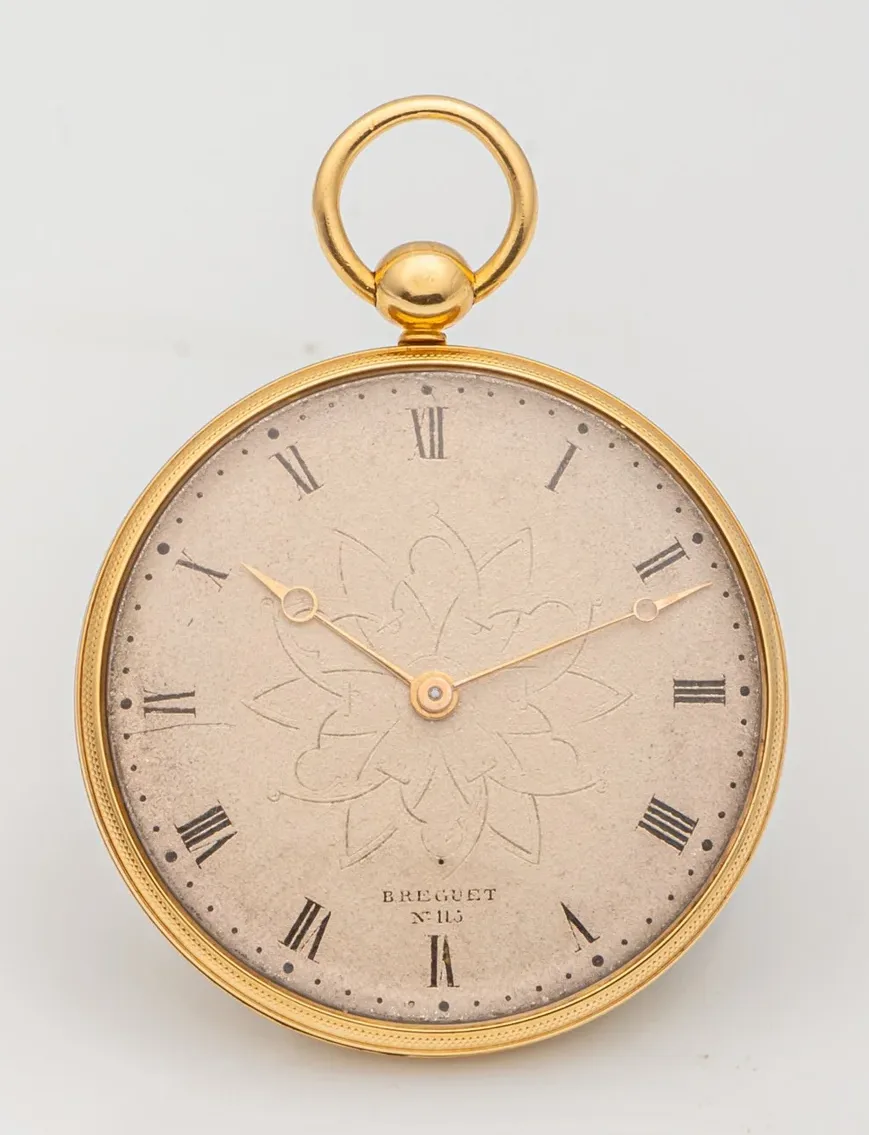
After the founder's death the firm passed to his only son, Antoine-Louis (1776 to 1858), who had worked in the trade from childhood and had been his father's partner. One account puts his taking over in 1824 rather than 1823. Watches described for these years include a watch of 1830 with a knurled button that both wound it and set the hands, and an extra-flat half-quarter repeater sold in 1831 with perpetual calendar, moon phases, equation of time and a power reserve indicator, only 7.7 mm thick. A quarter-repeating watch with moon phase, 37 mm across and signed Breguet Neveu et Cie, was sold in 1829, in these years, although the partnership of that name is placed later (see below). He handed the firm to his son in 1833 by most accounts; one directory gives 1853.
Signature and marks. Breguet et Fils is the firm name from the partnership between father and son; the literature does not say how the dials and movements of these years were signed beyond that.
- single knurled button for winding and setting (watch of 1830)
- very thin case
Louis-Clément Breguet, 1833 to 1870
Louis-Clément (1804 to 1883), the founder's grandson, took over in 1833 by most accounts (one directory says 1853). He began making standardised watches alongside individually made ones, and the firm's own account dates the start of mass production to him; output is given as about 350 watches a year. One account says he went into partnership with a relative as Breguet, Neveu et Cie; a directory instead has Antoine-Louis joining a nephew under that name in 1840, and gives L. Breguet et Fils from 1853. His interest turned to electric telegraphs and scientific instruments, shared by his son Antoine (1851 to 1882), whom two accounts name as the last of the family to run the business; another gives that place to Louis-Clément himself. The watchmaking side was sold in 1870. After the sale the plain name Breguet stayed with the watches, and the name Breguet FT with the electrical apparatus.
Signature and marks. Breguet Neveu et Cie and L. Breguet et Fils are given as firm names of these years; the literature does not describe stamps or numbering for them.
- Neveu et Cie in the signature
Edward Brown and his sons, 1870 to 1927
The watchmaking business was sold on 8 May 1870 to Edward Brown, an Englishman who had run the workshop and become a partner. That is the date most accounts give; one instead has a British watchmaker of the name taking charge only when Louis-Charles Breguet turned to aircraft, and owning the firm after his death (see Where accounts differ). Sales fell in the unsettled years that followed and recovered only in the years from 1900 to 1914. By 1881 the firm had been reorganised as Maison Breguet and kept to a high-class clientele. Edward Brown died in 1895 and his sons Edward and Henry took over; Henry became head when Edward retired in the early 1900s. Published accounts give few details of the watches themselves, because this period has been little studied; the firm's archive, which records every customer, is what allows a watch of these years to be placed. The Brown family is described as three generations and four owner-managers over the century.
Signature and marks. The signature in use is Breguet; no stamp or numbering detail is given for these years in the literature.
Complicated gold pocket watches of the 1920s and 1930s
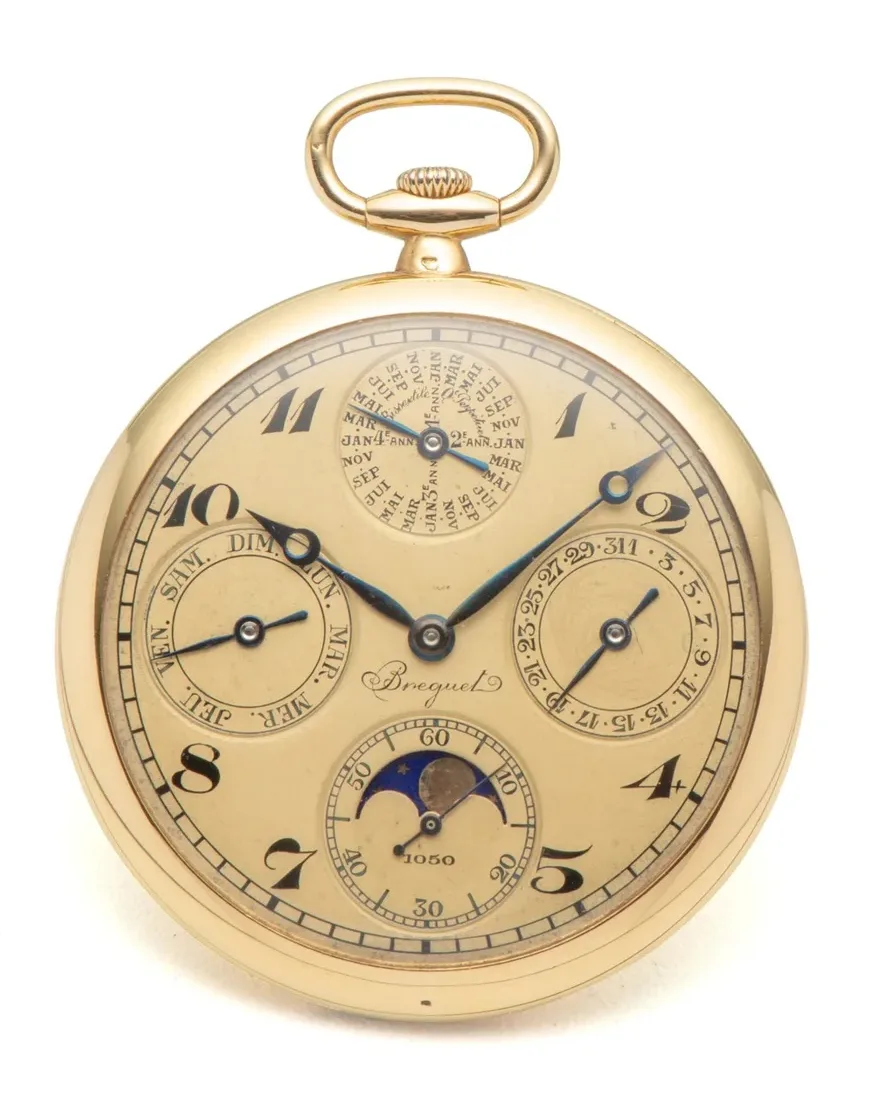
In the 1920s and 1930s the firm made some of its most complicated pocket watches, known by their numbers and completion dates. An astronomical watch, no. 4802, was completed in November 1925 with quarter repeating, full calendar, thermometer and independent jumping seconds with split seconds and a subsidiary flying fifth-of-a-second hand. No. 1639, of 1929, shows perpetual calendar, moon phase, a differential equation of time and sunrise and sunset. An ultra-thin watch, no. 1648 of 1928, departs entirely from the usual dial layout. Nos 2752 and 2795, both completed in 1932, share the firm's typical dial style; the second was made for the president of the French automobile club. Split-seconds chronographs of the early 1930s carry a snail-pattern track. Rotating-dial and jumping-hour watches rest on patents of 1928, which are often found on these pocket watches. Pocket watches were still made in the 1960s: one of 1963 is shown beside one of 1931 in the same style.
Signature and marks. The dial style is called typical Breguet, with ornate lettering; patent marks are often found on the jumping-hour watches.
- ornate Breguet lettering on the dial
- snail-pattern chronograph track
- patent inscription on jumping-hour watches
Aviation and marine instruments under the Browns
Under the Browns the firm put more weight on aviation and marine equipment: marine chronometers, dashboard and cockpit clocks, and chronographs supplied to pilots from as early as the 1920s. Its marine chronometers trade the ornate style for simplicity and legibility. The best-described pieces of this side of the business are wristwatches, outside this line: a steel pilot's chronograph sold in December 1948 (another account puts the firm's first wrist chronographs for combat pilots in 1949), with plain lettering, a large onion crown, gold numerals, coloured tracks and blued hands, which shares its case with a calendar wristwatch of 1946; and the chronograph the firm designed to the French air force's specification of the early 1950s, known as the Type 20 (dated 1954 in the firm's own account, with prototypes of 1952 approved in 1953 in others), delivered mainly to the air force from 1955 to 1959, to the flight test centre from 1956 to 1957 and to naval aviation in 1960, with a civilian Type XX after it. The literature gives no dated detail of the pocket-sized instruments themselves.
Signature and marks. The literature gives no signatures or stamps for the instruments.
Chronology
Specification
| Form | Pocket watch, in gold for most examples described; steel is called very rare in Breguet watches by one account, though the pilot's chronographs of the 1950s were made in steel in their thousands |
| Signatures found | Breguet et Fils; Breguet Neveu et Cie (on a watch sold in 1829, and a firm name one directory dates to 1840); L. Breguet et Fils (a firm name one directory dates to 1853); Breguet, the name that stayed with the watchmaking business after 1870 |
| Numbering | Watches are known by their numbers; the firm's archive, which records every customer, shows which watches fall in which period and when they were sold or completed |
| Typical complications described | Date, quarter and half-quarter repeating, perpetual calendar with moon phases, equation of time, split-seconds chronograph, jumping hour with rotating dial |
| Size noted | 37 mm for a quarter-repeating watch of 1829; 7.7 mm thick for an extra-flat repeater of 1831 |
Dial 2 described
The gold dress and complicated watches keep the ornate Breguet dial style. The rotating dial with jumping hour is the one dial type tied to a patent date.
Rotating dial with jumping hour
The rotating-dial and jumping-hour system was patented in 1928, and the patents can often be found on the early pocket watches; the patent year is not given as the year the first were sold. Published accounts treat these watches as growing out of the firm's earlier work rather than a break with it. In the library's records, titles describing a jumping or wandering hour mostly give stated years from 1928 to 1935, about 1930 above all, but a rotating-dial watch numbered 1285 is stated as 1926 and one jump-hour watch as about 1910, so a seller's year before 1928 is not by itself a reason to doubt a watch.
- hours shown in an aperture on a rotating dial
- patent inscription
Snail-pattern track on split-seconds chronographs
Split-seconds chronographs of the early 1930s carry a snail-pattern track, a feature said to have been repeated later on wristwatches.
- snail-pattern chronograph track
- Breguet-style lettering
Case and sizes 2 described
Gold is the usual case metal for the watches described; steel is the exception.
Steel case
One account calls steel very rare in Breguet watches, with only a handful known; the pilot's chronographs made from the 1950s to the early 1970s, some four thousand in all, were nonetheless cased in steel (see Where accounts differ). The steel watches the literature describes are wristwatches; the library's records hold a few steel chronograph pocket watches and timers of the 1940s to 1960s.
- steel case on a chronograph
Extra-flat case
A perpetual calendar repeater sold in 1831 is only 7.7 mm thick. An ultra-thin pocket watch of 1928, no. 1648, is described as departing from the usual dial layout.
- very thin case
Crown 1 described
One crown is described: the knurled button of 1830.
Knurled winding and setting button
A watch made for a count in 1830 had a knurled button that wound the watch and set the hands, described in published accounts as the birth of the modern winding crown.
- single knurled button for winding and setting
Movement 3 described
The literature describes movements by their complications and by the number of individual watches.
Lever escapement date watch
A modest date watch with an engine-turned gold case, an off-centre silver dial and a lever escapement belonged to a composer who died in 1868, after which his widow went on having it serviced by the firm. The literature does not date the watch.
- lever escapement
- off-centre dial
Extra-flat repeater with perpetual calendar
A half-quarter repeater with perpetual calendar, moon phases, equation of time and power reserve, in a case 7.7 mm thick, was sold in 1831.
- power reserve indicator
- moon phase
- equation of time
Astronomical and perpetual calendar pocket watches
No. 4802, completed in November 1925, combines quarter repeating, a full calendar, a thermometer and independent jumping seconds with split seconds and a subsidiary flying fifth-of-a-second hand. No. 1639, of 1929, has perpetual calendar, moon phase, a differential equation of time and sunrise and sunset indication.
- thermometer
- sunrise and sunset indication
Originality
- A watch described as signed Breguet needs checking against the archive entry for its number, which records the customer and the sale; sellers' titles in the library's records quote such entries.
- The Breguet name on a dial is not proof that the firm made the watch: imitators put it on their own work in the founder's time, some watches older than him bear it, and the library's records hold watches by other makers listed under the name.
Where accounts differ
Points on which the published literature and the library's own records do not agree, or on which the literature contradicts itself.
- Who took over in 1823 or 1824. One account says the founder's son took over the firm in 1824; the others describe him as taking over on the founder's death in 1823.
- The year the Chaumet brothers bought the firm. Most accounts give 1970 for the sale by the Brown family to the Chaumet brothers; one gives 1973.
- When the name Breguet Neveu et Cie was in use. A directory has Antoine-Louis joining a nephew as Breguet Neveu et Cie in 1840; another account puts the partnership under Louis-Clément, who took over in 1833; and a quarter-repeating watch sold in 1829 is described as signed Breguet Neveu et Cie, earlier than either.
- The date of the Breguet et Fils partnership. One account dates the partnership of father and son, and so the signature Breguet et Fils, to 1807; a directory dates the name to 1820.
- When Louis-Clément took over. Most accounts, the firm's own among them, say Antoine-Louis retired and passed the firm to his son Louis-Clément in 1833; a directory says he sold it to his son in 1853, after a partnership with a nephew from 1840.
- When the Type 20 was designed and approved. The firm's own history, as quoted, has its chronograph for the French air force designed and quickly approved in 1954. Other accounts have prototypes submitted in 1952 (three delivered on 23 July), approved by the air force's technical service in 1953, and the order for 1,100 watches placed in 1954.
- How rare steel is in Breguet watches. One account calls steel very rare in Breguet watches, with only a handful known. Accounts of the Type 20 and Type XX describe about 1,700 military and 2,300 civilian pilot's chronographs made to the early 1970s, cased in stainless steel apart from three in gold.
- The first pilot's wrist chronographs. One account describes a steel pilot's chronograph wristwatch sold in December 1948. Another says the first wrist chronographs Breguet developed for combat pilots appeared in 1949.
- When the Brown family took over. Most accounts date the sale of the watchmaking business to Edward Brown, the workshop manager and a partner, to 8 May 1870, and give the Browns a century to 1970. Another has a British watchmaker named Edward Brown managing the business only after Louis-Charles Breguet committed himself to aviation, becoming a partner and, after Louis-Charles's death, the owner, and places the Brown era in the mid-twentieth century.
- The last of the family to run the business. One account names Antoine (1851 to 1882), Louis-Clément's son, as the last of the family to run the business, and another has him bring in Edward Brown as successor. Another, quoting a biographer, names Louis-Clément as the last to run it and says his widow sold the watch numbered 160 in 1887.
In the records
Counted from 110 listings at dealers and auction houses. These are what sellers state, not measurements, a stated year is often an estimate, and a count of listings is not a count of watches made.
Case metal
| Metal | Listings | Share |
|---|---|---|
| Gold, any colour | 64 | 86% |
| Yellow | 12 | 16% |
| White | 10 | 14% |
| Pink | 8 | 11% |
| More than one colour | 3 | 4% |
| Colour not stated | 31 | 42% |
| Steel | 5 | 7% |
| Platinum | 2 | 3% |
| Silver | 2 | 3% |
| Silver and gold | 1 | 1% |
As sellers state it. Shares are of the 74 listings that name a metal. A listing that says "gold" or "18K gold" names no colour: it is counted under "colour not stated", not as yellow gold. Carat, where a listing of gold gives one: 18k 44 · 14k 3.
Case size
| Size | Listings | Share |
|---|---|---|
| 46 mm | 6 | 8% |
| 51 mm | 6 | 8% |
| 49 mm | 5 | 6% |
| 27 mm | 4 | 5% |
| 43 mm | 4 | 5% |
| 44 mm | 4 | 5% |
| 50 mm | 4 | 5% |
| 55 mm | 3 | 4% |
| Other sizes | 42 | 54% |
As sellers state it. Shares are of the 78 listings that give a size.
Listings by decade the seller gives
| Decade | Listings |
|---|---|
| 1820s | 4 |
| 1830s | 13 |
| 1840s | 6 |
| 1850s | 6 |
| 1860s | 2 |
| 1870s | 8 |
| 1880s | 10 |
| 1890s | 10 |
| 1900s | 12 |
| 1910s | 6 |
| 1920s | 14 |
| 1930s | 14 |
| 1940s | 1 |
| 1950s | 2 |
| 1960s | 2 |