Two-pusher chronograph
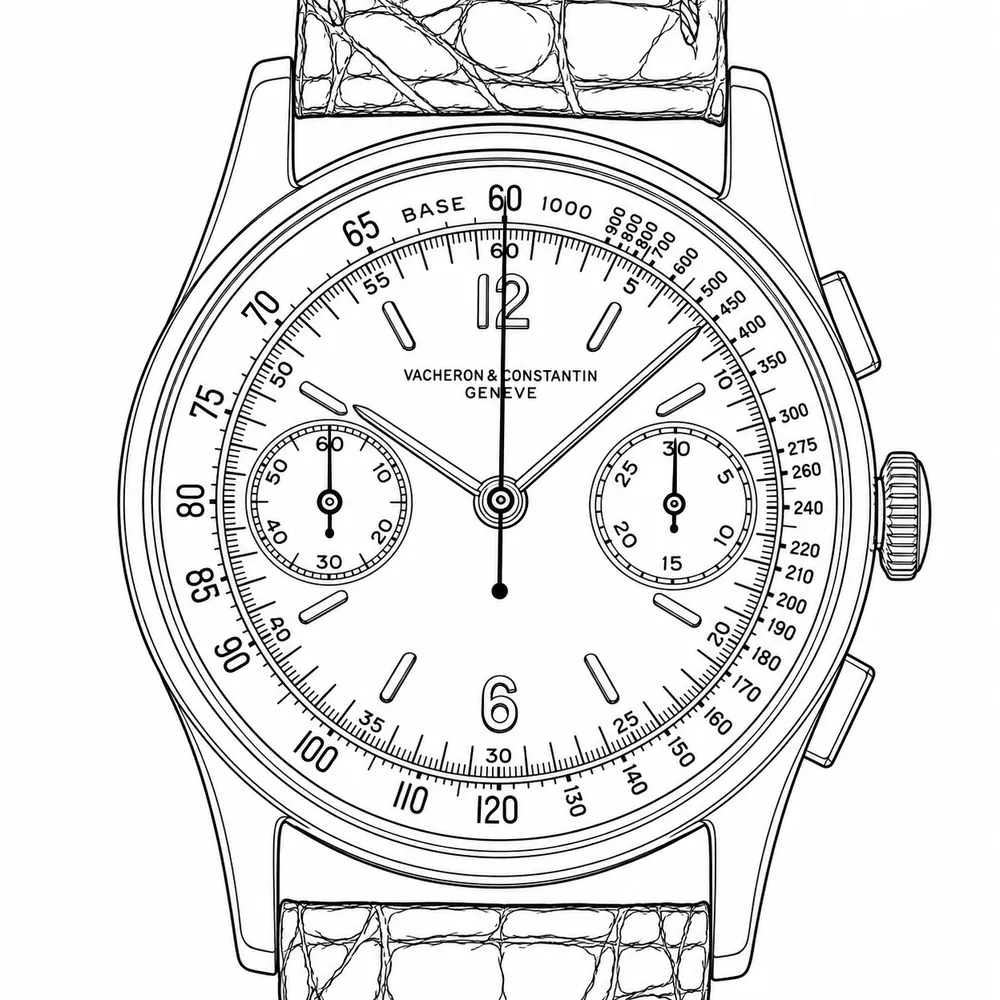
The 4072 is a hand-wound, two-pusher, two-register chronograph made by Vacheron Constantin from 1938 until the early 1970s. About 1178 were made in yellow gold, pink gold and steel, with a small number of two-tone watches. The case is round, about 34 mm, with hinged lugs, and the movements are Valjoux-based calibres 434 and 492, with a Martel calibre 295 in some. The reference covers many dial designs; one survey of over eighty watches sorted them into six variants. With the 4178 it accounts for most of the maker's early chronographs.

- Made
- 1938–1972dates approximate
- Seen in the library
- 1940–1967by years sellers state
- Case
- 35 mm · gold (77%), steel (12%)as sellers state
- Movement
- Calibre 434, 492hand-wound
- On record
- 62 listings162 photographs · 12 holders
Components
2 watches, oldest first, each straightened and cut the same way so that one row shows one component across them all. Chosen from 162 photographs on file for sharpness and for a face typical of the reference. A year marked c. is one its holder gives only roughly. Each picture is a detail cut from a listing photograph. Select the small mark in its corner for its year, its holder, a link to the listing it came from, and a way to report it.
| c. 1943 | undated | |
|---|---|---|
| Face | 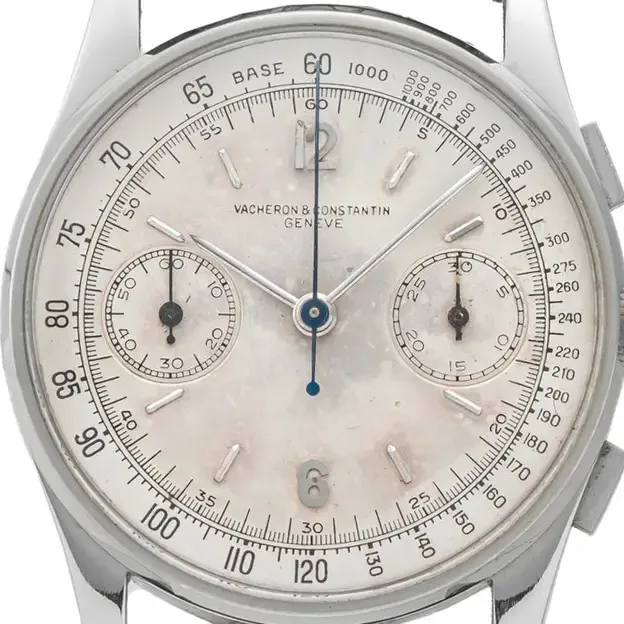 | 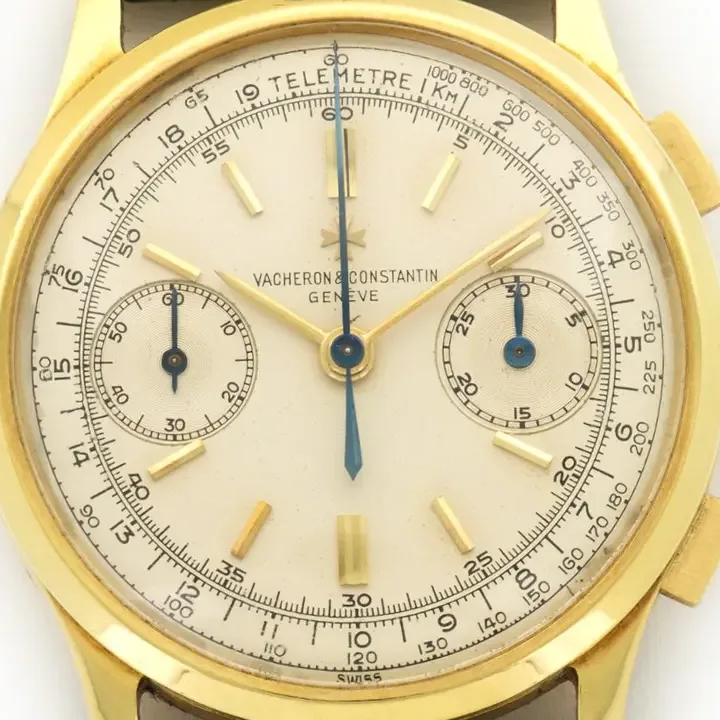 |
| Signature at twelve | 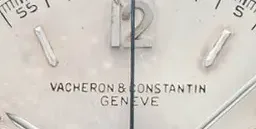 | 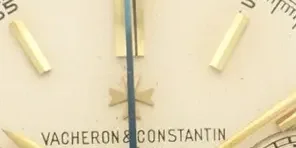 |
| Register at nine | 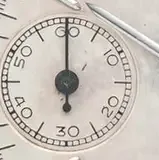 | 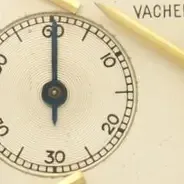 |
| Register at three | 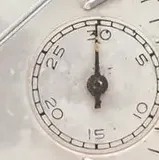 | 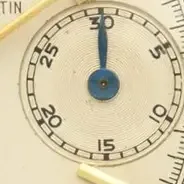 |
| Register at six | 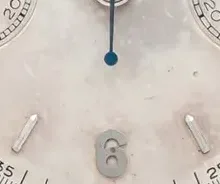 | 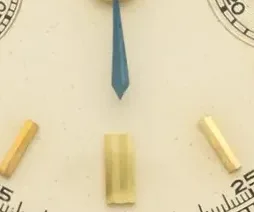 |
| Hands | 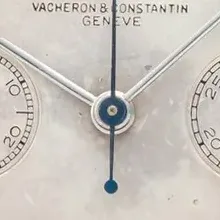 | 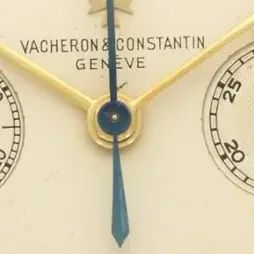 |
| Bezel at twelve | 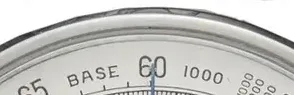 | 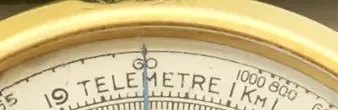 |
| Crown and pushers | 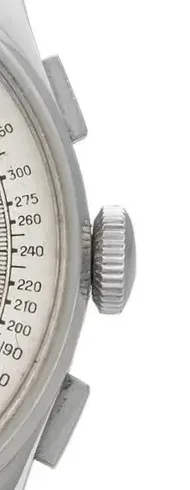 | 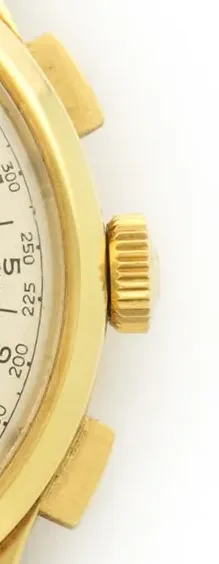 |
| Lug | 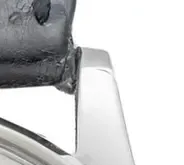 |  |


Chronology
Production is stated as 1938 to the early 1970s; the end is given only loosely, and a few sellers date watches to 1966 and 1967.
Every dated variant: what is written, and what the records show
For the reference the marks are every dated watch; for a variant, the watches a seller names as that variant, so a variant sellers do not name has none.
Specification
| Case | Round, about 34 mm (a 36 mm example is also described); yellow gold, pink gold or steel, with a few two-tone; hinged lugs; closed caseback |
| Pushers | Rectangular, or rarely oval |
| Bezel | Bevelled, or rarely flat |
| Dial | Two subsidiary dials, left for running seconds and right for the 30-minute chronograph counter; seconds track in fifths; signed Vacheron & Constantin with Genève below |
| Hands | On the watch described: baton hour and minute hands in gold; small seconds and chronograph hands in blued steel |
| Movement | Hand-wound Valjoux-based calibre 434 or 492, both styled 13'VZ by the maker (the 434 is also given as 14 ligne); a Martel calibre 295 in some |
| Strap | Leather strap on most watches seen; a few on a metal bracelet |
Dial 6 described
A survey of over eighty watches sorted the dials into six variants. They share two subsidiary dials, a seconds track divided into fifths (open on the inside, or closed) and a signature reading VACHERON & CONSTANTIN with GENÈVE under it. The only exception is the rare snail dial. The variants overlap in date, possibly because several dial makers supplied them at the same time, and the serial ranges below are those of the watches surveyed, not firm limits.
Variant 1
numbers 418664 to 427265
Fully printed dials with no applied markers. Hour markers are printed as rectangles with Arabic numerals at 12 and 6, and several sector dials fall in this group. It begins early in the run, with the first serial seen dating from the late 1930s.
- no applied hour markers
- printed rectangular markers
- Arabic 12 and 6
Variant 2
numbers 428413 to 466813
The commonest variant, 41 of the survey and roughly half of those observed. Applied bead or rectangular hour markers with Arabic or Roman numerals at 12 and 6, sometimes also at 2, 4, 8 and 10. The seconds track may be open or closed, and outer scales include tachymeter, telemeter in kilometres or miles, and pulsometer. A few carry an applied gold cross.
- applied bead or rectangular markers
- Arabic or Roman numerals at 12 and 6, not doubled markers
Variant 3
numbers 431474 to 446444
The black enamel dial, the least often seen: only two were found. The enamel is baked onto the blank and applied gold hour markers added. The two examples are about 1948 (serial 446444) and about 1943, the latter double-signed Turler (serial 431474).
- black enamel dial
- applied gold markers
Variant 4
numbers 431257 to 470010
Applied gold markers with Roman XII and VI, an open seconds track and no outer scales; the subdials are larger than on other variants. It seems to have been added in the early 1940s.
- Roman XII and VI
- larger subdials
- no outer scales
Variant 5
Defined by a snail scale at the centre of the dial, unique in the reference. Pulsometer and respirometer scales show these were meant for doctors. The signature may be curved or standard and lacks GENEVE; in one example it sits by the outer scales. Very rare.
- snail scale at the centre
- pulsometer and respirometer scales
- no GENEVE under the signature
Variant 6
numbers 466730 to 470171
Applied gold markers with strong bevelling, doubled at 12 and 6, an applied gold Maltese cross above the signature, outer scales such as tachymeter and telemeter, an open seconds track and a Swiss signature at 6 o'clock outside the tachymeter scale. The cross was also used on a limited number of variant 2 dials. The survey runs to 1967 and probably on to the end of production.
- double applied markers at 12 and 6
- applied Maltese cross above the signature
- bevelled markers
Hands 1 described
The hands described are classical in gold and blued steel.
Gold batons, blued steel chronograph hands
Hour and minute hands are gold batons. The small seconds hand and the chronograph hands (the 30-minute counter and the central hand) are blued steel, which keeps a deep colour on good examples.
- gold baton hands
- blued steel seconds and chronograph hands
Bezel 2 described
Two bezel forms are recorded.
Bevelled bezel
The usual form, finished in mirror polish on the watch described.
- bevelled bezel
Flat bezel
A flat bezel is rare, as are the oval pushers.
- flat bezel
Case 3 described
A round case of about 34 mm in yellow gold, pink gold, steel or a combination, with hinged lugs and a closed back. Pushers vary in shape.
Rectangular pushers
The common form.
- rectangular pushers
Oval pushers
Rare. A yellow gold example in a 34 mm case has oval pushers, brushed case sides and a polished top and lugs.
- oval pushers
Steel and two-tone cases
Steel watches are exceedingly rare; some two-tone watches have a steel mid-case with pink gold elsewhere. Yellow gold and pink gold make up most of the reference.
- steel or steel and gold case
Movement 3 described
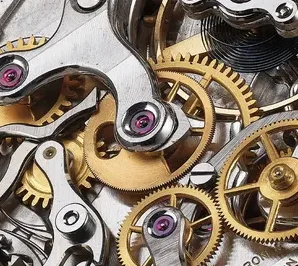
The movements are based on ébauches from outside suppliers and finished to Vacheron standards, with bevelled bridges and levers, straight graining and polished screw heads. Within a reference the calibre varied, so the reference is defined by design rather than movement.
Calibre 295
A two-register hand-wound movement from Martel, listed among the calibres of this reference. It was introduced in the late 1930s for the first two-pusher chronographs.
Calibre 434
Based on the Valjoux 22 and the usual movement of the reference; the maker styles it 13'VZ 434, though it is also given as 14 ligne (31.2 mm). It appears from 1940. Of the yellow gold watches, 285 are said to carry this calibre.
Calibre 492
Valjoux-based, 13 ligne (29.5 mm), and appears from 1943. Accounts differ on whether it shares the 434's base or uses the Valjoux 23. Fewer than 100 pink gold watches are said to carry it. Sellers' labels name it often, as 492 or V492.
Originality
- Dials are among the best tests of originality, and replacement or service dials may be recorded in the maker's archives.
- A dial that is genuine for the reference but belongs to a different date can mean parts from several watches were combined.
- Cleaned or reprinted dials need to be judged separately from replaced ones.
- The survey found a few dials that do not fit Vacheron's designs: an over-serifed signature, no GENEVE, a seconds track open towards the edge, a beige patina, red and blue outer tracks, or long marks at 3, 6 and 9 on the minute counter. Several such features together cast doubt on a dial.
Names
- Big eyes. A seller's label on a pink gold example; the literature does not say why.
Where accounts differ
Points on which the published literature and the library's own records do not agree, or on which the literature contradicts itself.
- Case size. One account gives a 34 mm case; another describes an example as 36 mm, and a third gives 35 mm for the watches it shows. Sellers most often state 35 mm, and 34 mm less often.
- Calibres 434 and 492. One account bases the 434 on the Valjoux 22 at 14 lignes (31.2 mm) and the 492 on the Valjoux 23 at 13 lignes (29.5 mm). Another calls both 13'VZ calibres, the 434 on a Valjoux 22, and says the 492 shares its base with minor differences.
Back and movement
From listings of this reference, each confirmed by eye to show what it is filed under. A picture on which a person's name or a personal engraving can be read is not shown. From most holders a detail from the middle of the photograph is shown; the mark in its corner gives its holder and a link to the listing.
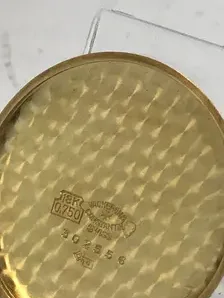
Caseback
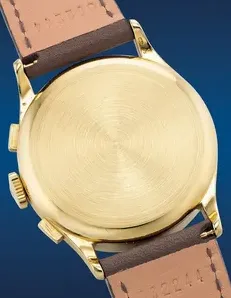

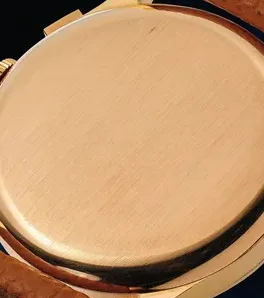

Inside the caseback

Movement

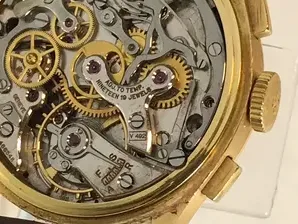

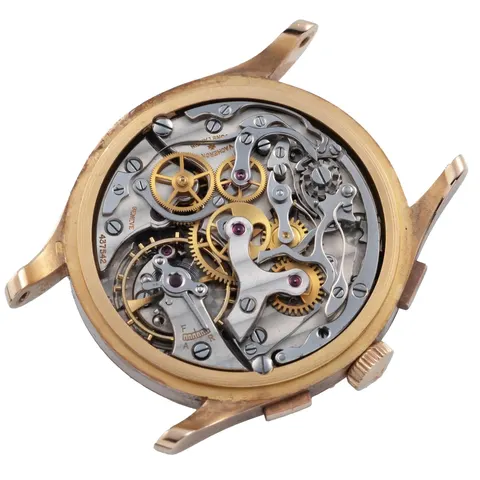

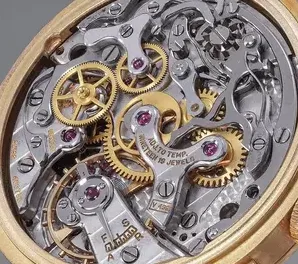

In the records
Counted from 62 listings at 12 holders between 16 October 2005 and 13 November 2026. These are what sellers and auction houses state, not measurements.
Case metal
| Gold, any colour | 43 | |
| Yellow | 18 | |
| Pink | 14 | |
| Colour not stated | 11 | |
| Steel | 7 | |
| Steel and gold | 4 | |
| Silver | 2 |
A listing that says "gold" or "18K gold" names no colour: it is counted under "colour not stated", not as yellow gold.
Dial colour
| Silver | 11 | |
| Champagne | 10 | |
| Gold | 2 | |
| Red | 1 | |
| Pink | 1 | |
| Cream | 1 |
Case size
| 35 mm | 30 | |
| 34 mm | 13 |
Calibre named
| 434 | 8 | |
| 492 | 8 | |
| V492 | 8 |
Bracelet or strap
| Leather strap | 33 | |
| Metal bracelet, kind not stated | 4 | |
| Strap, kind not stated | 1 |
Each table counts the listings that state the thing, in the seller's own terms. A size, metal, colour or calibre that cannot belong to this reference is a seller's slip or a listing filed under the wrong number.