Ingenieur SL Automatic ("Jumbo")
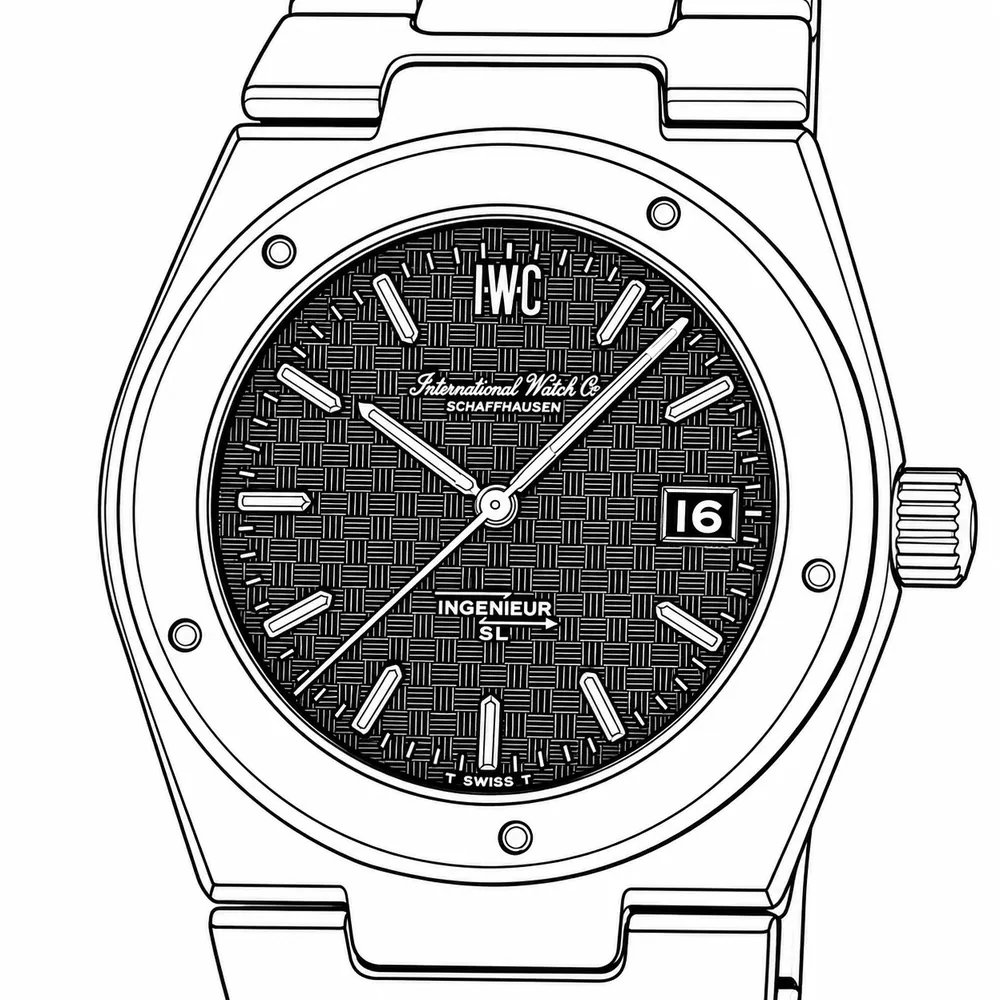
The 1832 is the automatic Ingenieur SL, the third generation of IWC's engineer's watch, designed by Gérald Genta and shown in 1976. It is a 40 by 38 mm cushion-shaped steel case with a screwed bezel pierced by five recesses, an integrated bracelet and a checkerboard guilloché dial, and it carries the amagnetic calibre 8541ES inside a soft-iron cage. The big case earned it the nickname "Jumbo". It sold slowly and was listed until about 1984. The gold version is ref. 9232, and the same case also held the quartz refs 3003 and 9503. The 1832 replaced the earlier round Ingenieur (ref. 866 line); collectors look first at the dial, the bezel and the movement.
- Made
- 1976–1984dates approximate
- Seen in the library
- 1979–1981by years sellers state
- Case
- 40 mm · steel (93%)as sellers state
- Movement
- Calibre 8541ESautomatic
- On record
- 24 listings55 photographs · 11 holders
Components
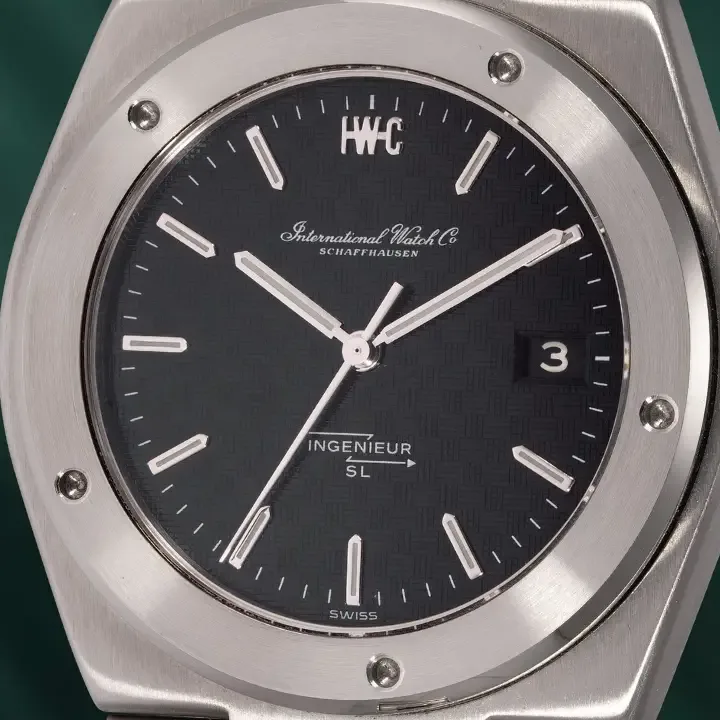
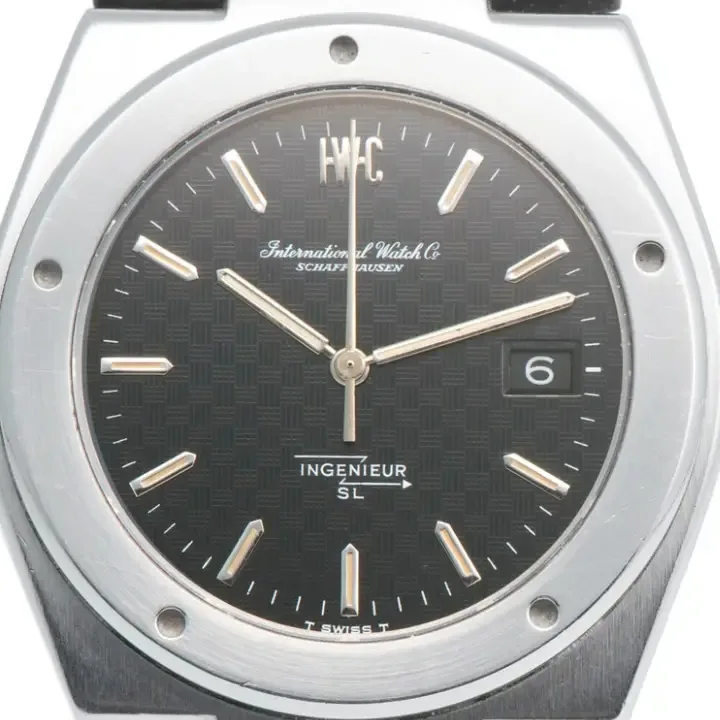
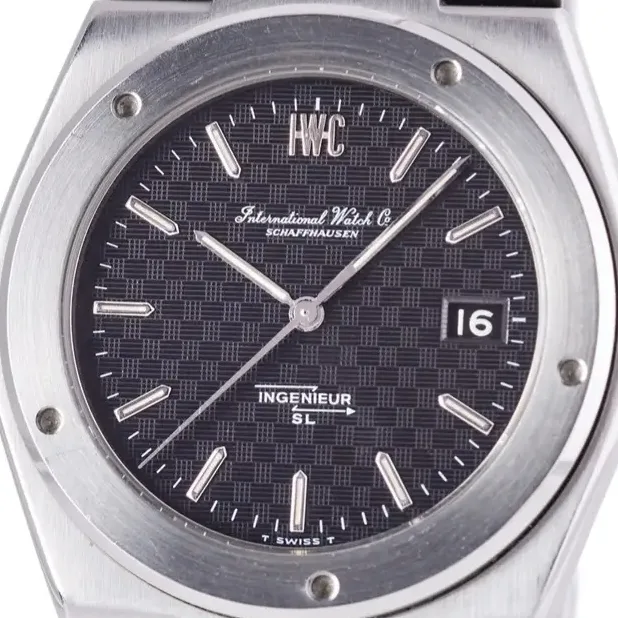
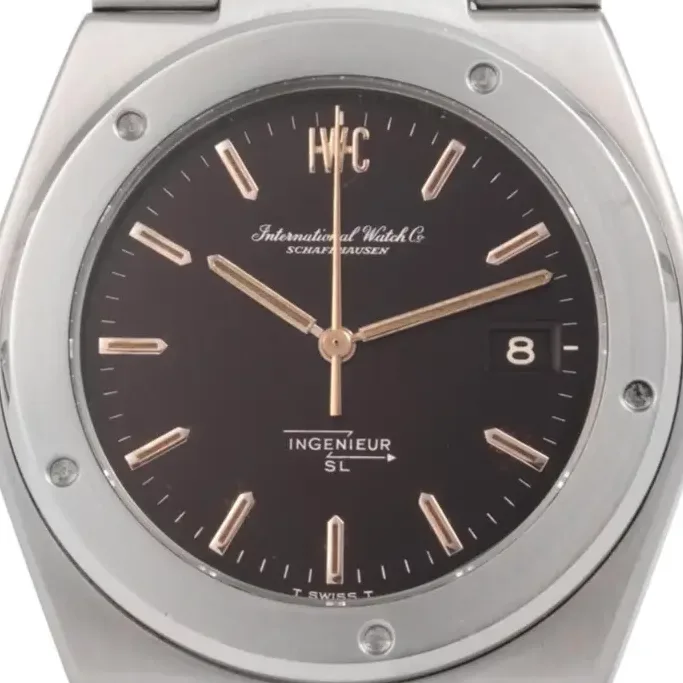
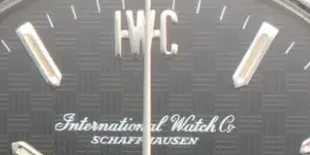
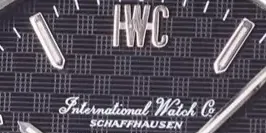
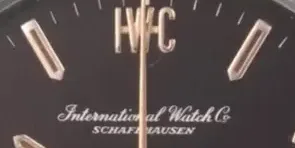
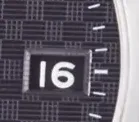
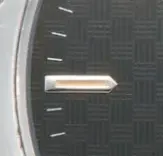
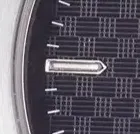
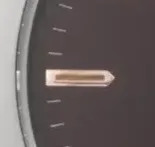
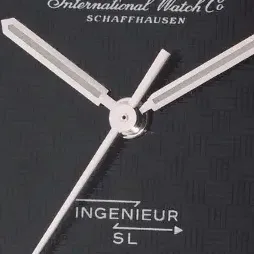
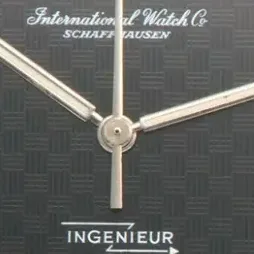
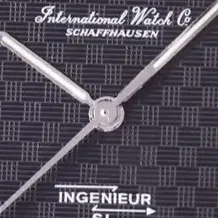
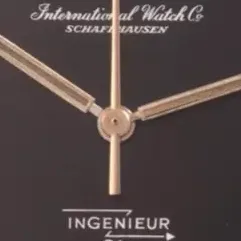
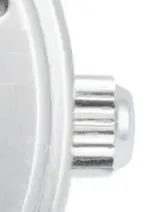
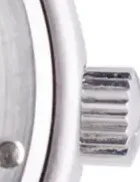
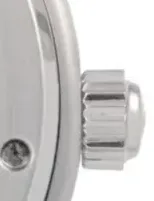
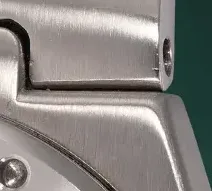
4 watches, oldest first, each straightened and cut the same way so that one row shows one component across them all. Chosen from 55 photographs on file for sharpness and for a face typical of the reference. A year marked c. is one its holder gives only roughly. Each picture is a detail cut from a listing photograph. Select the small mark in its corner for its year, its holder, a link to the listing it came from, and a way to report it.



















Chronology
The launch in 1976 is firm; the end is given as 1983, 1984 or 1985 depending on whether sale or listing is meant.
Every dated variant: what is written, and what the records show
For the reference the marks are every dated watch; for a variant, the watches a seller names as that variant, so a variant sellers do not name has none.
3 dated listings fall outside this scale and are not drawn.
Specification
| Case | Stainless steel (or steel with 14 ct gold inner links, "mixte"); three-part screwed case, 40 x 38 mm, about 12.5 mm high; screw-in bezel and caseback |
| Inner case | Soft-iron inner case and soft-iron dial base, protecting against fields up to 80,000 A/m (about 1,000 gauss) |
| Crystal | Sapphire, with anti-reflective coating on the outer face |
| Dial | Checkerboard guilloché, bar hour markers with fine minute bars, date at 3 o'clock |
| Movement | IWC calibre 8541ES: automatic, Pellaton winding, stop-seconds, date, 19,800 vibrations an hour, amagnetic parts, cushioned in the case on rubber blocks |
| Bracelet | Integrated bracelet ("SL type I") with flat, rounded-rectangular links and deployant clasp, in steel or mixte |
| Water resistance | 12 atm in steel; 6 atm in gold |
Reference 2 described
The 1832 was the lead model of IWC's steel SL collection. The literature puts the start of the project at 1 August 1969, early prototypes in 1970 and 1971 that failed the shock tests, and Genta's drawings in 1974, ahead of the 1976 launch. Four references share the case: the automatic 1832 and 9232, and the quartz 3003 and 9503.
1832 (steel and mixte)
The automatic watch in stainless steel or in steel with 14 ct gold links, on a bracelet to match. About 543 were made, though one table gives 532 for steel and mixte together; the total for all automatic Jumbos is about 598. The cases of the automatic and quartz versions were the same at first and a few watches were converted by IWC from one movement to the other, keeping the original reference number inside the caseback.
- case number on the outside of the caseback at the edge of the central circle
- IWC logo applied at 12 o'clock instead of an hour bar
9232 (18 ct yellow gold)
The solid gold automatic, with a steel caseback and a gold bracelet. It is shown beside the steel watch in a catalogue of 1978 and is listed from 1977 to 1979. Only 55 were made. Its water resistance is 6 atm, half that of the steel watch. A weight of 285 g is given, with a query.
Dial 4 described
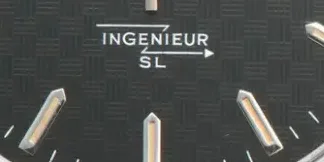
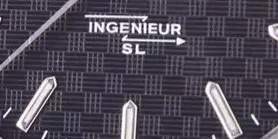
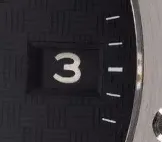
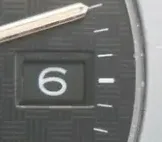
All 1832 dials share one layout: a checkerboard guilloché pattern, said to be modelled on graph paper, bar hour markers with small bars for the minutes, a date window at 3 o'clock, and the Ingenieur and SL logo above the marker at 6. The IWC logo sits at 12 in place of a marker. The finish changes from watch to watch and the literature gives no dated sequence.
Black guilloché
The black dial with the checkerboard pattern is the version singled out as the most attractive. The pattern is a basket-weave guilloché, not stamped.
- checkerboard guilloché pattern
- Ingenieur and SL logo above 6
- applied IWC logo at 12
- date at 3
Rhodium-plated
A silvery dial finished in rhodium is listed alongside the black one. The same finish is listed for the quartz watches.
Gilt
A gilt dial is the third of the three kinds listed for the automatic, beside the black and the rhodium-plated. It is listed for the gold 9232 as well.
- gilt dial
White or champagne
A published list for the Ingenieur SL family gives white and champagne dials beside the black.
Hands 1 described
The lumed sword hands of the earlier Ingenieur were kept on the SL, with a centre seconds hand.
Lumed sword hands
Sword-shaped hour and minute hands filled with lume, carried over from the earlier watch, with a running centre seconds hand. Unlike the Royal Oak and the Nautilus of the same years, whose movement has no seconds hand, the 1832 has a centre seconds hand.
- sword hands
- centre seconds
Bezel 1 described
The bezel and crystal are screwed into the middle part of the case, which looks like the Royal Oak's screws but works quite differently.
Screwed bezel with five recesses
A flat bezel with polished edges and five recesses for the screwing tool. Where the bezel stops depends on how far it was tightened, so the recesses land in a different place on nearly every watch, giving each one an individual look and, to some buyers, an unbalanced one.
- five recesses, evenly or unevenly placed
- polished bezel edges
Case 2 described
The case is a tripartite cushion shape, 40 by 38 mm with a thick profile and a heavy weight in steel of almost 150 g; a fuller specification gives 155 g on the steel bracelet.
Steel and mixte case
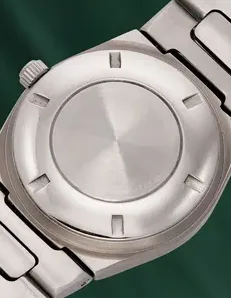
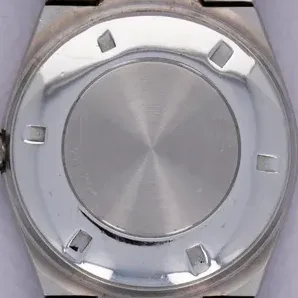
The middle part is satin-finished and the top has polished edges. The caseback slopes at the outer part, is polished, has six recesses for the opening tool, and a satin centre circle. The case number is on the outside of the caseback at the edge of the central circle. Inside is a soft-iron cage; the movement sits on shock-absorbing rubber blocks.
- six recesses on the caseback
- satin middle, polished top edges
- case number on the outside of the back
Gold case (9232)
The same shape in 18 ct yellow gold with a steel caseback, water resistant to 6 atm.
Crystal 1 described
The crystal is sapphire.
Sapphire, anti-reflective outside
A sapphire crystal with anti-reflective coating on the outer face, screwed in with the bezel.
Movement 2 described
The 1832 uses IWC's own automatic calibre in its latest form, the 8541ES. The same case also took the bought-in quartz calibre 2405.
Calibre 8541ES
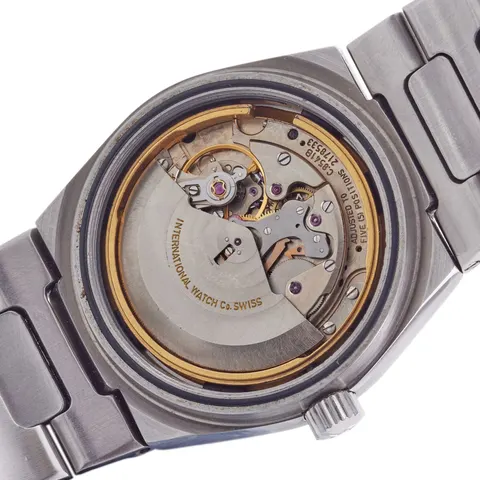
The 8541ES is the 8541B improved with amagnetic parts (E; the literature names the collet and parts of the escapement, among them the lever) and a stop-seconds mechanism (S). It has Pellaton winding, a Breguet overspring, 21 or 25 jewels, 28 mm diameter and a rate of 19,800 vibrations an hour. The date is displayed at 3 o'clock. It is regarded as the most refined form of the long IWC automatic line.
- amagnetic movement in soft-iron cage
Converted to quartz
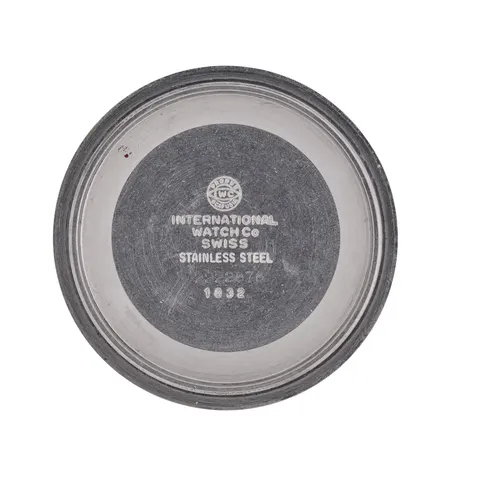
Some automatic watches were converted by IWC to quartz on request, and some quartz watches to automatic, because the first case took either movement. The original reference stayed inside the caseback. The later quartz ref. 3303 has a flatter case and cannot take the automatic movement.
- reference number inside the caseback that differs from the movement
Bracelet 1 described
The bracelet is integrated into the case and is heavy and rigid.
SL type I
Solid integrated links with flat, round-rectangular interlinks, in steel, mixte (steel with 14 ct gold inner links) or 18 ct gold, on a deployant clasp. The later ref. 3303 uses a less rigid type II bracelet with raised interlinks. Some experts claim the quartz Jumbo used a different bracelet from the automatic but the literature finds no evidence of it.
- flat interlinks
- wide rigid links
Originality
- The dial may be a service replacement. Whether late 1832 watches were ever sold new with so-called 'Swiss only' dials is debated, so on a late watch such a dial may be original or a later part.
- The movement may have been swapped between automatic and quartz at the factory or after sale, so the reference inside the caseback should be checked against the movement.
Names
- Jumbo. The 40 mm case was large for its time.
- Fat Ingenieur. The case is about 12.5 to 14 mm thick.
Where accounts differ
Points on which the published literature and the library's own records do not agree, or on which the literature contradicts itself.
- End of production. Most accounts give 1976 to 1984, and one has the 1832 sold out by April 1984. Another keeps it on sale through 1985, another counts about 1,000 Ingenieur SL watches sold from 1976 to 1983, and a third says the 40 mm automatic lasted about six years.
- Number made. One account gives 532 steel and mixte 1832 watches in its text and 543 in its table; another gives 532 in its table yet a total of 598 with the 55 gold watches; others give 543 or about 550. 543 and the 55 gold watches make 598.
- Calibre. The literature gives the 1832 the calibre 8541ES, the improved version of the 8541B. Some of the library's records name the 8541B.
- Launch. Most accounts give 1976 for the launch and the start of sales, and IWC is quoted as presenting the watch at the Basel fair of 1976. One account also says prototypes were made in 1974 and 1975 and that the watch made its debut at the Basel fair of 1975.
Back and movement
From listings of this reference, each confirmed by eye to show what it is filed under. A picture on which a person's name or a personal engraving can be read is not shown. From most holders a detail from the middle of the photograph is shown; the mark in its corner gives its holder and a link to the listing.
Caseback


Inside the caseback

Movement

In the records
Counted from 24 listings at 11 holders between 16 July 2019 and 13 November 2026. These are what sellers and auction houses state, not measurements.
The head of the page gives 1979–1981: the years that listings from two holders bear out.
Case metal
| Steel | 13 | |
| Silver | 1 |
Dial colour
| Black | 4 | |
| Silver | 1 | |
| Green | 1 |
Case size
| 40 mm | 11 |
Calibre named
| 8541B | 2 | |
| 8541ES | 2 |
Bracelet or strap
| Metal bracelet, kind not stated | 12 |
Each table counts the listings that state the thing, in the seller's own terms. A size, metal, colour or calibre that cannot belong to this reference is a seller's slip or a listing filed under the wrong number.