Royal Oak Offshore Chronograph (first generation)
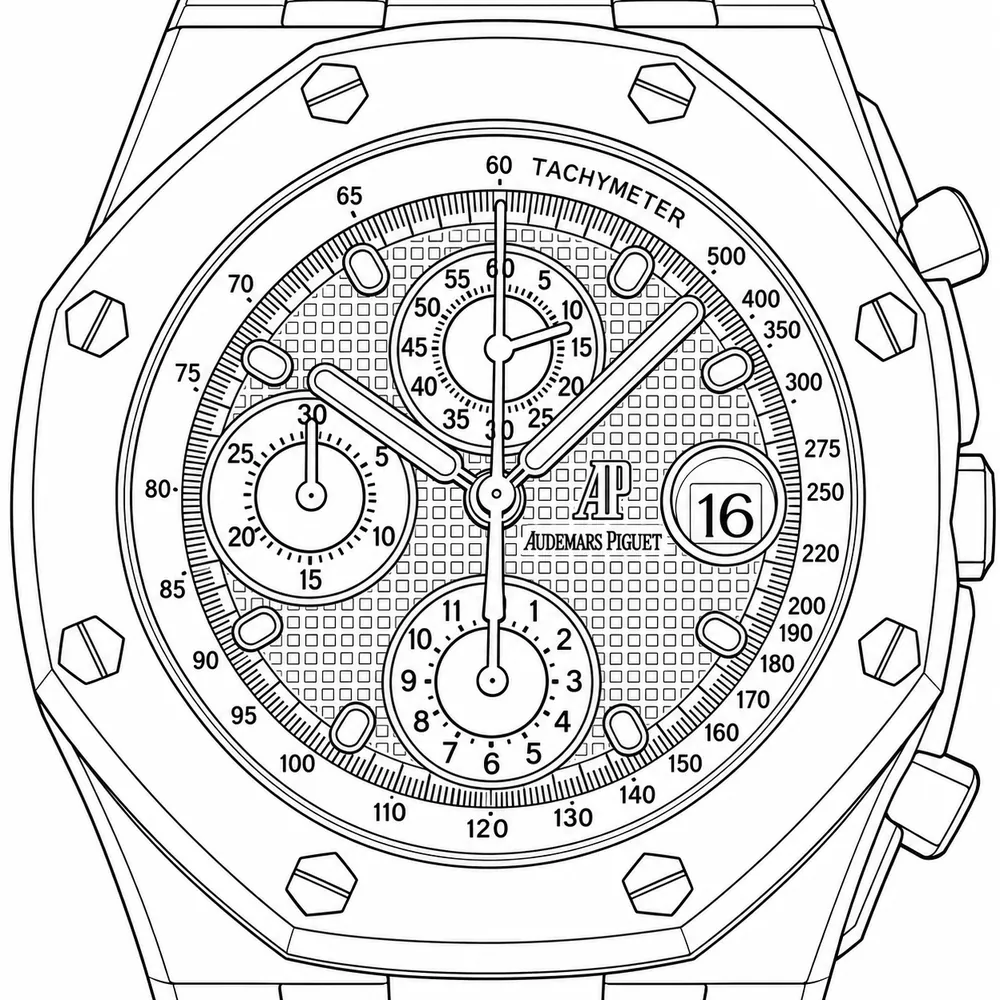
The 25721 is the first Royal Oak Offshore, a 42 mm chronograph with date shown at the Basel Fair in April 1993. It is a much enlarged Royal Oak, about 14 mm thick, with a visible gasket under the octagonal bezel, rubber-covered crown and pushers and water resistance to 100 metres. It was designed by Emmanuel Gueit and met a hostile first reception. Steel was joined by yellow gold in 1995 and titanium in 1998, with a few rarer metals, and the first blue petite tapisserie dial was followed by further dials, including grande tapisserie on the gold watch. It stayed in the catalogue until 2011, when the 26170 replaced it, and about 10,900 were delivered.
- Made
- 1993–2011dates approximate
- Seen in the library
- 1992–2010nine in ten in 1993–2010 · by years sellers state
- Case
- 42 mm · steel (59%), titanium (28%)as sellers state
- Movement
- Calibre 2126, 2226automatic
- On record
- 135 listings435 photographs · 30 holders
Components
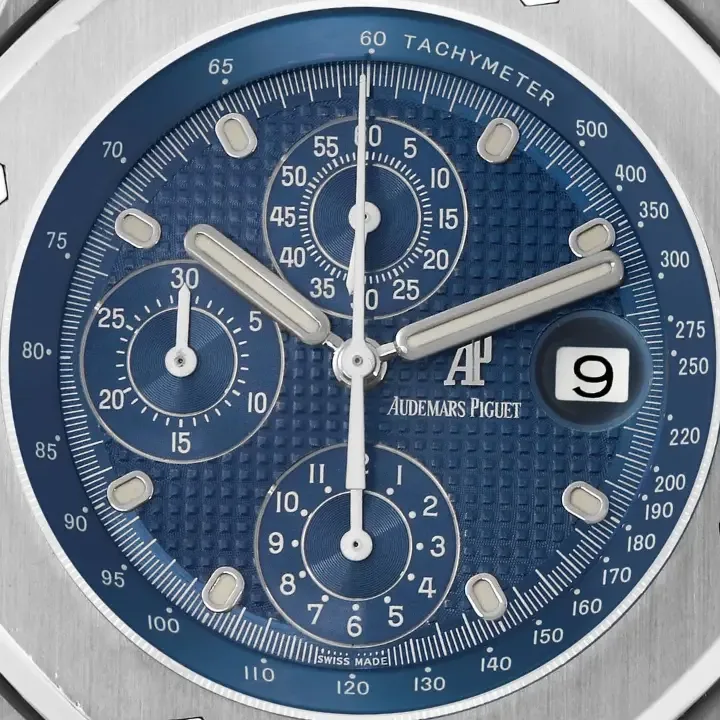
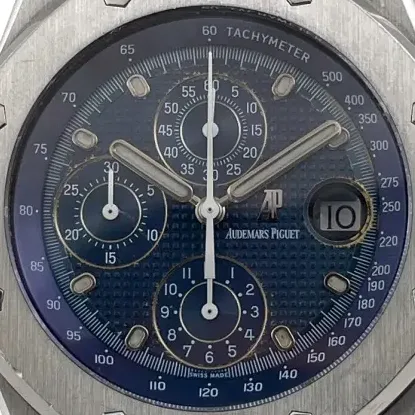
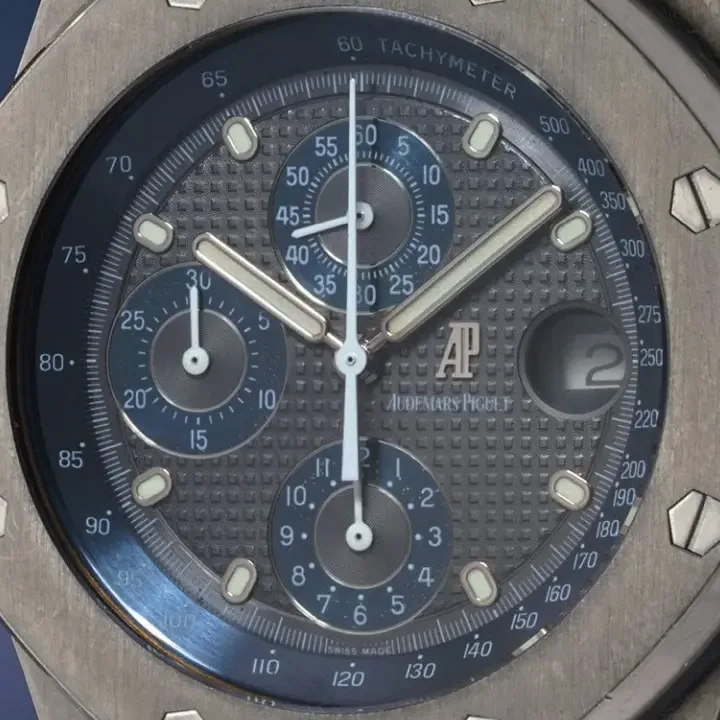
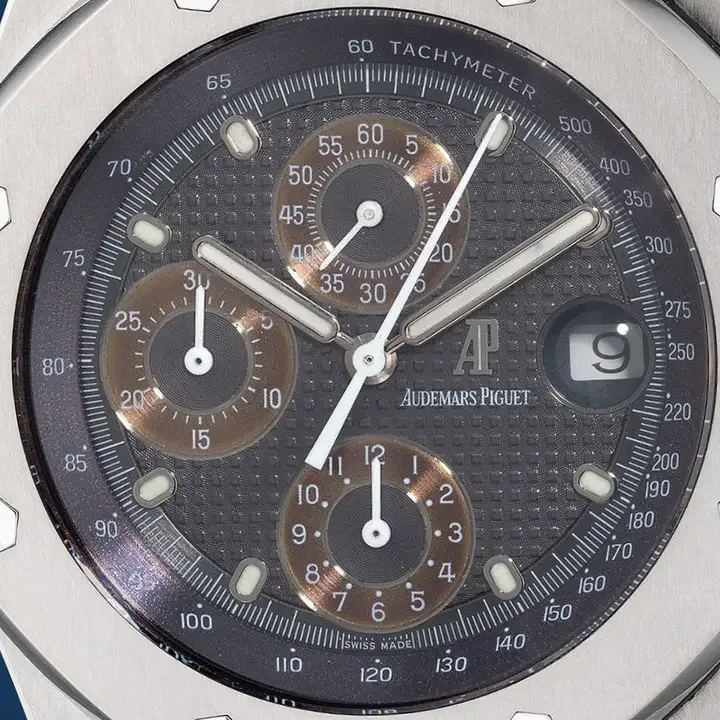
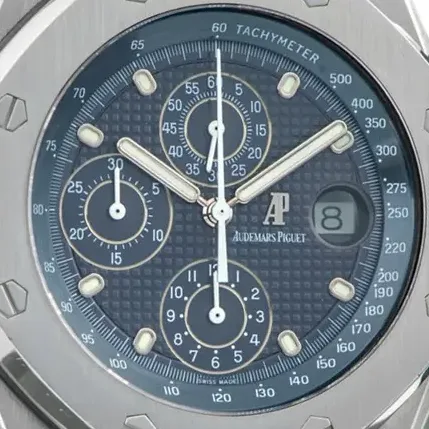
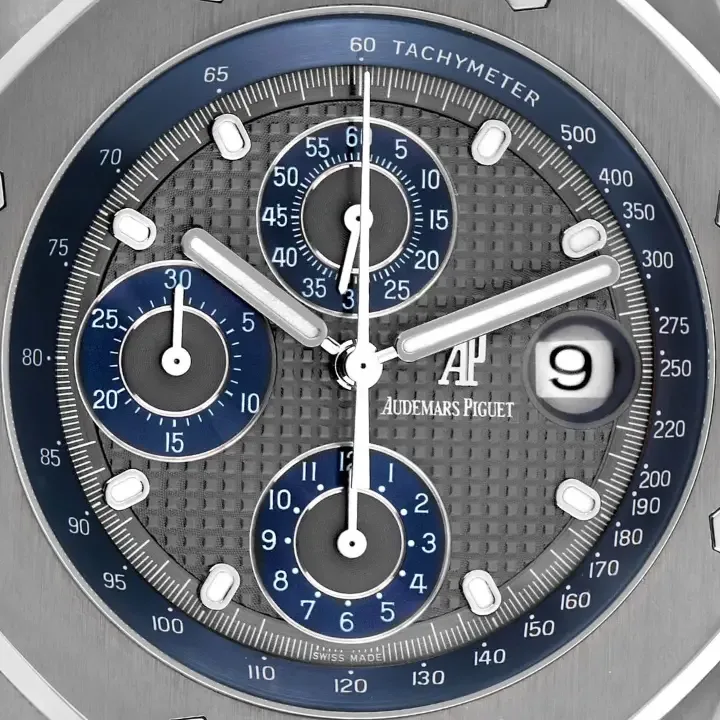
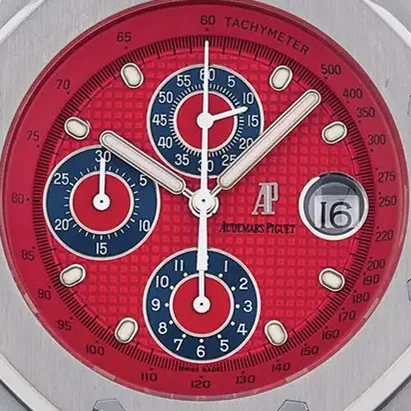
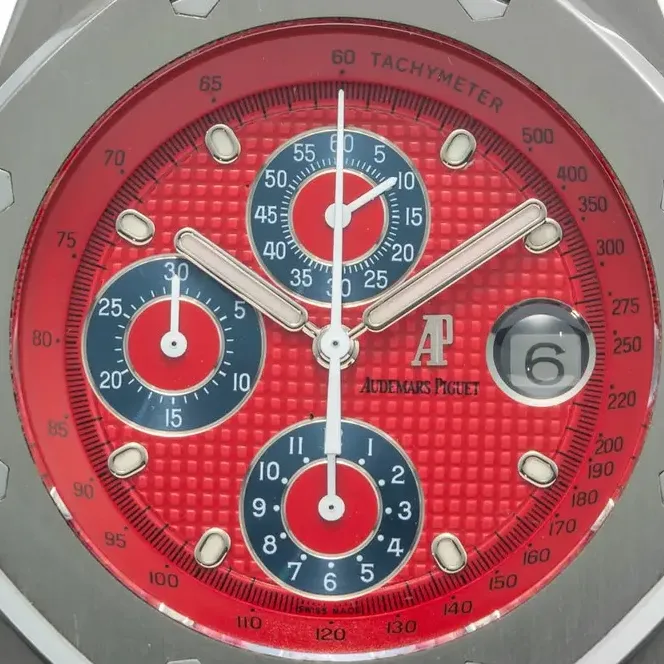
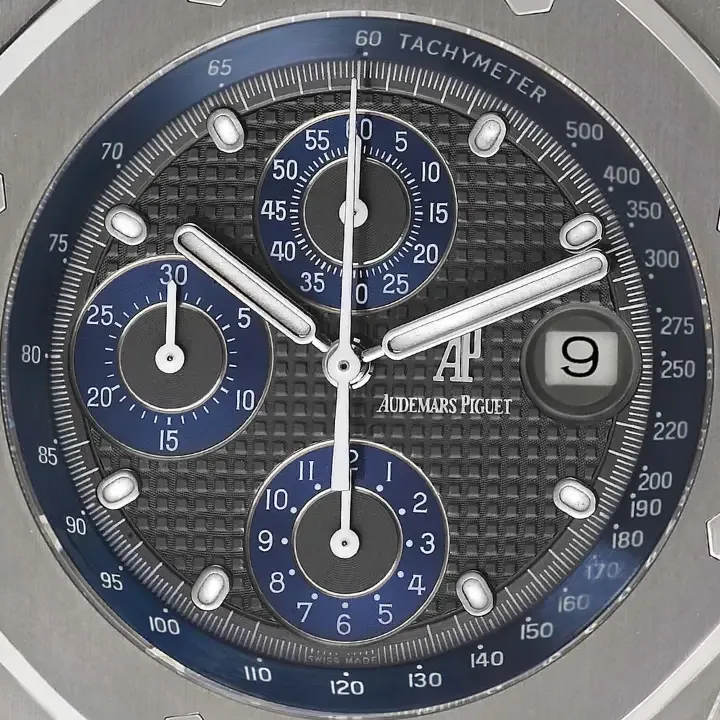
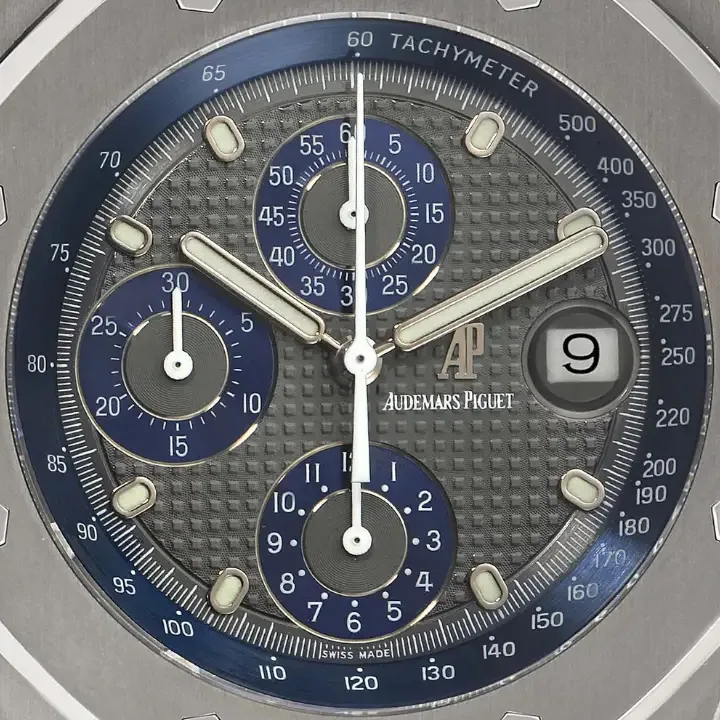
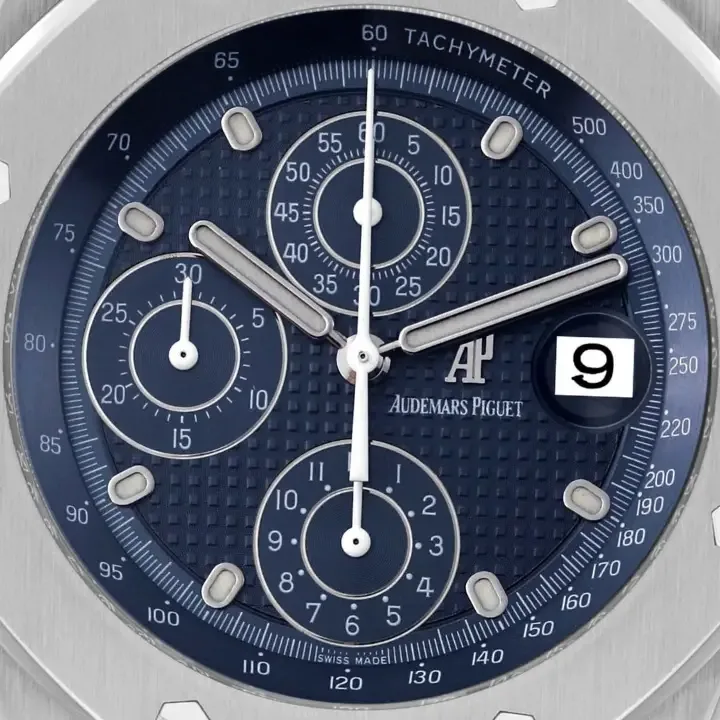
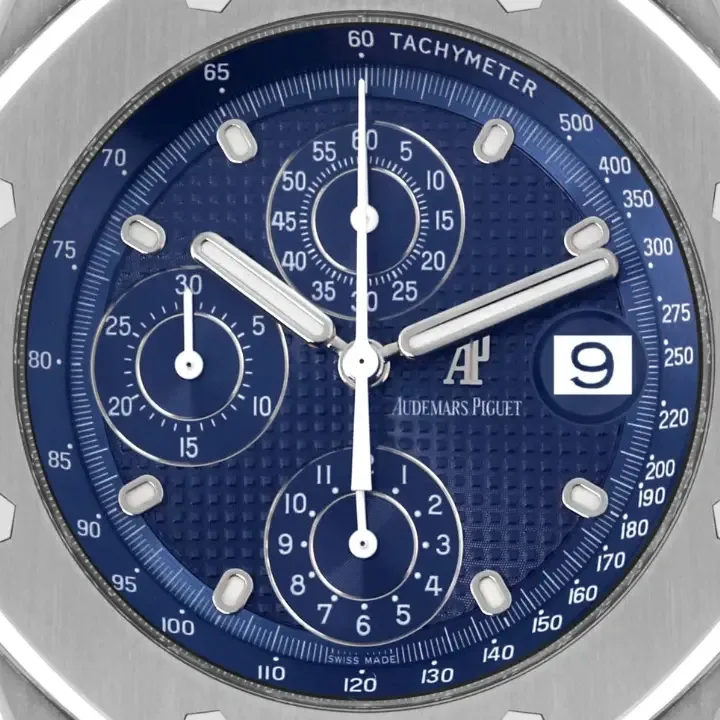
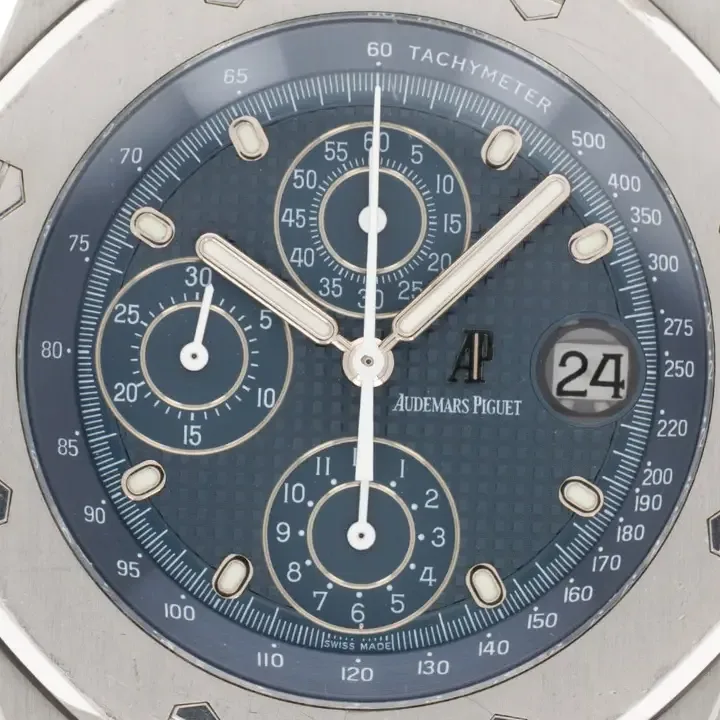
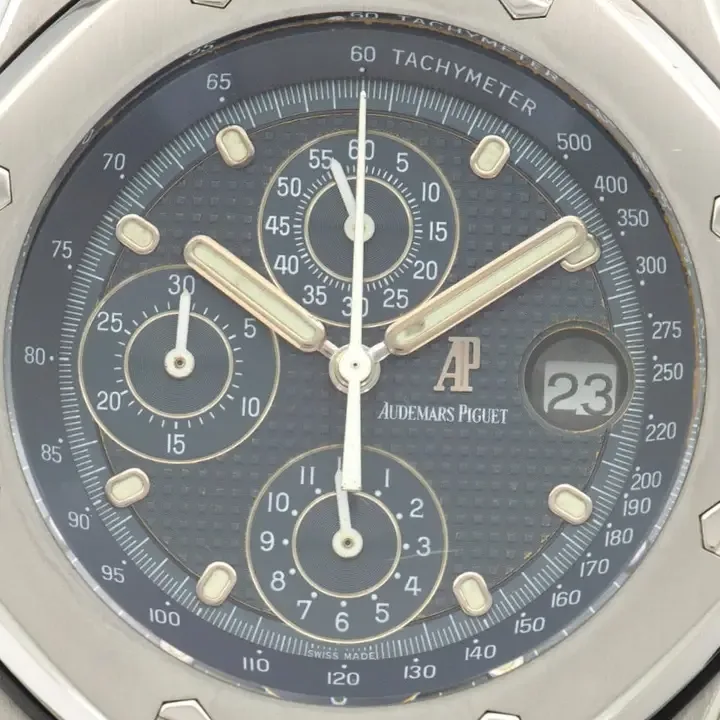
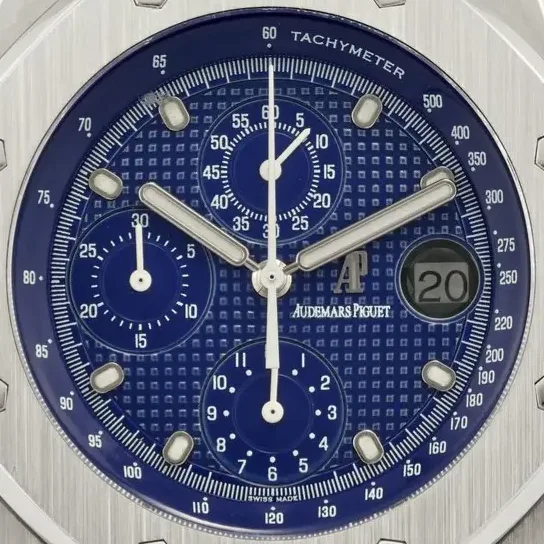
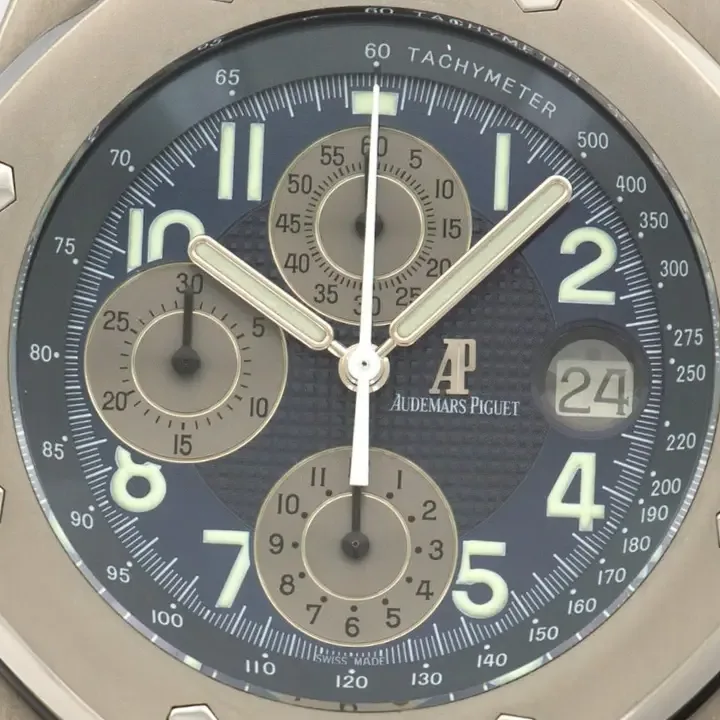
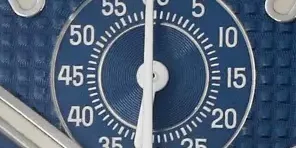
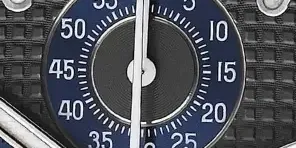
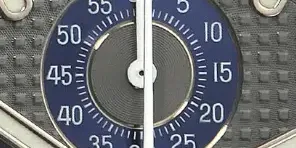
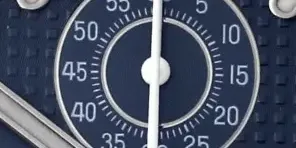
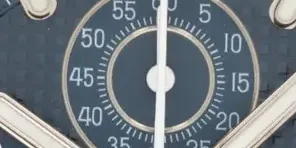
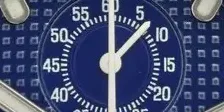
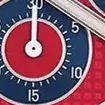
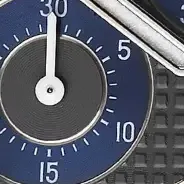
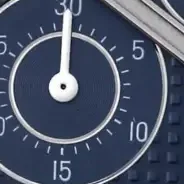
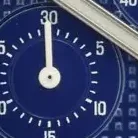
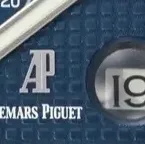
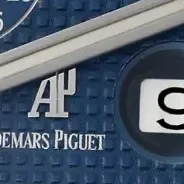
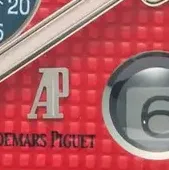
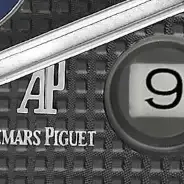
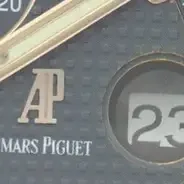
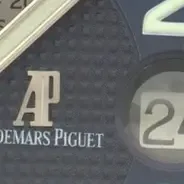
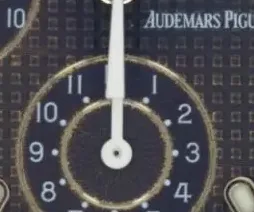
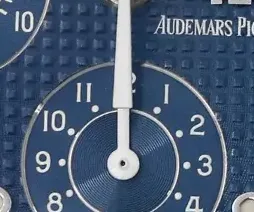
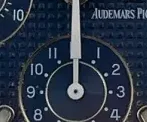
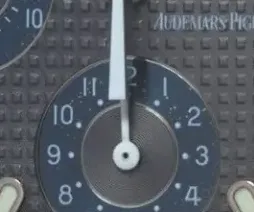
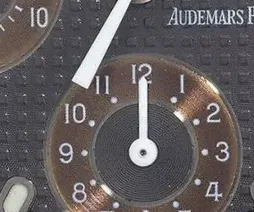
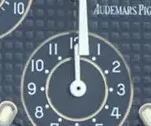
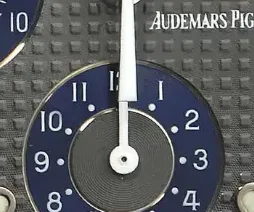
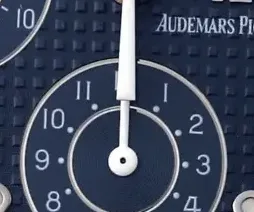
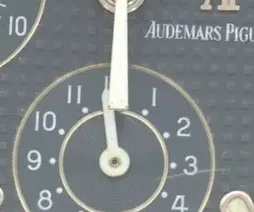
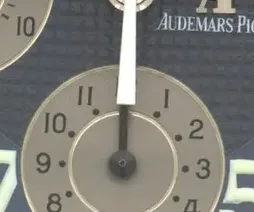
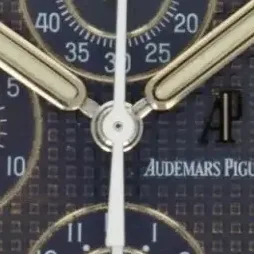
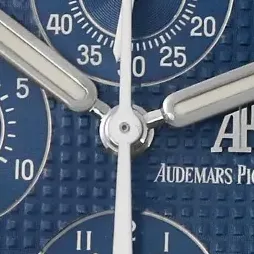
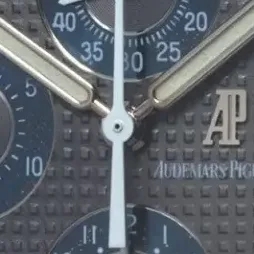
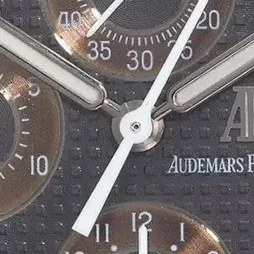
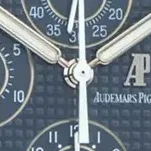
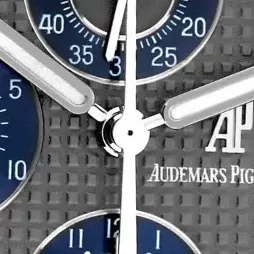
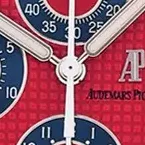
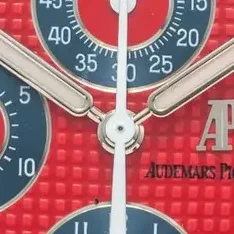
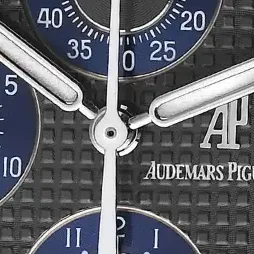
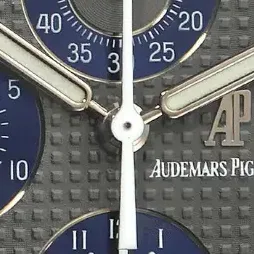
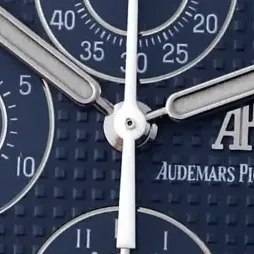
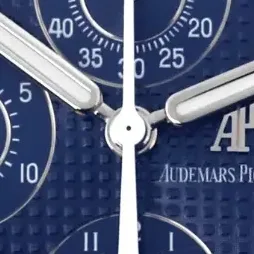
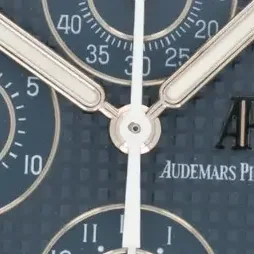
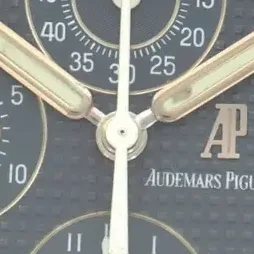
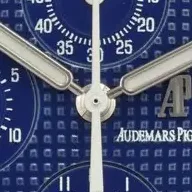
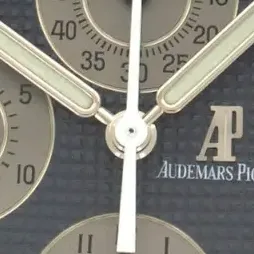
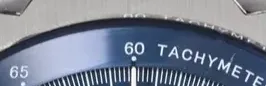
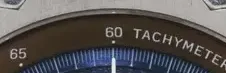
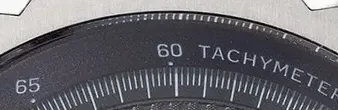
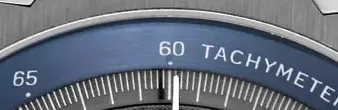
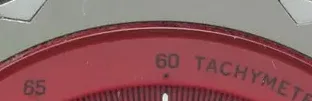
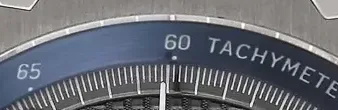
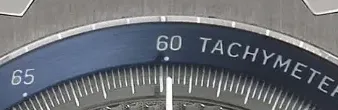
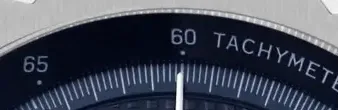
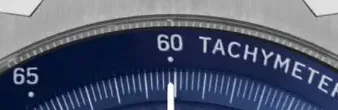
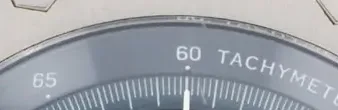
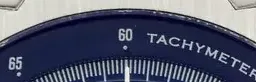
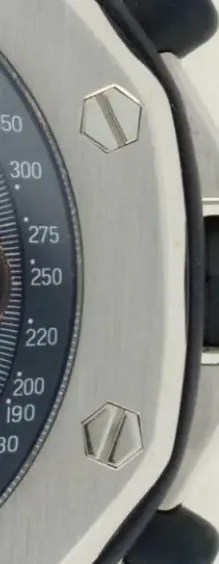
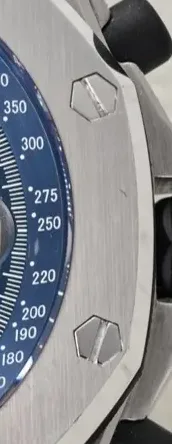
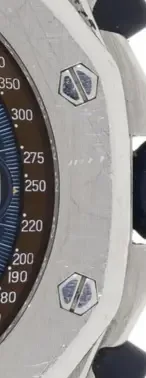
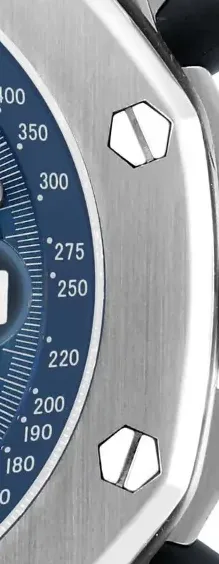
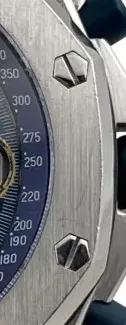
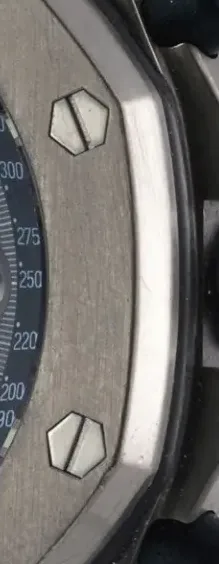
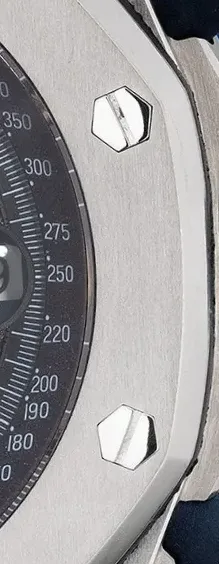
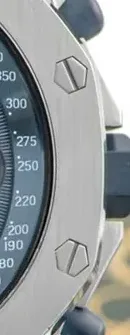
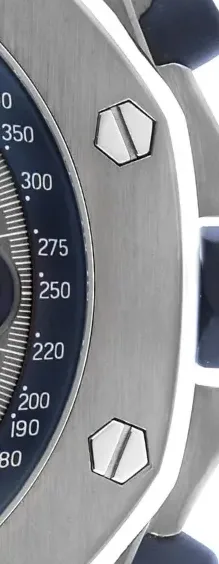
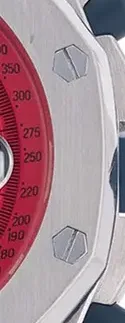
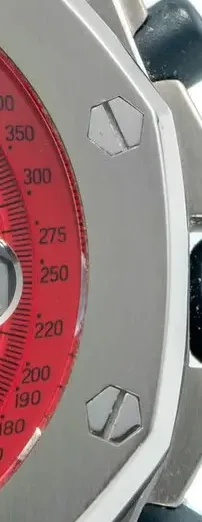
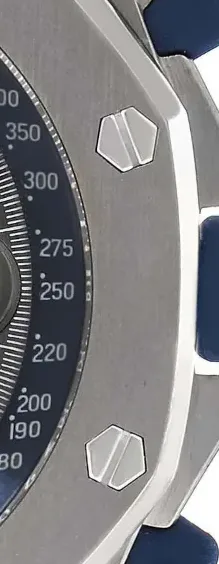
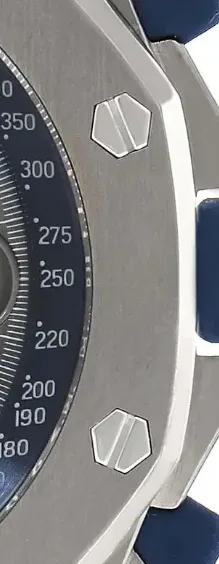
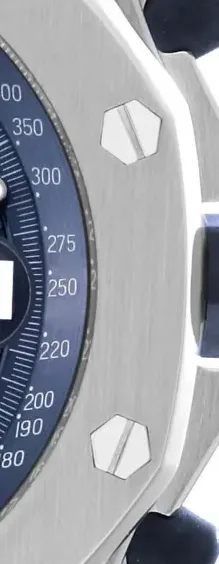
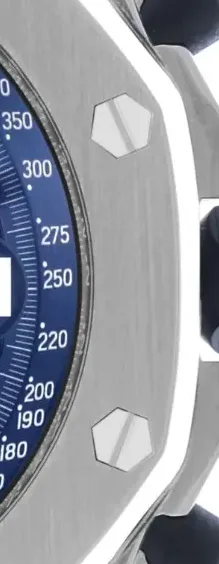
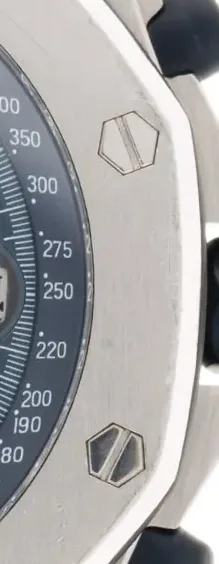
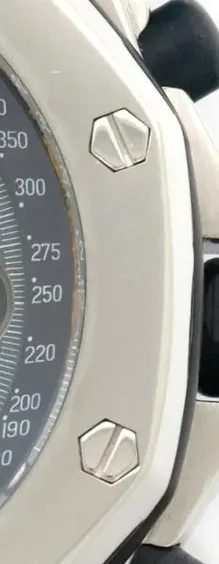
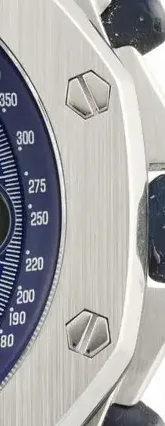
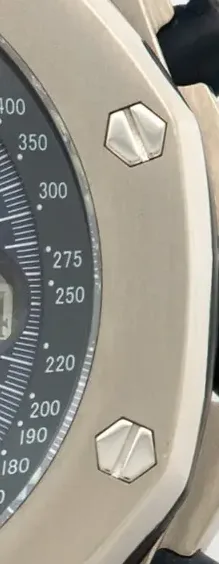
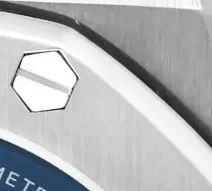
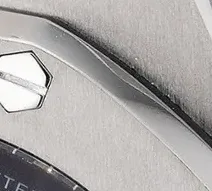
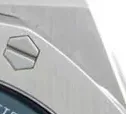
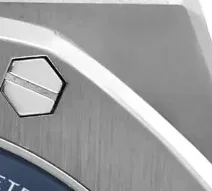
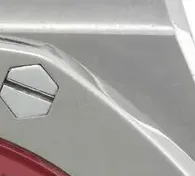
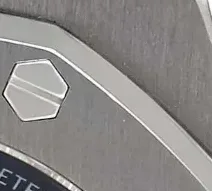
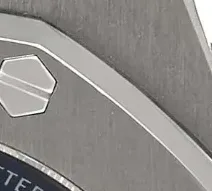
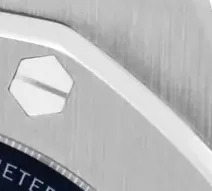
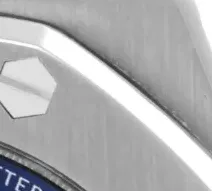
19 watches, oldest first, each straightened and cut the same way so that one row shows one component across them all. Chosen from 435 photographs on file for sharpness and for a face typical of the reference. A year marked c. is one its holder gives only roughly. Each picture is a detail cut from a listing photograph. Select the small mark in its corner for its year, its holder, a link to the listing it came from, and a way to report it.





































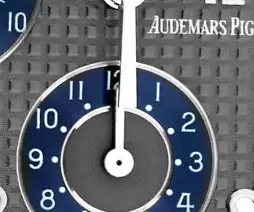
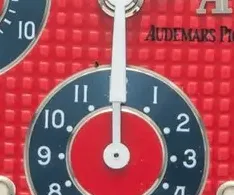
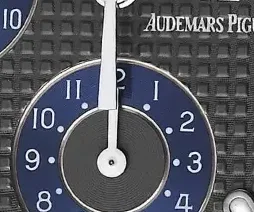






















Chronology
Launched in April 1993 and catalogued until 2011, though the manufacturer's delivery figures continue in small numbers to 2016.
Every dated variant: what is written, and what the records show
For the reference the marks are every dated watch; for a variant, the watches a seller names as that variant, so a variant sellers do not name has none.
Specification
| Case | 42 mm octagonal case, 14.05 mm thick in the manufacturer's figures (another account says 15 mm), steel, titanium, gold or platinum, with a screw-down back |
| Water resistance | 10 ATM (100 metres) |
| Bezel | Octagonal, with a large gasket showing under it and eight hexagonal screws |
| Dial | Tapisserie dial with tachymeter scale on the flange; chronograph counters at 12, 6 and 9, and date at 3 |
| Crown and pushers | Covered in rubber, blue on the first watches |
| Movement | Self-winding chronograph, calibre 2126/2840 at first, then 2226/2840 and 2326/2840; Jaeger-LeCoultre base with a Dubois Depraz chronograph module and a soft-iron anti-magnetic cage |
| Bracelet | Bracelet 1000 with rounded links and, on the first watches, a double folding clasp |
| Weight | About 220 g in steel, 150 g in titanium, almost 400 g in yellow gold, 410 g in white gold and 429 g in platinum |
| Metals | Steel (ST), yellow gold (BA), steel and yellow gold (SA), white gold (BC), steel and pink gold (SR), platinum (PT), blackened steel (SN), titanium (TI) |
Reference 8 described
The metal code after the number tells the case material. The manufacturer's figures give about 10,900 watches in all, and the great majority are steel or titanium; the other metals are small groups with their own histories.
25721ST (steel)
The original model, with 7,308 delivered between 1993 and 2016. The first thousand took five years to sell, annual sales passed 400 in 1999 and neared 1,000 in 2006. The steel watch was in production longer than any other 25721 variant.
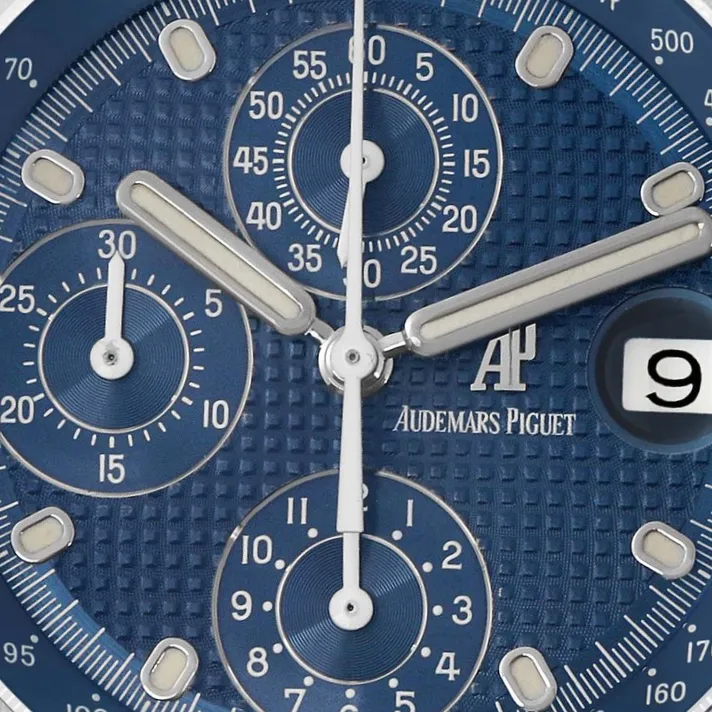

54 listings on record under the name.
25721BA (yellow gold)
The first Offshore in a precious metal, with 589 delivered between 1995 and 2014. The bracelet, case middle and bezel are all 18-carat gold, the dial and flange are gilded and the appliques are gold. At almost 400 g it earned the nickname 'pounder' in the United States, a weight record broken the next year by the platinum watch.
- gold bracelet
- gilded dial and flange
- gold appliques
25721SA (steel and yellow gold)
A rare version, with 64 delivered between 1995 and 1999. Unlike the usual two-tone Royal Oak, only the bezel is yellow gold; the studs are steel and the appliques and hands are white gold. The archives do not give the carat of the bezel gold, and two examples sold in 2022 show heavy oxidation on it.
- yellow gold bezel only
- steel studs
- white gold hands and appliques
25721BC (white gold)
A small group of 21, sold between 1996 and 2003, with eight diamonds in place of the hour markers. Otherwise it looks like the steel watch, but it weighs about 410 g against about 220 g for steel.
- eight diamond hour markers
25721SR (steel and pink gold)
A single watch, number 001, sold in Germany in December 1997. The steel is combined with pink gold, and hands, markers and applied logo are all in pink gold.
- pink gold hands, markers and logo
25721PT (platinum)
Ten watches, nine delivered in 1997 and one in 1998, four of them to Germany. At 429 g it was the heaviest wristwatch the maker had produced. Two dials are recorded, opaline blue and silver grey.
- 429 g
- opaline blue or silver-grey dial
25721SN (blackened steel)
One watch only, apparently made while preparing the End of Days limited edition. A watchmaker wore it on trial, probably to test how the black finish on the steel lasted. It entered the maker's museum in 2000 and was stolen about ten years later.
25721TI (titanium)
The first Audemars Piguet watch with a whole exterior in titanium, bracelet included, introduced in 1998 in response to demand for a metal-bracelet Offshore that was lighter. It weighs about 150 g, a third less than the steel watch. About 2,900 were delivered between 1998 and 2014; the literature gives 2,914 in one place and 2,902 in another.
- titanium bracelet
- light weight
Dial 7 described
The first dials are blue petite tapisserie. Dials are documented in more detail for the gold watch, which has a gold-toned, a dark blue and a silver grande tapisserie dial, and the platinum watch has two. Sellers describe many further colours on steel and titanium watches.
Blue petite tapisserie (steel, first watches)
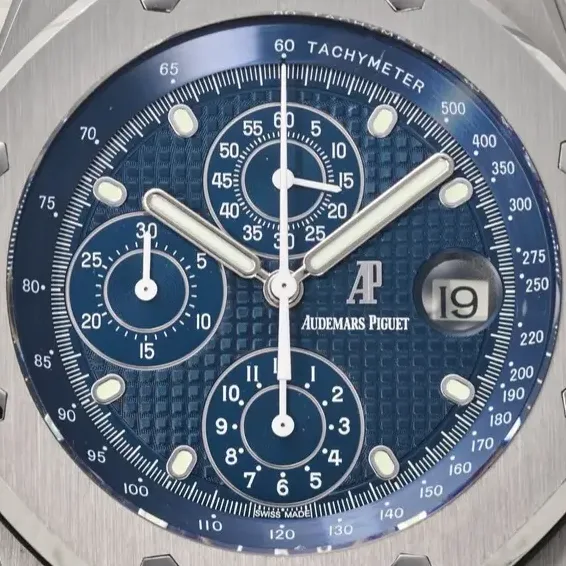
The dial of the 1993 steel watch is blue with a small tapisserie pattern and a tachymeter scale on the outer flange. The same blue petite tapisserie dial is shown on the 1998 titanium prototype. Published accounts give no year in which it was dropped.
- blue dial with small tapisserie
- tachymeter on the flange
6 listings on record under the name.
Tropical blue dial
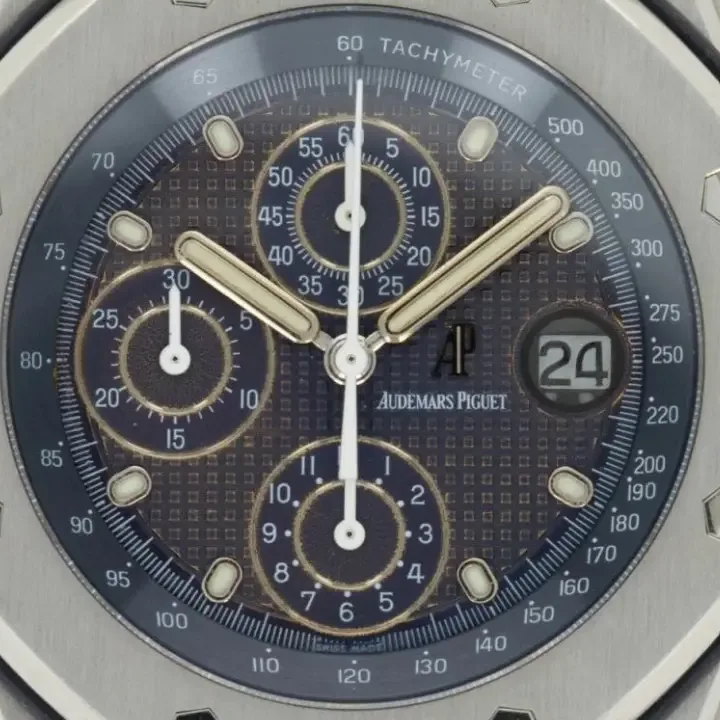
Early blue dials were painted with a paint that was unstable up to 1999. Where the colour has gone brown or caramel through the brass plate beneath, the result is called tropical, and it is taken as a sign that the dial is original.
- blue gone brown
- caramel tropical effect
Gold watch: gold-toned dial
The first gold watch has a gilded dial with gilded flange and gold appliques, dial 01, from 1995.
- gilded dial and flange
- gold appliques
Gold watch: dark blue dial
A second dial, dark blue, is documented for the gold watch from 2000.
- dark blue dial
Gold watch: silver grande tapisserie
The third gold dial is silver-toned with grande tapisserie, dial 03, documented from 2002. Published accounts give no year for its end.
- silver dial with grande tapisserie
Platinum dials
Platinum watches have either an opaline blue or a silver grey dial.
- opaline blue
- silver grey
Other colours in sellers' descriptions
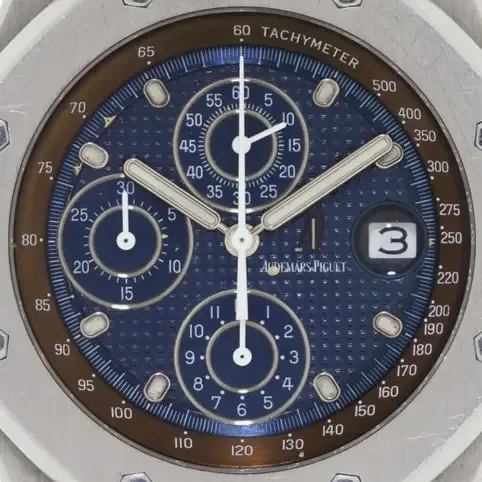
Sellers describe steel and titanium watches in blue, silver, grey, black, white and brown, and give black (dial 08) and silver (dial 07 on steel, dial 05 on titanium) among the sub-reference numbers. The literature does not date them one by one.
- black
- silver
- grey
- white
- brown
Hands 1 described
The literature gives little on the hands beyond the two-tone and pink gold watches.
White gold or pink gold hands on two-tone watches
On the steel and yellow gold watch the hands and appliques are white gold. On the single steel and pink gold watch the hands, markers and logo all match the pink gold.
Subregisters 1 described
The chronograph counters are in a 12, 6 and 9 o'clock arrangement with the date window at 3.
Twelve, six and nine counters, date at three
The layout is the same on the first steel watch and on the rest of the run.
- counters at 12, 6 and 9
- date window at 3
Bezel 1 described
The bezel is the Royal Oak octagon, scaled up and fitted with a large, visible gasket.
Octagonal bezel with gasket and eight screws
The 1993 watch has an octagonal bezel lined with a thick rubber gasket and eight hexagonal screws. The oversized gasket was a feature of the first sketches in 1989. On the 25721SA the bezel alone is yellow gold, and on the 25721BA it is 18-carat gold.
- thick gasket under the bezel
- eight hexagonal screws
Case 4 described
The case is an octagon of 42 mm and 14.05 mm that took years of development; the first five to pass water-resistance tests did so in September 1993. Caseback engraving distinguishes the earliest watches.
Unmarked caseback (first 100)
numbers D23744 to D23843 (one account)
The first 100 steel watches have only 'Royal Oak' on the caseback, without the word Offshore. One account gives their case numbers as D23744 to D23843; number 32 sold in Italy in December 1993 is of this type. The omission probably guarded the Offshore trademark in case of failure. Sellers call these 'No Logo' cases.
- ROYAL OAK engraved, no Offshore on the back
Offshore caseback
From about case number 100 (one account says 101) the caseback also carries the Offshore engraving. The revised engraving was drawn in November 1993, and the watches sold from January 1994 have it; number 208, sold in Spain on 29 June 1994, is one.
- OFFSHORE engraved on the back
Case number prefixes
Case numbers in the maker's records begin with a letter. Examples are D23775 on the 1993 steel watch, D91743 on a steel and gold watch sold in 1998, D80870 on a 1999 white gold watch and D95704 on a 1997 platinum watch; a titanium prototype of 1998 is E54634. Sellers speak of D-series and E-series watches.
- letter plus five digits
Case weights
Steel is about 220 g, titanium 150 g, yellow gold almost 400 g, white gold 410 g and platinum 429 g.
Crown and pushers 1 described
The crown and pushers are covered in synthetic rubber, a feature of the design from the first sketches.
Blue rubber crown and pushers
The first watches have dark blue rubber on the crown and the chronograph pushers, made of an elastomer. These were often replaced with a lesser black rubber when the watch was serviced outside the maker, so black parts on an early watch may not be original. Work to coat the pushers and crown began in 1990, and it was still unfinished in July 1993.
- dark blue rubber crown and pushers
Movement 3 described
The calibre is a Jaeger-LeCoultre base with a chronograph module, and three versions are named in the literature.
Calibre 2126/2840
The first movement, 6.15 mm thick, a Jaeger-LeCoultre self-winding base with a Dubois Depraz chronograph module of 30 mm diameter, chosen because it suited the large case. A soft-iron cage protects it from magnetism. It is reached by removing the caseback and then the cage cover, held by four small screws.
- iron cage under the back
Calibre 2226/2840
The next version. The earliest dated examples in the literature are the 1997 platinum watch, the steel and gold watches sold in January 1998 and the 1998 titanium prototype, while a white gold watch sold in 1999 still has the 2126/2840, so the change is not dated. It is listed as running at 28,800 beats per hour, with 42 hours of reserve.
Calibre 2326/2840
The last version, which the 26170 replaced with the in-house calibre 3126/2840 in 2011. The literature does not date the change from 2226.
Bracelet 2 described
The integrated bracelet 1000 has rounded links and was specially made for the weight of the watch.
Early double folding clasp and screwed links
The first bracelets close with a special double folding clasp of blade type, used on the first 100 watches and the 400 after. The removable links of the early steel watches are held with screws, two each side.
- double folding clasp
- screws in links
Gold and titanium bracelets
The yellow gold watch has a solid 18-carat gold bracelet. The titanium watch is fitted with a titanium bracelet.
Box and papers 1 described
The box is part of what a complete early watch has.
Octagonal porthole box
The first presentation box is octagonal, with a glass pane in the lid to give a porthole view. A collector's account describes it as green with blue accents.
- octagonal box with window
Originality
- Blue rubber crown and pushers on early watches are often replaced with black rubber, so the colour should match the first-series description.
- Early blue dials that have aged to a brown tropical tone are taken as a sign that the dial is original.
- The first 100 watches should have only the Royal Oak name on the caseback; one with the Offshore engraving and a very low case number needs explaining.
- The first bracelets have a double folding clasp and screwed links; later bracelets differ.
Names
- The Beast. Given for the massive case; accounts differ on whether it came from the trade's first reaction in 1993 or from the company's chief executive.
- Pounder. A United States name for the yellow gold watch of almost 400 g.
- T3 and End of Days. Later special editions on the 25721 base mentioned in the literature; the End of Days is the blackened steel 25770SN.
Where accounts differ
Points on which the published literature and the library's own records do not agree, or on which the literature contradicts itself.
- Steel production. The manufacturer's archive pages record 7,308 steel watches, and about 10,900 in total. A collector's guide says the 25721ST was limited to under 3,000, far fewer than the manufacturer's own delivery figures.
- Case thickness. The manufacturer's archive gives 14.05 mm in most places, while a collector's guide, and one version of the manufacturer's own history of the launch, give 15 mm.
- Years sellers state. The manufacturer's deliveries peak between 2004 and 2007, with 1,487 in 2006 alone. The years sellers state in the library's records lean earlier, centring on about 2000.
- Change from calibre 2126 to 2226. The manufacturer's archive shows calibre 2226/2840 in a platinum watch of 1997 and the 2126/2840 still in a white gold watch sold in 1999, and gives no date for the change. A collector's buying guide says the switch to 2226/2840 came after the first 200 watches.
- Who named it The Beast. The manufacturer's history says agents and retailers dubbed the watch the Beast when it was shown in 1993. A collector's article says the chief executive of the time gave it the nickname.
Back and movement
From listings of this reference, each confirmed by eye to show what it is filed under. A picture on which a person's name or a personal engraving can be read is not shown. From most holders a detail from the middle of the photograph is shown; the mark in its corner gives its holder and a link to the listing.
Caseback
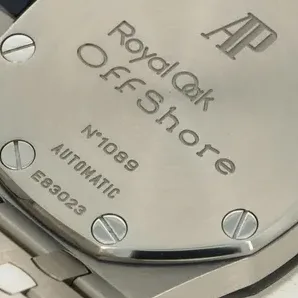

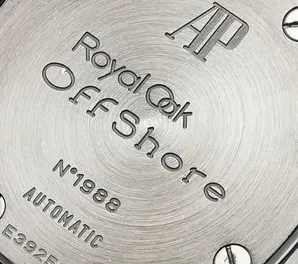

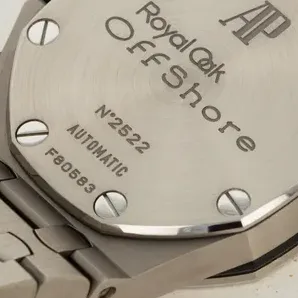

Catalogue versions 6 listed
The full numbers under which holders list this reference, with what their listings say of each. Each has a page of its own.
| Version | Metal | Dial | Years seen | Records |
|---|---|---|---|---|
| 25721ST | Steel | Blue or silver | 1992–2010 | 65 |
| 25721TI | Titanium | Grey or blue | 1993–2007 | 39 |
| 25721BA | Yellow gold | Blue or black | 2000–2007 | 13 |
| 25721BC thin | White gold | 1999 | 1 | |
| 25721PT thin | Platinum | 1997 | 1 | |
| 25721SA thin | Steel and gold | 1999 | 1 |
In the records
Counted from 135 listings at 30 holders between 16 December 2011 and 14 November 2026. These are what sellers and auction houses state, not measurements.
Fainter bars are the 5 outside the main run of 1993–2010 (the middle nine-tenths): the earliest is 1990 and the latest 2012. They are early and late examples, and now and then a seller's slip. The head of the page gives 1992–2010: the years that listings from two holders bear out.
At the holders that record papers on every watch, 56% of their 18 listings of this reference come with papers; at those that record the box on every watch, 79% of 19 come with a box. "Papers" is whatever the holder counts as papers, and can include service papers.
Case metal
| Steel | 68 | |
| Titanium | 33 | |
| Gold, any colour | 13 | |
| Yellow | 10 | |
| White | 1 | |
| Colour not stated | 2 | |
| Platinum | 1 | |
| Steel and gold | 1 |
A listing that says "gold" or "18K gold" names no colour: it is counted under "colour not stated", not as yellow gold.
Dial colour
| Blue | 24 | |
| Silver | 11 | |
| Grey | 9 | |
| Brown | 8 | |
| Black | 7 | |
| White | 6 | |
| Red | 1 | |
| Champagne | 1 |
Case size
| 42 mm | 86 | |
| 45 mm | 8 | |
| 43 mm | 1 |
Calibre named
| 2226 | 37 | |
| 2326 | 18 | |
| 2126 | 11 | |
| 3126 | 3 |
Bracelet or strap
| Metal bracelet, kind not stated | 90 | |
| Leather strap | 5 | |
| Rubber strap | 1 | |
| Strap, kind not stated | 1 |
Each table counts the listings that state the thing, in the seller's own terms. A size, metal, colour or calibre that cannot belong to this reference is a seller's slip or a listing filed under the wrong number.